Monday, July 27, 2026

‘This Is Not of God’: Faith Leaders Demand Release of Pastors, End to ICE ‘Terror’

“This is a terror campaign with the mission of traumatizing our neighbors,” one pastor said of the Trump administration’s deadly anti-immigrant crackdown. “We don’t need terror. We need peace.”

Texas pastors Nepthalí Zozaya Saucedo and Cinthia Saraí Cardona Otero were detained by US immigration authorities on July 23, 2026.
(Photo by Nepthalí Zozaya Saucedo)


Brett Wilkins
Jul 25, 2026
COMMON DREAMS

Faith leaders are calling on US Immigration and Customs Enforcement to immediately free a pair of pastors who advocates say were wrongfully detained by ICE agents in Texas on Thursday while traveling to a religious retreat.

Pastor Nepthalí Zozaya Saucedo and his wife, pastor Cinthia Saraí Cardona Otero, were detained by federal immigration enforcers after arriving at McAllen International Airport. According to the couple and their church leaders, the longtime pastors at the Comunidad Cristiana Emanuel Assemblies of God congregation in Edinburg, Texas were on their way to a marriage retreat in North Carolina when they were detained and taken to a US Border Patrol processing center in McAllen.

At a Friday press conference hosted by leaders from the Assemblies of God and the Latino Christian National Network, LCN board member Sandy Ovalle said that the couple has valid R-1 religious worker visas.

“We are calling for their immediate release, the protection of their due process rights, and an urgent oversight into ICE’s conduct,” Ovalle said. “No one should be pressured to give up their rights under the threat of losing their children.”

A Department of Homeland Security spokesperson told Religion News Service that the pastors are “illegal aliens” who overstayed their visas.

Addressing the conference by phone from the detention center, Nepthalí said that the couple was threatened with separation from their US citizen children if they did not sign papers authorizing their “voluntary” deportation.

“They spoke with us about separation—to be separated from our children and even as married people,” he said, according to Religion News Service. “They spoke about how much time that we could end up spending here.”

Speaking during the press conference, Comunidad Cristiana Emanuel senior pastor Sarai Martinez Luna said, “I think it’s very cruel that somebody that had no status for deportation be pressured to sign a voluntary deportation based on the separation of their children.”

Friday’s news conference followed a Wednesday press briefing by faith leaders at the Texas Capitol in Austin to condemn the killings of Johan Sebastián Durán Guerrero in Maine, Juan Jairo Coronilla Durán in Florida, and Lorenzo Salgado Araujo in Houston.

“This is not of God. This is no peace that we want a part of because let’s be honest, this isn’t a peacekeeping initiative. This is a terror campaign with the mission of traumatizing our neighbors until they self-deport,” said Dan De Leon, senior pastor at Friends Congregational Church in College Station. “We don’t need terror. We need peace.”


Elyse Rosenberg of the National Council of Jewish Women and Temple Beth Shalom in Austin said during the press conference that “throughout our history, we have repeatedly seen first-hand the consequences of governments exercising unchecked power on vulnerable populations.”

Friday’s event also preceded nationwide vigils in more than 300 communities across the nation on Saturday to demand justice for the dozens of people who have been killed by federal enforcers or died in ICE custody during President Donald Trump’s second term.

“We refuse to grieve quietly. We refuse to accept this terror and violence as inevitable”, Crystal Cron, executive director of Presente! Maine, said ahead of the vigils. “Johan Sebastián should still be here with his wife and daughter—and instead, his name joins a growing list of people killed by an institution that treats our communities as disposable.”

“This is bigger than one shooting,” Cron added. “We will not stop fighting until there is justice for the Durán Guerrero family and a total dismantling of this lawless, criminal agency that took him from them.”


US Detained pastor couple had religious worker visas, Assemblies of God leaders say

(RNS) — Pastor Nepthali Zozaya Saucedo, 36, said he and his wife, who came to the U.S. legally, were repeatedly pressured to sign voluntary departure papers but that they had refused.
Pastor Nepthali Zozaya Saucedo preaches at Comunidad Cristiana Emanuel in Edinburg, Texas, on September 4, 2018 (Video screenshot)


Update: Zozaya and Cardona were released from detention on Saturday and worshipped with their church on Sunday. An article about their release is forthcoming.

(RNS) — An Assemblies of God pastor has said he and his wife, also a pastor, were “pressured” with prolonged separation from their U.S. citizen children if they did not sign voluntary departure papers after immigration authorities detained them.

During a press conference Friday (July 24), hosted by leaders from the Assemblies of God and the Latino Christian National Network, Nepthali Zozaya Saucedo said he and his wife, who came to the U.S. legally, were repeatedly pressured to sign voluntary departure papers but that they had refused.

“They spoke with us about separation — to be separated from our children and even as married people,” Zozaya, 36, said in Spanish, speaking on the phone from detention at U.S. Border Patrol Central Processing Center in McAllen, Texas. “They spoke about how much time that we could end up spending here.”

At the press conference, Sandy Ovalle, a board member of the Latino Christian National Network, said Zozaya and his wife, Cinthia Sarai Cardona Otero, 34, have valid R-1 religious worker visas.

A Department of Homeland Security spokesperson disputed the faith leaders’ version of events in a statement to RNS on Saturday (July 25), calling each pastor “an illegal alien.” The spokesperson wrote, using the couple’s second last names, “Otero and Saucedo entered the U.S. on visas on February 27, 2022 and overstayed for four years after their visas expired on July 7, 2022.”

Sarai Martinez Luna, senior pastor at Comunidad Cristiana Emanuel in Edinburg, Texas, where Zozaya and Cardona are assistant pastors, emphasized how traumatic the detentions had been for the family and the church at the Friday press conference.

“I think it’s very cruel that somebody that had no status for deportation be pressured to sign a volunteer deportation based on the separation of their children,” Martinez said during the press call, adding that the pastor couple had told her of the threats to separate them from their children and to put the children in foster care.

The team supporting Zozaya and Cardona, including Ovalle, did not immediately respond to a request for comment on DHS’ claims that the pastors overstayed their visa.

According to Zozaya during the Friday press conference, he and Cardona, parents of a 7-year-old and twins who are nearly 3, were detained early Thursday as they boarded their flight on the way to a marriage retreat in North Carolina led by the Billy Graham Evangelistic Association.

“We are hoping to get released as soon as possible and be reunited with our family,” Zozaya said in English. “We got here legally, and it has been always our goal to do the right things, and we’ve been doing it.”

The DHS spokesperson’s statement contradicted Zozaya’s timeline, writing that Cardona was detained on Thursday, while Zozaya was detained on Friday. The DHS spokesperson did not directly address the allegations that their agents threatened the pastor couple with separation from their children if they did not voluntarily deport.

“They will remain in ICE custody pending removal proceedings. All of their claims will be heard by a Justice Department immigration judge and they will receive full due process. This administration will not ignore the rule of law,” wrote the spokesperson. 

The statement also encouraged immigrants without legal status to self-deport using the CBP Home app. “The United States is offering illegal aliens $2,600 and a free flight to self-deport now,” the DHS spokesperson wrote. Multiple news stories have reported cases of immigrants who have used processes for voluntary departure either not receiving flights or promised payments.

Ovalle said Zozaya had served Comunidad Cristiana Emanuel for more than a decade and that his wife, Cardona, also preaches. According to Ovalle, while the couple currently hold religious worker visas, they are waiting for their applications for lawful permanent residency, also known as green card status, to be adjudicated.

“We are calling for their immediate release, the protection of their due process rights, and an urgent oversight into ICE’s conduct,” Ovalle said. “No one should be pressured to give up their rights under the threat of losing their children.”

Last October, the American Civil Liberties Union of Illinois filed suit against the DHS, claiming DHS officers have a “policy and practice of threatening and coercing detainees to sign forms consenting to their being sent out of the country without appearing before an immigration judge and otherwise waiving their legal rights.” A judge later ordered DHS to ensure agents were not misrepresenting the contents of any papers they provided to detainees and to ensure detainees had a reasonable amount of time to read and understand the papers.

Martinez said she recruited Zozaya to pastor at her Edinburg, Texas, church because she was familiar with his work in Mexico. “He was a youth leader in our organization, the Assemblies of God,” she said. “And we needed help with the young people.”

During the call, Zozaya said he and his wife have loved their work at Comunidad Cristiana Emanuel.

“We’ve been serving with passion, and we love the families that are not only here in the valley of Texas, but in the past couple of years, God has given us opportunity to serve different states,” Zozaya said.

Abel Saucedo, Zozaya’s uncle, also appeared at the press conference and was visibly choked up as he spoke of the couple’s detention. “Nepthali and Sarai have distinguished themselves by living a responsible life, distant from vices. It’s very difficult to find young people these days who dedicate their lives to doing good,” he said in Spanish.

“What I admire in them is that they have worked to take advantage of those opportunities, not just for personal benefit, but to serve and help others,” Saucedo said.

At the press conference, Superintendent Edward de la Rosa, who leads the Texas Gulf Hispanic District of the Assemblies of God, praised Zozaya and Cardona’s ministry. “We need these kind of people here in our Rio Grande Valley. We need these kind of ministers. These are the people that we need to keep, and we need them desperately because they are essential to the growth, to the benefit, to the health of our churches, of our families, of our ministerial families,” he said.

When asked if he wanted to say anything to Homeland Security Secretary Markwayne Mullin, who is a member of the Assembles of God, de la Rosa said, “Please, somebody be a voice and stand up for the ones who are really trying to make our society 100% better. Can we please ask him to speak on our behalf — to speak on Nepthali’s behalf, Sarai’s behalf?”

This story has been updated to add comment from the Department of Homeland Security and to correct that Zozaya said that he and his wife were detained upon boarding, not exiting, their flight.


Embryo personhood, once on the margins of abortion debates, is moving closer to the center

(The Conversation) — In vitro fertilization has become a bigger part of reproductive rights debates as a once-fringe movement to recognize embryos as people grows louder.

Nitrogen tanks holding tens of thousands of frozen embryos and eggs sit in a lab at New Hope Fertility Center in New York on Dec. 20, 2017. (Carolyn Van Houten/The Washington Post via Getty Images)

(The Conversation) — About 100,000 babies were born through in vitro fertilization in 2024, according to the most recent U.S. data. But IVF commonly involves trying to create multiple embryos, because success is never guaranteed. If unused, those embryos can be frozen, discarded, donated to research or donated to another fertility patient.

In the eyes of some anti-abortion activists, those frozen IVF embryos are already children – children who need to be “adopted” into families. And that idea now appears in a federal document: grant guidelines announced by the Department of Health and Human Services in June 2026.

The department’s Embryo Adoption Awareness and Services program has existed since 2002. But this year’s funding notice describes IVF embryos as “children who already exist and are in need of a family.” Rather than presenting “embryo adoption” as one option among many for patients with remaining embryos, the document describes the practice as centered on embryos’ “rights” and “best interests.”

This language draws from a decades-long movement to give personhood status to fetuses and embryos, including those made in fertility clinics. The personhood movement is rooted in a belief embraced by many conservative Christians: that human life begins at fertilization and should receive legal protection from that moment.

Embryo adoption occupies a niche corner of U.S. fertility care. But the notice brings far-reaching questions about reproductive politics into sharper focus, including the future of IVF – a fertility treatment that many of those same conservative Christians support.

In my 2023 book, “Conceiving Christian America: Embryo Adoption and Reproductive Politics,” I show how embryo adoption developed as a Christian pro-life response to the accumulation of embryos remaining after IVF, recasting embryos as vulnerable children requiring rescue. Once a fringe view even among anti-abortion activists, that claim is now moving closer to the mainstream of reproductive politics.

Donation vs. adoption

Some fertility patients who no longer plan to use their frozen embryos donate them to other patients in the United States. An embryo is transferred through contracts and clinic consent forms, after which it can be transferred into a recipient’s uterus.

The small network of agencies, nonprofits and churches that offer embryo “adoption,” on the other hand, recast the donation process as one that saves “pre-born children.” Modeled on domestic adoption, many programs require home studies that assess prospective parents and their households. Many also allow donors to select who receives their embryos and encourage families to get to know each other rather than remain anonymous.

Legally, though, embryos in the U.S. generally are not adopted, because states do not classify them as children under adoption law. Instead, they are often transferred by contract as personal property.

The distinction between donation and adoption is not merely semantic, however, but part of a larger political project. Advocates seek to change how the public understands embryos and, ultimately, how the law classifies them.

As one advocate for embryo personhood told me in 2008, “What we call things matters.” Adoption language gives the process “some meaning and some dignity,” he said, by recasting IVF embryos as children deserving protection rather than as surplus tissue or research material.

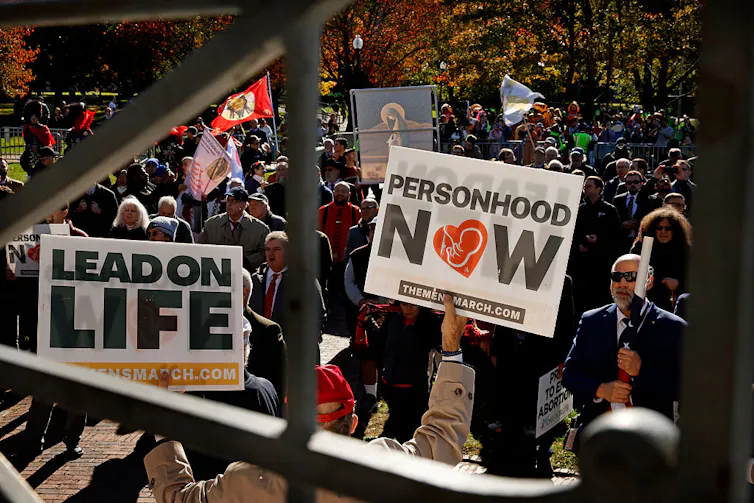
A crowd of people outside holding signs that say 'Personhood now' and 'Lead on life.'

Demonstrators rally on Boston Common during the National Men’s March to Abolish Abortion and Rally for Personhood on Nov. 1, 2025.
Craig F. Walker/The Boston Globe via Getty Images

Pushing for personhood

The world’s first embryo adoption program was launched in 1997 by Nightlight Christian Adoptions, which also facilitates traditional domestic and international adoptions. But the idea emerged from a longer effort that began taking shape in the 1960s, led largely by conservative Christian organizations, to establish legal personhood from the moment of fertilization onward.

In 1973, the Supreme Court’s Roe v. Wade ruling found that the Constitution protected the right to have an abortion – a decision grounded in the right to privacy, stemming from the 14th Amendment’s due process clause. But the majority’s opinion also observed that the case for abortion rights would “collapse” if a fetus were recognized as a person under the 14th Amendment, with a constitutional right to life.

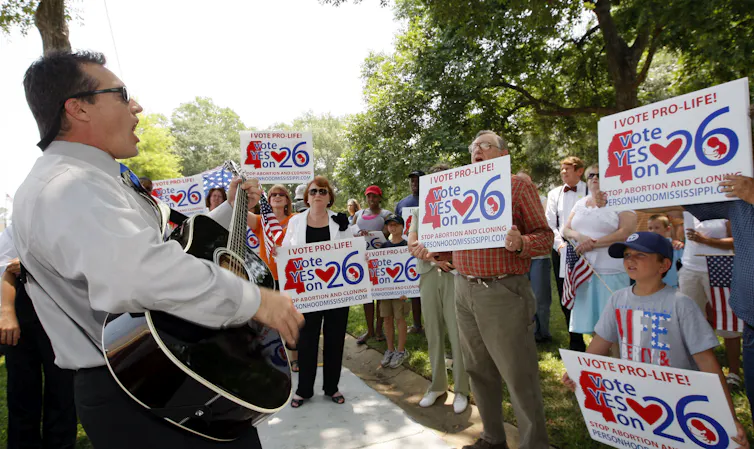
It was a watershed moment for personhood politics, and anti-abortion strategists responded quickly. One week later, Maryland Rep. Lawrence Hogan proposed the Human Life Amendment, which sought to extend constitutional personhood to “the moment of conception.” Similar efforts repeatedly failed in Congress and at the ballot box, including a prominent 2011 measure that Mississippi voters rejected.

A man plays a guitar to a crowd of people outside holding signs that say 'I vote pro-life!'

A prayer rally gathers at the Capitol in Jackson, Miss., in 2011, in support of a proposed amendment to recognize human life as beginning at fertilization.
AP Photo/Rogelio V. Solis

As IVF advanced, the treatment raised new questions about when and where personhood begins. Some anti-abortion advocates extended claims about life beginning at fertilization to embryos created outside the body, but IVF was not one of the movement’s main targets.

In the late 1990s and early 2000s, debates over human embryonic stem cell research drew national attention to what happens to embryos that remain after IVF. Scientists and patient advocates viewed embryos remaining after IVF as valuable materials for research that might lead to treatments for serious diseases.

To anti-abortion activists, however, using embryos in research destroyed human life. Embryo adoption entered the debate as a “life-affirming alternative” to discarding them or donating them to research.

President George W. Bush brought families from Nightlight’s embryo adoption program to White House press conferences opposing expanded federal funding for embryonic stem cell research. These children helped convey Bush’s message that “there is no such thing as a spare embryo.”

From margins to mainstream

Embryo politics changed dramatically in 2022, when a new Supreme Court ruling, Dobbs v. Jackson Women’s Health Organization, overturned the constitutional protection for abortion.

Before Dobbs, persuading courts to recognize embryos and fetuses as persons had been a potent but divisive goal among anti-abortion groups. Some embraced it, while others favored a different strategy – in part because public support for IVF is so strong.

After Dobbs, however, activists intensified efforts to extend legal rights to embryos and fetuses. Personhood arguments now surface in not only abortion restrictions but also disputes involving pregnancy loss, child support and taxes. Fertility care, in particular, has moved toward the center of anti-abortion politics.

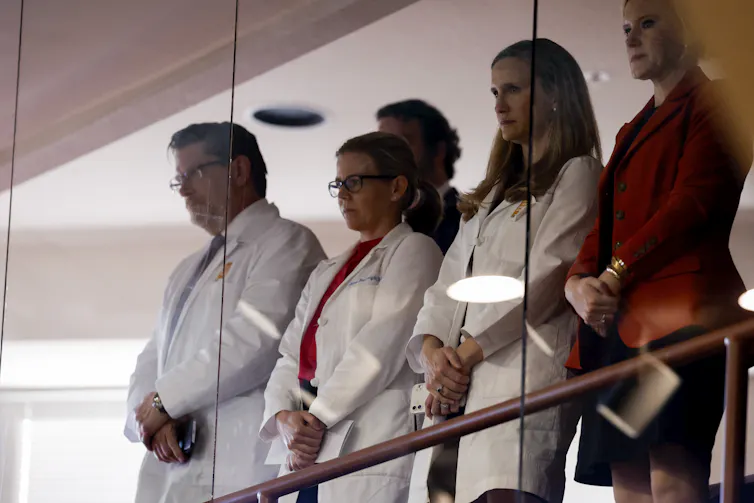
Alabama became a bellwether in 2024 when its Supreme Court ruled that frozen embryos created during IVF treatment qualified as “children” under the state’s wrongful death law, which allows parents to sue over the death of a child. The case arose after a patient entered a fertility clinic’s cryogenic storage area and dropped a container holding frozen embryos. Concerned about liability, clinics paused services, and the state quickly passed a law giving providers immunity for embryo damage or death during IVF services.

Five people, three of whom wear white doctor coats, stand behind a pane of glass, holding their hands in front of them.

Doctors from the Alabama Fertility Clinic watch the state Legislature debate a bill to protect IVF providers on March 6, 2024, in Montgomery, Ala.
AP Photo/Butch Dill

New territory

Today, the Health and Human Services funding notice signals a shift toward the personhood movement’s central premise: that embryos are children.

To be sure, embryo adoption occupies a small corner of U.S. fertility medicine. Few people choose to donate remaining embryos for procreative use. Nor is embryonic personhood a popular idea: Only 39% of Americans support laws declaring that human life begins at fertilization. A majority of white evangelical Protestants, Hispanic Protestants and Latter-day Saints support that view, yet majorities of these religious groups also oppose banning IVF.

But embryo adoption’s political power has never depended on widespread participation or public support. It lies in the story the movement tells about what embryos are, and advocates’ efforts to embed that story in institutions, policies and law.

I would argue the funding notice is one sign that the personhood movement is gaining force after the Dobbs decision. The question it raises is what legally recognizing embryos as children would mean for reproductive health and rights.

(Risa Cromer, Associate Professor of Anthropology, Purdue University. The views expressed in this commentary do not necessarily reflect those of Religion News Service.)

The Conversation

The Conversation religion coverage receives support through the AP’s collaboration with The Conversation US, with funding from Lilly Endowment Inc. The Conversation is solely responsible for this content.
Opinion

Faith is back in Democratic politics

(RNS) — After decades of watching Democrats dodge the God question, I think they finally have an answer.

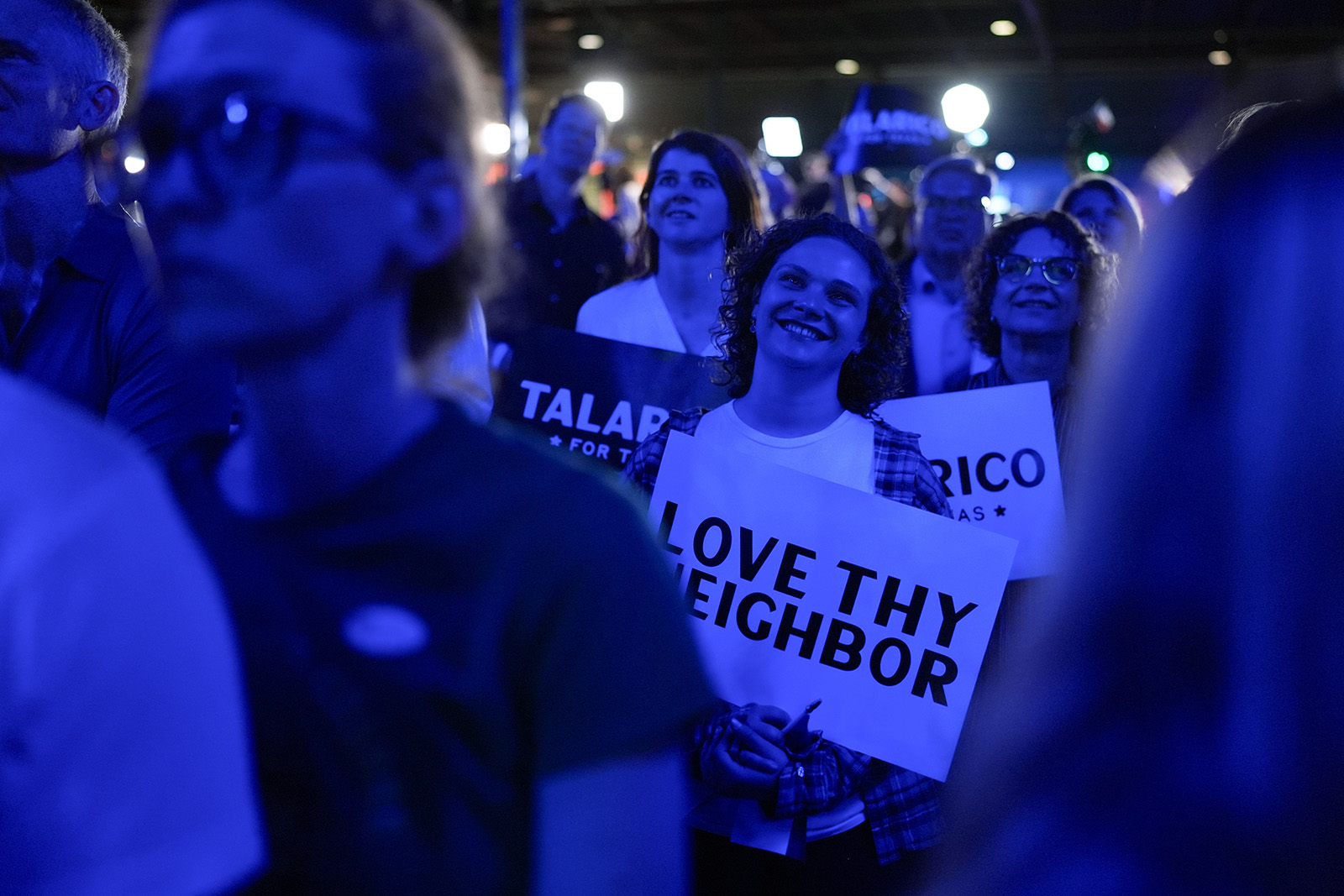
Supporters of Texas state Rep. James Talarico, D-Austin, a Democratic candidate for the U.S. Senate, react as results come in during a primary election watch party Tuesday, March 3, 2026, in Austin, Texas. (AP Photo/Eric Gay)

(RNS) — I recently found a years-old copy of a national political magazine with a cover story I had written, titled “Will Democrats Ever Get Religion?” It built off the subtitle of one of my books, “God’s Politics: Why the Right Gets It Wrong and the Left Doesn’t Get It.” I smiled as I looked at this piece from over 20 years ago asking the same question I still find myself wondering even now.

For decades now in America, the Republican Party has claimed to own religion and religious values. They proceed to use, abuse, co-opt and reduce religion for their own political agenda. Faith should stay private, they say, except in the cases of “moral values” issues like abortion and gay marriage. Of course, that is bad theology. It is unbiblical theology, ignoring the more than 2,000 verses in the Bible that focus on the poor and oppressed. But Republicans want to command religion in America.

That is made easier by the Democratic Party, which tends to ignore, dismiss or even discredit religion. Part of the reason why Democrats don’t talk much about faith is that they struggle to know how to express it without sounding like they are proselytizing or imposing their religion upon a pluralistic society.

I cannot count the number of times that Democratic senators and members of Congress — many of them names you’d recognize — have asked me privately how to talk about their faith. They don’t want to “wear it on my sleeve,” as they say, or make people feel uncomfortable, or offend those of other faiths or no faith at all. They have concerns around expressing their own religion alongside their strong commitment to the separation of church and state. And while all of that is understandable, the reluctance to speak about faith has ceded religion to the Republicans.

This is despite the fact that Black women, the strongest and most consistent Democratic voting group across any racial or gender demographic group, are also the most religious group across any racial or gender breakdown.


The other factor is what I call secular fundamentalism. I have been fighting religious fundamentalism most of my life, with the public description of being an alternative to the religious right, which gets tiresome. But there is a bias against religion per se in some parts of the political and cultural left, which is just as irrational and openly prejudiced as religious fundamentalism is.

All this makes many Christians committed to social justice often feeling without a party’s support, and sometimes even politically homeless.

I strongly believe that faith communities should be morally independent of party politics, and their values should both help challenge and shape both political parties. But an amazing thing seems to be happening.

An increasing number of Democratic office holders and candidates in upcoming elections are no longer apologetic about their personal faith. Indeed, they want to apply their own devout faith to the social arena where so much is at stake for justice and the common good, beyond the individualism of private religion.

I spoke to Sen. Tim Kaine from Virginia, who coined a new phrase, “faith-forward democrats.”

For Kaine, his Catholic faith and, in particular, serving as a young Jesuit volunteer alongside poor people and families in Honduras shaped the rest of his life and career as a civil rights lawyer and now a U.S. senator.

We had a very encouraging discussion about a new group of Democrats who are not afraid to put their faith forward, while being deeply committed to a pluralistic country of people with many faiths and no faith whatsoever. Together, they can all work for the common good — a core goal of Catholic social teaching.

Kaine is close with other faith-forward Democratic senators, including Chris Coons of Delaware, who attended Yale Divinity School alongside Yale Law School. Then there’s the Rev. Raphael Warnock of Georgia who, despite serving in the Senate, is still pastor of the historic Ebenezer Baptist Church in Atlanta, the home congregation of the Rev. Martin Luther King Jr. Sen. Cory Booker was also forthright about his Christian faith during his historic 25-hour speech on the Senate floor, where he and Coons had a long discussion about what we are called to do by Scripture.

The electoral landscape is changing, too. A new generation of candidates is speaking openly about faith as a guiding force in their campaigns. Now running for the Senate is Methodist clergyman Adam Hamilton from Kansas, who leads a diverse political church of 24,000 members. Presbyterian seminarian James Talarico is running in Texas and has given faith and politics a fresh face. Minnesota Lt. Gov. Peggy Flanagan, a devout Catholic and Indigenous leader, is also running for the Senate as a former community organizer who is close to the ground in people’s lives.

Running for the House of Representatives is the Rev. Frederick Douglass Haynes III, pastor of Friendship-West Baptist Church in Dallas, and is perhaps the leading Black revival preacher in the country. And a new Iowa House candidate and Lutheran minister is the Rev. Sarah Trone Garriott. If these candidates win, they will join other leaders of deep faith in Congress like pastor and Rep. Emanuel Cleaver II, the former mayor of Kansas City, among others.

This is a striking shift in American politics — especially in a moment when religion is being dangerously manipulated and weaponized by Christian nationalists for their own political agenda.

These Democrats are reclaiming religion not as a partisan weapon, but as a moral framework for public service. Many of them meet regularly with Republican colleagues of faith at a weekly prayer breakfast for senators. Conversation about the moral values of public life are taking place, before, after and maybe even during prayer times.

We are seeing a dynamic that is finally changing. These “faith-forward Democrats,” as Kaine calls them, are showing that faith can be spoken in the language of compassion and justice, dignity, religious freedom, human solidarity and service to the neighbor. For the first time in a generation, Democrats are learning to speak of faith with authenticity instead of apology.

They do not want to use faith to impose beliefs on others or to hide their faith in private. Instead, they hope to let it shape their conscience, judgments and decisions in public life.

Faith may be our last line of defense in saving, and then restoring, our democracy.

Kaine talks honestly and powerfully about privileged people needing to take risks in the trajectory to dictatorship. Are we up to this test of our faith in God and belief in democracy?

Decades after I first asked whether Democrats would ever get religion, I think I finally have an answer: A group of Democrats are ready to meet their Republican colleagues in the space where faith and democracy meet.

(The Rev. Jim Wallis is Archbishop Desmond Tutu Chair and director of Georgetown University’s Center on Faith and Justice and is the author, most recently, of “The False White Gospel: Rejecting Christian Nationalism, Reclaiming True Faith, and Refounding Democracy.” A version of this commentary appeared on the Substack God’s Politics with Jim Wallis. The views expressed here do not necessarily reflect those of RNS.)

Opinion

How classical education can be an antidote to AI

(RNS) — AI is more likely to harm education than help it. Classical education will become ever more relevant.


Kindergarten teacher Terrie Osborne helps students in her class at the Winter Garden Christian Academy Thursday, Aug. 29, 2024, in Winter Garden, Fla. (AP Photo/John Raoux)


Thomas Varacalli
July 24, 2026
RNS


(RNS) — In his 1939 essay “Learning in Wartime,” C.S. Lewis posed the question of whether it was still worthwhile to study while one’s country was at war. His audience was full of young men with a sense of foreboding for the safety of their country, the lives of their friends serving in the army and their own possible enlistment.

As a Christian thinker, Lewis answered in the affirmative, arguing that it was very appropriate for men to continue their studies while they could. “Life has never been normal,” Lewis writes, and therefore, the belief that education should occur only in times of normalcy is unfounded. No war can ever eradicate our pursuit of truth, meaning and happiness. Therefore, he argues, these should be pursued vigorously, even during times of imminent danger.

The advent of artificial intelligence brings similar feelings of foreboding and disruption. Some Americans fear they might lose their jobs to AI. Teachers, parents and administrators are urgently discussing how AI might change the classroom. Some view AI as a harbinger of welcome efficiency, whereby students can avoid the thankless grunt work of memorization and other tasks, enabling them to use their newfound time for more creative output. Others fear that AI could unleash a lazier, less literate society, more dependent on technology and less likely to engage in independent thinking.


While the future remains unknown, I’m more inclined to credit the less optimistic AI prediction.

I do not fear AI, nor do I doubt that AI can have some benefits. But I think AI is more likely to harm education than help it, even if it is used simply as a supplementary tool to a traditional education, and I fear the level of trust some are placing in it. There are certain educational pillars for the young — such as grammar, memorization, composition, recitation, discipline, endurance and the general trial and error of solving a problem — that reliance on AI and its shortcuts is likely to weaken.
RELATED: Can AI replace vocation?


In this time of uncertainty, we should look to Lewis as our guide. Lewis’ defense of education was not antiquarian. He didn’t encourage his students to continue their studies simply because that was what previous generations had done. He wanted his audience to continue learning because it was better for their souls. Centered on the pursuit of the true, the good and the beautiful — a reflection of God’s own nature — genuine education was directed to a higher end. If his students were to be drafted, and the prospect of death loomed even larger, then they would be able to face death armed with a good education. To Lewis, this meant a classical education.

In its substance, classical education consists of the seven liberal arts: the trivium of grammar, logic and rhetoric and the quadrivium of arithmetic, geometry, music and astronomy. Grammar describes the world through the symbols we call words, making all the arts communicable. Logic disciplines our reason to decipher between true and false, so that we can make rational, rather than emotional, decisions. Rhetoric teaches us how to persuade, so that we can engage in political life civilly and peaceably. The quadrivium, meanwhile, explores number, space, harmony and order, coming to know reality in its truth, goodness and beauty through essential, knowable structure.

In its aims and essentials, classical education is the best that a student can receive. It is a comprehensive education because it consists of both a distinct perspective on human nature alongside a sophisticated, matching framework for the liberal arts. Classical education upholds an objective reality knowable through human reason. It affirms a right and a wrong, a good and a bad, a true and a false. Ideally, it inspires virtue through the witness of moral teachers and through a culture that habituates students to courage, moderation, prudence and justice. It upholds the rationality of human beings and teaches that the passions and emotions are subject to reason. And in contrast to today’s increasingly common assumption that diminishes the dignity of personhood, classical education views human beings as a composite of body and soul, with the soul as supreme. Just as there is order in the universe, students must find order in themselves by developing their intellects and wills to act in accordance with nature.

The Christian tradition grounds classical education even more deeply: Human beings are made in the image of God. Our capacity for reason, moral judgment, creativity and love is not an accidental evolutionary feature but part of our created nature. Education therefore cultivates gifts that belong properly to persons, not machines.


When we consider what AI lacks in light of this, the prospect of bringing the technology into education becomes troubling. AI doesn’t know the truth; it merely compiles data, which may or may not be accurate, from the range of texts at its disposal. It cannot possess wisdom or moral judgment. It does not reason. It has neither intellect nor will. It does not even have the sentience of an animal. Lacking both body and soul, AI cannot wonder or understand; it cannot pursue or comprehend any of the seven liberal arts.
RELATED: AI has a bias toward Catholicism, researchers say

Following Lewis’ example, I want to avoid antiquarian arguments in expressing my skepticism about AI. I don’t oppose it on the grounds that it is new, or that it represents a departure from previous ways of learning. I want students to receive the best possible education, and I am concerned that AI shortcuts will impoverish learning. After all, it is better to know how to spell a word unaided than to need technology to spell it. It is better to memorize the state capitals and be able to recognize them than to be ignorant of basic geography. It is better to compose a five-paragraph essay from scratch than to need structural tips from a bot. It is better to spend the time learning long division (even after several mistakes) than to rely on AI to make the calculations. It is better to sit still in class, reading a paper book, than to stare at a screen with its inbuilt distractions, and it is certainly better to read a book than to access an AI summary.

If students who don’t use AI in school need to use it in future employment, they will have the immense benefit of knowing how to do tasks both with and without AI assistance, as educated adults know how to do long division with and without a calculator. And as AI disrupts job markets, those who can reason well without its aid have the most to gain.

What makes AI so dangerous is that it appears to be wise, rational, volitional and sentient. As human beings, we are too easily duped into attributing these characteristics to what is, essentially, only sophisticated pattern recognition and reformulation. To think critically and probingly about artificial intelligence, we need first to have adequately reflected and contemplated our own nature. Classical education is the way in which we, as human beings, can best come to know ourselves. Therefore, as Lewis warned us, let us not be too distracted by the manmade noise of our era, but instead direct our gaze to those things that are eternal.

(Thomas Varacalli is the Dean of the Honors College at Belmont Abbey College. The views expressed in this commentary do not necessarily reflect those of Religion News Service.)
AI catches up with humans to score 100% at top maths contest

AFP
July 23, 2026

A man faces the realistic artist” robot “Ai-Da” using artificial intelligence at a stand during the ITU AI for Good Global Summit in Geneva – © AFP/File Alain JOCARD


A perfect result at the world’s most prestigious mathematics contest used to be the preserve of a handful of bright young minds each year, but for the first time, artificial intelligence has also scored full marks.

Two Chinese tech companies, Huawei and Xiaohongshu, said their AI models each achieved 100 percent on the questions given to human hopefuls at this month’s International Mathematical Olympiad (IMO).

They were the first AI labs to announce their scores, but others from around the world may follow suit in the coming days.

“We are delighted with this result, because achieving a perfect score at the IMO is extremely challenging,” Xiaohongshu said in a statement this week.

“Previously, no large language model had ever achieved a perfect score under the IMO’s official judging process,” the firm added, referring to the tech that underpins AI tools like chatbots.

In 2025, models made by the likes of Google and OpenAI reached gold-level scores for the first time — but could not match the abilities of five human contestants who got 100 percent.

– ‘Frontier of AI’ –

This year, 666 contestants from different countries took part in Shanghai.

Just seven of them achieved full marks, according to the official IMO scoreboard.

Participants at the IMO, held in different locations each year, must be aged under 20.

Chinese tech giants Huawei and Xiaohongshu said their AI models each achieved 100 percent on the questions given to human hopefuls at this month’s International Mathematical Olympiad – Copyright AFP WANG Zhao

Huawei said Wednesday that its AI system “Celia” had shown “comprehensive problem-solving capabilities” across several mathematical fields.

Xiaohongshu, known as RedNote in English, said its model “dots-note-3.0” had entered the IMO for the first time this year.

Tech firms were only provided with the IMO problems after human contestants had taken the exam, with their submissions required within a specified time limit.

“During testing, any form of human intervention was strictly prohibited,” and the AI solutions were submitted to IMO organisers for grading, Xiaohongshu said.

AI’s progress has been fast: at the 2024 IMO, Google achieved a silver-medal score, solving four of the six problems over two to three days.

Deedy Das, a partner at the US-based investment firm Menlo Ventures, said he had given this year’s IMO questions himself to four cutting-edge AI models.

All four — from leading US labs OpenAI and Anthropic, the startup Axiom Math and “Kimi K3” from China’s Moonshot AI — scored 42 points out of 42, he said on LinkedIn.

“The frontier of AI has officially moved well past IMO math,” Das wrote.