Thursday, September 03, 2026

Israel Faces Toxic Blowback From Its Genocide in Gaza

by | Sep 3, 2026 | 

Reprinted from Andy Worthington’s website.

Many thanks to Dr. Dianne Woodward, a former lecturer in Biological Sciences, and a manager at the Galilee Foundation, a UK charity empowering Palestinian youth since 2007, for writing a compelling article for Al Jazeera, “Toxic waste of war on Gaza reached Israel”, highlighting how the ecocidal impact of Gaza’s genocidal and ongoing 34-month assault on the Gaza Strip is creating a monstrous public health crisis, not just for the Palestinians, but also for the Israelis themselves.
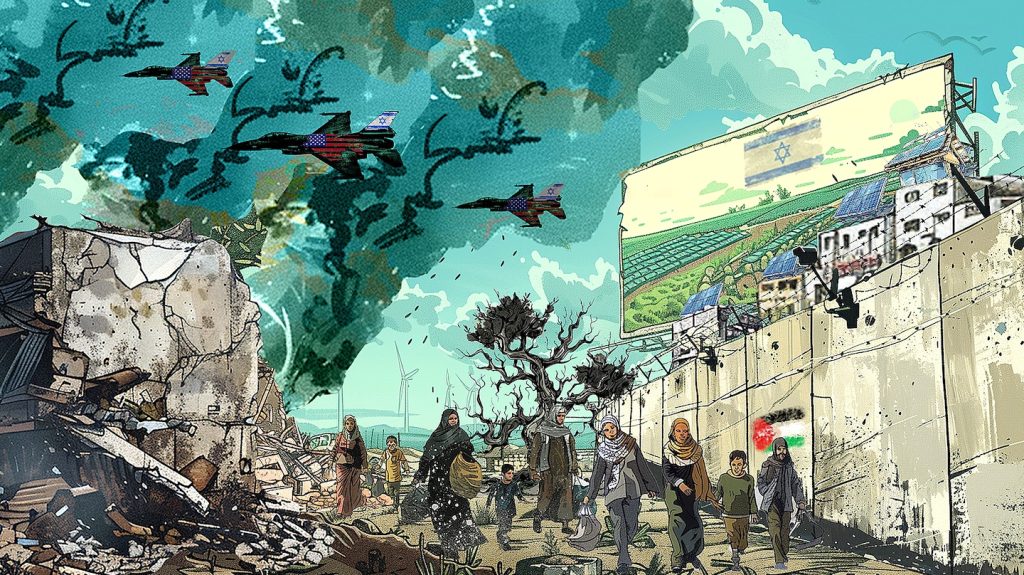
An illustration by Fourate Chahal El Rekaby, a French-Lebanese filmmaker, writer, and illustrator based in Beirut, accompanying an article, “Ecocide, Imperialism and Palestine Liberation”, published by the Dutch-based Transnational Institute in September 2025.

Typically, Israel’s leadership was blinded by its own genocidal fury and its appalling supremacism to such an extent that it never dawned on them that, by bombarding Gaza, its immediate neighbour, with more deadly weapons than have ever been dropped anywhere on earth on an area of comparable size, and by deliberately destroying its entire infrastructure, including the whole of its sewage system, it was paving the way for the impact of this frenzy of unforgivable depravity to, literally, wash up on its own shores.

As Dr. Woodward explained:

Gaza shares the Mediterranean, coastal ecosystems and coastal aquifers with Israel. The destruction of its electric power and sanitation infrastructure forces over 100,000 cubic metres of raw, untreated sewage into the Mediterranean Sea or on land every day. Because in this part of the Mediterranean currents move primarily from south to north, this waste is carried straight up the coast into Israeli waters.

The Ashkelon desalination plant in southern Israel has been forced to shut down multiple times due to high faecal bacteria contamination from Gaza’s wastewater. Raw sewage also triggers toxic algae blooms blocking and damaging desalination filtration systems, as well as creating dead zones where fishing would normally happen.

Wastewater toxins, heavy metals and pathogens are absorbed by local marine life. Because fish migrate across maritime boundaries, contaminated seafood poses a direct health hazard to Palestinian as well as Israeli consumers. Raw sewage carries the same pathogens afflicting Gaza into the shared marine environment. Its northward drift directly impacts Israeli coastal cities.

Although pathogens can persist and migrate under certain conditions, pathogen contaminated groundwater is unlikely to feed into Israeli municipal water supplies, but can still affect the shared aquifer and surrounding environment.

Salts and other chemical contaminants can travel much farther and are often a bigger long-term aquifer concern. They can contaminate a shared groundwater system and reduce the quality and usability of the aquifer over time for irrigation, agriculture and drinking.

Dr. Woodward noted that, earlier this month, the Israeli Prime Minister, Benjamin Netanyahu, and representatives of the Board of Peace established under Donald Trump to, ostensibly, oversee a new Palestinian-led administration in Gaza, “agreed to set up a working group on sanitation and public health affecting both Israel and Gaza”, although its “membership and detailed operating structure” have not been made public.

It’s a rare example of Israel showing any interest in the Board of Peace, whose UN-backed mandate to entrust the day-to-day running of Gaza to a Palestinian technocratic committee, supported by an international peacekeeping force, has been persistently thwarted by Israel, which perhaps shows how serious the health crisis is.

Dr. Woodward also noted how, ironically, while trying to erase evidence of its genocide, Israel was importing from Gaza, “into undisclosed locations inside Israel and the West Bank”, some of “the estimated 60 million tonnes of rubble from Gaza”, without seeming to be aware that, in doing so, it is “potentially transferring the pollutants in that rubble directly to disposal or storage sites” that will also affect the public health of Israelis.

She noted how, recently, the Euro-Med Human Rights Monitor “tracked some 100 Israeli trucks daily leaving the Gaza Strip with debris”, which I wrote about at the time, in a post on Substack entitled, “How Israel is seeking to erase evidence of its genocide in Gaza.”
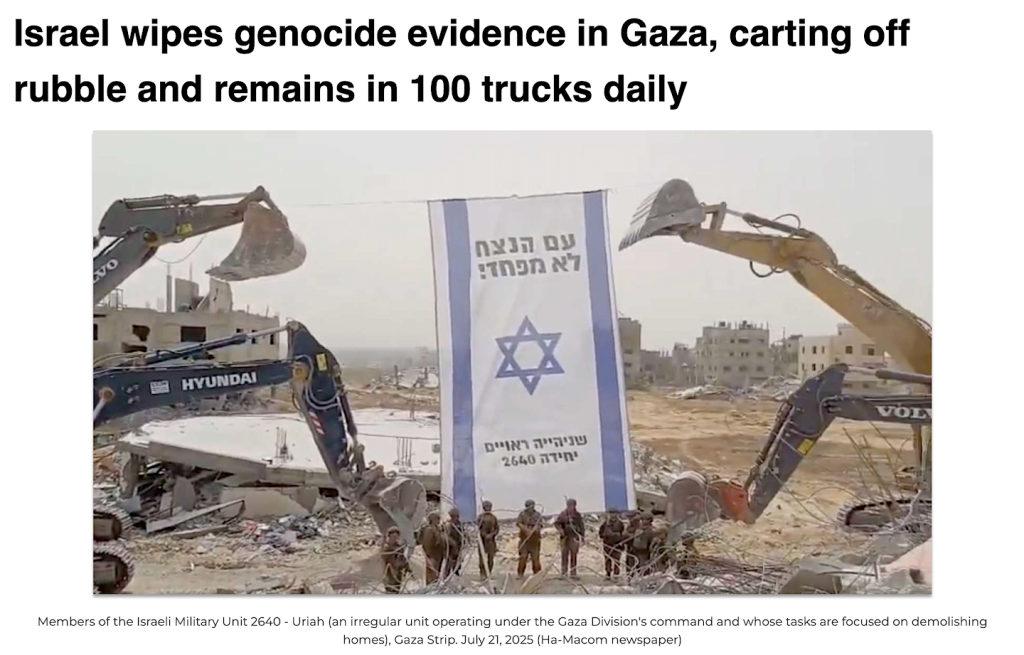
Israel endangers its own people while seeking to erase evidence of genocide

The Euro-Med article highlighted how Israeli contractors have been removing crucial evidence of the genocide from the two-thirds of the Gaza Strip under the control of the Israeli military, as it has steadily increased the amount of land in Gaza under its control from the 50% that was agreed at the time of the ceasefire last October.

As they explained, “Israel is acting unilaterally within closed areas under its military control by demolishing remaining buildings and then crushing, mixing, and transporting the rubble before forensic teams, evidence experts, and unexploded ordnance specialists can examine, document, and preserve the sites, along with the evidence and human remains.”

They also suggested that “at least 10 million tonnes of rubble have been removed, crushed, or moved from their original sites”, and assessed that “approximately 400 heavy pieces of excavation, demolition, crushing, and transport machinery, operated by Israeli civilian companies under military protection, are active across eastern and southern Gaza”, which “demolish remaining structures, crush rubble from destroyed neighbourhoods, and load the debris onto trucks for transportation away from the original sites” into Israel itself, or to locations in the West Bank, although, as they also noted, the Israeli authorities “have not provided details on the quantities removed, the routes taken, the destination sites, or how the material is utilized.”

Israel’s efforts to conceal its genocidal crimes by removing the evidence is truly shocking, and adds to its grotesquely long list of war crimes and crimes against humanity, but, as with the impact of its destruction of Gaza, Israel’s leadership again seems to have been blithely unconcerned about how its actions would create a health crisis within Israel itself.

As Dr. Woodward explained:

Transferred pollutants may include heavy metals, such as lead, mercury, cadmium and traces of other metals or residues from specialised munitions, as well as white phosphorus particulates, unspent explosives, industrial chemicals, and widespread asbestos fibres from pulverised older buildings. Heavy metals present in dust and rubble may exhibit carcinogenic, mutagenic, teratogenic, neurotoxic, nephrotoxic and bioaccumulative properties, posing long-term human health and environmental risks.”

The rubble also contains biological matter, pathogens and fluids from decomposing human remains and accumulated organic waste, as well as insects, rodents, and other disease vectors. Airborne transmission of hazardous dust particles, asbestos fibres and particulate matter degrades the quality of the air while hidden unexploded ordnance in the debris can cause a detonation risk and soil toxicity.

When managing highly contaminated disaster debris, international agencies such as the UN Environment Programme (UNEP) and regional environmental authorities like the Gaza Debris Management Working Group (DMWG) stipulate transfers must follow strict protocols and operational procedures to isolate hazards, including an immediate freeze on all operations if human remains are detected. Moving these materials across borders or jurisdictions should also trigger legal frameworks and rigid groundwater protection standards.

As she added, summing up this sickening demonstration of a unique combination of crime scene destruction and toxic threat, “Critics have pointed out that bulldozing sites that contain mass graves is destroying key evidence of genocidal crimes. But apart from that, this transfer of debris in disregard of international rules and regulations is putting at risk the health of people around collection and disposal sites.”

She continued, “If the aim of this structural disparity is to keep Israeli groundwater zones tightly protected and shift the long-term burden of aquifer and soil pollution onto Palestinian communities in the West Bank, it ignores the risks to the Israeli transfer personnel and to all people living there, which includes 700,000 illegal settlers.”

As she also explained, this is not a problem that has been created through the genocide of the last 34 months, although the impact is much more severe than anything that has happened before. She noted how environmental groups, like EcoPeace, “have long warned that the shared environment creates total interdependence, meaning humanitarian and sanitation crises in Gaza directly compromise Israel’s public health”, and referred to an occasion in 1990 when “the former Jerusalem Mayor Teddy Kollek candidly admitted that his administration had done little for East Jerusalem beyond extending basic water and sewage lines out of fear that cholera outbreaks in neglected Arab neighbourhoods would spread to West Jerusalem.”

Her conclusion was stark. “Even if Israel is morally incapable of meeting its human rights responsibilities as occupiers to solve the sanitation crisis”, she wrote, “it should understand that if it does not strictly follow environmental protocols, its own population will endure the same consequences as the Palestinians whose welfare it callously and criminally disregards.”

No sympathy for Israel

It’s impossible to feel any sympathy for the Israelis, who have created this ecological disaster through their genocidal arrogance and their inability to recognize that, as Dr. Woodward described it, “the shared environment creates total interdependence, meaning humanitarian and sanitation crises in Gaza directly compromise Israel’s public health.”

This, after all, is a nation state in which numerous officials and pundits, after October 7, were so carried away with their vengeance that they called for a nuclear bomb to be dropped on Gaza, oblivious to the fact that doing so would cause nuclear fallout that would also be almost indescribably devastating for Israel.

Israel’s far-right Heritage Minister Amichai Eliyahu, a member of Itamar Ben-Gvir’s Jewish Power party, was reprimanded by Benjamin Netanyahu and suspended from cabinet meetings after he said, on November 5, 2023, that “one of Israel’s options in the war against Hamas could be to drop a nuclear bomb on the Gaza Strip”, as the Times of Israel described it, although Netanyahu was probably more concerned not by his statement, but by how it would be received in the west, and also because it revealed the existence of the nuclear arsenal that Israel possesses, but which it always denies having.

Similar statements were made by the journalist Shimon Riklin, who asked, on October 7, “Why exactly do we have an atomic bomb?”, and by Eliyahu’s father, Rabbi Shmuel Eliyah, the Chief Rabbi of Tzfat, who said, on November 14, 2023, “A nuclear bomb on Gaza is indeed an option! They will not fire me, they wanted my son, but they will not fire me.”

Shamefully, however, although Israel is facing toxic blowback that it deserves, the cost for the Palestinians is immeasurably higher. A devastating analysis of the long-term damage to Gaza was published by the UN Environment Programme last September, just before the ceasefire began, which contained “30 recommendations for reversing the damage to Gaza’s environment”, including “the rapid reconstruction of water and sewage infrastructure, a systemic testing of Gaza’s soil for contamination, the removal — and to the extent possible recycling — of debris and the safe disposal of munitions.”

Estimates for the timescale of reconstruction focus on decades, rather than years, while, in July, an Oxfam-led assessment, “Building Gaza Anew”, estimated that $71.4 billion is needed to rebuild Gaza, which is “seven times the combined cost of reconstruction after every major Israeli military offensive there over the past two decades.”

The UN assessment concluded that “Gaza’s environmental recovery will hinge on careful, inclusive and science-based planning”, but, despite a ceasefire of sorts, absolutely no expert-led programs of land clearance and beginning to deal with the chronic environmental degradation have been allowed by Israel, just as the genocidal oppressor has also defied its obligations, as part of the ceasefire deal, to even allow in sufficient humanitarian aid, including food, water, fuel and medicine, to address the still-unfolding human catastrophe.

Two weeks ago, when I posted How Can the Genocidal State of Israel Be Brought to an End?, my definitive condemnation of Israel’s depravity, I summed up the situation as follows: “As I write this, the surviving Palestinians are still living, permanently and precariously, on the edge of death, beleaguered, bombed and besieged, still half-starved, deprived of almost all necessary medical supplies, and forced to live in medieval squalor in the destroyed remains of their homeland.”

As the journalist Tamer Nahed wrote from Gaza just last week, “Gaza is not coming back to life … we are simply trying not to die.”

With just five weeks to go until the third anniversary of the genocide, and the first anniversary of the porous and largely meaningless ceasefire, it is shameful beyond belief that the world has largely forgotten Gaza, that Israel is still allowed to continue its slow genocide of the Palestinian people, and that the human and ecological devastation — which includes the immense and almost entirely overlooked carbon footprint of the weapons used by Israel — continue to be ignored.

Andy Worthington is a freelance investigative journalist, activist, author, photographer (of a photo-journalism project, ‘The State of London’, which ran from 2012 to 2023), film-maker and singer-songwriter (the lead singer and main songwriter for the London-based band The Four Fathers, whose music is available via Bandcamp). He is the co-founder of the Close Guantánamo campaign (see the ongoing photo campaign here) and the successful We Stand With Shaker campaign of 2014-15, and the author of The Guantánamo Files: The Stories of the 774 Detainees in America’s Illegal Prison and of two other books: Stonehenge: Celebration and Subversion and The Battle of the Beanfield. He is also the co-director (with Polly Nash) of the documentary film, “Outside the Law: Stories from Guantánamo”, which you can watch on YouTube here.

To receive new articles in your inbox, please subscribe to Andy’s new Substack account, set up in November 2024, where he’ll be sending out a weekly newsletter, or his RSS feed — and he can also be found on Facebook (and here), Twitter and YouTube. Also see the six-part definitive Guantánamo prisoner list, The Complete Guantánamo Files, the definitive Guantánamo habeas list, and the full military commissions list.  Please also consider joining the Close Guantánamo campaign, and, if you appreciate Andy’s work, feel free to make a donation via PayPal or via Stripe.


REST IN POWER
Honor Life of Gloria Steinem (1934-2026) ‘By Organizing’ for Rights, Equality, and Freedom

“Thank you, Gloria, for showing the world what it means to speak up for women’s equality.”


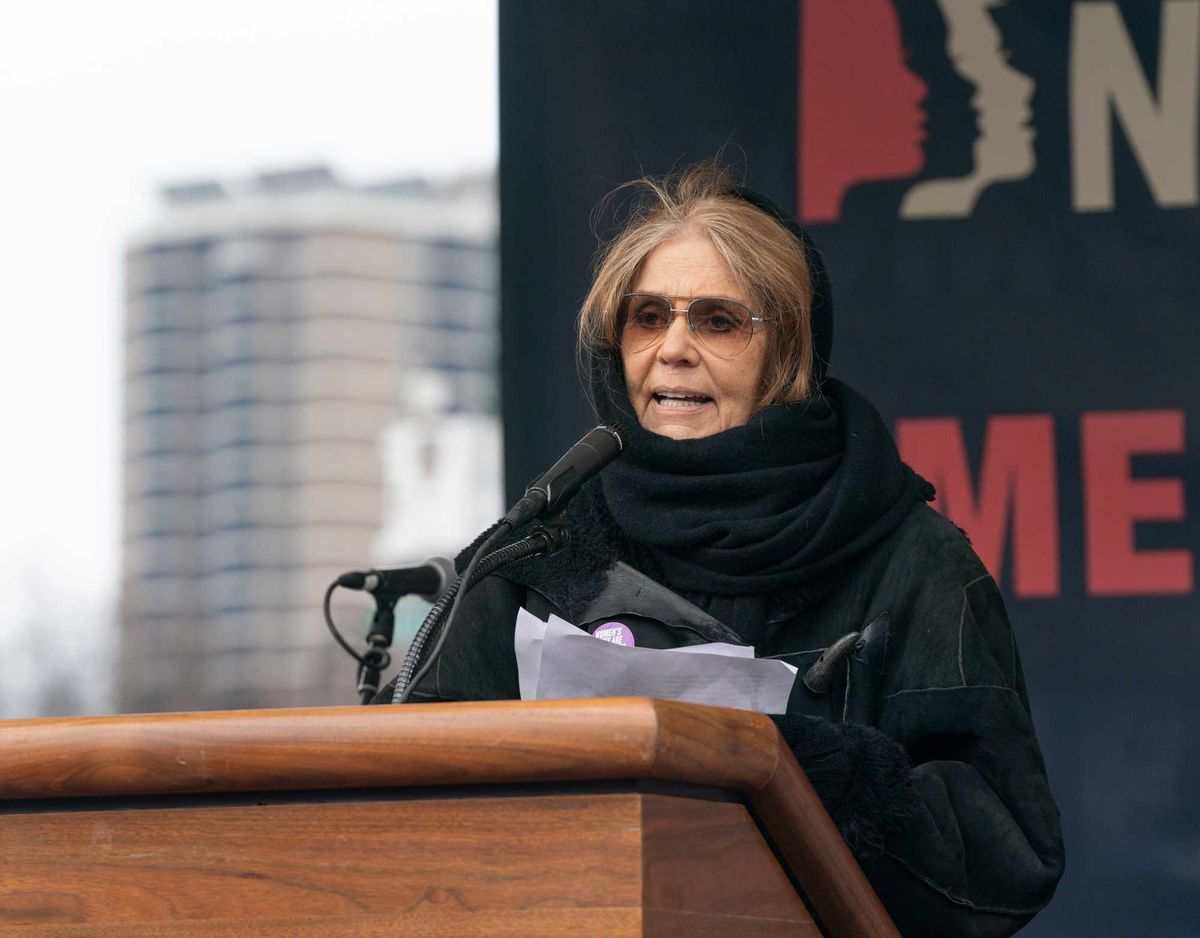
WASHINGTON, DC - JANUARY 21: Gloria Steinem attends the Women's March on Washington on January 21, 2017 in Washington, DC.
(Photo by Noam Galai/WireImage)


Jon Queally
Sep 03, 2026
COMMON DREAMS


Progressive advocates, lawmakers, veteran journalists, labor leaders, and champions of feminism on Thursday are mourning the death of trailblazing women’s rights activist and author Gloria Steinem, who has passed away at the age of 92.

Steinem, regarded as an icon of the second-wave feminism that emerged in the 1960s and 70s and co-founder of Ms. Magazine, was known for decades as a leading voice on reproductive rights, women’s equality at work, and gender equity across society.

According to her representatives, Steinem died Wednesday at her home in New York City, surrounded by loved ones. An exact cause of death was not given.

“It is a moment of remembrance and celebration of this extraordinary woman. And it is too a moment of reflection.” —Agnes Callamard, Amnesty International

“Gloria’s near-century on earth was years well-lived, and she continued working for equality until the very end,” read a message posted to her Instagram account.

“Gloria’s greatest gift was her ability to listen to others, to make others feel seen and heard,” the message continued. “Her words, actions, and example gave people permission to be their truest selves. Gloria lived true to her independent spirit, always with curiosity and a great sense of humor.”

“Oh no,” declared Agnes Callamard, secretary general of Amnesty International, upon learning of Steinem’s passing.


“It is a moment of remembrance and celebration of this extraordinary woman. And it is too a moment of reflection,” Callamard said. “The fight for gender justice and women’s equality is at a critical juncture. The advancements of the last decades are attacked, threatened, mocked. We resist, fight back, build anew.”

The progressive advocacy group Our Revolution said that Gloria Steinem “understood that liberation is not something handed down from the powerful. It is something ordinary people organize and fight for.”

For more than 50 years, the group added, “she fought for women to have power over our bodies, our work, our lives and our futures. And she understood that the struggle for women’s liberation could never be separated from the struggles for racial justice, economic justice and human dignity. At a moment when women’s rights and fundamental freedoms are once again under attack, the best way we can honor Gloria is not simply by remembering her. It is by organizing. Rest in power, Gloria Steinem.”

According to the New York Times:
Steinem helped usher in sweeping cultural transformations across virtually every facet of American life, from the boardroom to the courtroom to the bedroom.

For more than half a century, she personified the women’s movement and became its most enduring symbol; her tinted aviator glasses and curtain of streaked-blond hair parted in the center made her one of the most recognizable women in the world.

A prolific writer, Steinem started her career as a journalist in the 60s and in 1972 she co-founded Ms. Magazine, a publication focused on women’s issues with the idea of translating “a movement into a magazine.”

Steinem, wrote CNN’s chief international anchor Christiane Amanpour, “will go down in history as one of the most important activists of all time, leading a movement for the equality of half the world: its women.”

“She lived a long and passionate life dedicated to this vital and basic cause,” Amanpour continued. “She did it with intellectual precision, emotional awareness, humor and beauty. May she rest in peace and may the cause thrive.”

In a video posted to social media, Rep. Becca Balint (D-Vt.) said that Steinem “always understood that gender equality was absolutely bound up with economic equality and racial justice and that has to continue to be our North Star.”


In 2017, after the first election of President Donald Trump, Steinem was one of the key leaders behind the Women’s March, which kicked off opposition to the far-right Republican, with marches in cities nationwide that helped galvanize resistance to the destructive policies to come.

At the time, Steinem warned that Trump’s arrival in the White House represented “disaster and a danger,” but added that the upside of his ascendancy could be the force brought together to galvanize against him.

“He’s made us see that everything is connected,” she said. “I’m a hope-aholic, nonetheless. I feel we’re beginning to approach the end of one structure and the beginning of another. It’s a time of both danger and possibilities.”

As the Associated Press reports:
On Jan. 21, 2017, when hundreds of thousands of women gathered in Washington in their pink “pussy hats” for the historic Women’s March, it surprised nobody that the keynote speaker, and the most rousing, was Steinem.

“We are linked,” she told the crowd. “And this is a day that will change us forever because we are together.”

For many women, Steinem was the galvanizing voice that day. She would go on to advocate fiercely. But, though many saw her as a singular figure in history, she often liked to say that if she hadn’t come along, someone else would have accomplished the same things.

By the same token, she said, it was less important that younger people listen to her, and more important that they listen to themselves.

“The primary thing is not that they know who I am,” she said, “but that they know who THEY are.”

As news of Steinem’s passing spread on Thursday, others offered their reflections on her life and accomplishments.

“Thank you, Gloria, for showing the world what it means to speak up for women’s equality,” said the National Organization for Women (NOW) in a statement. “Thank you for fighting for our rights so that every woman and every person can live with dignity, freedom, and equality.”

Democratic New York State Rep. Jessica Ramos said Steinem “spent her life refusing to accept a world where women were expected to settle for less.”

“She organized, challenged power, and helped turn women’s equality into a movement that changed America,” Ramos said. “We honor her legacy by refusing to go backward.”

“Gloria Steinem did not simply advocate for women; she changed what women believed was possible,” said Victoria Mancinelli, a member of the labor movement in Canada, in response to news of Steinem’s death.

“She confronted a world that expected women to remain quiet, accept less, and wait patiently for progress. Gloria refused. Through her journalism, activism, and unrelenting pursuit of equality, she helped transform deeply personal struggles into a powerful collective movement and forced institutions to recognize women as leaders, decision-makers, and agents of change.”


Gloria Steinem, feminist icon, dies at 92

Kathleen Culliton
September 3, 2026 
RAW ST0RY


New York, NY - January 19, 2019: Feminist Gloria Steinem speaks during Women's Unity Rally at Foley Square as hundreds of people attend. Lev Radin | Shutterstock


Gloria Steinem — the iconic feminist journalist who revolutionized work for generations of women to come — has died. She was 92.

Steinem passed away in her New York City home on Wednesday, surrounded by those who loved her, The Gloria Steinem Foundation announced Thursday morning.

"Gloria’s greatest gift was her ability to listen to others, to make others feel seen and heard," the foundation stated. "Her words, actions, and example gave people permission to be their truest selves. Gloria lived true to her independent spirit, always with curiosity and a great sense of humor."

The cause of death was not revealed.

Steinem dedicated her life to causes such as reproductive freedom, domestic violence prevention and workplace gender inequalities.

She became a household name in 1963, when she went undercover as a Playboy bunny and exposed the poor conditions workers faced in Hugh Hefner’s clubs.

In her later years, Steinem hosted talking circles in her home and wrote a forthcoming book, "𝘈𝘯 𝘜𝘯𝘦𝘹𝘱𝘦𝘤𝘵𝘦𝘥 𝘓𝘪𝘧𝘦," according to the foundation.

"Gloria loved the tradition of lighting signal fires on hills to light the way to the other side of the mountain," they stated. "Lighting your own candle for Gloria makes you part of this global and celestial community circle."

Read more about her life and work here.

When Gloria Steinem identified as a Jew most

(The Forward) — ‘Never in my life have I identified as a Christian,’ she said, ‘but wherever there is antisemitism, I identify as a Jew.’
FILE - Feminist Gloria Steinem appears in New York on Feb. 17, 1970. (AP Photo/Anthony Camerano, File)

Gloria Steinem, the journalist and organizer who became the most recognizable face of America’s modern women’s movement, died Wednesday at her New York City home. She was 92.

For more than half a century, Steinem pushed American women to imagine lives beyond the limits society had set for them. She co-founded Ms. magazine, helped establish the National Women’s Political Caucus and turned phrases like “sexual harassment” from unnamed experiences into subjects of national debate.

Steinem was the daughter of a Jewish father, Leo Steinem, and a Protestant mother, Ruth Nuneviller. She was raised without much religion and generally described herself as secular, but she was unequivocal about where she stood when Jews were targeted: “Never in my life have I identified as a Christian,” she said, “but wherever there is antisemitism, I identify as a Jew.”

Her mother taught her to value her Jewish roots. Steinem told the Forward in 2015 that her father rarely discussed his heritage; it was her non-Jewish mother who presented Judaism to her as something positive — “She also told me Jewish men made better husbands” — and taught her about her paternal grandmother.

That grandmother was a feminist pioneer in her own right. Pauline Steinem, who kept kosher, was an educator, suffragist, delegate to the 1908 International Council of Women and the first woman elected to Toledo’s school board — and during the Nazi’s rise in the mid-1930s, she worked to rescue members of her family from Europe.

A feminist Seder became her strongest connection to Jewish ritual. Steinem participated for decades in an annual women’s Seder, calling it the first spiritually centered experience of her feminist life. What drew her to Judaism, she said, wasn’t the law — it was “the mystical part, the Kabbalah, the Shechinah.

She recognized how antisemitism and misogyny fed each other. In her memoir, Steinem recalled a cabdriver telling her that feminism was a Jewish plot to destroy the Christian family. Her response to such hatred was not to distance herself from Jews, but to identify with them more strongly.

That identification outlasted her. Gloria and her sister, Susanne, donated a catalog of jewelry seized from Nazi victims to the U.S. Holocaust Memorial Museum — in honor of their grandmother.

Steinem continued writing and advocating for equality into her 90s. Her final book, An Unexpected Life, is scheduled to publish later this month.

This story was originally published on the Forward.


BRAZIL'S JBS

Trump's meeting with 'billionaire beef bro' flagged by legal expert: 'The timing stinks'

Bennito L. Kelty
September 2, 2026
RAW STORY


FILE PHOTO: A cow stands in the Lubbock Feeders feedlot, that has 350 acres of feedyard pens, in Lubbock, Texas, U.S., April 22, 2026. REUTERS/Annie Rice/File Photo

Lawyer and journalist Katie Phang is questioning the timing of a private Oval Office meeting between President Donald Trump and a bribery-linked Brazilian billionaire.

On August 20, Joesley Batista met with Trump, and the following day, the president announced the U.S. would allow up to 300,000 metric tons of imported beef product over the next 90 days, sold at 25 percent below market price, Phang explained in a Wednesday podcast episode. She noted that Batista's company, JBS, processes meat and is the world's largest meatpacker.

"I'm calling him the Brazilian billionaire beef bro of Donald Trump," Phang said.

She characterized the Trump White House as a "pay-to-play kind of place" and noted that the two men reportedly discussed how additional supply from Brazil could help if Trump dropped a 26 percent import tax.

"It's like you can't even script it, right?" Phang said. "You can't even script it."

The arrangement, which Trump framed as relief for "working American families," drew immediate pushback from cattle ranchers who say the move undercuts them, Phang explained.

"The timing stinks, does it not?" she asked. "Be mad. Farmers, ranchers, those of you that supported Donald Trump, be outraged. Be outraged that your bottom line is being impacted by corruption and grift and graft."

Phang tied the deal to a broader pattern and pointed to Pilgrim's Pride — majority-controlled by JBS — as the single largest donor to Trump's inaugural committee at $5 million. The figure prompted a letter from Sen. Elizabeth Warren, Phang noted.

"Its $5 million donation amounts to more than the contributions from Apple's CEO plus Amazon, Meta, and Google combined," Phang said.

JBS admitted in 2017 to paying bribes to Brazilian politicians. Joesley and his brother Wesley later served jail time, Phang said.

"You think that just because they got caught in Brazil bribing politicians to get favorable deals, you think that would stop in Brazil?" Phang asked. "What's to stop them from doing the same thing in America?"

The Justice Department is simultaneously running an antitrust probe into the major meatpackers, including Tyson Foods, Cargill, JBS and National Beef, after Trump blamed foreign-owned processors for high prices.


TRUMP'S WAR ON FISHING BOATS

As Trump Resumes Boat Strikes, Amnesty Says ‘Congress Must Stop Murderous Yearlong Campaign’

“We look forward to the day when the architects and perpetrators of this campaign of extrajudicial killings are investigated and face justice, including the people who ordered these operations.”


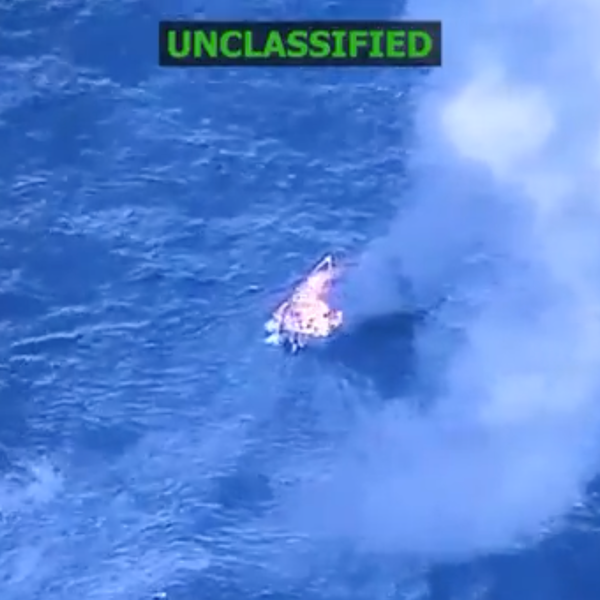
A boat burns after being bombed by US forces in the Pacific Ocean on May 29, 2026.
(Photo by US Southern Command/screenshot)

Jessica Corbett
Aug 31, 2026
COMMON DREAMS

In anticipation of Wednesday, which will mark one year since the Trump administration launched its recently revived bombing campaign against boats allegedly trafficking drugs in the Caribbean Sea and Pacific Ocean, Amnesty International USA on Monday renewed its call for congressional action.


“For one year, the US military has carried out a campaign of extrajudicial killings at sea that has left more than 225 people dead, with the most recent four deaths just six days ago,” said Amanda Klasing, Amnesty International USA’s national director for government relations, in a statement. “For just as long, we have called on Congress to take meaningful action to stop these killings, which are illegal under both international and US law.”

Both chambers of Congress are narrowly controlled by Republicans, who have refused to advance war powers resolutions intended to stop the strikes. The US military has confirmed 68 bombings, with at least 227 deaths and 3 survivors, including two attacks last week—though there have been at least three other suspicious attacks on Ecuadorian fishing boats.

All of the attacks have been denounced by legal experts worldwide as “war crimes, murder, or both.” While the Trump administration has tried to justify the deadly campaign by claiming that the United States is in an armed conflict with drug-smuggling cartels, many experts and members of Congress disagree.

“War crimes are violations of the law of armed conflict that take place in armed conflict,” Sarah Elaine Harrison, nonresident fellow in the Stimson Center’s Conventional Defense Program, wrote for Lawfare last week. “By contrast, all of these boat strikes conducted by the US military... are extrajudicial killings. That is, they are deliberate killings that are outside the law: That means murder under domestic criminal statutes, and now likely crimes against humanity under international law.”

Amnesty’s Klasing similarly noted Monday that “US authorities have yet to offer a shred of evidence to support their claims against the people they have killed. They have not even named the dead. But even if the victims were transiting narcotics as the administration alleges, international law absolutely prohibits summary killings of criminal suspects.”

“Unfortunately, with a few notable exceptions, lawmakers have done little to try to halt this horrific campaign of murder at sea,” she continued. “And let us be clear: Extrajudicial killings are a form of murder. How many more people will die at sea from this administration’s illegal actions before Congress does its job?”


Klasing said that “we look forward to the day when the architects and perpetrators of this campaign of extrajudicial killings are investigated and face justice, including the people who ordered these operations: President Donald Trump, Secretary of State Marco Rubio, and Secretary of Defense Pete Hegseth.”

“Until then, we will continue pushing Congress to do its job to stop this ongoing policy of murder, and we urge people to call their representatives and do the same,” she stressed. “But the blame does not solely rest on US authorities.”

Amid the boat bombings overseen by US Southern Command, Trump in March sent American troops to Ecuador for a joint effort to combat “narco-terrorists” in the South American nation. Earlier this month, SOUTHCOM announced an expanded operation dubbed Joint Task Force Western Hemisphere, with an aim to “defeat all threats” across Latin America.

Klasing declared Monday that “any authorities in Latin America who have aided these killings with equipment or intelligence must stop collaborating in this illegal airstrike campaign and likewise face justice.”


Trump Condemned for 200+ Extrajudicial Killings After Yearlong Murder Spree at Sea

“This is a make-believe armed conflict, but these are very real killings,” said one legal expert.


Four victims of the Trump administration’s boat bombings, Eduard Hidalgo, Dushak Milovcic, 
Ricky Joseph, and Chad Joseph, are seen in a composite image.
(Photo courtesy of CLIP)

Jessica Corbett
Sep 02, 2026
COMMON DREAMS

Wednesday marked one year since President Donald Trump began bombing boats allegedly smuggling drugs in the Caribbean Sea and Pacific Ocean—a grim anniversary that sparked a fresh wave of condemnation from rights advocates across the United States and beyond.

“For a year now, the Trump administration has engaged in a terrifying, lawless killing campaign at sea and has yet to provide the public with anything beyond the most threadbare justifications,” said Jeff Stein, staff attorney with ACLU’s National Security Project, in a statement late Tuesday.


The ACLU and the Center for Constitutional Rights are suing over the administration’s refusal to comply with a Freedom of Information Act request for a legal opinion authored by the US Department of Justice’s Office of Legal Counsel (OLC) attempting to justify the strikes.

“These strikes have devastated countless families, terrified communities, and, by the administration’s own admission, failed to achieve their purported goal of stopping drugs from entering into the United States,” Stein said. “We urge leaders in both Congress and the executive branch to put an immediate end to these strikes before anyone else is killed.”

Despite mounting outrage over the bombings, which have killed at least 227 people and, as Amnesty International USA’s national director for government relations, Amanda Klasing, highlighted Monday, “are illegal under both international and US law,” the Republican-controlled Congress has failed to pass any war powers resolutions intended to stop the campaign.

“The Trump administration has summarily killed more than 200 people over the course of the past year, bragging about these killings online and facing no accountability,” Ida Sawyer, crisis, conflict, and arms director at Human Rights Watch, said Wednesday. “The victims and their loved ones deserve a full accounting of these operations, and justice for the grave harm they have suffered.”

After a two-month pause in the bombings, the administration revived them last week, launching a pair of attacks that killed at least six people, according to social media posts and aerial footage from US Southern Command. The strikes followed SOUTHCOM’s early August announcement of an expanded operation across Latin America called Joint Task Force Western Hemisphere.

As MS NOW noted Wednesday:
In September and October 2025, when the strikes began, US Southern Command, known as SOUTHCOM, linked three of the strikes to the Tren de Aragua and Ejército de Liberación Nacional criminal organizations. Most later strikes were described as targeting “a vessel operated by designated terrorist organizations.”

But the military’s most recent two announcements of strikes simply stated that “confirmed intelligence revealed the vessel’s active involvement in narco-trafficking.”


Brian Finucane, a former State Department legal adviser who now advises the US Program at the International Crisis Group, told the outlet that “they are engaging in conduct that is widely regarded to be flagrantly illegal, criminal even, and have not offered anything approaching plausible legal rationale.”

The OLC memo may be the administration’s “permission slip,” Finucane said, but it hasn’t actually substantiated claims that the United States is engaged in an armed conflict with cartels that traffic drugs.

“This war framing on the part of the administration is really bogus,” he added. “This is a make-believe armed conflict, but these are very real killings.”


Several Democrats in Congress, from House Minority Leader Hakeem Jeffries (NY) to Senate Minority Whip and Judiciary Committee Ranking Member Dick Durbin (Ill.), renewed their criticism of the boat bombings on Wednesday.

Sen. Ruben Gallego (D-Ariz.) said that “the most recent strike was four days ago. A year of killing, and this administration has never once come to Congress to justify any of it. This cannot become the way our country goes to war.”

“The American people are already paying for one war they didn’t want in the first place,” he continued, nodding to the illegal six-month assault on Iran. “I fought in Iraq. I know what these wars cost, and I know who pays them. I will use every tool I have as a United States senator to stop this and to defend the Constitution.”

House Armed Services Committee Ranking Member Adam Smith (D-Wash.) noted that “it remains unclear whether these operations have made any real difference in stopping illegal drugs from reaching the United States.”

“This is especially true for fentanyl,” he noted, which Trump and Defense Secretary Pete Hegseth “have repeatedly claimed is the reason for these extrajudicial killings even though we know that it is cocaine—not fentanyl—that is typically shipped via small boats from South America.”

Smith also called out the Department of Defense for failing “to publicly provide the costs of these operations, both in terms of dollars and readiness,” and declared that “never before in my over 20 years on this committee have I seen such a staggering lack of transparency on behalf of an administration and DOD to meaningfully inform Congress of the use of lethal military force.”


However, with Republicans holding narrow majorities in Congress and mostly still refusing to truly challenge the administration on the boat strikes—and various other violent actions around the world—some campaigners are also stepping up pressure on other governments.

“The Trump administration has had complete impunity for this campaign of unlawful killings for a year, and has stated openly that it has no intention of stopping,” said Sawyer. “Other countries should refrain from any cooperation on these strikes, and Congress should urgently work to rein in the deadly actions of an administration bent on violating international law.”

Jamil Dakwar, director of ACLU’s Human Rights Program, said that “the international community must do everything in its power to hold the Trump administration responsible for these extrajudicial killings that are blatant violations of international law.”

“No other country should provide any assistance that could contribute to these unlawful US government killings,” Dakwar added, calling for an “independent international investigation into this lawless campaign.”


‘We Are in a Constitutional Crisis’: Congress Urged to Sue Trump to End Iran War

“Sitting and doing nothing is not an option and is eroding our democracy and system of checks and balances.”


A demonstrator holds a placard in front of the White House in Washington, DC on April 7, 2026. U.S.
(Photo by Li Rui/Xinhua via Getty Images)

Brad Reed
Sep 02, 2026
COMMON DREAMS


With no end in sight to President Donald Trump’s illegal war with Iran, Congress is being urged to take legal action to bring the conflict to an end.

Jamal Abdi, executive director at National Iranian American Council (NIAC) Action, said on Wednesday that Congress must go to court to enforce the war powers resolution that passed in the House and the Senate earlier this year.

“We are in a constitutional crisis and our lawmakers cannot simply roll over or bide their time as Trump traps the country in an illegal forever war,” said Abdi. “For the first time in US history, Congress has passed legislation mandating the president withdraw from the war, and now they must take him to court to enforce it.”

Rep. Gregory Meeks (D-NY), ranking member of the House Foreign Affairs Committee, introduced a resolution in July that would compel House Speaker Mike Johnson (D-La.) to sue Trump and enforce the will of Congress to end the war.

However, Abdi argued that US lawmakers are not moving with the proper urgency to stop Trump from continuing his illegal attacks on Iran, which have been carried out for more than six months despite receiving no congressional authorization.

“Congress must assert its authority as a co-equal branch of government and sue to end the administration’s illegal war,” Abdi emphasized. “We need urgent action, not more deliberation. Sitting and doing nothing is not an option and is eroding our democracy and system of checks and balances.”

According to Politico congressional reporter Riley Rogerson, Meeks on Tuesday said that there are currently no plans to bring up a new war powers resolution, although he didn’t rule out taking action.

“Democrats are unsure how long the House will be in before the midterms,” wrote Rogerson, “which makes planning a challenge.”


Johnson on Tuesday showed no appetite for getting Congress more involved in the conflict during a testy exchange with CNN reporter Manu Raju, who asked the Louisiana Republican if the American public should judge him for the negative impact the war has had on their personal finances.

“That is one of the stupidest questions you’ve ever asked,” Johnson replied.

“What, why is that stupid?” Raju asked.

“I have nothing to do with the prosecution of the war across the globe,” Johnson said.

Article 1, Section 8 of the US Constitution states that Congress, not the president, has the power to declare war.
Hegseth Quietly Extends Middle East Troop Deployments Into 2027 as Iran War Drags On

Pentagon Secretary Pete Hegseth previously echoed President Donald Trump’s claim that the Iran war, launched in late February, would be over quickly.


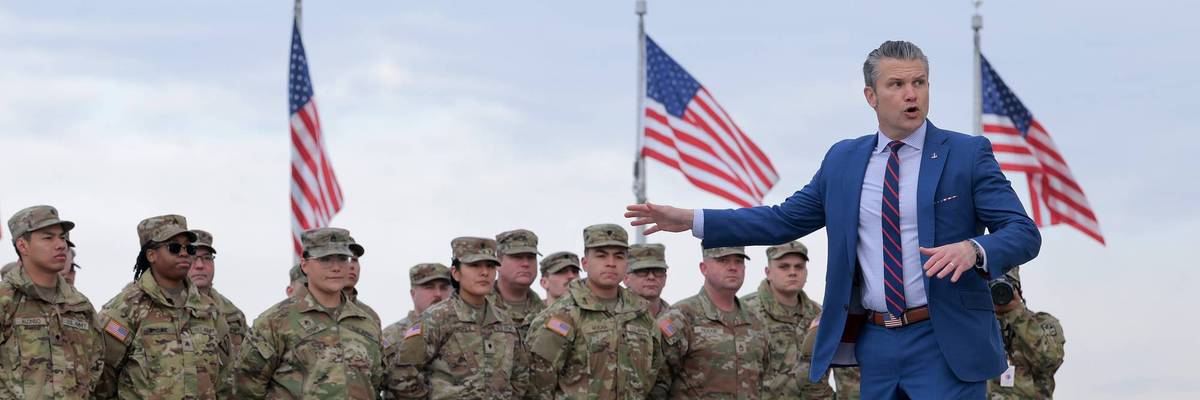
Pentagon Secretary Pete Hegseth addresses a group of troops at the base of the Washington Monument on February 6, 2026 in Washington, DC.
(Photo by Chip Somodevilla/Getty Images)

Jake Johnson
Sep 03, 2026
COMMON DREAMS


The Pentagon has reportedly extended Middle East deployments of American troops, fighter squadrons, and warships into next year as the deadly, expensive, and deeply unpopular Iran war drags on with no end in sight.

The Wall Street Journal reported late Wednesday that Pentagon Secretary Pete Hegseth—who, like President Donald Trump, insisted the Iran assault would be over swiftly—has decided that the US military will maintain a “presence of 50,000 troops in the region in part to give the president flexibility on next steps.” The Pentagon “could also keep elements of the Army’s 82nd Airborne Division in the Middle East well into 2027,” the Journal added, citing a letter that military leaders sent to families.

The Journal also reported that Trump, who has falsely called Iran a “dead” country, is “having discussions with senior aides about whether to declare the Iran war over,” even as the bombings continue, American troops remain in the region, and the administration ratchets up economic sanctions.

“ Trump administration seems to excel at bombing schools and weddings,” Brian Finucane, senior adviser to the US Program at the International Crisis Group, wrote on Wednesday. “Winning the illegal and unnecessary war with Iran—not so much.”

Hegseth has reportedly backed a plan that would involve “periodic” bombings of Iran in an attempt to keep ship traffic flowing through the Strait of Hormuz, a strategy that analysts say would lead to a “permanent state of war.”

Trita Parsi, executive vice president of the Quincy Institute for Responsible Statecraft, argued earlier this week that Trump appeared to be leaning toward “maintaining a low-level conflict until the midterms—neither securing a diplomatic deal nor allowing the situation to deteriorate into full-scale war.”

“Iranian officials say, both publicly and privately, that they expect the U.S. and Israel to resume the war after the midterms regardless of the impact of the D-Day sanctions,” Parsi wrote. “Regional diplomats have largely reached the same conclusion. If sanctions weaken Iran over time while the global economy recovers and adjusts to the new reality in the Strait, a prolonged pause will work against Tehran. Iran may therefore decide to escalate dramatically, taking full advantage of Trump’s perceived vulnerability in the run-up to the elections.”

Thousands of Iranians—including hundreds of children—and at least 18 US servicemembers have been killed during the war so far, and the conflict has cost the average American household $1,200 in extra costs as gas prices remain at record levels. Trump has said he doesn’t “think about Americans’ financial situation” when he makes decisions pertaining to the Iran war.

The war is fueling the Trump administration’s push for a record $1.5 trillion in military spending for the coming fiscal year—a budget demand that has intensified concerns of a “forever war” against Iran.

“ Washington is betting that sustained military and economic pressure will eventually force Tehran to retreat,” the National Iranian American Council wrote in a blog post on Wednesday. “Iran appears to be betting that it can survive long enough to force Washington to do the same. For ordinary Iranians, American servicemembers, and civilians across the region, the danger is that testing those two assumptions will require a much longer and more destructive war.”