Monday, October 26, 2026

 ‘Generational rage’ drives young Europeans to fight to be heard


Rome (AFP) – From blockaded schools in Rome to tent camps in Madrid and street protests in France, young people across Europe are turning their anger on a political class they say is not listening.


Issued on: 23/10/2026 -  RFI

Student protest movements across Europe have condemned heavy-handed police action. © PATRICIA DE MELO MOREIRA / AFP

Their demands vary, but they are united in wanting to make their often marginalised voices heard, sometimes even with radical methods in the face of heavy-handed policing.

"We are fighting and taking our future in our hands," said Damiano Fusa, 18, a student at Rome's Cavour high school, the first to be occupied in a wave of student takeovers that has spread across the Italian capital.

"We're not represented by anyone," Fusa told AFP, criticising both Prime Minister Giorgia Meloni's hard-right coalition and previous centre-left governments for cutting education funding and ignoring young people's needs.

Students are demanding action on soaring rents, more spending on education instead of defence and more job opportunities for young people © Piero CRUCIATTI / AFP

Hundreds of thousands of high school and university students have rallied in France, Italy, Spain and other European countries in recent weeks, with some protests descending into violence.

Governments have largely focused on restoring order, with France imposing partial curfews and Italy deploying soldiers, responses protesters say obscure their demands and could make things even worse.

"Politicians are responding in ways that are completely disconnected from reality, completely absurd," said Luis Marques, a 19-year-old psychology student in Lisbon.

Students are demanding action on soaring rents, more spending on education instead of defence and more job opportunities for young people.

But experts say the unrest reflects a broader sense among many young Europeans that they have been shut out of politics and sidelined.

"These young people do not just feel like they do not have a place in politics, they feel they are not being heard at all," said Geoffrey Pleyers, president of the International Sociological Association.

Rosario Forlenza, a professor at Rome's Luiss University, called it a "European generational revolt" rooted in a social and economic crisis "to which politicians cannot give a substantive response".

"Young people are a minority of the population that is shrinking and so their social, economic, cultural, political and electoral weight is becoming ever more irrelevant," he said.

'Inspiring other people'


The anger has been particularly palpable in France and Italy, where fresh demonstrations are planned for Saturday.

Many protesters in Europe have taken inspiration from the nationwide movement led by high school students in France © Thibaud MORITZ / AFP

"People are very angry, they've had enough. Working hard all day and still not being able to fill up their shopping cart," a 20-year-old student who gave his name as Eddy told AFP at a protest in Bordeaux last weekend.

"Will smashing everything change anything? I think it can be a jolt to wake up the politicians. We don't know what else to do to make ourselves heard. The ballot box? We don't believe in it anymore," he said.

Protest movements across Europe are increasingly drawing inspiration from one another, and even looking to youth-led movements further afield in places like Bangladesh, India and Nepal.

In Italy, one student slogan last week urged protesters to "do as in France", while shared symbols, including the Jolly Roger pirate flag, have become common across youth rallies.

Marcos Navarro, 22, a laboratory quality-control technician from Madrid, said protesters across Europe were meeting to share tactics.

"They've come to ask us: 'How did you do it? How do you organise yourselves?' We've already exchanged ideas," said Navarro, who has been camping with hundreds of others in Madrid's central Puerta del Sol square since September to protest housing costs and evictions.

Ayla Herrero, a 26-year-old anthropologist helping at the camp's infirmary, said it was "inspiring for us to know that we're inspiring other people, that it doesn't just stay here".

'Not acceptable'


Concern about the rise in military spending in Europe following the Russian invasion of Ukraine has also been a rallying point.

Nikos Mavroudis, a 17-year-old high school student in Athens' Exarchia neighbourhood, said the money could be better spent on his school, where chunks of plaster are falling.

"It's not acceptable for classrooms to be dangerous," said Mavroudis, who hopes to become a cook and plans to move elsewhere in Europe to "countries where things are better".
Young protesters across Europe say they want their concerns heard © Kiran RIDLEY / AFP

At Rome's occupied Morgagni high school, where students have barricaded entrances with desks, protesters pointed to the crumbling infrastructure as evidence of neglect.

An 18-year-old, who did not want to be named, said the media and politicians in Italy were focusing too heavily on looting and vandalism by some protesters.

"It turns hatred against the students who are victims of this system," he said.

Asked about the violence, Sabrina Brizzola, 24, coordinator of the Italian University Students' Union, said organisations like hers should "organise and channel this generational rage".

"We have shared concerns, even if our ways of protesting differ," she said.


Protests sweep across Europe from France to Albania, Italy, Spain and Portugal.


By Anna Kirchheim
Published on

Violence in earlier protests prompted authorities to take additional security measures, with massive deployments of police and even soldiers observed across several European capitals.

Protests over a range of issues have taken place in cities across Europe, from Milan and Madrid to Lisbon and Tirana. Demonstrators are taking to the streets over pensions, housing, education, corruption and opposition to war, reflecting a diverse mix of grievances across the continent.

Despite precautions, bans and heavy policing the protests led to violent clashes in several cities in France - around 2,400 people have been arrested, while nearly 1000 members of the security forces were injured, as well 100 protesters and residents in Paris alone.
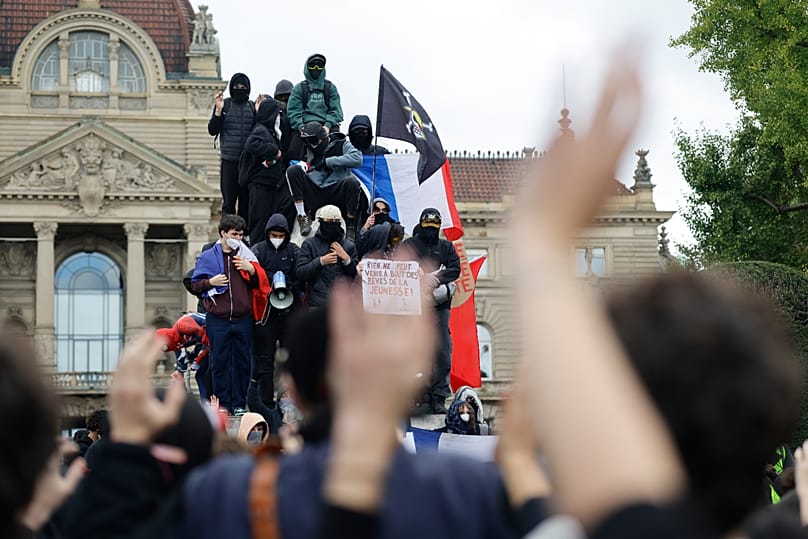

Protesters attend a demonstration against rising living costs in Strasbourg, France, Saturday, Oct. 24, 2026 Copyright 2026 The Associated Press. All rights reserve
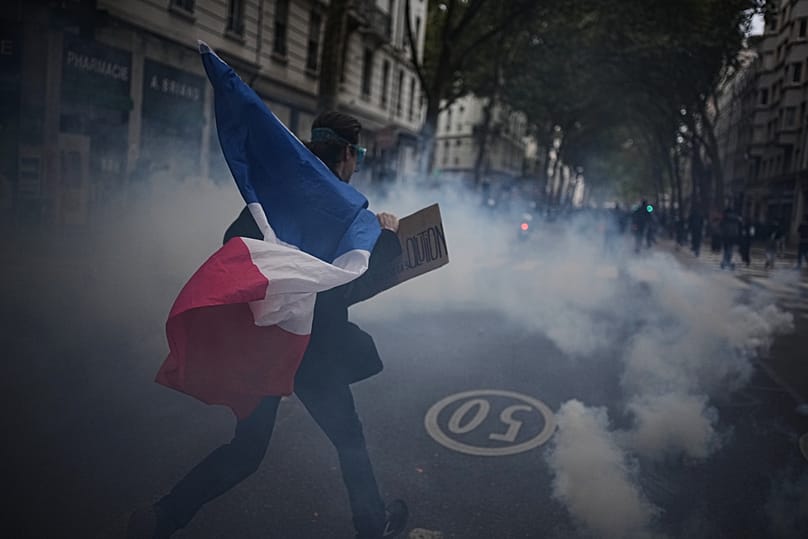

A protester holds a French flag during a demonstration against rising living costs in Lyon, France, Saturday, Oct. 24, 2026. Copyright 2026 The Associated Press. All rights reserved

Albania sees clashes between police and students, artists and opposition parties

Thousands of people rallied for a fresh anti-government protest in the Albanian capital Tirana on Saturday, with police firing tear gas to disperse the crowd. In the latest of several clashes between police and protesters since mid-October, government buildings were attacked and dozens of demonstrators were detained. Authorities said that more than 300 protestors and police have been injured.
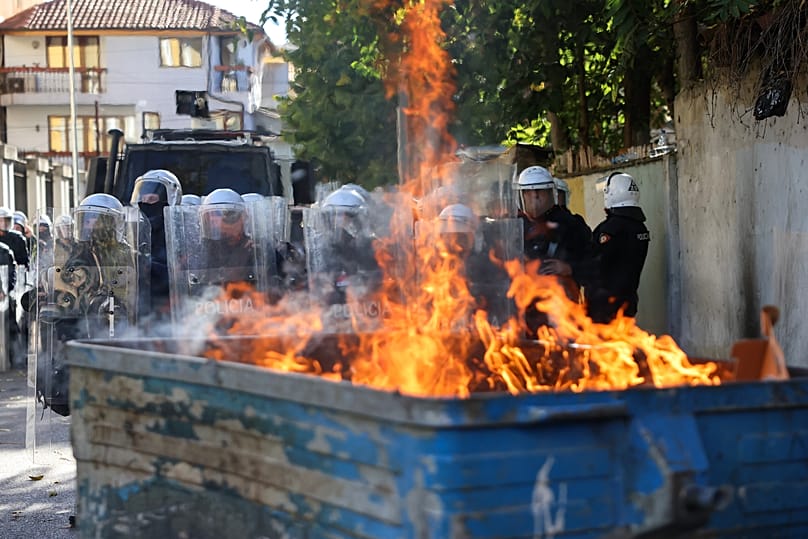

Riot police stand in formation behind a burning garbage can during an anti-government rally, in Tirana, Albania, Saturday, Oct. 24, 2026. (AP Photo/Hameraldi Agolli) Copyright 2026 The Associated Press. All rights reserved
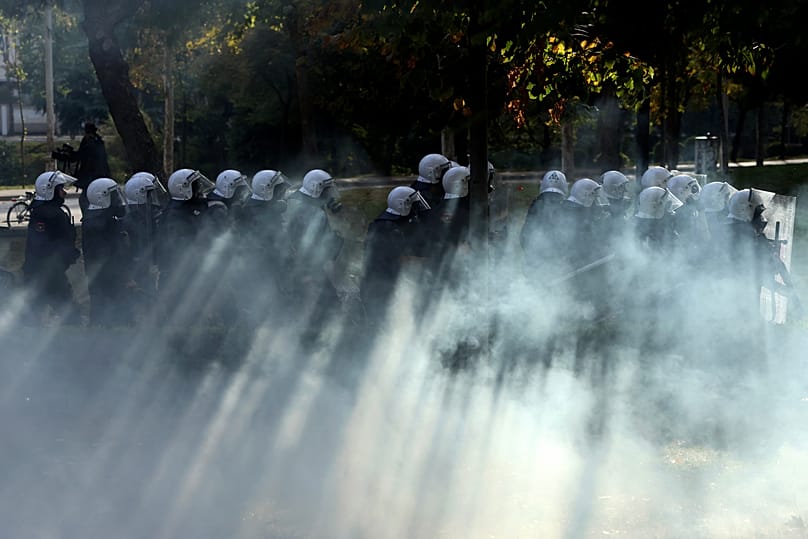

Riot police advance during an anti-government rally in Tirana, Albania, Saturday, Oct. 24, 2026. (AP Photo/Hameraldi Agolli) Copyright 2026 The Associated Press. All rights reserved


Clashes erupted between protesters and police across several Italian cities

Thousands took to the streets in Milan, Rome, Turin, Naples, Bologna and Florence with protester throwing bottles, stones and firecrackers.
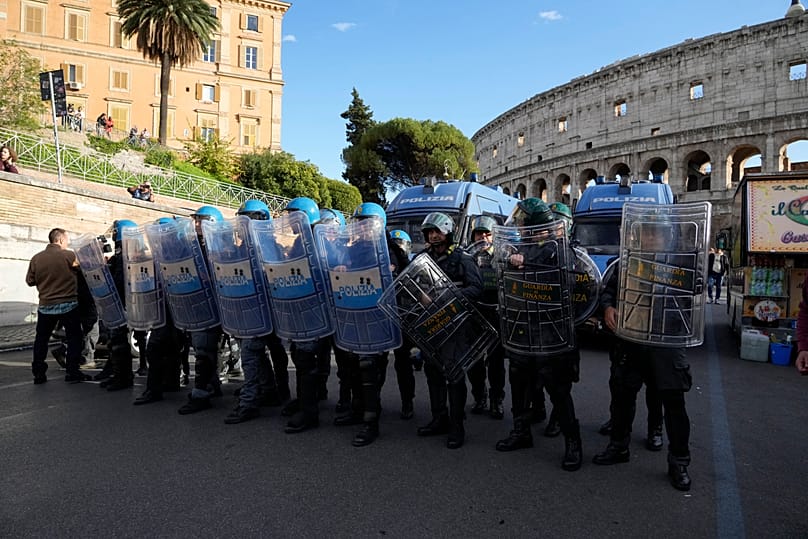


Italian anti-riot police watch antiwar activists demonstrating against rearmament and Italy's involvement in wars in Rome, Saturday, Oct. 24, 2026, Copyright 2026 The Associated Press. All rights reserved


Italian police said in a statement they had carried out nine arrests and briefly detained 371 people during protests in eight cities on Saturday. Of the people who were detained and taken to police stations, 110 were minors, the statement added.
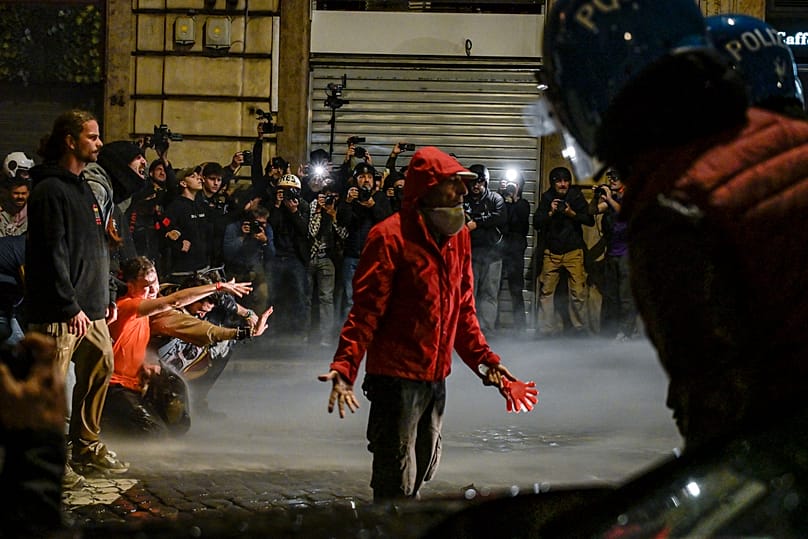
People attend a protest in Rome, Italy, Saturday, Oct. 24, 2026. (Valentina Stefanelli/LaPresse via AP) LaPresse via AP

In Spain and Portugal, protesters marched for retirement rights and affordable housing

In Madrid the protesters' key demands include linking pension increases to actual inflation, raising the minimum pension to match the minimum wage, closing the gender pension gap and protecting the public pension system from privatisation.
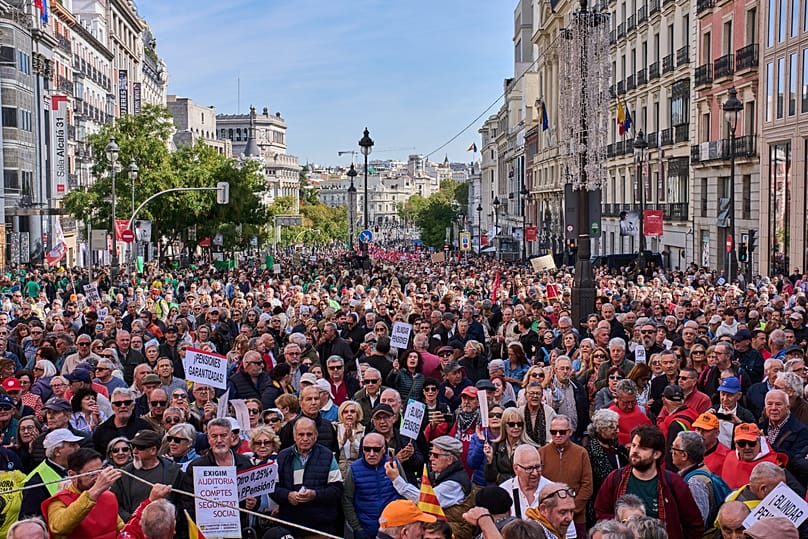
Pensioners and supporters march to defend their retirement rights in Madrid, Spain, Saturday, Oct. 24, 2026. (AP Photo/Bernat Armangue) Copyright 2025 The Associated Press. All rights reserved

In Portugal affordable housing is the main demand
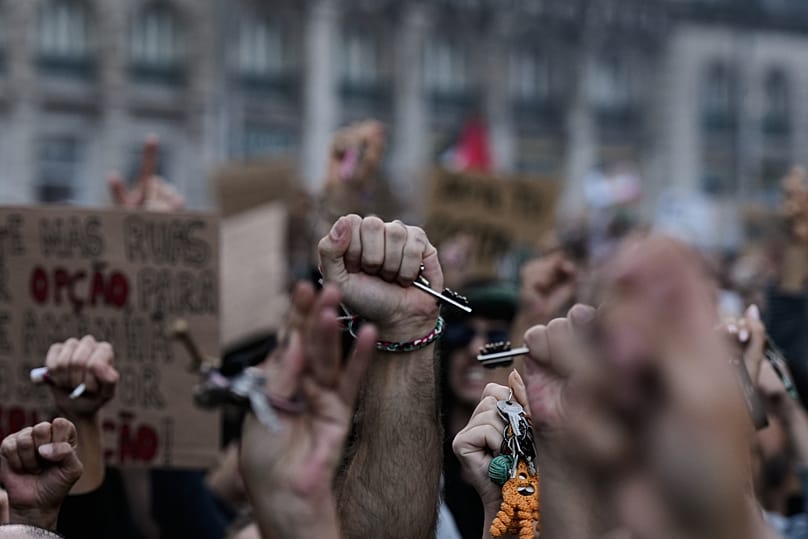
People hold keys during a protest to demand affordable housing in Lisbon, Saturday, Oct. 24, 2026. (AP Photo/Ana Brigida) Copyright 2026 The Associated Press. All rights reserved

\
French unions and protest groups call fresh rallies and nationwide strike

French unions and protest groups have called for fresh demonstrations on 31 October and a nationwide strike on 5 November, seeking to build on a movement over wages, living costs and public services after a massive police deployment helped contain unrest during Saturday’s marches.


Issued on: 26/10/2026 - RFI

Protesters hold a French flag amid clashes during demonstration organised by labour unions in Paris as part of nationwide protests called by the "Yellow Vests" movement joined by French high school and university students against the cost of living and rising fuel prices, in France, October 24, 2026. © Abdul Saboor / Reuters


Around 410,000 people took part in rallies across France, according to the Interior Ministry. Authorities deployed 70,000 police and other security personnel in an operation that helped avert a repeat of the widespread looting and vandalism seen on 17 October.

The movement, which began with student protests last month, has drawn support from a broader range of groups. Organisers hope that growing frustration will sustain pressure on the government as it holds talks with unions and student representatives.

“We see an aggregation of anger,” Murielle Guilbert, co-leader of the left-wing Solidaires trade union federation, told BFM TV on Sunday.

She said grievances among students, workers, firefighters and other groups were increasingly converging.

“We call on people to take to the streets next Saturday.”

A widening protest movement

The SUD Education teaching union said it would join the 31 October demonstration, while the CGT, one of France’s largest trade unions, said it would decide during the week whether to participate.

Labour leaders also urged support for a nationwide strike on 5 November, arguing that the discontent now extends well beyond the students who first took to the streets.

The Yellow Vests movement has called for mass rallies next Saturday, including sit-ins outside town halls and the National Assembly.

The grassroots movement emerged in 2018 in opposition to fuel taxes before developing into a wider challenge to President Emmanuel Macron over living standards and economic policy.

“There is anger in this country. It's growing in schools and universities, on roundabouts, in neighbourhoods, on farms and in workplaces,” activist Azelma Sigaux told reporters.

The references to roundabouts recall the traffic junctions that became gathering points for Yellow Vest protesters during their original campaign.

The government has opened discussions with unions and student representatives in an effort to ease tensions. Protest leaders, however, say the measures proposed so far fall short of what is needed.

“We have received no response at all from this government,” Guilbert said.

Macron has limited room to respond. During the earlier Yellow Vest crisis, he was able to offer financial concessions to address anger over household costs.

Today, strained public finances make further spending commitments harder, while his centrist camp lacks the parliamentary majority needed to pass major legislation on its own. His presidency is also approaching its end, adding to the political constraints.

Pressure on police resources

Saturday’s security operation reduced the scale of disorder, although sporadic clashes broke out in several cities, including Paris and Marseille.

The Interior Ministry said 1,314 people were arrested – around half the number recorded the previous weekend. About 50 police officers were injured, compared with more than 1,000 a week earlier, according to the ministry.

Police unions warned on Sunday that staffing levels would make it difficult to sustain such a large deployment over an extended period.

With another round of demonstrations planned for Saturday and a nationwide strike the following week, the authorities face the challenge of maintaining security while talks continue over the protesters’ demands.

Unrest has also surfaced elsewhere in Europe, although the demonstrations reflect different national grievances.

In Brussels on Saturday, Belgian police used tear gas and pepper spray during clashes with anti-government demonstrators.

In Albania, a protest movement that began peacefully at the end of May turned violent this month. Several Italian cities have also seen skirmishes for a second consecutive week.

(with newswires)
Government says protests across France 'went well' despite nearly 1,000 arrests

Hundreds of thousands marched across France on Saturday protesting the rising cost of living and a lack of government resources for essential services like schools. While demonstrations in Paris started peacefully they ended with a heavy security response, with almost 1,000 arrested across the country.


Issued on:  25/10/2026 

By: FRANCE 24

Video by: Daniel Whittington/Gavin LEE

Cover image: Protesters march during a demonstration against the rising cost of living in Paris, Saturday, October 24, 2026. © Thibault Camus, AP
12:15


Clashes broke out Saturday in Paris and other French cities amid demonstrations held a week after others that degenerated into street violence and prompted a robust security backlash as President Emmanuel Macron seeks to restore order.

Police arrested nearly 1,000 people as officers were confronted with "an extremely elevated level of violence" from black-clad "ultra-left" extremists, Interior Minister Laurent Nuñez said.

In Paris, 142 people were arrested, 120 of whom were taken into police custody, according to the local police prefecture.

Riot police squads fired tear gas at protesters in the capital as well as in Marseille, Lyon, Bordeaux, Lille, Toulouse, Montpellier and Nantes.

Two people were "seriously" injured, Nuñez said: one man in Toulouse, who reportedly had fingers blown off, and another person in Clermont-Ferrand. He did not give details of either case.

Authorities had deployed 70,000 security forces across the country for the new marches, called to protest the cost of living.

The violence came a week after rioting that saw public buildings vandalised, hundreds of shops looted and 2,700 people arrested, casting a pall over a country that goes to the polls in six months to choose a successor to Macron after 10 years.

Nuñez said Saturday's outcome was more "positive" than a week ago, with more police on the streets acting more rapidly, conducting more pre-demonstration checks and better protecting businesses.

There was nevertheless widespread anger at the government over a protest crackdown viewed as an assault on the right to protest.
Police battle 'rioters'

Saturday's demonstrations drew between 410,000 and 800,000 people across the country, according to differing estimates from the authorities and the organising CGT union.

The main Paris march had between 110,000 attendees, according to the interior ministry, and 250,000, according to organisers.


Paris: Protest starts at Porte d'Italie, after last-minute change to the route
Cover image: © France 24
01:52


Macron's government has ordered police to prevent protesters reaching city centres, where shops are concentrated, and in Paris and some other cities, partial curfews were imposed in certain urban zones. The French president had ordered non-union demonstrations be banned as "illegitimate".

In Paris, where many shops had boarded up windows to prevent looting, and the Louvre and the Musee d'Orsay museums shut for the day, the main demonstration passed off largely peacefully.

READ MOREFrance to deploy 70,000 police officers as students call for fresh protests Saturday

The march had been pushed to the capital's southeast rim under a last-minute order by authorities.

Afterwards, though, clashes broke out as the crowd was dispersing. Nuñez said the confrontations lasted two hours and involved "500 rioters" at the back of the march.


Protests continue while police fire tear gas at demonstrators
Cover image: © France 24
04:13


AFP journalists saw police charge several times and vigorously use tear gas and batons against some, mostly young, protesters.

"The police started moving towards everyone, telling them to get down and back off. They were just taking people down, you know, beating protesters," one demonstrator bleeding from a baton blow to his face, who gave his first name as David, told AFP.
Ultra-right vs ultra-left

In the western city of Nantes, thousands of protesters broke through lines of police firing tear gas and a water cannon to reach the city centre, an AFP journalist there witnessed.

Emma, 23, marching in the northwest city of Rennes, said she was angry at "everything happening at the moment", denouncing the bans on demonstrations and the "repression" of the high school student protests.

Marching in the rain at the head of the protest in the northern city of Lille, 47-year-old Delphine insisted: "Neither the president, nor the weather will stop me from demonstrating."

In Lyon, police used tear gas to disperse around 1,000 people gathered in the south of the city.

"If they prohibit protests then that means we are heading more and more towards a regime that is fascist, that is dictatorial," said one 20-year-old protester in Lyon, who gave only his first name, Silem.

In the southern cities of Cannes and Montpellier, far-right activists came out onto the streets seeking confrontations with "ultra-left militants", in what authorities said was an unprecedented development.

There was looting on the sidelines of the marches in Marseille and Grenoble, said police.

Meanwhile, the Yellow Vests, who staged disruptive protests against Macron eight years ago, called for more demonstrations on October 31 for "the freedom to protest".

Far-left presidential candidate Jean-Luc Mélenchon, who marched in the Paris rally, said Macron "is going to understand that this is going to repeat itself every week".
Protest against Le Pen's party

Tensions were heightened by a rally in the city of Orleans by far-right leader Marine Le Pen's National Rally party to kick off her campaign for the presidential election.

Thousands of counter-protesters chanting anti-fascist slogans marched in the city. Police put their number at 13,000 while organisers said twice as many participated.

The unrest across France highlighted the febrile political atmosphere ahead of the vote, in which Le Pen leads in surveys.

Inflation in France, particularly affecting the cost of fuel, has surged since the start of the Middle East war in February.

Protests have also been taking place in Italy, Belgium, Spain and Portugal over different issues, yet with some overlap on inflation and education problems. Italy has mobilised 500 troops to Milan after street violence there.

(FRANCE 24 with AFP)


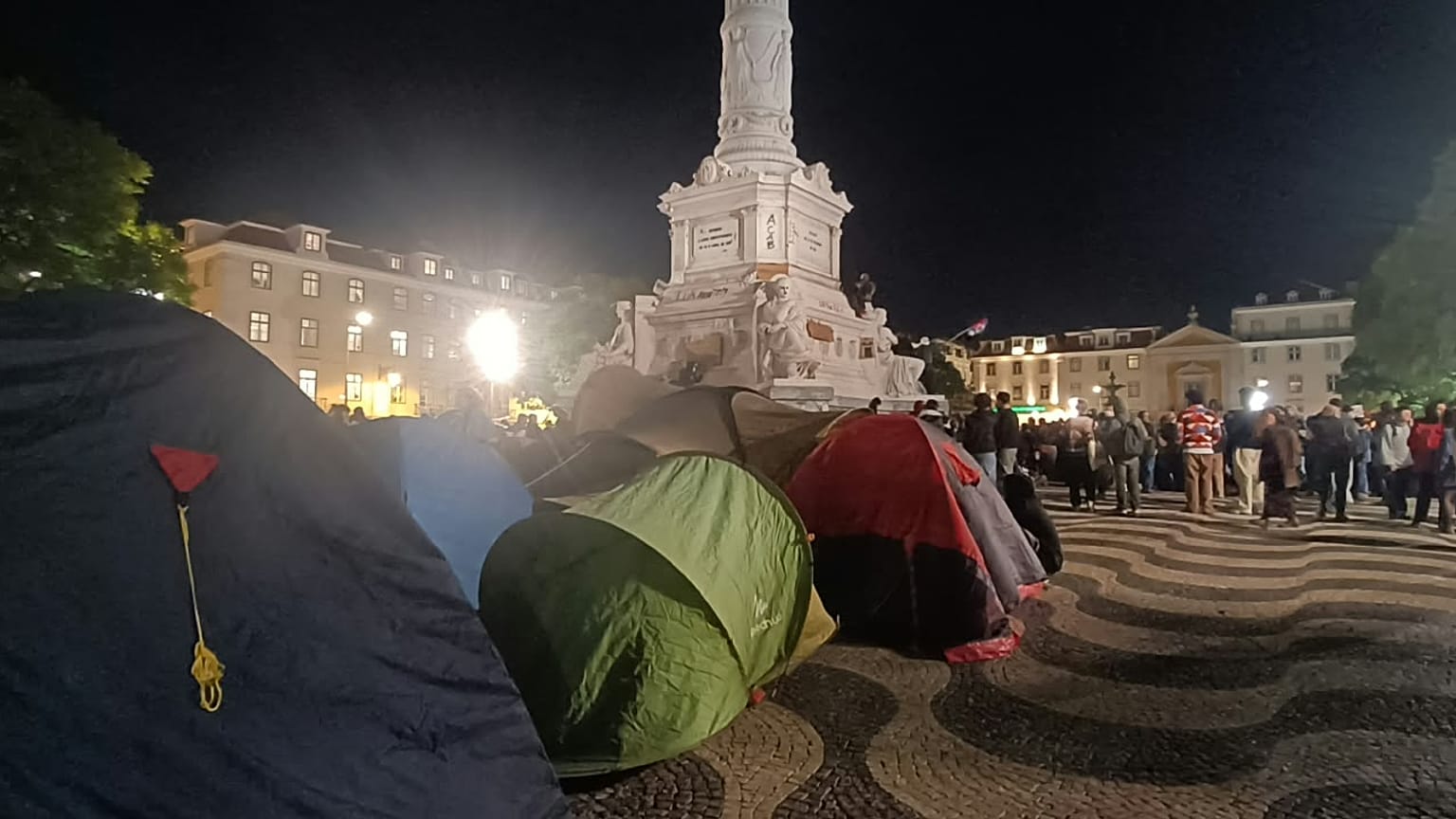
Demonstrators wounded as police break up Lisbon and Porto housing protest camps

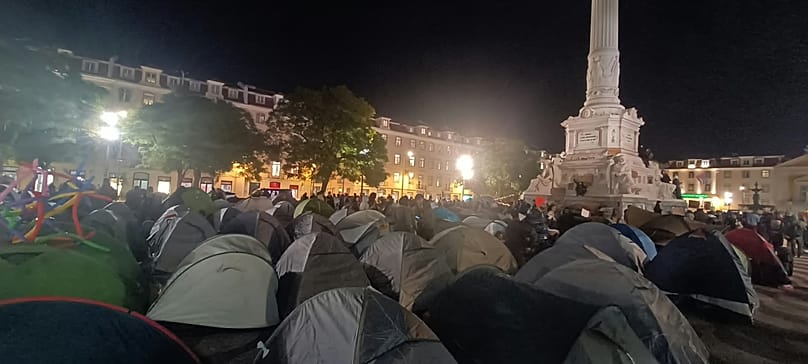
Tents at the Rossio camp in Lisbon set up after a protest against the housing crisis. 24.10.2026
Copyright Manuel Ribeiro/Euronews

By Manuel Ribeiro  & euronews
Published on


The ongoing confrontation between police and protesters demanding affordable housing turned violent overnight. Police again moved in against protest camps in Lisbon and Porto in the early hours of Sunday, with several arrests and injuries reported.

Protesters chanted "smells like a dictatorship" overnight into Sunday as police hit desmonstrators with batons in both the capital Lisbon and and the city of Porto, in an operation to dismantle tents set up to protest against skyrocketing housing prices.

In a message posted on X, the police said officers had "intervened early this morning... to put an end to these illegal encampments".

"Once dialogue ended, the operation led to 31 arrests for disobedience," the police added.

A spokeswoman for the protest camp in Porto told the Portuguese news agency Lusa there were 37 minor injuries and two arrests.

"It is the third night in which we are being repressed with a method of total intimidation that one would never expect in a democratic country governed by the rule of law," said Catarina dos Santos, speaking to reporters.

The Public Security Police (PSP) had warned earlier in the afternoon that it would not allow tents to remain overnight in Rossio.

Protest camps in main public squares a point of friction for weeks

The presence of tents in Rossio Square and Praça D. João I (in Porto) have been the main points of friction with the police during the past weeks of protest. As night fell, the demonstrators decided by majority to put up tents and stay overnight.

Around 130 tents were erected in Rossio Square in Lisbon.

130 tents erected in Rossio Square, Lisbon.
130 tents erected in Rossio Square, Lisbon. Manuel Ribeiro/Euronews

The operation to remove the tents began at around 1 am in both cities, after protesters started to notice what they called "disproportionate" police reinforcement, with canine units gathering in the squares in both locations.

"There were at least 20 crowd-control dogs, clearly agitated, and and a number of weapons pointed at us, and if this is not intimidating and serious, I don't know what is," lamented Catarina Santos, quoted by Lusa.

Shortly before 2 am on Sunday, the police contingent had both squares cordoned off and began moving in against the demonstrators, who had formed a human chain. Police used batons, while firecrackers were heard causing considerable confusion. In Praça D. João I, bystanders criticised the PSP's conduct and began to sing "Grândola Vila Morena", a song associated with the revolution of the 25 April that ended decades of dictatorship in 1974.

The "clean-up" operation in the squares was swift: the tents were removed immediately by the authorities and the protesters, who say they will return, dispersed to nearby squares.

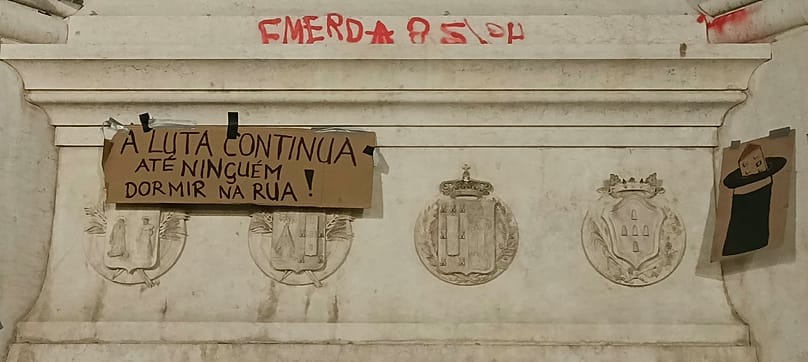
A banner placed on the statue of D. Pedro IV, in Rossio Square, reads, in Portuguese, 'The fight goes on until nobody sleeps on the streets'. Lisbon, 24.10.2026
A banner placed on the statue of D. Pedro IV, in Rossio Square, reads, in Portuguese, 'The fight goes on until nobody sleeps on the streets'. Lisbon, 24.10.2026 Manuel Ribeiro/Euronews

Protesters demand changes in new tenancy law and a cap on rents

The Lisbon and Porto camp movements are calling for measures such as the reversal of the tenancy law, an end to evictions of people with no housing alternative, limits on the purchase of property by real-estate funds, the rehabilitation of vacant buildings and a ceiling on rents.

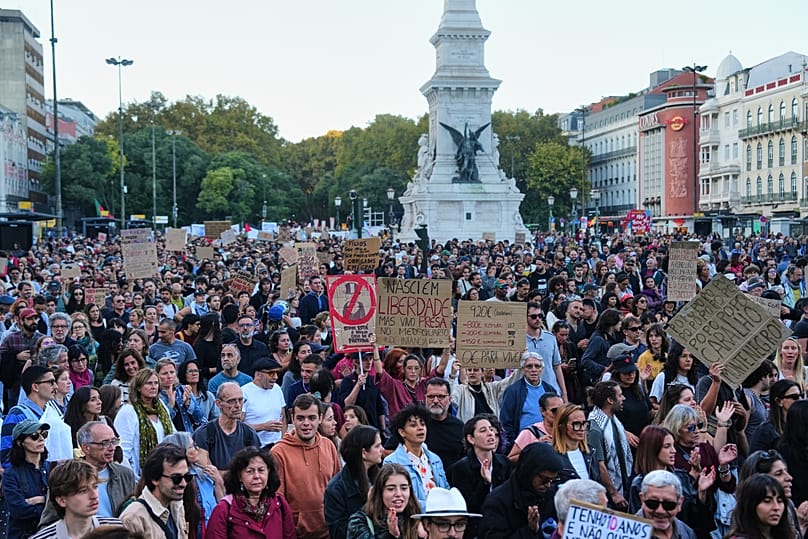
People march during a protest to demand affordable housing in Lisbon, Portugal, Saturday, Oct. 24, 2026. (AP Photo/Ana Brigida)
People march during a protest to demand affordable housing in Lisbon, Portugal, Saturday, Oct. 24, 2026. (AP Photo/Ana Brigida) Copyright 2026 The Associated Press. All rights reserved

Large crowds had turned out the previous day for peaceful demonstrations, accusing the government of failing to act to tackle Portugal's housing crisis


2.92 metres: German angler lands giant catfish from Polish reservoir

Oliver Schäfer and Kevin Cremers have caught a catfish measuring almost three metres in length.
Copyright anglerphoto // kevin_cremers27 // instagram


By Maja Kunert
Published on

Oliver Schäfer from the Eifel, together with his fishing partner, landed a 2.92‑metre catfish during a tournament in Poland. The fish is already well known among anglers.

In the moment when Oliver Schäfer from North Rhine-Westphalia feels the weight at the other end of his line, he quickly realises: this is no ordinary fish. The 34-year-old is competing in a predator fishing tournament in the Polish city of Rybnik, together with his Dutch fishing partner Kevin Cremers.

On 10 and 11 October, according to the newspaper BILD, 70 teams with around 150 anglers from all over Europe took part. Schäfer and Cremers had travelled there specifically for the event. They were using a special rod designed for large catfish and a soft-plastic lure, as Schäfer told the paper.

He only grasped how enormous his opponent was when the fish broke the surface for the first time. The struggle lasted more than 30 minutes. Cremers kept the boat on course against the wind, while Schäfer held on and fought the fish.

Measured and released again

On the shore, the tournament jury measured the animal: 292 centimetres. After that, the catfish was returned to the lake, as required by the tournament rules. Schäfer told BILD that the fish are carried to land on a tarpaulin so that their protective slime layer is not damaged.

The catch was not enough to secure overall victory. What counted was the total number of points. According to the Berliner Zeitung and the results list of the PZW Katowice angling association, the pair finished second with 28,930 points.

The same fish as last year?

The catfish already has a story. Media reports say participants assume it is the same animal that was landed at the tournament in October 2025. The Polish anglers Krzysztof Pyra and Adrian Gontarz also measured 292 centimetres back then. The Berliner Zeitung reports that the fish has not grown any longer since, but has become noticeably more robust.

The world body IGFA records catfish records by weight; there is no official list based on length. In 2023, according to Welt, Italian angler Alessandro Biancardi pulled a 2.85-metre catfish out of the River Po. Within the angling community, the Polish city of Rybnik in the Silesian Voivodeship is therefore regarded as the place where the longest known catfish has been caught.

Schäfer’s dream of a three-metre catfish is still alive even after this success, he told BILD – he says he is now just a hand’s breadth short.

Europe’s largest freshwater fish

According to Germany’s Federal Agency for Nature Conservation, the European catfish is the largest native freshwater fish on the continent. It can grow up to three metres in length and reach a weight of 150 kilograms. Striking features include its scaleless body, broad head and six barbels, which it uses to find its way in murky waters.

Its diet consists mainly of other fish; larger specimens occasionally prey on small water birds or mammals. For 2026, the national angling association, the Federal Agency for Nature Conservation and the Society for Ichthyology have chosen the catfish as Fish of the Year.

Benefiting from warming

Originally, the catfish was native mainly to the Danube and Rhine catchment areas. Stocking programmes dating back to the 19th century and waterways such as the Main-Danube Canal have since opened up many more habitats for the species, the agency says.

On top of that, the climate is helping it. As a warmth-loving species, the catfish benefits from rising water temperatures. Biologist Jürgen Geist told the magazine Focus that populations are increasing markedly, both in terms of their range and their density. Cold-loving species such as brown trout, on the other hand, are among the losers.

Warm water is also a key factor in Rybnik. The reservoir there serves as a cooling pond for a coal-fired power plant, and the heated water flows back into the lake. Because fish feed more actively at higher temperatures, catfish, carp and zander grow faster in these conditions, according to angler Oliver Schäfer.

Experts say the animals pose hardly any danger to humans. They have only small, rasp-like teeth, and outside the spawning season there is virtually no risk. In June 2025, a catfish around two metres long in the Brombachsee reservoir in Middle Franconia bit several swimmers and caused minor injuries.


London mayor hails new era as Oxford Street goes traffic-free

26.10.2026, DPA

Photo: James Manning/PA Wire/dpa

London Mayor Sadiq Khan has hailed the pedestrianization of Oxford Street as "a truly momentous occasion for the capital."

From Monday, almost a kilometre of the busy central London shopping street, between Orchard Street and Great Portland Street, will be traffic-free with vehicles being diverted onto nearby roads.

Oxford Street, which produces an annual spend of around £3.1 billion ($4.1 billion), is one of the world's busiest shopping areas, with around half a million visitors each day and the overhaul comes in time for the run-up to Christmas.

Buses, taxis, private hire vehicles, private motorized vehicles, cycles, scooters and pedicabs can no longer enter while deliveries can be made from midnight to 7 am.

Emergency services will have access to the street at all times.

The area has become increasingly popular as an office location thanks to the Elizabeth line and Khan believes the scheme will help revitalize the site, boost economic growth and attract visitors.

Describing it as "a new vibrant destination", he said: "I'm hugely excited to see my bold vision for Oxford Street coming to life from today. It is a truly momentous occasion for the capital."

He added: "For centuries, Oxford Street has reinvented itself, adapting to changing times and helping shape British culture along the way.

"There has been talk of pedestrianizing Oxford Street for decades. After so many false dawns, and now working with a government who share the scale of my ambition, I'm proud that we're finally unlocking a new era for the street."

He hopes the changes will open up the chance to bring new experiences to the street, from sport to fashion and cultural events.

He said: "Revitalizing Oxford Street will boost jobs and economic growth in the capital, unlock the full potential of this key part of the West End and help build a better, greener and more prosperous London for everyone."

The move marks the first phase of a pedestrianization and wider regeneration project aimed at putting Oxford Street among top global shopping destinations including Times Square, the Champs-Élysées and La Rambla.

Critics have said the scheme is too rushed and fears have been raised about diverted traffic increasing congestion.

New bus stops are sited along Wigmore Street, Henrietta Place and Cavendish Place approximately 200 metres from the traffic-free area.

The deputy leader of Westminster City Council believes Lord Khan is "rushing preparations."

Councillor Tim Barnes has previously said: "If this is going to be the 'greener, better and more prosperous' success that the mayor has promised, then issues around access, air pollution, street cleaning and public safety need answers urgently.

"Right now there's a danger that we will have all of the downsides and too little upside.

"Traffic will be pushed to the small streets nearby causing economic and environmental harm."

The scheme has the backing of businesses including John Lewis and Selfridges, who both described it as "exciting", along with Under Armour and Grosvenor Property plus organizations such as UK Hospitality and the New West End Company.

Minimal construction will take place in the immediate weeks to reduce disruption in the busy Christmas period.

By the end of spring 2027, visitors to Oxford Street should see more than 50 new trees, two new public squares and better signage.

More than 100 new seats, dining tables and new lighting are also to be installed.


UK's Burnham rules out rejoining EU within this parliamentary term

26.10.2026, DPA

Photo: Temilade Adelaja/PA Wire/dpa

British Prime Minister Andy Burnham has ruled out the prospect of Britain rejoining the EU within this parliamentary term.

Burnham said he would not “move ahead of the public” but that he wanted to see the UK return to the bloc within his lifetime and would work to secure a better deal with Brussels.

He insisted a general election would not be called “any time soon” amid speculation he could go to the country early to secure a mandate of his own and put proposals to rejoin to voters following a bounce in Labour’s poll ratings.

Asked about Brexit on ITV’s Good Morning Britain, Burnham said: “I don’t think things have worked out as people said they would at the time, particularly when it comes to immigration.

“I think we’ve got weaker control now. The reason the small boats crisis has arisen is because we can’t return people, and people know we can’t do that in the same way that we used to be able to do.”

But he added: “I’m not proposing any changes in this Parliament. I’m not going to move away from the red lines that were in the Labour manifesto.

“I am respecting what I said to the voters in Makerfield, but I’m not going to say this morning, sitting here, that the deal we’ve got at the moment is good enough for Britain. I don’t think it is good enough for Britain.

“I think we can make it better and I’m going to lead a discussion about how do we make it better in a way that people can support.”

Burnham rules out UK return to EU free movement without referendum

26.10.2026, DPA


By Helen Corbett and Nina Lloyd, Press Association Political Staff

British Prime Minister Andy Burnham has said he would not return the UK to EU freedom of movement rules without a referendum, after ruling out the prospect of Britain rejoining the bloc within this parliamentary term.

It comes after his call at the weekend for an "honest discussion" about a return to freedom of movement fuelled questions about the parameters around his vision for a deepening relationship with Brussels.

The prime minister was asked on Monday morning if he would allow the UK to join the EU freedom of movement scheme without a referendum.

He said: "No, I mean I wasn't saying that yesterday. I was asked about how things have changed in the 10 years since Brexit, and the truth of the matter is we've lost immigration control in the way that we once had.

"For instance, the small boats crisis has arisen in the last 10 years because we lost that returns agreement when people came here that we could work with other countries to return them.

"And when it comes to immigration more broadly, we're seeing a situation where people are coming here to settle permanently in a way that we had more revolving door migration in the EU."

Burnham said the UK needed to "have an honest discussion about that and take steps back to get a more functional relationship again" ahead of a summit with the bloc in November.

"I want to use that opportunity to get a practical deal in place to support our farmers, our food manufacturers, but also to increase collaboration on immigration because we lost that and we need to get it back.

"So I'm talking about practical steps to deal with the things that matter to people, and I will never move ahead of the British public when it comes to Brexit."

The prime minister had earlier ruled out the possibility of rejoining the EU within this parliamentary term, signalling however that he could fight the next general election on a promise to take the UK back into the bloc.

He told ITV: "I'm not proposing any changes in this parliament. I'm not going to move away from the red lines that were in the Labour manifesto."

Asked when the public could expect to see a manifesto proposing a return to the EU, Burnham ruled out an early general election but left the door open to fighting the next vote on a promise to rejoin.

"No time soon, if at all, it's not. It's not about that. My mind isn't on that. I don't know if that is coming over here, but it genuinely is not on that. There is no election coming anytime soon," he said.

Burnham will meet EU chiefs including European Commission President Ursula von der Leyen for a key summit in Brussels on November 20 as he seeks to strike a better deal with the bloc.

The prime minister wants to consider various longer-term options for a new relationship with Brussels, potentially including a return to full EU membership or joining the single market - which would require free movement.

Burnham told the Sunday Times he wanted to have a "very factual, quite evidence-based debate about this" as he acknowledged freedom of movement "had very significant challenges associated with it."

He said he could not imagine recommending joining the Schengen borderless area or ditching the pound to adopt the euro.


From whales to elephants: Can wild animals really grieve?

26.10.2026, DPA

Photo: Carola Frentzen/dpa

A female humpback whale refuses to leave her dead calf, remaining close for hours. Similar behaviour has been observed in elephants, chimpanzees and orcas. But are these animals really grieving?

By Carola Frentzen, dpa

The sea off Australia's Gold Coast is remarkably calm on a winter morning.

Two humpback whales move through the shallow waters near Palm Beach Reef, but one repeatedly returns to the same spot on the seabed.

The young female dives down again and again, touching the calf with her head and pectoral fin. At one point, she lies beside it, eye to eye. She remains close for almost two hours as another adult whale swims nearby. Vocalizations can also be heard.

Marine biologist Olaf Meynecke of Griffith University says this is the first detailed documented case of such behaviour in the species. Meynecke analysed the observation together with whale rescuer Andrew Mulville and wrote a study on it.

"For me, her search for physical contact and her attempt at eye contact with the dead calf were surprising, but so was the duration of the behaviour - over hours and presumably days," Meynecke says.

He and Mulville reported that the female did not try to bring the dead calf to the surface. Normally, mothers help their newborn calves take their first breath this way.

"We have two theories," Meynecke says. "It may be that the mother was unable to bring the calf to the surface, but that seems unlikely because we could not document any attempt to do so. Or maybe she was aware that it was no longer alive."

Tahlequah's journey of grief

The behaviour is reminiscent of that seen in other mammals, with orcas offering one of the most striking examples.

In 2018, the female Tahlequah carried her dead calf on her snout and forehead for 17 days off the coast of North America, covering more than 1,500 kilometres.

Again and again, she lifted the body out of the water when it threatened to sink.

Scientists spoke of a "tour of grief" - a journey of mourning. Pilot whales and dolphins have also been observed carrying dead young for long periods. Evidence of similar behaviour in humpback whales, however, remains much more limited.

"From personal experience, I am very certain that other species, and mammals in general, perceive the loss of a fellow member of their species, and this leads to behaviours that can be described as grief or depression," Meynecke says.

He says the feelings were presumably different from those of humans, but the effects were often similar, such as refusing food.

Chimpanzee Flint died of a broken heart

The story of young chimpanzee Flint is particularly dramatic. When his mother Flo died in Tanzania's Gombe National Park, the then eight-year-old son increasingly isolated himself.

The world-famous primatologist Jane Goodall watched Flint repeatedly go to his dead mother. Then he stopped eating, and a few weeks later he was dead himself. Goodall later said Flint had died of a broken heart.

Chimpanzee mothers, conversely, also seem to find it hard to part from their dead young. Some carry the lifeless bodies for days, sometimes weeks or months.

What about pets? In a study from Australia and New Zealand involving 159 dogs and 152 cats, owners reported, among other things, changes in eating behaviour when a companion died.

Among dogs, 35% ate less and 31% ate more slowly. Cats also showed changes, with many meowing more often and more loudly. Both species sought out the favourite places of the dead companion.

Elephants "bury" their dead

Elephants gather around carcasses, touch, sniff and guard them, and repeatedly return to the dead. They have also been observed trying to support dying animals or carry dead calves away.

Sometimes they cover deceased companions with soil or plants. Whether this truly corresponds to the human idea of burial, however, no one knows for certain.

A striking case occurred in Kenya in 2013. When the 55-year-old elephant cow Victoria died, her family did not leave the matriarch's side. Victoria's 10-year-old daughter Noor stayed with her for a long time, and her 13-year-old son Malasso nudged the mother with his tusks, probably in an attempt to get her back on her feet.

Weeks later, researcher Shifra Goldenberg observed an even more surprising scene: elephants from other families were still visiting Victoria's remains.

What drives such behaviour? For now, science has no clear answer. Perhaps it is not a farewell in the way humans understand it.

Yet if grief means being unable to simply let go of a companion who has died, then many animals may come surprisingly close to what we call mourning.


The Individual In Relation To Self And The World: Conscience As The Foundation Of Personality In The Work Of Ibush Reçica – Book Review

October 25, 2026

By Ernesto Kahan


Ibush Reçica’s Thoughts on Human Traits and World, translated into English by Avni Spahiu, represents an extensive effort to understand human beings through their qualities, feelings, actions, and relationships. At the heart of the work lies the question of how to develop a stable, conscientious personality that contributes to the community. The author explores this question through brief reflections, advice, and moral judgments. The book thus becomes a space for reflection in which lived experience meets the search for meaning, and self-knowledge becomes a prerequisite for a more ethical relationship with the world.

In the foreword, Reçica explains that these reflections were recorded over twenty-five years and that the work continues the concerns of his earlier book, Our Personality. This information helps clarify the nature of the collection: it emerges from sustained observation, an engagement with human behavior, and a desire to give experience an enduring expression. Its central concern is the weakening of moral values in an increasingly fast-paced society. In response, the author proposes education, reasoning, and responsibility as ways of preserving human dignity and directing life toward collective well-being.

Photo credit: Prof. Dr. Acad. Jeton Kelmendi, private collection (2026). World poetry and culture Summit in Kosovo, September 2026.

The book’s structure, organized into two chapters and one hundred and forty topics, demonstrates its ambition to examine human life from numerous perspectives. The first chapter encompasses traits, values, actions, and social factors, while the second focuses on feelings and the characteristics associated with them. Family, work, time, politics, health, and science appear alongside love, fear, conscience, freedom, and hope. This thematic proximity suggests that human beings cannot be understood by separating their inner lives from their external circumstances. Personality develops precisely through the continuing interaction between individual experience, education, and relationships with others. The work’s central intellectual concern is the relationship between reason and emotion.


Reçica emphasizes that knowledge, judgment, and emotional life must work together in shaping behavior. Unregulated emotion may lead individuals to react impulsively, whereas reasoning should help them recognize the consequences of their actions. In the section devoted to intense emotional states, attention centers on the loss of self-control and the danger of irreversible harm. The advice to pause before reacting contains practical wisdom: even a brief period of reflection can change the course of a conflict. Maturity, in this sense, is the ability to regulate emotion responsibly. Conscience forms the ethical core of the book. It is presented as the capacity to examine one’s actions, acknowledge mistakes, and respect the dignity of others. Particularly significant is the view that punishment should aim to reform the wrongdoer rather than satisfy the desires of the person administering it. Here, reflection moves from individual advice to an important social principle. Judges, teachers, and all those in positions of authority bear responsibility for the consequences of their decisions. Conscience therefore requires justice, prudence, and courage: it must remain active even when the right decision is difficult or conflicts with personal interests.

Another important dimension is education as a lifelong process. In keeping with the spirit of the foreword, individuals must reassess their knowledge and attitudes, correcting whatever new experience reveals to be inadequate. Personality is understood as an open formation, capable of change. This conception gives the book a pedagogical orientation: readers are invited to work on themselves, develop understanding, and learn from their mistakes. Self-knowledge becomes an ongoing practice that helps them recognize weaknesses, improve their responses, and establish healthier relationships.


Work and ambition are discussed in close connection with dignity. The author values activity that produces benefits, develops abilities, and helps others. At the same time, he insists that personal aspirations must not compromise modesty, justice, or respect for nature. In his reflections on ambition, success is also judged by the means through which it has been achieved. A victory founded on harming others loses its moral legitimacy. The relationship between employer and employee is likewise examined through honesty, mutual agreement, and fair remuneration. Ethics thus emerges in concrete situations in which keeping one’s word and recognizing the value of effort have direct importance.

Human relationships occupy a substantial place in this landscape of reflections. Family, besa—the solemn commitment to honor one’s word—friendship, courtesy, and compassion are treated as conditions of coexistence. In particular, besaconnects trust with responsibility for a promise. A promise kept creates security, while its violation damages both relationships and character. In his reflections on friendship, the author also acknowledges human imperfection: seeking a friend without weaknesses jeopardizes the durability of friendship itself. This observation brings the work closer to lived experience, in which closeness requires understanding and relationships are tested especially in adversity. A person’s worth becomes apparent in the willingness to help when no personal benefit is involved.

From private life, the book moves toward politics, power, conflict, and war. This widening of its scope shows that moral responsibility extends beyond the individual. Political decisions affect people’s lives and security and therefore require particular ethical scrutiny. In discussing war, Reçica distinguishes the interests of those who instigate it from the sacrifices of those who endure its violence. He also recognizes the legitimacy of defending freedom and dignity against aggression. This perspective combines a concern for peace with an acknowledgment of the need for resistance. Actions are evaluated in relation to their purpose, circumstances, and human consequences.


The aphoristic form is one of the work’s most distinctive features. Its brief reflections seek clarity, are easily remembered, and can be read independently. They are often constructed through contrasts between wisdom and ignorance, honesty and deception, restraint and haste. Quotations from various authors also appear at the end of the thematic sections, placing personal reflection within a broader tradition of wisdom.

The book consequently lends itself to slow, selective reading. Readers may pause over a thought, compare it with their own experience, and return to it later with a different understanding. Nevertheless, a critical reading requires a distinction between ethical observations and assertions that take on a psychological or scientific character. Some formulations are categorical and connect moral qualities with psychological conditions too directly. The complexity of human behavior calls for caution when approaching such explanations. The repetition of advice can also, at times, weaken the force of the argument. These limitations arise partly from the aphoristic form itself, which condenses a conclusion while omitting the full reasoning behind it. The work is therefore most fruitfully read as moral reflection and distilled experience, with its generalizations examined in the light of concrete circumstances and relevant knowledge.

The book’s significance lies in its insistence on making individuals accountable to themselves and to their communities. Reçica understands a dignified life as a union of knowledge, feeling, work, and conscience. He maintains that courtesy must have inward roots, that success must preserve humanity, and that authority must be accompanied by justice. Across its many themes, this is the thread that holds the work together. Readers are invited to examine how they live, make promises, judge, and act. In this daily practice of self-knowledge, the book finds its most enduring purpose: cultivating a personality capable of establishing responsible relationships with the world.

Finally, I can say with deep conviction that this author is truly distinctive, for he engages in one of the most profound forms of inquiry into the human condition: the exploration of the inner life and the ways in which it finds expression in human thought and behavior.


About Ernesto Kahan
Ernesto Kahan, Professor Emeritus at Tel Aviv University’s Faculty of Medicine, is an Argentine-Israeli physician, epidemiologist, and poet. Former Director General of Argentina’s Ministry of Health and Vice-President of International Physicians for the Prevention of Nuclear War (Nobel Peace Prize 1985), he has published widely on public health and literature.
View all posts by Ernesto Kahan →