Monday, October 26, 2026


Germany Launches Cleanup to Remove Dumped Munitions From WWI and WWII
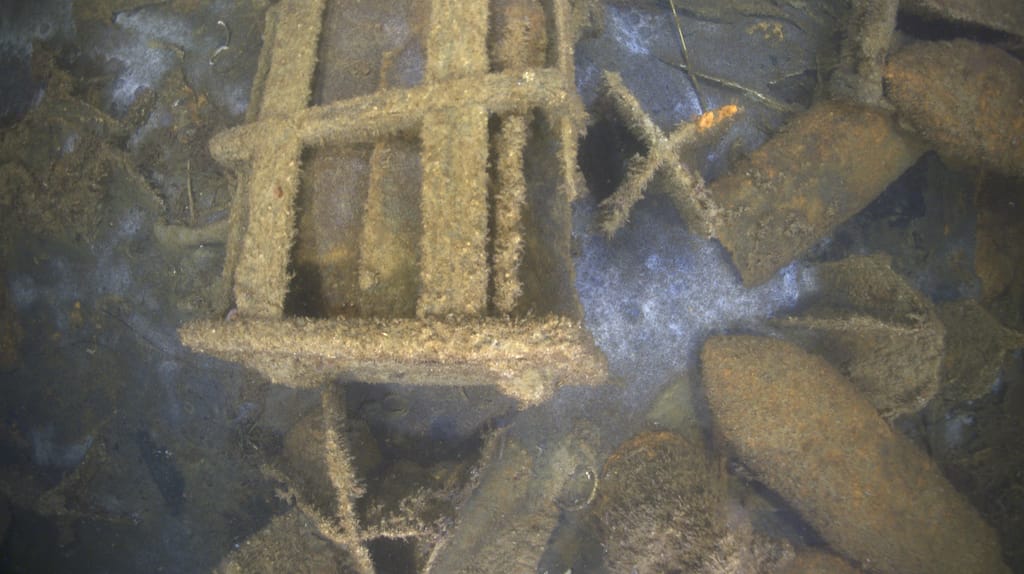
Munitions on the seabed just off Lubeck, Germany (GEOMAR)

Germany has embarked on an immediate project to recover tons of munitions that were scattered on the floor of the North and Baltic seas at the end of World Wars I and II. The discarded bombs and shells are becoming a threat to the marine environment due to the release of toxic chemicals.

More than 1.5 million tons of ordnance were intentionally dumped in German waters at the end of WWII, with around 300,000 tons of unexploded ordnance lying in the German Baltic Sea and the rest in the German North Sea.

A study by the GEOMAR Helmholtz Centre for Ocean Research Kiel last year found that the ordnance was increasingly becoming a risk to the marine environment owing to corrosion and the release of toxic chemicals. Ammunition-related chemicals were detected in water samples collected from the Baltic Sea, with concentrations in some samples approaching critical toxicological thresholds. (The concentrations in most samples were well below all relevant limits for health and safety, including drinking water limits.)

As corrosion progresses, contamination is expected to increase, raising the risk to the environment. The threat is exacerbated by rising temperatures and increased storm activity due to climate change, which further accelerate the release of chemicals.

Following a push for the dumped ordnance to be classified as “historical contaminants of emerging concern,” the German federal government has launched a project to remove the munitions. As an immediate task, the government has contracted for the construction and operation of a platform that will be used to remove dumped ordnance.

As part of the project, the research vessel Heincke has also been deployed on a two-week expedition to visit several dumping sites in the German Bight to map hidden munitions under the sand and prepare a pilot recovery operation. The research team aboard the 55-meter vessel, which is operated by the Alfred Wegener Institute (AWI), will also investigate how chemicals released by the munitions are affecting marine life by sampling water and sediments around wrecks lying on the seabed, most of which have been mapped and documented.

During the expedition, the team intends to survey the wreck of SMS Mainz, a German World War I light cruiser that sank in the North Sea in August 1914 during the Battle of Heligoland Bight and is among the wrecks that have already been the subject of research. The team will also visit the wreck of the battle cruiser Blücher. For both wrecks, the researchers will analyze their condition, and specifically the threat their munitions pose to the marine environment.

“After over 100 years on the sea floor, there is a heightened risk that the wrecks will collapse. That is why it’s important to monitor their condition. In addition, with increasing corrosion, toxic and carcinogenic explosives are released from the remaining munitions. These pollutants pose a threat to marine life, food safety and human health,” said Matthias Brenner, leader of the REMARCO project.

As part of a further project dubbed CONMAR, Heincke will subsequently be deployed to seven munitions dumping sites in the German Bight. Previous research has shown that the munitions lie beneath the sand and can be mapped using magnetometry.

Scientists contend that Germany’s munitions clearance operations could serve as a model for the removal of such hazardous waste around the world.

 

Borr Drilling Jackup Loses Stability and Sinks off Gabon

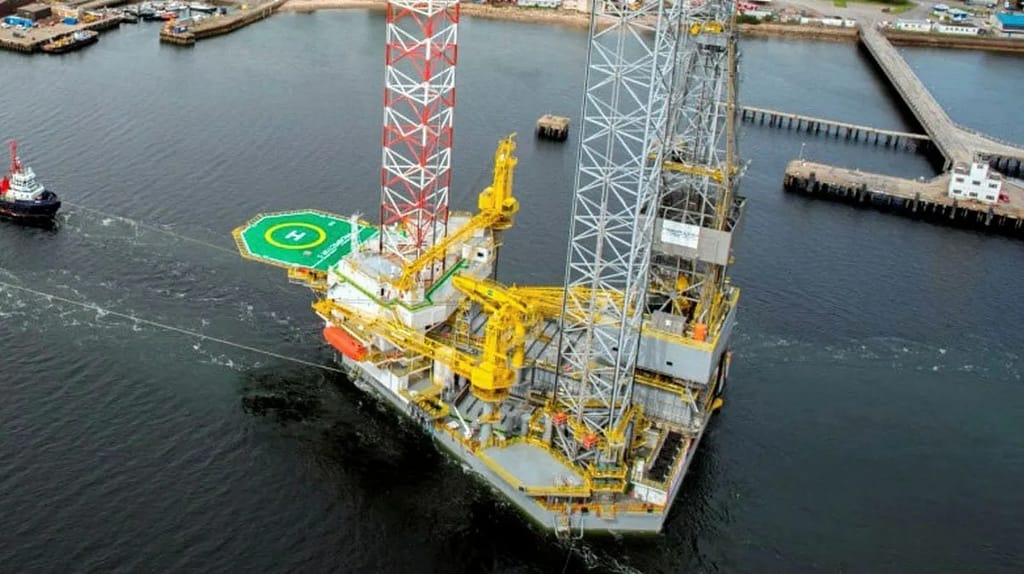
Prospector 5 (file image courtesy Borr Drilling)

[Breaking] On Saturday night, a jackup rig operated by Borr Drilling sank off the coast of Gabon, leaving one dead and four people missing. 

According to Borr, the rig Prospector 5 was conducting pre-loading of its jackup legs when it suffered a punch-through - an accident in which the spudcan on the bottom of a leg suddenly penetrates the sediment, sinks into the mud and throws the rig into a list. The incident was severe enough that the rig lost stability and sank. 

110 people were rescued, one has been found dead and four remain missing. 

E&P leaseholder BW has confirmed the casualty and identified the location as its Dussafu license area off the coast of Gabon. 

"We are deeply concerned for those who remain unaccounted for and everyone affected by this incident. Our immediate priority is supportingd the ongoing search and rescue efforts and the welfare of all personnel involved," Borr Drilling CEO Bruno Morand said in a statement on Sunday. 

Punch-through events are among the most serious hazards for jackup operations. They occur without warning and severe cases can result in one leg falling several feet into the mud, creating a significant and sudden list. The biggest risks, according to training institute Pisys, occur when a stiffer layer overlays softer sediments, or when the composition of the silt isn't uniform - giving the operator the impression that the bottom has more holding power than it really does. 

Cruise Ship Damaged as It Hits Containership Departing Bremerhaven

cruise ship hitting containership
Mein Schiff 3 hitting the MSC container vessel (screen grabs from passenger videos)

The German cruise ship Mein Schiff 3 and one of MSC’s large containerships sustained significant damage as the cruise ship was attempting to depart Bremerhaven late Sunday afternoon bound for the Canary Islands on a three-week cruise. Police reports cite strong winds from a storm, and the authorities have detained the ships as part of an ongoing investigation.

According to the media reports, the Mein Schiff 3 (99,526 gross tons) had 2,428 passengers and 922 crew aboard as it was departing. The cruise ship, registered in Malta and operated by TUI Cruises, is 293 meters (961 feet) in length and was built in 2014.

The ship reportedly held off the pier in Bremerhaven after its departure at 5:10 p.m. before starting its exit from the harbor. Images show tugs alongside and a heavy swell in the harbor.

Mein Schiff 3 was passing alongside the smaller MSC feeder MSC Anne F (11,800 dwt), and a tug can be seen pushing the cruise ship away from the docked containership. It is unclear if the MSC Anne F was hit, although the police statement references “minor damage” to the 964 TEU vessel. Registered in Portugal, it had arrived in Bremerhaven on October 24 from Tangier.

Next tugs can be seen frantically working as the cruise ship approaches the larger MSC Victorine (203,855 dwt), which had been on dock since October 24. The bridge wing of the cruise ship appears to have made first contact, clipping the container stacks and then the port stern corner of the 366-meter (1,210-foot) containership. The cruise ship continued forward, with reports saying at least four lifeboats/tenders were destroyed. The cruise ship also sustained hull damage.

MSC Victorine is reported to have an approximately 10-meter-long gash in its hull above the waterline. The container guides were also deformed during the allision. 

There were no reports of injuries to the passengers or the crew aboard any of the vessels. The police also reported there was no water ingress.

The cruise ship returned to its dock, and the captain told passengers they would remain aboard overnight, inviting them to enjoy the bars and lounges. Today, TUI Cruises issued a statement reporting that technical teams had inspected Mein Schiff 3 and that the “damage discovered necessitates urgent repairs at a shipyard.” Obviously, the current cruise has been canceled, and the company is saying it will have to determine what happens for the later scheduled trips.

The police, water police department, and the port authority are investigating the circumstances. It is not yet known if the ship had a pilot aboard. Questions are also being raised about the wind strength and whether the port should have been closed.


Captain investigated after cruise liner hits two container ships

26.10.2026,

Photo: Sina Schuldt/dpa

By dpa correspondents

Following a shipping accident in the northern German port of Bremerhaven, police are investigating the captain of the TUI cruise ship Mein Schiff 3 (My Ship 3).

A police spokeswoman stated on Monday that administrative offence proceedings had been initiated against him: “Investigations are under way to determine whether he breached his duty of care.” 

The police did not initially provide any further details, such as exactly what the alleged breach of duty of care relates to. 

The news had initially been reported by broadcaster RTL.

A strong gust of wind caused the cruise ship carrying more than 3,300 passengers and crew to collide with two container vessels while leaving the port of Bremerhaven, police said, sharing new details about Sunday's accident.

Mein Schiff 3 was departing for the Canary Islands on Sunday evening when a gust of wind pushed it towards two container ships moored alongside the harbour wall, police said.

One container ship was severely damaged by the collision, while the other one sustained slight damage, according to police. The cruise ship was also severely damaged, with images showing that the ship's on-board lifeboats were crushed.

"The collision tore open the port side of the large container ship over a length of several metres and deformed the container guides," police said.

No one was injured on any of the three ships and no water entered the vessels, as the damage occurred a few metres above water level, according to police.

Mein Schiff 3 returned to the cruise ship terminal following the collision and all three vessels have been barred from leaving the port.

The police estimate the damage to property to run into millions.

The smaller container ship sustained minor damage, whilst the larger one sustained significant damage. The TUI ship was also significantly damaged.

TUI Cruises confirmed on Monday that it was cancelling the cruise in light of the crash. According to the operator, the cruise ship requires repair work at a shipyard.

According to TUI, 2,428 passengers and 922 crew members were on board the cruise ship at the time.

An eyewitness video verified by dpa shows the cruise ship leaving the port accompanied by tugboats in choppy waters.

The vessel can be seen moving increasingly close to a container ship moored alongside the harbour wall before striking it.

"I think that’s it for the trip," a woman can be heard saying in the clip.

German police: Strong wind pushed cruise liner into container ships

26.10.2026, DPA

Photo: Sina Schuldt/dpa

A strong gust of wind caused a cruise ship carrying more than 3,300 passengers and crew to collide with two container vessels while leaving the German North Sea port of Bremerhaven, police said on Monday, sharing new details about Sunday's accident.

TUI-operated Mein Schiff 3 was departing for the Canary Islands on Sunday evening when a gust of wind pushed it towards two container ships moored alongside the harbour wall, police said.

One container ship was severely damaged by the collision, while the other one sustained slight damage, according to police. The cruise ship was also severely damaged, with images showing that the ship's on-board lifeboats were crushed.

"The collision tore open the port side of the large container ship over a length of several metres and deformed the container guides," police said.

No one was injured on any of the three ships and no water entered the vessels, as the damage occurred a few metres above water level, according to police.

Mein Schiff 3 returned to the cruise ship terminal following the collision and all three vessels have been barred from leaving the port.

TUI Cruises confirmed on Monday that it was cancelling the cruise in light of the crash. According to the operator, the cruise ship requires repair work at a shipyard.

According to TUI, 2,428 passengers and 922 crew members were on board the cruise ship at the time.

An eyewitness video verified by dpa shows the cruise ship leaving the port accompanied by tugboats in choppy waters.

The vessel can be seen moving increasingly close to a container ship moored alongside the harbour wall before striking it.

"I think that’s it for the trip," a woman can be heard saying in the clip.


Invisible eland identified from 60,000-year-old ochre-rich sediment


Ancient proteins reveal hidden aspects of technical and symbolic behaviors of early humans


Kyushu University

Illustration of an eland

image: 

An eland is a large plains antelope found in East and Southern Africa

view more 

Credit: Takumi Tsutaya/Kyushu University


Fukuoka, Japan—Publishing in the journal Proceedings of the Royal Society B a research team from Kyushu University, Universitetet i Bergen, and the University of Copenhagen reports that they found traces of ancient collagen protein from the common eland, Taurotragus oryx, on a 60,000-year-old ochre-rich surface in the Kilpdrift Complex, a Middle and Later Stone Age archeological site located within the coastal cliffs of the De Hoop Nature Reserve in South Africa.

To better understand how ochre was used by early humans, the team used palaeoproteomics, the high-throughput analyses of ancient proteins, to search for potential proteinaceous traces within this archaeological feature. The study identified collagen from elands in the ochre surface, suggesting that either animal-derived materials were deliberately mixed with the ochre or ochre-treated eland hides were present at the site.

These findings provide new evidence for the complex technical and possibly symbolic behaviors of early Homo sapiens.

The most significant finding is the identification of type I collagen proteins from the common eland, which provides biomolecular evidence that animal-derived materials were associated with ochre use during the Middle Stone Age. Until now, evidence of organic components mixed with ochre has been extremely rare, especially in Africa. This discovery offers a new way to investigate how early humans used ochre and other organic materials in their daily, technical, and potentially symbolic activities.

The team analyzed archived sediment samples taken from the Kilpdrif Complex using palaeoproteomics, a growing field of archaeology and paleontology that examines ancient proteins preserved in materials collected at archeological sites. The proteins were extracted from the sediments and analyzed using liquid chromatography-tandem mass spectrometry (LC-MS/MS). The resulting protein fragments were then compared to large protein databases and a custom collagen reference database to identify their species of origin.

These findings demonstrate that palaeoproteomics can successfully recover and identify ancient proteins from archaeological sediments, even in challenging African environments where ancient DNA rarely survives. This creates a powerful new tool for archaeologists studying early human behavior, allowing them to investigate biological materials no longer visible in the archaeological record.

###

For more information about this research, see "Palaeoproteomic investigation of archaeological sediments associated with ochre use in the Middle Stone Age of southern Africa," Zahra Haghighi, Takumi Tsutaya, Elizabeth Catherine Velliky, Simon James Armitage, Christopher Miller, Meaghan Mackie, Francesco d'Errico, Gaudry Troché, Jesper Velgaard Olsen, Karen L. van Niekerk, Christopher Stuart Henshilwood, Enrico Cappellini. Proceedings of the Royal Society B, https://doi.org/10.1098/rspb.2025.3300


First author Zahra Haghighi pictured preparing a sample in a clean laboratory for palaeoprotemic analysis

Credit

Takumi Tsutaya/Kyushu University


A photo of the Kilpdrift Complex located within the coastal cliffs in the De Hoop Nature Reserve in South Africa where the samples for the study were collected

Credit

Ole F. Unhammer/Universitetet i Bergen


Smart planning of outdoor sports tournaments using environmental heat measurements


Researchers develop a heat-informed framework to assess available playing time and help organizers evaluate tournament schedules under hot conditions


Doshisha University

Tennis championships in Japan during peak summers

image: 

To mitigate heat-related risks among competitive athletes, researchers propose a novel framework for better for heat-informed tournament design.

view more 

Credit: EaglebrookSchool via Flickr from Openverse https://openverse.org/image/3ee5c47a-e200-44e3-9e83-6f975d22fb71?q=Eaglebrook-School-Spring-2014-Athletics20140409_5478&p=1


Rising temperatures caused by climate change are making it harder to organize outdoor sports events safely. Exercising in the heat lowers performance and raises the risk of heatstroke, which is a leading cause of non-traumatic death among professional athletes. In Japan, where school tennis championships are often held during summer vacation, excessively hot days pose a significant challenge for organizers. With many matches to complete within a fixed schedule, they face a difficult balancing act between protecting players from heat-related illnesses and ensuring that the competition can finish on time.

One of the most widely used tools for assessing heat stress on a given day is the wet-bulb globe temperature (WBGT), an index that accounts for air temperature, humidity, and solar radiation. The International Olympic Committee and many sports federations rely on it to guide decisions about whether exercise should continue under hot conditions. However, WBGT can only indicate when conditions may be hazardous; it does not help organizers determine whether it will be possible to finish a tournament considering factors like long matches or unexpected disruptions. There is no well-established approach to convert such heat measurements into estimates of available playing time and scheduling margin. 

To tackle this problem, a research team led by PhD student Hiroki Yamaguchi from the Graduate School of Health and Sports Science at Doshisha University, Japan, has developed a framework for evaluating whether tennis tournaments can be completed under high-heat conditions. Their study, published in Volume 8 of the journal Frontiers in Sports and Active Living on October 9, 2026, was co-authored by Professor Kojiro Ishii of the Faculty of Health and Sports Science at Doshisha University.

The researchers analyzed more than 119,000 hourly WBGT observations collected between 2018 and 2022 at 11 meteorological stations across Japan. Following the heatstroke prevention guidelines of the Japan Sports Association, the team counted hours with a WBGT below 28 as ‘low-risk operational time.’ Then, they converted these hours into practical tournament indicators, such as feasible tournament days and the number of matches that could be completed.

As a benchmark, the researchers modeled the first day of the individual tournament at the 2025 Inter-High School Athletic Meet, comprising 180 matches. Assuming 20 courts based on recent tournament practices and 30 minutes per match plus a 10-minute turnover, the required operating time was set at 6 hours per court per day. The operational margin was calculated as the difference between the WBGT-based low-risk operating hours and the required operating time. Then, they compared tournament schedules across different periods from July to September, using three daily scheduling models. These were the standard 9 a.m. to sunset format, as well as an early morning format and a nighttime format that both avoid the midday peak.

Their statistical analysis showed that adjusting playing hours had a stronger effect on the availability of low-risk hours than changing tournament dates. Both the nighttime and early morning models increased the odds of WBGT remaining below 28 by 46% and 36%, respectively. Notably, applying changes to both tournament dates and playing hours produced the greatest overall improvement, adding the equivalent of up to 0.8 days of low-risk playing time over a 7-day tournament period.

The researchers also investigated whether the analyzed schedules provided enough time to complete the benchmark tournament. While many scheduling scenarios met this requirement on average, the amount of extra time available varied considerably. For example, the July 11–20 early morning scenario had the largest average margin at 2.2 hours per day, while the September 1–10 standard schedule fell short of the requirement by an average of 0.5 hours per day.

These results suggest that passing a threshold is not enough and that organizers should carefully consider how much spare time remains under a given schedule. “Our approach provides decision makers with information directly relevant to tournament planning, rather than relying solely on environmental heat indices,” says Yamaguchi. The proposed method provides new indicators to complement existing safety guidelines by showing how much time is available before an event begins.

Overall, this novel framework provides a foundation for future discussions on climate-adaptive tournament scheduling and management. Organizers could use the proposed metrics to evaluate options to make large sporting events safer. “We believe that using operational margins and matching surplus to fundamentally review tournament dates, time of day, locations, the number of courts, and match formats will help protect players’ lives and support the sustainable hosting of tennis tournaments,” concludes Yamaguchi.


About Hiroki Yamaguchi from Doshisha University, Japan
Hiroki Yamaguchi is currently a PhD student at the Graduate School of Health and Sports Science, Doshisha University. His broader research interests encompass sports science, exercise physiology, heat exhaustion, and environmental physiology. He has extensive experience as a player, coach, and tournament organizer in tennis.

About Professor Kojiro Ishii from Doshisha University, Japan
Dr. Kojiro Ishii is a Professor in the Faculty of Health and Sports Science at Doshisha University. He obtained his Ph.D. in Physical Activity and Human Performance from Osaka City University in 1993. His research centers on the promotion of health and human performance through physical activity, nutrition, and environmental design, seeking solutions to specific practical problems. To date, Dr. Ishii has authored over 160 peer-reviewed publications.

Funding information
The author(s) declared that financial support was not received for this work and/or its publication.

World set to breach 1.5°C warming limit set by Paris Climate Agreement


Issued on: 21/10/2026 - FRANCE24

The UN is warning that global commitments to cut planet-heating emissions are falling far short of the Paris climate goals of 1.5 degrees Celsius warming – and put the world on course for 2.6C warming this century. The report by the United Nations Environment Programme lays bare the chasm between rhetoric and action when it comes to tackling global warming, and the challenge before political leaders at November's COP31 climate summit - set to take place next month in Turkey. 

Story by Emerald Maxwell.