Tuesday, July 21, 2026

Piketty Offers a Vision for Sharing What We Have Left, But How Do We Convince the 1%?
EXPROPRIATE THEM

It’s inspiring to see the World Inequality Lab researchers directly engage in the post-growth debate with a grand vision of global economic convergence. We can only hope it spurs a peaceful mass citizens’ movement to overcome the inevitable opposition of the ultra rich.
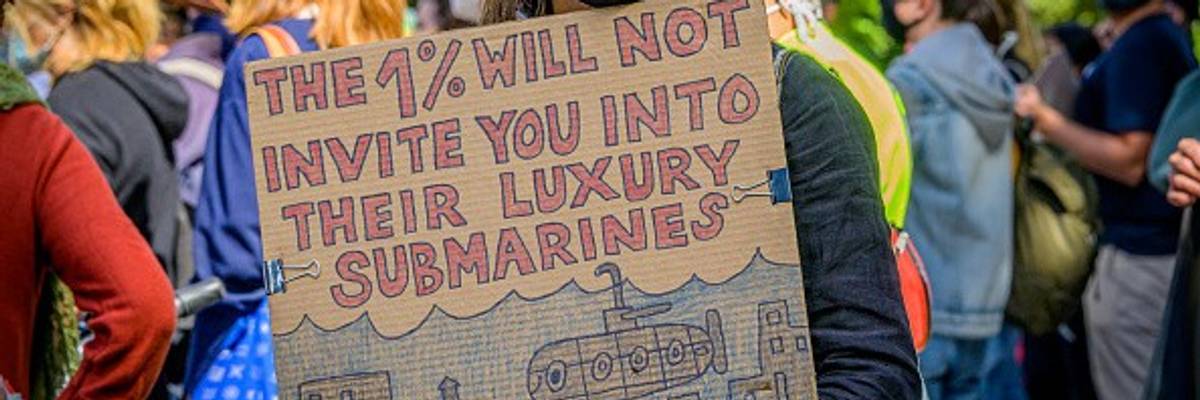

A participant holds a sign at a climate march.
Photo by Erik McGregor/LightRocket via Getty Images

Adam Parsons
Jul 21, 2026
Share the World's Resources


At the World Inequality Conference in June, the renowned economist Thomas Piketty and a team of 45 researchers from the World Inequality Lab unveiled the Global Justice Report. It’s a highly impressive and eloquent proposal to achieve “equality and prosperity within planetary boundaries” by the end of the century. Based on a fully quantified road map derived from extensive macroeconomic analysis, the 135-page report sets forth an ambitious vision: to construct a global economy that shares global wealth and achieves high well-being for all while rapidly decarbonizing energy systems, thereby maintaining emissions within the relatively safe limits of 1.8°C.

This hopeful outlook provides a welcome antidote to our times, in which the world is already reeling from climate breakdown, geo-economic confrontation, and a widening structural economic divide.

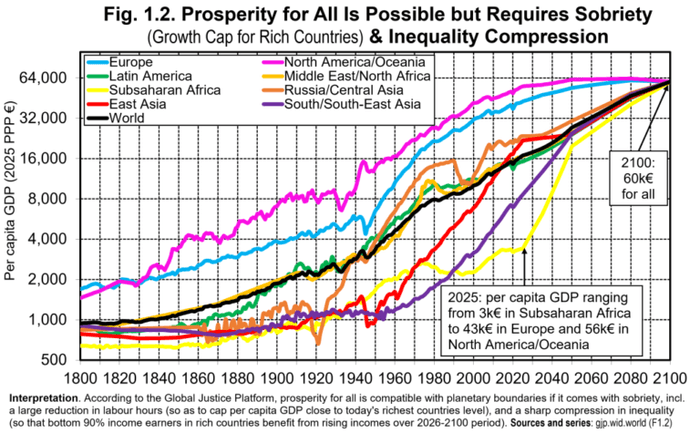
The core aim of the proposal is to achieve full income convergence across all countries by 2100, centered around a target level of €5,000 (about $5,700) per month for every person. To achieve this, the bottom 50% of humanity need to increase their global wealth share from 2-30%. The top 0.001%, in contrast, would see their wealth fall from 6% to 0.05%—a “striking redistribution,” to quote the report, which would essentially abolish the billionaire class.

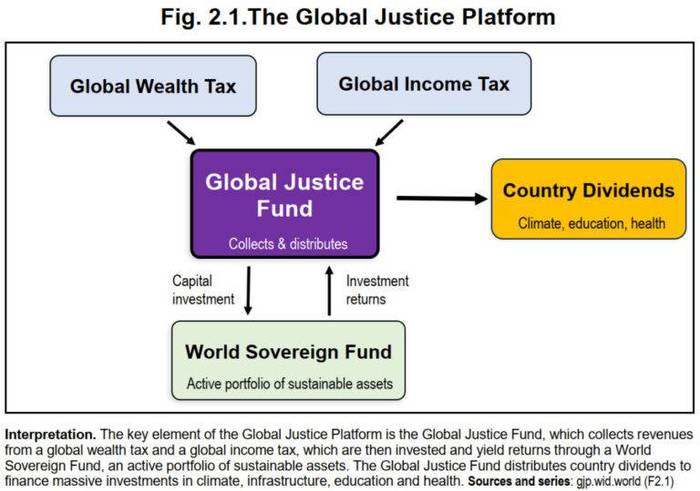
A Global Justice Fund serves to administer this immense effort at international economic sharing, financed by a global wealth tax and a top income tax levied on the richest 1% of the world’s population. Some of the revenue raised would go into a World Sovereign Fund, which is projected to accumulate assets equivalent to 60% of world GDP and replace tax revenue as the main source of financing. Country dividends are designed to be distributed on an equal per-capita basis, therefore providing more resources to poorer than richer countries and vastly more resources than currently allocated to development aid. These funds also come with strong conditionalities in terms of climate investments, inequality targets, and health and education expenditures.


A Vision of Sufficiency

The main novelty of the report is to put the concept of sufficiency at the center of its analysis, rightly arguing that we cannot stay within a 2°C carbon budget if the entire human population adopts a rich-world lifestyle of high private consumption. Sufficiency, as the report defines it, therefore requires more than halving average working time to 1,000 hours, roughly the equivalent of a two-and-a-half-day standard week.

This needs to be accompanied by a significant shift from material to immaterial sectors, such as health and education, which in turn would help refocus the economy toward low-consumption activities. A substantial change in food habits and reduced meat consumption could also allow for a strict deforestation ban, freeing up arable land while scaling down high-emitting agricultural practices. At the same time, sufficiency in production and consumption patterns must be combined with rapid decarbonization of the energy system, as spurred and enabled by the Global Justice Fund.

All this can read, at times, as a wish list of sustainability concepts and policies long espoused by environmental thinkers. But the work of the Global Justice Project is far wider in scope than Piketty’s best-selling tome, Capital in the 21st Century, which famously used vast historical and economic data to argue the case for a progressive global tax on wealth. Back in 2015, we at Share the World’s Resources and others criticized the book for failing to take seriously the ecological limits to growth and planetary boundaries. So it’s inspiring to see the World Inequality Lab authors directly engaging in this debate, fully denouncing the rhetoric of “green growth“ that assumes we can address environmental challenges by indefinitely increasing the size of the pie without reducing inequality, consuming less, or sharing resources globally.


Sharing Environmental Space

Their new report argues that technology alone is not enough to achieve rapid decarbonization. They acknowledge that to manage the green transition globally within a strict carbon budget, it will be necessary for today’s richest countries to radically downscale their resource and energy demands with near-zero growth in GDP. This will clear the ecological and carbon space needed for poorer countries of the Global South to continue growing their economies, enabling a fast energy transition while guaranteeing essential public services and a decent standard of living to all people.


It is hardly a novel framing of the issue, but the report emphasizes how their Sustainable Convergence Scenario entails a form of “class-based reparatory justice,” in that the very rich—who have benefited the most from fossil-based global economic growth in recent decades—will primarily fund the Global Justice Platform. What’s more, the proposal is somewhat aligned with the concept of climate equity, and effectively translates the principle of “common but differentiated responsibilities” into quantitative policies for addressing climate change.

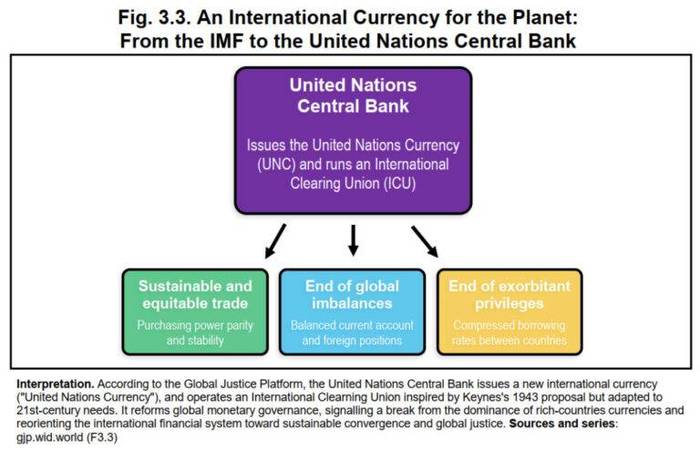
Another strength of the report is how it connects macroeconomic and environmental projections directly to questions of international institutional reform. It centrally highlights the need for a broader overhaul and democratization of the global economic and monetary system, including the reconstitution of the International Monetary Fund into a United Nations Central Bank that issues its own reserve currency. This would eliminate the exorbitant privilege of the US dollar and other major currencies that can borrow at much lower rates, ending a massive reverse redistribution of wealth from Global South countries to the Global North.

All other international institutions would be governed by strict rules and equal voting rights, further eradicating the special privileges and veto powers of dominant nations. A new international order would include the reform of World Trade Organisation rules and a reset of dispute settlement mechanisms. And the large financial resources allocated to the Global Justice Fund would de facto underwrite a major restructuring of the entire UN system, strengthening its many agencies, human rights protections and international laws.


From Plutocracy to Democracy

As the report affirms, these proposals to transform global governance from “plutocracy to democracy” are closely related to many other existing frameworks and initiatives. The Bridgetown Initiative in 2022, for example, also stresses the complementary role of global wealth taxation and international monetary reform. The UN Tax Convention process also focuses on democratizing the international tax system and curbing illicit financial flows, while the G20 initiatives led by Brazil and South Africa also champion global wealth taxes to fund climate policies and green energy transitions.

There are numerous other networks and organizations that aim toward similar tax and governance reforms, such as the work of Progressive International with their Program of Action on the Construction of a New International Economic Order. The Stiglitz Commission of 2010 and Brandt Commission of 1980 are gladly cited by the Global Justice Report as complementary discussions surrounding the reform of the international monetary and reserve system.

Above all, the report authors deservedly mention the Roadmap for Eradicating Poverty Beyond Growth—a major project coordinated by the former UN Special Rapporteur on Extreme Poverty and Human Rights, Olivier De Schutter, that puts forward an exhaustive policy toolkit for building a global economy with human rights and ecological justice at its core. Thomas Piketty and many other prominent economists have put their names to this plan, which is one of the most comprehensive policy documents of recent years to define “living well within planetary boundaries” through increased South-South cooperation, reparative climate finance, and support for universal social protection floors. De Schutter’s pioneering proposal for a Global Fund for Social Protection is arguably a less utopian prospect for closing chronic financing gaps in low-income countries, building upon existing structures like the UN’s International Labour Organisation, and seeking more immediately viable sources of international financing.

The operative question, as always, is how the political conditions will arise to implement these policies as an alternative to the far-right techno-authoritarian vision being championed by reactionary political elites and their billionaire supporters. It’s certainly true, as Piketty and his team write in a Guardian op-ed, that technical impossibility is not what is standing in the way but rather “the absence of a shared vision of social progress, at once concrete and radical.” And both the Piketty and De Schutter road maps make clear that formidable forces will oppose any socioeconomic shift toward global sustainable convergence, with the fiercest resistance coming from the ultra rich.

Both reports also briefly outline the need to build countervailing power from the grassroots, explicitly supporting collective action from progressive political parties, labor unions, and civil society organisations. The Global Justice Report even gives its conclusion the subtitle: “A global citizen movement for social justice,” and it modestly proffers its analysis to the broader collective mobilization that is already (if all too slowly) advancing at the world scale. So whatever limitations and shortcomings these reports may contain, we can only hope they spur the massive groundswell of popular support that is urgently needed to share the world’s finite resources before it’s too late.

This work is licensed under a Creative Commons Attribution-Share Alike 3.0 License.

Adam Parsons
Adam Parsons is the editor at Share The World's Resources, (STWR), a London-based civil society organization campaigning for a fairer sharing of wealth, power and resources within and between nations. He can be contacted at adam@sharing.org
Full Bio >


Donald Trump: An Atomic Bomb of a President

If his dreams (oh, sorry, nightmares) come true, he will certainly be known historically (if, of course, there is any “historically” then) as the president of the United States who did his best to end it all.


 A satirical float of US President Donald Trump is displayed during the Rose Monday celebration in Cologne, Germany.
(Photo: via Ann Wright)

Tom Engelhardt
Jul 21, 2026
Common Dreams

Let’s face it: Donald Trump should be considered an atomic bomb of a president—potentially all too literally, even if in slow motion, thanks to climate change. When it comes to actual atomic weaponry, he’s been threatening for a while first to restart the testing of nuclear weapons, which the US stopped 33 years ago, and then (at least implicitly) to use just such a weapon against the Iranians. In April, in fact, he insisted that, if Iran refused to reopen the Strait of Hormuz, “a whole civilization will die tonight, never to be brought back”—only to later deny that he meant he would ever consider using an atomic weapon against that country.

Of course, once upon a time in school (think the 1950s), the young Donald Trump, like me, must have “ducked and covered” under his desk in preparation for a potential Soviet atomic attack on our city (New York). During those Cold War years, of course, atomic testing was considered normal, while our country and the Soviet Union were indeed facing off globally in a remarkably threatening fashion. But no ducking and covering now, not from our president anyway.

Once upon a time, in the last century when I was an editor at Pantheon Books, I published Unforgettable Fire: Pictures Drawn by Atomic Bomb Survivors. Then, at the invitation of the Japanese editor of that book, I actually visited Hiroshima and went to the museum there dedicated to my country’s nuclear devastation of that city and Nagasaki to end World War II. I’ll never forget that dead 12-year-old’s charred lunchbox or that human shadow etched in stone by the atomic blast. Of course, as a boy, I had all too typically grown up dreaming (in the sense of a nightmare) about mushroom clouds exploding over New York City.

But in all those years, I never quite imagined that there might be a slow-motion version of atomic warfare on this planet, which we’ve come to mildly label “climate change.” (It should, of course, be called something more like “climate catastrophe” or “climate hell.”) Nor had I ever quite imagined that we would elect a president seemingly intent on making it happen ever more quickly and severely. After all, he’s pushed remarkably hard to further fossil-fuelize our world. As Juan Cole noted all too aptly at his Informed Comment website, just as the 250th anniversary of this country’s founding was passing, “Trump’s promotion of coal burning and cancellation of wind turbines makes him the Benedict Arnold of America’s current struggle.”

When it comes to him and the possibility of either a potentially devastating nuclear war or a fossil-fuelized heat war on this planet, he seems perfectly willing to engage in world-ending activities.

These days, of course, nine countries have nuclear arsenals (enough weapons to wipe out any number of Earth-sized planets), and Donald Trump has recently been at war with Iran, the country he feared might become the 10th. And yet, in the 80 years since my country ended World War II by dropping atomic bombs on the Japanese cities of Hiroshima and Nagasaki, killing more than 200,000 people (including an estimated 38,000 children), consider it a miracle that another of those weapons (now horrifically more powerful) has never been used, although since the first nuclear test in 1945, there have been more than 2,000 other “tests” in which such weapons were exploded, which have, of course, sent cancer-causing radiation across the planet.

But don’t push that miracle idea too far, since it turns out that we humans proved all too capable of coming up with another way to devastate this planet, a distinctly slow-motion version of atomic warfare. In fact, at this very moment, I’m sitting in an air-conditioned room writing this piece, while the world more or less burns outside my window. Recently, high temperature records were tied or broken across 21 states in my country, including my own state, with worse potentially still to come in our future. (The same, by the way, has been true across much of Europe, the part of the planet reputedly heating fastest in this increasingly strange world of ours, with Spain only recently topping a record 113°F.) I’m thinking, of course, of climate change and, sadly, at this very moment, when it comes to that version of warfare—and it should indeed be thought of as a form of warfare!—against this planet, there really is no ducking and covering (unless you count air conditioning, which uses electricity and so only makes matters worse). If you happened to live in Europe recently or in the Midwestern and Eastern parts of the United States where temperatures rose to striking heights or simply went crazy (including hitting 104°F in my hometown, New York City), you would certainly know that.

In short, it’s increasingly hot, hot, hot, damagingly so on this planet of ours, and Donald Trump, the second time around, not only doesn’t give a damn (an all too appropriate term under the circumstances) but seems remarkably intent on making this planet hotter still. At least, to look on the bright side, climate change did make something of a mess of his celebration of the 250th anniversary of American independence, or was that the 250th anniversary of Glorious Donald? When it comes to him and the possibility of either a potentially devastating nuclear war or a fossil-fuelized heat war on this planet, he seems perfectly willing to engage in world-ending activities as long as they’re in slow motion and, at 80 years old, he (like me) won’t be around to experience the resulting holocaust, which he has, of course, termed a “green energy scam” and a “hoax.”

Yes, make no mistake about it, while he’s officially ended that 33-year moratorium on nuclear testing, that may be the least of our problems. Whatever other recent presidents have (or haven’t) done in terms of climate change, he seems remarkably intent on doing so much worse by wildly promoting fossil fuels, while doing everything he can to dismiss anything that might make this planet less hot, including wind and solar power of any sort. (In the process, he’s giving imperial decline a new meaning by turning what’s left of imperial power on this planet over to China, which now controls so much of green energy development and production.)

If his dreams (oh, sorry, nightmares) come true, he will certainly be known historically (if, of course, there is any “historically” then) as the president of the United States who did his best to end it all (even if in slow motion).

Under the circumstances, we should consider Donald Trump the human equivalent of a slow-motion atomic bomb.


THE POLITICS OF CRUELTY

‘Frankly Sickening’: Reports Highlight Brutal Impact of Trump-GOP Cuts to SNAP Food Aid

“States are absolutely contemplating a world in which SNAP isn’t available.”


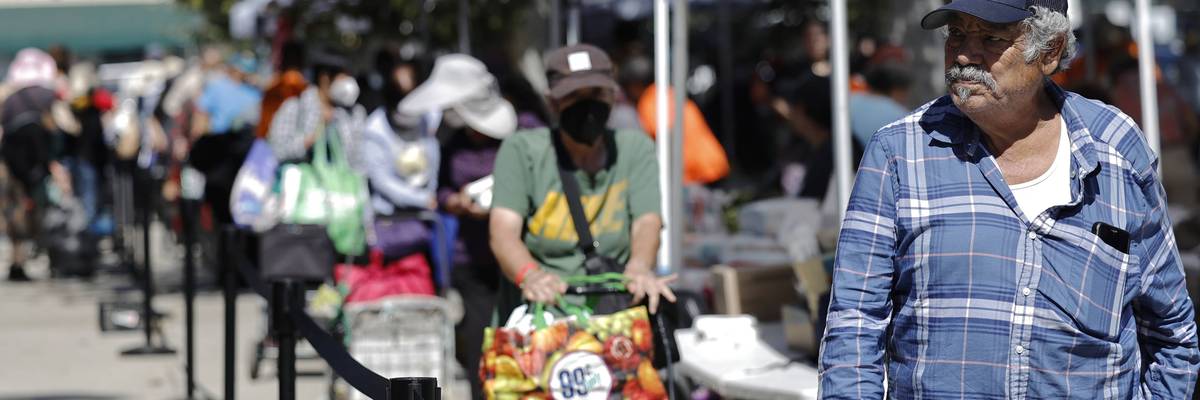
People walk after receiving food from volunteers with Pasadena Community Job Center at the Mano a Mano Pantry food distribution program on July 10, 2026 in Pasadena, California.
(Photo by Mario Tama/Getty Images)


Brad Reed
Jul 21, 2026
COMMON DREAMS


Several reports published this week highlight the brutal impact cuts made to the Supplemental Nutrition Assistance Program in Republicans’ 2025 budget law are having on Americans’ access to food.

A lengthy Tuesday report in The New York Times zeroed in on the bill’s impact in Arizona, where roughly 440,000 people have been dropped from the program even though many of them are still eligible to receive assistance.

The GOP-passed One Big Beautiful Bill Act established severe penalties for states that have high error rates when awarding SNAP benefits, and Arizona has responded by vastly increasing the paperwork applicants must file to qualify for the program in order to avoid making mistakes that could result in the loss of federal funding.

According to the Times, this has created “bureaucratic chaos” that has caused many otherwise eligible people to lose aid.

“It can take months to reach besieged caseworkers, and offices have gone as far as asking people with panhandling income for verification from strangers dropping cash in their jar,” reported the Times. “Arizonans losing SNAP say they are skipping meals, quarreling over food, and missing rent payments to restock pantry shelves.”

One former SNAP beneficiary featured in the Times story was Dee McDonald, a 65-year-old cancer survivor who reported skipping meals to ensure that the three grandsons she’s raising have enough to eat.

According to the Times, McDonald has been scrambling from one local food pantry to another to ensure there is enough food in the house for the whole family, a process she told the paper has left her “exhausted.”

“I go to sleep thinking about what are we going to have,” McDonald said.

Michael Wisehart, director of the Arizona Department of Economic Security, told the Times that it’s “frankly sickening to me the number of individuals” who are suffering due to the bureaucratic hurdles the state is enacting.

However, Wisehart said that if Arizona doesn’t add these bureaucratic layers, it could risk seeing its SNAP program completely destroyed.

“It’s an existential threat,” he explained. “States are absolutely contemplating a world in which SNAP isn’t available.”

Another state facing this dilemma is Arkansas, which the local news station KATV reported on Monday is scrambling to lower its SNAP error rate that, under new rules, could cost the state $55 million per year.

Keesa Smith-Brantley, executive director of Arkansas Advocates for Children and Families and former deputy director of the Arkansas Department of Human Services, told KATV that the financial penalties imposed on the state could create a downward spiral in which state officials have fewer resources to effectively lower the SNAP error rate.

“It is very concerning that we may not have a SNAP program in years to come if the state can’t come up with the funding,” said Smith-Brantley.

A Tuesday report in Axios examined how the GOP’s SNAP cuts have impacted Virginia, where 100,000 fewer residents are now enrolled in the program compared to a year ago.

Aaron McClung, chief development officer at Feed More, an umbrella organization for food banks in the central part of the state, told Axios that visits to food pantries have increased by more than 20% since the passage of the GOP budget law last year.

While food banks have tried to fill the gap, McClung said, they are no substitute for SNAP, which he described as “the nation’s most effective, dignified, and scalable tool for reducing food insecurity.”

Jacqueline Mott, Virginia state manager for the Save the Children Action Network, expressed a similar sentiment, telling Axios that “charitable food assistance was never designed to replace SNAP.”


‘Imagine All the Better Things That Could Have Been Done’: Trump Has Blown $37.5 Billion on Iran War

“THIS from the administration that said there was no money for food assistance, Medicaid, and healthcare tax credits.”


US Defense Secretary Pete Hegseth testifies during a Senate Committee on Appropriations hearing on Capitol Hill in Washington, DC, on July 21, 2026.
(Photo by Alex Wroblewski/AFP via Getty Images)

Jessica Corbett
Jul 21, 2026
COMMON DREAMS

While economists have warned for months that the true cost of President Donald Trump’s illegal war on Iran could be trillions of dollars, US Defense Secretary Pete Hegseth estimated on Tuesday that it’s currently about $37.5 billion.

That figure came from a line of questioning by US Sen. Dick Durbin (D-Ill.), as Hegseth appeared before the Senate Appropriations Committee to support Trump’s June supplemental funding request, which includes tens of billions for the Pentagon.

Hegseth told Durbin that the $37.5 billion estimate includes what’s been spent so far, plus some projected spending through the end of the fiscal year in September—an exchange quickly met with fury by various critics, many of whom pointed out the range of ways that money could have been better spent by an administration allegedly dedicated to combating “waste, fraud, and abuse.”


“Imagine all the better things that could have been done with $37.5 billion,” Jonathan Cohn, political director for the group Progressive Mass, wrote on Bluesky.

Noting that the Strait of Hormuz “is still closed,” progressive writer Alex Cole similarly said, “Imagine what $37.5 billion could’ve done for veterans, schools, or healthcare.”

Congressman James Walkinshaw (D-Va.) specifically noted: “That could cover a full school year of free lunches for 30 million children. Or a full year of childcare for nearly 2 million kids.”

“Trump finds money for war while families get excuses,” he added, as working people struggle with rising costs of housing, groceries, and gasoline—the price of which has soared due to Iran restricting strait traffic over US attacks.


The liberal political group American Bridge 21st Century highlighted how Trump and congressional Republicans have attacked programs for working families while giving more tax cuts to billionaires and waging war on Iran.

“THIS from the administration that said there was no money for food assistance, Medicaid, and healthcare tax credits,” the organization said.

Since Trump joined with Israel to start bombing Iran on February 28, most congressional Democrats, legal experts, and other critics have argued that the war—for which the president never secured support from Congress—is not only foolish but also unlawful under both international and US law.

Citing Trump’s attempts to evade limits of the War Powers Act of 1973, Congressman John Larson (D-Conn.) said Monday that he is preparing legal action against the administration and a new bill to cut off funding for the war on Iran, which has killed over 3,000 people according to the Iranian government.


Previous war cost estimates from the US Department of Defense have been met with scrutiny. After Pentagon comptroller Jules “Jay” Hurst offered the $25 billion figure in April, Stephen Semler, a senior fellow at the Center for International Policy, estimated that the government spent at least $71.8 billion during the first two months of the war, or around $1.2 billion per day.

As for the US death toll, at least 17 service members have been killed and many more wounded. The New York Times revealed Monday that the Pentagon hid dozens of American military injuries from Iranian strikes on bases in Jordan last week.

Two Iranian-Americans, a US veteran, and a nurse disrupted Hegseth’s Tuesday appearance before the Senate, according to CodePink. In addition to that anti-war group, the protesters were from the National Iranian American Council (NIAC) and Vets About Face DMV.


“Pete Hegseth and this administration will be remembered for the killing of innocent civilians and children. They have protected neither the American people nor our security, only the interests that have lined their pockets,” said Bella of NIAC, who joined the protest, in a statement.

“While Americans struggle to afford their lives, this government always finds billions to bomb our families in Iran, Palestine, Lebanon, and elsewhere,” Bella added. “This is a repugnant betrayal of humanity. It is illegal, and the American people will hold them accountable.”
Raskin Launches Investigation Into Evidence Epstein Was ‘Foreign Agent’ Working to Influence Trump Policies

“Numerous recently released documents now show he acted aggressively on behalf of multiple foreign governments... in order to influence policies of the first Trump administration.”


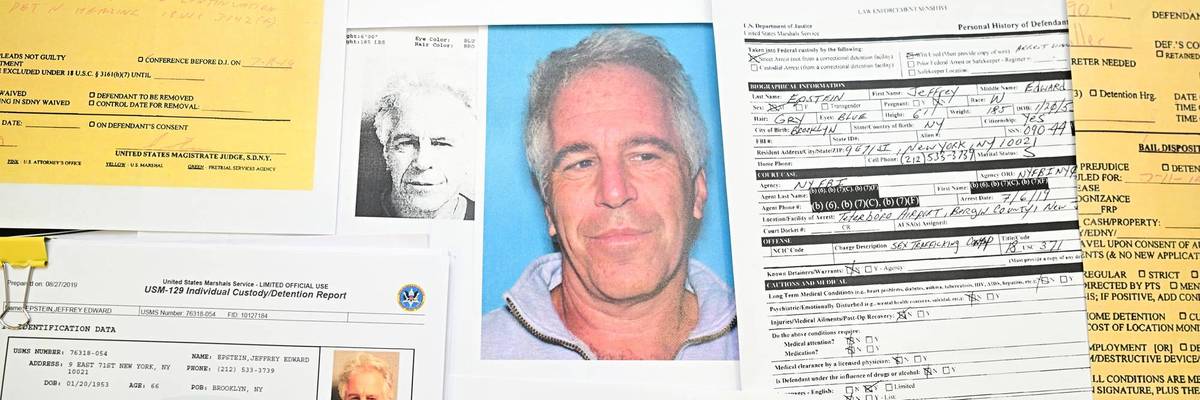
This photo illustration from February 5, 2026, shows released documents from the US Justice Department files on Jeffrey Epstein.
(Photo Illustration by Vladislav Nekrasov/SOPA Images/LightRocket via Getty Images)


Stephen Prager
Jul 21, 2026
COMMON DREAMS

The top Democrat on the House Judiciary Committee, Rep. Jamie Raskin, launched an investigation Monday into whether the disgraced financier Jeffrey Epstein worked on behalf of foreign governments to influence President Donald Trump during his first term.

In a letter addressed to acting Attorney General Todd Blanche; Trump’s nominee to be director of national intelligence, Jay Clayton; and Secretary of State Marco Rubio, Raskin (D-Md.) said that files provided to the Judiciary Committee show “substantial evidence” that Epstein acted to advance the interests of Saudi Arabia and Kuwait, advised the Russian government on its dealings with Trump, and worked as a consultant to former Israeli Prime Minister Ehud Barak.

“Jeffrey Epstein never registered as a foreign agent,” Raskin said. “Yet numerous recently released documents now show he acted aggressively on behalf of multiple foreign governments, including several with interests adverse to the United States, in order to influence policies of the first Trump administration.”

Epstein, a convicted sex criminal who was found dead in his jail cell in 2019 after being charged with trafficking minors, has long been surrounded by questions about his relationships to foreign governments. But this is the first time an inquiry from the US Congress has expressly focused on them.

Raskin called attention to a trip taken by Epstein to Riyadh in November 2016, the week of Trump’s first election, during which he met with Crown Prince Mohammed bin Salman (MBS) before sending one of his representatives an email offering to become the “financial confidant” to members of the Saudi government. “I am happy to represent [Kingdom of Saudi Arabia] interests. period,” he said.

Epstein also apparently offered to represent Saudi Arabia’s sovereign wealth fund in the US and serve as an adviser to a development project overseen by MBS. The crown prince’s response to the proposal has not been provided to the committee, according to Raskin.

Several emails to friends and confidantes indicate that around the same time, Epstein was regularly boasting of his visits to Trump Tower and meetings with “Trump people” during the presidential transition, which he said presented “lots of opportunity.”

Other correspondence seems to indicate that Epstein coached the emir of Kuwait on how to deal with Trump. In May 2017, prior to a summit of Gulf states in Riyadh, Epstein wrote to an unnamed political figure that he had “much to do around the Trump trip.”

The figure responded that he wanted “tips on how we should communicate with Trump,” specifically on the Saudi-led war against Yemen; Kuwait had played host to three months of UN-led negotiations related to the conflict the year before.

It is unclear from the records which US officials, if any, Epstein intended to engage on Kuwait’s behalf.

Raskin also highlighted what is perhaps Epstein’s most well-documented foreign government contact, Ehud Barak, who served as Israel’s prime minister from 1999 to 2001 and later its minister of defense.

According to a trove of leaked emails published by Drop Site News last year, Epstein worked to create a backchannel between Barak and the Russian government and helped him to pursue a meeting with President Vladimir Putin in 2013 as he pushed for Russia to abandon its support for then-Syrian President Bashar al-Assad, which was a major national security priority of Israel.

Epstein also provided information about US officials to Barak as he tried to push the Obama administration to take a harder stance toward Iran and Syria.

It is one of many instances in which Epstein and Barak worked to advance Israeli interests across the world, including brokering security and surveillance agreements with the governments of Mongolia and Côte d’Ivoire and helping to build the relationship between Israel and the United Arab Emirates.

Other emails reveal Epstein advising high-ranking Russian officials on how to deal with Trump as they sought to avoid sanctions placed by the US over its interference in the 2016 election and its aggression toward Ukraine.

Raskin said that Epstein seemed to be consciously acting as a foreign agent despite never registering as one under the Foreign Agents Registration Act (FARA). The congressman pointed to exchanges in which Epstein appeared to advise Trump’s former chief strategist Steve Bannon on how to avoid FARA reporting requirements.

Raskin argued that Epstein’s deep well of knowledge about Trump and his apparent access to members of his circle “posed a major national security liability.” Epstein often bragged that he had leverage over the president and said he was “the one able to take [Trump] down.”

The congressman argued for transparency in light of the administration’s efforts to delay the release of the files and withhold information despite congressional requirements.

Beyond potentially embarrassing revelations about Trump, he said the repeated use of the White House Situation Room to discuss the Epstein scandal indicated that it posed possible national security concerns that have not been disclosed to the public.

Raskin called on the Department of Justice and State Department to release all files referencing Epstein and other foreign nations and information that may point to his efforts to avoid FARA requirements.
Official Reports ‘Unprecedented’ Rise in Gaza Miscarriages Amid Israeli Genocide

One US author called the staggering surge a “reproductive genocide that Western feminists can’t be allowed to ignore.”


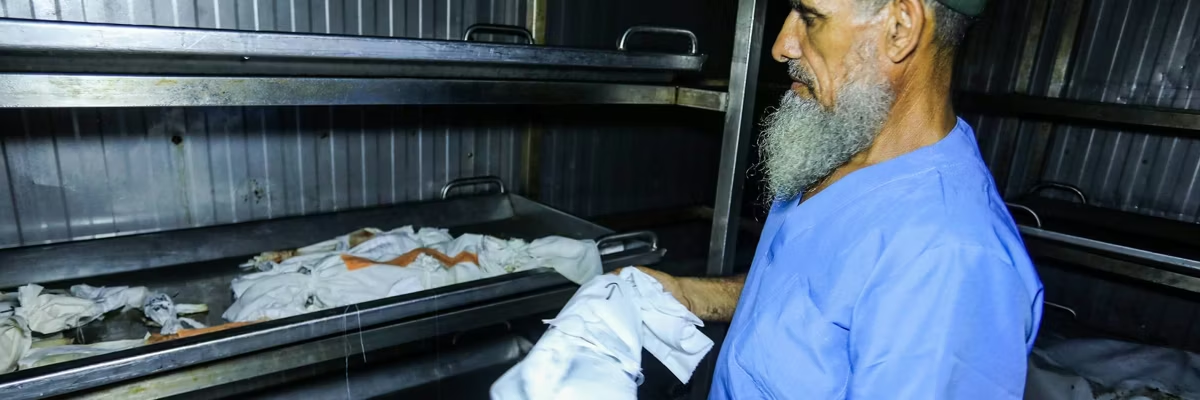
A worker at Nasser Hospital’s morgue adds the wrapped body of a dead newborn baby to a tray containing 19 other miscarriage victims, on July 13, 2026 in Khan Younis, Gaza, Palestine.
(Photo by Abed Rahim Khatib/Anadolu via Getty Images)

Brett Wilkins
Jul 21, 2026
COMMON DREAMS

A senior medical official in the Gaza Strip sounded the alarm on Tuesday over a dramatic rise in miscarriages in the Palestinian exclave, with nearly 4,000 cases reported during the first half of 2026 amid Israel’s ongoing genocide.

Gaza Medical Relief Director Bassam Zaqout said that 3,958 miscarriages were recorded in Gaza during the first half of this year—an increase the doctor called “unprecedented,” and a serious risk to the health of pregnant women and their unborn fetuses.

Zaqout cited the soaring miscarriage rate to factors in Israel’s genocidal assault on Gaza, including the destruction of the strip’s infrastructure, unsanitary living conditions in camps for forcibly displaced Palestinians—where numerous babies have died of hypothermia—lack of hot water and hygiene supplies, and relentless terror caused by Israel Defense Forces bombing.


The Gaza Health Ministry documented 921 miscarriages and 2,004 live births in April. This staggering ratio—460 miscarriages for every 1,000 live births—is more than double that in neighboring nations Israel and Egypt.

Live births have also dropped dramatically in Gaza this year, from 5,210 in January, to 3,433 in February, 3,233 in March, 2,004 in April, and just 1,701 in May 2026, according to the ministry.

Last month, the Gaza Center for Human Rights said that the alarming rise in miscarriages is due to the systematic destruction of Gaza’s healthcare system, repeated attacks on hospitals, and widespread deprivation of food, medicine, and essential medical services amid 33 months of what United Nations experts and others have described as a genocide.

The Gaza Center for Human Rights said the following factors are the most significant drivers of the miscarriage crisis:The widespread destruction of hospitals, primary healthcare centers, maternity wards, and fertility clinics;
Repeated attacks on medical personnel, including the killing, detention, and targeting of healthcare workers;
Mass malnutrition caused by Israel’s siege;
The collapse of maternal and child healthcare services; and
Restrictions on the entry of essential medicines and medical supplies needed by pregnant women and newborns.

The center also noted that Article II of the Genocide Convention—the legal basis for the South Africa-led genocide case against Israel currently before the International Court of Justice—includes “imposing measures intended to prevent births within the group” in its definition of the crime.

United Nations officials and other experts have accused Israel of “systematically” using reproductive, sexual, and other forms of gender-based violence against Palestinians in Gaza and committing “genocidal acts” by deliberately destroying reproductive and healthcare facilities in the strip.

There has also been a documented surge in birth defects among Gaza newborns. According to the Gaza Health Ministry, congenital anomalies doubled in 2025 compared with 2022.


Experts attribute the increase to many of the same factors driving miscarriages, pointing to contaminated water and widespread malnutrition, including the former famine that killed at least hundreds of Palestinians in Gaza, many of them children and infants.

Zaqout warned that Gaza’s health crisis is worsening as severe shortages of medicines, equipment, diagnostic tools, and laboratory supplies persist amid the strip’s heavily damaged healthcare infrastructure and ongoing siege. He also noted the epidemics of diseases such as chickenpox, waterborne illnesses, and respiratory infections.


Numerous Palestinian women have lost their pregnancies due to direct acute trauma inflicted by Israeli bombs and bullets, which have often also killed would-be mothers. Israeli invaders have also ordered the evacuation of Gaza’s hospitals, forcing staff to leave prematurely born babies to die and decompose in incubators.

A United Nations commission of inquiry reported last month that approximately 30% of the more than 73,000 Palestinians killed during Israel’s 33-month war on Gaza were children—many of whom were deliberately targeted. Israeli forces have killed more than 21,500 Gazan children, including 1,022 babies, since the October 7, 2023 Hamas-led attack, according to the Gaza Government Media Office.

The United Nations Children’s Fund has called Gaza “the most dangerous place in the world to be a child.”


‘Nowhere Is Safe’: Israel Kills Gaza Families and Bombs Hospital Despite Ceasefire

“I don’t feel like there is a ceasefire at all,” said a man who witnessed an Israeli missile attack on a hospital.


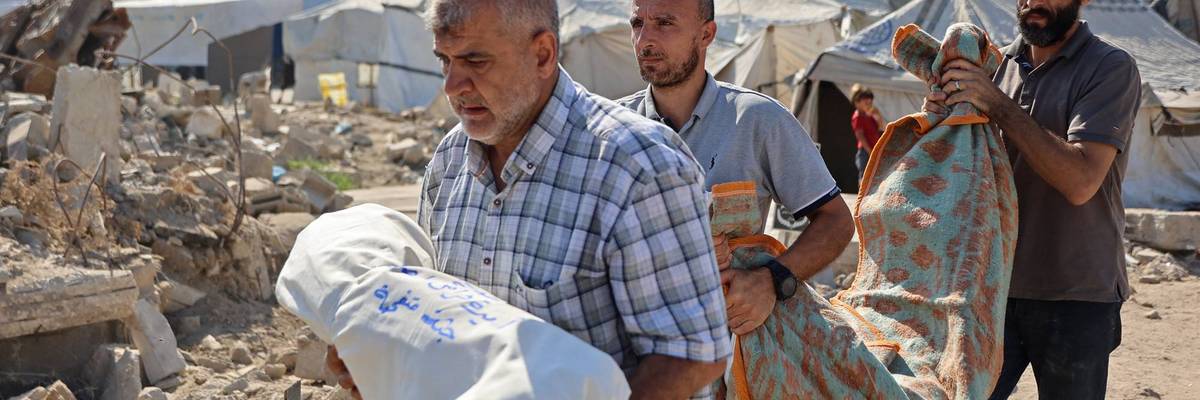
Family members carry the bodies of the Palestinians killed in a July 21, 2026 Israeli airstrike on an apartment in the Sabra neighborhood of Gaza City, Palestine.

(Photo by Omar al-Qatta/AFP via Getty Images)

Brett Wilkins
Jul 21, 2026
COMMON DREAMS


Palestinian officials said an Israel Defense Forces drone strike burned a family of six alive in their Gaza City home on Tuesday, a bombing that followed the massacre of another Palestinian family over the weekend and other attacks—including one on a hospital—as the Israeli genocide continues amid a nominal ceasefire.

The Palestinian Red Crescent Society said that rescue workers initially recovered the charred bodies of a mother, later identified as Salsabeel el-Masri, and her four children from their home in the Sabra neighborhood of Gaza City. Husband and father Firas el-Masri was later confirmed killed in the same strike.

The couple’s three daughters and son—Faryal, Salma, Amira, and Naeem—ranged in age from 6 to 13.
(Photo by el-Masri family/X)

At least some members of the family—who were sleeping when their home was bombed—were apparently not killed by the blast.

“They were all burned so much that our crews couldn’t reach them,” said Palestinian Civil Defense spokesperson Mahmoud Basal. “They were screaming and begging us to get them before they were martyred, but all attempts failed.”

Video recordings of the airstrike’s aftermath show first responders desperately trying to extinguish the blaze caused by the attack and retrieving the burnt victims’ bodies.

Ahmed el-Masri told the Emirati newspaper The National that his brother’s “entire family was wiped out from the civil registry.”


The el-Masri family is one of approximately 2,700 erased from the registry since Israel launched its war on Gaza in retaliation for the Hamas-led attack of October 7, 2023, according to an Al Jazeera analysis published in January.

The Israel Defense Forces confirmed the bombing, claiming the strike was targeting a Hamas member. The IDF dramatically loosened its rules of engagement following the October 7 attack, effectively allowing an unlimited number of civilians to be killed when targeting a single Hamas member, no matter how low-ranking.

Reuters reported at least six more Palestinians were killed by Israeli strikes later on Tuesday, including one targeting a vehicle in the central Gaza Strip.

On Monday, an IDF missile attack on the al-Yemen al-Saeed Hospital in northern Gaza’s Jabalia refugee camp killed at least two people and wounded 16 others, including women and children.

“The children were having fun and playing football, and suddenly they started screaming,” eyewitness Youssef Akasha told Drop Site News contributor Mohamed Ahmed. “We found many children lying on the ground, women screaming, and young men running to rescue the wounded.”

Graphic video footage shows children, including infants, being treated for shrapnel embedded in their bodies.

Israel’s attack on the el-Masri family followed a Saturday IDF airstrike on the home of the Nasman family in the al-Nasser neighborhood of Gaza City that killed five people. The Israeli newspaper Haaretz reported that Adham Nasman, 42; his wife, Marwa, 40; and three of their children—Arwa, 8, Ibrahim, 16, and Yahya, 18—were killed, and that Adham was apparently the intended target.

The couple’s 13-year-old son, also named Adham, was not home at the time of the strike. Video footage published by photojournalist Nahed Hajjaj shows the grieving boy beside the bodies of his slain family.


In another massacre on Saturday, an Israeli drone bombed a funeral in the Nuseirat refugee camp for a man who was allegedly a member of Palestinian Islamic Jihad, who had been killed earlier the same day in another IDF strike. Eight people were killed and 20 others wounded in the second attack, according to Palestinian, Israeli, and international media reports.

Israel’s US-backed assault on Gaza has left more than 250,000 Palestinians dead, maimed, or missing since October 2023 and around 2 million people forcibly displaced, starved, or sickened. Over 21,500 children—1,022 of them babies—are among the more than 73,000 Palestinians killed by Israeli forces during the war that scholars, jurists, human rights groups, a panel of United Nations experts, and others say is a genocide.

Israel is facing a genocide case filed by South Africa at the International Court of Justice and supported by nearly 20 nations, while Israeli Prime Minister Benjamin Netanyahu and Yoav Gallant—his former defense minister who ordered the “complete siege” on Gaza that fueled famine and disease—are wanted by the International Criminal Court for alleged crimes against humanity and war crimes, including murder and forced starvation.

The IDF’s continued attacks come despite a US-backed ceasefire that went into effect last October. Since then, more than 1,160 Palestinians—most of them civilians—have been killed and over 3,750 others wounded by Israeli forces, according to the Gaza Health Ministry.

“Nine months after the announcement of a ceasefire, still nowhere is safe for Palestinians in Gaza,” UN human rights spokesperson Thameen Al-Kheetan told reporters in Geneva on Tuesday. “The killing of civilians in these attacks raises concerns of continuing violations of international humanitarian law, war crimes and other possible atrocity crimes in Gaza. Under international law, deliberately attacking civilians is a war crime.”

Akasha, who witnessed the Jabalia hospital bombing, told Drop Site News, “I don’t feel like there is a ceasefire at all.”


Gaza Is in a Water Crisis as Israel’s Blockade Makes Reconstruction Impossible

Water should never be a luxury. Yet, in Gaza, it has become one.
July 20, 2026

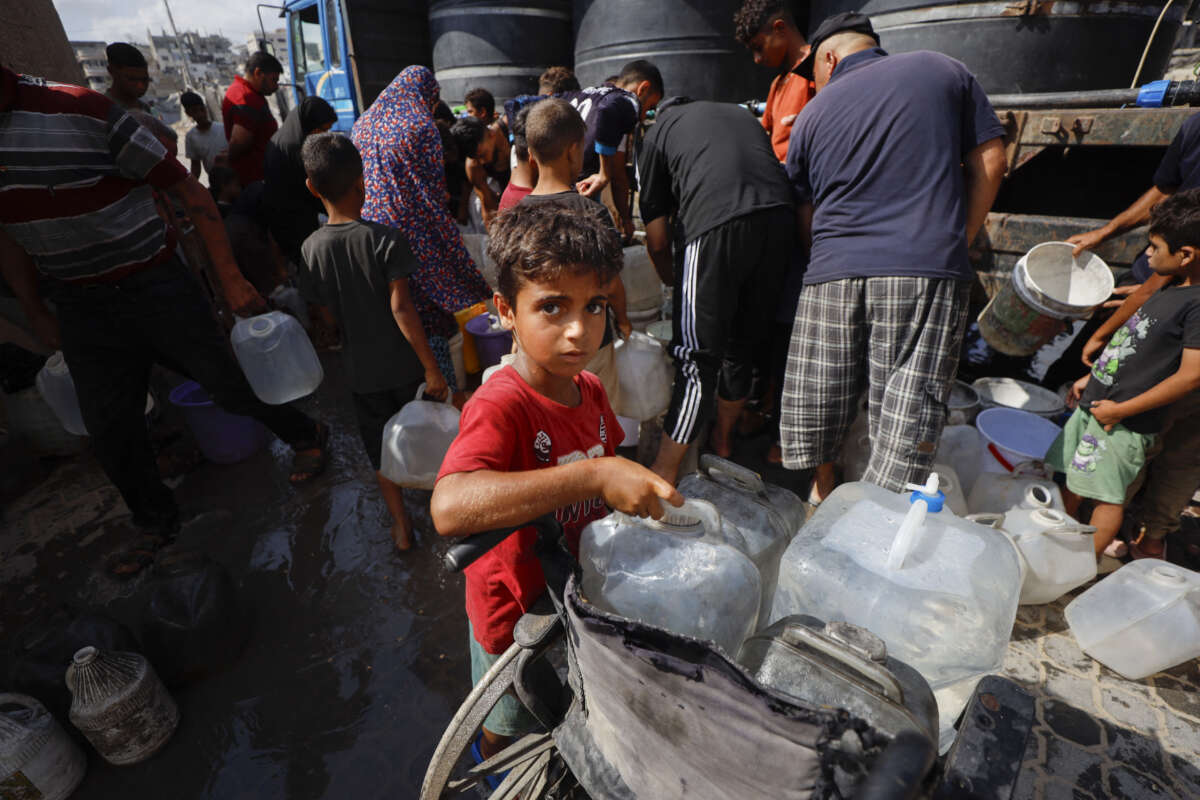
A Palestinian child stands next to a wheelchair loaded with water containers near a water distribution truck in Al-Shati refugee camp, west of Gaza City, Gaza Strip, on July 4, 2026.Ahmed Al Arini / Middle East Images / AFP via Getty Images

Each Tuesday, at exactly 8 a.m., Abo Watan Al-Shararha’s mornings are marked by the distant sirens of humanitarian water trucks. The 39-year-old, who struggles to provide for his family of five, must carry empty jerrycans and venture through the rubble of his neighborhood in al-Zawaida, hoping he will make it to the trucks before the drinking water runs out.

For Al-Shararha, whose name references the Arabic word for “homeland,” home is where he can live with dignity and safety, without battling for life’s most basic necessities. Displaced six times during the genocide, he has reached what he hopes will be his latest refuge.

“But getting water is a matter of luck,” he told Truthout. “Sometimes I manage to fill my containers. Many other times the water runs out before my turn, leaving desperate people who have queued for hours parched and empty-handed. Other times I see the endless line and give up. And sometimes fights erupt over the remaining water, so I am forced to avoid the battle.”

When that happens, Al-Shararha has no choice but to buy water, despite its soaring prices.

“I used to work as a freelancer before the genocide,” Al-Shararha lamented. “We lived a humble life in a residential tower where tap water was available around the clock.”


Babies in Gaza Die Preventable Deaths Due to Medical Shortages Imposed by Israel
Mothers in Gaza are losing their newborns as hospitals struggle to function without adequate supplies and resources. By Shahad Ali & Sojoud Alkhour , Truthout July 16, 2026


Before the genocide, Gaza relied on three main water resources: three seawater desalination plants, providing around 7 percent of the Strip’s drinking water; three pipelines operated by the Israeli water company Mekorot, accounting for nearly 13 percent of Gaza’s drinking water; and a network of around 300 municipal wells tapping the Coastal Aquifer for desalination. Alongside them, three wastewater treatment plants recycled treated wastewater, primarily for agricultural use.

The director of the desalination plant in the Central Governorate of the Coastal Municipalities Water Utility, Dr. Muhammad Al-Abwini, told Truthout that, before October 7, 2023, the average share of water per person reached around 80 liters per day, including both domestic and drinking water.

“Although it was still far below the World Health Organization’s recommended [optimal] liters per person per day, it was a milestone for us. It was a breakthrough, given Gaza’s longstanding status quo,” he said.

Despite these achievements, a UN report released in 2018 warned that the water produced in Gaza was unfit for human consumption and that, unless urgent action was taken, the crisis would have disastrous consequences, rendering Gaza uninhabitable by 2020.

Al-Abwini explained that Gaza’s water insecurity largely stems from its geographical location along the coast. Seawater continuously leaks into the Coastal Aquifer, increasing the concentration of total dissolved salts and rendering much of the groundwater unfit for drinking.


“Before the genocide, people received 80 liters of water in their homes, with dignity. Today, 20 liters is the best we can offer, and even that reaches people through an exhausting and undignified process.”

“From there, several master plans were proposed to improve both the quality and quantity of water,” Al-Abwini said.

Yet since the first days of genocide, Israel has weaponized water, turning it into a tool of mass suffering. The Israeli Defense Minister Yoav Gallant ordered the cutoff of water supplies to Gaza just days after October 7.

Then the systematic destruction of water and sanitation infrastructure followed. According to a report by Médecins Sans Frontières released in April 2026, about 90 percent of water, sanitation, and hygiene infrastructure has been damaged or destroyed. Wastewater treatment plants have been put out of service, leaving sewage overflowing across displacement camps, while Gaza’s largest functioning desalination plants have been decimated.

Speaking in a weary voice, Al-Abwini told Truthout, “The Water, Sanitation, and Hygiene (WASH) system has been reduced to ashes. Before the genocide, it was designed with remarkable precision, taking into account both Gaza’s geography and its population density. Yet now, people are crammed into the so-called safe zones and al-Mawasi, which was originally designated for agricultural purposes rather than human settlement. That has further deepened the crisis.”

The ordeal extended far beyond the destruction of infrastructure and the deliberate killing of municipal staff. Engineers and water utility staff struggled to keep the plants functioning, but the complete blackout across Gaza hampered any attempt to revive its Water, Sanitation, and Hygiene system.

Al-Abwini elaborated, “Generators in Gaza were originally intended to operate for only a few hours a day. Today, however, the water sector relies on them almost entirely.”

Yet severe fuel shortages have forced many facilities to shut down. Israel’s restrictions on essential equipment, along with its ban on spare parts under the pretext of “dual use,” have further hindered efforts to restore the water system.

“The desalination plant has been plagued by technical failures … forcing us to run the plant manually,” Al-Abwini said. Damage to critical components reduced “production capacity from 2,500 cubic meters to just 1,200. We spent six months pleading with international organizations to facilitate its entry before it was finally allowed in.”


“I have to buy gallons of water for between two and four shekels each, nearly one dollar per gallon.”

Even beyond the severe restrictions on fuel, tight restrictions remain on both the power capacity and the type of generators allowed into Gaza.

Al-Abwini condemned the policy, saying, “The generator required to operate our desalination plant has a capacity of 1,600 kilowatts. Yet the only generators allowed to enter Gaza — if they are allowed at all — have a capacity of 30 kilowatts or less.”

Lubricating oil, an essential component for operating and maintaining machinery, has also been barred from entering Gaza.

“If we have a generator, we don’t have the oil to run it. And even when we do, the generator is now operating nearly four times beyond its intended workload, yet the lubricating oil is never changed.”

He put it plainly: “This is not a heroic act. This is a slow death for the generators and the gradual dismantling of the entire system. It’s a closed, hollow circle of suffering.”

All these factors combined have paved the way for a humanitarian crisis. According to a May 2026 report from Oxfam, “By early 2026, the United Nations estimated that drinking water availability in Gaza City had fallen below six litres per person per day, well below even emergency humanitarian standards.”

Dr. Al-Abwini proudly said, “Despite the unprecedented challenges, we managed to improve the quantity, reaching 20 liters per person per day for both drinking and domestic use. We considered it as us having had smashed the target, yet it is still far too little compared with the immense need on the ground. Before the genocide, people received 80 liters of water in their homes, with dignity. Today, 20 liters is the best we can offer, and even that reaches people through an exhausting and undignified process.”

Many families have resorted to compensating for the shortages by retrieving water from small private wells or relying on turning brackish water into potable water.

For Abo Ahmed Abo Ghatrous, a 52-year-old unemployed father of seven, domestic water has not reached him for almost a month and a half.

“My suffering to get domestic water far exceeds my struggle to find drinking water,” he told Truthout. “I have been displaced from Rafah for the third year in a row and now live in a tent pitched on agricultural land. I have to buy gallons of water for between two and four shekels each, nearly one dollar per gallon. We need more than seven gallons every day for bathing and cleaning. That means spending more than $200 every month just to meet our basic water needs. And that’s on top of the skyrocketing prices of the containers.”

Speaking in a broken voice, he said, “I can’t take it anymore. What should we do? Where should we go? Life has become unbearable, and the situation grows worse day by day.”

The water crisis has also profoundly affected Gaza’s social fabric.

“It’s a battle for survival,” Abo Ghatrous added. “Any aggressive reaction is understandable. We need water to live.”

Yet he also recalled how he and his neighbors continue to share what little water they have with one another.


Abo Ghatrous, who once cared for olive, lemon, pomegranate, and guava trees, is now bidding them a final farewell.

On the other hand, Al-Shararha stressed that disputes over water can quickly turn violent. “People have been shot over a single gallon of water,” he said.

Back in 2024, an analytical study released by Euro-Med Monitor found that 66 percent of the sample reported severe diarrhea, intestinal diseases, skin rashes, scabies, and vomiting. Each passing additional day of water insecurity and pollution jeopardizes the health of an already immunocompromised population in Gaza.

That is a predictable consequence, given the deteriorating hygiene conditions and the collapse of the desalination and wastewater treatment systems. As a result, waterborne pathogens spiral out of control, threatening many lives.

Abo Ghatrous remarked, “My daughters have developed gastroenteritis multiple times. I also underwent a chondrectomy shortly before the genocide, but my recovery was compromised because I had to haul heavy containers of water.”

The crops on the remaining agricultural land that survived the Israeli bombardment may not survive the water shortages.

Abo Ghatrous, who once cared for olive, lemon, pomegranate, and guava trees, is now bidding them a final farewell, accepting their fate.

“We are barely finding water to drink, let alone enough to water the trees. All of them have withered,” he said in distress.

Not surprised, Al-Abwini remarked, “This genocide has ruthlessly killed life itself — the marginalized people, the environment, humans, plants, and dignity. This genocide has pulverized 50 years of tireless work and investment in the environment. To restore the kind of water situation we had before the genocide, we will need at least decades.”

Looking for a sustainable solution as the scorching summer heat continues to rise, Hatem Abo Tahoun, a Water, Sanitation, and Hygiene system engineer with extensive experience working with international NGOs during emergencies, said the lack of materials continues to hinder any meaningful recovery plan.

“We are working in reverse,” he explained. “We first assess what is still usable, then build our plans around it.”

Water trucks continue to fall far short of people’s immense needs and are no longer an effective solution, Abo Tahoun said:


For now, portable reverse osmosis desalination plants distributed across overcrowded and densely populated areas are the ideal solution. To avoid overcrowding around the plants themselves, they should be supported by distribution networks that make water accessible to as many people as possible. Displacement has forced people to replace proper water storage containers with thin, makeshift ones that no longer meet their needs. Many humanitarian organizations are now working to provide families with durable jerrycans and equip desalination plants with water storage tanks. It is a complementary process. Each part depends on the other. The goal is to mitigate these harsh conditions and help people reach the bare minimum needed for survival.

Regarding domestic water, Abo Tahoun explained, “One practical solution is to reactivate old, unused wells to provide water for household and sanitation purposes, then connect them to distribution networks. This, in turn, would reduce the demand for drinking water supplied by the desalination plants.”


“Everything we are doing is an emergency measure. We cannot address the root cause. All we can do is take a humanitarian approach to keep people from falling into the abyss.”

As fuel continues to stand as a major roadblock, Abo Tahoun suggested, “If solar panels were allowed to enter at scale, they would completely change the humanitarian situation. Instead of facing a cascade of shortages and operating costs, we could rely on a natural resource — the sun.”

Abo Tahoun added, “Earlier in the genocide, we assessed the needs of the plants and, according to the available budget, distributed fuel to private wells so they could operate and provide water free of charge to marginalized families in the surrounding areas.”

Almost all families are now forced to ration their water use by recycling greywater.

“It’s not an effective solution, but we use it for flushing. My own family does the same,” Abo Tahoun said. “We’re running out of solutions. They are simple solutions that should be easy to implement, but without fuel, materials, and the equipment needed to restore the system, they remain out of reach.”

Given that the so-called reconstruction plan remains little more than ink on paper, Abo Tahoun warned: “We are still in emergency mode. We are simply trying to enhance our people’s resilience and preserve their dignity. Gaza’s future remains uncertain. Everything we are doing is an emergency measure. We cannot address the root cause. All we can do is take a humanitarian approach to keep people from falling into the abyss.”

For Al-Shararha, Abo Ghatrous, Al-Abwini, Abo Tahoun and all Gazan families, the unalienable right to water should never be undermined or weaponized. No one should have to chase the sirens of water trucks, queue for hours, or go to sleep thirsty. Water should never be a luxury. Yet, in Gaza, it has become one


This article is licensed under Creative Commons (CC BY-NC-ND 4.0), and you are free to share and republish under the terms of the license.


Hend Salama Abo Helow

Hend Salama Abo Helow is a researcher, writer and medical student at Al-Azhar University in Gaza. She is also a writer with We Are Not Numbers and has published in the Washington Report on Middle East Affairs, Institute for Palestinian Studies, Mondoweiss and Al Jazeera. She believes in writing as a form of resistance, a silent witness to atrocities committed against Palestinians, and a way to achieve liberation.