Saturday, October 31, 2026

UN nature summit approves two key agreements after marathon negotiations

Almost 200 nations approved two agreements on Friday to halt biodiversity loss by 2030, following almost two weeks of negotiations that ran into extra time on the final day.


Issued on: 30/10/2026 
By: FRANCE 24

Inger Andersen, UN Under-Secretary-General and Executive Director of the United Nations Environment Programme, Hambardzum Matevosyan, Armenia's Minister of Environment and COP17 President, and Astrid Schomaker, Executive Secretary of the Convention on Biological Diversity, attend a session of the 17th meeting of the Conference of the Parties (COP 17), in the Armenian capital of Yerevan on October 27, 2026. © Stringer, AFP


Nearly 200 nations on Friday adopted hard-fought agreements at a UN biodiversity summit aimed at putting the world back on track in efforts to halt nature's destruction by 2030.

Delegates cheered as the crucial texts were approved in overtime following two weeks of tense negotiations at the COP17 conference in Armenia's capital Yerevan.

"And that's it. Perfect", said COP17 president Hambardzum Matevosyan to applause as he brought down the gavel on the documents, the final versions of which were not made immediately available to the public.

The world adopted a historic pact in 2022 setting ambitious targets to halt biodiversity loss by 2030.

But ahead of the summit, the UN warned that countries would fail to meet the goal unless they urgently corrected course.

Most of the objectives are falling short, including targets to protect 30 percent of Earth's land and oceans, tackle pollution, and provide poorer countries with greater conservation finance.A draft COP17 text earlier called on countries to "accelerate" efforts to keep the pact alive and stressed "increased action" was needed to tackle the root drivers of nature loss.


El Nino to intensify with peak in December, UN warns
Cover image: © France 24
01:29


Highlighting the disagreements that dogged the talks, the document proposed various options to achieve the 2030 goal. It was not immediately clear which of those options made the cut.

During negotiations, countries wrangled over reforming subsidies and other incentives that encourage activities harmful to nature, such as fossil fuels, intensive agriculture and overfishing.

A separate row revolved around finding new cash sources to fund conservation efforts around the globe – a hot-button issue with public budgets under strain amid an energy crisis and conflicts in Ukraine and the Middle East.

To restore degraded ecosystems, save endangered species and conserve forests, wetlands and other vital natural habitats, the world needs an estimated $700 billion more every year than it currently spends.


Climate change: Glacier loss and dry rivers threaten water security
Cover image: © France 24
01:53


The European Union led a charge for wealthy emerging economies such as China to join in paying for global conservation efforts – a contentious issue at COP17.

In a sign that a compromise was in the offing, another draft text that circulated earlier Friday invited countries outside the list of developed country donors to voluntarily join the group.

Science under attack


Efforts to refine the lacklustre Cali Fund – a UN mechanism for sharing profits from corporations that use genetic data from plants and other organisms – also proved difficult.

The fund set out to raise $1 billion a year for conservation in developing countries when it launched in early 2025. So far, it has attracted around $10,000.

Nations have also feuded over key scientific reports, with a small handful of countries accused of stonewalling efforts to accept the benchmark findings of a UN-backed biodiversity body.

"The attacks on science have bothered me a lot," French Ecological Transition Minister Monique Barbut said.

Around 70 ministers joined the negotiations this week in an effort to nudge things along, while indigenous leaders and civil society activists appealed to nations to act with greater urgency.

At the last biodiversity summit in Colombia in 2024, talks ran overtime as nations haggled over conservation finance and ended without a deal. Negotiations resumed in Rome in 2025 where an agreement was reached.

The COP17 summit was also expected to decide on Friday whether Panama or Ecuador will host the next biodiversity summit in 2028.

(FRANCE24 with AFP)


US judge narrows Macrons' defamation lawsuit against American podcaster

A judge in the United States has ruled that French President Emmanuel Macron and his wife Brigitte ​could continue their defamation lawsuit against the companies of the American podcaster Candace Owens, but not against Owens herself.


Issued on:  30/10/2026 - RFI

French president Emmanuel Macron and his wife Brigitte filed a lawsuit in July 2025 against the American podcaster Candace Owens and two companies, accusing her of helping fan online rumours about whether Brigitte is a transgender woman.
 © REUTERS - Abdul Saboor


Editor’s note: This story was updated at 13:25 on 30 October 2026 to include a statement from lawyers for Emmanuel and Brigitte Macron, sent to us by Ketan Sengupta, who works with the Macron's legal team. It responds to the court’s ruling on Candace Owens’ motion to dismiss the case against her.

In the statement, lawyers for the Macrons said: “We are pleased that the Court rejected Mrs. Owens’ attempt to remove the case from Delaware, where her companies continue to publish and monetize her defamatory falsehoods. As for Mrs. Owens personally, we are keeping all options open to ensure that, in addition to the liability she still faces through her companies, she is held accountable personally.”

***

The Macrons had filed a lawsuit in July 2025 against Owens and two companies, accusing her of helping fan online rumours about whether Brigitte is a transgender woman.


Owens, 37, an influencer with a large following on social media platforms, has claimed that Brigitte was a man.

Delaware Superior Court Judge Sheldon Rennie said in a ruling on Tuesday that Owens could not be held personally liable in the case.

But Rennie allowed the suit against two companies associated with her – Candace Owens LLC and GeorgeTom Inc – to continue.
Question of jurisdiction

Rennie said the Delaware court did not hold jurisdiction over Owens because her residence was in another state, Tennessee.

The ruling means that if the French first couple were to eventually win the case, Owens' personal assets would be shielded.

In their lawsuit, the Macrons said Owens ⁠touted ​false claims and conspiracy theories ​against them "to promote her independent platform, gain notoriety, and make money".

Rennie deferred judgment on Owens' motion to dismiss ‌the ⁠Macrons' litigation until he was briefed on how French defamation law and statutes of limitation intersect with US law.

"I am in the absolute best mood over this Macron dismissal," Owens said on X on Wednesday.

'Centuries of patriarchal history': why trans rumours are wielded against women
Damages to Brigitte Macron

Brigitte Macron, 73, has taken to the courts in France to combat claims she was born a man.

Two French YouTubers, Natacha Rey and Amandine Roy, were convicted in September 2024 of spreading false claims after they posted a video in December 2021 alleging that Brigitte Macron had once been a man named Jean-Michel Trogneux – who is actually her brother.

Rey and Roy were ordered to pay €8,000 in damages to Brigitte Macron and €5,000 to Jean-Michel Trogneux.

The defendants were also given a suspended fine of €500.

Did French media silence enable Brigitte Macron fake news story to go viral?

Brigitte Macron had filed a libel complaint against the two women after their claim went viral, triggering conspiracy theories notably among the far right.

Roy, an online fortune-teller, interviewed Rey, a self-described independent journalist, for four hours on her YouTube channel in December 2021.

The women discussed the unsubstantiated rumour that Brigitte Macron had undergone gender reassignment, with Rey claiming to have uncovered a “state lie” and “scam”.

The claim went viral just weeks before France's 2022 presidential election, spreading even to the US where Owen derided the first lady in a now deleted YouTube video.
THE EPSTEIN CLASS


Scottish police probe Andrew, Epstein stay at royal castle: UK media

London (AFP) – Scottish police are in the "very early stage" of probing the late US sex offender Jeffrey Epstein's reported stay at the royal Balmoral estate at the invitation of ex-prince Andrew, UK media reported Friday.


Issued on: 30/10/2026 - RFI

Jeffrey Epstein and Ghislaine Maxwell are thought to have stayed at Balmoral following an invitation from Andrew © Andrew Milligan / POOL/AFP/File

Epstein, who died in prison in 2019 while awaiting trial for sex trafficking, is believed to have visited the British monarch's estate in northeast Scotland in 1999 along with his jailed ex-girlfriend and accomplice, Ghislaine Maxwell.

The pair are thought to have stayed following an invite from Andrew, who has previously acknowledged his friendships with both but has denied all allegations of wrongdoing.

"We have received information and active inquiries are ongoing but these are at a very early stage," Police Scotland said in a brief statement to some UK media, without elaborating on the probe.

The Daily Express newspaper reported the inquiries were related to alleged trafficking of women to the Scottish Highlands castle -- now the property of King Charles III, but at the time belonging to his mother, Queen Elizabeth II.

AFP has contacted Police Scotland for comment.

At least ten UK police forces are probing Andrew and Epstein's links to Britain.

Police Scotland had previously appealed for information about Epstein's alleged chartering of private jets to transport women through Edinburgh Airport.

The king last year stripped his brother, now known as Andrew Mountbatten-Windsor, of royal titles and ousted him from his residence in Windsor amid continued fallout from his ties to Epstein.

The former prince was briefly arrested in February on suspicion of misconduct in public office related to Epstein, as police searched his properties.

He has denied wrongdoing, and won a legal challenge over the searches this month after police agreed the warrants they obtained were "unlawful" -- although the investigation remains ongoing.

The latest line of inquiry, according to the Daily Express which broke the story, was linked to Epstein and Maxwell's reported 1999 visit to Balmoral, with the US probe into Epstein including pictures of him and Maxwell in Balmoral.

Scandal has engulfed the king's younger brother since one of Epstein's accusers, Virginia Giuffre, claimed that she had been trafficked three times to have sex with Andrew when she was a teenager.

The ex-prince has repeatedly denied the claims. He settled a US civil lawsuit in 2022 brought by Giuffre while not admitting liability.

The UK police probes followed new revelations from documents relating to the American financier released by the United States this year, including emails in which Andrew appeared to share potentially confidential information with him.

© 2026 AFP


Ghana think tank launches year-long review of nuclear power investment readiness

Ghana think tank launches year-long review of nuclear power investment readinessFacebook
By bne IntelliNews October 30, 2026

Ghana’s Institute of Economic Affairs (IEA), an independent public policy think tank, has launched a one-year assessment of the institutional, regulatory, workforce and financing requirements needed to advance the country’s nuclear power programme.

The Ghana Nuclear Phase II Completion and Investment Readiness Support Programme was launched at an inception workshop in Accra, the Ghana News Agency reported on October 30. It will support priority activities under the International Atomic Energy Agency’s (IAEA) framework for countries developing nuclear electricity generation.

Ghana is implementing Phase Two of the IAEA’s three-stage Milestones Approach, working towards readiness to invite bids or negotiate a contract for its first nuclear power plant. Then-president Nana Addo Dankwa Akufo-Addo formally approved the inclusion of nuclear power in the country’s energy mix in 2022, with Nuclear Power Ghana designated as owner-operator and the Nuclear Regulatory Authority as regulator. The IEA said its initiative would complement, rather than replace, the statutory responsibilities of the country’s nuclear institutions.

The work will be carried out by the IEA’s Nuclear Energy Centre of Excellence, which will assess institutional coordination, workforce capacity, regulatory preparedness and investment frameworks. Expected outputs include a prioritised Phase Two implementation and tracking framework, a nuclear workforce development blueprint, a regulatory and institutional readiness roadmap and a framework to inform future investment decisions. The institute did not disclose the programme’s budget or funding arrangements.

Stephen Yamoah, executive director of Nuclear Power Ghana, warned in March that the lack of funding for detailed site characterisation and an environmental impact assessment meant the project could not progress beyond Phase Two. In September, Environment, Science and Technology Minister Zanetor Agyeman-Rawlings told the IAEA General Conference that meteorological monitoring systems had been installed at the preferred and alternative sites and that site characterisation was progressing, but gave no details of funding for the outstanding studies.

Robert Sogbadji, a deputy director responsible for nuclear energy at the Ministry of Energy and Green Transition, told the workshop that the government had acquired a site in the Central Region for consideration for the plant, according to the Ghana News Agency. Ghana previously identified Nsuban in the Western Region as its preferred location and Obotan in the Central Region as an alternative. Sogbadji did not name the site, and no revised site-selection decision was announced.

The IEA announcement disclosed no construction contract, financing commitment or final investment decision. Separately, President John Dramani Mahama said on October 29 that Ghana had opened negotiations with Russia’s state nuclear corporation Rosatom to build the country’s first nuclear power plant, without giving a timetable, size or cost. The talks build on a memorandum of understanding between the Ghana Atomic Energy Commission and Rosatom, which Russia’s ambassador to Accra, Andrei Ordash, cited in July as a major step towards the plant.

Nuclear power remains a long-term option. For nearer-term supply, Energy and Green Transition Minister John Abdulai Jinapor said in August that the government planned to procure 1,200MW of state-owned combined-cycle thermal capacity by 2029. The IEA assessment is expected to continue into 2027.

See IntelliNews: Ghana opens talks with Rosatom on first nuclear power plant
See IntelliNews: Russia eyes Ghana as West Africa gateway after trade tops $800mn
See IntelliNews: Ghana plans 1,200MW state-owned thermal power expansion by 2029
See IntelliNews: Ghana’s president approves nuclear power as part of country’s energy mix


Albania unveils tax cuts as violent protests pile pressure on government

Albania unveils tax cuts as violent protests pile pressure on government
Prime Minister Edi Rama's 2027 fiscal package shifts the tax burden towards big business and high earners, but industry groups say they were promised stability. / IntelliNews
By Clare Nuttall in Glasgow October 30, 2026

Albania will cut VAT on 54 basic foods to 6% from 20% and nearly double the tax on dividends, Prime Minister Edi Rama said, as violent student-led protests shake Tirana.

Rama set out the measures in a televised address on October 28, the day the government submitted the 2027 state budget to parliament. The food VAT cut covers meat, fish, dairy, eggs, flour, oils, sugar, pasta, fruit, vegetables and basic baby foods, and will leave about €150mn a year with households, he said.

To pay for it, the standard VAT rate rises by one percentage point to 21%, the dividend tax goes to 15% from 8% and the VAT rate for hotels climbs to 10% from 6%, with agritourism exempt. Rama said the corporate profit tax would remain at 15%, which he described as "the highest rate in the Western Balkans"; Confindustria said the draft it was opposing would raise the rate to 17%.

The package is an attempt to answer the cost-of-living anger behind weeks of street protests with a redistribution budget, while drawing more revenue from big business, the wealthy and the informal economy. Business groups, which had already warned of the cost of the draft measures, say the government is breaking a promise not to raise their taxes during its mandate.

"We want more businesses, more companies, more private investments, small and large, domestic and foreign. We also want as many rich people in Albania as possible, because the problem is never the rich, but the gap between those who have a lot and those who have very little," Rama said.

Who pays more

The salary tax changes cut in both directions. The upper threshold of the income tax band rises to ALL300,000 (€3,300) a month from ALL200,000, a move Rama said would benefit 32,000 middle-class taxpayers. A new top band of 30% applies to monthly salaries above ALL700,000, which he presented as a way to stop high earners paying themselves in dividends to avoid tax.

The threshold for compulsory VAT registration halves to ALL5mn in annual turnover from ALL10mn from January 1, 2027. The finance ministry's report on the draft decision estimates the change will bring about 17,516 businesses into the VAT system and raise VAT revenue by about ALL4.5bn, Monitor reported.

"We cannot allow many small businesses to continue to be abused by serving as a shell for large businesses to hide in," Rama said, adding that the government's pledge of zero profit tax for all small businesses by 2029 "remains intact".

The package also includes a super tax on luxury cars, while separate legislation will bring higher property taxes on empty apartments and coastal villas. The circulation tax will be taken out of the fuel price, cutting the pump price by ALL32 (€0.35) a litre, and charged on vehicles instead, with a new levy on foreign cars entering the country. A new revenue control bureau at the finance ministry will check the income declarations of high earners.

Rama pitched the measures as a dividend of growth. The 2027 budget is the first to exceed €10bn, he said, and pension increases will be doubled from January.

Business pushes back

Confindustria Albania said the government had publicly committed to keeping the 15% corporate income tax rate for large companies unchanged for its whole mandate. Its statement, published on October 28, opposed the draft package's proposals to raise that rate to 17%, the dividend tax to 15% and standard VAT to 21%, and called for them to be withdrawn.

"The government must explain why it is reneging on its promise. What has changed since it made this commitment? What new needs make this choice essential?" the association said.

For a company that distributes all its after-tax profit, the combined burden of profit and dividend tax would rise to 29.45% from 21.8% under the draft rates, Confindustria calculated. "For every 100 lek of pre-tax profit, the state would collect 7.65 lek more: an increase of approximately 35% in the combined tax burden," it said.

The association also pointed to finance ministry data showing budget revenue exceeded spending by about ALL70.3bn (€774mn) in January-September, while public investment reached only 75.2% of plan. "Before requesting more resources, the State must account for how it manages and uses the resources it already collects," it said.

"Businesses that declare and pay regularly cannot continue to be the automatic solution to every new budget requirement," it added.

The Union of Albanian Producers said the package puts extra pressure on domestic production and leaves it at a disadvantage against imports. Its secretary general, Arben Shkodra, called the package "absurd and paradoxical" in an interview with Top News, and criticised the speed of its approval, according to a summary on the union's website.

Shkodra welcomed the VAT cut on basic foods but questioned whether it would bring lower prices, and how stocks already bought with 20% VAT would be treated. Input costs, rising energy and fuel costs, competition from imports and informality were the producers' main concerns. "The voice of entrepreneurship must be heard before any decision-making of an economic nature," the union said in an earlier response to the draft.

Exporters want the package to go further on labour costs. ProEksport Albania asked the finance and economy ministries to raise the non-taxable salary threshold to ALL60,000 a month for all employees from January 1, 2027, Ekofin reported on October 21. The association, which represents clothing and footwear makers among others, said the lek's continued strengthening against the euro and rising production costs had weakened the competitiveness of Albanian exports, and asked for grants, tax incentives and simpler access to finance.

Stones on the boulevard

The tax package lands in the middle of the most serious unrest of Rama's 13 years in office. Student protests over university conditions, the cost of education and job prospects turned violent on October 13, when demonstrators threw bricks and concrete blocks at the Education Ministry and police responded with tear gas and water cannon.

The police chief said 71 officers were injured in the first three days, while the EU called for an investigation into police violence. The students have rejected Rama's offers of dialogue and are demanding his resignation, and opposition leader Sali Berisha has called a national rally for October 31.

The student movement has merged with the wider Flamingo Revolution, which began in late May as a campaign against a luxury resort linked to Jared Kushner on the protected Zvernec lagoon and grew into a broader protest over corruption and the government's accountability. The government has responded with tougher protest laws, including fines for unauthorised demonstrations and compensation for damaged businesses.

Rama used the same address to attack the protesters as "a crowd of urban bullies and online stalkers" who had broken the windows of the Education Ministry and nearby shops.

"These weeks of bum-booms have no chance of removing the government, but they have hit the economy and Albania itself, which for two weeks has been exporting views that do not invite tourists, but are driving them away; that do not invite investors, but are driving money away from the country," he said.

He also offered students a ALL15,000 monthly increase in scholarships for those from poorer families, bringing them to ALL25,000, about half the minimum wage, and extended them to master's level.

Growth slows

The government can afford the giveaways because revenue is running ahead of plan. Public revenue rose 11.3% y/y to ALL626.6bn in the first nine months of 2026, with net VAT receipts up 29%, while capital spending lagged at 75.2% of target.

Growth is cooling, however. The IMF expects GDP growth of 3.5% in 2026 and 3.2% in 2027, after 3.7% in 2025, with inflation accelerating to 3.2% in both years from 2.2%. The World Bank forecasts growth easing to 3.4% this year.

Rating agencies have looked more kindly on the public finances. Moody's raised Albania's outlook to positive in September on stronger fiscal and external positions, and Rama said public debt had fallen to a historic low.


Lithuania weighs €200mn Palantir AI system to modernise military operations

Lithuania weighs €200mn Palantir AI system to modernise military operations
Defence Minister Robertas Kaunas says Lithuania is considering acquiring artificial intelligence-powered battlefield management software. / Lithuania defence ministry
By bne IntelliNews October 29, 2026

Lithuania is considering acquiring artificial intelligence-powered battlefield management software from US technology company Palantir, with the system potentially costing nearly €200mn over its first seven years of operation, according to Defence Minister Robertas Kaunas, independent Lithuanian news agency BNS and public broadcaster LRT.lt reported on October 29.

Lithuania's is modernising its armed forces as Nato members increasingly turn to artificial intelligence and advanced data processing to improve military planning, intelligence analysis and operational coordination.

Kaunas said the proposed technology would consolidate information from multiple military sources into a single platform, enabling commanders to process intelligence more efficiently and make faster operational decisions.

"The purchase is being considered, and there will be further discussions, because we need a technological solution that would bring together all the data, of which we have a great deal," Kaunas told TV3 News on October 28.

"By using artificial intelligence, it would be possible to analyse data and manage certain aspects of the battlefield. Lithuania, like other Nato countries, needs this kind of software," he added, BNS and LRT.lt reported.

Palantir, a US-based software company specialising in data integration and analytics, develops platforms used by government agencies, intelligence organisations and military institutions.

Its technology is designed to combine information from different systems, identify patterns and support complex decision-making, including in defence operations.

According to TV3 News, the proposed Lithuanian contract could approach €200mn during the initial seven-year period, although the final cost has not been established.

Kaunas acknowledged that purchasing the software might require changes to the Defence Ministry's existing expenditure plans.

The potential investment would represent another step in Lithuania's broader military modernisation programme, which includes strengthening conventional capabilities alongside digital and intelligence infrastructure, BNS and LRT.lt reported.


Ukraine hits Moscow with record 600 drones during Africa summit

Ukraine hits Moscow with record 600 drones during Africa summit
Ukraine sent more than 600 drones at Moscow as African leaders met in the Kremlin; Russian officials said the war must continue. / bne IntelliNews
By Ben Aris in Berlin October 30, 2026

Ukraine flew more than 600 drones at Moscow, a record wave of attacks that  was designed to embarrass Russian President Vladimir Putin, who is currently hosting almost all of Africa’s leaders at the Kremlin.

Moscow Mayor Sergei Sobyanin said 613 drones flew at the Moscow region between the evening of October 28 and the morning of October 29, the night before the second day of the Russia-Africa summit at the Grand Kremlin Palace, which brought delegations from 48 African countries to the capital.

Russia's defence ministry said it downed a total of 1,214 drones over 19 regions that night, its highest overnight figure since the start of the war, The Bell reported.

The following night was heavier over the capital: Sobyanin said 862 drones flew at Moscow between the evening of October 29 and the morning of October 30, while the ministry put its nationwide tally at 1,043. Flights were restricted at Domodedovo, Vnukovo, Zhukovsky and Sheremetyevo. No damage or casualties were reported in Moscow on either night.

Summit in focus

The ferocity of the drone swarm attack was designed to embarrass the Kremlin and make Russia feel unsafe for its visiting friends. This is not the first time Bankova, Ukraine’s presidential administration, has employed this tactic.The raids coincided with a high-profile diplomatic gathering. The summit closed on October 29 with more than 60 agreements signed.

Kremlin spokesperson Dmitry Peskov called it "strange" that Kyiv had organised "such a massive drone attack" on the capital while a "global-scale" event was taking place there, the Kyiv Independent reported on October 29.

"Our air defense systems are working effectively. But this shows once again that the situation continues, and the (war) must continue so that we are protected from threats," Peskov told reporters. 

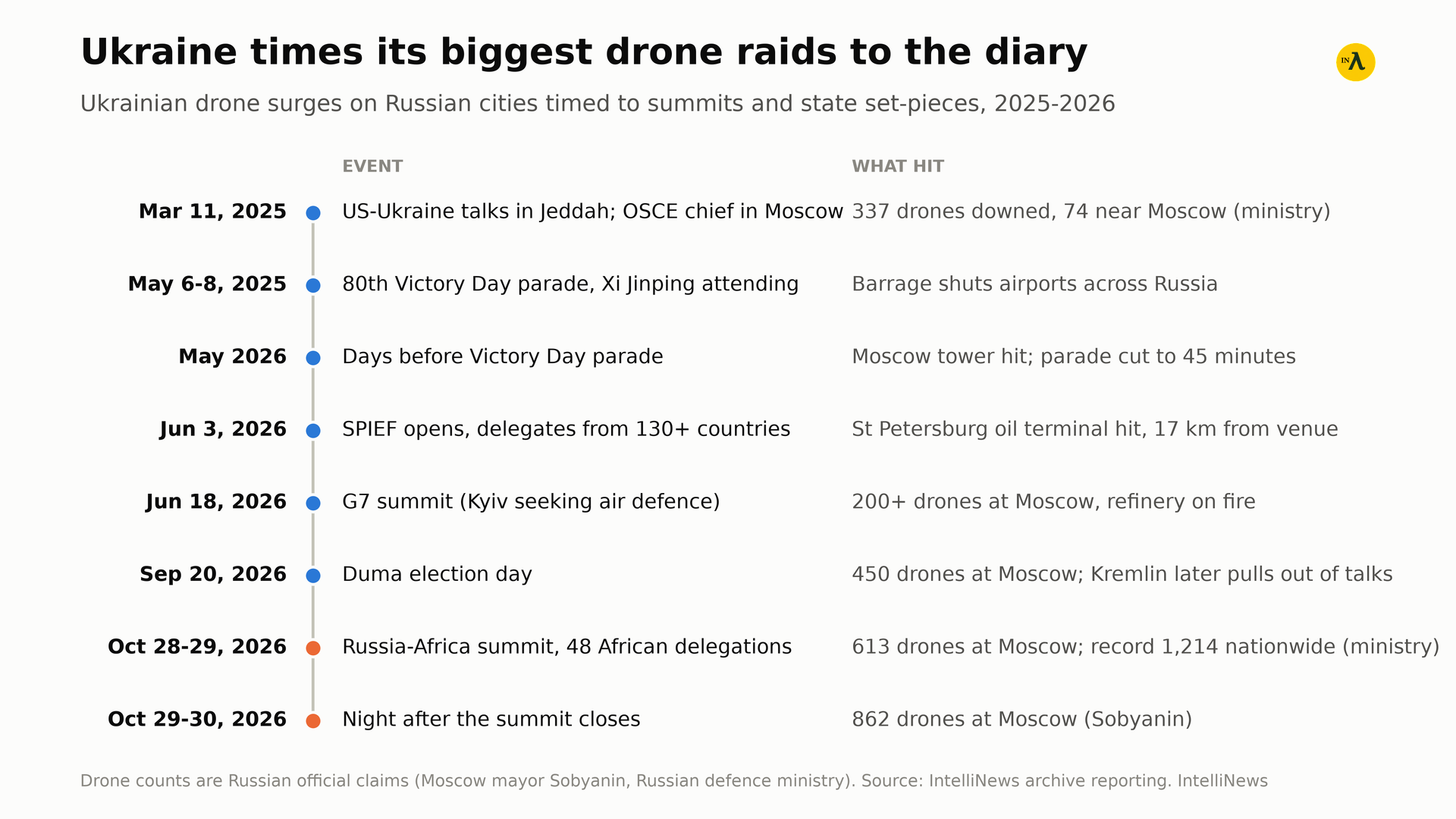
Ukraine hits Russia with heavy drone attacks everytime it hosts a high level meeting.

Ukrainian drone surges on Russian cities that coincided with summits, talks and state set-pieces, 2025-2026. Drone counts are Russian official claims. Source: IntelliNews archive reporting. IntelliNews


SPIEF: Ukrainian drones set fire to the St Petersburg Oil Terminal on June 3 this year, 17 km from the venue, just as the St Petersburg International Economic Forum (SPIEF) opened with dignitaries from more than 130 countries in attendance. The authorities closed the airspace over the city, stranding delegates who had not yet arrived.

Victory Day: In May 2025, ahead of the 80th anniversary Victory Day parade attended by Chinese President Xi Jinping and Brazil's president, a Ukrainian drone barrage caused civil aviation chaos across Russia, and President Volodymyr Zelenskiy warned that Ukraine "cannot guarantee the safety of anyone that attends the parade". This year a drone hit a luxury tower on Mosfilmovskaya Street days before May 9, and the parade was over in 45 minutes, with few guests and no armour, after Zelenskiy issued a mocking decree giving Putin "permission" to hold it, complete with Red Square's GPS coordinates.

Jeddah talks: Events aimed at Western audiences get the same treatment. A raid of 337 drones, 74 of them near Moscow, on March 11, 2025, coincided with US-Ukraine talks in Jeddah, and Russian officials took the visiting OSCE Secretary General Feridun Sinirlioglu to see the damage.

G7 summit: More than 200 drones were downed over Moscow on June 18 as the G7 summit met, where Kyiv was asking for more air defence, and the Moscow refinery was set on fire.

Duma elections: Some 450 drones flew at Moscow on September 20, the last day of the Duma elections, which Putin later said showed the enemy's attempts to disrupt the vote.

The March 2025 attack was the largest on Moscow of the war at the time, and the raids have grown since. Sobyanin reported 637 drones flying at the capital on the night of August 17-18, nearly 500 were reported on the night of October 13-14 and more than 600 on October 21-22, before the 613 and 862 of this week. That is despite an air defence network around the city that open-source analysts count at roughly 79 Pantsir towers within 50 km and some 25 S-300 and S-400 batteries, which still lets drones through.

Using force to strengthen a diplomatic hand is an old habit in Kyiv. Under former President Petro Poroshenko, fighting in Donbas habitually escalated before Normandy Four meetings, as it did around Debaltseve on the eve of the Minsk summit of February 2015, and Poroshenko used the tension to press the leaders of France and Germany to be tough on Russia.

Putin answers provocations differently, punishing Ukraine with mass bombardment rather than making targeted gestures. After Ukrainian drones destroyed a Wildberries warehouse outside Moscow in July, killing seven night-shift workers, the war turned into Operation Wildberries, and by the end of August Russian strikes had destroyed about 90% of the storage facilities of Ukraine's retail chains, Agriculture Minister Taras Vysotskyi said.

Strikes undermine the peace process

This week's raids have also undercut what little progress had been made towards ongoing talks to end the conflict. US envoys Steve Witkoff and Jared Kushner secured an agreement in principle on trilateral negotiations after visiting Kyiv and Moscow, but the Kremlin pulled out, accusing Kyiv of strikes on the September 20 election day. Kremlin aide Yuri Ushakov said on October 28 that the start of talks would depend on the battlefield situation, and Zelenskiy said the same day that he expected a meeting in mid-November, with no date confirmed by Washington.

Taking Ushakov at his word means as the scale of the drone strikes goes up, the progress at the talks will go down. Bankova is talking about peace, but its actions are those of war. Peskov's answer to the summit raid was that the war must continue, which gives Moscow a ready reason to keep the talks on hold.

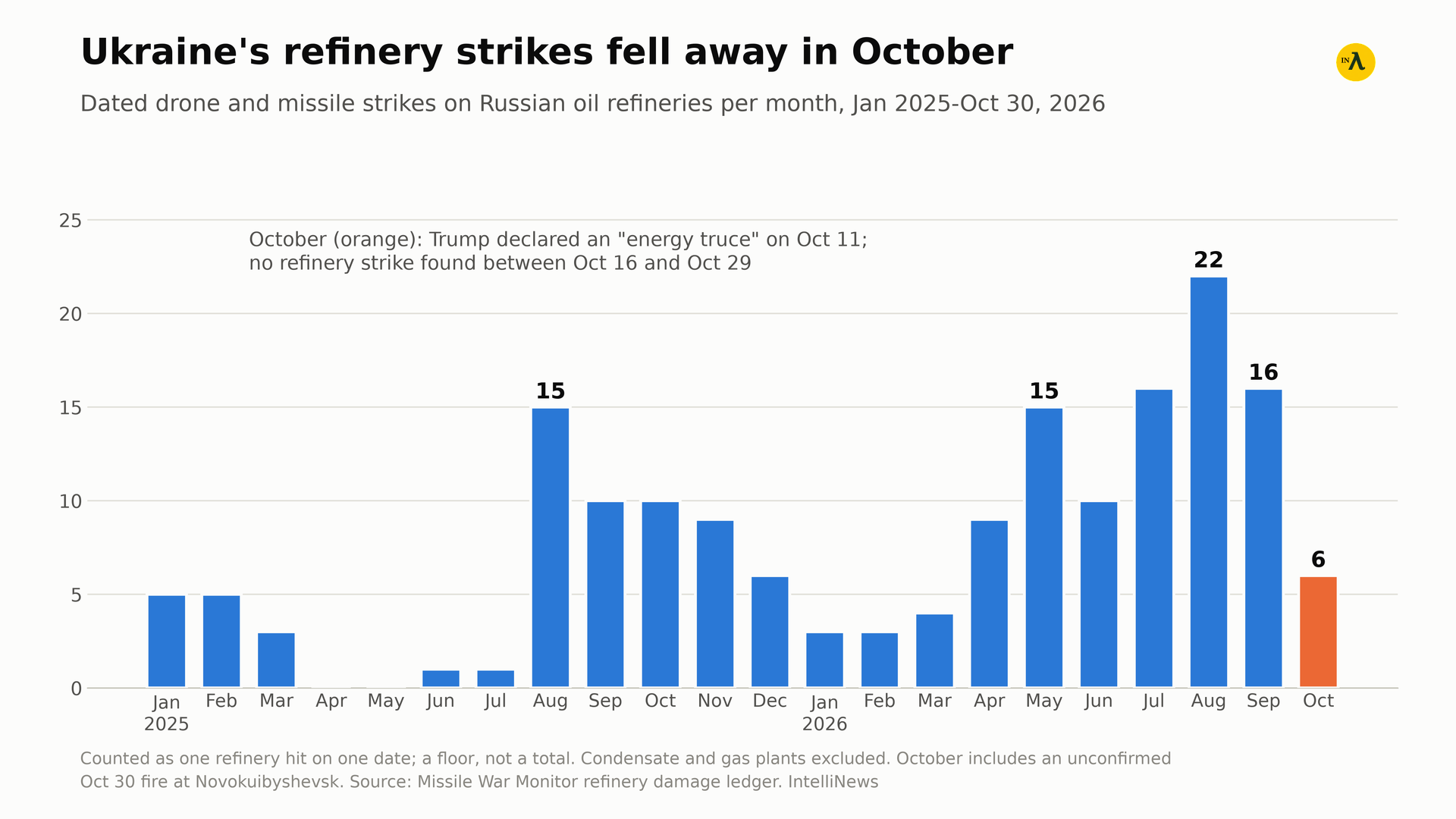
The strikes on Moscow have grown as the attacks on refineries have fallen away. Following pressure from US President Donald Trump, Ukraine's strikes on Russian oil refineries have dropped sharply in recent weeks. IntelliNews' Missile War Monitor's refinery damage ledger records 22 dated strikes on refineries in August, 16 in September and six in October, with none found between October 16 and October 29.

Dated Ukrainian strikes on Russian oil refineries per month, January 2025-October 30, 2026. One strike is one refinery hit on one date; the counts are floors. Condensate and gas plants excluded; October includes an unconfirmed fire at Novokuibyshevsk on October 30. Source: Missile War Monitor refinery damage ledger. IntelliNews

Zelenskiy said Ukraine halted refinery attacks for three days after Trump declared an energy truce on October 11, and the strikes resumed with a hit on Ryazan on October 15. A fire was reported at the Novokuibyshevsk refinery in the Samara region on the night of October 29-30, which has not been officially confirmed. The campaign had made Russia's refining sector a liability for Moscow, and Putin put its cost at 1% of GDP on October 1.

There are reports that Ukraine is switching to metallurgical and chemical plants. Steelmaker Severstal (MOEX: CHMF) said a substation at its Yakovlevsky iron ore mine in the Belgorod region was damaged on October 7, while Telegram channels claimed hits on the Balakovo steel works on October 14 and Novolipetsk Steel (MOEX: NLMK) in Lipetsk on October 27-28. The Lipetsk governor called the reports of an industrial fire "not true", and the Saratov governor said Balakovo's infrastructure was working normally.


Russia seeks to raise the cost of Europe's support for Ukraine through sabotage

Russia seeks to raise the cost of Europe's support for Ukraine through sabotage
An explosive-laden drone was found in the secure cargo area of Leipzig/Halle airport in August, next to a parked Ukrainian Antonov Airlines freighter. / Leipzig/Halle airport
By Clare Nuttall in Glasgow October 30, 2026

Russia is concentrating its sabotage campaign in Europe on the rear of Ukraine's war effort, from drone factories to Starlink stations, BMI analyst Cassia Scott-Jones told a webinar on October 27.

"We've seen attacks on drone production facilities, Starlink infrastructure, and essentially Russia is increasingly targeting the European rear of the war in Ukraine: communications, defence production, logistics," said Scott-Jones, a senior analyst for Europe country risk who leads Russia and Ukraine analysis at BMI, the research arm of Fitch Solutions.

Scott-Jones described a shift from a wider, sometimes apparently random set of targets towards the communications, defence production and logistics supporting Ukraine. Each attack can disrupt suppliers, relay stations or cargo hubs and force European governments to spend more defending targets far from the front. "Before, there was a wider set of targets, which sometimes seemed random," she said.

The targets since the summer bear that out. Fire gutted the assembly section of WB Electronics' drone components plant in Skarzysko-Kamienna on August 31, and Estonia blamed Russian intelligence for an arson attack on Milrem Robotics, the Tallinn-based maker of unmanned ground vehicles for Ukraine. Slovak police said they had foiled a planned arson attack on the Slovak-Ukrainian drone maker Skyeton, and incendiary devices were thrown at a site outside Rohde & Schwarz's Munich headquarters in September.

Communications have been hit too. Polish officials called a September 23 fire at a Starlink ground station south of Warsaw, which supports internet links into Ukraine, sabotage; Russian intelligence may have hired a Turkish criminal gang known as the Daltons to start it, Der Spiegel reported. On October 28 Polish police detained a Ukrainian suspected of organising a Russian-directed arson attack beside the CARFIL arms factory in Brasov, Romania.

Harder to pin on Moscow

BMI's analysis of incidents shows a fairly continuous intensification from 2022 to 2024 and an apparent decline in 2025. Scott-Jones warned against reading that as a let-up, because the number of incidents in which Russia's role cannot be established has risen at the same time.

"I think Europe is moving into a more difficult phase where activity is widespread but attribution is becoming harder," she said.

How much of the campaign can be laid at Moscow's door is disputed. Published counts of Russian hybrid attacks in Europe since February 2022 range from 52 to 255 depending on the source, the writer Thomas Fazi argued in Responsible Statecraft, because there is no agreed definition of what counts. Germany's federal criminal police alone recorded 321 acts of sabotage against critical infrastructure in 2025.

The escalation in 2026, in both the number of incidents and the risks they carry, has been sharper. "The attempted attack in Leipzig was probably the most significant case," Scott-Jones said.

In early August an explosive-laden drone was found in the secure cargo area of Leipzig/Halle airport, next to a parked Ukrainian Antonov Airlines freighter. Investigators later traced a DNA link to the 2024 incendiary parcels sent through the DHL hub at the same airport. On September 1, Berlin formally blamed Russia and ordered Moscow's last career consulate in Germany, in Bonn, to close. Russia's SVR foreign intelligence service answered with a claim that Nato spies had linked Ukraine to the plot.

A Kremlin official then contacted a counterpart in the German government and warned that Leipzig would not be Moscow's last target, the Wall Street Journal reported in October, citing unnamed sources. The paper also reported that people familiar with US intelligence said Russian President Vladimir Putin had personally ordered the stepped-up sabotage campaign against Nato countries.

"If accurate, that tells us something really important about Russia's risk appetite," Scott-Jones said of the warning. "We would normally think about plausible deniability as one of the main advantages of sabotage activity, but here Russia wanted to warn Germany, to understand there could be further attacks."

She added: "One of the reasons is it's so cheap for Moscow to generate these threats and so expensive for Europe to comprehensively defend against them. And Russia wants Europe to know that." 

Germany before the Baltics

The geography of the attacks does not follow the map of Europe's invasion fears. The Baltic states, most often discussed as the likeliest target of a Russian military attack, are not the most frequently hit. Germany was the most frequently affected country in the incident data, followed by Poland and France.

"I think that tells us vulnerability follows strategic value as well as geography," Scott-Jones said. "Poland is the principal logistical corridor into Ukraine, while Germany, France and the UK matter because they are the military-industrial complex of Europe, and politically."

Poland has had the most violent cases. In November 2025 an explosion damaged the Warsaw-Lublin rail line, a route for supplies to Ukraine, and Warsaw blamed two Ukrainians working for Russian intelligence and shut Russia's last consulate in the country. Prime Minister Donald Tusk said in September that the latest incidents were "certainly not the last".

Raising the price of helping Ukraine

Scott-Jones separated the immediate goal of the operations, disrupting Ukraine's defence production and logistics, from their longer-term effect on European politics.

"Every incident imposes additional costs: governments have to protect more infrastructure, intelligence services have to investigate and companies have to spend more on security," she said. "Most importantly, European governments have to explain to voters why supporting Ukraine is producing security risks at home."

She cautioned against a narrow reading of what Moscow wants. "I wouldn't frame the Russian objective as simply trying to elect pro-Russian parties or parties that are more negative toward Ukraine," she said. The aim is rather to shape the political environment in which decisions about Ukraine are made, and to feed concern about escalation and security, "potentially to influence calculations of mainstream governments as well as parties on the political fringes."

That fits a debate already running in European capitals, where Europe has gone from paymaster to participant in Moscow's rhetoric as it builds weapons for Kyiv. Czech counterintelligence chief Michal Koudelka warned in October that Russia could move on to sabotage strikes against logistical hubs used to supply Ukraine.

Nothing Europe has done yet appears to have changed Moscow's calculation. "So far at least, Russia seems to judge that the European response has not imposed significant enough costs to make it change," Scott-Jones said.

BMI expects more of the same. "I would expect these operations to intensify further into 2027, and while it's unlikely to be a defining issue in Europe's elections, it will be interesting to see how parties respond to that pressure," she said.