Thursday, November 05, 2026

Butane’s Perfect Storm Sends Prices to Decade Highs


  • Butane prices have hit a 30-year high of $1,125/t in Europe and a 14-year high of $920/t in the US as disrupted Gulf supplies tighten global availability.

  • India’s cooking-gas needs and China’s expanding chemical industry have been drawing American butane into Asia, leaving Europe short as winter gasoline blending demand strengthens.

  • High US domestic prices and freight costs are making replacement cargoes to Asia commercially unattractive, leaving buyers dependent on a fragile recovery in Middle Eastern exports.

Butane prices are surging across the world. Northwest European November butane prices have reached $1,125/t by early November, their highest level in 30 years, having exceeded even the peaks following Russia’s invasion of Ukraine. In Asia, the AFEI butane index stood at $1,180/t on November 3. US butane Belvieu prices have climbed to a 14-year high $920/t.

This surge in prices reflects several overlapping trends, with the most significant being a reorientation of global propane/butane trade flows since the US-Iran war kicked off in March. Before the conflict, the US supplied roughly 45–50% of global LPG exports and the Middle East another 30–35%. After the beginning of the Middle Eastern crisis, the Gulf countries’ share subsequently collapsed to 11%, while the US substituted much of this shortfall and its share reached 65%.
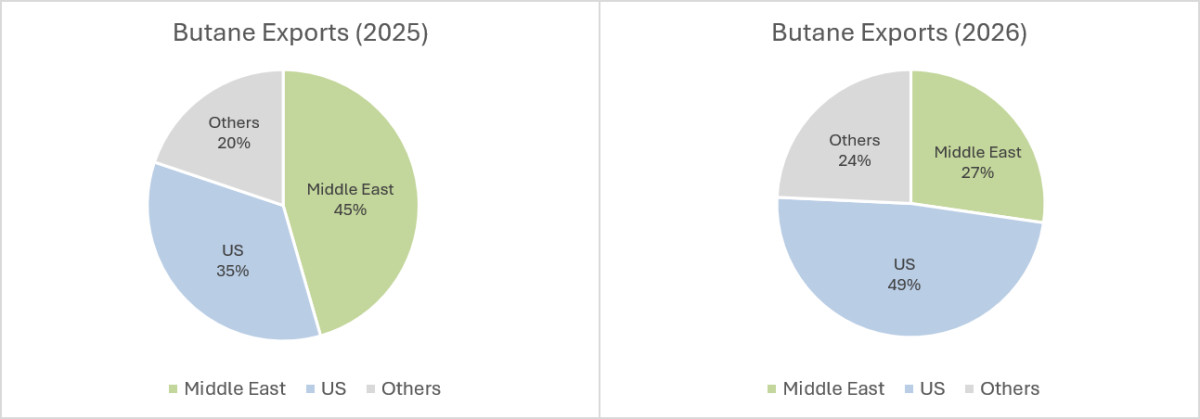
Asia has absorbed much of that replacement supply. Middle Eastern producers previously covered around half of Asia’s imports, offering relatively short voyages and cargoes suited to local requirements. In April-October, the US propane and butane supplied as much as 75% of Asian imports, drawing volumes away from other destinations, including Europe. That share eased to around 55% in October as deliveries from the UAE, Kuwait, Qatar and Saudi Arabia gradually recovered. Yet the broader restoration of Gulf exports has been stronger in oil, and the current flow of LPG shipments remains insufficient to loosen Asia’s inevitable reliance on American cargoes. This is pulling US cargoes away from other regions. Subsequently, in October butane monthly imports into the Amsterdam-Rotterdam-Antwerp (ARA) hub have fallen to a multi-year low of just 130,000 tonnes, down 34% from a year earlier.

Related:

However, replacing Middle Eastern supplies to Asia is complicated by their composition. US LPG exports are approximately 75% propane and 25% butane in outright terms, whereas Indian (and many other Asian countries) cooking-gas requirements typically favour a blend closer to 50:50, with butane helping maintain suitable vapour pressure in warmer climates. More American propane therefore cannot fully compensate for missing Middle Eastern butane.

India’s exposure made the consequences particularly severe. At the outbreak of the crisis, roughly 87% of its LPG imports came from the Gulf, with the UAE and Qatar together accounting for half. Imports dropped from 2.03 million tonnes in February to 1.17 million tonnes in March, a fall of more than 40%. The government ordered refiners, including petrochemical complexes, to maximise LPG production and prioritise households. Some consumers switched to piped natural gas, although its higher cost and only partial indirect government support limited the relief. Recovering imports from the Middle East and strong reliance on US cargoes have given refiners more flexibility to ease emergency LPG production and restore output of other products, particularly petrochemicals.
China’s demand comes from a different direction, as expanding capacity for gasoline additives and basic chemicals increases its feedstock requirements. Five new plants producing MTBE (methyl tertiary-butyl ether, which raises gasoline’s octane rating, helping prevent engine knocking, with butane supplying its hydrocarbon component through several processing steps) opened in 2025, adding combined capacity of 3.4 million t/year and supporting demand for imported butane. Crucially, the gasoline using Chinese MTBE need not be consumed in China. Producers export the additive to other Asian markets, Europe and Latin America, allowing overseas demand to sustain butane purchases even when Chinese gasoline consumption is subdued. China produces butane domestically, but industrial expansion increases its need for supplementary imports.

This Asian demand is coinciding with another major factor that pushes butane prices up – the seasonal increase in Atlantic basin consumption. Winter gasoline specifications in the US and Europe require refiners to blend in more butane, whose high vapour pressure helps fuel vaporise and engines start in cold weather. The autumn switch into winter-quality gasoline typically strengthens butane demand between October and March, which means American producers are competing more actively with overseas buyers. US exports reached a record 2.4 million tonnes in May before decreasing to 1.55 million tonnes in October (still 12% higher than a year earlier). Asia received 840,000 tonnes, or 54% of October shipments, while Europe took only 105,000 tonnes, approximately 7%.

That distribution explains Europe’s predicament: American exports are seasonally decreasing, just as Asian demand leaves less and less butane available amidst strengthening European blending demand. Operational disruptions have tightened US butane availability further, with force majeure at Energy Transfer’s Nederland terminal in Texas and a compressor outage affecting butane loadings at Freeport last month.

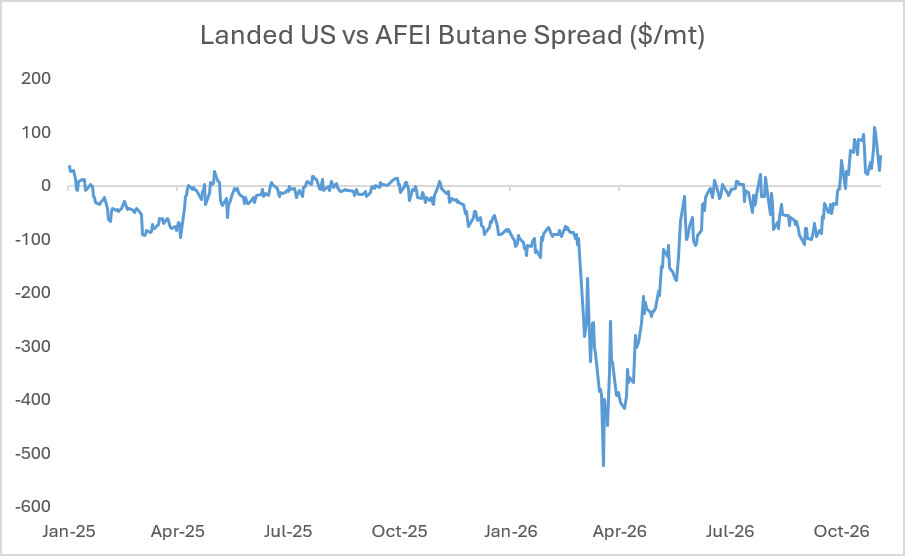
Even Asia’s ability to attract American cargoes is now approaching a commercial limit. US butane at $920/t, plus approximately $320/t in freight to India, produces a delivered cost of $1,240/t. The landed US butane versus AFEI butane spread is at $50-60/t, making the arbitrage commercially unattractive for American producers. For comparison, in April the spread reached minus $300-400/t, creating a huge incentive for US shippers to sell their LPG volumes to Asia. For additional shipments to become once again attractive, US prices or freight must fall, or Asian prices must rise further. Winter blending demand complicates the first possibility, while the last would deepen the burden on importers already struggling with expensive energy.

Continued recovery in Gulf deliveries can ease pressure across these interconnected markets, allowing Indian refiners to retreat from emergency LPG production and freeing more American cargoes for Europe. Yet that relief depends on maritime security in the Hormuz Strait, leaving buyers exposed to renewed US hostilities with Iran. Another escalation would force India back into the market for long-haul cargoes while Chinese industrial demand and European winter consumption would compete for the same supplies. America remains the obvious source of replacement volumes, but its own internal dynamics and the current economics of shipping suggest it cannot keep filling the Gulf’s supply gap at prices buyers can comfortably afford.

By Natalia Katona for Oilprice.com


Eagle Nuclear Energy to acquire Noble Plains Uranium 


Eagle Energy’s Aurora uranium project in southeast Oregon. credit: Eagle Energy Metals

Eagle Nuclear Energy (NASDAQ: NUCL) announced Wednesday it has signed a binding Letter of Intent (LOI) to acquire 100% of Noble Plains Uranium (TSX-V: NOBL, OTCQB: NBLXF, FSE: INE0) in an all-stock transaction. 

The deal will expand Eagle’s resource footprint beyond Oregon, where it is advancing its Aurora uranium project, which it says is the largest mineable uranium deposit in the US. The company’s land package spans the Oregon-Nevada border, with the mine on the Oregon side and the plant on the Nevada side. 

Under the LOI and subject to a definitive agreement, Eagle will acquire 100% of Noble Plains’ issued and outstanding common shares at a deemed price of C$0.125 per Noble Plains’ share. Based on the Exchange Ratio of 0.0167 Eagle shares for each Noble Plains share, the offer price represents a premium of approximately 92% to the closing price of Noble Plains shares on the TSXV on October 29 of C$0.065.  

Upon closing it is anticipated that existing Eagle stockholders will hold approximately 95.22% and former Noble Plains shareholders will hold approximately 4.78% of the equity of Eagle, on an issued and outstanding share basis. 

Noble Plains is a U.S.-focused uranium exploration and development company advancing two In-Situ Recovery (ISR)-amenable projects strategically located within two of the country’s most prolific uranium districts in Wyoming.  

Noble Plains’ ISR portfolio combines brownfield projects covering ~5,965 acres of demonstrated ISR geology in close proximity to established operators. 

Noble Plains has an option to acquire an 80% interest in its flagship Duck Creek project located in the Powder River basin of Wyoming that hosts a U₃O₈ resource, reported on a 100% basis, containing 5.32M lbs in the Indicated category and an additional 1.04M lbs in the Inferred category, as reported by Noble Plains under the Canadian NI 43-101 regulatory standards.  

Eagle said its technical team believes this current resource estimate represents a relatively small portion of the total resource potential at Duck Creek, as it covers only 2.5 miles of a total 5.25-mile trend, and sits entirely in the shallower of two prospective mineralized formations.  

The company said it plans to unlock significantly more value at Duck Creek through the execution of a systematically phased exploration program over the next 12-18 months. 

Noble Plains’ Shirley Central is an earlier-stage uranium project that represents additional prospectivity for developing U₃O₈ resources in the strategically prominent Shirley basin of Wyoming. 

“This transaction gives Eagle greater scale at a time when demand for U.S. uranium is growing,” Eagle Nuclear Energy CEO Mark Mukhija said in a news release.  

“Noble Plains adds established resources in Wyoming and strengthens our portfolio with favorable ISR geology. We believe we can move these assets forward efficiently while we continue to work towards development of an integrated nuclear energy platform combining domestic uranium resources with advanced SMR technology,” Mukhija said.  

“We’ve proven we can acquire uranium assets with historical data, move them forward quickly and add value without having to recreate decades of work,” Noble Plains CEO Drew Zimmerman added. “Combining with Eagle gives us more scale and the capital to keep executing that strategy. We have a strong resource at Duck Creek, more opportunity across the portfolio and existing uranium infrastructure all around us.”  

Eagle’s stock was down 2.8% on the NASDAQ at Wednesday’s closing. The company has a $123.5 million market capitalization.  Noble Plains stock closed the day up 13% on the TSX.   


Colombia’s mining rules reset puts billions back in play


The Santurbán páramo, a high-altitude ecosystem, is now open to mining amid disputes. (Stock image by Manuel.)

Colombia has scrapped two major mining restrictions imposed under former president Gustavo Petro, potentially reopening millions of hectares to exploration and unlocking billions in investment under President Abelardo de La Espriella.

The Ministry of Mines repealed 15 special mining districts covering 5.3 million hectares, or nearly 5% of Colombia’s territory, on Oct. 22. The Ministry of Agriculture separately revoked Food Production Protection Areas (APPA) across four regions in October, removing another obstacle to mineral development.

“Colombian mining is seeking to begin a new phase and once again become a driver of growth for the country and its regions,” Colombian Mining Association (ACM) president Juan Camilo Nariño said at the National Mining Congress in September.

The policy reversal could allow companies to revisit projects constrained by overlapping land-use regulations after years of uncertainty. Nariño estimates a more supportive investment climate could unlock $4.7 billion in mine construction, attract $350 million annually in exploration spending and support industry growth of as much as 10% a year.

Removing the designations does not automatically authorize mining. Companies must still comply with environmental regulations, permitting requirements and other land-use restrictions before advancing projects.

Mining districts scrapped

The repeal affects Antioquia, Boyacá, Cauca, Cesar, Chocó, Córdoba, Huila, La Guajira, Nariño, Norte de Santander and Valle del Cauca, as well as areas along Colombia’s Pacific coast.

The Ministry of Mines annulled the resolutions establishing the districts, including their technical annexes and maps, and ordered updates to the Colombian Mining Cadastre.

The ministry cited poor results, inadequate alternatives for mining-dependent communities, legal uncertainty and insufficient consultation with regional authorities.

It said the districts conflicted with municipal land-use plans and had not been agreed upon with governors and mayors, creating overlapping jurisdictions. The regulations also lacked expiry dates, limits on territorial expansion and transition provisions.

Mining Minister María Nohemí Arboleda said the sector was central to Colombia’s economic recovery and could help supply minerals needed for the global energy transition.

Arboleda argued that the previous policy sought to replace an industry supporting thousands of families without providing viable alternatives. The government now aims to establish clearer rules for formal miners and strengthen protections for their rights.

Law firm Holland & Knight said the repeal could restore regulatory certainty for mining companies, investors and communities, while creating opportunities to reassess exploration and development projects in previously restricted areas.

The decision follows an earlier rollback in August, when the Ministry of Environment revoked a resolution establishing a reserve in the Santurbán páramo, a high-altitude ecosystem that has been a focus of mining and environmental disputes.

Farmland protections lifted

The Ministry of Agriculture also moved to eliminate Food Production Protection Areas (APPA) that had restricted mineral development in agricultural regions.

In early October, the ministry revoked protections covering 15,839 hectares in Sopó, Nemocón, Cogua, Tenjo and Tabio in Cundinamarca’s Sabana Centro province, along with designated areas in nine municipalities in southern La Guajira.

A subsequent decision on Oct. 23 removed APPA restrictions in 17 municipalities across Córdoba, including Montería, Montelíbano, Ayapel, Cereté and Planeta Rica.

Four days later, the ministry repealed nine resolutions covering 102,801 hectares in 19 municipalities in southwestern Antioquia, including Jericó, Támesis, Andes, Jardín and Ciudad Bolívar.

A technical review found that 31,801 hectares, or 30.9% of the affected Antioquia territory, overlapped with valid mining titles or areas reserved for their mineral potential. The ministry said the original designations lacked adequate spatial cross-checks.

Agriculture Minister Indalecio Dangond said the government intended to eliminate all remaining APPA designations in Colombia.

The regulatory reset could have its greatest impact on copper, where Colombia has substantial geological potential but little production despite its location along the Andean belt that hosts some of the world’s largest deposits.

Atico Mining’s (OTCMKTS: ATCMF) El Roble, Colombia’s only significant producing copper mine, yielded 9.2 million lb. (about 4,200 tonnes) in 2025. By comparison, Chile produced about 5.5 million tonnes and Peru 2.7 million tonnes.

The country’s development pipeline includes AngloGold Ashanti’s (JSE: ANG)(NYSE: AU)(ASX: AGG) Quebradona, Cordoba Minerals’ (TSX-V: CDB) Alacrán, Libero Copper’s Mocoa and Royal Road Minerals’ (TSX-V: RYR) Guintar-Aleman-Margaritas projects.

The Colombian Mining Association estimates the industry could attract as much as $4 billion through 2030, with investment opportunities spanning copper, gold, coal and nickel.

Removing regulatory barriers will not necessarily turn those deposits into producing mines. Large copper developments can require billions of dollars and take 15 to 20 years to advance from discovery to production, making predictable permitting and regulation critical to investment decisions.

“Colombia could become a meaningful copper producer, but it will not happen on potential alone,” Juan Ignacio Guzman, head of mineral consulting firm GEM, told MINING.COM. “It requires at least one, preferably two, large-scale mines reaching construction and steady-state.”

Security presents another obstacle. Illegal gold mining has expanded in parts of Colombia and is frequently linked to organized crime and narcotics trafficking, raising operating costs, compliance requirements and risks for legitimate miners.


Colombia’s offshore Sirius gas project delayed to 2031 by consultation hurdles


Stock image.

The Sirius offshore gas project in Colombia’s Caribbean waters, jointly owned by state-run Ecopetrol and Brazil’s Petrobras is now expected to start operating in 2031 instead of 2030 because of delays in the prior consultation process, Petrobras’ Colombia head said on Wednesday.

Petrobras had said in April that the venture had completed more than half of the 120 prior consultations required for the project, with the remainder originally expected to be completed by the end of this year.

Prior consultation is a legal process intended to protect the rights of ethnic communities by ensuring they can take part in decisions on projects that may affect their lands, culture or livelihoods.


“There are some challenges in the prior consultation process that we are overcoming. We are making great progress, but there are still one or two challenges remaining,” Petrobras Colombia head Alcindo Moritz said.

Ecopetrol owns 55.6% of Sirius, while Petrobras holds 44.4% and operates the offshore project.

Moritz said the partners aim to take a final investment decision by the end of next year, paving the way for production to begin in 2031.

Sirius is estimated to hold 6 trillion cubic feet of gas and will require about $5 billion in total investment.

The project is strategically important for Colombia, which currently imports nearly 40% of the gas it needs to meet domestic demand. Moritz said Colombia should begin planning now to expand gas transport capacity so it can handle future production from Sirius.

(Reporting by Nelson Bocanegra; Editing by Natalia Siniawski and Kylie Madry)


Simandou offsets iron ore supply cuts elsewhere, Macquarie says


Simandou holds over two billion tonnes of iron ore reserves and some of the highest grades in the industry (66% – 68% Fe which attracts premium pricing). (Image courtesy of Rio Tinto Simandou)

The ramp up at Guinea’s massive Simandou iron ore project has offset supply declines elsewhere as lower prices, high freight rates and diesel costs squeeze producers, according to Macquarie Group. 

“Simandou has single-handedly supported seaborne volumes,” the bank said in a note by analysts including Florence Sun. If October shipment volumes are sustained, full-year exports could be about 28 million tons, weather permitting, they said.

Iron ore prices have retreated about 24% from a peak in May, as rising supply coincided with lackluster demand, dipping below $90 a ton last month. As much as 170 million tons of production becomes loss-making below that level, UBS Group AG said in a note last week. Macquarie estimated overall supply of the steelmaking ingredient will grow by about 14 million tons in 2026, while Chinese output will drop by 4.5%. 

Two of Simandou’s mine blocks are owned by the China and Singapore-led Baowu Winning Consortium Simandou, while the other two are owned by Simfer, a joint venture between Rio Tinto Group and Chinalco

Guinea exported 8.9 million tons of iron ore in the third quarter, up from 6 million tons in the previous three months, according to government data. Baowu-Winning accounted for 6.55 million tons, while Simfer shipped 2.16 million tons.

(By Katharine Gemmell)

 BRAZIL

Gerdau shuts down steel production in Divinopolis plant


(Image: Gerdau.)

Brazilian steelmaker Gerdau (BVMF: GGBR4) decided to shut down steel output at its Divinopolis plant, located in Brazil’s southeastern state of Minas Gerais, it said on Tuesday.

The plant lost competitiveness as the lack of access to iron ore at accessible prices pressured production costs, Gerdau said in a statement.

The firm also cited higher steel imports into Brazil and unfavorable market conditions for exports — “an important component of the unit’s operations.”

The measure is aligned with Gerdau’s strategy to concentrate steel production in Brazil in more competitive, efficient, and technologically advanced assets, the firm said.

Gerdau has been in Divinopolis since 1994 operating an integrated steel mill that combines blast furnace, steelmaking, and rolling mill operations, the company said.

(Reporting by Alberto Alerigi Jr. and Andre Romani in Sao Paulo, Editing by Iñigo Alexander)

Copper’s biggest new mine stumbles again as costs soar


Staff Writer | November 4, 2026 |


Kamoa-Kakula. (Image courtesy of Ivanhoe Mines.)


Robert Friedland’s Ivanhoe Mines (TSX: IVN) has cut its 2027 copper production forecast for Kamoa-Kakula in the Democratic Republic of Congo for the second time this year while raising costs and extending the recovery of the world’s largest new copper mine developed in recent years.


The Canadian miner, which released the update after markets closed Tuesday, now expects to produce 300,000 to 350,000 tonnes of copper next year, down from 380,000 to 420,000 tonnes. This removes 75,000 tonnes from the plan at the midpoint. Its target stood at 500,000 to 540,000 tonnes before a more cautious mine plan emerged in March.

Ivanhoe also raised its 2027 cash cost (C1) guidance to $2.50 to $3.00 per pound from $2.10 to $2.50, citing prolonged high diesel prices, lower ore grades and reduced production.

“The revised production and cost guidance over the short term reflects a disciplined approach to the ongoing turnaround at Kamoa-Kakula, prioritizing operational stability, mining flexibility and the sustainable recovery of annualized copper production to approximately 500,000 tonnes,” Friedland, Ivanhoe’s founder and co-chairman, said in the statement.

The downgrade highlights the difficulty of restoring major copper operations even as miners race to bring new supply to market. While Freeport-McMoRan (NYSE: FCX) has approved an expansion at its Bagdad mine in Arizona targeting additional production in 2030, Kamoa-Kakula’s recovery is taking longer than expected.

“The path back to about 500,000 tonnes per year has become longer, more capital intensive and more dependent on future execution,” TD Cowen analyst Craig Hutchison wrote in a note Tuesday. He downgraded Ivanhoe to hold from buy and slashed his target price to C$9 ($6.42) from C$14.

Recovery delayed

Ivanhoe lowered the expected steady-state annual production capacity of Kamoa-Kakula’s existing Phase 1, 2 and 3 concentrators to 400,000 to 450,000 tonnes as it prepares to introduce shallow open-pit mining alongside its underground operations.

The company plans to begin stripping waste rock from two high-grade starter pits in the first quarter of 2027, with first ore expected in the third quarter. The new mining approach is intended to improve flexibility while the underground Kakula mine recovers.

That turnaround has suffered another setback. Ivanhoe now expects production mining on the eastern side of Kakula to restart in late March 2028, rather than late 2027, following further geological and engineering work.

Kamoa-Kakula produced 76,401 tonnes of copper in saleable products during the third quarter, up from 64,328 tonnes in the preceding three months. Full-year 2026 output is expected to reach approximately 290,000 tonnes.

The company also reduced the upper end of its 2026 capital spending forecast by $200 million, deferring that expenditure to 2027. Next year’s spending guidance now stands at $950 million to $1.15 billion, excluding an estimated $100 million to $200 million for open-pit pre-stripping.

Supply outlook

Ivanhoe plans to begin detailed engineering for a Phase 4 concentrator expansion in the first quarter of 2027, aiming to lift annual copper production capacity to approximately 500,000 tonnes.

The expansion has not yet received project approval. Ivanhoe estimates construction would take 18 to 24 months after approval, with an updated life-of-mine plan scheduled for March 2027.

Copper prices fell 2.1% to $14,034 a tonne on the London Metal Exchange on Tuesday, its lowest level since mid-August, as uncertainty surrounding the US midterm elections weighed on metals.

Investment in future copper supply continues despite the near-term setbacks. Within the same 48-hour period, Canadian producer Hudbay Minerals (TSX, NYSE: HBM) agreed to lead a C$49.8 million investment in Pecoy Copper, which is exploring an undeveloped copper-gold project in southern Peru.

Hudbay will contribute approximately C$30.1 million, while an unnamed second strategic investor will provide C$19.7 million. Each is expected to hold just under 10% of Pecoy following the financing.

The contrasting developments underline a growing divide in the copper market: established producers face operational constraints while developers seek the financing needed to bring new deposits into production.


Freeport approves $4.5 billion Bagdad copper expansion


Aerial view of the Bagdad copper mine in Arizona. Credit: Freeport-McMoRan.

Freeport-McMoRan (NYSE: FCX) has approved a $4.5-billion expansion of its Bagdad mine in Arizona that would more than double copper output, bolstering domestic supply as Washington seeks to lessen China’s dominance of metals processing.

The investment would lift the site’s annual copper production to more than 400 million lb., an increase of about 225 million lb., making Bagdad the second-largest copper mine in the United States behind Freeport’s Morenci operation. Molybdenum output would climb by 12 million lb. annually to more than 20 million lb., the company said Wednesday.

The expansion marks “an important step in advancing Freeport’s US copper growth strategy,” CEO Kathleen Quirk said.

Initial production is targeted for mid-2030 following about three-and-a-half years of construction. The project would add concentrating facilities capable of processing 115,000 tonnes of ore daily, alongside a crusher, conveyor and expanded infrastructure. Freeport anticipates a roughly 20% reduction in long-term unit net cash costs.

Cost escalation

“The largely anticipated approval comes amid healthy copper prices, with capital intensity, production expectations and timing consistent with prior communications,” BMO Capital Markets mining analyst Katja Jancic said in a note.

Capital costs are about $1 billion, or 29%, above the $3.5 billion estimate prepared in 2023. In its third-quarter filing last week, Freeport attributed the increase to cost escalation, changes in project scope and revised estimates following additional engineering.

Project economics are supported at a copper price of about $4 per lb., Freeport says. The expanded operation to benefit from economies of scale, modernized operating practices and lower costs over the long term, the company added. Bagdad’s existing reserves support more than 80 years of operations, providing a substantial base for the investment.

The expansion also strengthens an integrated domestic business. Freeport manages seven US copper operations and operates a smelter and rod mill in Miami, Arizona, plus a refinery and rod mill in El Paso, Texas. Its growth strategy includes recovering additional copper from existing leach stockpiles using additives and heat.

National security

Washington has sought to speed up investment through faster permitting and financial support. President Donald Trump’s March 2025 minerals order directed agencies to expedite priority projects and expanded access to Defence Production Act authorities to support domestic mineral production, explicitly including copper. The measures cover mining, processing, refining and smelting.

The Trump administration has framed copper supply as a national-security concern because of its use in military equipment, electrical infrastructure and manufacturing. China controls more than half of global copper smelting capacity, the White House says.

America’s immediate import dependence largely involves other suppliers. Net imports supplied 57% of US refined-copper consumption in 2025, according to data from the US Geological Survey. Chile accounted for 68% of refined imports during 2021–24, followed by Canada at 16%.

Freeport shares dropped 0.3% to $61.60 Wednesday morning in US trading, valuing the company at about $86 billion. The stock has traded between $38.54 and $80.24 in the past year.


Chile signals slow copper recovery from historic output slump


Chuquicamata smelter. (Image courtesy of Codelco | Flickr.)

Chile expects its copper output to stage only a modest recovery next year after a historic slump, leaving it well below recent levels as aging mines contend with deteriorating ore quality and increasingly challenging geology.

State copper commission Cochilco cut its 2027 production forecast to 5.08 million metric tons, implying a 3% rebound. It also slashed this year’s estimate to 4.94 million tons from 5.27 million amid accidents and wild weather, representing an 8.4% annual drop. 

The subdued outlook underscores the challenge facing a country that accounts for more than a fifth of global mined copper at a time when supply is struggling to keep pace with growing electrification demand. Chile’s output sank to its lowest quarterly level in at least two decades in the three months through September.


This year’s downturn has been concentrated at some of Chile’s biggest operations. Mines run by Codelco and BHP Group account for 77% of the net decline, according to Cochilco, which cited lower ore grades, maintenance and interruptions that have hurt processing and copper recoveries.

A muted Chilean rebound is nevertheless expected to play an important role in an improvement in global mine supply next year. Cochilco sees worldwide production recovering 3.4% in 2027 after contracting 0.6% this year, with Chile and the Democratic Republic of Congo together accounting for about 37% of the increase.

The refined market will remain tight even as supply improves, according to Cochilco. It forecasts a surplus next year equivalent to just 0.8% of consumption, leaving little cushion for further production disruptions or stronger-than-expected demand.


Demand for refined copper is expected to grow 1.5% this year and 1.8% in 2027, even as growth in China slows to 1% from 1.6%. Markets outside China are forecast to account for about two-thirds of next year’s global demand growth. Against that backdrop of constrained supply and resilient consumption, Cochilco raised its copper-price forecasts to $6.18 a pound for 2026 and $5.95 for 2027, from $5.95 and $5.10 previously.

(By James Attwood)


Rare Earth Americas sees leach recovery boost at Alpha project in Brazil  


The Alpha project in Brazil. (Image courtesy of Rare Earths Americas.)

Rare Earths Americas (NYSE American: REA) announced Tuesday encouraging metallurgical test results at its Alpha ionic adsorption clay rare earth project in Bahia, Brazil.  

SGS Geosol laboratory testing achieved approximately 40% rare earth leach recovery (excluding cerium), compared with the 27% recovery assumption in Alpha’s Technical Report Summary — a 48% relative improvement under different test conditions, the company said.  

Alpha hosts an inferred mineral resource of 202 million tonnes at 1,520 ppm total rare earth oxides (TREO) at a 1,000 ppm TREO cut-off, with magnet rare earths neodymium and praseodymium (NdPr) and dysprosium and terbium (DyTb) making up approximately 21% and 3% of the TREO basket, respectively. Inferred resources are not mineral reserves and have no demonstrated economic viability. 

REA added that key metallurgical input is now available for Alpha’s Initial Assessment, over 80% complete, which remains targeted for release in the first quarter of 2027. 

In the tested composite, neodymium, praseodymium, dysprosium and terbium represented approximately 37% of rare earth content excluding cerium; heavy rare earths represented approximately 29%.  

Rare Earths Americas is advancing a portfolio of high-grade heavy rare earth projects in the US and Brazil, including three core assets it says could position the company as a key non-Chinese supplier. 

“Alpha combines substantial resource scale with an encouraging mix of the magnet and heavy rare earth elements needed to diversify global supply chains,” Rare Earths Americas CEO Donald Swartz said in a news release.  

“These SGS results provide an important technical input to the next stage of evaluating Alpha’s development potential: we recovered more rare earths during laboratory leaching than assumed in our prior technical report, although further work is required to establish overall recoveries and economics,” Swartz said.  

At market close in New York, REA stock was down 5%. The company has a $150.7 million market capitalization.