NUKE NEWZ
Japan Aims for 20 Percent Nuclear Power by 2040
- Japan’s government has revised its energy plan to increase reliance on nuclear power, aiming for 20% nuclear energy production by 2040.
- The decision reverses a previous policy to reduce dependence on nuclear power following the 2011 Fukushima disaster.
- Concerns about safety, aging reactors, and the potential for accidents have been raised by both the public and environmental groups.

Around 14 years after the Fukushima disaster, Japan is preparing to increase its nuclear power capacity once again, to a mainly negative public reaction. Japan’s government has developed a revision of the country's basic energy plan, removing the statement that said it planned to decrease its dependence on nuclear power. This signals the government’s intention to continue using nuclear energy to power the country.
The 2011 Fukushima accident is seen as the second-worst nuclear disaster after the Chornobyl disaster of 1986. On 11th March 2022, a magnitude-9.0 earthquake hit the north of Japan, with the shock from the quake provoking a tsunami, the waves of which damaged the backup generators at the Fukushima Daiichi plant. Although all three of the operating reactors were successfully shut down, the loss of power caused cooling systems to fail in each of them. Rising residual heat within each reactor’s core caused the fuel rods in reactors 1, 2, and 3 to overheat and partially melt down, leading to the release of radiation. Three explosions resulted from the buildup of pressurised hydrogen gas in the following days, leading to fears of leaked radiation and the evacuation of tens of thousands of people within a 30 km radius of the plant.
The accident prompted a widespread distrust for nuclear power in Japan that encouraged the government to halt nuclear energy development and introduce targets to reduce the country’s dependence on nuclear power. However, at the beginning of February, Japan's Ministry of Economy, Trade and Industry released a draft revision of the national basic energy plan, removing the statement on plans to move away from nuclear power. Later in the month, the Cabinet approved the revised Seventh Strategic Energy Plan.
The new plan states that Japan should use as much renewable energy and nuclear power as possible to decarbonise the economy. It also says that nuclear energy should contribute around 20 percent of power production by 2040. Before 2011, Japan's 54 reactors provided around 30 percent of the country's electricity. However, following the incident, this figure dropped significantly, as the government halted production. Activities have since been renewed at 14 reactors, with nuclear energy now providing less than 10 precent of Japan's electricity.
The plan states, “Nuclear power has an overwhelmingly large energy output relative to the amount of fuel input, and as a quasi-domestic energy source that can maintain power generation for several years using only domestic fuel, it is a highly autonomous power source with excellent stable supply, and technological self-sufficiency, and has a cost level that is comparable with other power sources and has little fluctuation.” It goes on to say, “It is also a decarbonised power source that can generate power stably at a constant output regardless of the weather.”
The Ministry of Economy, Trade and Industry adds, “In order to utilise nuclear power as a decarbonised power source, we will work to develop and install next-generation innovative reactors that incorporate new safety mechanisms, aiming to improve the safety of nuclear power. In order to ensure a balanced power supply mix, we will work to ensure that operators who have nuclear power plants that have been decommissioned are able to replace their existing nuclear power plants with next-generation innovative reactors.”
To achieve the government’s clean energy targets, experts say 33 reactors must come online. The government is expected to reopen some of its existing nuclear facilities, refitting them with modern technology. However, widespread objections from residents near the sites and thorough safety checks will likely slow the pace of plants recommencing operations.
Daishiro Yamagiwa, an MP who was part of a government advisory committee on the energy plan, said, “[The] most difficult problem is that each nuclear power plant is in a different location and will need its own safety protocol and infrastructure.” Yamagiwa added, "We must check each of them carefully. It still takes time.”
Climate groups are concerned about the potential reopening of Japan’s ageing nuclear facilities. Aileen Smith, the executive director of the Kyoto-based group Green Action, explained, “Nuclear plants are not where the Japanese government should be investing its money… Many nuclear plants are old, and the technology they use is even older. The costs of retrofitting are high, so even operating existing plants is no longer commercially viable.”
Unlike many other countries that use nuclear power, Japan is vulnerable to strong earthquakes, which has raised concerns for the safety of old and new nuclear reactors. Campaigners argue that restarting Japan’s old reactors could leave the country vulnerable to more major accidents like Fukushima. Environmentalists are calling for the government to, instead, focus its attention on the development of Japan’s renewable energy capacity. However, the government sees nuclear power as key to supporting a green transition and achieving its mid-century climate goals.
By Felicity Bradstock for Oilprice.com
Kazakhstan's Energy Deficit Sparks Nuclear Power Push
- Kazakhstan has chosen the village of Ulken, on the shore of Lake Balkhash, as the site for its first nuclear power station.
- Russia's Rosatom is considered a frontrunner in the bidding process, but companies from China, France, and South Korea are also in contention.
- The United States is showing increased interest in the Central Asian nuclear energy market, aiming to compete with Russia in countries like Uzbekistan, Kazakhstan, and Kyrgyzstan.
Kazakhstan has settled on a site for the construction of the country’s first nuclear reactor. The next big question is who will build it?
The selected location is the village of Ulken, situated on the shore of Lake Balkhash, almost 300 miles northeast of Kazakhstan’s commercial capital Almaty. “The Balkhash site is very promising,” Energy Minister Almasadam Satkaliyev told journalists at a February 26 briefing. “The relevant hearings were held there, but the exact site will be determined after engineering surveys. They are already being conducted. If potential vendors make a proposal to use another site, we will, of course, consider it. But the final decision will be made after the completion of engineering surveys.”
Satkaliyev added that Kazakhstan intends to build three reactors over the medium term. In a major policy speech in January, President Kassym-Jomart Tokayev warned of a growing “energy deficit” and called for the creation of a nuclear power “cluster” to ensure the country can remain on a stable economic growth trajectory.
Kazakh officials have stated they will award the construction contract for the Ulken facility by the end of 2025. Presently, the four entities in the running are: Russia’s Rosatom; China’s National Nuclear Corp.; France’s EDF; and (South) Korea Hydro and Nuclear Power.
Kazakh delegations have visited all four countries in recent months to review proposals from the bidders. The most recent presentation, by Rosatom officials, occurred in late January, according to an Energy Ministry statement. The contracting decision will not be based solely on financial considerations but will also consider the “national interests of Kazakhstan, international norms and obligations,” the statement added.
Observers in Kazakhstan widely believe Rosatom has the inside track on securing the contract. But in recent days, there have been indications that a bidder from the United States may seek to enter the tender sweepstakes, if not for the Ulken project then perhaps for other planned reactors.
During a recent conversation between US Secretary of State Marco Rubio and Uzbek Foreign Minister Bakhtiyor Saidov, Rubio highlighted Washington’s desire to explore “opportunities for investment in … US civil nuclear energy technologies” in Uzbekistan.
Uzbekistan, like Kazakhstan, is intent on building nuclear power stations. Kyrgyzstan has also expressed interest in developing nuclear energy. In mid-2024, Uzbekistan signed an agreement with Russia to build a low-power nuclear reactor with a generating capacity of 55 Megawatts. But Uzbek authorities intend to add more low-power nuclear facilities in the future.
Rubio’s remarks during his discussion with Saidov signal a US intent to compete with Rosatom in Central Asia – not only in Uzbekistan but also in Kazakhstan and Kyrgyzstan.
Uzbek officials have already indicated an openness to forming an international consortium to build a reactor “as efficiently as possible and with the best technologies,” the Gazeta.uz outlet quoted Azim Akhmedkhadzhayev, the head of Uzbekistan’s Atomic Energy Agency, as saying.
Italy Looks to Revive Its Nuclear Power Industry
- Italy has approved a proposal to draft laws for the return of nuclear power generation, focusing on Small Modular Reactors (SMRs).
- This move comes after Italy halted nuclear reactors following a 1987 referendum.
- The government aims to finalize plans and legislation by the end of 2027, with the intention of complementing renewable energy sources.
Italy’s government on Friday approved a proposal to begin drafting a series of laws that would ultimately lead to Italy’s return to nuclear power generation after more than four decades.
Italy halted nuclear reactors after a referendum in 1987 following the Chernobyl disaster a year earlier. In 2011, Italians rejected again the use of nuclear power in yet another referendum.
But Italy’s current government led by Giorgia Meloni said last year that it plans to adopt legislation to return to nuclear power with the latest generation of small modular reactors (SMRs), as part of efforts to decarbonize industry.
These reactors are believed to be simpler and cheaper to build and install. Because of their smaller size, it is possible to install SMRs on sites that are not suitable for bigger reactors. They are also significantly cheaper and faster to build than conventional reactors and can be constructed incrementally to meet the growing energy demand of a site.
Today, the Italian government launched the process to draft and eventually adopt laws to return to nuclear power.
“We will be able to achieve the decarbonization targets with the latest-generation nuclear and renewables, guaranteeing the country’s full energy security,” Italian Energy Security Minister and Environment Minister, Gilberto Pichetto Fratin, said in a statement.
Italy looks to finalize by the end of 2027 plans and legislation that would allow a return to nuclear power generation after more than four decades, Pichetto said last month.
“Italy is ready to return to nuclear power, which is a crucial choice and will not replace renewables, but complement them,” Pichetto said.
Last year, Pichetto said that Italy is in talks with several companies, including U.S. Westinghouse and French EDF, for nuclear power cooperation. The companies could be partners in an Italian state-backed firm to build advanced nuclear reactors in Italy, the minister said in October.
“The scale of investment in nuclear power requires cooperation with several international players,” Pichetto told reporters
By Charles Kennedy for Oilprice.com
Michael Lee-Chin says nuclear power poised to replace fossil fuels over the long term
By Ivonne Flores Kauffman,
Billionaire Michael Lee-Chin shares tips for investing in nuclear powerRenowned businessman and Portland Holdings chairman Michael Lee-Chin explains why he's investing in nuclear power and what investors should know about exposure in the sector.
Renowned businessman and Portland Holdings chairman Michael Lee-Chin explains why he's investing in nuclear power and what investors should know about exposure.
As countries and companies rush to make strategic changes to accomplish their net zero goals by 2050, nuclear power will replace fossil fuels over the next decades, billionaire investor and entrepreneur Michael Lee-Chin told BNN Bloomberg.
Lee-Chin, who is the Chairman of Portland Holdings, said an interview Friday he is investing in nuclear power because it is the only known source of energy that is dense, scalable, always on, and clean.
He adds investors should pay close attention to non-fossil fuels alternatives given that “whenever there is a shift in the dominant source of energy, there is also a shift in economic power.”
Lee-Chin adds that investors should be looking forward as he believes those who have become very successful at creating wealth through investments used a simple formula known as the three Ps “predict, plan for the prediction and persevere.”
Lee-Chin is investing in nuclear energy through its Portland Replacement of Fossil Fuels Alternative Fund. The fund has over $11 million of net assets with an objective to provide positive long‐term total returns by investing primarily in a portfolio of securities focused on businesses active in industries which will drive the transition from traditional energy to sustainable energy sources.
Chernobyl shelter fire still smouldering two weeks after drone strike
More than 400 people have been working in shifts since the damage was caused to the giant shelter structure covering the area of Chernobyl's unit 4. International Atomic Energy Agency experts report that radiation levels remain normal.
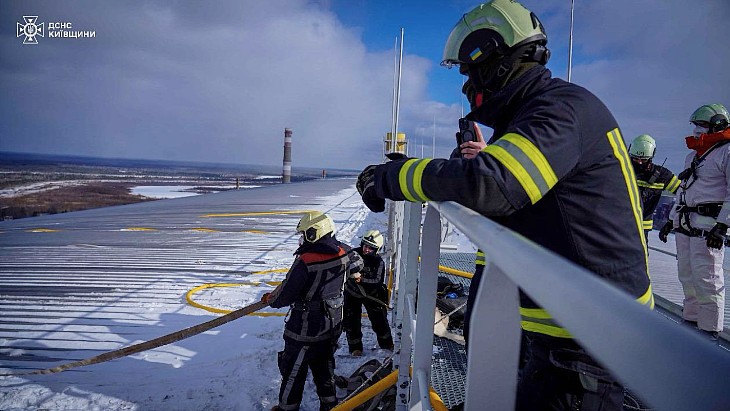
IAEA Director General Rafael Mariano Grossi, in his latest update on the situation, said that since the strike on 14 February Ukrainian experts had used thermal imaging and surveillance drones to locate "smouldering fires in the insulation between the layers of the arch-shaped New Safe Confinement structure, injecting water to put them out".
"The firefighters and other responders are working very hard in difficult circumstances to manage the impact and consequences of the drone strike. It was clearly a serious incident in terms of nuclear safety, even though it could have been much worse. As I have stated repeatedly during this devastating war, attacking a nuclear facility must never happen," he said.
The Chernobyl plant company (ChNPP) said that the external cladding of the arch-shaped New Safe Confinement (NSC) had a 15 square metre area of damage from the drone, with further damage in areas up to 200 square metres. It said there was also damage to the internal cladding filler and to some bolted connections in the structure.
There have been air raid alarms over the past week which have forced the suspension of work on the shelter structure, Grossi said, and on Thursday "an IAEA expert team observed the remains of a drone that Ukraine said were collected following the strike on the NSC. The team observed drone parts that they assessed are consistent with a Shahed-type unmanned aerial vehicle. However, the team did not make any further assessment regarding the origin of the drone".
Elsewhere, the IAEA teams at Ukraine's nuclear power plants have heard air raid alarms on most days. At the Zaporizhzhia nuclear power plant, which has been under Russian military control since early March 2022, a backup 330 kV power line is available again after it was lost for about a week earlier this month - the IAEA team at the site continue to hear explosions - some close to the plant site - as well as machine gun fire earlier this week.
What is the New Safe Confinement?
Chernobyl Nuclear Power Plant's unit 4 was destroyed in the April 1986 accident (you can read more about it in the World Nuclear Association's Chernobyl Accident information paper) with a shelter constructed in a matter of months to encase the damaged unit, which allowed the other units at the plant to continue operating. It still contains the molten core of the reactor and an estimated 200 tonnes of highly radioactive material.
However it was not designed for the very long-term, and so the New Safe Confinement - the largest moveable land-based structure ever built - was constructed to cover a much larger area including the original shelter. The New Safe Confinement has a span of 257 metres, a length of 162 metres, a height of 108 metres and a total weight of 36,000 tonnes and was designed for a lifetime of about 100 years. It was built nearby in two halves which were moved on specially constructed rail tracks to the current position, where it was completed in 2019.
It has two layers of internal and external cladding around the main steel structure - about 12 metres apart - with the IAEA confirming that both had been breached in the incident. The NSC was designed to allow for the eventual dismantling of the ageing makeshift shelter from 1986 and the management of radioactive waste. It is also designed to withstand temperatures ranging from -43°C to +45°C, a class-three tornado, and an earthquake with a magnitude of 6 on the Richter scale.
According to World Nuclear Association, the hermetically-sealed New Safe Confinement allows "engineers to remotely dismantle the 1986 structure that has shielded the remains of the reactor from the weather since the weeks after the accident. It will enable the eventual removal of the fuel-containing materials in the bottom of the reactor building and accommodate their characterisation, compaction, and packing for disposal. This task represents the most important step in eliminating nuclear hazard at the site - and the real start of dismantling".
The wider context
Chernobyl nuclear power plant lies about 130 kilometres north of Ukraine's capital Kyiv, and about 20 kilometres south of Belarus. A 30-kilometre exclusion zone remains around the plant, although some areas have been progressively resettled. Three other reactors at the site, which was built during Soviet times, continued to operate after the accident, with unit 3 the last one operating, until December 2000.
When Russia launched its invasion of Ukraine in February 2022 it rapidly took control of the Chernobyl plant. Its forces remained there until withdrawing on 31 March 2022 and control returned to Ukrainian personnel. The IAEA has had experts stationed at the site as the war has continued, seeking to help ensure the safety and security of the site.
IAEA teams are also in place at Ukraine's three operating nuclear power plants and the Zaporizhzhia nuclear power plant, which has been under the control of Russian forces since early March 2022.
Ukraine has blamed Russia for the drone strike, while Russia denied it was responsible and blamed Ukraine. The IAEA has not attributed blame to either side during the war, with Director General Grossi explaining in a press conference at the United Nations in April last year that this was particularly the case with drones, saying "we are not commentators. We are not political speculators or analysts, we are an international agency of inspectors. And in order to say something like that, we must have proof, indisputable evidence, that an attack, or remnants of ammunition or any other weapon, is coming from a certain place. And in this case it is simply impossible".
Bruce 4 defuelled in record time
The unit's 5,761 fuel bundles were removed in just 24 days, making it the most efficient Candu reactor defuel ever, according to Bruce Power.
_77375.jpg)
Bruce unit 4 began its Major Component Replacement - or MCR - outage earlier this month. It is the third of six units at the Bruce site in Ontario to undergo MCR, which involves removing and replacing key reactor components including steam generators, pressure tubes, calandria tubes and feeder tubes, adding 30-35 years to the reactor's operating life.
The first unit to undergo MCR, Bruce unit 6, took 46 days to complete defueling, and the second - Bruce unit 3 - took 29 days. Each successive MCR has leveraged innovation and lessons learned from the previous projects, said Bruce A Plant Manager Lucas Van Wieringen. "Our private investments in state-of-the-art innovative modifications to improve safety and efficiency of our defuel campaign set our teams up for success," he said. "Our continued focus on proficiency of our workforce and a high-quality schedule through planning and preparation will enable us to continue to build momentum in our Life-Extension Program."
The next major milestone for the Bruce 4 MCR project is the chemical decontamination of the Primary Heat Transport (PHT) system prior to the start of construction activity, which begins with major component disassembly. Lessons learned from the first MCR outage at Bruce 6 led to the development of an innovative approach, with chemical decontamination of the PHT system at low level drain state, before the start of work at Bruce 3. This innovation, which reduces dose rates, will also be applied in unit 4.
The renewed unit will be loaded with new fuel bundles ahead of its restart in 2027.
Bruce Power will see overlapping MCR outages until 2033 in a CAD13 billion (USD9 billion) refurbishment that is one of the largest infrastructure projects in Canada.
Last Energy plans Texan microreactor plant
US microreactor developer Last Energy has announced plans to construct 30 microreactors in Haskell County in northwest Texas to serve American data centre customers across the state.
_96269.jpg)
The company, which said it has obtained site control, plans to build the microreactors on a 200 acre site and will provide power to offtakers via a mix of private wires and grid transmission. Last Energy has already filed for a grid connection with the Electric Reliability Council of Texas and, following briefings with local stakeholders, is preparing to file for an Early Site Permit with the US Nuclear Regulatory Commission.
Last Energy - a founding member of the Texas Nuclear Alliance, which aims to accelerate nuclear deployment across the state - said its plans are in response to overwhelming demand from Texas-based data centre developers over the last year. Of the company's existing commercial agreements, which entail the delivery of more than 80 microreactors across Europe, half will serve data centres. Last Energy's Texas site would increase the company’s development capacity by another 30 units, and enable the development of a commercial pipeline throughout the USA.
The company said its Northwest Texas project will "play a crucial role in adding capacity to the state's grid and meeting the state's data centre deployment projections. Texas is currently home to over 340 data centres which consume nearly 8 GW of power and make up 9% of all Texas electricity demand. In the Dallas-Fort Worth region alone, data centres are expected to drive an additional 43 GW of demand".
Bret Kugelmass, founder and CEO of Last Energy, said: "Texas is America's undisputed energy leader, but skyrocketing population growth and data centre development is forcing policymakers, customers, and energy providers to embrace new technologies. Nuclear power is the most effective way to meet Texas' demand, but our solution - plug-and-play microreactors, designed for scalability and siting flexibility - is the best way to meet it quickly. Texas is a state that recognises energy is a precondition for prosperity, and Last Energy is excited to contribute to that mission."
The company said that, in addition to developing its site in Texas, it is exploring projects in Utah.
Last Energy's announcement was welcomed by Governor of Texas Greg Abbott. He said: "Texas is the energy capital of America, and we are working to be No. 1 in advanced nuclear power. Last Energy’s microreactor project in Haskell County will help fulfill the state’s growing data centre demand. Texas must become a national leader in advanced nuclear energy. By working together with industry leaders like Last Energy, we will usher in a nuclear power renaissance in the United States."
Last Energy is a spin-off of the Energy Impact Center, a research institute devoted to accelerating the clean energy transition through innovation. Its reactor technology is based on a pressurised water reactor with a capacity of 20 MWe or 80 MWt. Power plant modules would be built off-site and assembled in modules.
A Last Energy plant, referred to as the PWR-20, is comprised of a few dozen modules that, it says, "snap together like a Lego kit". The PWR-20 is designed to be fabricated, transported, and assembled within 24 months, and is sized to serve private industrial customers. Under its development model, Last Energy owns and operates its plug-and-play power plant on the customer's site, bypassing the decade-long development timelines of electric transmission grid upgrade requirements.
Earlier this month, Last Energy formally entered the UK's nuclear site licensing process for its plans to develop four 20 MWe microreactors at the site of the decommissioned Llynfi coal-fired power station in Bridgend County, south Wales. It aims to deliver its first microreactor in Wales in 2027, pending the licensing, permitting, and planning processes.
Texas Needs Equivalent of 30 Reactors to
Meet Data Center Power Demand

(Bloomberg) -- Demand on the Texas power grid is expected to expand so immensely that it would take the equivalent of adding 30 nuclear plants’ worth of electricity by 2030 to meet the needs.
That’s according to the Electric Reliability Council of Texas, which manages the grid. The forecast is based on the addition of new data centers needed to power artificial intelligence. And it’s raising concerns about whether infrastructure in the state will be able to expand fast enough — and at what cost.
Coming out of the pandemic, electricity demand on the Texas grid was already growing faster than anywhere else in the country. Now that’s being supercharged by AI, with the state vying to become the data-center hub of the country, if not the world. Individual projects are already starting to request 1 gigawatt of power and they pose new risks to maintaining a stable grid, said Agee Springer, Ercot’s senior manager of grid interconnections. A gigawatt is typically enough to power 250,000 homes in Texas.
The data centers “present a reliability risk to the Ercot system,” said Springer, who spoke on a panel at Infocast’s ERCOT Market Summit in Austin this week.
“We’ve never existed in a place where large industrial loads can really impact the reliability of the grid, and now we are stepping into that world.”
Risk of Grid Stress
Ercot said it’s gotten requests equal to 99 gigawatts for new connections to the grid from big power users, including data centers, bitcoin miners and hydrogen producers, according to an internal grid presentation Thursday. That’s up from 40.8 gigawatts last March.
The state grid is projecting that peak power demand will jump by 75% by 2030 from the current record of 85.5 gigawatts. The outlook was recently revised up sharply to factor in data centers on top of strong demand from the electrification of the economy.
Listen: When a Small Town Gets a Big Data Center (Podcast)
Ercot, lawmakers and regulators are trying to figure out how to bring online data centers without adding stress to the grid, which in extreme conditions increases the chance of blackouts, or if they can be throttled back when needed.
“There can’t be anymore demand than there is supply,” said Beth Garza, a senior fellow at think tank R Street Institute.
Infrastructure Needs
There’s a big question as to whether infrastructure can be built fast enough because of supply chain issues, resulting in long wait times for things like big turbines to produce electricity and other key equipment such as transformers. Another critical issues is who is going to pay for all of this build out.
Data centers make money until power prices reach about $2,000 a megawatt-hour, but the price cap from Ercot is $5,000, Resmi Surendran, vice president of regulatory policy at Shell Energy north America, said on a panel at the summit in Austin. It’s unclear whether data centers are willing to be flexible, but she noted that such ability to ramp and down in response to price signals – known as demand response – could help solve significant problems.
Flexibility from data centers and other big electricity consumers, though, creates another issue: shifting costs for transmission projects to households and smaller businesses. This is because of a program launched about two decades ago that allows the state’s chemical plants, refineries and even Bitcoin miners to reduce or eliminate millions of dollars of contributions for grid upgrades by throttling back their power usage during the highest demand periods of the summer months. Known as four coincident peaks, or 4CP, it was seen as a way to reduce stress on the grid during the hottest times of the year, when electricity is needed to run air conditioners.
But this methodology for socializing costs is “just not right” as reliability risks have shifted, Texas Senator Charles Schwertner said in an interview at the event. A current Texas Senate bill is proposing to reform this.
“We need to make sure the methodology respects all rate payers,” Schwertner said.
©2025 Bloomberg L.P.
Transport disruptions reflected in Energy Fuels' 2024 output
US uranium producer Energy Fuels' 2024 output was affected by the suspension of ore transports from the Pinyon Plain Mine in northern Arizona to the White Mesa Mill in southern Utah from early August until February.
_54777.jpg)
Total production of 158,000 pounds of finished U3O8 (60.8 tU) during 2024 from stockpiled alternate feed materials and newly mined ore was at the lower end of the company's previous guidance of 150,000-200,000 pounds, it said in its 2024 results announcement.
Production at Pinyon Plain began in late 2023, with the ore to be stockpiled at White Mesa ahead of processing. But in early August, Energy Fuels voluntarily suspended transportation of uranium across Navajo lands after the Navajo Nation challenged the legality of the transport following the completion of the first uranium shipment from the project.
In late January, the company signed an agreement with the Navajo Nation, facilitating the transport of uranium ore on the federal and state highways in which it also committed to assist in the cleanup of abandoned Cold War-era uranium mines. Ore transport from Pinyon Plain to White Mesa began again in February.
Ore containing about 208,000 pounds U3O8 was produced at Pinyon Plain during 2024, which was stockpiled at the mine site. Ore containing about 142,000 pounds of U3O8 from the La Sal and Pandora mines was produced and/or delivered to the mill, the company said.
It expects to mine and stockpile ore containing a total of approximately 730,000 to 1,170,000 pounds of U3O8 from the Pinyon Plain, La Sal and Pandora mines during 2025, subject to market conditions, mining rates and other factors, and also said it expects to purchase uranium ore from third-party miners in the region. So-called Alternate Feed Materials and mine cleanup materials, are expected to add a total of about 160,000 to 200,000 pounds of additional contained uranium to ore inventories.
Uranium processing activities from conventional ore inventories and Alternate Feed Materials are expected to result in total finished uranium production of 200,000 to 250,000 pounds U3O8 during the first half of 2025. Combined with existing inventories, this is expected to be sufficient to complete expected uranium sales in 2025, while providing additional material for discretionary sales on the spot market, the company said.
"2024 was a fundamental building year for Energy Fuels, as we resumed US uranium mining, realised profitable uranium sales, achieved commercial US rare earth production, and secured two 'Tier 1' critical mineral projects in allied nations, which upon development, are expected to be able to provide low-cost rare earth feedstocks to our US processing plant, while supporting additional stability, growth, and revenues for decades," President and CEO Mark Chalmers said, adding that Energy Fuels "is now well positioned to take advantage of numerous emerging opportunities in uranium, rare earths, mineral sands, and potentially medical isotopes".
Reactor vessel installed at first Lianjiang unit
The reactor pressure vessel has been installed at unit 1 of the Lianjiang nuclear power plant in China's Guangdong province. It will be one of two CAP1000 reactors planned for the first phase of the plant.
_72820.jpg)
The vessel - which will house the nuclear reactor and is the core of a nuclear power plant - was manufactured by Shanghai Electric Nuclear Power Group and was delivered to the Lianjiang site on 13 February.
With a net weight of about 271 tonnes, the vessel was hoisted into place on 27 February, the Shanghai Nuclear Engineering Research and Design Institute (SNERDI) announced. It noted that during the preliminary preparations for this hoisting, the integrated installation technology for the reactor pressure vessel shell insulation was used for the first time. This, it said, "effectively reduced on-site cross-construction, greatly improved construction efficiency, and provided new technical ideas and reference solutions for the construction of nuclear power projects".
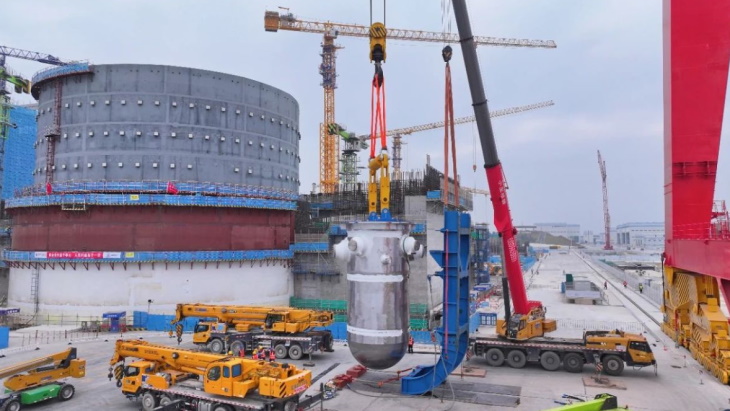
(Image: SNERDI)
SNERDI - a subsidiary of State Power Investment Corp (SPIC) - said that installation of the vessel marks "the beginning of the installation of the main system equipment of the nuclear island and laying a solid foundation for the subsequent main pipeline installation".
The construction of the first two 1250 MWe CAP1000 reactors - the Chinese version of the Westinghouse AP1000 - at the Lianjiang site was approved by China's State Council in September 2022. Excavation works for the units began in the same month, with the pouring of first concrete for the foundation of unit 1 starting in September 2023 and that of unit 2 in April last year. Unit 1 is expected to be completed and put into operation in 2028.
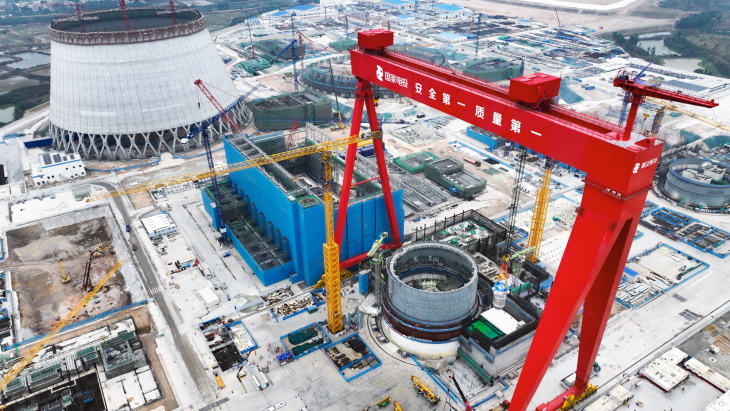
(Image: SNERDI)
Once all six CAP1000 units planned at the site are completed, the annual power generation will be about 70.2 TWh, which will reduce standard coal consumption by more than 20 million tonnes, and reduce carbon dioxide emissions by more than 52 million tonnes, sulphur dioxide by about 171,000 tonnes and nitrogen oxides by about 149,000 tonnes.
SPIC says the Lianjiang plant will be the first nuclear power project in China to adopt seawater secondary circulation cooling technology as well as the first to use a super-large cooling tower.
Siemens Energy to supply turbines for Rolls-Royce SMR
Rolls-Royce SMR of the UK has selected Germany-based energy technology company Siemens Energy as its global turbine systems partner for its small modular reactor. The final contract, detailing all specifics, is expected to be completed by the end of 2025.
_81149.jpg)
Siemens Energy said the partnership agreement is expected to lead to the exclusive supply of conventional technology for future small modular reactors (SMRs). Under this agreement, the company is to be the sole supplier of steam turbines, generators, and other auxiliary systems for Rolls-Royce SMR's planned nuclear power plants.
"Forming an enduring partnership to deliver this key package of work significantly de-risks the programme and strengthens our ability to deliver our SMR," Rolls-Royce SMR said. "This agreement will leverage Siemens Energy UK's existing manufacturing base, and their global presence will ensure we are able to deliver in multiple countries."
Siemens Energy's solutions for nuclear power plants include steam turbines and generators with outputs ranging from 20 MW to 1900 MW, as well as operational control technology and control systems.
"Although Siemens Energy is not directly involved in developing the reactors, its decades of experience in the conventional nuclear sector makes it a natural supplier for such power plants," the company said. "Siemens Energy's portfolio includes steam turbines, generators, and operational instrumentation and control systems that monitor the entire power plant."
"The turbine systems are a vital part of the Rolls-Royce SMR power plant, and we are delighted to be working with Siemens Energy, a global leader in energy systems who have significant experience and a proven track record in nuclear steam turbines," said Rolls-Royce SMR CEO Chris Cholerton. "This partnership will unlock UK jobs and a range of manufacturing opportunities and further cements our position as Europe's leading SMR technology. We are delighted that Siemens Energy will support our capability and enhance our ability to deliver a global fleet of Rolls-Royce SMRs."
Karim Amin, Siemens Energy Executive Board Member, added: "We are currently experiencing a global renaissance of nuclear energy. Numerous countries are turning to nuclear technology to produce zero emission electricity, and small modular reactors will play a key role in this. Siemens Energy brings decades of experience in turbo machinery for power generation applications, while Rolls-Royce SMR has the necessary critical expertise in nuclear applications. This perfect symbiosis enables us to jointly shape the future of energy supply. We are very pleased to be working with Rolls-Royce SMR on this exciting project."
The Rolls-Royce SMR is a 470 MWe design based on a small pressurised water reactor. It will provide consistent baseload generation for at least 60 years. 90% of the SMR - measuring about 16 metres by 4 metres - will be built in factory conditions, limiting on-site activity primarily to assembly of pre-fabricated, pre-tested, modules which significantly reduces project risk and has the potential to drastically shorten build schedules.
UK's SMR selection process 'into final stage'
GE Hitachi, Holtec, Rolls-Royce SMR and Westinghouse have been issued with an Invitation to Submit Final Tenders, with Great British Nuclear saying it remains on track to select the chosen technology before the summer.
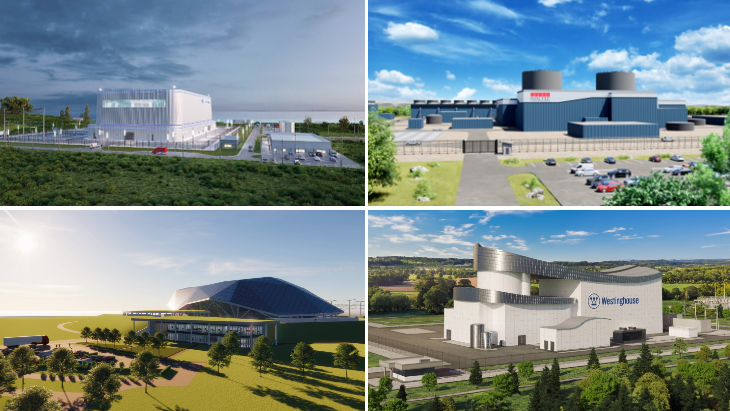
There were initially six companies shortlisted by Great British Nuclear (GBN) - the arms-length body set up to oversee the UK's plans for new nuclear - with the four shortlisted companies entering negotiations last September.
The aim is for GBN to select one or two of the technologies, with the intention of supporting the deployment of multiple units of a company's small modular reactors (SMRs) at a site. GBN currently owns land for potential new nuclear at Wylfa in Anglesey in North Wales, and at Oldbury in Gloucestershire in southwest England, but other sites could also be chosen.
Simon Bowen, GBN chairman, said: "This is an exciting moment for Great British Nuclear and the UK as we reach the final stage of the technology selection process for the Small Modular Reactor programme."
Energy Security and Net Zero Secretary, Ed Miliband, said: "Small modular reactors will support our mission to become a clean energy superpower. That’s why we are backing new nuclear technology to help secure our energy independence and grow the economy."
The background
GE Hitachi is putting forward its BWRX-300, a boiling water reactor, Holtec's SMR-300 is a 300 MWe pressurised water reactor, the Rolls-Royce SMR is a 470 MWe pressurised water reactor and Westinghouse's AP300 is a 300 MWe/900 MWth pressurised water reactor. They all stress that their designs are based on existing technologies and will be able to be constructed at speed and benefit from modular production techniques.
In an interview earlier last year for the World Nuclear News podcast, GBN Chairman Simon Bowen said the intention was to place contracts with one, two or three technology providers - this would be for co-funding the technology all the way through to completion of the design, regulatory, environmental and site-specific permissions process, and the potential to place a contract for the supply of equipment. Each selected technology would have an allocated site with the potential to host multiple SMRs.
The aim had been for a selection decision in 2024 and for a final investment decision to be taken in 2029.
There has since been a change of government in the UK, but it has pledged to continue with the process, although it announced in the Budget that the timeline for the selection decision had slipped to "Spring" 2025, which in the UK lasts from 20 March to 21 June. The timeline for the final investment decision remains unchanged.
Capping of UK repository progresses
Work has begun to place a new protective layer over historic trenches at the UK's Low Level Waste Repository site at Drigg in West Cumbria, Nuclear Waste Services has announced.
_70716.jpg)
The Low Level Waste Repository (LLWR) site has operated safely since 1959. Its role is to ensure that low-level waste generated in the UK is disposed of in a way that protects people and the environment. The repository site receives low-level solid waste from a range of customers, such as the nuclear industry, the Ministry of Defence, non-nuclear industries, educational, medical and research establishments. Legacy disposal trenches and vaults are now full and ready for permanent closure.
Capping is a key part of the disposal lifecycle and work started last year on the Southern Trench Cap Interim Membrane (STIM) which involves placing a new membrane, or protective layer, over the legacy disposal trenches, replacing a current interim membrane. This new membrane will remain in place for up to 100 years. The project also includes placing other construction materials to progress towards the final cap.
Nuclear Waste Services (NWS), which manages the disposal of the LLWR, has now announced the first rail deliveries of aggregate to be used in the protective layer arrived on site earlier this month. Each train making the journey from Shap granite quarry in Cumbria to the repository will deliver over 750 tonnes of material. A total of 280,000 tonnes of aggregate will be delivered over a three-year period, with eight deliveries expected each week.
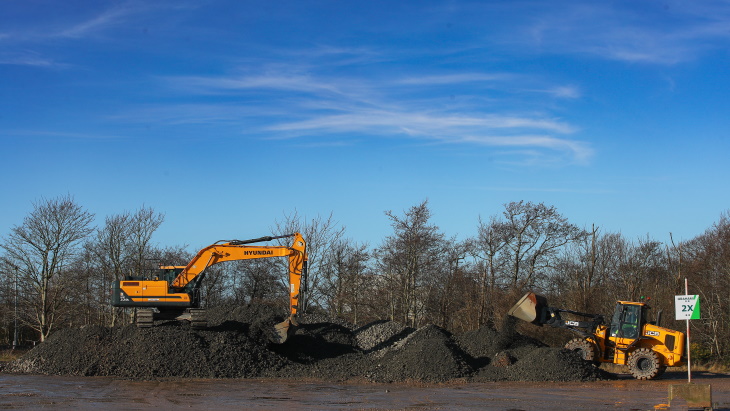
Aggregate at STIM (Image: NWS)
"This is a first-of-a-kind activity in the UK, and it's fantastic to see the first train load of aggregate arrive by train onto our site," said Mike Pigott, Repository Site Director, NWS. "This work enables NWS to deliver a safe and secure long-term approach to protecting the environment and people for generations to come. Collaboration with Nuclear Transport Solutions' rail division, Direct Rail Services, has played a pivotal role for us, with their launch of a new rail service for this project yielding significant environmental benefits."
Nuclear Transport Solutions Rail Managing Director Gottfried Eymer added: "Rail is the obvious choice for bulk movements like these, taking many thousands of lorries off the road, reducing congestion, and improving the environment. This phase of the project will see 46,000 tonnes of aggregate delivered by 64 trains, taking an estimated 2320 lorry journeys, that's over 150,000 miles."
Last year, civil engineering firm Graham was awarded a four-year contract for the works, which started in September.
The final closure of the LLWR is currently expected in 2135, when the completed cap will be 10 metres thick.
EU court's adviser backs Austria over Paks II state aid
The European Court of Justice's advocate-general says Austria's appeal relating to the legality of Hungary's state aid for the Paks II nuclear power project should be upheld by the court.
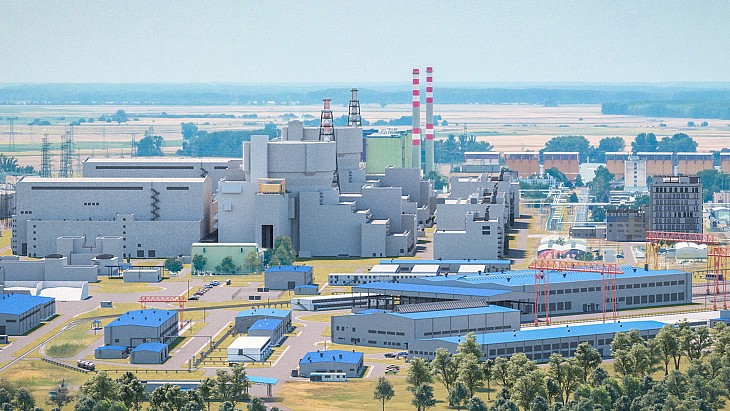
The advocate-general Laila Medina says that "Austria is correct in arguing that the Commission, when assessing the aid at issue, should have examined whether the direct award to Nizhny Novgorod Engineering of the contract for the construction of the new reactors is compatible with the European Union’s provisions on public contracts".
The opinion of the advocate-general is not binding on the court - the role is "to propose to the court, in complete independence, a legal solution to the cases for which they are responsible. The judges of the court are now beginning their deliberations in this case. Judgment will be given at a later date".
What is the issue?
In 2017 the European Commission approved Hungary's proposed state aid investment for two new nuclear reactors at the Paks II site, with the construction contract awarded to Nizhny Novgorod Engineering Company Atomenergoproekt (JSC NIAEP) as part of the agreement with Russia which also included Russia agreeing to provide Hungary with a state loan in order to finance the new reactors.
Austria contested that Commission decision, but in 2022 the General Court of the European Union dismissed their case, leading to the current appeal. The advocate-general has now said there was an "inextricable link" between the aid and the construction contract's award and "the Commission is required to take into account, in assessing the compatibility of State aid with the internal market, a possible infringement of provisions of EU law other than those relating to aid".
Although the Commission "may fulfil its obligation to carry out such an examination by referring to infringement proceedings that it has initiated against the Member State concerned and that it has closed after finding that there was no infringement of the relevant provisions" it had "made a mere reference, without setting out, in the contested decision, the considerations which had led it to find that there had been no infringement, that decision did not provide a sufficient statement of reasons on that issue".
The General Court ruling 2022 had said the commission was justified in its view that "it had found that the direct award of the task of constructing the two new reactors to JSC NIAEP did not infringe EU public procurement law".
The Paks II project
The Paks plant, 100 kilometres south of Budapest, currently comprises four Russian-supplied VVER-440 pressurised water reactors, which started up between 1982 and 1987. An inter-governmental agreement was signed in early 2014 for Russian enterprises and their international sub-contractors to supply two VVER-1200 reactors at Paks as well as a Russian state loan of up to EUR10.0 billion (USD10.5 billion) to finance 80% of the project.
The construction licence application was submitted in July 2020, the construction licence was issued in August 2022 and a construction timetable agreed in 2023. First concrete is expected this year, with a target to connect the new units to the grid at the beginning of the 2030s.
Austria, which shares a border with Hungary, has no nuclear power plants. It also launched legal action against the Commission in 2015 over its approval of the UK's support for the Hinkley Point C nuclear power plant project in Somerset, England. The General Court dismissed that lawsuit in July 2018 saying the Commission "did not err" in accepting the UK's stance that construction of the plant was in the British public's interest.
Foreign Minister Peter Szijjarto posted on Facebook on Thursday afternoon that he had spoken on the phone with Rosatom's Director General Alexei Likhachev and said the project was of "critical importance to Hungarian energy security" and was going on "despite constant difficulties and obstacles". Szijjarto, who repeated Hungary's determination to block sanctions affecting the nuclear energy industry, did not specifically refer to the court case in the post which also said "Brussels is constantly trying to hinder our energy cooperation with Russia".
Curtiss-Wright wins Natrium contracts
Curtiss-Wright Corporation has been awarded two contracts to design and supply plant simulation and digital control solutions for TerraPower's Natrium advanced nuclear reactor.
_50685_32698.jpg)
The contracts cover the design and delivery of the Training Simulator and the Distributed Control System for the Natrium plant. The Training Simulator is a full-scope simulator that will replicate plant equipment and simulate system conditions and operations to support operator training and licensing. The Distrbuted Control System is a digital platform that serves as a core component for automating control and operation of plant processes.
The company has also been selected to develop control systems for the plant's nuclear island and its energy island. Previously, Curtiss-Wright has been selected to develop the Reactor Protection System for the Natrium plant, and the software platform and engineering services for the Natrium Engineering Simulator.
The Natrium reactor is a 345 MW sodium fast reactor coupled with a molten salt energy storage system and can simultaneously both carbon-free electricity, heat and steam to support decarbonisation of power and industrial sectors. The first reactor is being built in Kemmerer, Wyoming and TerraPower experts its first Natrium plant to be on line in 2030
Podcast: India's plans for large-scale nuclear energy expansion
India is planning to expand nuclear capacity from 7 GW to 100 GW by 2047, with legislative changes, international partnerships and development of indigenous technology all set to play their part.
Retired diplomat, author and distinguished fellow of the Vivekananda International Foundation - and coordinator of the foundation task force's report on the energy transition in India - Ambassador D.P. Srivastava joins us to discuss developments - and suggests that the 100 GW capacity figure could just be the start. He also says that progress on the Prototype Fast Breeder Reactor at Kalpakkam is set to continue this year after fuel loading, with the technology set to have a key role, given India's large thorium reserves.
The past few weeks have seen Minister of Finance Nirmala Sitharaman's budget speech promising amendments to Indian legislation - the Atomic Energy Act and the Civil Liability for Nuclear Damage Act - to encourage private sector participation in nuclear projects, including partnering on the development of the Bharat Small Modular Reactor, a compact 200 MW pressurised heavy water reactor.
Since then, Indian power companies Tata Power and the Naveen Jindal Group have expressed interest in setting up small modular reactors and Vedanta has put out a Global Invitation for an Expression of Interest to build and operate 5000 MWe of nuclear capacity in India. Prime Minister Narendra Modi has also signed cooperation agreements with France's President Macron and US President Donald Trump.
Srivastava says the motivation for new nuclear in India is driven by three factors - economic development, energy security and meeting the country's 2070 net-zero climate goal. He says that public opinion and political opinion is generally favourable to the idea of new nuclear. He also sees export potential in the future.
All these developments helped put nuclear firmly in the mix at India Energy Week in February. World Nuclear Association Director General Sama Bilbao y León was there and she gives her reflections on the event, which included Prime Minister Modi talking about new nuclear. She says it is clear India is serious about international collaborations, and that the country will have an important role for the global nuclear industry in the years ahead.
Listen and subscribe on all major podcast platforms:
World Nuclear News podcast homepage
Apple
Spotify
Amazon Music
Youtube Music
Episode credit: Presenter Alex Hunt. Co-produced and mixed by Pixelkisser Production
Holtec and Hyundai E&C target 10 GW SMR fleet after Palisades
Holtec International has officially launched its Mission 2030 project for two of its small modular reactors at the Palisades site in Michigan - and signed an expanded construction agreement with South Korea's Hyundai Engineering & Construction.
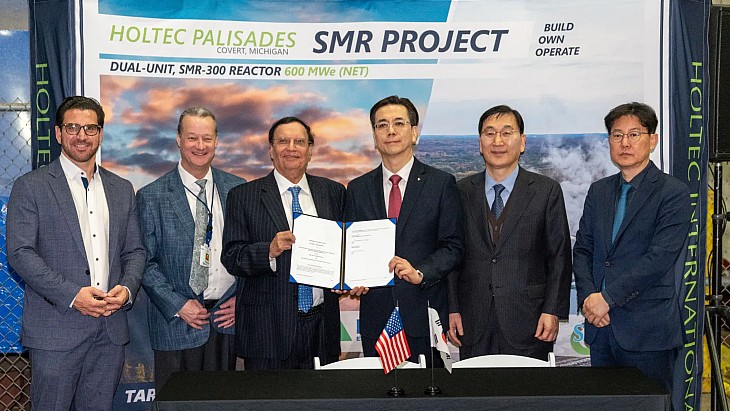
The Palisades SMR-300 project, announced in 2023, targets 2030 for first commercial operation, with Holtec saying that USD50 million has been invested so far in site selection and development activities, such as detailed environmental studies and soil borings.
Holtec has been developing deployment plans for its small modular reactors (SMRs) in various countries, including for up to 5 GW of capacity in the UK and for multiple units in Ukraine. It says the Palisades project will become the "global reference point for deploying this next generation nuclear technology".
Holtec said it remains on target to start the formal US Nuclear Regulatory Commission construction permitting process early in 2026, and has now also signed a wider partnership agreement with Hyundai E&C to enable the rapid scaling of the SMR-300 programme following the first-of-a-kind project at Palisades "to build a 10 GW fleet of SMR-300s in North America through the 2030s".
Hyundai E&C said it planned to complete site design in the second quarter of 2025 and begin construction "around the end of this year".
Kris Singh, Holtec CEO, said: "Hyundai E&C has the most distinguished credentials as a constructor of nuclear power plants ... our own vertically integrated supply capability and a world-class project management organisation, which has established a solid track record of completing numerous complex projects around the world without cost overruns, gives us the confidence that our Mission 2030 will be realised in full measure. We should also recognise our long-term ally and the third pillar of our SMR coalition, Mitsubishi Electric, whose state-of-the-art control system will be deployed in the SMR-300 plants."
Hyundai E&C CEO Han-Woo Lee said: "Hyundai E&C has established its US subsidiary, Hyundai America Inc, and has been making diversified investments in US power projects and SMR-300 technology. To ensure the successful completion of this project, we will work closely with the US government and leading local companies to build a systematic supply chain, create and develop high-quality jobs in the US, and develop strategies for mutual growth with local communities, ultimately pioneering a new era in the global SMR industry."
The background
Holtec has been developing its SMR unit since 2011. The SMR-300 is a pressurised water reactor producing around 300 MW of electrical power or 1050 MW of thermal power for process applications, and the company says it has undergone several design evolutions, the most recent of which is the incorporation of forced flow capability overlayed on gravity-driven flow in the plant's primary system.
The Palisades nuclear power plant was shut down by Entergy in May 2022 after 50 years in service. The 805 MWe (net) reactor was defuelled that June, and its sale to Holtec was completed later that same month with decommissioning envisaged for completion in 2041.
However Holtec then announced plans to apply for federal funding - which it later got - to enable it to reopen the plant. It also signed a long-term power purchase agreement with Michigan non-profit Wolverine Power Cooperative to purchase two-thirds of the power generated from a reopened Palisades, with Wolverine's partner Hoosier Energy, which supplies member electric cooperatives across Indiana and Illinois, purchasing the balance. Holtec says it hopes to restart the plant before the end of 2025.
Spanish nuclear industry calls for rethink of phase-out policy
Companies representing the Spanish nuclear industry have signed a manifesto calling for the long-term operation of the country's nuclear power plants. Under current plans, Spain's power reactors are all scheduled to shut by 2035.
_79407.jpg)
Spain's seven operating nuclear power reactors - Almaraz I and II, Ascó I and II, Cofrentes, Trillo and Vandellós II - generate about 20% of its electricity. Under the country's nuclear phase-out plans, agreed in 2019, four reactors are scheduled to close by the end of 2030, while the remaining three reactors will shut by 2035.
The manifesto - signed by 32 companies, including Empresarios Agrupados-GHESA (EAG), Framatome, GDES, GE Vernova, IDOM and Westinghouse - says: "We urge the initiation of a dialogue and renegotiation of the 2019 agreement on the phased shutdown of nuclear power plants. This agreement was made under an industrial, geopolitical, social and economic context that is vastly different from today's reality.
"Our industrial network must not see its competitiveness reduced due to the decision to shut down nuclear power plants starting in 2027, beginning with the Almaraz nuclear power plant, without first securing a viable alternative involving all CO2-free energy sources."
The signatories call on the Spanish government and relevant authorities to revise the National Integrated Energy and Climate Plan to incorporate measures ensuring the continuity of nuclear energy. "This energy source must be recognised as reliable, efficient and competitive, with low carbon emissions, and should receive fair treatment to encourage investment," they say.
The companies say that extending the operation of Spain's nuclear power plants "would ensure the sustainability of our increasingly demanding energy system without jeopardising security of supply or the expansion of renewable infrastructures. Additionally, it would reinforce geostrategic independence from other nations".
However, the manifesto notes that to achieve this "it is crucial to ensure the economic viability of nuclear power plants, with a special emphasis on the excessive tax burden imposed on the sector".
Spanish nuclear power plants, it says, have been modernised and are capable of operating for many more years, "up to 60 or even 80, in line with global trends".
The document notes the auxiliary industry that supports Spain's nuclear sector generates nearly 20,000 stable, highly-skilled jobs including engineering firms, component manufacturers and support services. "The premature dismantling of these infrastructures would deal an irreparable economic and social blow to the regions where they operate," it says.
"The early closure of nuclear power plants will entail a high environmental and economic cost, affecting citizens and destroying thousands of jobs in the industry and associated sectors. Additionally, it will cause an irreparable loss of technological resources and human capital, weakening the country's ability to maintain a competitive and sustainable energy infrastructure."
Earlier this month, the Plenary Session of the Spanish Congress approved a proposal calling for the government to implement a series of measures that would reverse the country's decision to phase out nuclear power. The proposal, presented by the right-wing People's Party, was passed on 12 February, with 171 votes in favour, 164 against and 14 abstentions.

No comments:
Post a Comment