Maersk Maps India Investment Strategy as it Names Boxship in Mumbai
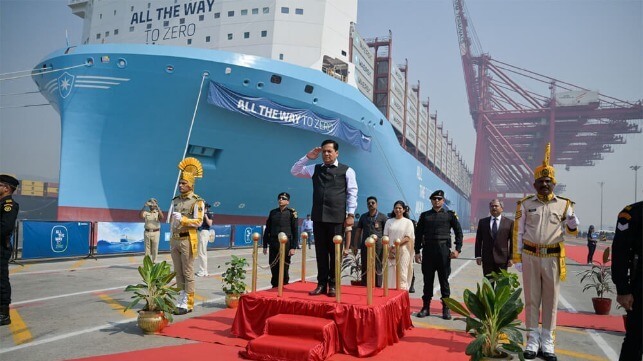
Maersk celebrated the naming of its eleventh dual-fuel methanol containership today, February 28, in Mumbai, India. It was Maersk’s first-ever naming ceremony in India and coincided with the company mapping out an investment opportunity pipeline of $5 billion in ports, terminals, and landside infrastructure development in India.
The company has been using the rollout of its fleet of methanol containerships to build global relations and highlight its leadership in future technologies for shipping. The newest vessel named Albert Maersk was celebrated at APM Terminals Mumbai. Serving as godmother for the vessel was Raksha Nikhil Khadse, Minister of State for Ministry of Youth Affairs and Sports.
The ship is part of the fleet being built by Hyundai Heavy Industries in Ulsan, South Korea. She has a rated capacity of 16,592 TEU, including 2,000 refer plugs. The vessel, which measures 350 meters (1,148 feet) can sail up to 23,000 nautical miles on methanol with two fuel tanks providing a total methanol capacity of 16,000 cbm.
“It is a privilege for India to host the naming of this advanced dual-fuel vessel, a historic first for a foreign shipping company in our country,” said Sarbananda Sonowal, India’s Minister of Ports, Shipping and Waterways. “With the demand for green vessels rising, India has the potential to become a major producer and supplier of green methanol, ammonia, and hydrogen-based fuels. Maersk’s decision to focus on green fuel production in India is a welcome step that will accelerate our journey towards a sustainable maritime future.”
As part of this week’s events, A.P. Moller – Maersk Chair Robert Maersk Uggla and APM Terminals CEO Keith Svendsen met India’s Prime Minister Narendra Modi to further discussions and the company’s future investments. Maersk reports it sees an investment opportunity pipeline of about $5 billion in India.
“Maersk looks forward to partnering with India on various aspects, such as exploring the potential sourcing of alternative fuels for low-emissions shipping and activities involving ship repairs and shipbuilding in the future,” reports the company. It highlights that the opportunities align well with the Indian Government’s ambitions to promote the shipping sector.
The company reports it facilitates the movement of one in every six containers imported or exported from India currently. APM Terminals has operations in Mumbai and Pipavav that handle over three million containers every year. The company also has 26 warehouses and a wide-reaching distribution network in India.
Report: HD Hyundai is Shopping for an Indian Shipyard

The Indian media is reporting that South Korea’s HD Hyundai is actively pursuing opportunities in India as it looks for either a location for a yard or a partnership arrangement. It coincides with a larger effort by the Indian government to make the country into a world-class shipbuilder.
A delegation from the South Korean shipbuilder was reported by The Times of India to be touring the country’s facilities and talking with different domestic shipbuilders. The newspaper links the Koreans to L&T among other companies for a possible partnership. In addition, it reports that the South Koreans are spurring competition among the Indian states to attract the possible investments as it assesses potential sites for a shipbuilding facility.
According to the newspaper, the visit by the delegation from Hyundai was in response to a visit by the Indians to South Korea in December. The paper reports India’s Ports and Shipping Ministry secretary T.K. Ramachandran led a delegation to meet with the three largest South Korean shipbuilders. They expressed the government’s interest in collaboration opportunities.
India’s Prime Minister Narendra Modi has declared plans to establish India on the international stage for shipbuilding. The government has said it will be a critical industry for the future while also citing the benefits of reducing international expenses while boosting foreign trade and increasing earnings from the international economies. India, the government declared, will rank among the top 10 shipbuilders by 2030 and the top five by 2047.
HD Hyundai which is the largest in South Korea continues to face strong competition from the Chinese shipbuilders. The South Koreans reported strong profitability in 2024 despite rising costs and capacity limits which see order slots full till at least 2026 or beyond. Hyundai attempted foreign partnerships in the past, including in the Philippines, without success.
The company is mapping its long-term strategy focusing on automation and green technology orders. For its shipyard, it looks to dramatically increase productivity. The company in 2021 launched its plan for the shipyard of the future and cites its use of the latest technologies including AI and digital twins as it seeks to increase productivity and safety.
This week its partner in the shipyard of the future, Palantir Technologies released a video in South Korea highlighting the efforts to create an automated shipyard. Hyundai is quoted as saying it will increase productivity by 30 percent in shipbuilding while also cutting production time for new ships by 30 percent. The goal is to complete the Future of Shipyard project by 2030.

No comments:
Post a Comment