Petrobras to Triple LPG Fleet Capacity and Support Brazilian Shipbuilding
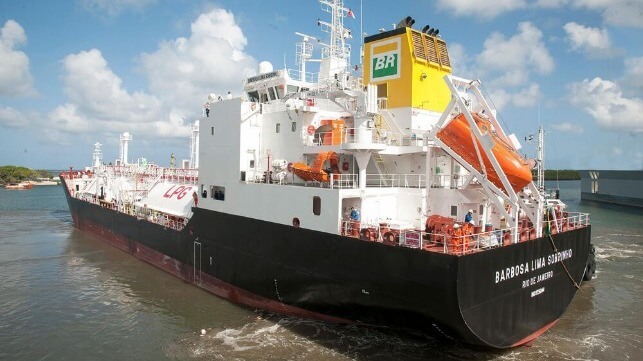
Transpetro the shipping arm of Brazil’s energy major Petrobras (Petróleo Brasileiro) announced ambitious growth plans for its LPG fleet and its entry into ammonia transport at an event that also highlighted support for Brazil’s shipbuilding industry. President Luiz Inácio Lula da Silva, Vice President Geraldo Alkmin, and the Minister of Mines and Energy, Alexandre Silveira, attended to demonstrate the government’s commitment to the maritime, shipbuilding, and energy sectors.
Two initiatives were announced during the Brazilian Naval and Offshore Industry Business Fair with the federal government saying it will foster new opportunities in the sector. Petrobras CEO Magda Chambriard said the new initiative was in line with the gradual increase in natural gas production while predicting it would boost job creation and expand participation of Brazilian industry in the maritime and offshore sectors.
“We will consolidate Transpetro as the largest Brazilian shipowner in gas transportation, strengthening the company in a segment that is of great importance to the Petrobras System and all of Brazil,” announced Transpetro CEO Sérgio Bacci. He said it was part of the broader plan to renew and expand Transpetro’s fleet and provide less exposure to vessel charters.
The effort calls for increasing the number of vessels in the gas tanker fleet from six to 14 and increasing the transport capacity from 36,000 to 108,000 cubic meters. The companies launched a tender for eight new gas carriers split into two tenders. The first is for five vessels, with three vessels with a capacity of 7,000 cubic meters and two with a capacity of 14,000 cubic meters. These gas carriers will be pressurized and intended for the transport of LPG and derivatives. The second tender is for three semi-refrigerated vessels with a capacity of 10,000 cubic meters which would be the first for the company capable of transporting ammonia.
The design of the vessels calls for them to be 20 percent more efficient in fuel consumption which they said would reduce greenhouse gas emissions by 30 percent. They also need to be able to operate in electrified ports. Companies have 90 days to submit their bids but they can only win one of the two tenders.
The tender calls for the first of the vessels to be delivered within 30 months after the contract is finalized. The others should be delivered at six-month intervals.
Petrobras highlights it is a continuation of its newbuilding program which began in July 2024. In January, the company contracted for four new handy class tankers. At the end of last year, the company also contracted for 12 new support vessels (PSV) to transport equipment to its offshore locations. Petrobras plans to also hire 20 new vessels, including 10 for emergency support and response (OSRVs), eight for inspections (RSVs), and two for platform anchoring (AHTS). Petrobras is requiring 40 percent local contact in the construction of the OSVs to ensure the participation of Brazilian companies.
The company also said that it plans to decommission 10 platforms by 2029. They are now exploring the reuse of these units as they said it could reduce logistics costs, strengthen the supplier base, and promote sustainable business practices.
The new vessels are part of a group of 25 ships that Petrobras plans to add between 2025 and 2029. They noted that 16 have already been contracted. Transpetro reports in addition to the six gas carriers, it currently has 16 crude oil tankers, five product tankers, and nine shuttle tankers, making it the largest multimodal oil, derivative and biofuel logistics company in Latin America.
Petrobras Gears Up for Offshore Boom
Petrobras is beefing up its offshore game, throwing four more support vessels into the mix by 2026—bringing the grand total to 48. Brazil’s state-run oil company is gearing up to boost production to 2 million barrels per day (bpd) at the Buzios field by 2030, cementing Brazil’s status as an offshore oil heavyweight.
Petrobras has faced challenging times in recent months. In Q4 2024, Petrobras’ production took a 10.5% hit, sliding to 2.63 million barrels of oil equivalent per day (boe/d), thanks to maintenance shutdowns. Exports tanked 22% year-over-year. The trade winds are shifting too—China’s share of Petrobras’ exports shrank to 30%, down from 44%, while Europe’s slice of the pie grew from 28% to 38%. The message? The global oil chessboard is always in motion.
Petrobras is now preparing its next move. The company trimmed its 2025 capital expenditure to $17 billion from $21 billion, but over the next five years, it’s still throwing $111 billion into the mix, including $77 billion, which is earmarked for oil and gas exploration and production activities. That’s a whole lot of cash aimed at keeping its foothold in Brazil’s oil game.
And Petrobras isn’t the only one making power plays. Private oil firms in Brazil are set to boost production by 75% by 2030, according to Wood Mackenzie. Heavy hitters like Shell, Equinor, TotalEnergies, and Repsol Sinopec Brasil are piling into Brazil’s pre-salt fields, chasing that sweet, low-sulfur crude.
A pre-salt field is a geological formation where oil was deposited before the salt layer formed, creating a reservoir protected from escaping to the surface.
Meanwhile, oil prices are doing their usual dance—Brent is hovering around $73.32 per barrel, while WTI is at $69.91. With Petrobras fortifying its fleet, cranking up Buzios, and facing stiffer competition, Brazil’s offshore showdown is just getting started. Buckle up.
By Julianne Geiger for Oilprice.com

No comments:
Post a Comment