Indira Gandhi And The Years That Transformed India – Book Review
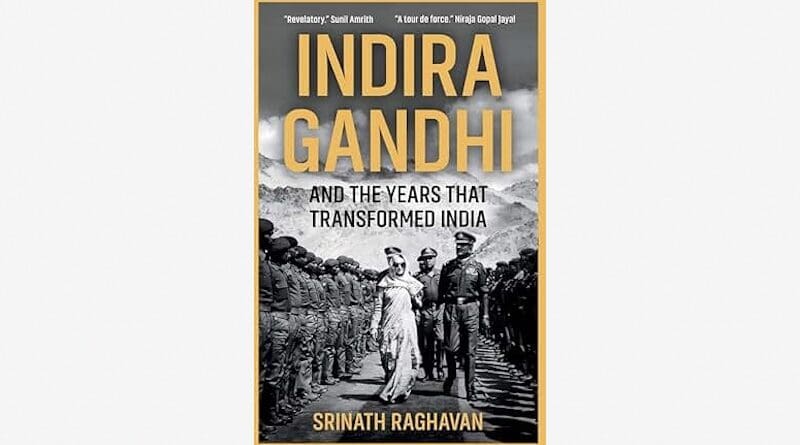
"Indira Gandhi and the Years that Transformed India" by Srinath Raghavan
An incisive new book “Indira Gandhi And The Years That Transformed India” by leading historian Srinath Raghavan explodes myths about India working to a grand plan to break up Pakistan in 1971 — claims made often by admirers of Indira Gandhi and by Pakistanis.
Raghavan’s book, published by Penguin and acclaimed by leading experts as an accurate portrayal of Indira Gandhi’s long years at the helm, details the great caution with which Indira Gandhi started handling the first major international crisis of her political career.
“In the aftermath of the war , Indira Gandhi would be credited with exceptional foresight, impeccable timing and unerring judgement – all of which would add to her political charisma. Yet her handling of the developing situation was tentative and improvisatory… her instinctive caution was reinforced by Haksar (her principal aide). Although their sympathies lay with the Bengalis, Indira Gandhi and Haksar believed India as a state had to walk warily.“
Raghavan notes in some detail the huge domestic pressure on Indira Gandhi to act decisively in support of the Bengali Liberation struggle cutting across the political divide. Inspite of these pressures, the Indian Prime Minister tried her best to get international support to force Pakistan’s military junta to stop the genocide and take back the vast numbers of Bengali refugees who had fled into eastern and northeastern states of India. Only when Pakistan refused to stop the genocide on the Bengalis and the flow of refugees remained unabated, did Indira Gandhi start to consider the military option.
Not only was the financial burden for maintaining the refugees taxing India’s fragile economy, which was still dependent on foreign aid, but the presence of the refugees was fraught with consequences dangerous for India.
By October 1971, the projected cost of maintaining the 9 million refugees was Rs 5250 million, while the quantum of external aid was only Rs 1125 million.
At one point, observes Raghavan, Indira Gandhi’s advisers had even projected a possible need for pushing for a moratorium on external debt repayment to shore up resources to handle the refugee crisis.
It is at that time, says Raghavan, that Indira Gandhi seriously started considering war against Pakistan.
“The government realised that a prolonged crisis would push the problem to unmanageable proportions. While war would entail significant costs, these would be more bearable than the burden posed by the refugees.”
Raghavan observes that many in Delhi’s policy making circles feared that ultra Leftists in both Bengals could join hands to take over the leadership of the Liberation struggle, what with West Bengal reeling under an intense bout of Naxalite armed activism. Indira’s decision-making circles also factored in the possible demographic fallout as a result of the presence of too Bengali refugees not going back anytime soon that could spark nativist upheavals in India’s Northeastern states, many of which were already facing intense ethnic insurgencies.
Raghavan rightly observes that the emerging power equations with US drawing close to China and both backing Pakistan strongly pushed Indira into a now-or-never desperate situation where military intervention to create an independent Bangladesh was the only option to send back ten million Bengali refugees. Even the Soviet Union, with whom a treaty of friendship had been signed to counter the Sino-US nexus, was keen to avoid war or a breakup of Pakistan, until Indira Gandhi made it clear to the Russian leaders that she had no choice.
But once she decided on military intervention, Indira Gandhi was on a no-holds barred mode. The Indian army, with huge support from the Bengali freedom fighters of ‘Mukti Bahini’, infiltrated deep into East Pakistan to create launchpads for the final assault once war was declared. The tank battle at Garibpur inside East Pakistan on 21-22 November 1971 involving a full detachment of India’s 45th Cavalry and an Infantry battalion points to the deep infiltration a good two weeks before the formal declaration of war.
Raghavan’s detailed analysis of how Indira Gandhi handled the Bangladesh crisis clearly points to one enduring reality — that India has been a defensive, status quo power that seeks to avoid conflict unless left with no other options.
Despite its ultra-nationalist Hindutva ideology, both the BJP’s Prime Minister’s, late Atal Behari Vajpayee and the current PM Narendra Modi have reached out to Pakistan with an olive branch to its political leadership, only to thwarted by the military adventurism of the Pakistan army, which sees conflict with India as one sure way to reinforce its control of the nation’s polity.

Subir Bhaumik
Subir Bhaumik is a former BBC and Reuters correspondent and author of books on South Asian conflicts.

No comments:
Post a Comment