The MSC Elsa 3 Disaster Off Kerala’s Maritime Coast: Causes And Consequences – Analysis
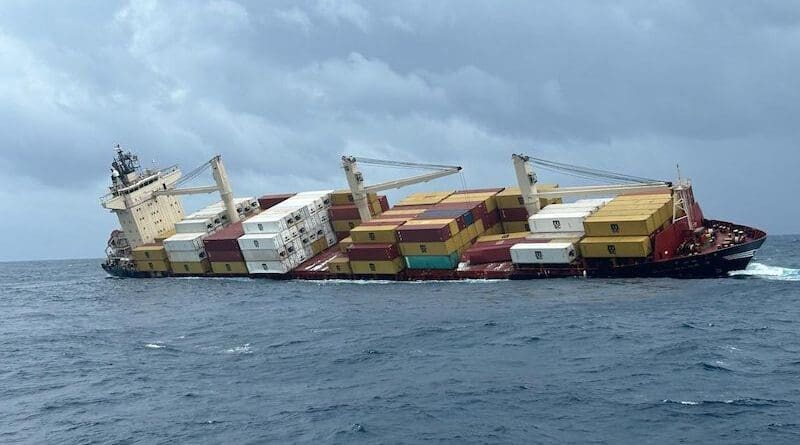
At the time of the incident, MSC ELSA 3 was carrying 640 containers. Photo Credit: Ministry of Defence, Government of India
By K.M. Seethi
The capsizing and subsequent sinking of the MSC Elsa 3 on May 25, 2025, just 14.6 nautical miles off the Kerala coast, was not a routine maritime mishap. It revealed the fragility of a system where shipping operations, environmental protections, and regulatory mechanisms often function in silos.
With 640 containers on board—13 of which held hazardous materials—and over 450 metric tonnes of marine fuel, the vessel’s sinking released a potent mix of commercial cargo and environmental toxins into one of India’s most ecologically sensitive and densely inhabited coastal regions. While Kerala Chief Minister Pinarayi Vijayan declared the episode a “state-specific disaster,” its implications go far beyond temporary relief and isolated cleanup. What transpired was a telling example of the growing mismatch between the expansion of global maritime commerce and the underprepared infrastructure and oversight mechanisms of coastal states like Kerala.
This disaster came in the context of intensified maritime activity following the inauguration of Vizhinjam International Deepwater Multipurpose Seaport Port and increased vessel traffic through Kerala’s maritime corridor. It lays bare the tensions between developmental ambitions and ecological fragility, highlighting systemic failures in global shipping regulation, vessel maintenance standards, and the enforcement of international maritime law. The episode also reveals gaps in India’s preparedness for complex maritime emergencies involving hazardous substances, raising questions about coastal strength and institutional accountability. Moreover, this is not an isolated incident but part of a worrying pattern of increasing maritime casualties involving aging vessels, flag-of-convenience registrations, and insufficient global oversight. What follows from this event is not merely a set of localized consequences but an emblem of broader systemic inertia that afflicts global maritime governance.
A Captain’s Warning: Ageing Fleets and Flags of Convenience
In the wake of the MSC Elsa 3 disaster, a merchant ship captain with over 25 years of international experience shared with this writer his valuable insights into persistent structural problems in the global shipping industry. While he did not comment on the specifics of the MSC Elsa 3, his observations drew attention to the broader systemic vulnerabilities linked to ageing vessels and regulatory evasion.
According to him, cargo ships that cross the 25-year threshold must undergo mandatory annual certification of service, alongside rigorous safety inspections. These procedures are designed to ensure that critical operational systems—such as hull integrity, propulsion, fuel systems, and onboard safety mechanisms—meet internationally accepted standards. However, to bypass these costly and time-consuming procedures, many shipowners resort to “reflagging” their vessels in jurisdictions known for lenient oversight.
This practice of operating under “flags of convenience” allows companies to register ships in countries like Panama, Liberia, and the Marshall Islands—nations with open registries and minimal enforcement of safety, labour, and environmental regulations. The captain stressed that many of the ships flying such flags would not pass the inspection protocols applied by stricter maritime authorities, such as those in the European Union, Japan, or the United States. Yet, under current international law, they continue to operate legally, albeit with diminished accountability.
The implications are far-reaching. These reflagged vessels are often older, poorly maintained, and prone to technical failures, posing a disproportionate risk to marine ecosystems and coastal communities. When accidents occur, such as leaks of bunker fuel or hazardous cargo, shipowners often avoid legal liability by exploiting the ambiguity of jurisdictional responsibility and the limited enforceability of transnational maritime regulations.
This loophole in global governance is compounded by uneven enforcement mechanisms and the limited authority of port state control regimes in many developing countries. While classification societies—entities responsible for certifying ships as seaworthy—exist to ensure compliance, many operate without stringent third-party audits, leading to potential conflicts of interest. The cumulative result is a global shipping network where operational expediency often trumps environmental and human safety.
The insights from this experienced seafarer serve as a crucial reminder: maritime safety is not merely about navigation or weather—it is deeply entangled with the political economy of global trade, regulatory evasion, and an under-resourced system of international accountability.
Environmental and Economic Fallout in Kerala
The sunken vessel posed an immediate ecological threat to Kerala’s unique coastal ecosystem. While no large-scale oil spill has yet been confirmed, the presence of 367.1 tonnes of Very Low Sulphur Fuel Oil (VLSFO) and 84.4 tonnes of Marine Gas Oil (MGO) on board the ship remains a ticking environmental time bomb. Also, the cargo included calcium carbide and other hazardous materials, which, if leaked, could severely contaminate marine habitats.
Kerala’s coastline supports a dense population and a thriving fisheries economy. The state accounts for roughly 15% of India’s marine fish production, employing more than a million people directly and indirectly. A marine pollution incident of this magnitude could devastate breeding grounds, especially during the southwest monsoon when nutrient flows and spawning cycles are in full swing. Already, the region has witnessed shoreline plastic contamination in the past—often from sunken containers—which can disrupt coral reefs, entangle marine fauna, and introduce microplastics into the food web.
With preliminary assessments by the Indian Coast Guard showing no oil slick as yet, the threat has not passed—it has only moved underwater. Surveillance aircraft and pollution control vessels may offer short-term reassurance, but long-term environmental monitoring and an independent ecological impact assessment are crucial to ensure accountability. Kerala’s coastline, already vulnerable to climate-induced erosion and flooding, cannot afford cumulative stressors from maritime neglect.
Kerala’s coastal ecology has long been under pressure from industrial expansion, sand mining, port construction, and tourism. The MSC Elsa 3 disaster aggravates this fragile balance. Early assessments by the Kerala State Pollution Control Board and the National Centre for Coastal Research suggest the spillage of marine fuel and leakage from hazardous containers has already affected marine biodiversity in the region. Toxic residues, plastic pellets, and fuel slicks have begun washing ashore across multiple districts, raising fears of long-term damage to spawning grounds and coral reefs.
The disaster’s economic fallout is no less severe. Kerala’s fisheries economy, which contributes over ₹7,000 crore annually to the state’s GDP and employs more than one million people directly or indirectly, faces disruption from bans on fishing activity in affected waters. Several fishers’ cooperatives have reported a collapse in daily income, while marine exporters fear an embargo due to contamination concerns. The timing couldn’t be worse: the incident coincided with the pre-monsoon season, when fishing activity traditionally peaks. The event also raises red flags for Kerala’s fledgling coastal tourism sector, particularly in areas like Kovalam and Varkala.
Regulatory and Zoning Failures
At the heart of this disaster lies the absence of an effective maritime zoning framework that delineates shipping lanes, ecological reserves, and exclusion zones. Despite repeated calls from environmental scientists and coastal planners, no binding mechanism exists to keep hazardous maritime activity away from high-risk ecosystems and fishing grounds along India’s southwest coast. The lack of real-time vessel monitoring, poor enforcement of speed and anchorage restrictions, and absence of contingency planning for port-adjacent spills exemplify regulatory apathy.
There have been earlier warnings. A 2020 study by the Integrated Coastal and Marine Area Management (ICMAM) project under India’s Ministry of Earth Sciences flagged Kerala’s coast as particularly vulnerable to chemical and oil spills due to increasing port activity. Yet, no follow-up action materialized in the form of updated risk maps, public awareness protocols, or joint drills. This reactive approach—where planning only follows disaster—has deepened public mistrust in state and central institutions.
Structural Weaknesses in Maritime Oversight
The MSC Elsa 3 was an aging vessel, reportedly built over two decades ago and flagged under a jurisdiction known for weak regulatory standards. This reflects a broader structural problem: the prevalence of flag-of-convenience systems, where shipping companies register vessels in countries with lax inspection regimes to avoid stricter standards in their home countries. These registries often outsource crucial safety and maintenance oversight to private classification societies.
While classification societies play a central role in certifying vessel seaworthiness, their credibility has come under question. Critics argue that these entities operate in a conflict-prone environment, often being paid by the very companies they are meant to scrutinize. The International Association of Classification Societies (IACS) does provide global guidelines, but enforcement varies widely. India’s port state control regime—though empowered to detain unfit vessels—remains understaffed and inconsistently applied, especially in smaller or emerging ports.
A deeper problem is the opacity of vessel histories. In many cases, vessels undergo rapid changes in ownership, flag, and classification in ways that make accountability elusive. Investigative journalists and maritime watchdogs have repeatedly flagged this practice, citing incidents like the X-Press Pearl disaster in Sri Lanka and the MSC Zoe container spill in the North Sea. The MSC Elsa 3 fits this pattern, and its inspection record, classification status, and insurance coverage now deserve full public scrutiny.
Legal and Jurisdictional Challenges
Maritime law is notoriously complex, involving overlapping jurisdictions between flag states, coastal states, and international waters. India has domestic statutes like the Merchant Shipping Act and the Environment (Protection) Act, but these are often insufficient when dealing with foreign-flagged vessels and complex spill scenarios. For instance, if criminal negligence is established against the shipowner or crew, prosecuting them under Indian law would require navigating international legal frameworks such as the United Nations Convention on the Law of the Sea (UNCLOS) and mutual legal assistance treaties.
India has faced such challenges before. The Enrica Lexie case, involving the killing of two Indian fishermen by Italian marines on board an oil tanker, became a diplomatic quagmire that lasted nearly a decade. Similarly, the MSC Chitra–Khalijia 3 collision in Mumbai’s harbor in 2010 triggered a massive oil spill, yet compensation proceedings dragged on for years due to gaps in liability frameworks.
The lack of a specialized maritime environmental tribunal in India has further delayed justice in such cases. Current redress mechanisms involve overburdened civil courts or bureaucratic arbitration boards, neither of which are equipped to handle cases involving transnational actors, complex cargo manifests, or ecological restoration demands. This not only slows recovery but also weakens deterrence.
Towards Regulatory Reform: Lessons from a Global Industry
The MSC Elsa 3 disaster is a powerful reminder of the need for stronger maritime governance, not only at the national level but also within the international shipping community. With over 90% of global trade moved via maritime routes, shipping remains the lifeline of the global economy. It facilitates the mass movement of food, energy, and industrial goods, making it indispensable to global supply chains. However, this enormous logistical engine is governed by a fragmented regulatory system, often skewed in favour of commercial interests over environmental or labour protections.
Despite being the most efficient mode of large-scale transport in terms of emissions per ton-mile, the shipping industry is a significant contributor to marine pollution—through oil spills, ballast water discharge, hazardous waste dumping, and greenhouse gas emissions. Recognizing this, the International Maritime Organization (IMO) has gradually expanded its regulatory ambit since the 1970s to include 21 environment-related treaties out of the 51 international conventions it has adopted. Instruments like MARPOL, the Ballast Water Management Convention, and the Hong Kong Convention for ship recycling are crucial in framing a global environmental code for the seas. Yet implementation remains inconsistent, particularly among developing nations.
The MSC Elsa 3 case underlines why India must take a leadership role in regional maritime governance. The IMO’s Integrated Technical Cooperation Programme (ITCP) aims to assist countries in building institutional capacity, but stronger coordination with national ports, customs authorities, and coastal state administrations is essential. India’s current dependence on foreign-flagged and aging vessels—often registered under open registries with minimal oversight—exposes its maritime zones to heightened risk. Classification societies and port state control regimes must be held to stricter scrutiny, with independent audits and transparent reporting.
Furthermore, India needs to urgently invest in maritime spatial planning, develop an effective marine pollution response framework, and expand its legal toolkit for prosecuting and penalizing foreign shipowners responsible for marine damage. Establishing a specialized environmental maritime tribunal could expedite case resolution and strengthen deterrence. As climate change intensifies maritime risks—from extreme weather events to rising sea levels—India’s ports and coastal economies will only become more vulnerable. The MSC Elsa 3 incident should be a wake-up call for a strategic reset – to ensure that maritime trade evolves not just in scale, but also in safety, sustainability, and global accountability.

K.M. Seethi
K.M. Seethi is is Director, Inter University Centre for Social Science Research and Extension (IUCSSRE), Mahatma Gandhi University (MGU), Kerala. He also served as ICSSR Senior Fellow, Senior Professor of International Relations and Dean of Social Sciences at MGU. One of his latest works is "ENDURING DILEMMA Flashpoints in Kashmir and India-Pakistan Relations."

No comments:
Post a Comment