China Navigates a World of Uncertainty
Photo by Li Yang
A jarring contrast defines the present global landscape. While the IMF forecasts a multiyear drag on growth due to the current tariff wars—and markets eye the United States with crisis-era caution—Beijing is proclaiming an era of regional stability. This divergence isn’t just a matter of differing perspectives. It highlights a fundamental tension in the global landscape, a chasm between the perceived realities of economic policy-making and the aspirational rhetoric of geopolitical leadership, a tension with significant implications for the United States.
The level of trade policy uncertainty is particularly alarming. According to the Economic Policy Uncertainty Index, compiled by professors at Stanford University and Northwestern University, this specific metric has spiked to levels only witnessed during the peak of the pandemic. Even before President Trump’s “Liberation Day” tariff announcements, it had already surpassed the levelsseen during the Great Recession of 2008-2009. The index further reveals that the trade policy uncertainty index has reached an unprecedented level in the post-World War II era. The “off the charts” reading, coupled with the IMF’s dire predictions of escalating trade wars and intertwined supply-chain vulnerabilities, underscores the profound disruption and unpredictability that current trade policies are injecting into the global economy, directly impacting American businesses and consumers.
Although some lagging economic data might still present a picture of relative strength, emerging trends suggest a potential shift. Reports of increasing layoffs, slowing trade activity, and cautious consumer behavior are becoming more frequent. These early signals hint at a cooling economic environment, raising questions about the resilience of the current expansion. This uncertainty is having a paralyzing effect on businesses and consumers, evidenced by the languishing traffic at the Port of Los Angeles, reminiscent of the early pandemic. Adding to the concern, traditional recession-fighting tools appear limited, with inflation likely constraining the Federal Reserve’s ability to lower interest rates and safety nets already stretched thin. Reflecting this growing unease, betting markets now predict a significant 60 percent chance of a recession this year, a sentiment shared by JPMorgan Chase.
This pessimism is further underscored by the unprecedented behavior of financial markets: fewer than 100 days into Trump’s presidency, investors are reportedly treating the United States as a poorly managed, crisis-prone, and unstable country, dumping U.S. Treasury bonds and shunning virtually all American assets—a stark departure from past financial crises when U.S. Treasuries were seen as a safe haven, even during the 2008 meltdown. This erosion of trust in U.S. financial instruments has significant implications for the cost of borrowing and the overall stability of the American economy.
Beijing’s Counter-Narrative of Regional Stability
Against this backdrop of palpable uncertainty, the narrative emerging from Beijing, takes on a particular resonance. A detailed readout from the Chinese Foreign Ministry regarding President Xi Jinping’s recent Southeast Asian tour meticulously emphasizes the themes of “stability” and “certainty.” The term “stability” appears seven times in the readout, often in the context of promoting regional peace and economic prosperity. The concept of “to travel steadily and reach far” further underscores this emphasis on a stable and long-term vision for regional partnerships.
The readout’s repeated focus on building a “community with a shared future” with these nations suggests a long-term commitment to shared stability and mutual support. Notably, China’s trade with Association of Southeast Asian Nations (ASEAN) reached $982 billion in 2024, representing a 9 percent increase compared to the previous year, solidifying ASEAN’s position as China’s top trading partner, which underscores the deep economic interdependence that Beijing likely seeks to maintain and strengthen for regional stability and potentially as a counterweight to U.S. economic influence in the region.
Furthermore, since April 2025, China has actively sought to project an image of stability and counter the impact of trade tensions through several key initiatives. High-profile economic and trade events like the China International Consumer Products Expo(CICP), which opened on April 13 and attracted over 1,700 companies and 4,100 brands from 71 countries, and the Canton Fair, opening on April 15 with a vast exhibition space and record-breaking attendance of international buyers, demonstrate China’s commitment to open markets and global economic engagement, signaling a strong resolve against protectionism.
Moreover, China is actively pursuing international cooperation to mitigate the fallout from trade disruptions. The meeting of trade ministers from China, Japan, and South Korea in March 2025, where they agreed to enhance collaboration, counter the impact of U.S. tariffs, strengthen supply-chain cooperation and export-control dialogue, and accelerate free trade agreement negotiations, underscores a regional effort to create stability through collective action and the reinforcement of multilateral trade mechanisms. On April 21, China announced further measures to accelerate the expansion of openness in its services sector. The Ministry of Commerce and other departments introduced a comprehensive pilot program to ease foreign investment restrictions in several key areas, including telecommunications, healthcare, and finance.
China’s pronouncements and actions position it as a source of stability in a turbulent world, a “rational, strong, and reliable partner,” as noted by Malaysian Prime Minister Anwar Ibrahim. By emphasizing multilateralism, opposing unilateral tariffs, and advocating for free trade, China presents itself as a champion of a stable and predictable international economic order. The consistency and transparency of China’s own domestic and international policies will be critical, however, in translating this rhetoric into tangible trust and a truly predictable environment.
Bridging the Divide
The divergence between the high economic policy uncertainty index and the repeated calls for stability underscores a fundamental challenge: navigating a world where the desire for predictability clashes with the realities of geopolitical and economic volatility.
Recent reports of the Trump administration considering significant tariff cuts on Chinese imports, alongside the U.S. Treasury Secretary’s optimism for a trade deal contingent on reciprocal reductions, signal a possible shift in U.S. policy. These developments, reflected in market reactions, highlight the need for diplomacy to stabilize the global economy.
Ultimately, navigating this complex landscape demands more than just rhetoric; it necessitates tangible steps from all major global players to foster genuine cooperation and a more predictable international order.
This first appeared on FPIF.
The United States Versus China: Tesla, BYD and the Trump Follies
Photograph Source: Frank Schwichtenberg – CC BY-SA 4.0
Once the darling of the left for championing electric vehicles, even with a hefty $44,000-plus sticker price on a range of best-selling “S3XY” models, Tesla CEO Elon Musk was regularly pilloried by the right for his presumed eco-friendly stance and generous government loans. Back then, the Chinese carmaker BYD was barely a twinkle in Warren Buffet’s investment eye, but now tops Tesla at over $100 billion in annual sales thanks to lower prices, faster charging times, and Musk’s far-right political conversion. As consumers scramble to keep pace in a fast-changing and uncertain world, the fight for motor supremacy ramps up – more than the increased market share of 100 million cars sold each year is at stake.
Tesla Motors began in 2003 in California, becoming Tesla Inc. in 2010 with the largest-ever initial public offering in auto-making history and in 2017 the highest-valued American carmaker at $50 billion, despite building only 76,000 cars the previous year (compared to GM’s 7.5 million and Ford’s 6.4 million). The brave new electric world belonged to its brash young CEO Musk, who boasted, “When Henry Ford made cheap, reliable cars, people said, ‘Nah, what’s wrong with the horse?’ That was a huge bet he made, and it worked.” Musk promised a new world for a new millennium, propelled via electricity and magnetic induction rather than burnt gasoline and reciprocating pistons, planning to finance a clean green future for the masses via high-end sales, or so he claimed in his 2006 Master Plan. Today, 20% of new car sales are electric and increasing, not least because of Tesla’s pioneering push.
There is no comparison between an electric vehicle (EV) and a gasmobile. As calculated by Martin Eberhard, Tesla’s first CEO and one of five co-founders, an all-electric car can travel 110 miles using the equivalent energy in one gallon of gas. A no-brainer, without including the reduced fuel costs of electricity, minimal maintenance for a leaner, meaner electric engine, or the environmental benefit of no burnt hydrocarbons (e.g., octane).
Taking on the car industry is another story. Back when Ford took on the horse-drawn carriage, manure was the main bugaboo, piling up everywhere on our overcrowded streets. Smelly to be sure but minimal compared to today’s carbon-induced anthropomorphic global warming. In effect, one must take on the oil industry and all of Western civilization. “Drill, baby drill” means “Vroom, baby vroom” and the United States isn’t planning on braking.
EVs can slow the warming, but as the naysayers are keen to point out, if the electric grid runs on fossil fuels EVs will still warm the world and pollute the air, albeit in someone else’s backyard. The dirty grid argument is losing its lustre, however, as renewable energy sources continue to grow – 40% and counting. Likely crossing the 2 ºC (3.6 ºF) thresholdwithin two decades – in what the UN Intergovernmental Panel on Climate Change states “would pose large and escalating risks to human life as we know it” – global warming is still increasing, but at least one can buy an EV now for more than the eco-vibes if the price is right.
True, the same naysayers don’t believe in global warming, seemingly a MAGA win-win – clean streets and more domestic coal, oil, and gas – piped, trucked, and shipped to all corners of the globe from the number-one petroleum-producing nation ever. Oil not democracy made America great the moment it gushed from a Titusville, Pennsylvania, well in 1859, the original “liberation day.” Global warming may be an existential threat, but the United States has even more to lose from diminished market share and waning influence. Bottom lines matter more to American transactionalists than any downstream damage.
One would think today’s individualist would welcome the independence of making one’s own energy and keeping nature clean – solar power has doubled every three years over the last 12 years to 7%. No longer beholden to outside control, the everyday consumer can easily go it alone thanks to rooftop solar (e.g., 8 kW or 20 400-W panels), meeting all one’s energy needs with photovoltaic (PV) cells and a storage battery, while charging one’s car for free. But after more than a century of oil – safeguarded by the American military – 100 million barrels/day is under threat as demand suffers from growing electrification. No more easy oil profits or taxable revenue. EVs are leading the way to a cleaner future and the end of the US as we know it – on the road was never so liberating. No wonder the Trump administration rolled back EV support and tariffed solar up to 3,500% in a full-throttled fight against change.
There are always jitters as the old gives way to the new until one winner emerges – the heliocentric solar system, steam-powered looms, transistor switching. We are in the midst of even more radical change as gasmobiles lose out to EVs and oil to renewables, despite Trump’s vain attempts to turn back the clock to a presumed former glory via restrictive tariffs.* Seemingly onside with Trump’s great-making revisionism, Italian prime minister Giorgia Meloni tried to broaden the MAGA scope to “Make the West Great Again,” but as European Commission president Ursula von der Leyen noted, “The West as we knew it no longer exists.” What will emerge is still being worked out as the United States and China duke it out in a thoroughly modern economic spat for new-world supremacy.
For those who measure greatness in GDP, the US is tops at $28 trillion (26%), ahead of the EU $19 trillion (18%), and China $18 trillion (17%) according to the World Bank. But China is in the ascendancy, growing faster and boasting a trillion-dollar positive trade balance compared to the US at minus $1 trillion, the supposed impetus to realign a world economy and $33 trillion in annual trade. Importantly, China holds 90% of rare earths and critical minerals – essential for electronics, satellites, renewables, and AI militaries – now subject to export controls. The US is losing out to a new empire with almost one-sixth of the global population. With feet in both waters, Musk expects the Chinese market to double by 2050.
The EV revolution is safe despite resistance from the usual suspects as the US goes all-in on fossil fuels, cancelling renewable energy projects and even trying to resurrect a long-dead dirty coal industry, now more expensive than all energy sources other than nuclear power. Tesla sales are in free-fall, however, after Musk’s “special government employee” DOGE stint, a.k.a. slasher-flick cameo complete with chainsaw prop. Formerly the world’s top-valued carmaker – having passed Volkswagen in 2019 despite selling one-tenth the number of cars – Tesla’s shares continue to slide, down 50% from a peak value of $1.5 trillion.
The once-vaunted eco-brand may never recover, even as overall global EV sales rise, especially in Europe where both VW and BMW passed the once-dominant Tesla. Tesla’s Q1 sales dropped 13% and profits 71%, showing the depth of displeasure in Musk’s politicking and weak demand for a tired and expensive line-up. At the same time, Volkswagen’s EV sales doubled, GM’s increased 94% (Cadillac 21%), and Ford’s 12%. The car industry is under pressure from the Trump tariffs – jacking up car prices and costing jobs – but Tesla has fared worst, while a growing “Tesla Takedown” includes protests, vandalism, and “I bought this car before Musk went crazy” bumper stickers. Passionate about consumer choices, Germans were particularly outraged by Musk’s support for the far-right and anti-EU Alternative for Germany (AfD) in the most recent federal elections.
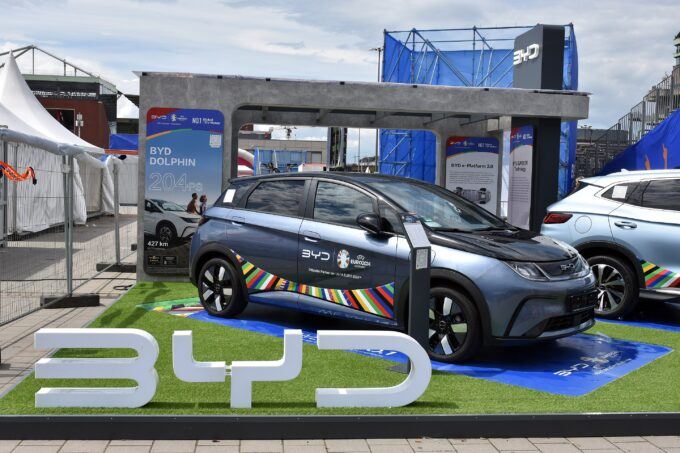
The main beneficiary of Musk’s madness is BYD (“Build Your Dreams”), the Chinese carmaker that started out supplying phone batteries for Motorola, Nokia, and Samsung. Co-founded in 1995 by chemist and engineer Wang Chuanfu, BYD benefited from an early infusion of cash from a subsidiary of Warren Buffet’s Berkshire Hathaway, which bought 10% of BYD in 2008 for $230 million, since reduced to 4.4% and now worth $2.4 billion (Yahoo). BYD was soon selling everywhere, including an envious line of electric buses in Shenzhen, the Special Economic Zone created in 1980 to aid a rapidly modernizing China.
All 16,400 buses in Shenzhen are electric BYDs with a range of 380 km. With 99% of the world’s electric buses, China is adding thousands of zero-emission transporters per week, and at the current rate will be 100% electric by 2035, displacing more than 1 million barrels of diesel per day. As part of its quest for a “zero-emissions world,” the former battery maker is helping to rid China of its ghastly urban pollution.
In 2009, China passed the US as the world’s top car market, while in the first quarter of 2025 BYD (430,000) surpassed Tesla (337,000) in global sales. Expanding on its success, BYD built its first foreign manufacturing plant in Lancaster, California, in 2013, where it specializes in electric school buses (ESBs). As of 2024, there were almost 5,000 ESBs operating and 7,000 ordered in the US. BYD’s first European plant is under construction in Hungary and will make 300,000 EVs per year. In Brazil, the world’s sixth-largest car market, BYD is building an EV plant on the site of an abandoned Ford factory – 70% of EVs in Brazil are now BYD and is the top seller in the capital Brasilia for all cars, electric or gas.
Initially slow to the game, legacy car companies have all rolled out their own e-versions, such as Nissan (Leaf), BMW (iX), and Ford (Mach-E). BYD is head of the pack, announcing a five-minute charging time, half that of Tesla’s with a new and improved chemical storage process – essentially liquid-fuel filling time. No need to fill up any more on coffee and donuts while you wait for a roadside e-fill. BYD also offers a free autonomous-driving add-on “God’s Eye” that outperforms Tesla’s vaunted autonomous driving option. With a proven range of lower-priced EVs such as the $10,000 Dolphin Surf, today’s car wars are no longer internal combustion versus electric induction, but EV versus EV, while the decreasing demand for oil adds pressure to a world run on petroleum and American dominance.
The electric revolution is roaring, nowhere more than in China that accounts for 90% of BYD’s sales. The inflection point between the old and new is fast approaching as EVs reach price parity with all gasmobiles. For some, the tipping point has come and gone – a $20,000 EV with a 200-mile range. As BYD breaks into more markets, Western carmaking supremacy will suffer and hasten the change to renewables and from West to East.
Enter the new dragon – the Trump tariffs on imported cars and car parts, supposedly intended to return manufacturing jobs to a high-wage US market. It’s hard to make sense of a coherent American strategy amid the contradictory messaging, regular reality-show taunts, and constant flip-flopping – sold as the oddest of negotiating tools that alienates more than rallies others to the MAGA cause – but despite losing more than 600,000 jobs under NAFTA the tariffs are a ruse designed in part to slow the change from brown to green. Tariffs will not raise revenue, return supply chains to the United States, or “reshore” American manufacturing jobs hollowed out of rusted industrial regions. Billion-dollar factories require planning, investment, and tax breaks over at least a decade, not anarchic policies, market uncertainty, and the loss of investor and consumer confidence.
Targeted tax cuts and subsidies are needed to incentive investment, such as the 2022 Inflation Reduction Act that made $369 billion available in green spending and was already creating American jobs in renewable energy, battery manufacturing, and critical mineral processing. But with most Trump antics, the goal is to divide and conquer, inciting chaos to advance an authoritarian agenda that increases corporate control at the expense of consumer protection.
American infrastructure is for sale to the highest bidder, including an eventual state-run TikTok sell-off to Trump’s tax-slashing billionaire tech pals as well as Space-X contracts for First Buddy Musk, whose Starlink company owns 60% of 10,000 earth-orbiting satellites. No surprise that space-launch support was spared the chainsaw in Musk’s DOGE clear-out. Next up, a “free trade zone” designation for his expanding empire in Bastrop, Texas, and relaxed regulation on autonomous driving for Tesla’s long-promised fleet of robotaxis. Insider trading is part of the quid pro quo, as in a “Good time to buy!!! DJT” social-media post hours before Trump announced a 90-day tariff pause using the NASDAQ ticker symbol for his company.
After four decades of outsourcing manufacturing to cheap-labour foreign markets (especially Mexico), Tesla also benefits from the tariffs on non-American-sourced cars, because 60% of the youngest American carmaker’s content is domestically produced. As Bernstein auto analyst Daniel Roeska noted, “Tesla is the clear structural winner” from the Trump tariffs, while Detroit’s Big Three, Japan, Korea, and Germany will suffer more because of larger foreign supply chains. It helps to have the ear and mouth of a salesman president using the White House as a backdrop for a new kind of showroom as Trump’s million-dollar donor is rewarded at the expense of American carmakers and workers.
Stellantis has already announced 900 lost jobs at five US factories, while Volvo plans to axe 800 jobs at three US facilities. At the same time, BYD is not subject to the vagaries of the Trump tariffs because it does not export EVs to the United States, choosing instead to concentrate on foreign markets. As June Yoon of The Financial Times noted, “Because BYD does not sell passenger EVs in the US, it is now insulated from the chaos unleashed by Trump’s latest tariff push.” As for other goods, restrictive barriers to Chinese imports (e.g., 145% tariffs) mostly hurt low-income consumers who buy at Walmart, Home Depot, Target, and other cut-price outlets.
Is it all just ignorance, based on a 40-year obsession with tariffs? We already knew Trump couldn’t count after claiming that he won the 2020 election because he received more votes than any previous president – not hard to do when the population keeps growing – albeit fewer votes than his opponent. Or is it another MAGA ruse to distract from a failed economic policy that purports to rejig the global supply chain in favor of a rusted rural America via blanket tariffs? – what Peterson Institute economist Mary Lovely called “re-industrialization in the most inefficient way possible.” If Trump was serious about workers, he would offer incentives to build domestically and impose penalties on corporations that don’t relocate.
After decades of neoliberal neglect, Trump claims that taxing nations more for goods will return manufacturing to the US, called “nostalgic fantasy” by CNN’s Fareed Zakaria. In The Post-American World, Zakaria also likened Western decline to professional tennis, once dominated by American players, though now “everyone is playing the game.” Same for the decline in IPOs, scientific papers, and manufacturing. As noted by the IMF, the US will suffer most as growth slows because of the “supply shock” as other countries divert their trade to cover the depressed demand from the US, which imports 25% of its goods.
No one expects the United States to start making the world’s jeans, shirts, and running shoes nor believes Trump’s obvious lies that “tariffs are making us rich.” In fact, the US has even more to lose as others shun American goods and realign trading relations because of his “unilateral bullying.” Treating China as a “hostile trading partner” in a US-designed trading world pushes China towards a new economic model that excludes American markets and expands ties with Southeast Asia, India, and Europe. A new Silk Road is being established that already exports more to Europe ($570 billion) than to the US. The rules-based order begun after World War II is no longer being directed from Washington.
Rather than resurrecting American manufacturing, the Trump game is to roil the competition, such as the European Union reacting piecemeal. The EU proposed a “zero for zero” deal on industrial goods prior to his April 2 tariff, rejected by Trump as “not good enough.” Musk also called for no tariffs between North America and Europe, even though Tesla benefits from the protectionist American market. European worries about German cars, Spanish olive oil, French and Italian wines, and Irish pharmaceuticals have held, but EU unity could falter with individual tariffs. Another prize is to stop investigations into Google, Meta, X, and Apple under the EU Digital Services Act – Meta and Apple were both fined as unfair “gatekeepers.”
Instead of halting China’s rise by “decoupling” the American economy from China’s vast export market – 15% of goods to the US – decoupling has begun from America as Trump pretends to be “actively negotiating” with others to calm the markets. Started in Canada, an “Anything but America” movement is expanding worldwide as consumers stop buying American-made goods, symbolically turning products upside down on supermarket shelves. The EU, China, and others will benefit from Trump’s protectionist policy, disengagement, and provocation as countries trade more freely in a post-American world – an American own goal as 40% of the world’s 50 largest companies are American and 36% of the world’s largest 100 (based on sales, profits, assets, and market value, Forbes). Trump’s Medicine Show is killing the patient as trade reorganizes without the US.
Trump’s callous advice to “hang tough” is okay for millionaires, but not average consumers as prices rise and jobs are shed (a 25% tariff on a $100,000 car won’t deter a millionaire). The Trump tariffs are expected to hike annual US consumer spending by $5,000, car prices by $5,000, and new house prices by $11,000. Similarly, farmers lose out as China turns to Brazil for soya beans (half supplied by the US), American hotels suffer as Canadians and other foreign travellers vacation elsewhere (US visits already down 40%), and low-income families pay extra for everything. Even Christmas will cost more as Chinese toys are marked up beyond Santa’s meagre means. Same for Apple’s iPhone, Sony’s PlayStation 5, and Dell computers, while China cancelled the sale of 50 Boeing jets at $55 million each.
The Trump tariffs have at least exposed the inherent flaws in unregulated capitalism and executive fiat. Retaliate or Negotiate? – sounds like a fawning reality show. Trump may win more Fox viewers but is losing everyone else in a shameless rebranding of the US as a low-end chop shop. The me-first preacher is at war with the world to advance his own greedy Amexit agenda, one more interested in work than workers, reduced governance, and a tax-slashing oligarchy. The reality-show banter may continue to dazzle those who think Trump’s sub-literate and low-IQ thinking is a solution to what ails the world, including his Republican supporters, who should all know by now that Trump is an elitist libertarian to the bone, Republican in name only, the dreaded RINO moniker he uses to mock GOP critics.
Rather than reform a broken America, the goal is to break more to create a free management hand with limited governance and reduced regulations. It is not America First, but a limited monied class first that exploits others and offers no protection to workers, the environment, or community standards. Trump is chief RINO, pretending to support worker ideals.
Given his friendship with Elon Musk, one might also ask if the US president is an oil and gas man or an EV man? Can Trump’s “Drill, baby drill” coexist with Musk’s “Gasmobiles are so yesterday?” Will the new right-wing Muskies take up the slack of the damaged Tesla and USA brands? No more 50% annual growth in sales as Musk predicted. No more American dominance or petroleum power. At least, demand is dampening.
In the face of increased pollution and global warming, slowing down and decreasing demand for oil is good for the earth. That wasn’t Trump’s intention – just the opposite – but slower growth is good. At his January inauguration, Trump also promised that Americans would “be able to buy the car of your choice.” The choice is becoming easier by the day. California already has more EV chargers than gas pumps. With 1.4 billion people, China’s domestic car market will benefit most from increased control over new technology that will ultimately help foreign consumers purchase cheaper EVs.
When the dust finally settles on the ongoing Trump Follies, we may have Elon Musk to thank for upending the basic tenets of capitalism. Beginning with Tesla and followed by BYD, a new future beckons. Electric bicycles, motorcycles, and scooters are all replacing gasoline vehicles in Asian markets, plagued by pollution and expensive gasoline. As Japan conquered the electronics market in the twentieth century, China is conquering the auto industry in this century. Tesla has lost the race for the low-end vehicle and the US is losing the race to lead the world.
Trump is paving the way to the end of the fossil-fuel industry, long supported by unfair regulations, oversized subsidies, and minimal taxation, while getting a free ride on pollution and global warming. EV to gasmobiles is approaching 50-50 with lower prices and improved charging infrastructure. The batteries are stronger, better, and more efficient. Most charging is still overnight at home, but for those on the go, one doesn’t need to worry any more. When the bi-directional grid is finished and batteries are in every home, we will say goodbye to oil, a win-win for citizens and their pocket books.
Rather than dismantling government with excessive downsizing and shrinking a global economy with counterproductive tariffs, American dominance is being diminished everywhere – more divisive than inclusive, more elitist than egalitarian, more Benedictine than Franciscan. Pretending to protect the world from governmental overreach, Trump’s policies are a libertarian free-for-all, a sell-out and sell-off to enrich the already wealthy. Rather than making anything great, Trump will be remembered as The Man Who Tried to Sell the World (and failed miserably).
Tomorrow’s consumerism will not be shaped by American chaos and uncertainty, but by China’s dominance and the transition to renewables. The next US electoral fair may restore some dignity and consistency to a rogue America, but the United States is already in decline. Happily, tomorrow’s world will be cleaner, greener, and quieter.
* Currently 10% on all imports, 25% on aluminum, cars, and car parts, and 145% on China excluding computers and phones (for now) and oil products. Country-specific “reciprocal” tariffs were paused for 90 days (early July), calculated with a simplistic “trade deficit divided by imported goods divided by 2” formula.
Trump’s Global Tariffs Are Meant for China

Photograph Source: The White House – Public Domain
Donald Trump’s “Liberation Day” on April 2, 2025, marked the formal launch of sweeping global tariffs, capping months of escalatory announcements since returning to office. Amplifying the economic nationalism of his first term, it marks the culmination of Trump’s decades-old advocacy for raising tariffs and reviving American industry.
His latest push builds on more than two decades of previous presidential efforts to recalibrate trade, in a far more aggressive form. Influenced by Project 2025’s chapter on fair trade by longtime adviser Peter Navarro, it calls for rapid, uncompromising trade action to reduce deficits, lower debt, and reshore manufacturing. Treasury Secretary Scott Bessent has similarly framed tariffs as part of a larger economic realignment to restore U.S. industrial and economic dominance.
Though rarely stated outright, Trump aims to break the dominance of China’s export-led economic model, with the understanding that there will be some consequences for the U.S. economy. While his strategy builds on former efforts to reshape trade, the public’s understanding of Trump’s agenda and impression of its execution enjoys only modest domestic support. The gamble carries the risks of global economic destabilization, blowback from allies, and handing China even more power on the global stage.
Protectionism, Free Trade, and Resurgent Skepticism
From 1798 to 1913, tariffs covered 50 percent to 90 percent of income and shielded American industry from foreign competitors. After World War II, however, the U.S. aimed to rebuild allied economies and draw them away from communism by opening its consumer, industrial, and capital markets. Trade deficits emerged by the 1970s, but abandoning the gold standard in 1971 let the U.S. print dollars more easily and sustain the imbalance.
The Cold War’s end in the early 1990s left the U.S. confident it could continue steering global trade on its own terms. It pushed for global tariff cuts and free trade deals like the North American Free Trade Agreement (NAFTA), while U.S. corporations helped build up foreign manufacturing, particularly in China, which benefited from preferential trade terms under its most-favored-nation trade status. American consumers absorbed global overproduction, and corporate profits soared, but many American workers were increasingly left behind.
These policies added to the anti-globalization movements of the late 1990s, most visibly at the 1999 World Trade Organization (WTO) summit in Seattle, prompting a rethink of trade policy. Domestic industries like steel had collapsed under cheap imports, and former President George W. Bush briefly imposed steel tariffs in 2002 before the WTO struck them down. The 2008 financial crisis brought bipartisan calls for economic restructuring, with the Obama administration pledging to reshore manufacturing jobs. Obama later distanced himself from the Trans-Pacific Partnership (TPP)—a free trade agreement—a move echoed by Hillary Clinton during her 2016 presidential campaign.
Trump’s first-term trade agenda broke from the previous caution. Favoring unilateral action, he withdrew from the TPP in 2017, clashed with the WTO, and renegotiated NAFTA. He then imposed tariffs on key trade partners, especially China. By then, the cost of offshoring had become clear. With U.S. corporate assistance, China had gained capital and technology expertise to become the “world’s factory.” Low-tariff access to the U.S. market gave Beijing a $300 billion surplus over America in 2024, and it emerged as the world’s top exporter and creditor.
President Biden struck a less confrontational tone upon assuming office in January 2021, yet he similarly raised tariffs on China. Like China, the EU and Japan had established large trade surpluses with the U.S., an issue he sought to address, but geopolitical unity with the U.S. on the global stage tempered criticism. Despite lowering tariffs on Europe, Biden nonetheless passed the Inflation Reduction Act and CHIPS and Science Act, both criticized by the EU as protectionist.
Trump’s second-term focus has again hit allies, yet the attention remains squarely on China, with individual tariffs on other countries being paused on April 9, while tariffs on Beijing have increased. Aside from direct exports, Washington also seeks to target China’s role in global trade. Biden’s push to “nearshore” manufacturing to countries like Mexico exposed the limits of decoupling, as Chinese companies quickly established themselves in new Mexican industrial parks.
Many imports shipped to the U.S. from other countries also contain Chinese components, meaning Trump’s 10 percent “baseline” tariff hike on all imports is meant to counteract other countries serving as conduits for Chinese goods.
In Project 2025, Peter Navarro emphasized the role of non-tariff barriers, like strict safety standards, customs delays, and local content requirements, in obstructing U.S. exports. The U.S. uses these, too, and in early February 2025, Trump cited fentanyl smuggling as justification for raising tariffs on China, Mexico, and Canada.
Even if a more conventional president follows, Trump’s tariff hikes and resulting supply chain rerouting may prove difficult to undo. Critics question whether this transition can be fast, affordable, or effective, but the COVID-19 pandemic proved supply chains can reorient under pressure relatively quickly, just as China showed its agility by setting up operations in Mexico during the 2020s.
Internal Risks
A tariff war will nonetheless raise prices for consumers and businesses, ending the era of cheap global goods that the U.S. economy has depended on for decades. Countries maintained friendly ties to keep consumer market access and reinvested U.S. dollars into American stocks, bonds, and real estate. Uncertainty over Trump’s policies saw a fake tweet about tariffs on April 7 trigger multi-trillion-dollar swings. Prolonged stock volatility or declines would reduce pensions, household wealth, and corporate valuations.
Some argue that if the stock markets crash, money could flow into and lower the price of U.S. treasuries, reducing their prices and allowing the government to refinance long-term bonds with cheaper debt. However, many traditional U.S. debt holders may demand concessions before continuing to finance it. Treasury yields have already risen, making new debt more expensive, and China, the second-largest holder of U.S. debt, is suspected of shedding bonds to help do so.
China has also retaliated by raising its own tariffs and recently haltingexports of rare earths and critical minerals essential for modern technologies. Its state-backed firms can flood global markets with cheap goods and advanced tech, squeezing out competitors. With a growing presence in international institutions and trade blocs, Beijing could increasingly shape global economic norms if these institutions and agreements become more fluid and the U.S. steps back.
Trump also wants to devalue the dollar to make U.S. exports more competitive, but insists on keeping the dollar as the world’s reserve currency, which eases access to cheap debt. His approach is undermining global confidence in the dollar, even if no clear alternative has emerged yet. Trump’s pressure on a resistant Federal Reserve to cut interest rates further reflects limited borrowing options and coordination in U.S. financial policy as he embarks on major economic upheaval.
Democrats have largely avoided serious condemnation of Trump’s policies, recognizing it may be a losing political strategy. Still, some top members like Chuck Schumer and Gavin Newsom have marked early opposition, along with seven GOP senators who recently voted against Trump’s Trade Review Act.
Trump’s policies have some support from the U.S. business class, which once saw China as a promising market but now sees it as a rival. No longer limited to cheap goods, Chinese companies like Temu, Shein, and BYD increasingly threaten giants like Amazon and Tesla. Any success in bringing manufacturing back will mostly come through automation instead of high-paying jobs, benefiting major U.S. corporations. Still, decades of cooperation with China means that these businesses remain exposed, with major corporate figures expressing public concern and Elon Musk publicly criticizingPeter Navarro’s role in the tariff push.
Trump has, in turn, framed tariffs not only as leverage over trading partners but also as a source of revenue to offset other taxes. His 2024 campaign called for cutting the corporate tax rate to 15 percent, down from 21 percent, already lowered from 35 percent during his first term. However, the promised economic boom was not evident before COVID-19 hit, and his suggestion of replacing personal income tax with tariff revenue is also unlikely to generate enough funds to do so, even in an optimistic scenario.
And while the U.S. needs to expand production for both domestic use and exports, current capacity falls far short. Tariffs might push companies and consumers toward new habits, but blanket protection without government initiatives in infrastructure development, skills training, and research and development risks doing more harm than good, and leaves the private sector to act with little guidance.
Compared to Trump’s unpredictable approach, China and the EU have positioned themselves as stable anchors of the global economy. U.S. calls to coordinate with major economic allies like the EU and Japan to limit dealings with China, including reducing Chinese imports and preventing its companies from establishing themselves, risk falling on deaf ears as tariffs have strained ties.
Global Risks
Reducing access to U.S. consumers also threatens a major pillar of global economic stability. The U.S. accounted for roughly 13 percent of global import consumption in 2023, acting as a safety valve for global overproduction by absorbing excess goods.
China, facing a property crisis, high youth unemployment, and mounting local government debt, has pledged to “vigorously boost domestic consumption,” according to the People’s Daily, to help replace American consumers. But its $300 billion trade surplus with the U.S. exemplifies its reliance and more limited leverage for retaliation. The EU has signaled it will not tolerate a flood of Chinese goods, as it, like the U.S., increasingly finds itself competing with China in high-end products.
The EU and Canada have similarly raised tariffs on the U.S. The Trump administration has tested EU unity by courting globalization-skeptic allies like Italy’s Prime Minister Giorgia Meloni, though tensions are likely to deepen before they ease. Europe’s struggle to sustain support for Ukraine against Russia has shown the perils of deindustrialization, a trend the U.S. now seeks to radically reverse ahead of others. And, by targeting allies with tariffs too, the U.S. ensures that any self-inflicted economic pain is matched abroad, making the cost of reshaping trade a shared burden.
Forcing a global trade war—an escalating Canada-China tariff clash in 2025 is one encouraging sign—is likely to further weaken China’s export-led model. As the U.S. signals a reduced role in safeguarding global maritime trade, already strained by disruptions like Houthi attacks in the Red Sea and rising piracy, geopolitical tensions could disrupt other key routes. Without U.S. intervention, free trade will face rising shipping and insurance costs.
Trump frequently changed tactics in his first term, mixing threats with negotiations. If his tariff strategy falters, voices like Kent Lassman’s in Project 2025, calling for a return to free trade, may gain traction. But Trump has been warning of trade imbalances since the 1980s, when Japan and West Germany were his main targets. He seems determined to make reversing it central to his legacy, this time focusing on China.
Scrapping the old, in his view, unreformable system, and embracing whatever follows is based on the belief that the U.S. is best positioned to shape the new system. The question now is which countries will support that shift or be forced to. Whether a complete globalization teardown occurs or not, he appears ready to push as hard as possible within constraints. As evidenced by much of MAGA’s merchandise still being made in China, dismantling Beijing’s advantages in global trade will not be easy.
This article was produced by Economy for All, a project of the Independent Media Institute.

No comments:
Post a Comment