The Antiwar Trump Was Always a Myth
The bipartisan consensus demanding war with Iran has left Americans opposed to war with little political representation.
.png)
By Schuyler Mitchell ,
The bipartisan consensus demanding war with Iran has left Americans opposed to war with little political representation.
.png)
By Schuyler Mitchell ,
June 18, 2025
As Donald Trump considers a U.S. war with Iran and the Pentagon builds up military forces in the Middle East, I find myself returning, oddly, to a question posed by Leo Tolstoy: “How many men are necessary to change a crime into a virtue?” He wondered this in his 1894 treatise on Christian nonviolence, The Kingdom of God is Within You, paraphrasing a pamphlet by Christian anarchist and abolitionist Adin Ballou: “One man may not kill. If he kills a fellow-creature, he is a murderer. If two, ten, a hundred men do so, they, too, are murderers. But a government or a nation may kill as many men as it chooses, and that will not be murder, but a great and noble action.”
I first encountered this passage last April, six months into Israel’s genocide in Gaza. At that point, the war felt like it had been going on for a lifetime; in hindsight, it had barely started. Now, more than 130 years after Tolstoy wrote his treatise, I’m struck by how political leaders still treat war as not just inevitable, but virtuous, good.
“We’re in the midst of one of the greatest military operations in history,” Israeli Prime Minister Benjamin Netanyahu said in a video statement released June 13, shortly after Israel began carrying out a series of airstrikes in Iran. Purporting to address the Iranian people directly, Netanyahu continued, “As we achieve our objectives, we’re clearing the path for you to achieve your objective, which is freedom. …Your light will defeat the darkness.”
This is pure propaganda. Israel’s attack on Iran was an act of naked aggression, not one of humanitarian concern. While the first wave of airstrikes targeted Iranian nuclear facilities, in less than a week, Israel has hit an Iranian state broadcaster and killed more than 200 civilians. Netanyahu claims the military action was preemptive, yet there is no evidence that an Iranian nuclear strike was imminent, or that Iran even has a nuclear weapon, or is capable of producing one soon. Meanwhile, officials in the U.S. and Israel have pointed to regime change as the ultimate goal.
The U.S. is, in many ways, already involved in a war against Iran, sending money and weapons to Israel and shooting down Iranian missiles. But Israel is now requesting that the U.S. directly partake in its military offensive — a move that 60 percent of Americans oppose, according to a recent poll. We know that additional U.S. military intervention would be disastrous; time and time again we’ve seen how war destabilizes entire regions. During the 2016 presidential primary, Trump himself railed against George W. Bush for invading Iraq in 2003 and said the former president had lied about Saddam Hussein’s weapons of mass destruction. Prior to that, in 2011, Trump lambasted Obama’s foreign policy, claiming the then-president would start a war with Iran in order to get reelected — “because he has absolutely no ability to negotiate. He’s weak and he’s ineffective.”
This type of rhetoric enabled Trump to paint himself as the antiwar candidate on the campaign trail, from 2016 to 2020 to 2024, drawing a contrast between himself and both war hawk Democrats and the neoconservative wing of his own party. Now, the MAGA movement is splintering over whether the U.S. should join Israel in attacking Iran. Representing the GOP hawk flank, Sen. Lindsey Graham (R-South Carolina) urged Trump to go “all in” on an attack on Iran. Far right political commentator Tucker Carlson, however, rebuked the warmongers for abandoning a commitment to “America First” — comments that incited a fiery social media response from Trump.
“Somebody please explain to kooky Tucker Carlson that, ‘IRAN CAN NOT HAVE A NUCLEAR WEAPON!’” Trump wrote on Truth Social. In a follow up post, he continued, “AMERICA FIRST means many GREAT things.”
MAGA’s Iran schism, and the president’s foreign policy decisions thus far, make clear that the antiwar Trump was always a myth. The fact is that, contrary to public sentiment, there is still no great political representation for people in the U.S. who are actually antiwar and trying to do something about it through policy or legislation. Aside from a few progressives in Congress, Democrats have either stayed silent or backed the idea of a U.S. offensive in Iran. And MAGA’s “America First” stance is not a viable alternative for antiwar voters, nor does it challenge the root of the issue.
Let us not forget that it was Trump who in 2018 unilaterally withdrew the U.S. from the Iran nuclear deal.
That’s because Carlson and other MAGA isolationists — including Rep. Marjorie Taylor Greene (R-Georgia), who has spoken out against a potential direct U.S. strike on Iran — are not opposing a possible war from a place of humanitarian concern or an expressed belief in the Iranian people’s right to self-determination. “I’m really afraid we’re watching the beginning of the end of the American empire,” Carlson told Steve Bannon on the War Room podcast. This type of “antiwar” stance is boldly in service of imperial violence, not opposed to it.
As Trump attempts to appeal to both factions of the MAGA coalition, U.S. and Israeli officials have provided conflicting statements about the degree of U.S. knowledge and involvement before Israel’s attack. This deception is seemingly part of the strategy: The president can pay lip service to diplomacy all he wants, but that does not change the facts on the ground. On June 16, Trump called on the 10 million citizens of Tehran to “immediately evacuate” — an impossible feat, and one that stands at odds with his gestures toward a peaceful way out of the current conflict.
While the Trump administration initially focused on calling for a diplomatic resolution, let us not forget that it was Trump who in 2018 unilaterally withdrew the U.S. from the Iran nuclear deal. In that agreement, negotiated by Barack Obama and several other world leaders in 2015, Iran consented to limiting its nuclear program and expanding international inspections in exchange for the easing of some economic sanctions. After the U.S. withdrew from the agreement, Iran then violated its terms, beefing up its uranium enrichment activities. U.S.-Iran relations further deteriorated in January 2020, when Trump authorized the drone strike assassination of Iranian major general Qasem Soleimani and threatened to strike Iran’s cultural sites.
As Murtaza Hussain wrote in The Intercept in 2021, “In place of a diplomatic arrangement, the Trump administration waged a campaign of economic pressure, sabotage, and assassinations targeting Iranian leadership.” But unlike the 2015 nuclear deal, these tactics failed to actually curb Iran’s nuclear program, which has continued to advance in the ensuing years, even as U.S. sanctions cause great humanitarian harm.
In light of these diplomatic failures, what has Democratic leadership had to offer? Not much. Senate Democratic Leader Chuck Schumer (D-New York) and House Minority Leader Rep. Hakeem Jeffries (D-New York) have stayed mum since Trump ordered the evacuation of Tehran, though they released statements expressing “ironclad” support for Israel after the initial June 12 airstrikes. In fact, they’ve both urged Trump to respond more belligerently to Iran in the first place. Earlier this month, Schumer attacked the president for “folding” on nuclear talks; in February, Jeffries told reporters, “We can’t take our foot off the gas pedal until Iran is brought to its knees.” Sen. John Fetterman (D-Pennsylvania), meanwhile, has explicitly called on the U.S. to escalate its involvement, writing that Israel should “keep wiping out Iranian leadership” and the U.S. “must provide whatever is necessary — military, intelligence, weaponry — to fully back Israel in striking Iran.”
Axios reports that only a few Senate Democrats have publicly supported a resolution, introduced by Sen. Tim Kaine (D-Virginia), that would limit Trump’s ability to wage war with Iran. Per the U.S. Constitution, only Congress, not the president, has the power to declare war, though the White House has often circumvented this rule in practice. Kaine said that his war powers resolution simply underscores the Constitutional requirement that war with Iran be explicitly authorized by Congress, and Reps. Thomas Massie (R-Kentucky) and Ro Khanna (D-California) introduced a similar bipartisan resolution in the house on Tuesday. On Monday, Sen. Bernie Sanders (I-Vermont) introduced the No War Against Iran Act, backed by seven Democratic senators, which would “prohibit the use of federal funds for any use of military force in or against Iran absent specific Congressional authorization.”
It’s a shame that these attempts do not have more widespread support and as such are unlikely to rein in the Trump administration. Still, it is not too late to chart a diplomatic course forward. We must not stop calling on our elected officials to do better, to commit to new ways of challenging U.S. complicity in this war, to demand an arms embargo on Israel and an end to military cooperation with Israel’s war crimes. I’ll return, now, to Tolstoy, again paraphrasing Ballou: “Gather the people together on a large scale, and a battle of ten thousand men becomes an innocent action. But precisely how many people must there be to make it so? That is the question. One man cannot plunder and pillage, but a whole nation can. But precisely how many are needed to make it permissible?”
I first encountered this passage last April, six months into Israel’s genocide in Gaza. At that point, the war felt like it had been going on for a lifetime; in hindsight, it had barely started. Now, more than 130 years after Tolstoy wrote his treatise, I’m struck by how political leaders still treat war as not just inevitable, but virtuous, good.
“We’re in the midst of one of the greatest military operations in history,” Israeli Prime Minister Benjamin Netanyahu said in a video statement released June 13, shortly after Israel began carrying out a series of airstrikes in Iran. Purporting to address the Iranian people directly, Netanyahu continued, “As we achieve our objectives, we’re clearing the path for you to achieve your objective, which is freedom. …Your light will defeat the darkness.”
This is pure propaganda. Israel’s attack on Iran was an act of naked aggression, not one of humanitarian concern. While the first wave of airstrikes targeted Iranian nuclear facilities, in less than a week, Israel has hit an Iranian state broadcaster and killed more than 200 civilians. Netanyahu claims the military action was preemptive, yet there is no evidence that an Iranian nuclear strike was imminent, or that Iran even has a nuclear weapon, or is capable of producing one soon. Meanwhile, officials in the U.S. and Israel have pointed to regime change as the ultimate goal.
The U.S. is, in many ways, already involved in a war against Iran, sending money and weapons to Israel and shooting down Iranian missiles. But Israel is now requesting that the U.S. directly partake in its military offensive — a move that 60 percent of Americans oppose, according to a recent poll. We know that additional U.S. military intervention would be disastrous; time and time again we’ve seen how war destabilizes entire regions. During the 2016 presidential primary, Trump himself railed against George W. Bush for invading Iraq in 2003 and said the former president had lied about Saddam Hussein’s weapons of mass destruction. Prior to that, in 2011, Trump lambasted Obama’s foreign policy, claiming the then-president would start a war with Iran in order to get reelected — “because he has absolutely no ability to negotiate. He’s weak and he’s ineffective.”
This type of rhetoric enabled Trump to paint himself as the antiwar candidate on the campaign trail, from 2016 to 2020 to 2024, drawing a contrast between himself and both war hawk Democrats and the neoconservative wing of his own party. Now, the MAGA movement is splintering over whether the U.S. should join Israel in attacking Iran. Representing the GOP hawk flank, Sen. Lindsey Graham (R-South Carolina) urged Trump to go “all in” on an attack on Iran. Far right political commentator Tucker Carlson, however, rebuked the warmongers for abandoning a commitment to “America First” — comments that incited a fiery social media response from Trump.
“Somebody please explain to kooky Tucker Carlson that, ‘IRAN CAN NOT HAVE A NUCLEAR WEAPON!’” Trump wrote on Truth Social. In a follow up post, he continued, “AMERICA FIRST means many GREAT things.”
MAGA’s Iran schism, and the president’s foreign policy decisions thus far, make clear that the antiwar Trump was always a myth. The fact is that, contrary to public sentiment, there is still no great political representation for people in the U.S. who are actually antiwar and trying to do something about it through policy or legislation. Aside from a few progressives in Congress, Democrats have either stayed silent or backed the idea of a U.S. offensive in Iran. And MAGA’s “America First” stance is not a viable alternative for antiwar voters, nor does it challenge the root of the issue.
Let us not forget that it was Trump who in 2018 unilaterally withdrew the U.S. from the Iran nuclear deal.
That’s because Carlson and other MAGA isolationists — including Rep. Marjorie Taylor Greene (R-Georgia), who has spoken out against a potential direct U.S. strike on Iran — are not opposing a possible war from a place of humanitarian concern or an expressed belief in the Iranian people’s right to self-determination. “I’m really afraid we’re watching the beginning of the end of the American empire,” Carlson told Steve Bannon on the War Room podcast. This type of “antiwar” stance is boldly in service of imperial violence, not opposed to it.
As Trump attempts to appeal to both factions of the MAGA coalition, U.S. and Israeli officials have provided conflicting statements about the degree of U.S. knowledge and involvement before Israel’s attack. This deception is seemingly part of the strategy: The president can pay lip service to diplomacy all he wants, but that does not change the facts on the ground. On June 16, Trump called on the 10 million citizens of Tehran to “immediately evacuate” — an impossible feat, and one that stands at odds with his gestures toward a peaceful way out of the current conflict.
While the Trump administration initially focused on calling for a diplomatic resolution, let us not forget that it was Trump who in 2018 unilaterally withdrew the U.S. from the Iran nuclear deal. In that agreement, negotiated by Barack Obama and several other world leaders in 2015, Iran consented to limiting its nuclear program and expanding international inspections in exchange for the easing of some economic sanctions. After the U.S. withdrew from the agreement, Iran then violated its terms, beefing up its uranium enrichment activities. U.S.-Iran relations further deteriorated in January 2020, when Trump authorized the drone strike assassination of Iranian major general Qasem Soleimani and threatened to strike Iran’s cultural sites.
As Murtaza Hussain wrote in The Intercept in 2021, “In place of a diplomatic arrangement, the Trump administration waged a campaign of economic pressure, sabotage, and assassinations targeting Iranian leadership.” But unlike the 2015 nuclear deal, these tactics failed to actually curb Iran’s nuclear program, which has continued to advance in the ensuing years, even as U.S. sanctions cause great humanitarian harm.
In light of these diplomatic failures, what has Democratic leadership had to offer? Not much. Senate Democratic Leader Chuck Schumer (D-New York) and House Minority Leader Rep. Hakeem Jeffries (D-New York) have stayed mum since Trump ordered the evacuation of Tehran, though they released statements expressing “ironclad” support for Israel after the initial June 12 airstrikes. In fact, they’ve both urged Trump to respond more belligerently to Iran in the first place. Earlier this month, Schumer attacked the president for “folding” on nuclear talks; in February, Jeffries told reporters, “We can’t take our foot off the gas pedal until Iran is brought to its knees.” Sen. John Fetterman (D-Pennsylvania), meanwhile, has explicitly called on the U.S. to escalate its involvement, writing that Israel should “keep wiping out Iranian leadership” and the U.S. “must provide whatever is necessary — military, intelligence, weaponry — to fully back Israel in striking Iran.”
Axios reports that only a few Senate Democrats have publicly supported a resolution, introduced by Sen. Tim Kaine (D-Virginia), that would limit Trump’s ability to wage war with Iran. Per the U.S. Constitution, only Congress, not the president, has the power to declare war, though the White House has often circumvented this rule in practice. Kaine said that his war powers resolution simply underscores the Constitutional requirement that war with Iran be explicitly authorized by Congress, and Reps. Thomas Massie (R-Kentucky) and Ro Khanna (D-California) introduced a similar bipartisan resolution in the house on Tuesday. On Monday, Sen. Bernie Sanders (I-Vermont) introduced the No War Against Iran Act, backed by seven Democratic senators, which would “prohibit the use of federal funds for any use of military force in or against Iran absent specific Congressional authorization.”
It’s a shame that these attempts do not have more widespread support and as such are unlikely to rein in the Trump administration. Still, it is not too late to chart a diplomatic course forward. We must not stop calling on our elected officials to do better, to commit to new ways of challenging U.S. complicity in this war, to demand an arms embargo on Israel and an end to military cooperation with Israel’s war crimes. I’ll return, now, to Tolstoy, again paraphrasing Ballou: “Gather the people together on a large scale, and a battle of ten thousand men becomes an innocent action. But precisely how many people must there be to make it so? That is the question. One man cannot plunder and pillage, but a whole nation can. But precisely how many are needed to make it permissible?”
'Insecure men are dangerous': Analyst says Trump may declare war due to 'sad-boy feelings'
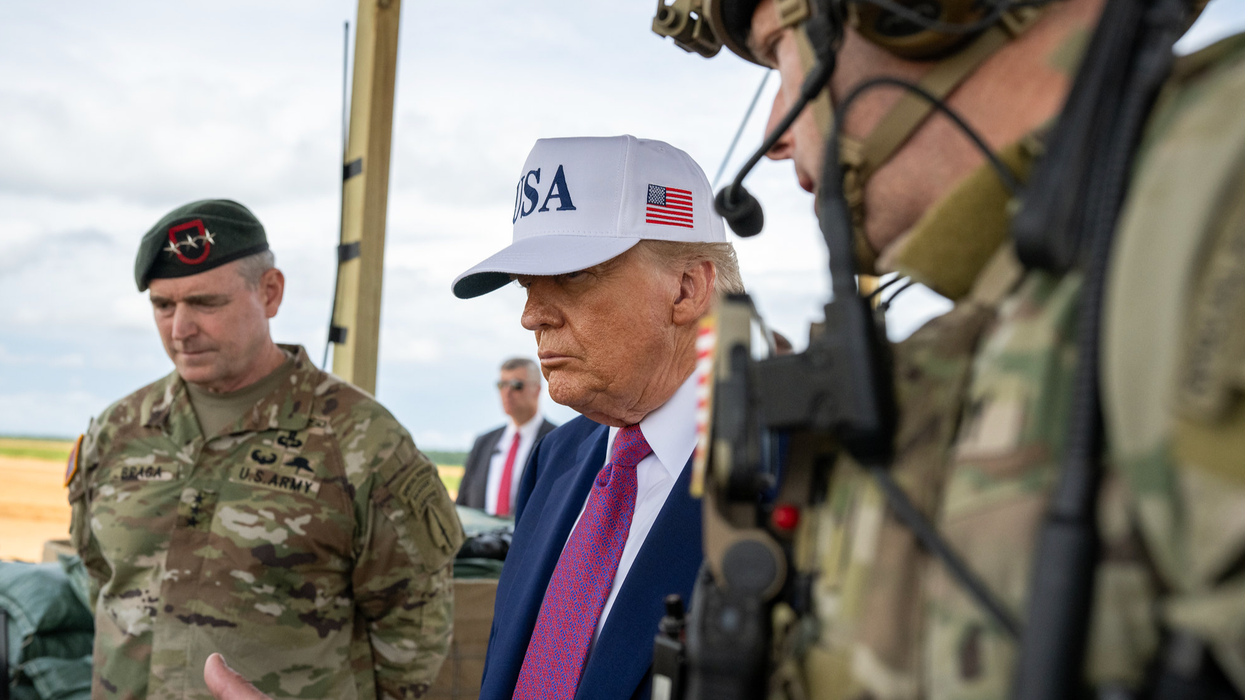
President Donald Trump observes a military demonstration at Fort Bragg, North Carolina on Tuesday, June 10, 2025, during a visit to commemorate the 250th anniversary of the U.S. Army. (Official White House Photo by Daniel Torok)
President Donald Trump observes a military demonstration at Fort Bragg, North Carolina on Tuesday, June 10, 2025, during a visit to commemorate the 250th anniversary of the U.S. Army. (Official White House Photo by Daniel Torok)
June 18, 2025 |
ALTERNET
President Donald Trump has apparently approved attack plans against Iran though has so far stopped short of officially giving the order, according to the Wall Street Journal. And one columnist thinks whether the president of the United States gets the nation involved in another foreign war could be decided by Trump's self-esteem.
In a recent op-ed for USA TODAY, columnist Rex Huppke posited that Trump's recent actions could be attributed to the world's most powerful man having a crisis of self-confidence. Huppke argued that the commander-in-chief's deployment of U.S. military personnel to the nation's second-most populous city ended in an anticlimactic fashion, and his sparsely attended military parade didn't move the needle either.
According to the columnist, a new foreign war is just part of "the quest to quench this man’s insecurity," opining that even being among other foreign leaders at the G7 summit in the Canadian Rockies didn't do enough to satisfy his ego.
Huppke pointed out that that Trump left the G7 summit before its official conclusion under the pretense that he had to return to Washington to address the escalating tensions in the Middle East between Israel and Iran after the former carried out a series of strikes on the latter. However, the USA TODAY columnist observed that Trump's response "seemed to largely involve posting unhinged comments on social media, bizarrely advising residents of Tehran to evacuate and, despite claiming the United States isn’t involved in Israel’s ongoing attacks on Iran, boldly proclaiming: 'We now have complete and total control of the skies over Iran.'"
"Trump is proving, as if we needed proof, that insecure men are dangerous," Huppke wrote after declaring that Trump's "sad-boy feelings will always override what's best for America."
"They act impulsively, with no focus beyond soothing their own tender feelings," he continued. "Dispatching troops against American citizens didn’t make Trump feel big. A military parade didn’t make him feel big. He didn’t feel big around other world leaders at the G7 summit, so he left and did some online hollering and saber-rattling.
"And now? We wait to see if our capricious president needs to drop a bunker-busting bomb on Iran to feel big," he added.
Click here to read Huppke's full op-ed in USA TODAY.
President Donald Trump has apparently approved attack plans against Iran though has so far stopped short of officially giving the order, according to the Wall Street Journal. And one columnist thinks whether the president of the United States gets the nation involved in another foreign war could be decided by Trump's self-esteem.
In a recent op-ed for USA TODAY, columnist Rex Huppke posited that Trump's recent actions could be attributed to the world's most powerful man having a crisis of self-confidence. Huppke argued that the commander-in-chief's deployment of U.S. military personnel to the nation's second-most populous city ended in an anticlimactic fashion, and his sparsely attended military parade didn't move the needle either.
According to the columnist, a new foreign war is just part of "the quest to quench this man’s insecurity," opining that even being among other foreign leaders at the G7 summit in the Canadian Rockies didn't do enough to satisfy his ego.
Huppke pointed out that that Trump left the G7 summit before its official conclusion under the pretense that he had to return to Washington to address the escalating tensions in the Middle East between Israel and Iran after the former carried out a series of strikes on the latter. However, the USA TODAY columnist observed that Trump's response "seemed to largely involve posting unhinged comments on social media, bizarrely advising residents of Tehran to evacuate and, despite claiming the United States isn’t involved in Israel’s ongoing attacks on Iran, boldly proclaiming: 'We now have complete and total control of the skies over Iran.'"
"Trump is proving, as if we needed proof, that insecure men are dangerous," Huppke wrote after declaring that Trump's "sad-boy feelings will always override what's best for America."
"They act impulsively, with no focus beyond soothing their own tender feelings," he continued. "Dispatching troops against American citizens didn’t make Trump feel big. A military parade didn’t make him feel big. He didn’t feel big around other world leaders at the G7 summit, so he left and did some online hollering and saber-rattling.
"And now? We wait to see if our capricious president needs to drop a bunker-busting bomb on Iran to feel big," he added.
Click here to read Huppke's full op-ed in USA TODAY.
Ted Cruz Suggests US Is Involved in Israeli Strikes on Iran, Despite US Denials
“We are carrying out military strikes today,” Senator Cruz said in an interview.
By Sharon Zhang ,
“We are carrying out military strikes today,” Senator Cruz said in an interview.
By Sharon Zhang ,
June 18, 2025

The evangelical pastor and ambassador to Iran told Trump he “will hear from heaven” with guidance about the war.
By Sharon Zhang ,
Huckabee also urges Trump to listen to “HIS voice,” an apparent reference to God, saying that Trump “will hear from heaven” about the issue.
Like many evangelical Christians in the U.S., Huckabee is a Christian Zionist who subscribes to the belief that Israel must dominate Palestine in order to bring about the end-times prophecy and second coming of Jesus Christ. Christ would then rule over Israel in the new age, where all people worship Christ or get eliminated and condemned to hell.
Some Christian Zionists have outright preached that Israel must claim dominance over enemies like Iran, who will try to destroy Israel as it pursues total control over Palestine. Huckabee has been heavily criticized for his erasure of the occupied West Bank, which he refers to as Judea and Samaria, and for saying once that there is “really no such thing as a Palestinian.”
Sen. Lindsey Graham (R-South Carolina), who has spent over a decade urging the U.S. to enter into a war with Iran, praised Huckabee’s text, saying it is “spot on.”
“It is now time to end this terrible chapter in the Middle East and start a new chapter,” said Graham, seemingly referring to an old neo-conservative fantasy of regime change in Iran.
The text, seeking to stoke Trump into using extreme force against Iran, comes at a fragile moment as Israeli Prime Minister Benjamin Netanyahu is openly urging Trump to attack Iran, lending Israel even more support on top of the current defensive backing from U.S. military assets.
Similarly to Trump’s statement on Tuesday brushing aside the U.S. intelligence community’s assessment that Iran isn’t pursuing a nuclear weapon, Huckabee’s invocation of a higher purpose echoes President George W. Bush’s bizarre reasoning for starting the Iraq War. Just months after the U.S.’s invasion initially began, Bush reportedly told an Israeli-Palestinian summit that he was “driven with a mission from God.”
It’s unclear what Trump’s next move will be. He has repeatedly said that his goal is to force Iran to capitulate on his administration’s demands for a nuclear deal. “COMPLETE SURRENDER,” he wrote on Truth Social on Tuesday.
Trump has said that he may be sending Vice President J.D. Vance or his Middle East envoy Steve Witkoff to conduct negotiations. According to sources cited by Axios, the president was reportedly considering striking Iran ahead of a meeting about the war with his national security team in the White House Situation Room on Tuesday.

Sen. Ted Cruz attends a Senate Foreign Relations Committee confirmation in Dirksen building on March 25, 2025.Tom Williams / CQ-Roll Call, Inc via Getty Images
Did you know that Truthout is a nonprofit and independently funded by readers like you? If you value what we do, please support our work with a donation.
Sen. Ted Cruz (R-Texas) was caught stumbling to answer basic questions about Iran and the U.S.’s role in Israel’s war in an eye-opening interview airing Wednesday, despite his full-throated support for overthrowing the Iranian government and deeper U.S. involvement in the fighting.
In clips of the interview with far right provocateur Tucker Carlson posted on social media on Tuesday, the senator alarmingly suggests that the U.S. is, in fact, already heavily involved in Israel’s strikes on Iran.
“We are carrying out military strikes today,” Cruz said. “I said we — Israel is leading them, but we’re supporting them.”
This directly contradicts what federal officials have said about the U.S.’s involvement. The State Department has said that Israel’s strikes are “unilateral,” and directed all embassies and consular posts to reiterate that claim in a cable, CBS reported on Sunday. The cable instructed officials to emphasize to their respective host governments that the U.S. “is not involved in Israel’s unilateral action against targets in Iran and did not provide tanker support.”
This position has not changed in recent days, as the strikes have intensified and President Donald Trump openly mulls becoming more deeply involved in the war. Numerous Trump administration spokespeople claimed on Tuesday that any reports of the U.S. participating in Israeli strikes in Iran are “not true.”
“American forces are maintaining their defensive posture, and that has not changed. We will defend American interests,” said spokesperson Alex Pfeiffer on Tuesday.
The U.S. military is already involved in the conflict. Officials have been open about the U.S.’s defensive positions in helping to strike down missiles fired at Israel.
However, direct U.S. involvement in conducting strikes on Iran, as Cruz suggests is happening, would be a major escalation of the war. Cruz’s statements potentially suggest that the U.S. is actually directly aiding in the bombings, as the Senate is privy to classified information about the military not available to the public.
“You’re breaking news here,” said Carlson. “This is high stakes, you’re a senator. If you’re saying the United States government is at war with Iran right now, people are listening!”
It’s possible that Cruz is suggesting deeper U.S. involvement to push the Trump administration into striking Iran, as many conservative lawmakers have done in recent days — in hopes of pushing the dangerous pipe dream of regime change in Iran.
“I think it is very much in the interest of America to see regime change,” Cruz told Fox News on Sunday. “I don’t think there’s any redeeming the ayatollah.”
Despite his confidence that he could install a better government in Iran, earlier in the interview, Cruz is caught unable to even name basic facts about Iran’s population.
“I don’t know the population,” Cruz says.
“You don’t know the population of the country you seek to topple?” Carlson asks, incredulously. “How could you not know that?”
In a follow up, Carlson says, “okay, what’s the ethnic mix of Iran?”
Cruz hesitates, then says, “they are Persians, and predominantly Shia,” he says, tellingly naming a religious sect rather than an ethnicity. When Carlson asks what proportion of the population is Persian, Cruz becomes incensed.
“I’m not the Tucker Carlson expert on Iran,” Cruz says sarcastically, his voice raised.
“You’re a senator who’s calling for the overthrow of the government!” Carlson exclaims in response.
The exchange highlights a rift among the right over the U.S.’s role in the Middle East. Carlson’s interview circulated widely online for exposing Cruz’s blasé ignorance of the country he wants to wage war against.
However, Carlson, who has consistently allied with white supremacists, himself owes much of his career to the figures who peddled the lies that led to the Iraq War. Early on, Carlson was a proponent of the U.S.’s invasion, and only changed his mind later because of racist beliefs that Iraq and Afghanistan aren’t “worth invading” because “the people aren’t civilized.”
This is, as commentators have noted, a drastically different approach to anti-interventionism from the left’s anti-war and anti-imperialist foundations. And yet, Carlson’s interview caught attention online as the right has sought to capitalize on genuine anti-war sentiment among the public that’s been completely dismissed by the Democratic Party.
Did you know that Truthout is a nonprofit and independently funded by readers like you? If you value what we do, please support our work with a donation.
Sen. Ted Cruz (R-Texas) was caught stumbling to answer basic questions about Iran and the U.S.’s role in Israel’s war in an eye-opening interview airing Wednesday, despite his full-throated support for overthrowing the Iranian government and deeper U.S. involvement in the fighting.
In clips of the interview with far right provocateur Tucker Carlson posted on social media on Tuesday, the senator alarmingly suggests that the U.S. is, in fact, already heavily involved in Israel’s strikes on Iran.
“We are carrying out military strikes today,” Cruz said. “I said we — Israel is leading them, but we’re supporting them.”
This directly contradicts what federal officials have said about the U.S.’s involvement. The State Department has said that Israel’s strikes are “unilateral,” and directed all embassies and consular posts to reiterate that claim in a cable, CBS reported on Sunday. The cable instructed officials to emphasize to their respective host governments that the U.S. “is not involved in Israel’s unilateral action against targets in Iran and did not provide tanker support.”
This position has not changed in recent days, as the strikes have intensified and President Donald Trump openly mulls becoming more deeply involved in the war. Numerous Trump administration spokespeople claimed on Tuesday that any reports of the U.S. participating in Israeli strikes in Iran are “not true.”
“American forces are maintaining their defensive posture, and that has not changed. We will defend American interests,” said spokesperson Alex Pfeiffer on Tuesday.
The U.S. military is already involved in the conflict. Officials have been open about the U.S.’s defensive positions in helping to strike down missiles fired at Israel.
However, direct U.S. involvement in conducting strikes on Iran, as Cruz suggests is happening, would be a major escalation of the war. Cruz’s statements potentially suggest that the U.S. is actually directly aiding in the bombings, as the Senate is privy to classified information about the military not available to the public.
“You’re breaking news here,” said Carlson. “This is high stakes, you’re a senator. If you’re saying the United States government is at war with Iran right now, people are listening!”
It’s possible that Cruz is suggesting deeper U.S. involvement to push the Trump administration into striking Iran, as many conservative lawmakers have done in recent days — in hopes of pushing the dangerous pipe dream of regime change in Iran.
“I think it is very much in the interest of America to see regime change,” Cruz told Fox News on Sunday. “I don’t think there’s any redeeming the ayatollah.”
Despite his confidence that he could install a better government in Iran, earlier in the interview, Cruz is caught unable to even name basic facts about Iran’s population.
“I don’t know the population,” Cruz says.
“You don’t know the population of the country you seek to topple?” Carlson asks, incredulously. “How could you not know that?”
In a follow up, Carlson says, “okay, what’s the ethnic mix of Iran?”
Cruz hesitates, then says, “they are Persians, and predominantly Shia,” he says, tellingly naming a religious sect rather than an ethnicity. When Carlson asks what proportion of the population is Persian, Cruz becomes incensed.
“I’m not the Tucker Carlson expert on Iran,” Cruz says sarcastically, his voice raised.
“You’re a senator who’s calling for the overthrow of the government!” Carlson exclaims in response.
The exchange highlights a rift among the right over the U.S.’s role in the Middle East. Carlson’s interview circulated widely online for exposing Cruz’s blasé ignorance of the country he wants to wage war against.
However, Carlson, who has consistently allied with white supremacists, himself owes much of his career to the figures who peddled the lies that led to the Iraq War. Early on, Carlson was a proponent of the U.S.’s invasion, and only changed his mind later because of racist beliefs that Iraq and Afghanistan aren’t “worth invading” because “the people aren’t civilized.”
This is, as commentators have noted, a drastically different approach to anti-interventionism from the left’s anti-war and anti-imperialist foundations. And yet, Carlson’s interview caught attention online as the right has sought to capitalize on genuine anti-war sentiment among the public that’s been completely dismissed by the Democratic Party.
CHRISTIAN ZIONIST RAPTURE
Huckabee Suggests Trump Should Nuke Iran, Follow Guidance From “Heaven”The evangelical pastor and ambassador to Iran told Trump he “will hear from heaven” with guidance about the war.
By Sharon Zhang ,
PublishedJune 17, 2025
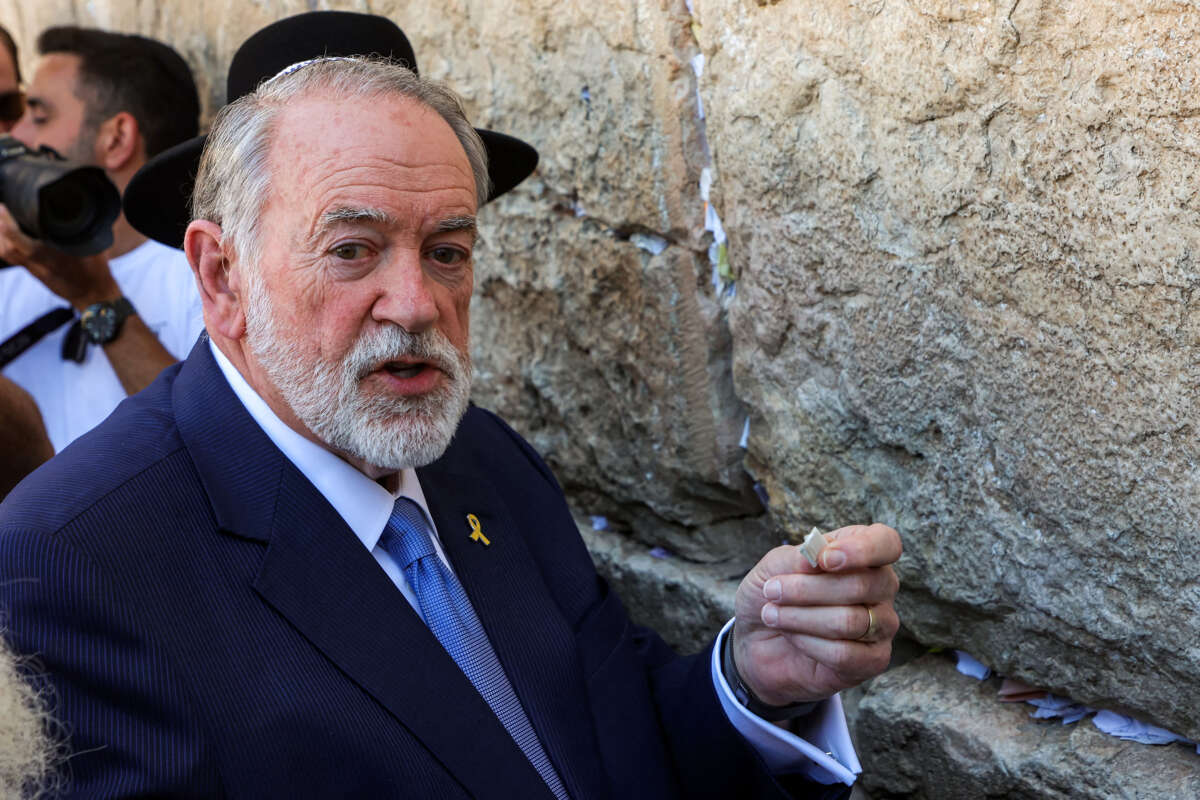
The U.S.' new ambassador to Israel Mike Huckabee holds a note given to him from President Donald Trump to be placed in the cracks of the Western Wall, the holiest site where Jews are allowed to pray, during Huckabee's visit to the holy site in the old city of Jerusalem on April 18, 2025.Gil Cohen-Magen / AFP via Getty Images
U.S. Ambassador to Israel Mike Huckabee has suggested to President Donald Trump that he should use a nuclear bomb against Iran, urging Trump to listen to the voice he will “hear from heaven” and follow its guidance in making decisions about Israel’s war on Iran.
In a post on Truth Social on Tuesday, Trump posted a screenshot of the lengthy text he says was sent to him by Huckabee, an evangelical and Christian Zionist who Trump praises as a “Great Person!”
In the text, Huckabee says Trump’s current decision on whether or not to involve the U.S. further in attacks on Iran is akin to the decision President Harry Truman faced in 1945 — when Truman dropped two atomic bombs in Hiroshima and Nagasaki, killing hundreds of thousands of innocent people in Japan and decimating the cities.
Huckabee further says that he seeks not to persuade but to “encourage” Trump. “God spared you in Butler, PA to be the most consequential President in a century — maybe ever,” Huckabee writes. “No President in my lifetime has been in a position like yours. Not since Truman in 1945.”
The rambling message is extremely ironic, considering that Huckabee is suggesting that Trump should use a nuclear bomb against Iran in a war that was started by Israel to supposedly target Iran’s nuclear weapons program, though most of the targets and casualties so far appear to be civilian.
In a post on Truth Social on Tuesday, Trump posted a screenshot of the lengthy text he says was sent to him by Huckabee, an evangelical and Christian Zionist who Trump praises as a “Great Person!”
In the text, Huckabee says Trump’s current decision on whether or not to involve the U.S. further in attacks on Iran is akin to the decision President Harry Truman faced in 1945 — when Truman dropped two atomic bombs in Hiroshima and Nagasaki, killing hundreds of thousands of innocent people in Japan and decimating the cities.
Huckabee further says that he seeks not to persuade but to “encourage” Trump. “God spared you in Butler, PA to be the most consequential President in a century — maybe ever,” Huckabee writes. “No President in my lifetime has been in a position like yours. Not since Truman in 1945.”
The rambling message is extremely ironic, considering that Huckabee is suggesting that Trump should use a nuclear bomb against Iran in a war that was started by Israel to supposedly target Iran’s nuclear weapons program, though most of the targets and casualties so far appear to be civilian.
Huckabee also urges Trump to listen to “HIS voice,” an apparent reference to God, saying that Trump “will hear from heaven” about the issue.
Like many evangelical Christians in the U.S., Huckabee is a Christian Zionist who subscribes to the belief that Israel must dominate Palestine in order to bring about the end-times prophecy and second coming of Jesus Christ. Christ would then rule over Israel in the new age, where all people worship Christ or get eliminated and condemned to hell.
Some Christian Zionists have outright preached that Israel must claim dominance over enemies like Iran, who will try to destroy Israel as it pursues total control over Palestine. Huckabee has been heavily criticized for his erasure of the occupied West Bank, which he refers to as Judea and Samaria, and for saying once that there is “really no such thing as a Palestinian.”
Sen. Lindsey Graham (R-South Carolina), who has spent over a decade urging the U.S. to enter into a war with Iran, praised Huckabee’s text, saying it is “spot on.”
“It is now time to end this terrible chapter in the Middle East and start a new chapter,” said Graham, seemingly referring to an old neo-conservative fantasy of regime change in Iran.
The text, seeking to stoke Trump into using extreme force against Iran, comes at a fragile moment as Israeli Prime Minister Benjamin Netanyahu is openly urging Trump to attack Iran, lending Israel even more support on top of the current defensive backing from U.S. military assets.
Similarly to Trump’s statement on Tuesday brushing aside the U.S. intelligence community’s assessment that Iran isn’t pursuing a nuclear weapon, Huckabee’s invocation of a higher purpose echoes President George W. Bush’s bizarre reasoning for starting the Iraq War. Just months after the U.S.’s invasion initially began, Bush reportedly told an Israeli-Palestinian summit that he was “driven with a mission from God.”
It’s unclear what Trump’s next move will be. He has repeatedly said that his goal is to force Iran to capitulate on his administration’s demands for a nuclear deal. “COMPLETE SURRENDER,” he wrote on Truth Social on Tuesday.
Trump has said that he may be sending Vice President J.D. Vance or his Middle East envoy Steve Witkoff to conduct negotiations. According to sources cited by Axios, the president was reportedly considering striking Iran ahead of a meeting about the war with his national security team in the White House Situation Room on Tuesday.


No comments:
Post a Comment