Trump: “I Don’t Care” That US Has Assessed Iran Is Not Pursuing Nuclear Weapon
US spies have assessed that Iran has not been pursuing a nuclear weapon for over 20 years.
US spies have assessed that Iran has not been pursuing a nuclear weapon for over 20 years.

By Sharon Zhang ,
June 17, 2025
President Donald Trump said on Tuesday that he doesn’t care that his own Director of National Intelligence Tulsi Gabbard has said that according to the assessment of U.S. intelligence sources, Iran has not been pursuing the development of a nuclear weapon for over two decades — an assessment that undercuts the U.S. and Israel’s stated reason for the current attack on Iran.
In March, Gabbard testified that U.S. spy agencies “continu[e] to assess that Iran is not building a nuclear weapon.” She added that “Supreme Leader [Ayatollah Ali] Khomeini has not authorized the nuclear weapons program that he suspended in 2003.”
However, in an eerie echo of the U.S. propaganda around the Iraq War, on Tuesday, Trump outright dismissed his own government’s assessments of Iran’s nuclear capabilities. The statement is seemingly made in service of his quest to continue fueling Israel’s aggression and ramp up the campaign to pressure Iran to capitulate in talks for a nuclear deal, like the deal Trump himself withdrew from during his first term.
“I don’t care what she said. I think they were very close to having one,” Trump said.
This is, at best, a complete mischaracterization of what intelligence assessments have said and is designed to stoke further violence.
Officials have found that not only is Iran not actively pursuing a nuclear weapon, it is also up to three years away from creating a functional one, per CNN. However, that has not stopped U.S. and Israeli officials, especially Prime Minister Benjamin Netanyahu, from warning that Iran is just months away from a nuclear weapon — which they have done for decades now to push for a war with Iran.
In fact, The Wall Street Journal reported on Tuesday that the U.S. was also unconvinced when Israeli officials, as a justification for the war, recently provided the U.S. with its own supposed intelligence that Iran is conducting research related to building a nuclear bomb.
Trump’s dismissal of Gabbard’s statements undercuts the idea that the core purpose of Israel’s current aggression against Iran is to stop Iran from obtaining a nuclear weapon, as Netanyahu has dubiously claimed. Notably, Israel is the only country in the Middle East to actually possess nuclear weapons.
In posts on Truth Social on Tuesday, Trump further dispensed with the pretense of negotiations with Iran.
“UNCONDITIONAL SURRENDER!” he posted, shortly after sending another post where he outright threatened to assassinate Khomeini if Iran doesn’t capitulate to the U.S.’s demands.
“We don’t want missiles shot at civilians, or American soldiers. Our patience is wearing thin,” he said.
Analysts like Iranian writer Trita Parsi have said that the Trump administration’s demands in nuclear deal negotiations have always been about laying the groundwork for war. Last month, Parsi pointed out that the U.S.’s demand that Iran completely stop enriching uranium is “unrealistic” and a “fantasy” that, ironically, only allows Iran to take more steps toward obtaining a nuclear weapon in the absence of a deal.
“Over the past two decades, the persistent demand for zero enrichment — an unachievable goal — has only resulted in a larger and more advanced Iranian nuclear program by postponing realistic, enforceable limits on enrichment,” Parsi wrote.
Trump and Netanyahu’s fear mongering over Iran’s nuclear capabilities is heavily reminiscent of the Bush administration’s now infamous lie about Saddam Hussein’s weapons of mass destruction as a pretense for the U.S.’s disastrous invasion of Iraq.
“We did not have any proof of a systematic effort to move into a nuclear weapon,” IAEA’s Rafael Grossi said.
By Sharon Zhang ,
June 18, 2025
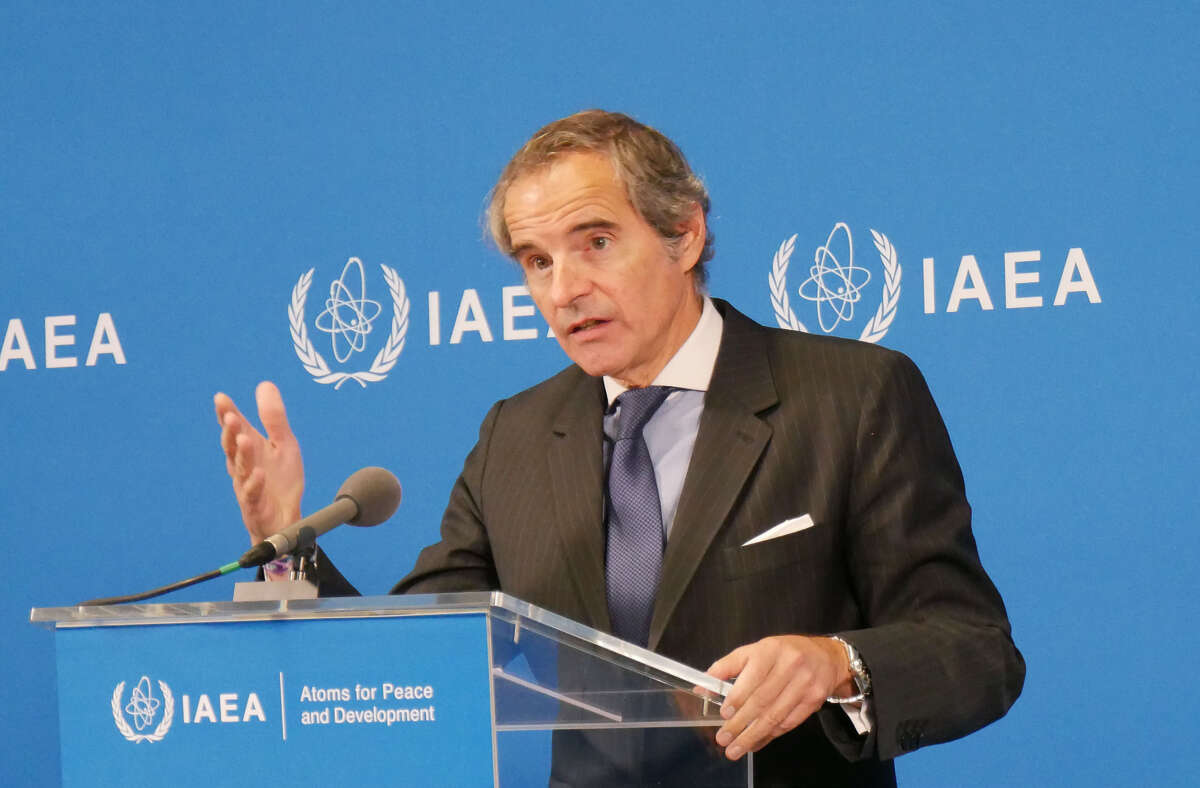
Rafael Grossi, head of the International Atomic Energy Agency (IAEA), speaks at a press conference in Wien, Austria, on June 9, 2025.Albert Otti / picture alliance via Getty Images
The head of the leading intergovernmental watchdog for nuclear energy and atomic weapons has confirmed that the agency has not found “any proof” of an effort to obtain a nuclear weapon by Iran, lending yet more evidence contradicting Israel’s “self-defense” narrative for its war on the country.
In an interview this week, International Atomic Energy Agency (IAEA) Director General Rafael Grossi said that, while it is possible that there are operations being kept secret from regulators, reports that Iran has not been actively pursuing a nuclear weapon since 2003 are accurate.
Those claiming to know exact details about Iran moving toward a nuclear weapon are engaging in “speculation,” he told CNN’s Christiane Amanpour.
“If there was some activity which was clandestine or hidden or away from our inspectors, we couldn’t know,” said Grossi. What the agency has reported, he said, is that “we did not have — as in coincidence with some of the sources you mentioned there — that we did not have any proof of a systematic effort to move into a nuclear weapon.”
This undercuts Israel’s claims that it has evidence that Iran is working to obtain a nuclear bomb. Israeli officials say they’re so sure of this that they have started a war supposedly in order to stop it from happening.
These claims aren’t backed up by any other sources. As Tulsi Gabbard, the top intelligence official in President Donald Trump’s administration, has testified, U.S. intelligence officials have not found evidence of Iran moving toward a nuclear weapon.
Israeli Prime Minister Benjamin Netanyahu has suggested that Iran is actually pursuing a nuclear weapon in “secret”. But a lack of proof of a claim is hardly a legitimate reason to begin a war.
Grossi’s clear reiteration of IAEA’s findings are significant as Netanyahu and pro-Israel lawmakers in the U.S. have used IAEA’s findings in order to justify the war, misleadingly using the agency’s reports as evidence of Iran working toward a nuclear bomb even as the agency has definitively said it has no evidence of that.
For its part, Iran has long insisted that its nuclear development is for civilian purposes. IAEA has, indeed, found evidence that Iran possesses some of the elements needed for a nuclear bomb, but has emphasized that it has not found evidence for active bomb development.
Last week, the group admonished Iran for not complying with the terms of an international nuclear non-proliferation agreement it’s party to — the deal that Trump withdrew from during his first term.
Iran has threatened to withdraw from the nuclear Non-Proliferation Treaty (NPT) as a result of the war, but that’s an agreement that Israel never signed onto, with Israel widely believed to have at least 90 nuclear warheads and materials to create hundreds more. IAEA has assessed Israel to be one of the only nine countries in the world known to have nuclear weapons.
Netanyahu’s claims of definitive evidence of Iran pursuing a nuclear bomb are clearly politically motivated. Netanyahu has spent over three decades presenting supposed evidence that Iran is just months or years away from obtaining a nuclear weapon.
Further, even if Iran has a secretive program to obtain nuclear weapons, Israel’s aggression is actually making it harder for inspectors to make a determination either way. Bloomberg reported on Wednesday that inspectors are currently unable to determine the location of Iran’s enriched uranium stockpile because of the war.
“In a time of war, all nuclear sites are closed. No inspections, no normal activity can take place,” Grossi told Bloomberg Television, adding that Iranian officials had told him that the stockpile would be moved in the case of war.
The head of the leading intergovernmental watchdog for nuclear energy and atomic weapons has confirmed that the agency has not found “any proof” of an effort to obtain a nuclear weapon by Iran, lending yet more evidence contradicting Israel’s “self-defense” narrative for its war on the country.
In an interview this week, International Atomic Energy Agency (IAEA) Director General Rafael Grossi said that, while it is possible that there are operations being kept secret from regulators, reports that Iran has not been actively pursuing a nuclear weapon since 2003 are accurate.
Those claiming to know exact details about Iran moving toward a nuclear weapon are engaging in “speculation,” he told CNN’s Christiane Amanpour.
“If there was some activity which was clandestine or hidden or away from our inspectors, we couldn’t know,” said Grossi. What the agency has reported, he said, is that “we did not have — as in coincidence with some of the sources you mentioned there — that we did not have any proof of a systematic effort to move into a nuclear weapon.”
This undercuts Israel’s claims that it has evidence that Iran is working to obtain a nuclear bomb. Israeli officials say they’re so sure of this that they have started a war supposedly in order to stop it from happening.
These claims aren’t backed up by any other sources. As Tulsi Gabbard, the top intelligence official in President Donald Trump’s administration, has testified, U.S. intelligence officials have not found evidence of Iran moving toward a nuclear weapon.
Israeli Prime Minister Benjamin Netanyahu has suggested that Iran is actually pursuing a nuclear weapon in “secret”. But a lack of proof of a claim is hardly a legitimate reason to begin a war.
Grossi’s clear reiteration of IAEA’s findings are significant as Netanyahu and pro-Israel lawmakers in the U.S. have used IAEA’s findings in order to justify the war, misleadingly using the agency’s reports as evidence of Iran working toward a nuclear bomb even as the agency has definitively said it has no evidence of that.
For its part, Iran has long insisted that its nuclear development is for civilian purposes. IAEA has, indeed, found evidence that Iran possesses some of the elements needed for a nuclear bomb, but has emphasized that it has not found evidence for active bomb development.
Last week, the group admonished Iran for not complying with the terms of an international nuclear non-proliferation agreement it’s party to — the deal that Trump withdrew from during his first term.
Iran has threatened to withdraw from the nuclear Non-Proliferation Treaty (NPT) as a result of the war, but that’s an agreement that Israel never signed onto, with Israel widely believed to have at least 90 nuclear warheads and materials to create hundreds more. IAEA has assessed Israel to be one of the only nine countries in the world known to have nuclear weapons.
Netanyahu’s claims of definitive evidence of Iran pursuing a nuclear bomb are clearly politically motivated. Netanyahu has spent over three decades presenting supposed evidence that Iran is just months or years away from obtaining a nuclear weapon.
Further, even if Iran has a secretive program to obtain nuclear weapons, Israel’s aggression is actually making it harder for inspectors to make a determination either way. Bloomberg reported on Wednesday that inspectors are currently unable to determine the location of Iran’s enriched uranium stockpile because of the war.
“In a time of war, all nuclear sites are closed. No inspections, no normal activity can take place,” Grossi told Bloomberg Television, adding that Iranian officials had told him that the stockpile would be moved in the case of war.
Op-Ed: Is the US about to enter yet another forever war? Bad idea
By Paul Wallis
DIGITAL JOURNAL
June 18, 2025

Smoke billows from an explosion at the Islamic Republic of Iran Broadcasting (IRIB) building in Tehran on June 16, 2025 - Copyright AFP Brendan SMIALOWSKI
“Middle East peace” is just a wistful expression. It hasn’t been a fact or even a possibility for generations. The current situation between Israel and Iran is a heirloom war between two totally opposed forces.
The daily headlines are becoming more like a grotesque weather report. What’s not happening is peace or any suggestion of peace.
Middle East politics largely revolve around conflict. The fires are regularly and often deliberately stoked by “incidents”. These incidents are generally supported by third parties outside the war zones. The current Gaza situation is a prime example.
Iran’s generational support for Hamas and Hezbollah is a genuine threat to Israel. Its endless hostile rhetoric is another. Most of these issues are effectively muted, most of the time, until some genius decides to make it worse.
The Gaza flashpoint, however, has turned into a raging fire for the last year and a half. It’s real enough to trigger escalation on almost any basis. That’s what’s happening now, as Israeli strikes on Iran inevitably caused a direct confrontation.
Into this truly unholy mess stumbles America’s noisy anti-President, fresh from recent triumphs in trade and foreign relations. Will the US participate in strikes on Iran?
Sounds simple, doesn’t it?
It isn’t.
There are more than a few mines in this minefield.
For instance:
The Iranian nuclear issue was well and truly asleep until now. There was no publicly available information regarding the real status of weaponization of uranium, for example, until very recently. Israeli intelligence apparently sees it differently.
The Obama administration’s nuclear deal with Iran was one of the few successful American initiatives in the Middle East in decades. It did shut down a very tense and extremely difficult situation. One of the issues was convincing Israel that it’d work. Israel had previously attacked Iraqi facilities and was poised to strike Iran. The current situation was effectively delayed by ten years.
Iran has multiple assets and proxies throughout the Middle East and, to a lesser extent, around the world. The attacks on shipping in the Red Sea are cases in point. An American attack on Iran could result in global strikes by Iranian assets in many different forms.
Israel and Iran have been swapping low-key attacks for many years. Israeli cyberattacks and Iranian harassment are pretty normal events. It’s likely that this ongoing and largely futile forever war will heat up fast if the right buttons are pushed.
Local politics in the Middle East are never simple or transparent.
According to Al Jazeera, for example, the Israeli attacks have shored up support for the Iranian leadership. Iran’s domestic issues are rarely mentioned in foreign media, but there have been some major issues with Iran’s stagnant economy.
There’s also a question as to whether Netanyahu has used the Iranian strikes to deflect mounting Israeli criticism of his handling of Gaza. There’s no way of knowing. It’s hard to believe that Israel has suddenly decided to open a second front for a few nice headlines.
The question for America is how to handle this particularly thankless situation.
US airstrikes can only achieve the same degree of penetration as the Israeli strikes.
It’s unlikely that a large, highly decentralized Iranian nuclear weapon program can be entirely shut down by these strikes.
Is there a realistic military objective for the US? There have to be defined criteria for success.
Iran is extremely unlikely to bow to external pressure, particularly from the US.
This sort of war can and does typically go on for years. Major US strikes using all America’s Middle East military assets could simply start a cycle of further escalation, while not materially affecting the situation.
Imagine trying to beat someone to death with a handful of banknotes.
This has all the hallmarks of a long, expensive range of options, none of which will shut down the risks.
It’s a new quagmire in process.
Update: Trump is said to have “privately” approved strikes, according to Reuters, quoting the Wall Street Journal. “Nepo news” is up and running at last.
__________________________________________________________
Disclaimer
The opinions expressed in this Op-Ed are those of the author. They do not purport to reflect the opinions or views of the Digital Journal or its members.
By Paul Wallis
DIGITAL JOURNAL
June 18, 2025
Smoke billows from an explosion at the Islamic Republic of Iran Broadcasting (IRIB) building in Tehran on June 16, 2025 - Copyright AFP Brendan SMIALOWSKI
“Middle East peace” is just a wistful expression. It hasn’t been a fact or even a possibility for generations. The current situation between Israel and Iran is a heirloom war between two totally opposed forces.
The daily headlines are becoming more like a grotesque weather report. What’s not happening is peace or any suggestion of peace.
Middle East politics largely revolve around conflict. The fires are regularly and often deliberately stoked by “incidents”. These incidents are generally supported by third parties outside the war zones. The current Gaza situation is a prime example.
Iran’s generational support for Hamas and Hezbollah is a genuine threat to Israel. Its endless hostile rhetoric is another. Most of these issues are effectively muted, most of the time, until some genius decides to make it worse.
The Gaza flashpoint, however, has turned into a raging fire for the last year and a half. It’s real enough to trigger escalation on almost any basis. That’s what’s happening now, as Israeli strikes on Iran inevitably caused a direct confrontation.
Into this truly unholy mess stumbles America’s noisy anti-President, fresh from recent triumphs in trade and foreign relations. Will the US participate in strikes on Iran?
Sounds simple, doesn’t it?
It isn’t.
There are more than a few mines in this minefield.
For instance:
The Iranian nuclear issue was well and truly asleep until now. There was no publicly available information regarding the real status of weaponization of uranium, for example, until very recently. Israeli intelligence apparently sees it differently.
The Obama administration’s nuclear deal with Iran was one of the few successful American initiatives in the Middle East in decades. It did shut down a very tense and extremely difficult situation. One of the issues was convincing Israel that it’d work. Israel had previously attacked Iraqi facilities and was poised to strike Iran. The current situation was effectively delayed by ten years.
Iran has multiple assets and proxies throughout the Middle East and, to a lesser extent, around the world. The attacks on shipping in the Red Sea are cases in point. An American attack on Iran could result in global strikes by Iranian assets in many different forms.
Israel and Iran have been swapping low-key attacks for many years. Israeli cyberattacks and Iranian harassment are pretty normal events. It’s likely that this ongoing and largely futile forever war will heat up fast if the right buttons are pushed.
Local politics in the Middle East are never simple or transparent.
According to Al Jazeera, for example, the Israeli attacks have shored up support for the Iranian leadership. Iran’s domestic issues are rarely mentioned in foreign media, but there have been some major issues with Iran’s stagnant economy.
There’s also a question as to whether Netanyahu has used the Iranian strikes to deflect mounting Israeli criticism of his handling of Gaza. There’s no way of knowing. It’s hard to believe that Israel has suddenly decided to open a second front for a few nice headlines.
The question for America is how to handle this particularly thankless situation.
US airstrikes can only achieve the same degree of penetration as the Israeli strikes.
It’s unlikely that a large, highly decentralized Iranian nuclear weapon program can be entirely shut down by these strikes.
Is there a realistic military objective for the US? There have to be defined criteria for success.
Iran is extremely unlikely to bow to external pressure, particularly from the US.
This sort of war can and does typically go on for years. Major US strikes using all America’s Middle East military assets could simply start a cycle of further escalation, while not materially affecting the situation.
Imagine trying to beat someone to death with a handful of banknotes.
This has all the hallmarks of a long, expensive range of options, none of which will shut down the risks.
It’s a new quagmire in process.
Update: Trump is said to have “privately” approved strikes, according to Reuters, quoting the Wall Street Journal. “Nepo news” is up and running at last.
__________________________________________________________
Disclaimer
The opinions expressed in this Op-Ed are those of the author. They do not purport to reflect the opinions or views of the Digital Journal or its members.


No comments:
Post a Comment