By Juan Cole

Bombed residential building in Iran
A revised version of an essay from a long time ago. It didn’t need much revision.
Belief: Iran is aggressive and has threatened to attack Israel, its neighbors or the US
Reality: Iran has not launched an aggressive war in modern history (unlike the US or Israel), and its leaders have a doctrine of “no first strike.” This is true of Supreme Leader Ali Khamenei, as well as of Revolutionary Guards commanders.
Belief: Iran is a militarized society bristling with dangerous weapons and a growing threat to world peace.
Reality: Iran’s military budget in recent years has expanded from $10 billion a year around $15 billion annually, making it 25th in the world for such expenditures and putting it in the same range as Singapore and Uruguay. Algeria and Turkiye spend more, and Israel spends twice as much. Even if the war causes Iran to double its spending, it would still only match the United Arab Emirates and Israel, and would not reach the level of Saudi Arabia. Moreover, Iran is a country of 92 million, so that its per capita spending on defense is tiny compared to some of these others, since they are much smaller countries with regard to population.
Belief: Iran has threatened to attack Israel militarily and to “wipe it off the map.”
Reality: Iran’s leaders have often warned Israel that an attack would be met with a strong response. No Iranian leader in the executive had threatened a first-strike, aggressive act of war on Israel, since this would contradict the doctrine of ‘no first strike’ to which the country has adhered.
Belief: But didn’t President Mahmoud Ahmadinejad (in office 2005-2013) threaten to ‘wipe Israel off the map?’
Reality: President Mahmoud Ahmadinejad did quote Ayatollah Khomeini (d. 1989) to the effect that “this Occupation regime over Jerusalem must vanish from the page of time” (in rezhim-e eshghalgar-i Qods bayad as safheh-e ruzgar mahv shavad). This was not a pledge to roll tanks and invade or to launch missiles, however. It is the expression of a hope that the regime will collapse, just as the Soviet Union did. It is not a threat to kill anyone at all.
Belief: But aren’t Iranians Holocaust deniers?
Actuality: Some are, some aren’t. Former president Mohammad Khatami has castigated Ahmadinejad for questioning the full extent of the Holocaust, which he called “the crime of Nazism.” Many educated Iranians in the regime are perfectly aware of the horrors of the Holocaust. In any case, despite what propagandists imply, neither Holocaust denial (as wicked as that is) nor calling Israel names is the same thing as pledging to attack it militarily.
Belief: Iran is like North Korea in having an active nuclear weapons program, and is the same sort of threat to the world.
Actuality: Iran has long had a nuclear enrichment site at Natanz near Isfahan where it said it was producing fuel for its Bushehr nuclear energy plant and for future civilian nuclear reactors to generate electricity. All Iranian leaders denied that this site was for weapons production, and the International Atomic Energy Agency repeatedly inspected it over the decadesand found no weapons program. Iran is not being completely transparent, generating some doubts, but all the evidence the IAEA and the CIA can gather points to there not being a weapons program. As recently as March Director of National Intelligence Tulsi Gabbard reaffirmed that US intelligence has no evidence for a weapons program. She recently backtracked, saying that Iran has the elements to launch a weapons program, but you could say that about Japan, South Korea, and the Netherlands, too. These longstanding US intel assessments have been based on debriefings of defecting nuclear scientists, as well as on the documents they brought out, in addition to US signals intelligence from Iran and numerous inspections by the UN The International Atomic Energy Agency (IAEA). While the IAEA criticized aspects of Iran’s civilian enrichment program, Rafael Grossi, its head, recently reaffirmed,
““We did not have any proof of a systematic effort to move into a nuclear weapon.”
Belief: Isn’t the Iranian regime irrational and crazed, so that a doctrine of mutally assured destruction just would not work with them?
Actuality: Iranian politicians are rational actors. If they were madmen, why haven’t they invaded any of their neighbors? Saddam Hussein of Iraq invaded both Iran and Kuwait. Israel has invaded its neighbors more than once, most recently Syria. In contrast, Iran has not started any wars. Demonizing people by calling them unbalanced is an old propaganda trick. The US elite was once unalterably opposed to China having nuclear science because they believed the Chinese are intrinsically irrational. This kind of talk is a form of racism.
Belief: The U.S. would not have put sanctions on Iran, and would not be so worried, if it were not a gathering nuclear threat.
Actuality: The centrifuge technology that Iran is using to enrich uranium is open-ended. In the old days, you could tell which countries might want a nuclear bomb by whether they were building light water reactors (less suitable for bomb-making) or heavy-water reactors (could be used to make a bomb in short order, as in North Korea). But with centrifuges, once you can enrich to 5% to fuel a civilian reactor, you could theoretically feed the material back through many times and enrich to 90% for a bomb. However, as long as centrifuge plants are being actively inspected, they cannot be used to make a bomb. The two danger signals would be if Iran threw out the inspectors or if it found a way to create a secret facility. The latter task would be extremely difficult, however, as demonstrated by the CIA’s discovery of the Qom facility construction in 2006 from satellite photos. Nuclear installations, especially centrifuge ones, consume a great deal of water, construction materiel, and so forth, so that constructing one in secret is a tall order. In any case, you can’t attack and destroy a country because you have an intuition that they might be doing something illegal. You need some kind of proof. Moreover, Israel, Pakistan and India are all much worse citizens of the globe than Iran, since they refused to sign the nuclear Non-Proliferation Treaty and then went for broke to get a bomb; and nothing at all has been done to any of them by the United Nations Security Council.

Juan Cole
Juan R. I. Cole is Richard P. Mitchell Collegiate Professor of History at the University of Michigan. For three and a half decades, he has sought to put the relationship of the West and the Muslim world in historical context, and he has written widely about Egypt, Iran, Iraq, and South Asia. His books include Muhammad: Prophet of Peace Amid the Clash of Empires; The New Arabs: How the Millennial Generation is Changing the Middle East; Engaging the Muslim World; and Napoleon’s Egypt: Invading the Middle East.
Iran And Nuclear Weapons Production – Analysis
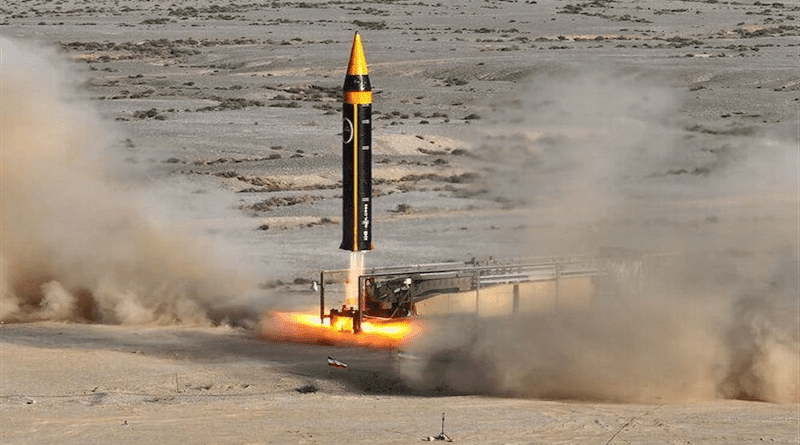
Iran launches test of missile. Photo Credit: Tasnim News Agency
By CRS

By Paul K. Kerr
Iran’s nuclear program has generated widespread concern that Tehran is pursuing nuclear weapons. According to U.S. intelligence assessments, Tehran has the capacity to produce nuclear weapons at some point, but has halted its nuclear weapons program and has not mastered all of the necessary technologies for building such weapons. (For additional information, see CRS Report RL34544, Iran’s Nuclear Program: Status, by Paul K. Kerr.)
Since the early 2000s, Tehran’s construction of gas centrifuge uranium enrichment facilities has been the main source of proliferation concern. Gas centrifuges enrich uranium by spinning uranium hexafluoride (UF6) gas at high speeds to increase the concentration of the uranium-235 (u-235) isotope. Such centrifuges can produce both low-enriched uranium (LEU), which can be used in nuclear power reactors, and highly enriched uranium (HEU), which is one of the two types of fissile material used in nuclear weapons. Tehran asserts that its enrichment program is only meant to produce fuel for peaceful nuclear reactors.
The 2015 Joint Comprehensive Plan of Action (JCPOA) requires Iran to implement various restrictions on its nuclear program, as well as to accept specific monitoring and reporting requirements. (For more information, see CRS Report R40094, Iran’s Nuclear Program: Tehran’s Compliance with International Obligations, by Paul K. Kerr.)
Then-President Donald Trump announced in May 2018 that the United States was ending U.S. participation in the JCPOA. Over time, Iran subsequently stopped implementing much of this agreement, as well as JCPOA-required International Atomic Energy Agency (IAEA) monitoring. Beginning in July 2019, the IAEA verified that some of Iran’s nuclear activities were exceeding JCPOA-mandated limits. Tehran’s subsequent expansion of the country’s enrichment program has decreased the amount of time needed for Iran to produce enough weapons-grade HEU for a nuclear weapon—an action frequently termed “breakout.”
According to official U.S. assessments, Iran halted its nuclear weapons program in late 2003 and has not resumed it. This program’s goal, according to U.S. officials and the IAEA, was to develop an implosion-style nuclear weapon for Iran’s Shahab-3 ballistic missile. Tehran has not made a decision to develop nuclear weapons, according to 2024 and 2025 public U.S. intelligence assessments. The 2025 U.S. Intelligence Community Annual Threat Assessment published by the Office of the Director of National Intelligence (ODNI) identifies Iran’s Supreme Leader Ali Khamenei as the “final decisionmaker” over “any decision to develop nuclear weapons.”
The U.S. government assessed prior to the JCPOA that Iran had not mastered all of the necessary technologies for building a nuclear weapon. However, Tehran may now be conducting work on such technologies. The 2024 U.S. Intelligence Community Annual Threat Assessment) observes that “Iran is not currently undertaking the key nuclear weapons-development activities necessary to produce a testable nuclear device.” But this phrase is absent from 2024 and 2025 ODNI assessments of Tehran’s nuclear program.
The JCPOA-mandated restrictions on Iran’s nuclear program, as well as the agreement’s Iran-specific monitoring and reporting requirements, both supplement Tehran’s obligations pursuant to the government’s comprehensive IAEA safeguards agreement. Such agreements empower the agency to detect the diversion of nuclear material from peaceful purposes, as well as to detect undeclared nuclear activities and material. These agreements also require governments to declare their entire inventory of certain nuclear materials, as well as related facilities. Safeguards include agency inspections and monitoring of declared nuclear facilities.
Prior and subsequent to the JCPOA’s January 2016 implementation, IAEA and U.S. officials expressed confidence in the ability of both the IAEA and the U.S. intelligence community to detect an Iranian breakout attempt using either Tehran’s IAEA-monitored facilities or clandestine facilities (see CRS Report R40094). More recently, an ODNI spokesperson indicated that the U.S. intelligence community is capable of detecting Iranian efforts to build a nuclear weapon, the Wall Street Journal reported on August 9, 2024.
Estimated Nuclear Weapons Development Timelines
U.S. estimates concerning Iranian nuclear weapon development account for the time necessary to produce a sufficient amount of weapons-grade HEU and also complete the remaining steps necessary for an implosion-style nuclear device suitable for explosive testing.
Such a device, according to the Office of Technology Assessment, uses “a shell of chemical high-explosive surrounding the nuclear material … to rapidly and uniformly compress the nuclear material to form a supercritical mass” necessary for a sustained nuclear chain reaction.
Fissile Material Production
The time needed to produce enough weapons-grade HEU for a nuclear weapon is a function of a nuclear program’s enrichment capacity, as well as the mass and u-235 content of the UF6 stockpile fed into the enrichment process. LEU used in nuclear power reactors typically contains less than 5% u-235; research reactor fuel can be made using enriched uranium containing 20% u-235; HEU used in nuclear weapons typically contains about 90% u-235.
The JCPOA mandates restrictions on Iran’s declared enrichment capacity and requires that Iran’s enriched uranium stockpile must not exceed 300 kilograms of UF6 containing 3.67% u-235 “or the equivalent in other chemical forms.” This quantity of uranium hexafluoride “corresponds to 202.8 kg of uranium,” according to the IAEA.
The aforementioned JCPOA restrictions constrained Iran’s nuclear program so that Tehran, using its declared enrichment facilities, would, for at least 10 years, have needed a minimum of one year to produce enough weapons-grade HEU for one nuclear weapon. The agreement does not explicitly mandate such a timeline. The timeline would begin to decrease after JCPOA restrictions on Iran’s enrichment capacity, as well as the mass and u-235 content of the UF6 stockpile, begin to expire in January 2026.
Iran’s number of installed centrifuges, the mass and u-235 concentration of Tehran’s enriched uranium stockpile, and number of enrichment locations currently exceed JCPOA-mandated limits. Tehran is also conducting JCPOA-prohibited research and development, as well as centrifuge manufacturing and installation. A November 2024 ODNI report explains that Iran has enough fissile material that, if further enriched, would be sufficient for “more than a dozen nuclear weapons.”
According to the July 2024 ODNI report, “Tehran has the infrastructure and experience to quickly produce weapons-grade uranium.” The U.S. government estimates that Iran would need as little as one week to produce enough weapons-grade HEU for one nuclear weapon, according to a State Department official in March 2022. According to a May 11, 2025, Defense Intelligence Agency assessment, Iran would need “probably less than one week” to produce this amount of HEU. Asked about damage to Iran’s nuclear facilities inflicted by June 2025 Israeli airstrikes, IAEA Director General Rafael Grossi stated during a June 17 CNN interview that Iran’s enrichment program “has been significantly set back.”
If Tehran were to resume implementing its current JCPOA obligations, this fissile material production timeline would increase, but would be less than one year, according to State Department officials. This estimate reflects Iran’s recent accumulation of knowledge gained by operating centrifuges that are more sophisticated. Former National Intelligence Council official Eric Brewer noted in an October 2021 Center for Strategic and International Studies publication that, absent this experience, Iran would probably have used less efficient, first-generation centrifuges for a breakout attempt.
Weaponization
At the time when the JCPOA negotiations concluded, the U.S. intelligence community assessed that Iran would have needed one year to complete the necessary steps for producing a nuclear weapon that do not involve fissile material production. This estimate assumed that Iran could complete fissile material production and weaponization in parallel, which meant that Iran would have needed about one year to produce a nuclear weapon.
Until recently, the U.S. intelligence community assessed that Iran had not resumed work on its weaponization research. A State Department official told CRS in an April 2022 email that Iran would need approximately one year to complete the necessary weaponization steps. This timeline took “into consideration assessed knowledge gaps” and reflected the intelligence community’s “view of Iran’s fastest reasonable path to overcome them,” the official added. The current assessed public timeline is unclear. Chairman of the Joint Chiefs of Staff Mark Milley testified in March 2023 that Iran would need “several months to produce an actual nuclear weapon,” but he did not explain the assumptions underlying this estimate.
IAEA reports indicate that Iran does not yet have a viable nuclear weapon design or a suitable explosive detonation system. Tehran may also need additional experience in producing uranium metal; weapons-grade HEU metal for use in a nuclear weapon is first “cast and machined into suitable components for a nuclear core.”
Discussion
The aforementioned one-year fissile-material breakout estimate assumes that Iran would use its declared nuclear facilities to produce fissile material for a weapon. But the breakout concept does not accurately measure Tehran’s nuclear weapons capability.
The U.S. government has long assessed that Iran is more likely to use covert, rather than declared, facilities to produce the requisite fissile material; whether this is still the U.S. assessment is unclear. Neither the U.S. government nor the IAEA have publicly described any evidence that Iran is conducting covert fissile material production nuclear activities.
During JCPOA negotiations, the breakout timeline was an unclassified proxy measure of Iranian nuclear weapons capabilities. A State Department official described the breakout “concept” in a September 2021 email as “a useful metric to help quantify” U.S. negotiating goals and as “a useful analytic framework to structure the negotiation of technical measures related to enrichment.” The timeline was also “helpful in explaining the deal and selling it politically,” the official noted, adding that the timeline has “become an important political yardstick” for evaluating the agreement’s merits. In a February 2022 Bulletin of the Atomic Scientists article, Jon Wolfsthal, a National Security Council official during the Obama Administration, explained that the one-year breakout goal was meant to provide enough time “to generate an international response to any Iranian move to build weapons.”
The Obama Administration, former State Department official Robert Einhorn wrote in a 2021 United Nations Institute for Disarmament Research report, argued that stopping Iran from developing nuclear weapons required preventing Tehran “from having the fissile material production infrastructure” to break out “in less time than it would take the international community to intervene to block it.”
- About the author Paul K. Kerr, Specialist in Nonproliferation
- Source: This article was published by the Congressional Research Service (CRS).
CRS
The Congressional Research Service (CRS) works exclusively for the United States Congress, providing policy and legal analysis to committees and Members of both the House and Senate, regardless of party affiliation. As a legislative branch agency within the Library of Congress, CRS has been a valued and respected resource on Capitol Hill for nearly a century.


No comments:
Post a Comment