Fragmenting a Nation:
Israel’s Enduring Pursuit of Palestinian Disunity
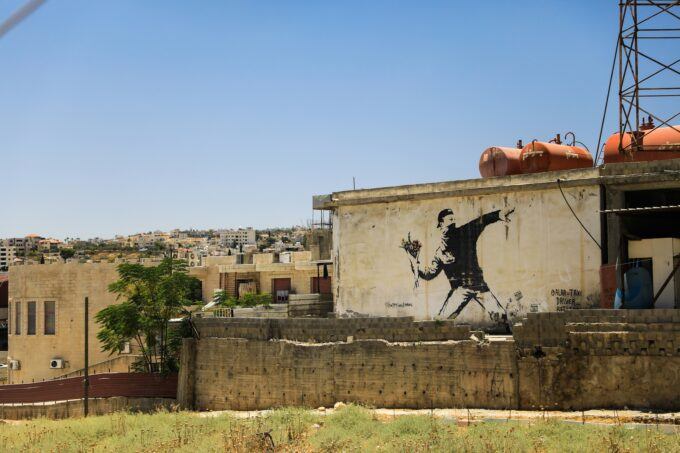
Image by Dylan Shaw.
Israel is aggressively implementing plans to shape Palestine’s future and the broader region, sculpting its vision for the ‘day after’ its genocide in Gaza.
The latest, bizarre iteration of this strategy proposes fragmenting the occupied West Bank into so-called ’emirates,’ starting with the ’emirate of Hebron.’
This unexpected twist in Israel’s protracted search for alternative Palestinian leadership first surfaced in the staunchly pro-Israeli US newspaper, the Wall Street Journal. It then quickly dominated all Israeli media.
The report details a letter from a person identified by the WSJ as “the leader of Hebron’s most influential clan.” Addressed to Nir Barakat, Jerusalem’s former Israeli mayor, the letter from Sheikh Wadee’ al-Jaabari appeals for “cooperation with Israel” in the name of “co-existence.”
This “co-existence,” according to the “clan leader”, would materialize in the “Emirate of Hebron.” This “emirate” would “recognize the State of Israel as the nation state of the Jewish people,” in exchange for reciprocal recognition of the “Emirate of Hebron as the Representative of the Arab residents in the Hebron District.”
The story may seem perplexing. This is because Palestinian discourse, regardless of geography or political affiliation, has never entertained such an absurd concept as united West Bank “emirates.”
Another element of absurdity is that Palestinian national identity and pride in their people’s unwavering resilience, especially in Gaza, are at an unprecedented apex. To float such clan-based alternatives to legitimate Palestinian leadership seems ill-conceived and is destined to fail.
Israel’s desperation is palpable. In Gaza, it cannot defeat Hamas and other Palestinian factions who have resisted the Israeli takeover of the Strip for 21 months. All attempts to engineer an alternative Palestinian leadership there have utterly collapsed.
This failure has compelled Israel to arm and fund a criminal gang that operated before October 7, 2023, in Gaza. This gang functions under the command of Yasser Abu Shabab.
The gang has been implicated in a litany of violent activities. These include hijacking humanitarian aid to perpetuate famine in Gaza and orchestrating violence associated with aid distribution, among other egregious crimes.
Like the clan leader of Hebron, the Abu Shabab criminal gang possesses no legitimacy and no public support among Palestinians. But why would Israel resort to such disreputable figures when the Palestinian Authority (PA), already engaged in “security coordination” with Israel in the West Bank, is ostensibly willing to comply?
The answer lies in the current Israeli extremist government’s adamant refusal to acknowledge Palestinians as a nation. Thus, even a collaborating Palestinian nationalist entity would be deemed problematic from an Israeli perspective.
While Benjamin Netanyahu’s government is not the first Israeli leadership to explore clan-based alternatives among Palestinians, the Israeli prime minister and his extremist allies are exceptionally determined to dismantle any Palestinian claim to nationhood. This was explicitly stated by extremist Finance Minister Bezalel Smotrich. He famously declared in Paris, in March 2023, that a Palestinian nation is an “invention.”
Thus, despite the PA’s willingness to cooperate with Israel in controlling Gaza, Israel remains apprehensive. Empowering the PA as a nationalist model fundamentally contravenes Israel’s overarching objectives of denying the Palestinian people their very claim to nationhood and, consequently, statehood and sovereignty.
Though Israel has consistently failed to establish and sustain its own alternative Palestinian leadership, its repeated efforts have invariably proven disruptive and violent.
Prior to the Nakba of 1948, the Zionist movement, alongside British authorities colonizing Palestine, heavily invested in undermining the Arab Higher Committee, a nationalist body comprising several political parties. They achieved this by empowering collaborating clans, hoping to dilute the Palestinian nationalist movement.
When Israel occupied the remainder of historic Palestine in 1967, it reverted to the same divide-and-conquer tactics. For instance, it established a Palestinian police force directly commanded by Israeli military administrations, in addition to creating an underground network of collaborators.
Following the overwhelming victory of nationalist candidates in the 1976 elections in occupied Palestine, Israel responded by cracking down on PLO-affiliated politicians, arresting, deporting and assassinating some.
Two years later, in 1978, it launched its ‘Village Leagues’ project. It hand-picked compliant traditional figures, designating them as the legitimate representatives of Palestinians.
These individuals, armed, protected and financed by the Israeli occupation army, were positioned to represent their respective clans in Hebron, Bethlehem, Ramallah, Gaza and elsewhere.
Palestinians immediately denounced them as collaborators. They were widely boycotted and socially ostracized.
Eventually, it became evident that Israel had no alternative but to engage directly with the PLO. This culminated in the Oslo Accords in 1993 and the subsequent formation of the PA.
The fundamental problem, however, persisted: the PA’s insistence on a Palestinian state remains anathema to an Israel that has shifted dramatically to the right.
This explains Netanyahu’s government’s unwavering insistence that the PA has no role in Gaza in any ‘day after’ scenario. While the PA could serve Israel’s interest in containing the rebellious Strip, such a triumph would inevitably recenter the discussion of a Palestinian state—a concept repugnant to most Israelis.
There is no doubt that neither the Abu Shabab gang nor the Hebron emirate will govern Palestinians, either in Gaza or the West Bank. Israel’s insistence on fabricating these alternatives, however, underscores its historic determination to deny Palestinians any sense of nationhood.
Israel’s persistent fantasies of control invariably fail. Despite their profound wounds, Palestinians are more unified than ever, their collective identity and nationhood hardened by relentless resistance and countless sacrifices.
Playing Out a Colonial Tragedy
July 18, 2025
Photograph Source: U.S. Secretary of Defense – Public Domain
At the heart of the long-established structure of U.S. foreign policy are powerful special interests (lobbies). Interests that are capable of substituting their parochial interest for national interest. The most powerful and successful of these special interests is the Zionist lobby. This is so despite the fact that the Zionists act as agents of a foreign power to assure American support for the national interests of Israel. Their influence with both U.S. political parties is well entrenched. Therefore, no one should be surprised when many Democrats discreetly supported Republican President Donald Trump’s attack on Iran (arguably, Israel’s enemy, not America’s). Or, at best, confined their objections to procedural matters, such as the sadly enfeebled “War Powers Act.”
For all too many U.S. politicians, the only “facts” worth attending to were those that conform to Israeli propaganda. Such politicians will always proclaim, quoting Senator Chuck Schumer, “ironclad support”— implying support of the Zionist state whatever the overall circumstances. A ubiquitous corollary to this position is the claim that Israel’s surprise attack on Iran of 13 June 2025 was an exercise of the “right to self-defense.” This, despite the fact that, in reality, Iran was not threatening Israel (their nuclear program has, by the evidence, always been a peaceful one) while, in reality, Israel was threatening Iran—having talked itself as a national collective into a paranoid fear of what the Iranians might do with their nuclear knowhow (an Israeli Holocaust?) in the unknown future. Of course Israel’s sneak attack can only push Iran’s leaders to consider fulfilling that Israeli nightmare.
Money Supports the Narrative
How is it that the Israeli narrative can erase the criminal reality of the Gaza genocide or the consistently non-threatening nature of Iran’s nuclear program, from the minds of two American electoral bodies (House and Senate) that have access to vast research and intelligence facilities? And how is it that the Democrats can hold to a position of “ironclad support of Israel,” that much of their voting base is, at last, questioning? The answer to these two questions is the same.
Success and failure in American politics comes down to winning elections. Winning elections rarely turns on foreign policy issues of which the public knows little. It does, however, turn on the raising of money. The Zionist lobby has, for generations, been a major source of money for all manner of elections and for both parties. The money has facilitated more than electoral wins. It has created an alliance of convenience between politicians and the Zionists. This alliance has led American politicians to accept the Zionist historical narrative as a financial imperative.
Thus, just as the Israeli citizens have been raised up to see the world only through their national narrative, so have most American politicians, when it comes to the Middle East in general and the Palestinians in particular, spent their entire careers immersed in the Zionist narrative—acceptance of which is one important foundation of their careers.
The same can be said for most American mainstream media personalities, from owners of TV and radio outlets to the reporters who work for them. This is not only a function of money. It has to do with the wider effects of a prevailing narrative and, again, the career enhancing acceptance that supports it. Since 1917 and the Balfour Declaration this narrative has, if you will, “colonized” the American mind. It has done so through repeated telling—largely through the media—until it is a facet of the nation’s own international worldview. Only now, with the wholesale slaughter of the Palestinians televised on alternative media, is the popular acceptance of the Zionist narrative eroding.
The Narrative Erodes
What happens if and when that popular acceptance of the Israeli narrative erodes enough to frighten the politicians who have taken it for granted for so long? Tradition might lead them to believe that money for counter propaganda will take care of the problem, but that may not be sufficient under the present genocidal circumstances.
Israel can no longer hide its inherent racist nastiness. The Gaza episode has made this clear. The public display of Israeli crimes has provided room, not only for second thoughts among politicians, but for a counter narrative to grow. If a new, pro-Palestine narrative takes hold, what might it ultimately call for? Perhaps the same thing that the Jews demanded in compensation for the genocide they suffered: accountability, security and lots of money. At least that is a most likely model.
As to the money and security, Israel, the United States, and most of the Western world owes the Palestinians compensation. This goes beyond rebuilding Gaza to the creation of a Palestinian state and the securing of its borders against any future Israeli pique.
As to accountability, consider the following: UN Human Rights Council: “Our finding that the basic military strategy used by the Israelis Since 7 Oct. ’23 leads to the inevitable conclusion that all those who have played a role in any way in the implementation of this strategy are suspected of the Commission of war crimes and crimes against humanity.“ (My italics).
The report goes on to itemize those culpable:
– the air crew in the bombers that are dropping the bombs and the rockets.
– the crews of ships off the coast that are shelling parts of Gaza, destroying fishing boats and the livelihood of fishers, the Palestinian people who depend on the sea.
– the soldiers on the ground who are implementing the strategy of destruction of infrastructure and killing of people in their thousands,
– Those who are far away from Gaza, who are piloting and controlling the drones that are inflicting slaughter on the Gazan people.
-Those who man the checkpoints to implement a strategy of starvation against the Palestinian people of Gaza.
There is not much more to say, except that the likelihood of the Western nations, particularly the U.S., coming through with a justice based solution to the present genocidal probldm will be, if at all, slow in coming. It will probably take years for a pro-Palestinian narrative to take hold at a governmental level, and by then the Palestinians might well be dead or scattered.
Finally, it is worth noting the irony that it is a country that claims to represent the Jewish people that has committed the present genocide. The Zionist Jews believed that only by possessing their own nation state could they be safe—a belief seemingly affirmed by the Holocaust. The result was a colonial nation state that led the Zionists to replicate the imperialist behavior of those who helped introduce Europe’s Jews into Arab Palestine. And, et sequitur, here we are playing out an historical colonial tragedy.
Lawrence Davidson is a retired professor of history at West Chester University in West Chester, PA.
The Bully Pulpit Reveals Trump’s Bullying the Special Rapporteur for Human Rights in Palestine

US President Theodore Roosevelt giving a speech in 1902.
President Theodore Roosevelt often referred to the term “bully pulpit” to mean he would use the country’s highest office to present his program. “Bully,” at the time, was positive, as in wonderful or sublime. President Trump and his subordinates have revealed during their time occupying the nation’s highest pulpit that they are bullies in the modern sense of the term, using force or comments to abuse or dominate others. Trump and Company’s bullying examples are numerous, but the administration’s actions against Francesca Albanese are particularly outrageous, bullying at its worst.
Francesca Albanese serves as the United Nations special rapporteur for the situation of human rights in the occupied Palestinian territories. She is not a U.N. official, but an independent, eminent Italian legal scholar, an expert on human rights as well as the first female to hold that position. She was appointed by the U.N. Human Rights Council in 2022. Previous special rapporteurs were such renowned figures as Richard Falk, Michael Lynk, and John Dugard.
How has Francesca Albanese been bullied? Last week, the Trump administration announced that it would impose sanctions on Albanese. “Today I am imposing sanctions on U.N. Human Rights Council Special Rapporteur Francesca Albanese for her illegitimate and shameful efforts to prompt International Criminal Court action against US and Israeli officials, companies, and executives,” Secretary of State Marco Rubio wrote on X. “We will not tolerate these campaigns of political and economic warfare, which threaten our national interests and sovereignty.” He also mentioned that the sanctions were part of a larger U.S. effort to marginalize the International Criminal Court (ICC) which had issued arrest warrants for Israeli Prime Minister Benjamin Netanyahu and Yoav Gallant, the former defense minister. “We will always stand by our partners in their right to self-defense,” Rubio wrote.
(The sanctions allow the United States to freeze Albanese’s assets within the U.S. and prohibit her and her family from entering the U.S. The Albanese sanctions are similar to those imposed by the U.S. on four ICC judges. The Trump administration also imposed sanctions on the ICC’s chief prosecutor, Karim Khan.)
What had Albanese done to merit the bullying sanctions? In a speech to the Human Rights Council on July 3, 2025, Albanese said that Israel was “responsible for one of the cruellest genocides in modern history.” She has long condemned Israel’s actions. In November 2024, she and 30 U.N. experts declared that their investigations “convincingly confirmed” Israel’s genocide, referring to an International Court of Justice’s ruling on Israel’s plausible genocide.
The sanctions against Albanese followed her July 3, 2025, report “From the Economy of Occupation to the Economy of Genocide” to the Human Rights Council. The report describes how companies have “profited from the Israeli economy of illegal occupation, apartheid, and now genocide.” She named over 40 companies such as Google, Amazon, Microsoft, Lockheed Martin, Caterpillar, Blackrock, IBM, Glencore, and HD Hyundai; claiming their involvement in what she called “the transformation of Israel’s economy of occupation to an economy of genocide.”
“Too many influential corporate entities remain inextricably financially bound to Israel’s apartheid and militarism,” she wrote. “[Israel’s] forever-occupation has become the ideal testing ground for arms manufacturers and Big Tech – providing significant supply and demand, little oversight, and zero accountability – while investors and private and public institutions profit freely,” the report said.
As an example of corporate profits, the special rapporteur noted that “In the past 21 months, while Israel’s genocide has devastated Palestinian lives and landscapes, the Tel Aviv stock exchange soared by 213 percent (USD), amassing $225.7 billion in market gains—including $67.8 billion in the past month alone. For some, genocide is profitable.”
As for the historic role of corporations in Israel’s illegal policies, she stated; “For decades, Israel’s repression of Palestinian people has been scaffolded by corporations, fully aware of and yet indifferent to, decades of human rights violations and international crimes.” Recommending that companies disengage from Israel, the report says that “The serious, structural and sustained nature of Israel’s crimes and violations triggered a prima facie responsibility to disengage — one that many corporations ignored.”
Can companies or countries be neutral? “[C]orporations cannot claim neutrality: they are either part of the machinery of displacement—or part of dismantling it,” she wrote. As for neutral countries, Albanese has had difficulties in Switzerland. Albanese has accused the Swiss-based mining and trading company Glencore of being the main exporter of coal for electricity in Israel and called on the company to stop doing business with Israel. In addition, a panel discussion with Albanese and a representative of Amnesty International was cancelled at the University of Bern and moved to a private location. “The university cancelled its commitment at short notice on the grounds that a balance could not be guaranteed,” Swissinfo reported.
While the July report dramatically shows the interface between business and human rights violations, it also indicated that the 40 or so companies mentioned are “just the tip of the iceberg.”
By pointing to the relationship between business and human rights violations, Albanese’s report goes further than traditional civil and political human rights violations. The report outlines, in graphic terms, the economic complicity in which companies enable Israel’s genocide to continue. By highlighting economic profits during a genocide, the special rapporteur has deepened the notion of accountability and challenged companies doing business with Israel. As she wrote; “Ending this genocide requires not only outrage but rupture, reckoning, and the courage to dismantle what enables it.”
As for reactions to the sanctions: Israel’s mission in Geneva told Reuters that the report was “legally groundless, defamatory and a flagrant abuse of her office.” Several of the companies cited have also condemned the report. U.N. Secretary-General Antonio Guterres’s spokesman said, “The use of unilateral sanctions against special rapporteurs or any other UN expert or official is unacceptable.”
As for Albanese’s response to the sanctions: In an interview with Al Jazeera, she said that the sanctions reminded her of “Mafia intimidating techniques.” And are obvious bullying, neither sublime nor wonderful.
Theodore Roosevelt’s presidential bully pulpit has become a mere presidential pulpit used by a bully and his underlings who have no sense of legal, moral or ethical norms.
Correction: In my last post, I wrote that Saddam Hussein had crossed President Obama’s red line about using chemical weapons. Thanks to an attentive reader, I should have written: “President Obama declared that the use of chemical weapons by Syrian President Bashar al-Assad would cross a ‘red line for us.’ The red line was crossed. There was no U.S. response.”

No comments:
Post a Comment