(RNS) — A new online group, the Dorothea Project, aims to bring attention to Catholic social teaching.
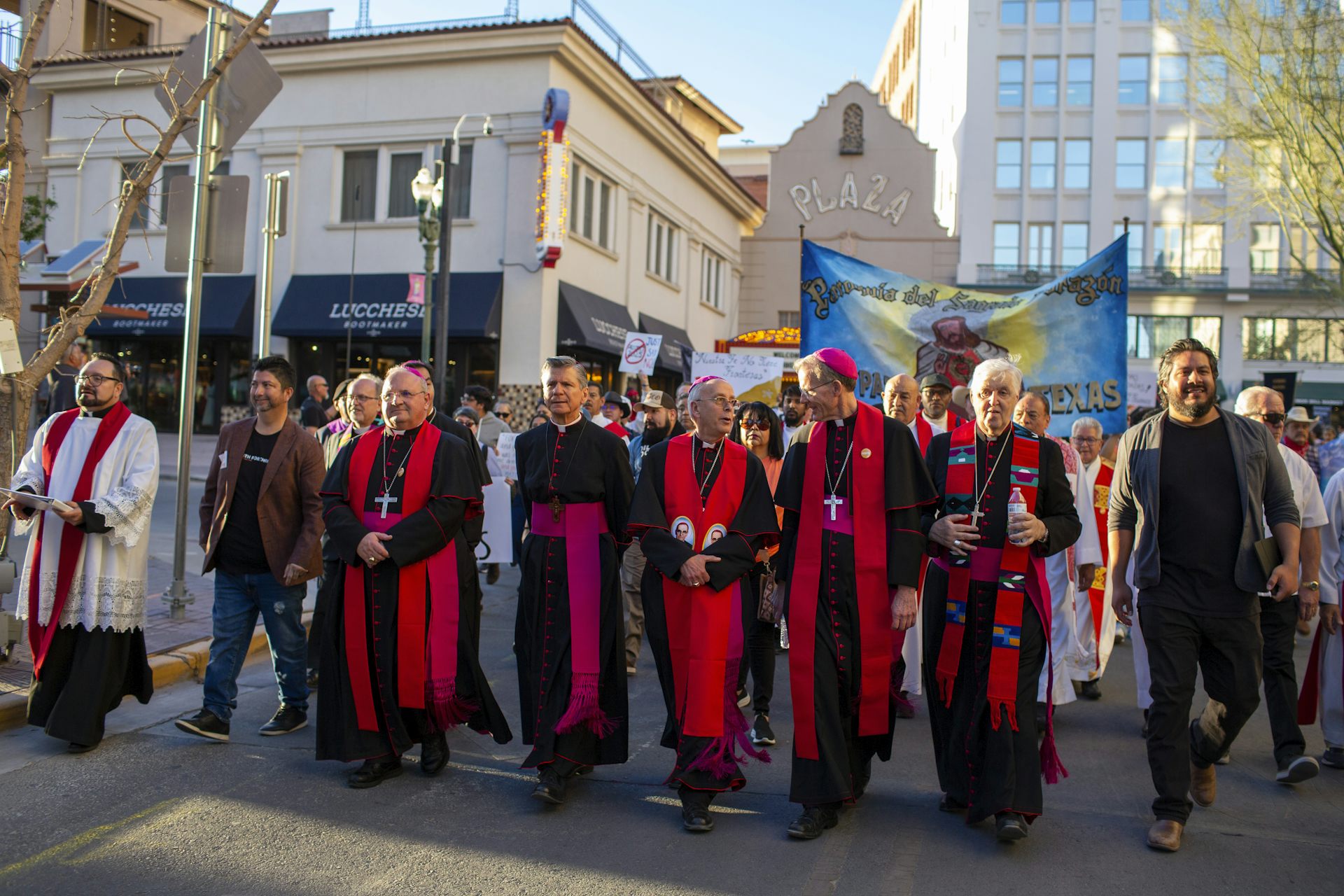
FILE - Catholic bishops invited by Mark Seitz, center, the bishop of El Paso, Texas, lead a march in solidarity with migrants on March 24, 2025, in downtown El Paso. (AP Photo/Andres Leighton)
Heidi Schlumpf
July 22, 2025
RNS
(RNS) — Katie Holler has watched with horror as migrants in the United States have been violently detained, some separated from their families and children. The case of a Cuban mother deported without her still-nursing baby especially anguished Holler, a Catholic and the mom of two young children herself.
“I have a 6-month-old baby. How distressing that would be to me as a mother to be separated from a baby I’m breastfeeding,” said Holler, a social worker who lives in Steubenville, Ohio. “These are vulnerable people, people we as Catholics say we love and want to support, and yet this administration is doing the exact opposite of what our faith demands us to do.”
RELATED: After immigration raids, Southern California Catholic bishop lifts Mass obligation
Even more frightening for Holler has been the rise of authoritarianism under Donald Trump, which she sees some of her fellow Catholics shrugging off, or even supporting.
A few months into the new administration, she decided to do something. With a few social media posts, Holler gathered a group of a dozen or so like-minded Catholic moms to meet online, and in July they took their first action: a letter-writing campaign to U.S. bishops, urging them to speak out publicly and advocate politically for mercy in the treatment of migrants.
“In the spirit of Christ, who Himself was a refugee, I ask you to help lead our local Church in defending the vulnerable and promoting policies that reflect the Gospel as well as Catholic Social Teaching,” the sample letter said.
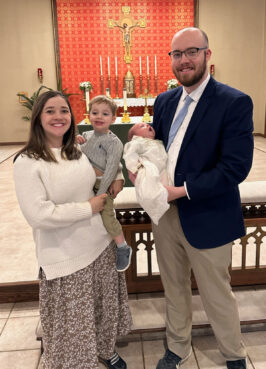
Kate Holler and her family. (Photo courtesy of Holler)
“As a shepherd of the Church, your voice carries moral authority and hope. In light of the Church’s teachings on human dignity, the preferential option for the poor, and the call to welcome the stranger, I believe now is the time for bold and courageous leadership in defense of the marginalized,” it said.
In just two weeks, more than 150 letters were sent to 75 bishops. At least one response has already arrived from the Indiana Catholic Conference seeking further conversation.
The group named itself the Dorothea Project, in homage to two Catholic women known for being outspoken for justice: Catholic Worker founder Dorothy Day and Sister Thea Bowman, a Franciscan Sister of Perpetual Adoration who famously called out the U.S. bishops on racism in 1989. Both are on the path to sainthood in the Catholic Church.
Though it started with moms, the group has opened itself to any Catholic woman interested in helping to educate others about Catholic social teaching. In just two months, its email list has grown to nearly 200 people, representing diverse backgrounds, geographical homes and experiences of Catholicism.
“Women have always been at the forefront of the social mission of the church. Women were the ones at the foot of the cross when Jesus was crucified,” said Holler. “I always say that moms can act as the moral compass of a society.”
Exit polls and more recent voter data indicate increased support for Trump among Catholic voters — including Catholic women — in the 2024 election.
Dorothea Project members want to help turn that tide, and immigration seems to be a key to doing so among members of a U.S. church created by waves of immigrants. While the Catholic Church holds that nations have a right to regulate their borders, it also teaches that people have the right to migrate to sustain their lives and the lives of their families. Church teaching also emphasizes the inherent dignity of all human persons, including migrants.
BreAnna Woznick, who voted for Trump in her first presidential election in 2016 because “that’s who Catholics I knew were voting for,” was feeling overwhelmed with the current political climate this spring when she discovered the Dorothea Project.
“I was not seeing Catholic values in online Catholic spaces,” says Woznick, who lives in Tucson with her husband and one child. Many of the conservative Catholic influencers Woznick followed online seemed more interested in arguing about their faith than living it, she said, and she had struggled with the same behavior. “There seemed to be very little compassion or seeking to understand each other.”
The Dorothea Project provided a more positive community and a practical project to start to make a difference. Woznick wrote to her former bishop, Edward Weisenberger, now of Detroit, who recently joined a public protest at an ICE facility to urge more humane practices.
Rachel Mondelli, a mom of two who lives outside Houston, wrote to Galveston-Houston Archbishop Joe S. Vásquez, who formerly headed the U.S. Conference of Catholic Bishops’ Committee on Migration. Vásquez has expressed concern about ICE raids, but Mondelli would like to see more. “This isn’t a moment when the church can step back and not be bold in defending the vulnerable,” she said.
RELATED: Trump’s immigration agenda is widening fissures in Catholic hierarchy’s consensus
Mondelli has been frustrated with the apparent marriage between Christianity and the Republican Party, especially since the first Trump administration.
“As Catholics, we don’t align perfectly with either party,” she said. “But it’s very difficult for me to square the circle of how many people I know who have a deep faith and are good and decent people and yet are supporting so much of what’s happening in our country right now. It seems antithetical to the gospel and who Jesus was.”

FILE – Migrants seeking asylum in the United States wait for humanitarian assistance and relief at Catholic Charities in McAllen, Texas, Jan. 18, 2025. (AP Photo/Eric Gay, file)
Mercedes Fratamico, a second-generation Mexican American and a member of the group, said the issue of immigration is personal. “I could have been born on the other side of the border. It’s just a matter of luck and circumstances,” she said. “My parents are citizens, but I still have a lot of solidarity with the migrant community.”
The project is reaching younger women especially — most in their 20s and 30s — who have a common yearning for a community committed to both faith and social justice, something many say is lacking in their own parishes.
“Sometimes it’s hard to find the right way to join politics and faith,” said Fratamico, a mom of two who works for an engineering design and manufacturing company outside of Philadelphia. “In some political spaces, people have a preconceived notion about religion, and other spaces have a preconceived notion about social justice.”
Catholic groups such as Pax Christi and the NETWORK Lobby for Catholic Social Justice have long advocated for Christian values in the public square. But the Dorothea Project’s personal invitation online, from an individual or group they trusted, was key for many of these young Catholic women, who felt isolated in their church circles and helpless in the face of growing authoritarianism in the country.
Their experience reflects the findings of religion sociologist Porsia Tunzi, professor of theology and religious studies at Saint Mary’s College in Moraga, California, who interviewed 75 Christian women for her doctoral dissertation on how faith and gender plays out online. Three-quarters of them reported forming real connections on social media, specifically Instagram, and almost two-thirds said those connections made them feel less alone.
“This was especially significant among women who felt ostracized, unsafe and/or not accepted in an in-person church community,” Tunzi said in a recent email interview. “In other words, women are finding ways to connect and form community online that is deeply meaningful.”
Tunzi’s research also showed that women want to bridge their faith and politics, but a significant number of them didn’t feel represented by pro-Trump rhetoric online from other Christian women content creators or in their church communities, she said.
The Dorothea Project will focus next on parish pastors, encouraging them to take actions of solidarity with immigrants and refugees, Holler said. A recently released study, based on 2022 data, showed that Catholic priests were more likely than leaders in other faith traditions to discuss immigration with their congregations, and they discussed immigration more than nearly all other political issues.
The group will also support the growing number of church leaders who are criticizing the administration’s mass deportation project, such as the Florida bishops trying to gain pastoral access to people being detained in the Everglades detention center known as “Alligator Alcatraz.”
RELATED: United Church of Christ synod denounces ICE raids as ‘domestic terrorism’
Catholic sisters joined anti-Trump protests over the summer, and some bishops and clergy have begun accompanying migrants to court, where asylum-seekers and others run the risk of being detained even as they pursue legal processes to stay in the country.
That kind of leadership, the project’s advocates believe, can have real power, spiritual as well as political. Mondelli said she has noticed that, online and in real life, people have been heartened when church leaders stand up for immigrants. “I’m seeing it open people’s hearts to the church in a way I haven’t seen in a long time,” she said.
Catholic clergy are speaking out on immigration − more than any other political issue except abortion
(The Conversation) — New research from sociologists finds that local Catholic leaders are more likely than many other Christian clergy to speak about immigration with their congregations.
Diane Beckman and Evan Stewart
July 18, 2025
The Conversation
July 18, 2025
The Conversation
Catholic priests across the U.S. discuss immigration with their congregations more than leaders in many other faith traditions, according to our new research published in the journal Sociological Focus.
Catholic priests also said they discussed immigration more than nearly all other political issues, including hunger in their communities, capital punishment, health care and the environment. Abortion was the only one priests discussed slightly more often.
Our study, which uses data from the 2022 National Survey of Religious Leaders, found that 71% of Catholic priests surveyed said they spoke about any political issue with their congregations. Among them, just over half talked about immigration.
In white conservative Protestant congregations, Black Protestant congregations and non-Christian congregations, only about a quarter of leaders who discussed political issues said they talked about immigration. Leaders of white liberal Protestant congregations, however, talked about the topic almost as much as Catholic leaders did.
Why it matters
The United States has a long history of religious leaders addressing political matters, on both the left and the right – and today is no different.
With immigration raids on the rise across the country and an unprecedented level of funding approved for deportations, Catholic bishops in the U.S. are speaking out. Many of them have called for compassion and care for migrants and the need to uphold human dignity and due process, regardless of someone’s immigration status – in line with Catholic social teaching.
As sociologists who study politics and religion, we wanted to know what is happening on the ground in congregations. Given the church’s teachings about caring for the vulnerable, we expected that Catholic clergy might be particularly likely to speak out.
However, the percentage of people affiliated with a religious congregation is decreasing, and those who do attend are increasingly politically conservative. Rank and file Catholics are very divided on their support for immigrants, according to a 2024 national survey by the Center for Applied Research in the Apostolate.
In this context, we were curious about whether clergy would discuss a political issue such as immigration with their congregations or say they avoid it altogether.
What still isn’t known
The survey we used is from 2022, before some of today’s immigration enforcement policies took effect. That said, these findings demonstrate that immigration was on the radar for Catholic leaders before the recent changes under the current administration.
Because we focused on survey data, we got a good picture of trends among Catholic leaders nationwide. However, we could look only at whether religious leaders reported discussing immigration; we could not know exactly what they said, or how. There is much more to learn about what kinds of political messages come from the pulpit today and what messages tend to stick with congregants.
We did find that Catholic leaders of congregations where the majority of worshipers are Hispanic were much more likely to talk about immigration, compared with leaders of non-Catholic Hispanic congregations and Catholic leaders of mostly white congregations. Because Hispanic communities in the U.S. are facing the brunt of the immigration crackdown, this finding shows that Catholic leaders have been addressing the needs of their communities.
Catholic priests also said they discussed immigration more than nearly all other political issues, including hunger in their communities, capital punishment, health care and the environment. Abortion was the only one priests discussed slightly more often.
Our study, which uses data from the 2022 National Survey of Religious Leaders, found that 71% of Catholic priests surveyed said they spoke about any political issue with their congregations. Among them, just over half talked about immigration.
In white conservative Protestant congregations, Black Protestant congregations and non-Christian congregations, only about a quarter of leaders who discussed political issues said they talked about immigration. Leaders of white liberal Protestant congregations, however, talked about the topic almost as much as Catholic leaders did.
Why it matters
The United States has a long history of religious leaders addressing political matters, on both the left and the right – and today is no different.
With immigration raids on the rise across the country and an unprecedented level of funding approved for deportations, Catholic bishops in the U.S. are speaking out. Many of them have called for compassion and care for migrants and the need to uphold human dignity and due process, regardless of someone’s immigration status – in line with Catholic social teaching.
As sociologists who study politics and religion, we wanted to know what is happening on the ground in congregations. Given the church’s teachings about caring for the vulnerable, we expected that Catholic clergy might be particularly likely to speak out.
However, the percentage of people affiliated with a religious congregation is decreasing, and those who do attend are increasingly politically conservative. Rank and file Catholics are very divided on their support for immigrants, according to a 2024 national survey by the Center for Applied Research in the Apostolate.
In this context, we were curious about whether clergy would discuss a political issue such as immigration with their congregations or say they avoid it altogether.
What still isn’t known
The survey we used is from 2022, before some of today’s immigration enforcement policies took effect. That said, these findings demonstrate that immigration was on the radar for Catholic leaders before the recent changes under the current administration.
Because we focused on survey data, we got a good picture of trends among Catholic leaders nationwide. However, we could look only at whether religious leaders reported discussing immigration; we could not know exactly what they said, or how. There is much more to learn about what kinds of political messages come from the pulpit today and what messages tend to stick with congregants.
We did find that Catholic leaders of congregations where the majority of worshipers are Hispanic were much more likely to talk about immigration, compared with leaders of non-Catholic Hispanic congregations and Catholic leaders of mostly white congregations. Because Hispanic communities in the U.S. are facing the brunt of the immigration crackdown, this finding shows that Catholic leaders have been addressing the needs of their communities.
What’s next
Catholic parishioners may be exposed to different opinions about immigration from religious and political leaders. Diane, one of the authors, is furthering this research by conducting interviews with Catholics in Greater Boston. By asking church members to talk through their attitudes toward immigrants, we can learn more about how people make sense of complicated ethical questions.
The Research Brief is a short take on interesting academic work.
Evan Stewart does not work for, consult, own shares in or receive funding from any company or organization that would benefit from this article, and has disclosed no relevant affiliations beyond their academic appointment.
(Evan Stewart, Assistant Professor of Sociology, UMass Boston. Diane Beckman, PhD Candidate in Sociology, UMass Boston. The views expressed in this commentary do not necessarily reflect those of Religion News Service.)

No comments:
Post a Comment