US ‘strongly rejects’ French plan to recognise Palestine, Saudis hail ‘historic decision’
US Secretary of State Marco Rubio blasted French President Emmanuel Macron decision to recognise a Palestinian state as “reckless” while Saudi Arabia described it as “historic” as world reactions to the plan poured in ahead of the UN General Assembly meeting in September.
Issued on: 25/07/2025
By: FRANCE 24

File photo of French President Emmanuel Macron and Palestinian Authority President Mahmoud Abbas taken on the sidelines of the UN General Assembly on September 25, 2024. © Ludovic Marin, AFP (archive)
01:29
01:29
France intends to recognise a Palestinian state in September at the UN General Assembly, President Emmanuel Macron said on Thursday in hopes of bringing peace to the region, but the plan drew angry rebukes from Israel and the United States.
Macron, who unveiled the decision on social media, published a letter sent to Palestinian Authority President Mahmoud Abbas confirming France's intention to press ahead with Palestinian recognition and work to convincing other partners to follow suit.
"True to its historic commitment to a just and lasting peace in the Middle East, I have decided that France will recognise the state of Palestine," Macron said.
"I will make this solemn announcement at the United Nations General Assembly next September."
Home to Europe's largest Jewish and Muslim communities, France will become the first major Western country to recognise a Palestinian state, potentially fuelling a movement so far dominated by smaller nations generally more critical of Israel.
The news sparked anger in Israel and Washington.
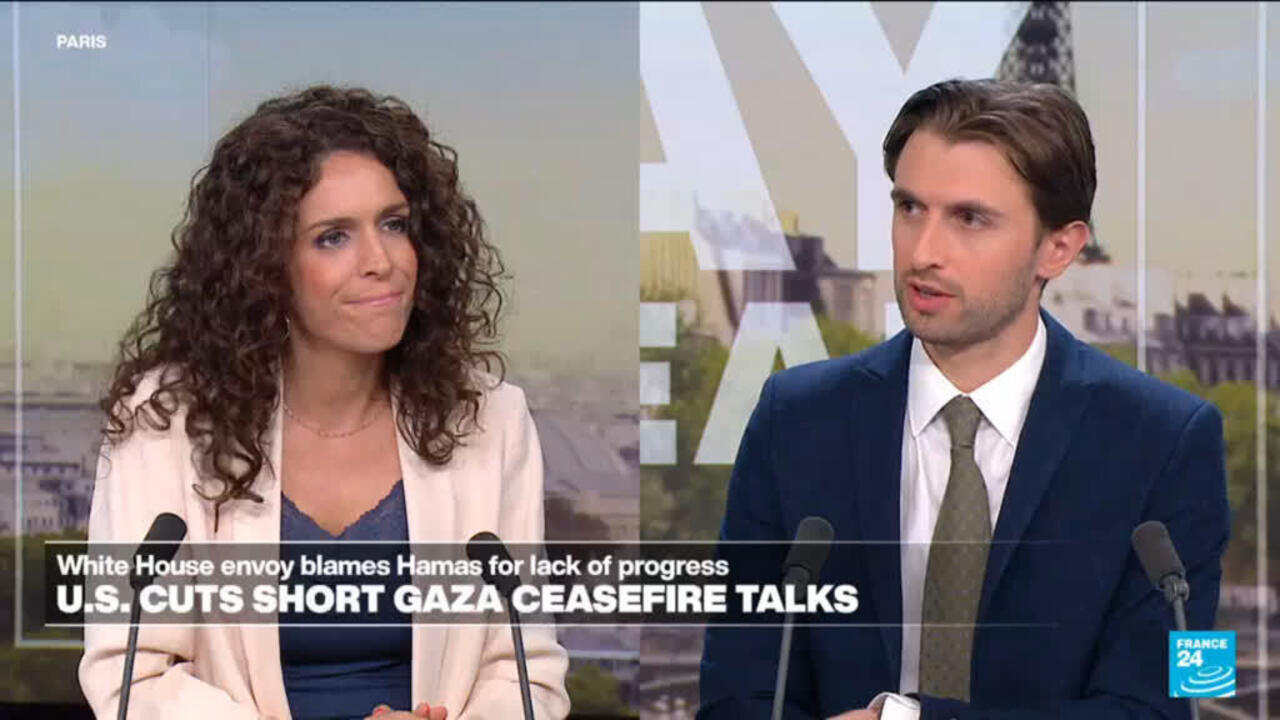
Macron, who unveiled the decision on social media, published a letter sent to Palestinian Authority President Mahmoud Abbas confirming France's intention to press ahead with Palestinian recognition and work to convincing other partners to follow suit.
"True to its historic commitment to a just and lasting peace in the Middle East, I have decided that France will recognise the state of Palestine," Macron said.
"I will make this solemn announcement at the United Nations General Assembly next September."
Home to Europe's largest Jewish and Muslim communities, France will become the first major Western country to recognise a Palestinian state, potentially fuelling a movement so far dominated by smaller nations generally more critical of Israel.
The news sparked anger in Israel and Washington.
© France 24
08:32
Israeli Prime Minister Benjamin Netanyahu condemned the decision by one of Israel's closest allies and a G7 member, saying such a move "rewards terror and risks creating another Iranian proxy."
In a post on X, he added, "A Palestinian state in these conditions would be a launch pad to annihilate Israel — not to live in peace beside it.
"Let’s be clear: the Palestinians do not seek a state alongside Israel; they seek a state instead of Israel."
Read moreFrance bears the brunt of Israel’s isolation ire
Israeli Defence Minister Israel Katz described the move as "a disgrace and a surrender to terrorism," adding that Israel would not allow the establishment of a "Palestinian entity that would harm our security, endanger our existence."
In response, US Secretary of State Marco Rubio said the United States "strongly rejects (Macron's) plan to recognize a Palestinian state at the UN general assembly."
In a post on X, he said, "This reckless decision only serves Hamas propaganda and sets back peace. It is a slap in the face to the victims of October 7th."

08:32
Israeli Prime Minister Benjamin Netanyahu condemned the decision by one of Israel's closest allies and a G7 member, saying such a move "rewards terror and risks creating another Iranian proxy."
In a post on X, he added, "A Palestinian state in these conditions would be a launch pad to annihilate Israel — not to live in peace beside it.
"Let’s be clear: the Palestinians do not seek a state alongside Israel; they seek a state instead of Israel."
Read moreFrance bears the brunt of Israel’s isolation ire
Israeli Defence Minister Israel Katz described the move as "a disgrace and a surrender to terrorism," adding that Israel would not allow the establishment of a "Palestinian entity that would harm our security, endanger our existence."
In response, US Secretary of State Marco Rubio said the United States "strongly rejects (Macron's) plan to recognize a Palestinian state at the UN general assembly."
In a post on X, he said, "This reckless decision only serves Hamas propaganda and sets back peace. It is a slap in the face to the victims of October 7th."
"The United States strongly rejects Emmanuel Macron's plan to recognize a Palestinian state at the UN general assembly", Secretary of State Marco Rubio posted on X. © Screenshot, FRANCE 24
France said that its plan to formally recognise a Palestinian state runs counter to the stance held by Palestinian militant group Hamas.
"Hamas has always ruled out a two-state solution. By recognising Palestine, France goes against that terrorist organisation," Foreign Minister Jean-Noel Barrot wrote Friday on X.

France said that its plan to formally recognise a Palestinian state runs counter to the stance held by Palestinian militant group Hamas.
"Hamas has always ruled out a two-state solution. By recognising Palestine, France goes against that terrorist organisation," Foreign Minister Jean-Noel Barrot wrote Friday on X.
"By recognising Palestine, France goes against (Hamas)," Foreign Minister Jean-Noel Barrot said on X. © Screenshot, FRANCE 24
Spain, Saudi Arabia welcome decision
Earlier, Canada also pressed Israel to seek peace, with Prime Minister Mark Carney condemning its "failure to prevent the rapidly deteriorating humanitarian disaster in Gaza" and reiterating support for a two-state solution.
Carney also accused Israel of violating international law over the blocking of Canadian-funded aid to civilians in the war-torn Palestinian enclave.
"Canada calls on all sides to negotiate an immediate ceasefire in good faith," he added.
"We reiterate our calls for Hamas to immediately release all the hostages, and for the Israeli government to respect the territorial integrity of the West Bank and Gaza."
Spanish Prime Minister Pedro Sanchez, whose country already recognises Palestinian statehood, welcomed Macron's announcement.
"Together, we must protect what Netanyahu is trying to destroy. The two-state solution is the only solution," said the Socialist leader and outspoken critic of Israel's offensive in Gaza.
Spain, Saudi Arabia welcome decision
Earlier, Canada also pressed Israel to seek peace, with Prime Minister Mark Carney condemning its "failure to prevent the rapidly deteriorating humanitarian disaster in Gaza" and reiterating support for a two-state solution.
Carney also accused Israel of violating international law over the blocking of Canadian-funded aid to civilians in the war-torn Palestinian enclave.
"Canada calls on all sides to negotiate an immediate ceasefire in good faith," he added.
"We reiterate our calls for Hamas to immediately release all the hostages, and for the Israeli government to respect the territorial integrity of the West Bank and Gaza."
Spanish Prime Minister Pedro Sanchez, whose country already recognises Palestinian statehood, welcomed Macron's announcement.
"Together, we must protect what Netanyahu is trying to destroy. The two-state solution is the only solution," said the Socialist leader and outspoken critic of Israel's offensive in Gaza.

"I welcome the fact that France joins Spain and other European countries in recognising the State of Palestine," Spanish Prime Minister Pedro Sanchez said on X. © Screenshot, FRANCE 24
The Saudi Foreign Ministry welcomed Macron's "historic decision".
"The Kingdom reiterates its call for all countries that have not yet recognised the State of Palestine to take similar positive steps and adopt serious positions that support peace and the legitimate rights of the Palestinian people."
In a diplomatic cable in June, the United States said it opposed steps to unilaterally recognise a Palestinian state, even saying it could go against US foreign policy interests and draw consequences.
In June, Washington's ambassador to Israel, Mike Huckabee, said he did not think an independent Palestinian state remained a US foreign policy goal.
President Donald Trump has himself expressed doubts about a two-state solution, proposing a US takeover of Gaza in February, that was condemned by rights groups, Arab states, Palestinians and the UN as a proposal of "ethnic cleansing".
Read moreTrump says US will take over Gaza Strip, create 'Riviera of the Middle East'
Macron had been leaning towards recognising a Palestinian state for months as part of a bid to keep the idea of a two-state solution alive, despite the pressure not to do so.
French officials initially weighed up the move ahead of a United Nations conference, which France and Saudi Arabia had planned to co-host in June to lay out parameters for a roadmap to a Palestinian state, while ensuring Israel's security.
The conference was postponed under US pressure and after the 12-day Israel-Iran air war began, during which the closure of regional airspace made it hard for representatives of some Arab states to attend.
It was rescheduled and downgraded to a ministerial event on July 28 and July 29, with a second event taking place with heads of state and government on the sidelines of the United Nations General Assembly in September.
Creating momentum
The decision to make the announcement ahead of next week's conference aimed to give the French team at the United Nations a framework to work with other countries that are also considering recognising a Palestinian state or have misgivings in doing so.
Diplomats say Macron has faced resistance from allies such as Britain and Canada over his push for the recognition of a Palestinian state. About 40 foreign ministers will be in New York next week.
Israeli officials have spent months lobbying to prevent what some have called "a nuclear bomb" for bilateral ties.
Sources familiar with the matter say Israel's warnings to France have ranged from scaling back intelligence sharing to complicating Paris' regional initiatives - even hinting at possible annexation of parts of the West Bank.
Israel has been waging a devastating war in Gaza since the Palestinian militant group Hamas' deadly attack on Israel in October 2023 and says recognising a Palestinian state now would be equivalent to rewarding Hamas.
Thanking France, the Palestinian Authority's Vice President Hussein Al Sheikh said on X that Macron's decision reflected "France's commitment to international law and its support for the Palestinian people's rights to self-determination and the establishment of our independent state."
(FRANCE 24 with Reuters and AFP)
The Saudi Foreign Ministry welcomed Macron's "historic decision".
"The Kingdom reiterates its call for all countries that have not yet recognised the State of Palestine to take similar positive steps and adopt serious positions that support peace and the legitimate rights of the Palestinian people."
In a diplomatic cable in June, the United States said it opposed steps to unilaterally recognise a Palestinian state, even saying it could go against US foreign policy interests and draw consequences.
In June, Washington's ambassador to Israel, Mike Huckabee, said he did not think an independent Palestinian state remained a US foreign policy goal.
President Donald Trump has himself expressed doubts about a two-state solution, proposing a US takeover of Gaza in February, that was condemned by rights groups, Arab states, Palestinians and the UN as a proposal of "ethnic cleansing".
Read moreTrump says US will take over Gaza Strip, create 'Riviera of the Middle East'
Macron had been leaning towards recognising a Palestinian state for months as part of a bid to keep the idea of a two-state solution alive, despite the pressure not to do so.
French officials initially weighed up the move ahead of a United Nations conference, which France and Saudi Arabia had planned to co-host in June to lay out parameters for a roadmap to a Palestinian state, while ensuring Israel's security.
The conference was postponed under US pressure and after the 12-day Israel-Iran air war began, during which the closure of regional airspace made it hard for representatives of some Arab states to attend.
It was rescheduled and downgraded to a ministerial event on July 28 and July 29, with a second event taking place with heads of state and government on the sidelines of the United Nations General Assembly in September.
Creating momentum
The decision to make the announcement ahead of next week's conference aimed to give the French team at the United Nations a framework to work with other countries that are also considering recognising a Palestinian state or have misgivings in doing so.
Diplomats say Macron has faced resistance from allies such as Britain and Canada over his push for the recognition of a Palestinian state. About 40 foreign ministers will be in New York next week.
Israeli officials have spent months lobbying to prevent what some have called "a nuclear bomb" for bilateral ties.
Sources familiar with the matter say Israel's warnings to France have ranged from scaling back intelligence sharing to complicating Paris' regional initiatives - even hinting at possible annexation of parts of the West Bank.
Israel has been waging a devastating war in Gaza since the Palestinian militant group Hamas' deadly attack on Israel in October 2023 and says recognising a Palestinian state now would be equivalent to rewarding Hamas.
Thanking France, the Palestinian Authority's Vice President Hussein Al Sheikh said on X that Macron's decision reflected "France's commitment to international law and its support for the Palestinian people's rights to self-determination and the establishment of our independent state."
(FRANCE 24 with Reuters and AFP)
Timeline: The state of Palestine’s long road to recognition
Explainer
Despite heavy Israeli pressure, President Emmanuel Macron has announced that France will formally recognise the state of Palestine on the sidelines of the UN General Assembly in New York in September. FRANCE 24 looks back over the state’s long road to widespread diplomatic recognition.
Issued on: 25/07/2025 -


The Six-Day War redraws the map
1967 – The third Israeli-Arab war, or the Six-Day War, is launched by Israel, putting the armed forces of neighbouring Arab states to flight and redrawing the map of the Middle East. Israel now occupies the West Bank, East Jerusalem, the Gaza Strip, the vast Sinai Peninsula and Syria’s Golan Heights. The Israeli government begins a policy of Jewish settlement across these newly conquered territories.
1974 – The UN General Assembly formally recognises the Palestinian people’s right to self-determination and independent and grants the PLO observer status to the international body.
1987 – The First Intifada, or uprising, breaks out in the occupied Gaza Strip and soon spreads to the West Bank. Dubbed the “war of stones”, this revolt against the Israeli occupation will last until 1993 and place the Palestinian cause front and centre of the international agenda. The uprising also gives birth to the Islamist militant group Hamas, which calls for the destruction of the State of Israel.
1988 – Gathered in Algiers, the PLO’s legislative assembly proclaims an independent Palestinian state with East Jerusalem as its capital. The group also implicitly recognises the existence of the State of Israel.
The Oslo Accords
1993 – PLO leader Yasser Arafat and Israeli prime minister Yitzhak Rabin sign the Declaration of Principles on Interim Self-Government Arrangements in Washington, D.C., following secret negotiations in Norway – the first of a series of agreements known as the Oslo Accords. These declarations are intended to lay the groundwork for an end to the Israeli-Palestinian conflict and build the basis for Palestinian autonomy within the borders preceding the Six-Day War.
The first part of the agreements create the Palestinian Authority, an interim body intended to give way to an independent Palestinian state in 1999.
1995 – The Oslo II Accord divides the Israeli-occupied West Bank into three parts: Zone A, administered by the Palestinians, Zone B under dual administration and Zone C – representing more than 60 percent of the territory – which, although intended to pass progressively into Palestinian control, remains for the moment entirely under the administration of the Israeli army.
More sensitive questions, including the status of Jerusalem, Israeli settlers in the occupied territories and the right of Palestinian refugees to return to their homes, remain unresolved.
1996 – Yasser Arafat is elected president of the Palestinian Authority in the first Palestinian elections.
1998 – US President Bill Clinton becomes the first US president to be officially received by a virtual Palestinian state.
Palestinian power struggles
2000 – The Second Intifada, also known as the Al-Aqsa Intifada, erupts following right-wing Likud party leader Ariel Sharon’s provocative visit to the Temple Mount – a holy site for Muslims, Jews and Christians alike.
2002 – The Arab Initiative, adopted in 2002 and relaunched in 2007, foresees the normalisation of ties between Arab states and Israel in return for Israel pulling out of Arab territories occupied since June 1967 and the creation of a Palestinian state with East Jerusalem as its capital. The same year, the UN Security Council adopts Resolution 1397, confirming its support for a two-state solution to the decades-old conflict.
2005 – Mahmoud Abbas is elected president of the Palestinian Authority. After 38 years of armed occupation, Israel withdraws from the Gaza Strip.
2007 – The Islamist group Hamas, which won the 2006 legislative elections, takes control of the Gaza Strip by force, fracturing the Palestinian leadership.
On the world stage
2011 – Palestinian Authority president Mahmoud Abbas formally requests Palestine’s admission into the United Nations. The same year, Palestine becomes a member of UNESCO. Furious, the US – staunch allies of Israel – suspend their donations to the UN agency, which make up almost a quarter of its total budget.
2012 – The UN votes to recognise Palestine as a “Non-Member Observer State” with 138 countries for, nine against and 41 abstaining.
2015 – Faced with an Israeli prime minister – Likud’s Benjamin Netanyahu – who has repeatedly sworn that a Palestinian state will never see the light of day as long as he remains in power, the Palestinian Authority doubles downs on its efforts to integrate itself with UN organisations, as well as the International Criminal Court.
How to break the cycle: From war in Gaza to a two-state solution?
2016 – The UN Security Council adopts Resolution 2334, calling on Israel to “immediately and completely cease all settlement activities in the occupied Palestinian territory, including East Jerusalem”. The resolution underlines that the UN will “not recognise any changes to the June 4 1967 lines, including with regard to Jerusalem, other than those agreed by the parties through negotiations”.
2017 – The administration of US President Donald Trump announces that the US recognises Jerusalem as the capital of the State of Israel and tells the state department to move the US embassy to the contested city.
2019 – The White House unveils Trump’s economic plan for the Palestinians, which despite promising to “fundamentally transform the West Bank and Gaza”, contains no mention of the creation of a Palestinian state.
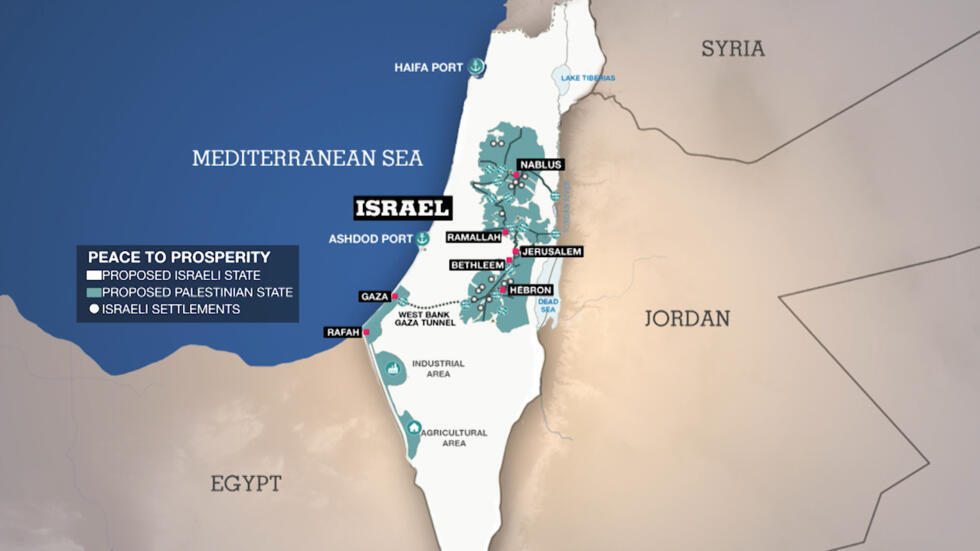
2020 – Trump suggests that the creation of a Palestinian state could be possible if the Palestinians are prepared to give way to the conditions outlined in his own peace plan. His proposal outlines a “contiguous” Palestinian state, connected across stretches of Israeli territory by “an efficient, modern transportation network” of rails and tunnels. The plan also suggests the creation of a Palestinian capital in “Eastern Jerusalem” without providing further details.
Israel expands West Bank settlements as Gaza crisis worsens

Explainer
Despite heavy Israeli pressure, President Emmanuel Macron has announced that France will formally recognise the state of Palestine on the sidelines of the UN General Assembly in New York in September. FRANCE 24 looks back over the state’s long road to widespread diplomatic recognition.
Issued on: 25/07/2025 -
FRANCE24
By: Marc DAOU

By: Marc DAOU
Young Palestinians carry a Palestinian flag through Beit Lahiya in the northern Gaza Strip on 26 November, 2006. © Hatem Moussa, AP
From the Ottoman Empire to the British Mandate
1916 – Concluded in May between France and Great Britain, the Sykes-Picot Agreement marks out the two imperial powers’ future spheres of influence across the Middle Eastern territories of the foundering Ottoman Empire – Palestine and Syria among them.
From the Ottoman Empire to the British Mandate
1916 – Concluded in May between France and Great Britain, the Sykes-Picot Agreement marks out the two imperial powers’ future spheres of influence across the Middle Eastern territories of the foundering Ottoman Empire – Palestine and Syria among them.
A map from the British Archives showing the areas of influence outlined in the Sykes-Picot Agreement. © DR
1917 – The Balfour Declaration, named for British foreign minister Arthur Balfour, promises “the establishment in Palestine of a national home for the Jewish people”. The declaration, responding to the campaigning of the growing Zionist movement, follows an earlier pledge from London to Mecca’s Hussein bin Ali al-Hashimi promising the creation of an independent Arab kingdom following the eventual break-up of the Ottoman Empire.
1922 – The League of Nations, the forerunner to the United Nations, grants the United Kingdom a mandate to administer the lands of historic Palestine. The mandate document explicitly references the wording of the Balfour Declaration promoting “the establishment in Palestine of a national home for the Jewish people”, adding that the British would be responsible for enacting a nationality law that would allow “the acquisition of Palestinian citizenship by Jews who take up their permanent residence in Palestine”.
1937 – Following the outbreak of Arab riots the previous year against the British Mandate and rising Jewish immigration, a report by the British Peel Commission recommends the division of historic Palestine into a Jewish state comprised of 33 percent of the territory and an Arab state connected to what was then the British protectorate of Transjordan.
1917 – The Balfour Declaration, named for British foreign minister Arthur Balfour, promises “the establishment in Palestine of a national home for the Jewish people”. The declaration, responding to the campaigning of the growing Zionist movement, follows an earlier pledge from London to Mecca’s Hussein bin Ali al-Hashimi promising the creation of an independent Arab kingdom following the eventual break-up of the Ottoman Empire.
1922 – The League of Nations, the forerunner to the United Nations, grants the United Kingdom a mandate to administer the lands of historic Palestine. The mandate document explicitly references the wording of the Balfour Declaration promoting “the establishment in Palestine of a national home for the Jewish people”, adding that the British would be responsible for enacting a nationality law that would allow “the acquisition of Palestinian citizenship by Jews who take up their permanent residence in Palestine”.
1937 – Following the outbreak of Arab riots the previous year against the British Mandate and rising Jewish immigration, a report by the British Peel Commission recommends the division of historic Palestine into a Jewish state comprised of 33 percent of the territory and an Arab state connected to what was then the British protectorate of Transjordan.
A map taken from the Peel Commission's proposal for the division of historic Palestine. © DR
A ‘Jewish state’ and an ‘Arab state’
1947 – In February, a United Kingdom – increasingly eager to renounce its role as Mandatory – submits the Palestinian question to the newly formed United Nations. In November, the UN General Assembly adopts Resolution 181, which calls for the division of Palestine into a “Jewish state” and an “Arab state”. The resolution, which passes despite the unanimous opposition of the Arab delegations, suggests that Jerusalem and its holy sites be placed under international administration.

A ‘Jewish state’ and an ‘Arab state’
1947 – In February, a United Kingdom – increasingly eager to renounce its role as Mandatory – submits the Palestinian question to the newly formed United Nations. In November, the UN General Assembly adopts Resolution 181, which calls for the division of Palestine into a “Jewish state” and an “Arab state”. The resolution, which passes despite the unanimous opposition of the Arab delegations, suggests that Jerusalem and its holy sites be placed under international administration.
The partition of Palestine proposed by the UN in 1947. © DR
1948 – As the British Mandate for Palestine expires, then-National Jewish Council president David Ben Gurion proclaims the independence of the State of Israel on May 14. The creation of the Israeli state, which soon seizes control of 77 percent of Mandatory Palestine, is synonymous for Palestinians and across the Arab world with the Nakba, or “catastrophe”, which saw hundreds of thousands of people driven from their homes and lands by armed force. Today, more than 4 million Palestinians are registered as refugees under the UN.
1949 – A ceasefire brings the first Israeli-Arab war to an end, giving Jordan control over the West Bank of the Jordan River and East Jerusalem and Egypt the Gaza Strip. Israel would henceforth take these lines of demarcation as the country’s official borders – a territory far greater than that envisaged in the original UN resolution.
The same year, the UN General Assembly adopts Resolution 273, admitting Israel into the United Nations. The following year, Israel transfers its capital from Tel Aviv to the western part of Jerusalem.
1948 – As the British Mandate for Palestine expires, then-National Jewish Council president David Ben Gurion proclaims the independence of the State of Israel on May 14. The creation of the Israeli state, which soon seizes control of 77 percent of Mandatory Palestine, is synonymous for Palestinians and across the Arab world with the Nakba, or “catastrophe”, which saw hundreds of thousands of people driven from their homes and lands by armed force. Today, more than 4 million Palestinians are registered as refugees under the UN.
1949 – A ceasefire brings the first Israeli-Arab war to an end, giving Jordan control over the West Bank of the Jordan River and East Jerusalem and Egypt the Gaza Strip. Israel would henceforth take these lines of demarcation as the country’s official borders – a territory far greater than that envisaged in the original UN resolution.
The same year, the UN General Assembly adopts Resolution 273, admitting Israel into the United Nations. The following year, Israel transfers its capital from Tel Aviv to the western part of Jerusalem.
The Middle East following the first Israeli-Arab war (1948-1949).
© FRANCE 24
1964 – The Palestine Liberation Organisation (PLO) is founded in Cairo. The group is empowered to negotiate and conclude international treaties in the name of the Palestinian people.
1964 – The Palestine Liberation Organisation (PLO) is founded in Cairo. The group is empowered to negotiate and conclude international treaties in the name of the Palestinian people.
The Six-Day War redraws the map
1967 – The third Israeli-Arab war, or the Six-Day War, is launched by Israel, putting the armed forces of neighbouring Arab states to flight and redrawing the map of the Middle East. Israel now occupies the West Bank, East Jerusalem, the Gaza Strip, the vast Sinai Peninsula and Syria’s Golan Heights. The Israeli government begins a policy of Jewish settlement across these newly conquered territories.
1974 – The UN General Assembly formally recognises the Palestinian people’s right to self-determination and independent and grants the PLO observer status to the international body.
1987 – The First Intifada, or uprising, breaks out in the occupied Gaza Strip and soon spreads to the West Bank. Dubbed the “war of stones”, this revolt against the Israeli occupation will last until 1993 and place the Palestinian cause front and centre of the international agenda. The uprising also gives birth to the Islamist militant group Hamas, which calls for the destruction of the State of Israel.
1988 – Gathered in Algiers, the PLO’s legislative assembly proclaims an independent Palestinian state with East Jerusalem as its capital. The group also implicitly recognises the existence of the State of Israel.
The Oslo Accords
1993 – PLO leader Yasser Arafat and Israeli prime minister Yitzhak Rabin sign the Declaration of Principles on Interim Self-Government Arrangements in Washington, D.C., following secret negotiations in Norway – the first of a series of agreements known as the Oslo Accords. These declarations are intended to lay the groundwork for an end to the Israeli-Palestinian conflict and build the basis for Palestinian autonomy within the borders preceding the Six-Day War.
The first part of the agreements create the Palestinian Authority, an interim body intended to give way to an independent Palestinian state in 1999.
1995 – The Oslo II Accord divides the Israeli-occupied West Bank into three parts: Zone A, administered by the Palestinians, Zone B under dual administration and Zone C – representing more than 60 percent of the territory – which, although intended to pass progressively into Palestinian control, remains for the moment entirely under the administration of the Israeli army.
More sensitive questions, including the status of Jerusalem, Israeli settlers in the occupied territories and the right of Palestinian refugees to return to their homes, remain unresolved.
1996 – Yasser Arafat is elected president of the Palestinian Authority in the first Palestinian elections.
1998 – US President Bill Clinton becomes the first US president to be officially received by a virtual Palestinian state.
Palestinian power struggles
2000 – The Second Intifada, also known as the Al-Aqsa Intifada, erupts following right-wing Likud party leader Ariel Sharon’s provocative visit to the Temple Mount – a holy site for Muslims, Jews and Christians alike.
2002 – The Arab Initiative, adopted in 2002 and relaunched in 2007, foresees the normalisation of ties between Arab states and Israel in return for Israel pulling out of Arab territories occupied since June 1967 and the creation of a Palestinian state with East Jerusalem as its capital. The same year, the UN Security Council adopts Resolution 1397, confirming its support for a two-state solution to the decades-old conflict.
2005 – Mahmoud Abbas is elected president of the Palestinian Authority. After 38 years of armed occupation, Israel withdraws from the Gaza Strip.
2007 – The Islamist group Hamas, which won the 2006 legislative elections, takes control of the Gaza Strip by force, fracturing the Palestinian leadership.
On the world stage
2011 – Palestinian Authority president Mahmoud Abbas formally requests Palestine’s admission into the United Nations. The same year, Palestine becomes a member of UNESCO. Furious, the US – staunch allies of Israel – suspend their donations to the UN agency, which make up almost a quarter of its total budget.
2012 – The UN votes to recognise Palestine as a “Non-Member Observer State” with 138 countries for, nine against and 41 abstaining.
2015 – Faced with an Israeli prime minister – Likud’s Benjamin Netanyahu – who has repeatedly sworn that a Palestinian state will never see the light of day as long as he remains in power, the Palestinian Authority doubles downs on its efforts to integrate itself with UN organisations, as well as the International Criminal Court.
How to break the cycle: From war in Gaza to a two-state solution?
2016 – The UN Security Council adopts Resolution 2334, calling on Israel to “immediately and completely cease all settlement activities in the occupied Palestinian territory, including East Jerusalem”. The resolution underlines that the UN will “not recognise any changes to the June 4 1967 lines, including with regard to Jerusalem, other than those agreed by the parties through negotiations”.
2017 – The administration of US President Donald Trump announces that the US recognises Jerusalem as the capital of the State of Israel and tells the state department to move the US embassy to the contested city.
2019 – The White House unveils Trump’s economic plan for the Palestinians, which despite promising to “fundamentally transform the West Bank and Gaza”, contains no mention of the creation of a Palestinian state.
2020 – Trump suggests that the creation of a Palestinian state could be possible if the Palestinians are prepared to give way to the conditions outlined in his own peace plan. His proposal outlines a “contiguous” Palestinian state, connected across stretches of Israeli territory by “an efficient, modern transportation network” of rails and tunnels. The plan also suggests the creation of a Palestinian capital in “Eastern Jerusalem” without providing further details.
The territorial divisions outlined in US President Donald Trump's "Peace to Prosperity" proposal. © FRANCE 24
The aftermath of October 7
2023 – The deadly October 7 attacks launched by Hamas and allied militant groups on Israeli soil and the resulting Israeli onslaught in the Gaza Strip draws the world’s gaze once more to the Israeli-Palestinian conflict. The question of a two-state solution once again enters the discussion, albeit increasingly out-of-reach due to Netanyahu’s hardline policies, Abbas’s growing irrelevance, Hamas’s grip on Gaza and Israel’s renewed settlement of the occupied West Bank.
2024 – The UN General Assembly votes for the admission of the state of Palestine into the United Nations with a crushing majority and raises its status to “Permanent Observer”. Spain, Ireland and Norway all formally recognise the state of Palestine, and France’s Emmanuel Macron declares himself ready to follow their example.
For its part, the Israeli government – the most right-wing in the nation’s history – announces the seizure and future settlement of the largest parcel of land in the occupied West Bank since the signing of the Oslo Accords.
The aftermath of October 7
2023 – The deadly October 7 attacks launched by Hamas and allied militant groups on Israeli soil and the resulting Israeli onslaught in the Gaza Strip draws the world’s gaze once more to the Israeli-Palestinian conflict. The question of a two-state solution once again enters the discussion, albeit increasingly out-of-reach due to Netanyahu’s hardline policies, Abbas’s growing irrelevance, Hamas’s grip on Gaza and Israel’s renewed settlement of the occupied West Bank.
2024 – The UN General Assembly votes for the admission of the state of Palestine into the United Nations with a crushing majority and raises its status to “Permanent Observer”. Spain, Ireland and Norway all formally recognise the state of Palestine, and France’s Emmanuel Macron declares himself ready to follow their example.
For its part, the Israeli government – the most right-wing in the nation’s history – announces the seizure and future settlement of the largest parcel of land in the occupied West Bank since the signing of the Oslo Accords.
Israel expands West Bank settlements as Gaza crisis worsens
Israeli settlers in the West Bank look towards their neighboring village on Thursday, May 15, 2025. © Maya Alleruzzo, AP
03:50
03:50
2025 – France’s Macron affirms that recognising the state of Palestine is “not just a moral duty, but a political necessity”. He prepares to officially recognise the Palestinian state at a conference in Saudi Arabia in June – a conference postponed following Israel’s unprecedented bombing campaign of Iran.
On July 10, Macron calls for a joint recognition of Palestine between Paris and London during a visit to the United Kingdom.
On July 24, he announces that France will recognise the Palestinian state at the UN General Assembly in September.
This article has been adapted from the original in French.
On July 10, Macron calls for a joint recognition of Palestine between Paris and London during a visit to the United Kingdom.
On July 24, he announces that France will recognise the Palestinian state at the UN General Assembly in September.
This article has been adapted from the original in French.

No comments:
Post a Comment