Humanoid robots embodiment of China's AI ambitions
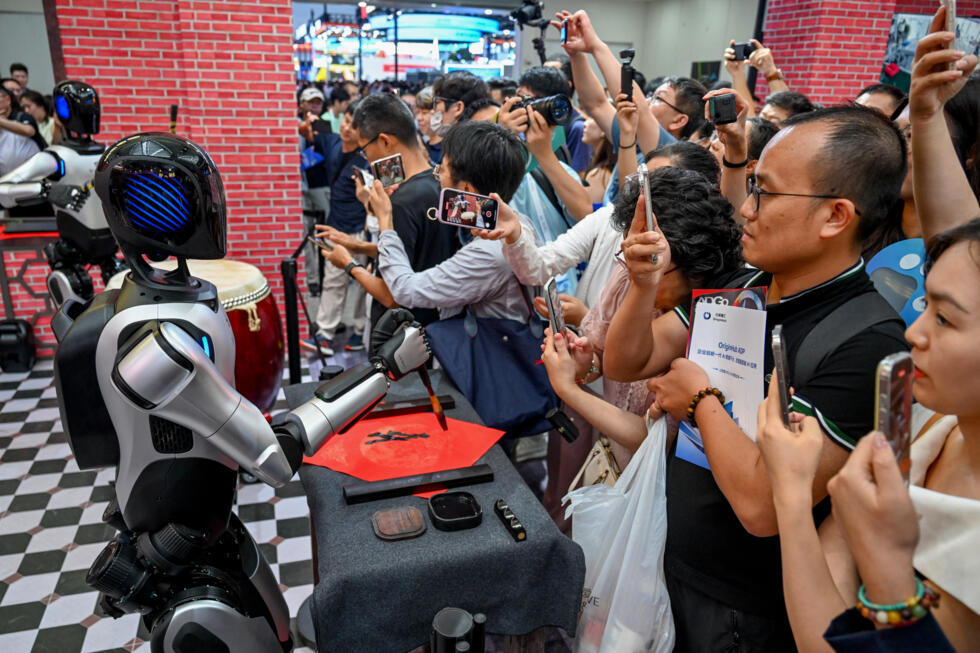
Shanghai (AFP) – Serving craft beer, playing mahjong, stacking shelves and boxing, the dozens of humanoid robots at Shanghai's World AI Conference (WAIC) this weekend were embodiments of China's growing AI prowess and ambition.
Issued on: 27/07/2025 -

The annual event is primed at showcasing China's progress in the ever-evolving field of artificial intelligence, with the government aiming to position the country as a world leader on both technology and regulation as it snaps at the United States' heels.
Opening the event on Saturday, Premier Li Qiang announced China would set up a new organisation for cooperation on AI governance, warning the benefits of development must be balanced with the risks.
But in the cavernous expo next door, the mood was more giddy than concerned.
"Demand is currently very strong, whether in terms of data, scenarios, model training, or artificial construction. The overall atmosphere in all these areas is very lively," said Yang Yifan, R&D director at Transwarp, a Shanghai-based AI platform provider.
This year's WAIC is the first since a breakthrough moment for Chinese AI this January when startup DeepSeek unveiled an AI model that performed as well as top US systems for an apparent fraction of the cost.
Organisers said the forum involved more than 800 companies, showcasing over 3,000 products -- the undeniable crowd pleasers being the humanoid robots and their raft of slightly surreal party tricks.
At one booth, a robot played drums, half a beat out of time, to Queen's "We Will Rock You" while a man in safety goggles and a security vest hyped up a giggling crowd.
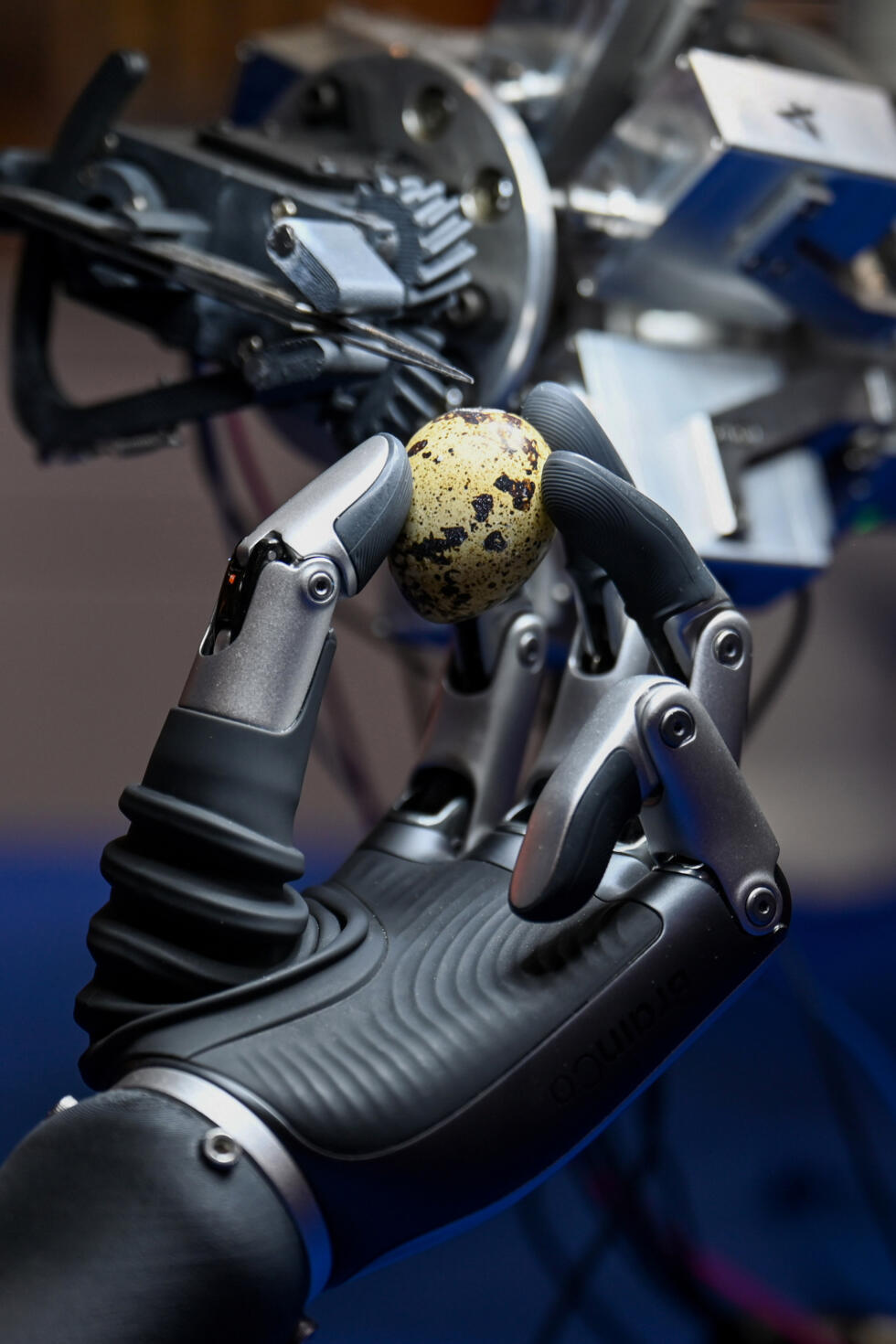
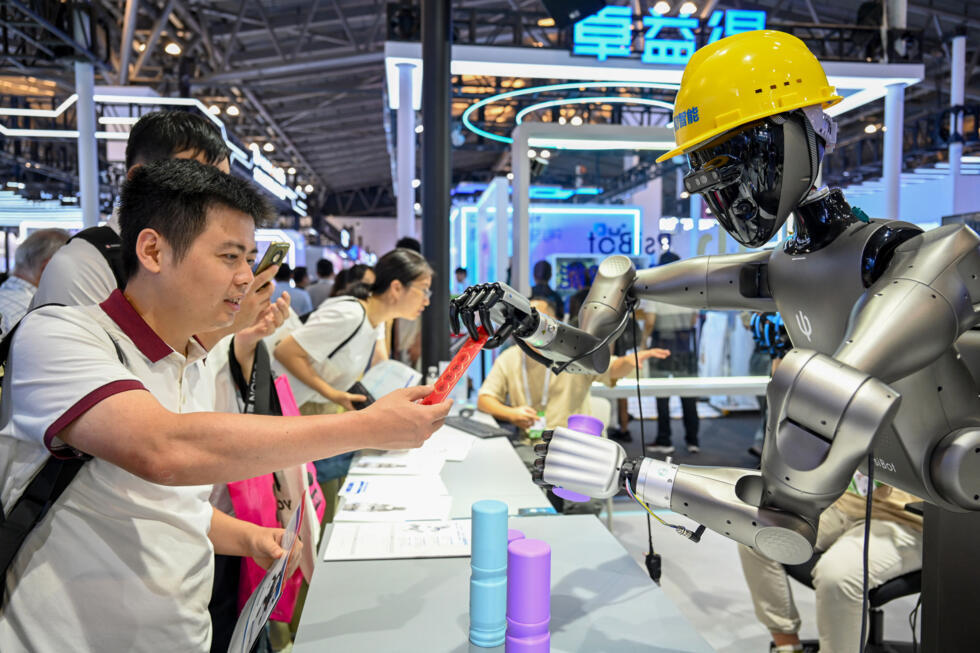
Other droids, some dressed in working overalls or baseball caps, manned assembly lines, played curling with human opponents or sloppily served soft drinks from a dispenser.
While most of the machines on display were still a little jerky, the increasing sophistication year-on-year was clear to see.
The Chinese government has poured support into robotics, an area in which some experts think China might already have the upper hand over the United States.
At Hangzhou-based Unitree's stall, its G1 android -- around 130 centimetres (four feet) tall, with a two-hour battery life -- kicked, pivoted and punched, keeping its balance with relative fluidity as it shadowboxed around a ring.
Ahead of the conference's opening, Unitree announced it would launch a full-size humanoid, the R1, for under $6,000.
'Digital humans'
Most high-tech helpers don't need hardware though.
At the expo, AI companions -- in the form of middle-aged businessmen, scantily clad women and ancient warriors -- waved at people from screens, asking how their day was, while other stalls ran demos allowing visitors to create their own digital avatars.
Tech giant Baidu on Saturday announced a new generation of technology for its "digital humans" -- AI agents modelled on real people, which it says are "capable of thinking, making decisions, and collaborating".
The company recently ran a six-hour e-commerce broadcast hosted by the "digital human" of a well-known streamer and another avatar.
The two agents beat the human streamer's debut sales in some categories, Baidu said.
Over ten thousand businesses are using the technology daily already, the department's head Wu Chenxia told AFP.
Asked about the impact on jobs -- one of the major concerns raised around widespread AI adoption -- Wu insisted that AI was a tool that should be used to improve quality and save time and effort, which still required human input.
In China, the integration of AI into everyday life is beginning to pick up pace.
At WAIC, Baidu also announced it had been granted a permit to operate fully driverless robotaxis in parts of the massive Pudong district, the service's first foray into downtown Shanghai.
For now, few visitors to the WAIC expo seemed worried about the potential ramifications of the back-flipping dog robots they were excitedly watching.
"When it comes to China's AI development, we have a comparatively good foundation of data and also a wealth of application scenarios," said Transwarp's Yang.
"There are many more opportunities for experimentation."
© 2025 AFP
Issued on: 27/07/2025 -
China is hosting the World AI conference in Shanghai this weekend, an annual event aimed at showcasing Beijing's leadership in the evolution of technology. At the opening event Saturday, the country's premier said China would be setting up a new organisation for cooperation on AI governance - again warning the risks of the technology must be considered as much as its benefits. Story by Eliza Herbert.
Video by: Eliza HERBERT
This robot system by TikTok parent ByteDance can fold clothes and clear your table thanks to AI
The TikTok parent company has been advancing its AI development.
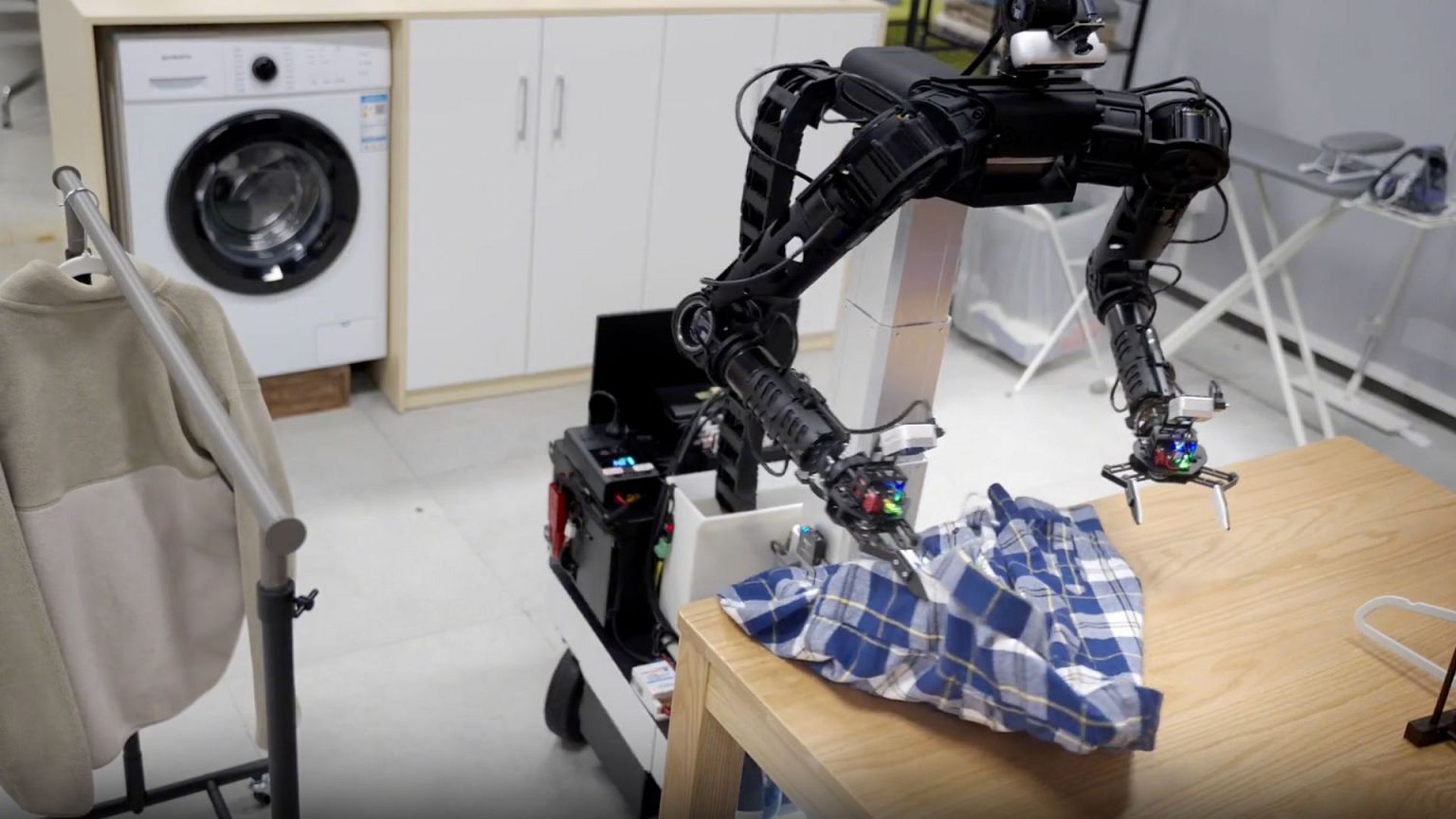
TikTok parent company ByteDance has built a robotic system that allows bots to perform household tasks such as folding laundry and cleaning tables.
The system uses artificial intelligence (AI) that allows robots to follow language commands and carry out tasks.
China, where ByteDance is based, has been developing the technology at lightning speed with the development of its DeepSeek and Manus.
According to chip designer Nvidia, robotics is the next phase of AI
That’s because while tech companies have been trying to build a general-purpose robot for years, programming robots is difficult. However, with AI, it becomes much easier.
What did ByteDance do?
ByteDance built a large-scale vision-language-action (VLA) model called GR-3, which allows robots to follow natural language commands and do general tasks.
GR-3 can be thought of as the brain of the robot.
ByteDance used a robot called ByteMini for the experiment. After GR-3 was inserted into it, the robot could put a shirt on a hanger and place it on a clothing rack.
Video by the company also shows the robot picking up household items and placing them in a designated spot. It could differentiate between sizes, successfully following commands to pick up the “larger plate”.
It also completed tasks such as cleaning up the dining table.
ByteDance’s Seed department, which heads the company’s AI research and large language model (LLM) development, said it trained the model with image and text data and then fine-tuned it with data from humans interacting in virtual reality. It was also taught to copy the movements of real robots.
ByteDance appears to be increasingly focusing on AI, launching the Seed department in 2023.
The new development comes as TikTok is facing another threat of being banned in the US unless the company sells its American assets.
US commerce secretary Howard Lutnick reiterated this on Thursday, saying, “China can have a little piece or ByteDance, the current owner, can keep a little piece”.
“But basically, Americans will have control. Americans will own the technology, and Americans will control the algorithm,” Lutnick told CNBC, adding that if this doesn’t happen, “TikTok is going to go dark, and those decisions are coming very soon”.
Urgent need for 'global approach' on AI
regulation: UN tech chief
Geneva (AFP) – The world urgently needs to find a global approach on regulating artificial intelligence, the United Nations' top tech chief said this week, warning that fragmentation could deepen risks and inequalities.
Issued on: 27/07/2025 -
Doreen Bogdan-Martin, head of the UN's International Telecommunications Union (ITU) agency, told AFP she hoped that AI "can actually benefit humanity".
But as concerns mount over the risks posed by the fast-moving technology -- including fears of mass job losses, the spread of deepfakes and disinformation, and society's fabric fraying -- she insisted that regulation was key.
"There's an urgency to try to get... the right framework in place," she said, stressing the need for "a global approach".
Her comments came after US President Donald Trump this week unveiled an aggressive, low-regulation strategy aimed at ensuring the United States stays ahead of China on AI.
Among more than 90 proposals, Trump's plan calls for sweeping deregulation, with the administration promising to "remove red tape and onerous regulation" that could hinder private sector AI development.
Asked if she had concerns about an approach that urges less, not more, regulation of AI technologies, Bogdan-Martin refrained from commenting, saying she was "still trying to digest" the US plan.
'Critical'
"I think there are different approaches," she said.
"We have the EU approach. We have the Chinese approach. Now we're seeing the US approach. I think what's needed is for those approaches to dialogue," she said.
At the same time, she highlighted that "85 percent of countries don't yet have AI policies or strategies".
A consistent theme among those strategies that do exist is the focus on innovation, capacity building and infrastructure investments, Bogdan-Martin said.
"But where I think the debate still needs to happen at a global level is trying to figure out how much regulation, how little regulation, is needed," she said.
Bogdan-Martin, who grew up in New Jersey and has spent most of her more than three-decade career at the ITU, insisted the Geneva-based telecoms agency that sets standards for new technologies was well-placed to help facilitate much-needed dialogue on the issue.
"The need for a global approach I think is critical," she said, cautioning that "fragmented approaches will not help serve and reach all".
As countries and companies sprint to cement their dominance in the booming sector, there are concerns that precautions could be thrown to the wind -- and that those who lose the race or do not have the capacity to participate will be left behind.
'Huge gap'
The ITU chief hailed "mind-blowing" advances within artificial intelligence, with the potential to improve everything from education to agriculture to health care -- but insisted the benefits must be shared.
Without a concerted effort, there is a risk that AI will end up standing for "advancing inequalities", she warned, cautioning against deepening an already dire digital divide worldwide.
"We have 2.6 billion people that have no access to the internet, which means they have no access to artificial intelligence", Bogdan-Martin pointed out.
"We have to tackle those divides if we're actually going to have something that is beneficial to all of humanity."
Bogdan-Martin, the first woman to serve as ITU secretary-general in the organisation's nearly 160-year history, also stressed the need to get more women into the digital space.
"We have a huge gap," she said.
"We definitely don't have enough women... in artificial intelligence."
The 58-year-old mother of four said it was "a big honour" to be the first woman in her position, to be "breaking the glass ceiling (and) paving the path for future generations".
But she acknowledged there was a lot of pressure, "not just to achieve, but to almost overachieve".
Bogdan-Martin, who is being backed by the Trump administration to stand for re-election when her four-year mandate ends next year, said she was eager to stay on for a second term.
"There is a lot to do."
© 2025 AFP

No comments:
Post a Comment