Explosion Kills Three and Sinks Ukrainian Dredge on a Danube Canal
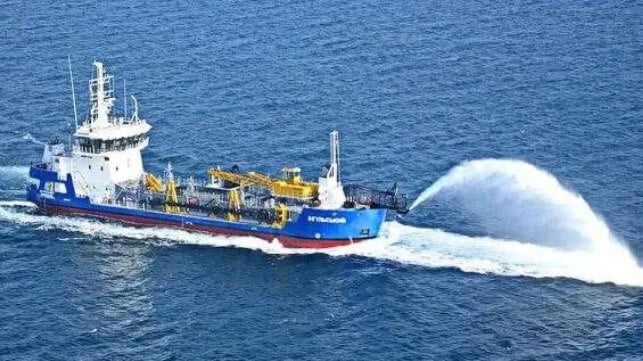
The Sea Ports Authority of Ukraine issued a brief statement confirming that there has been an explosion killing three people working on a dredge employed by the authority. Few details were released, but the Ukrainian media is saying it was likely a mine in the Bystre waterway, one of the canals linking the Danube to the Black Sea.
The authority reported that the explosion took place on the evening of July 23 while its dredger was conducting normal work on the channel. There was a total of 11 people aboard, and in addition to the three who were killed, others were reported to be in the hospital.
The Bystre is currently closed, and the emergency authorities are on the scene. The authority said the details were being investigated. It notes that the Sulin Channel to the south, also linking to the Danube, remains open for vessel traffic. Ukraine had reopened the Bystre strait for commercial vessels in July 202 after the liberation of Zmiiniy (Snake) Island from the Russians.
The Ukrainian media outlet Dumskaya is identifying the vessel as the Ingulskiy, a Damen-built dredge operating for the authority since 2012. The vessel, which was 60 meters (197 feet) and could operate at depths up to 15 meters (approximately 50 feet), has reportedly sunk in the waterway. It struck the mine, the media report says, near the town of Vilkovo, which is along the Danube in the Delta region.
The Danube seaports played a critical role for Ukraine after the Russian invasion, being the primary way to maintain water transport. After ports were reopened in the Odesa region, traffic on the Danube declined, but it remains a key waterway for commerce both for Ukraine and neighboring Romania. The Bystre was important during the Soviet era and reopened by Ukraine as an alternative to traveling along the Sulina, which is controlled by Romania. The Bystre is reported open for vessels with a maximum draft of 4.5 meters (approximately 15 feet).
Espionage Arrests Signal Shift in Ukraine-China Relations
- Ukraine has arrested Chinese nationals on espionage charges and sanctioned Chinese companies, signaling a hardened stance toward Beijing due to its perceived support for Russia's war.
- Despite China's claims of neutrality, evidence suggests it is providing significant support to Russia, including dual-use technology and military systems, leading Ukraine to abandon hopes of Beijing brokering peace.
- The growing distance between Kyiv and Beijing is underscored by Ukraine's actions and the US-Ukraine agreement on critical minerals, though Ukraine continues to tread carefully due to China being its largest trading partner.
The arrest of two Chinese nationals in Ukraine on espionage charges this month has punctuated a shift in Kyiv’s tone toward Beijing, whose support for Russia’s war is becoming harder to ignore.
Ukraine’s intelligence service on July 9 said a 24-year-old Chinese man – expelled from a Ukrainian technical school two years ago – tried to obtain classified information about the Neptune missile program by befriending a defense worker. Authorities say he intended to pass the information to his father, who was also arrested, for delivery to Chinese intelligence.
The arrests came just one day after President Volodymyr Zelenskyy imposed sanctions on five Chinese companies for aiding Russia’s war effort, an unusually direct move by Ukraine.
From the outset of Russia’s full-scale invasion, Beijing has claimed neutrality while buying up Russian oil and gas –- Moscow’s financial lifeline –- and supplying dual-use technology to its military. Kyiv, like many in the West, had hoped China would use its leverage over Russian President Vladimir Putin to press for peace.
That hope appears to be fading.
China, once content to provide components like microchips, is now believed to be delivering entire systems. In May, pro-Russian Telegram channels claimed Moscow was using a new Chinese laser weapon to shoot down Ukrainian drones.
This week, Ukraine’s military intelligence agency said Moscow is now launching drone decoys assembled inside Russia but made entirely from Chinese parts.
Meanwhile, Beijing has been welcoming officials from Ukraine’s occupied territories at trade shows while Chinese companies have been selling heavy equipment to Russian companies operating in those territories.
The shift in Beijing’s behavior comes amid reports that China is no longer even pretending to be neutral.
EU officials told RFE/RL that Chinese Foreign Minister Wang Yi told the bloc’s top diplomat Kaja Kallas during a July 3 meeting in Brussels that Beijing does not want Russia to lose the war, fearing it would free up the United States to focus more directly on China. Wang, the officials said, denied that China is backing the war, but his comments marked a departure from Beijing’s previous ambiguity.
At an EU-China summit on July 25, European Commission President Ursula von der Leyen told her Chinese counterpart Xi Jinping that relations between Brussels and Beijing were at an "inflection point" while issuing a thinly veiled warning that China's relationship with Moscow was a "determining factor" in how the ties would proceed.
Ukraine’s recent actions -– from espionage arrests to corporate sanctions –- suggest Kyiv is adjusting its stance as well.
“I think there has been a certain evolution,” said Oleksandr Merezhko, chair of the Ukrainian parliament’s foreign affairs committee.
“At the very beginning, there was some hope China could be involved in the [peace] process. But now we’ve become more realistic and speak more openly: China supports Russia.”
Beijing declined an invitation to attend the Ukraine peace summit in Switzerland last year, which drew representatives from more than 100 nations and organizations.
As recently as December, Zelenskyy had expressed hope of restoring prewar trade levels with China and deepening ties with the country as he accepted Beijing’s new envoy to Ukraine.
But that optimistic tone had changed by June, after China halted exports of drone parts to Ukraine. Days later, Zelenskyy traveled to Singapore and delivered what experts said was his first public criticism of Beijing since the invasion.
In July, at the Ukraine Recovery Conference in Rome, he warned that countries backing Russia would be excluded from postwar reconstruction –- a message widely interpreted as aimed at China.
Growing Distance
Meanwhile, the US-Ukraine agreement signed in June on critical minerals investment also calls for the exclusion of countries supporting Russia, underscoring the growing distance between Kyiv and Beijing.
Still, Ukraine is treading carefully.

No comments:
Post a Comment