Captain of Lost Volgoneft Tanker Had Expired License Russia Says in Court
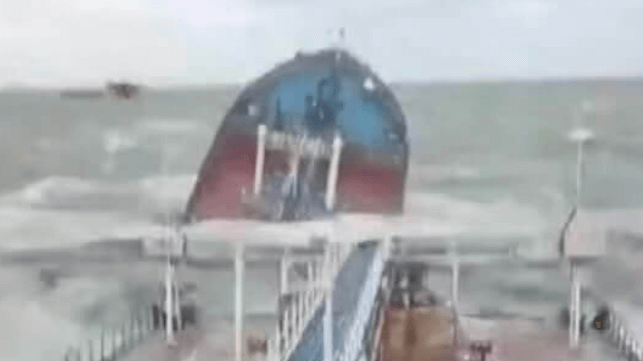
Russia’s state environmental organization, Rosprirodnadzor, alleged in court this week that the operator of the two tankers that were lost in December 2024 had multiple violations. The latest accusations of expired licenses came as the environmental watchdog is seeking further compensation and actions from the tanker operator to address the environmental impact of the dual casualties.
The river sea tanker Volgoneft 212 sank in a wintertime storm in December 2024, transporting 4,300 tonnes of oil. A second tanker of the same operator, Volgoneft 239, ran aground around the same time in the area near the Kerch Strait. Together, the two vessels were carrying approximately 9,200 metric tons of heavy fuel oil. The authorities estimate that half of the fuel was released in the two incidents, and days later, a third Volgoneft tanker, 109, also reported a leak while it was in port.
As part of the suit, the Russian authorities told the court that the captain of Volgoneft 239 was operating the vessel with an expired license. It said the unnamed master’s license was expired for “several days” prior to the vessel getting underway and encountering a winter storm in the Kerch Strait region. Some media reports had previously claimed the helmsman aboard the tanker was operating the ship alone, something that has been repeatedly denied.
Russian authorities further said that the operator of the tankers, Volgoneft, was not certified to operate the vessels in open waters during the winter months, according to a report in the Moscow Times. The company blames heavy winter weather in the region for both of the casualties.
The reports highlight that the vessels are based on a 1950s Soviet-era design. They were primarily built for river and calm water transport. The vessels are each approximately 133 meters (435 feet) long and 4,000 to 5,000 dwt. Reports said they were originally designed for seas less than seven feet, but reports contend the 239 was encountering 25-foot waves in December 2024 when it was lost.
Rosprirodnadzor is suing the tanker operator, saying it is its responsibility to pay for the cleanup and salvage of the tankers. The bow section of 239 remains submerged, which led to a dispute over its conditions. The court reports said the bow section continues to leak oil, and the next efforts at recovery and sealing the leaks are not scheduled till October.
The agency, however, quickly issued a denial saying that no current leaks were detected. It said, however, it remains the responsibility of the operator and acknowledged the potential environmental dangers from further leaks. Volgoneft has been suing to prevent the Russian authorities in Crimea from taking over the salvage efforts as the tanker operator contends that it would lead to inflated costs. Russian authorities wanted the remaining fuel pumped from the bow section of the vessel.
They told the court that the Anapa region has spent more than 211 million rubles (approximately $2.7 million) on cleanup efforts. It said that nearly 200,000 metric tons of contaminated sand have been removed and over 310 miles of coastline have been cleaned. The city has sued the operator separately for its costs.
Ukraine has also said it would seek to prosecute for the damages it received from the drifting oil.
The Russian authorities in February 2025 launched an inspection program for all the Soviet-era river-sea tankers. The reports said there were over 500 tankers built in the 1960s and 1970s that they would be inspecting, and none could return to service before they had been inspected.
Russia Cancels Navy Day Parade After Wave of Ukrainian Drone Attacks
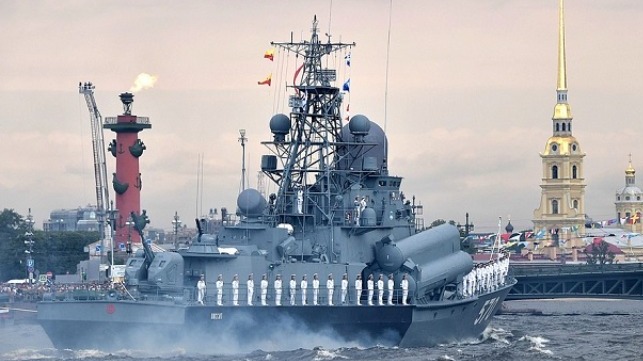
Every July since 2017, St. Petersburg has held a massive Navy Day parade for Russian President Vladimir Putin and other members of Russia's senior leadership. This year, for the first time ever, the event was called off at the last minute - likely because of the threat of Ukrainian drones.
Dmitry Peskov, Putin's spokesman, said Sunday that the parade was canceled due to unnamed "security reasons." While Peskov did not provide further details of the rationale, the UK Ministry of Defense assesses that it is almost certain that the parade - and all larger commemorative events across Russia - have been canceled due to force protection concerns.
"Small ceremonies will highly likely take place and Navy Day remains a Russian national holiday," the UK MOD said in an intelligence assessment.
The Navy Day parade is among Russia's biggest and best-publicized military events, and Putin will typically take part from a shoreside reviewing stand or aboard a VIP launch. Security precautions surrounding the event are stringent.
The cancellation follows one day after a large-scale Ukrainian drone operation over parts of Western Russia. Ukraine has developed technology and operating methods to launch long-range drone attacks on targets deep inside of Russian territory, typically targeting weapons factories, airfields, rail lines, refineries and oil and gas infrastructure.
In the area around St. Petersburg, higher-than-normal air-defense intercepts of Ukrainian drones prompted the regional airport to cancel flights for several hours overnight Saturday. Across Russia, about 100 drones were shot down Saturday night, Russia's defense ministry claimed.
Weakened Iran Clings to Russia in the Caspian Sea
Iran and Russia have concluded a short naval exercise in the Caspian Sea, which both nations may have regarded as an opportunity to shore up relationships in a region where both have recently lost friends. Iran, in particular, felt let down by the lack of Russian support during the 12-Day War with Israel - she received some support from China, but none from Russia. Iran is also at present highly nervous about porous border security, and wants to demonstrate heft in this area.
CASAREX 2025 commenced on July 21 and concluded two days later, under the direction of Commodore Mohsen Razzaghi. He announced via IRNA that the Nedaja, the IRGC Navy (Nedsa), and Iranian law enforcement forces would take part, alongside vessels from the Russian Navy. Observers would also participate from the three other Caspian Sea littoral nations - Azerbaijan, Kazakhstan, and Turkmenistan.
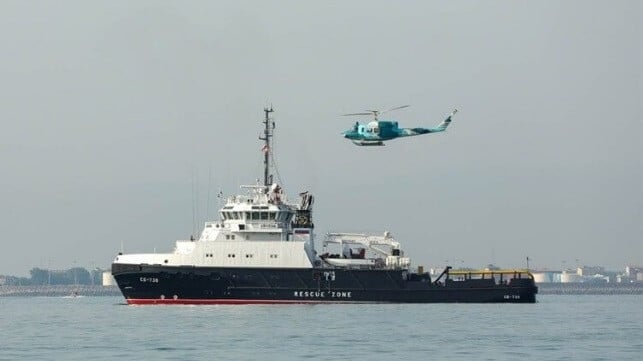
In a video released by IRNA, the only evidence seen of Russian involvement has been the presence of the civilian rescue tug SB 738 (MMSI: 273544130). Nedaja vessels participating (at least in the end of the exercise parade) were Sina Class fast attack craft Paykan (P224), Joshan (P225), Derfash, and Separ (P234). Also present was the IRGC Navy’s Nasser Class auxiliary Martyr Basir (117), which appears to be equipped with Zafar/C704 anti-ship missiles and normally operates from the Samen al-Hojaj Naval Base at Babolsar, Mazandaran Province.
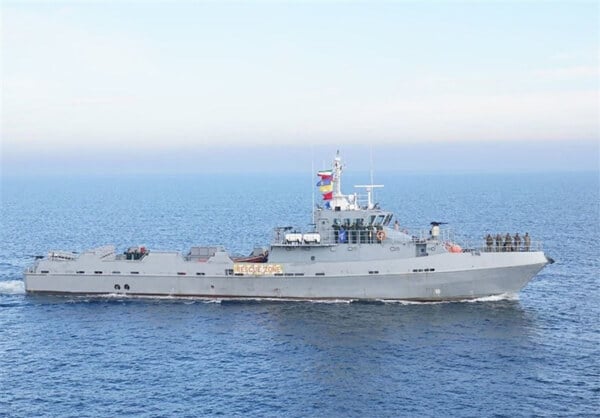
The IRGC Navy’s Martyr Basir (Tasnim - CC BY 4.0)
There was no evidence of the participation of the observers, and the Iranians have an established record of announcing the involvement of other nations in their exercises without their consent or participation. The Caspian Post, an Azeri media outlet, covered the exercise but made no mention of Azeri participation.
Relations between Russia and Azerbaijan are particularly stretched at the moment. Azerbaijan is furious about a series of arrests made of Azeris working in Russia, and still seething about the deaths of 38 passengers following the missile attack on an Azerbaijan Airline Flight 8243 coming in to land at Grozny on Christmas Day 2024, heightened by the Russians’ callous handling of the incident. Nor are Azeri relations with Iran much better, following Iranian suggestions of Azeri complicity in the Israeli air attacks on Iran during the 12-Day War.
Both Turkmenistan and Kazakhstan have grown tired of Russian bullying. Much of this springs from the Ukraine war and Russia’s assumption that it is still owed duties by these former Soviet states. At the St. Petersburg Economic Forum in June 2024, President Tokayev of Kazakhstan, on stage with President Putin, refused to recognize Russian annexations in Ukraine and Georgia. He also stated his country would respect Western sanctions on Russia, and he turned down a request to provide Kazakh troops to fight in Ukraine. Most of Kazakhstan’s oil production is exported through the Caspian Pipeline Consortium (CPC) network, which pipes through Russia and terminates at Novorossiysk on the Black Sea. However, Russia also uses the CPC network to export its Urals oil from Omsk and Kazan through Kazakhstan to China. Uncomfortable in this mutual inter-dependency, the Kazakhs have been developing their capability to export instead across the Caspian from Aktau to Baku, using shallow draft tankers built with Abu Dhabi Ports Group specially for Caspian operations. From Baku, the Kazakh oil can then use the Baku-Tbilisi-Ceyhan pipeline, thereby avoiding Russian territory.
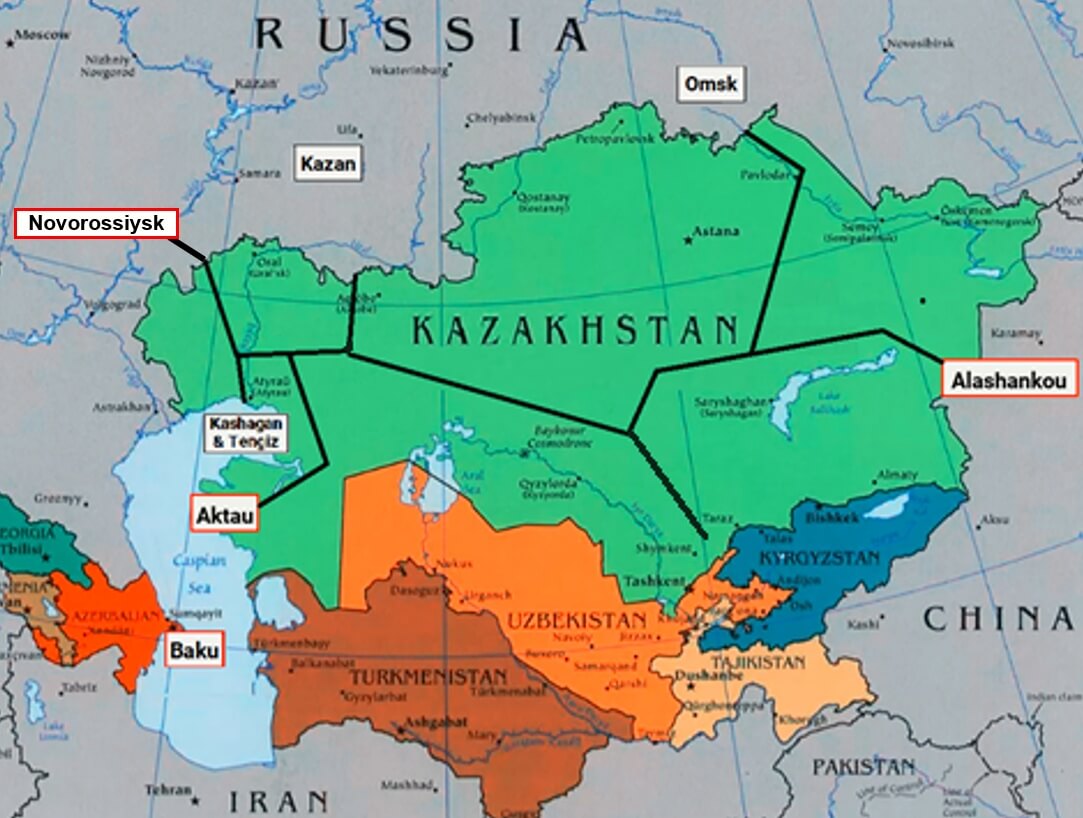
Main Kazakh oil pipelines (data from Kazakhstan-China Pipeline LLP/CJRC)
The geography of the Caspian means that Azerbaijan, Turkmenistan, and Kazakhstan, which have not enjoyed close relations hitherto, are being drawn into closer cooperation. Controlling the middle section of the Caspian, working together these three nations could impede shipping between Iran and Russia. This is an unlikely prospect for now, but a risk with some growth potential. Ukraine would be keen to spread discontent, so as to disrupt arms supplies flowing up the Caspian from Iran into Russia.
Russia controls the only access to the Black Sea through the Volga-Don canal. For now, the 28-strong Caspian Flotilla remains dominant, comprising the two Gepard Class frigates damaged in a Ukrainian attack on November 6 last year, plus 16 corvettes and minesweepers. The Iranian Northern Fleet, forming its 4th Naval Region, is led by Moudge Class frigate IRINS Deylaman (F78) with the four Sina Class fast attack craft, each armed with a 76mm gun and C-802 anti-ship missiles, which participated in CASAREX 2025. Together, Russia and Iran are much stronger than Azerbaijan, Kazakhstan, and Turkmenistan. But the Azeris have of late been militarily clever, upgrading their navy with Israeli and Turkish assistance; they also operate Triton Class midget submarines, the only such craft stationed in the Caspian.
Bilateral relations will not have been improved, and the Russians may have been tempted to return home somewhat earlier than planned, having heard the Iranian version of the Russian anthem as SB 738 was welcomed into port. Sailors worldwide will have endured similar ordeals on port visits, but this rendition of the Russian National Anthem was even more insulting (in the opinion of the Maritime Executive’s correspondent) than the famous Egyptian and Saudi salutes to President Putin in 2015 and 2019, respectively.

No comments:
Post a Comment