
Venezuela Will Pay for Its Own Reconstruction
January 7, 2026
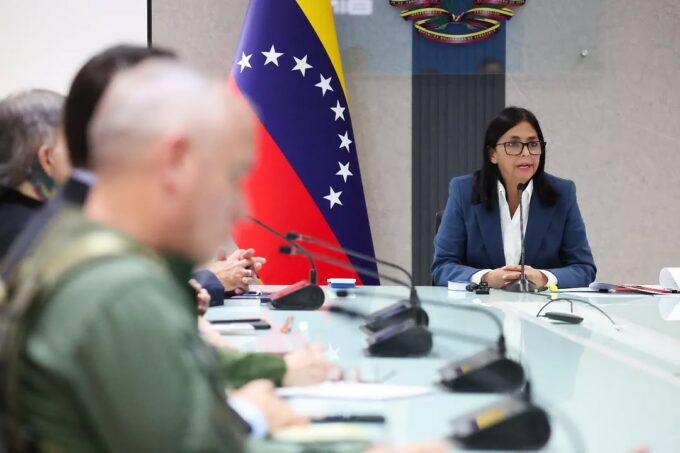
Photograph Source: Prensa Presidencial de Venezuela – Public Domain
When George W. Bush and his team invaded Iraq, ostensibly about weapons of mass destruction (something like drugs with Venezuela), their claim was that the country would pay for its own reconstruction with its oil revenue. They assured us that US troops (a.k.a. “boots on the ground”) would be welcomed with flowers. It didn’t quite work out that way.
Almost a quarter century later, we still have some US troops in Iraq. Over 3,000 US soldiers were killed in Iraq, tens of thousands more were injured, after President Bush famously declared “mission accomplished.” The cost of the war and subsequent occupation was over $1 trillion in today’s dollars.
Trump assures that things will turn out better this time because unlike his predecessors, he is smart. The evidence of his intelligence is that he claims to have passed tests for dementia three times. The rest of us are not terribly assured that Trump’s doctors felt it necessary to test for dementia on three different occasions, even if he did pass.
Anyhow, it seems Trump is too old to know much history, but those of us who aren’t remember all the other occasions, where overthrowing a government, even an authoritarian and dictatorial one, turned out not to be fun and easy. In addition to Iraq, the story in neighboring Afghanistan didn’t turn out any better.
Overthrowing Khadafy in Libya turned out not to be a great victory for democracy and human rights, or even oil extraction. Production plunged immediately after the overthrow. More than a dozen years later, it is still down by 20 percent from when Khadafy was in power.
Anyhow, just comparing the Iraq scenario with Venezuela, Iraq would have looked like a much better bet on paper 2003 to have a workable transition based on oil income than Venezuela does today. While Venezuela does have considerably larger reserves, most of it is heavy oil that requires substantial investment to get out of the ground.
In terms of current production, Iraq was at almost 3 million barrels a day just a couple of years before the invasion. In principle, it should have been possible to fairly quickly restore production to this level, absent major domestic unrest. Of course, there was major unrest in Iraq, so that proved to be a major obstacle to restoring and expanding production.
By comparison, Venezuela’s production is 900,000 barrels a day. While it may be possible to raise production by a few hundred thousand barrels a day fairly quickly by ending sanctions that blocked equipment sales, along with limited investment, most experts believe that major increases will require tens of billions in new investment and take many years. That investment will not be forthcoming without a more stable political environment.
The price picture also looked better in Iraq in 2003. Adjusted for inflation, world oil prices were roughly the same in 2003 as they are today. But they quickly rose, so that over the next decade inflation-adjusted oil prices were on average more than twice as high as they are today.
It is hard to envision a similar rise in oil prices going forward. Outside the United States the green transition is moving ahead rapidly. Already 60 percent of the new cars in China, the largest car market in the world, are electric, and that share is certain to rise much further in the next few years. In some other developing countries the share is even higher, as China is exporting high quality low-cost EVs to the rest of the world. With plenty of excess oil production capacity in the world, it seems more likely prices will go lower than higher.
Given the prospect for Venezuela’s oil production and exports, the Bush administration’s pledge that Iraq would pay for its own reconstruction seems far more credible than Trump’s claims about Venezuela. And this is before even considering the political situation.
It’s true that Maduro was unpopular at the time of his removal; so was Saddam Hussein. But in both countries, there was little support for a regime that would be a US puppet, which Trump has explicitly said is his intention in Venezuela.
From what he has said and done to date, it is difficult to get a clear idea of what Trump intends for the governance of Venezuela. Given how he has run his presidency, it is likely that Trump doesn’t have a clear idea himself. The one thing that does seem very likely is that it will cost taxpayers in the United States a good chunk of money, and that should be a concern even to people who are not bothered by the US invading a sovereign country on phony pretexts.
This first appeared on Dean Baker’s Beat the Press blog.

No comments:
Post a Comment