France and UK confirm boots on the ground after ceasefire in Ukraine
The security guarantees for Ukraine envisioned by the "Coalition of the Willing" and the United States include a high-tech mechanism to monitor a ceasefire, a multinational force led by France and the UK, and a legally binding obligation to assist Kyiv in case of a future Russian attack.
France and the United Kingdom have confirmed their intention to deploy their soldiers on Ukrainian soil after an eventual ceasefire as part of a broader package of security guarantees for Kyiv to avoid a repeat of Russia's full-scale invasion in the future.
The commitment was signed in a formal declaration by French President Emmanuel Macron, British Prime Minister Keir Starmer and Ukrainian President Volodymyr Zelenskyy at the end of a meeting of the "Coalition of the Willing" in Paris on Tuesday.
"I can say that following a ceasefire, the UK and France will establish military hubs across Ukraine and build protected facilities for weapons and military equipment to support Ukraine's defensive needs," Starmer said at the conclusion.
Macron said the multinational force would be deployed "away from the contact line" in the air, sea and land to provide the necessary "reassurance" so that Russia does not attack Ukraine again. Turkey, he said, would join in the operation with maritime support.
"The security guarantees are the key to ensuring that a peace agreement can never mean the surrender of Ukraine or a new threat to Ukraine," Macron said.
The guarantees discussed on Tuesday by allies would also involve a high-tech mechanism to monitor a ceasefire led by the United States and a legally binding obligation to assist Ukraine in the event of a renewed Russian attack.
The obligation, which appears to be modelled after NATO's Article 5 of collective defence, could mean military aid, but also logistical, economic and diplomatic.
Critically, it would require a ratification by national parliaments, a step that could prove difficult to pass in countries where support for Ukraine is fraying. In the case of the United States, it would go through the US Congress for approval.
It remains unclear how much each member of the coalition would contribute, both in the multinational force and the Article 5-like obligation.
After Tuesday's meeting, German Chancellor Friedrich Merz said his country's contribution would require the consent of the Bundestag and limited the deployment of military troops to countries neighbouring Ukraine.
But Merz also said: "We fundamentally don't rule anything out."
Spanish Prime Minister Pedro Sánchez announced he would launch talks with the main parties to discuss Spain's contribution, which, he said, could have a troops component.
"There's an open door for 2026 to become the year when the war ends. This is very good news," Sánchez said. "Europe never wanted this war."
'Huge step forward'
Tuesday's gathering saw leaders from almost 30 Western countries, alongside representatives from Turkey, Australia, Japan and New Zealand, come together.
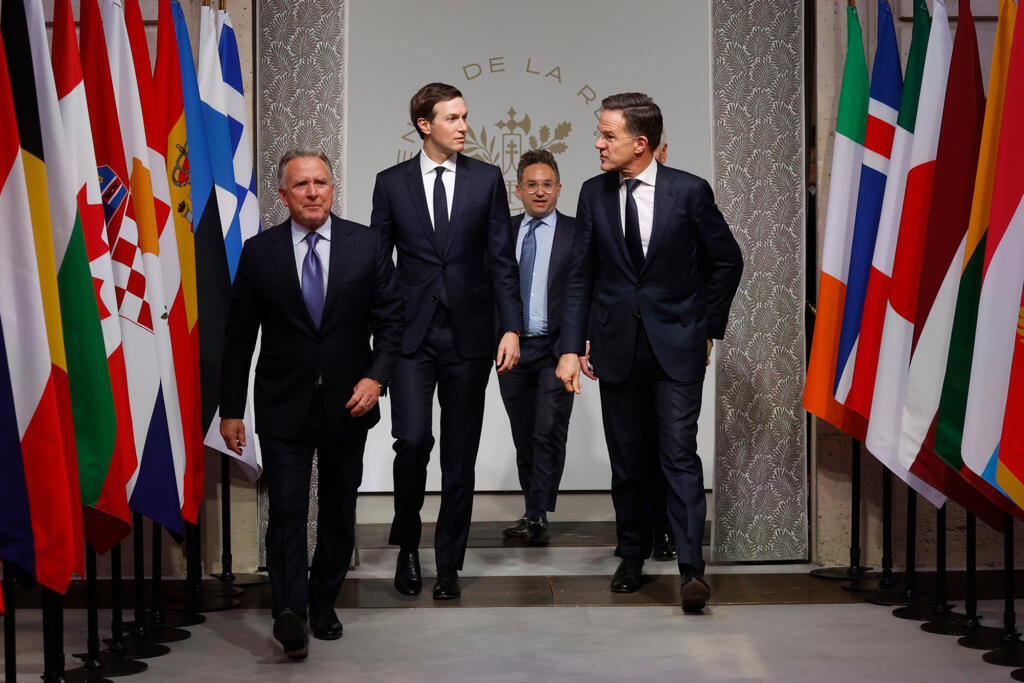
The US delegation was led by Steve Witkoff and Jared Kushner, the two chief negotiators appointed by President Donald Trump, marking the first time they attended the format in person. Secretary of State Marco Rubio was originally planned to attend, but the recent events in Venezuela prompted a change in his schedule.
"President Trump's mandate is that he wants peace in Ukraine, and we're determined on his behalf to do everything possible," Witkoff said.
Also present in Paris were European Commission President Ursula von der Leyen, European Council António Costa, High Representative Kaja Kallas and NATO Secretary General Mark Rutte. Alexus Grynkewich, the Supreme Allied Commander Europe (SACEUR), who is the highest military authority in NATO, participated in the meeting too.
"We collectively stand by Ukraine, and a safe, secure prosperous future lies ahead," von der Leyen said, calling the meeting a "strong display of unity".
Leaders sought to flesh out and clarify the security guarantees structured along five main pillars: the US-led verification mechanism, military support for the Ukrainian army, the multinational force led by France and the UK, the legally binding obligation to assist in the event of a new attack and long-term defence cooperation with Ukraine.
The obligation to assist Ukraine was first pitched after a meeting in Berlin last month, where it drew comparisons with Article 5 of collective defence, the core foundation of the transatlantic alliance, even if leaders did not use that term publicly.
For Kyiv, a credible deterrent is an indispensable condition to abandon its constitutionally enshrined aspiration to join NATO, which Moscow firmly opposes and Washington does not support under President Donald Trump
Still, the path for an Article 5-like guarantee is riddled with questions.
European governments would have to convince their parliaments, many of which are paralysed by political deadlock, to agree to an exceptionally consequential commitment.
The obligation to assist Ukraine in case of an attack would rely on a mechanism to monitor an eventual cessation of hostilities. This mechanism, envisioned as a system of high-tech sensors across the contact line, would be of critical importance because it would serve to verify potential breaches and allocate responsibility.
If allies were to conclude that Russia is to blame, the Article 5-like assistance would come into play. Triggering the provision would ultimately be a political, not automatic, decision, according to European officials briefed on the discussions.
Zelenskyy hailed Tuesday's meeting as a "huge step forward" but noted the efforts were still not enough. "It will be enough when the war in Ukraine will end," he said.
At this stage, Russia has not given indications that it is willing to compromise on a peace deal and end the war, maintaining the pace of drone and missile strikes against Ukrainian cities, killing scores of civilians and infrastructure.
"We can only get to a peace deal if Putin is ready to make compromises, "Starmer said. "For all Russia’s words, Putin is not showing he's ready for peace."
Ukraine’s Allies Pledge ‘Robust’ Security
Guarantees After Russian War Ends –
Analysis
January 7, 2026
RFE RL
By Rikard Jozwiak
Officials from more than 30 Western countries — the so-called Coalition of the Willing — have agreed ensure “politically and legally binding guarantees” for Ukraine once a peace agreement to end the war with Russia is reached.
With Ukrainian President Volodymyr Zelenskyy, along Steve Witkoff and Jared Kushner, US President Donald Trump’s chief negotiators at the table during the January 6 talks in Paris, the coalition agreed that Kyiv’s “ability to defend itself is critically important” to ensure the security of both Ukraine and Europe.
“We confirmed that ensuring the sovereignty and lasting security of Ukraine shall be an integral part of a peace agreement, and that any settlement will have to be backed up by robust security guarantees for Ukraine,” a statement issued after the meeting said.
“Both the Coalition partners and the United States will play a vital and closely coordinated role in the provision of these security guarantees,” it added.
The meeting was called amid an intense flurry of diplomacy to fine tune a peace proposal aimed at ending Europe’s largest and deadliest conflict since World War II.
The statement is the most defined wording the allies have given on military pledges to secure Ukrainians after any peace deal is reached with Moscow.
It says support for Ukraine by the allies would include a US-led cease-fire monitoring and verification mechanism, support for Ukraine’s armed forces, a multinational force for Ukraine, and “binding commitments to support Ukraine in the case of a future armed attack by Russia in order to restore peace.”
“We are talking about strong security guarantees,” French President Emmanuel Macron told reporters after the meeting.
“These security guarantees are a key that a peace agreement cannot mean a Ukrainian surrender.”
European officials have told RFE/RL that there is “a renewed sense of urgency” after a meeting over the weekend of national-security advisers and a gathering of military planners on January 5.
The statement gives no specifics on troops for any multinational force but some officials have said the number that is floating around in various European capitals is that the force will consist of 15,000-20,000 troops, while others hope the level will be closer to 30,000 working under the motto “safe sea, sky and land.”
The bulk of the troops will come from France and the United Kingdom, which would lead the land and air component, while Turkey has indicated it would be in charge of securing transport lanes in the Black Sea.
“Following a ceasefire UK and France will establish military hubs across Ukraine,” British Prime Minister Keir Starmer.
“We can only get to a peace if [Russian President Vladimir] Putin makes compromises and we have to be frank for all Russia’s words Putin has shown he is not ready for peace,” he added without giving further details on the plan.
Unresolved Questions
While the outlines of a Western presence in Ukraine are taking shape, there are still several question marks to sort out, including the rules of engagement and US security guarantees.
“We are largely finished with the security protocol so that the Ukrainian people know that peace comes it will last,” Witkoff said, adding further meetings with the Ukrainian delegation would follow.
“The president [Donald Trump] strongly stands behind security protocols. The president does not back down on commitments. We will be there for the Ukrainians to get there for the final peace.”
Peace talks have intensified since November, when Trump pressed Zelenskyy to accept a 28-point peace proposal that many saw as heavily favoring Russia.
Ukraine and its European allies — led by Britain, France, and Germany — scrambled to develop a counterproposal, eventually putting forward a 20-point plan that took in more of Kyiv’s interests, especially on security guarantees and territorial integrity.
Thorny Issues
Ukraine’s chief negotiator Rustem Umerov recently asserted that “most of the positions — 90 percent of the peace plan — have already been agreed, work continues on the details.”
These details include the thorny issue of territorial concessions with Ukraine pushing the line of contact to be frozen or for the entire Donbas region to become a demilitarized zone.
“We want to be ready so when diplomacy reaches peace we can place the forces of the coalition,” Zelenskyy said.
“We need to work on the question of territory. Ukraine needs missiles because every day notwithstanding the diplomacy the Russian strikes continue.”
Another issue is the ownership of the Zaporizhzhya nuclear power plant with Kyiv dismissing the idea of Ukraine and Russia running it together, preferring that the United States steps in to sell energy from it to Moscow instead.
Few in Brussels, however, are thinking that Russia would agree on any of these issues with the assessment that the Kremlin still feels it is winning on the battlefield.
Russian President Vladimir Putin has said several times in recent weeks that Moscow will achieve the goals of what it calls its “special military operation” either by agreement or force.
With that in mind, the EU is separately preparing a fresh round of sanctions, the 20th since the full-scale invasion nearly four years ago, which is likely to be presented to its member states for approval later in January.Rikard Jozwiak is the Europe editor for RFE/RL in Prague, focusing on coverage of the European Union and NATO. He previously worked as RFE/RL’s Brussels correspondent, covering numerous international summits, European elections, and international court rulings. He has reported from most European capitals, as well as Central Asia.
The United States has for the first time backed a broad coalition of Ukraine's allies in vowing to provide security guarantees that leaders said would include binding commitments to support the country if it is attacked by Russia again. The agreement followed a "coalition of the willing" summit in Paris in which Ukraine's allies agreed to deploy troops in Ukraine in the event of a ceasefire.
Issued on: 07/01/2026 - RFI

French President Emmanuel Macron, Ukraine's Volodymyr Zelensky and British Prime Minister Keir Starmer signed a declaration of intent on Tuesday in Paris at the "coalition of the willing" summit of mainly European nations.
The declaration foresees Britain, France and other European allies deploying troops on Ukrainian territory after any ceasefire with Russia.
The allies also agreed to participate in a proposed US-led ceasefire monitoring and vertification mechanism.
Macron said that Paris could deploy "several thousand" French troops to Ukraine after the war.
US special envoy Steve Witkoff said that President Donald Trump "strongly stands behind security protocols".
"Those security protocols are meant to ... deter any attacks, any further attacks in Ukraine, and ... if there are any attacks, they're meant to defend, and they will do both. They are as strong as anyone has ever seen."
But a promise that Washington would commit to "support" the European-led multinational force "in case of a new attack" by Russia, which was present in the draft statement, was not in the communique released on Tuesday evening.
US and Ukrainian officials are to continue talks over security guarantees for Kyiv on Wednesday.
Talks to bring the almost four-year conflict to an end have accelerated since November. However, Moscow has yet to signal willingness to make concessions after Kyiv pushed for changes to a US proposal that initially backed Russia's main demands.
Until recently, much of the focus was on pledges of military aid for Ukraine's forces and possible contributions to an international reassurance force.
Attention has now shifted to legally binding guarantees to come to Kyiv's aid in the event of another attack by Moscow. The possibility of a military response is likely to trigger debate in many European countries, diplomats say.
"These commitments may include the use of military capabilities, intelligence and logistical support, diplomatic initiatives, adoption of additional sanctions," the leaders' statement said, adding that they would now "finalise binding commitments".
"We all want ... peace (in Ukraine) to be fair, lasting and clear-eyed… we want this peace to have its guarantees," Macron told a news conference after the summit.
Macron demands 'robust security guarantees' before any Ukraine territorial talks
Renewed unity
European leaders present at the meeting, including Macron, Starmer, Polish Prime Minister Donald Tusk and Italy's Prime Minister Giorgia Meloni stressed that the statement showed renewed unity between Europe and the United States on helping Ukraine.
The leaders' statement also pledged a European-led "Multinational Force for Ukraine ... to support the rebuilding of Ukraine's armed forces and support deterrence" with "the proposed support of the US".
Kyiv has long said it cannot be safe without guarantees that are comparable to the Nato alliance's mutual defence agreement, to deter Russia from attacking again.
Moscow wants any peace deal to bar Ukraine from military alliances.
(with newswires)

No comments:
Post a Comment