SPACE/COSMOS
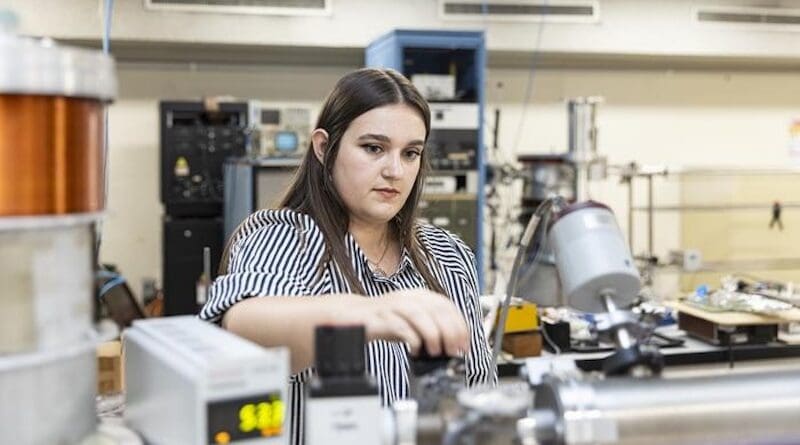
PhD candidate and lead author of the study Linda Losurdo in the plasma physics laboratory at the University of Sydney. CREDIT: Fiona Wolf/The University of Sydney
February 9, 2026
By Eurasia Review
A Sydney PhD student has recreated a tiny piece of the Universe inside a bottle in her laboratory, producing cosmic dust from scratch. The results shed new light on how the chemical building blocks of life may have formed long before Earth existed.
Linda Losurdo, a PhD candidate in materials and plasma physics in the School of Physics, has used a simple mix of gases – nitrogen, carbon dioxide and acetylene – to mimic the harsh and dynamic environments around stars and supernova remnants.
By subjecting these gases to intense electrical energy, she generated carbon-rich “cosmic dust” similar to the material found drifting between stars and embedded in comets, asteroids and meteorites.
Her results are published in The Astrophysical Journal of the American Astronomical Society.
The dust she created contains a complex cocktail of carbon, hydrogen, oxygen and nitrogen – known collectively as CHON molecules – which are central to many organic substances essential for life.
“We no longer have to wait for an asteroid or comet to come to Earth to understand their histories,” Ms Losurdo said. “You can build analogue environments in the laboratory and reverse engineer their structure using the infrared fingerprints.
“This can give us huge insight into how ‘carbonaceous cosmic dust’ can form in the plasma puffed out by giant, old stars or in cosmic nurseries where stars are being born and distribute these fascinating molecules that could be vital for life.
“It’s like we have recreated a little bit of the Universe in a bottle in our lab.”
Cosmic dust is known to form in extreme astrophysical environments, where molecules are constantly bombarded by ions and electrons. Scientists can identify this dust in space because it emits a distinctive infrared signal – a molecular fingerprint that reveals its chemical structure.
The dust produced in Ms Losurdo’s experiments showed the same tell-tale infrared signatures, confirming the laboratory process closely mirrors what happens in space.
BUILDING BLOCKS OF LIFE
One of the enduring questions in science is how life began on Earth. Researchers are still debating whether the earliest organic molecules formed locally on our young planet, arrived later aboard comets and meteorites, or were delivered during the earliest stages of solar system formation – or some combination of all three.
Between about 3.5 and 4.56 billion years ago, Earth was bombarded by meteorites, micrometeorites and interplanetary dust particles originating from asteroids and comets. These objects are thought to have delivered vast amounts of organic material to the planet’s surface. Yet the origins of that material remain mysterious.
“Covalently bonded carbon and hydrogen in comet and asteroid material are believed to have formed in the outer envelopes of stars, in high-energy events like supernovae, and in interstellar environments,” Ms Losurdo said.
“What we’re trying to understand are the specific chemical pathways and conditions that incorporate all of the CHON elements into the complex organic structures we see in cosmic dust and meteorites.”
HOW THEY DID IT
In the experiment, the team, consisting of Ms Losurdo and her supervisor Professor David McKenzie, used a vacuum pump to evacuate air from glass tubes, recreating the near-empty conditions of space. Nitrogen, carbon dioxide and acetylene were then introduced. The gas mixture was exposed to around 10,000 volts of electrical potential for about an hour, creating a type of plasma known as a glow discharge.
Under this intense energy, molecules broke apart and recombined into new, more complex structures. These compounds eventually settled as a thin layer of dust on silicon chips placed inside the tubes.
The collected dust at times looks like glittering collections of cosmic material.
Professor David McKenzie, co-author on the paper, said the work will allow scientists to probe conditions that are otherwise impossible to study directly.
“By making cosmic dust in the lab, we can explore the intensity of ion impacts and temperatures involved when dust forms in space,” Professor McKenzie said. “That’s important if you want to understand the environments inside cosmic dust clouds, where life-relevant chemistry is thought to be happening.
“This also helps us interpret what a meteorite or asteroid fragment has been through over its lifetime. Its chemical signature holds a record of its journey, and experiments like this help us learn how to read that record.”
Beyond insights into the origins of life, the researchers aim to build a comprehensive database of infrared fingerprints from lab-made cosmic dust. Astronomers could then use this library to identify promising regions of space – in stellar nurseries or the remnants of dead stars – and work backwards to understand the processes shaping them.
By recreating cosmic chemistry on Earth, the research opens a new window onto deep stellar processes – and the ancient steps that may have helped make life on Earth possible.
Ms Losurdo won the best presentation for this research at the international Annual Meeting of the Meteoritical Society late last year.
China develops compact microwave driver that could power a ‘Starlink-killer’ weapon
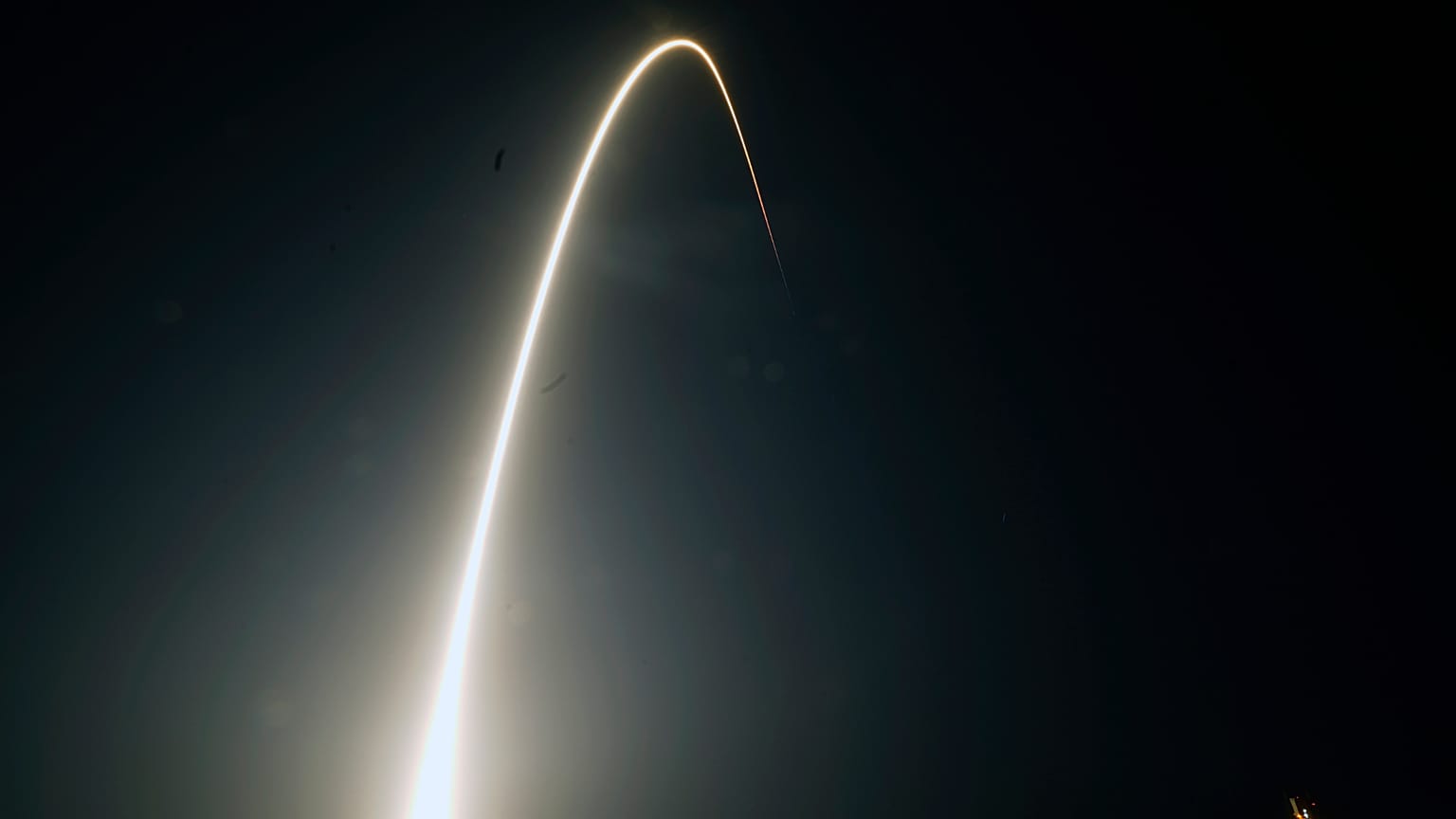
The compact pulse-power driver could enable high-power microwave attacks that are harder to detect and attribute than conventional anti-satellite weapons, potentially putting China ahead of the United States and Russia in the space-weapons race.
China has developed a new piece of military technology that could one day be used to disrupt satellite networks such as Starlink, according to a study.
Researchers at the Northwest Institute of Nuclear Technology (NINT), a research facility linked to the Chinese military in Xi’an, say they have built the world’s smallest driver for a high-power microwave (HPM) weapon, a system that could potentially be used to disrupt satellite networks such as Starlink.
The device, known as TPG1000Cs, measures about four metres long and weighs roughly five tons, making it significantly smaller than comparable systems.
“The system has demonstrated stable operation over continuous one-minute durations, accumulating approximately 200,000 pulses with consistent performance,” the study said.
Until now, similar known systems could only operate continuously for no more than just a few seconds and were far bulkier, making them difficult to install in smaller weapons systems
The TPG1000Cs system can generate electrical pulses reaching 20 gigawatts, according to the study. This far exceeds the roughly 1 gigawatt output that experts say a ground-based microwave weapon would need to potentially disrupt low-Earth-orbit satellite networks such as Starlink.
How does it work?
The United States, Russia, and China have all been exploring whether high-power microwave technology could be developed into weapons capable of disrupting satellites.
Destroying satellites using conventional weapons can create large clouds of orbital debris that may threaten other spacecraft, including those belonging to the attacking country.
Microwave weapons, in contrast, could theoretically disable electronics without creating significant debris, potentially offering strategic advantages and a degree of plausible deniability.
These weapons store electrical energy and then release it in a sudden, powerful burst. This pulse can produce intense microwave radiation that can disrupt electronics.
Starlink satellite communications have been used to support Ukraine’s communications infrastructure during Russia’s invasion of Ukraine, thanks to demonstrated resilience against jamming attempts.
The study was published in the Chinese journal High Power Laser and Particle Beams on January 13.
China has published a number of studies in recent years discussing the need to develop ways to disrupt large satellite constellations, including Elon Musk’s Starlink network.
Researchers say the breakthrough was made possible by a special liquid insulating material called Midel 7131.
“By adopting a high-energy-density liquid dielectric Midel 7131 and a dual-width pulse-forming line, the study achieved miniaturisation of an integrated Tesla transformer and pulse-forming system,” scientists wrote in the study.

No comments:
Post a Comment