Innovative Low-Emission RoRo Launched in China for Airbus and LDA
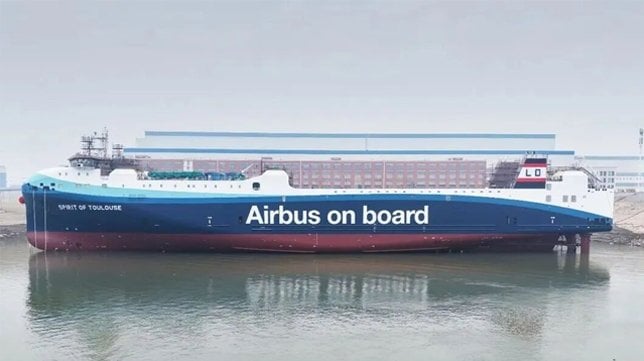
The first of three innovative cargo RoRos was recently launched in China for LD Armateurs, which will operate the ships for Airbus. The vessels are designed to incorporate the latest technologies, including AI and wind-assisted propulsion, to reduce emissions.
LDA ordered the ships in January 2024, highlighting them as the next generation in low-emission shipping. LDA currently operates two ships on a transatlantic route carrying assemblies from the Airbus plant in France to the United States. The largest of the vessels currently has a capacity for six aircraft bodies. The new vessels will support an increase in capacity designed to meet Airbus’ plan to increase production of its A320 class of planes to 75 aircraft per month. The new vessels will have the capacity to transport around 70 40-foot containers and six aircraft subassembly sets. This will include wings, fuselage, engine pylons, and horizontal and vertical tails. Airbus has said any excess capacity could be used by other divisions or its partners.
China’s Wuchang Shipbuilding, a division of China State Shipbuilding Corporation (CSSC), floated the first of the vessels, which is named Spirit of Toulouse. The sisterships, Spirit of Mobile and the Spirit of Mirabel, are currently under construction. Each of the vessels will have an overall length of 169 meters (554 feet).
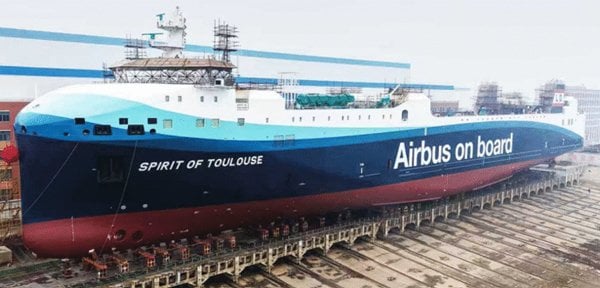
Key among the features in the design, each will be equipped with six 35-meter (115-foot) tall Norsepower rotors. They are being constructed of aerospace-grade lightweight composite materials. The ships will also be outfitted with two bi-fuel engines capable of running on e-/bio-methanol or marine diesel. They are expected to have a service speed of 14 knots and a maximum of 17 knots.
From their inception, LDA highlights that the vessels were designed to minimize CO2 emissions through a comprehensive approach. This includes high-efficiency propellers and shaft lines made from recycled steel, ultra-low friction antifouling coatings, an intelligent energy management system, and a waste heat recovery system.
Equipped with advanced routing software, they will optimize their routes to maximize sail propulsion and reduce drag caused by adverse ocean conditions. Their performance will be further enhanced by an advanced control solution based on artificial intelligence, allowing the vessels to adapt in real time to weather and sea conditions and achieve aerodynamic optimization specific to each wind condition.
Each ship in this new fleet is expected to deliver a 70 percent annual reduction in CO2 emissions compared to the previous generation. Further emission reductions could be achieved through the use of low-carbon alternative fuels, such as hydrotreated vegetable oil (HVO) or e-methanol.
The shipyard reports the Spirit of Toulouse will now enter the mooring and sea trial phases. It will be undergoing a comprehensive commissioning of the propulsion system, methanol fueling, and sail installation and debugging. They had originally been scheduled to start delivery in 2025. No timeline was announced for the entry into service.

No comments:
Post a Comment