Monday, July 06, 2020

UK protesters denounce Yemen war

Protestors in the UK hit the streets
 to oppose the Yemen war


Displaced Yazidis head back to Sinjar as coronavirus lockdown bites

July 6, 2020

An elderly woman and children stand outside a tent internally displaced persons of Iraq's Yazidi minority in Iraqi Kurdistan region on 30 August, 2019 [ZAID AL-OBEIDI/AFP via Getty Images]

July 6, 2020

Hundreds of Yazidi families driven from their hometown of Sinjar in northern Iraq years ago are now returning as the impact of coronavirus lockdown measures makes their lives in exile even harder.

Many have lost their jobs and aid from donors in Sharya, where they have been living since they fled Sinjar in 2014.

Mahma Khalil, the mayor of Sinjar but now in exile in Dohuk in Iraq’s Kurdistan region, said more than 1,200 displaced families have returned from their temporary homes to Sinjar since June. Most had relatives there who serve in the military or police, he said.

Overrun by Islamic State in 2014 and liberated by an array of forces the following year, little has been rebuilt in Sinjar.

READ: UN Commission investigates Daesh crimes in Iraq, makes progress thanks to telephone data

Water is scarce and power intermittent in the city, whose former occupiers killed thousands of Yazidis and forced many women in sexual slavery.

Despite the devastation that makes the city still largely unfit for habitation, members of this ancient minority feel they have no other choice.

“The situation has become really bad,” Yazidi community leader Jameel Elias Hassan al-Hamo said outside his makeshift home in Sharya, just south of Dohuk.

Young men from his community who used to earn up to $17 a day working at restaurants and factories can no longer find work because of the lockdown’s impact on the economy, al-Hamo said.

As he spoke, men carried pieces of furniture, blankets, and bags of food out of his home and piled them onto the back of a pickup truck.

The coronavirus outbreak has worsened Iraq’s economic crisis, pushing oil prices down in a country that depends on crude export for more than 90% of its revenue. Restrictions on travel and curfews have driven many out of work.

Al-Hamo’s daughter-in-law Gole Zeblo Ismaeel said that the monthly aid packages they used to depend on became scarcer as the crisis impacted the work of humanitarian organizations.

Another reason for their return was the restriction on internal travel between semi-autonomous Kurdistan and neighbouring Iraqi regions, imposed since March to curb the spread of the virus.

INTERVIEW: Rape, torture and capture, the doctor helping Yazidi victims of Daesh rebuild their lives

Al-Hamo said that most Yazidi families in Sharya have a son enrolled in armed forces stationed in Sinjar, who have been unable to visit for weeks.

“Some haven’t seen their families for over three months now,” he said.

Although their hometown is destroyed, al-Hamo said they have been promised support by local aid organisations upon their return and he believed soon he will be reunited with the rest of his family soon.

“I registered over 400 names and phone numbers of relatives, members of the tribe, and of the community. They said that once we, the sheikhs and tribal leaders, go back, they will follow us,” he added.

Khalil said he has been pleading for funds from the central government to step up reconstruction efforts in Sinjar but he believed it would not happen any time soon.

World’s largest drug haul was shipped by Assad regime, not Daesh


July 6, 2020

Over 127 plastic bags filled with an addictive drug called Captagon lie ready for destruction after being seized by US and Coalition partners in Southern Syria, May 31, 2018. [US Army/ WIkipedia]

July 6, 2020

The world’s largest drug haul of amphetamine pills, which was seized by Italian police last week, has been revealed to have been packaged and shipped by Syrian businessmen tied to the regime of President Bashar Al-Assad. Earlier reports had claimed that the Daesh terror group was responsible.

The captagon amphetamine pills, with a street value worth €1 billion, were seized by Italian police on Friday last week after they received intelligence of the shipment by tracking the mobile devices of known gang members who were set to receive and distribute the drugs.

The shipment had a record number of at least 84 million pills hidden in paper cylinders within agricultural machinery. It was thought at first to have been produced, packaged and shipped by Daesh from Syria.

This story was spread by media outlets that laid responsibility on the terror group. However, it was suspected by many of being false due to the shipment coming from the port of Latakia which is fully under the control of the Syrian regime and to which Daesh has no access.

In fact, it was produced and sent by the regime itself, as businessmen affiliated with Assad own facilities within the territory under his control that are able to produce amphetamine pills. Furthermore, numerous drug smuggling operations run by the regime’s business elite have been seized several times throughout the Syrian civil war. In April, for example, a shipment was seized in Egypt on the way to Libya, and another was in Saudi Arabian when the authorities seized over 44 million of the pills.

The suspicions of Assad’s involvement were confirmed in a report by Britain’s Sunday Times yesterday, which cited an unnamed Syrian businessman with knowledge of the paper industry in which the rolls that hid the pills were produced. He revealed that the cylinder rolls were produced in a new factory within an area of Aleppo which is owned by a businessman tied to the regime.


“They said it was Isis [Daesh],” he said. “It’s so funny because logistically they can’t have access to the port and they can’t have the machines that put the drugs inside the paper rolls. It’s impossible: when I saw the photos it is impossible that you could do such a thing without having machines for paper manufacture.”

Germany’s Der Spiegel said that the pills were manufactured in a village south of Latakia, an area deep within regime-held territory.

Throughout the ongoing conflict, Syria has become a major hub for the illegal international narcotics trade. The Assad regime’s smuggling operations have been particularly active under the economic sanctions imposed by the US and EU, making them a primary source of revenue which enable the regime to continue to fund its war efforts.

239 scientists call on WHO to recognize coronavirus as airborne


Fadel Allassan AXIOS


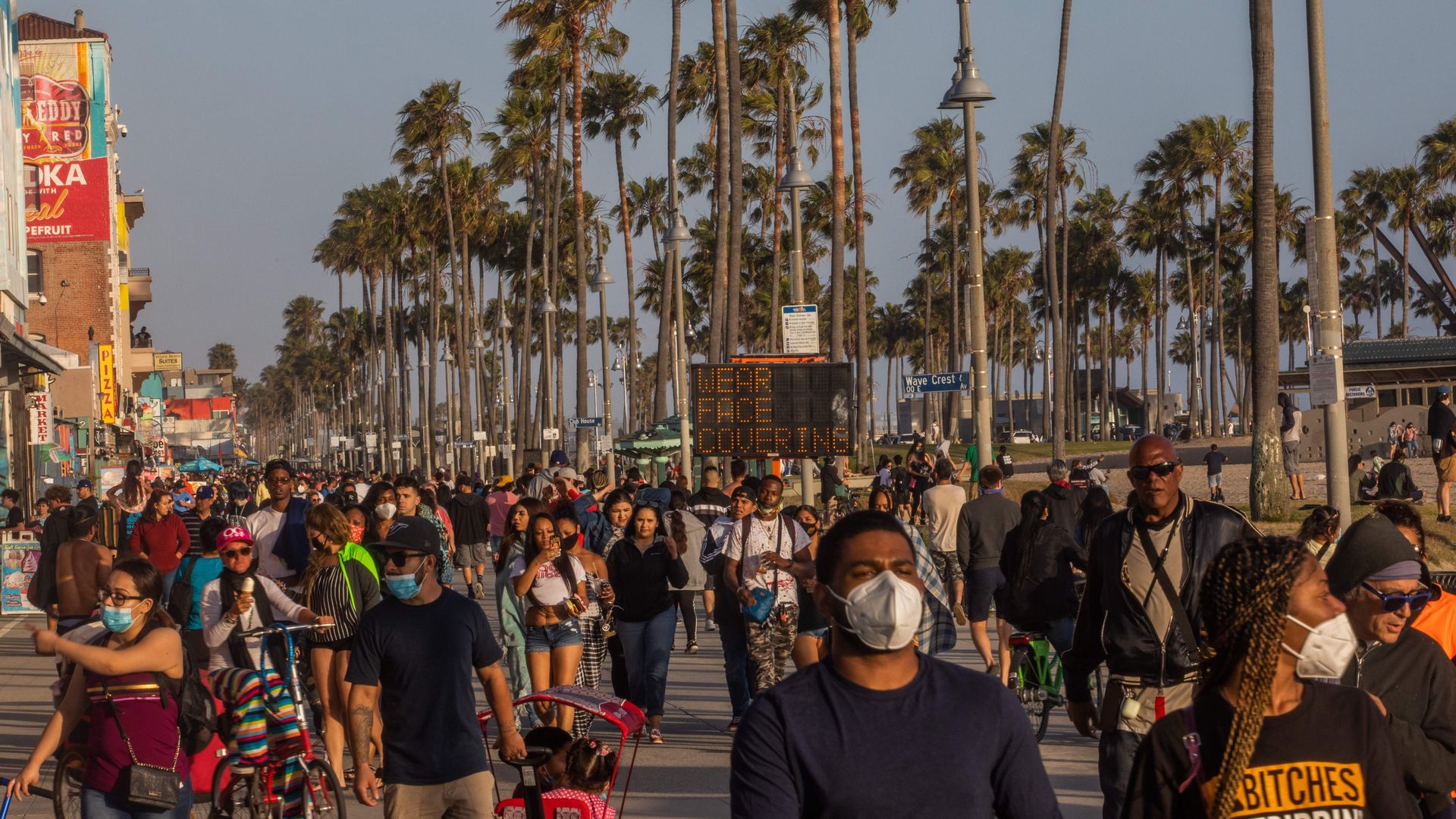
People walk at the boardwalk in Venice Beach. Photo: Apu Gomes/AFP via Getty Images

A group of 239 scientists in 32 countries is calling for the World Health Organization to revise its recommendations to account for airborne transmission as a significant factor in how the coronavirus spreads, the New York Times reports.

The big picture: The WHO has said the virus mainly spreads via large respiratory droplets that fall to the ground once they've been discharged in coughs and sneezes. But the scientists say evidence shows the virus can spread from smaller particles that linger in air indoors.

Why it matters: If airborne transmission is indeed a significant factor, it would call for major adjustments in efforts to contain the virus, according to the Times.
Masks would be needed indoors, even if people are socially distancing.
Health care workers may need N95 masks that filter out the smallest droplets as they care for coronavirus patients.
Air ventilation systems in public spaces would need powerful new filters.
It would likely call for ultraviolet lights to kill viral particles floating indoors.

The other side: Benedetta Allegranzi, the WHO's technical lead on infection control, called the evidence for the coronavirus being airborne unconvincing.
“Especially in the last couple of months, we have been stating several times that we consider airborne transmission as possible but certainly not supported by solid or even clear evidence,” she said, per the Times. “There is a strong debate on this.”

Yes, There Really Could Be Life In The Cloud Tops Of Venus

Ethan SiegelSenior Contributor
Starts With A Bang
Contributor Group
Science
The Universe is out there, waiting for you to discover it.

The Mariner 10 spacecraft captured this image of Venus, which has been processed to appear in... [+] 2005 MATTIAS MALMER, FROM NASA/JPL DATA

From afar, Venus seems like the most uninhabitable planet of all.


NASA's Magellan mission conducted radar mapping of the entire surface of Venus, penetrating its... [+] NASA / JPL-CALTECH / MAGELLAN

Beneath its carbon dioxide/nitrogen atmosphere, 90 times thicker than Earth's, a hellscape of a surface awaits.


The surface of Venus, one of the Soviet Union's old Venera landers: the only set of spacecraft to... [+] VENERA LANDERS / USSR

Day or night, Venus's surface is constantly 880 °F (470 °C): the hottest planet of all.

Venus' surface, as seen by the Venera 14 lander. Humanity has not been back to the Venusian surface... [+]
Although we've successfully sent numerous landers, they've all failed after mere hours.


An infrared view of Venus' night side, by the Akatsuki spacecraft. The features revealed here... [+] ISAS, JAXA
Most Popular In: Science

When Is The Next ‘Blood Moon’ Total Lunar Eclipse In North America?


Exactly When To See A ‘Buck Moon’ Form A ‘Summer Triangle’ With Our Giant Planets Sunday And Monday


‘Buck Moon’ Wanes As Bright Planets Peak: What You Can See In The Night Sky This Week


The reason? A layer of sulfuric acid clouds enshrouds Venus at high altitudes.


Multiple layers of clouds on Venus are responsible for different signatures in different wavelength... [+] VENUS EXPRESS; PLANETARY SCIENCE GROUP AT HTTP://WWW.AJAX.EHU.ES/These radiation-reflecting clouds create a runaway greenhouse effect: responsible for Venus's incredible temperatures.


Before we had explicit measurements of the temperature of Venus's atmosphere at various altitudes... [+] ESA, SPICAV/SOIR TEAMS

Above the cloud-tops, however, conditions become far more hospitable.

This false-color image of Venus, in the ultraviolet, shows the full view of the southern hemisphere... [+] ESA © 2007 MPS/DLR-PF/IDA

At 60 kilometers (36 miles) in altitude, temperatures and atmospheric pressures are similar to Earth's.

Using data from the ESA's Venus Express mission, both daytime and nighttime temperatures, as a... [+] ESA, VERA TEAM, (M. PÄTZOLD ET AL.)

The right ingredients for life, including carbon, oxygen, and nitrogen-rich molecules, are all abundant.


With a majority CO2 atmosphere alongside nitrogen gas, the presence of sulfur dioxide, water, and... [+] JUNKCHARTS / WIKIMEDIA COMMONS

Ultraviolet photos of Venus display "dark patches," which Harold Morowitz and Carl Sagan suggested could indicate microorganisms.

Ultraviolet image of Venus' clouds as seen by the Pioneer Venus Orbiter. The dark regions are still... [+] NASA

A zeppelin filled with breathable air would "float" at this altitude, making investigative missions feasible.


NASA's hypothetical HAVOC mission, the High-Altitude Venus Operational Concept, would look for life... [+] NASA LANGLEY RESEARCH CENTER

Above the cloud-tops, Venus has been called a "paradise planet."

This composite image of Venus's night side (left, from Venus Express) and night side (right, from... [+] JAXA / ESA / J. PERALTA, JAXA / R. HUESO, UPV/EHU

NASA has proposed a mission devoted to human settlements there, HAVOC: the High Altitude Venus Operational Concept.


There is a detailed plan for the deployment and entry of a HAVOC airship destined for Venus, which... [+] ADVANCED CONCEPTS LAB AT NASA LANGLEY RESEARCH CENTER

For life beyond Earth, the heavens of hell-planet Venus might, quite surprisingly, be "just right."
Mostly Mute Monday tells an astronomical story in images, visuals, and no more than 200 words. Talk less; smile more

Follow me on Twitter. Check out my website or some of my other work here.

Ethan Siegel
I am a Ph.D. astrophysicist, author, and science communicator, who professes physics and astronomy at various colleges. I have won numerous awards for science writing…

Read More

The More Military Equipment Cops Have, They More They Kill
WARTIME FOOTING

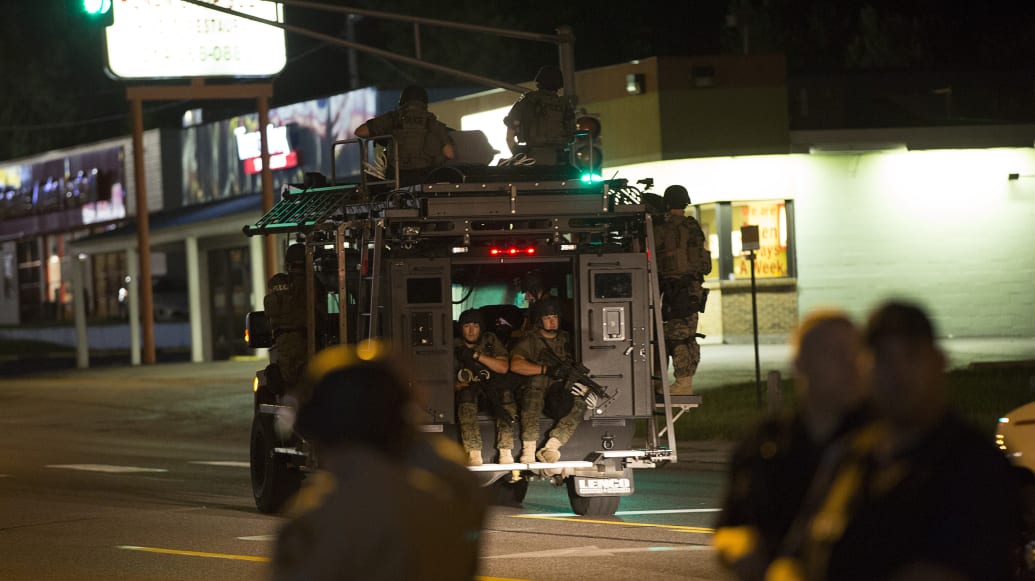
Militarization of police doesn’t reduce crime or improve officer safety. It does make civilians less trusting of the police, with good reason.


Casey Delehanty, The Conversation

Published Jul. 06, 2020


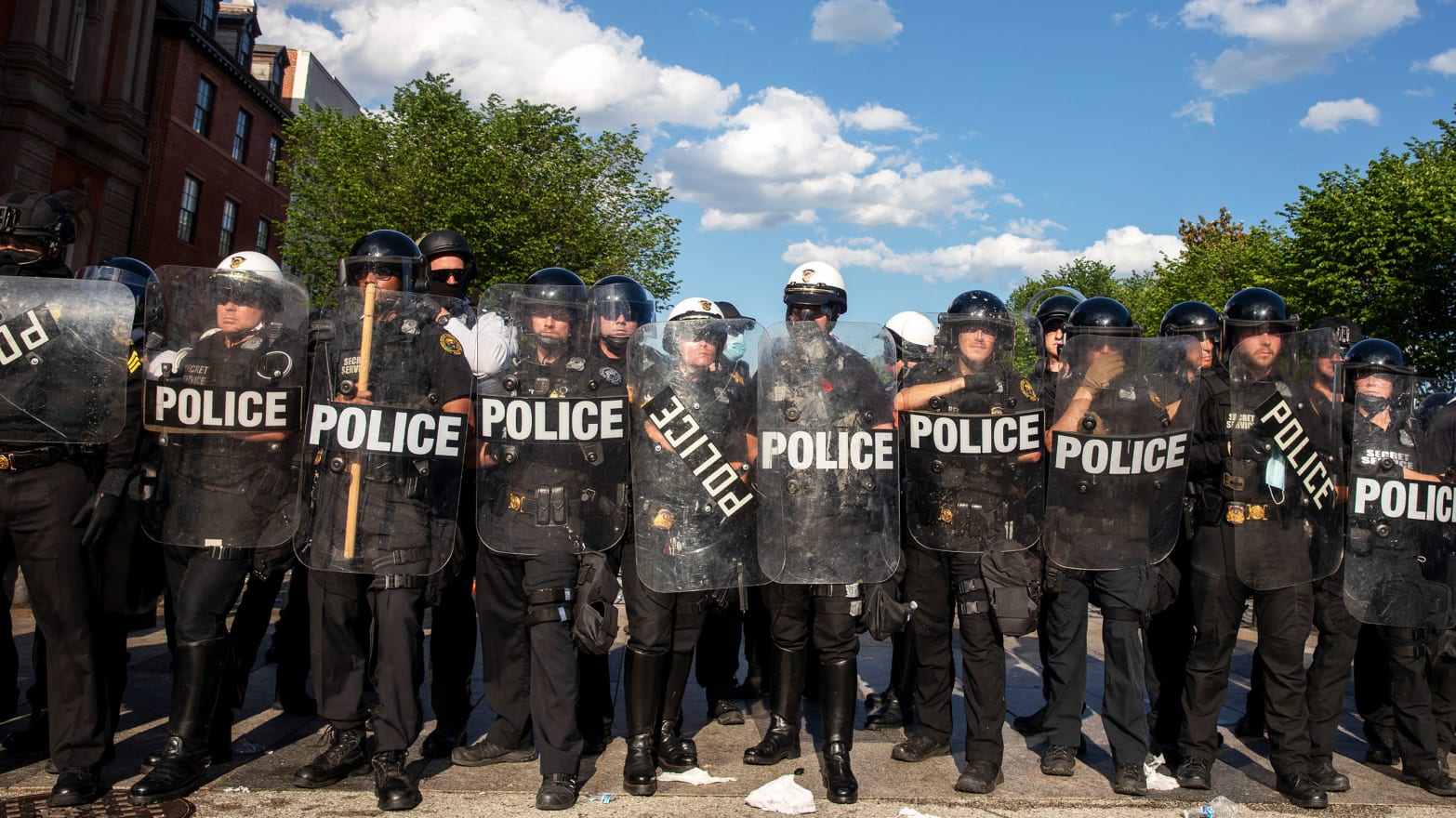
Tasos Katopodis/Getty


Police departments that get more equipment from the military kill more civilians than departments that get less military gear. That’s the finding from research on a federal program that has operated since 1997 that I have helped conduct as a scholar of police militarization.

That finding was recently confirmed and expanded by Edward Lawson Jr. at the University of South Carolina.

This federal effort is called the “1033 Program.” It’s named after the section of the 1997 National Defense Authorization Act that allows the U.S. Defense Department to give police agencies around the country equipment, including weapons and ammunition, that the military no longer needs.

Much of the equipment is brand new and some is innocuous—like file cabinets and fax machines. But the program has also equipped local police with armored vehicles and helicopters, as well as weapons meant to be used against people, like bayonets, automatic rifles and grenade launchers used to deploy tear gas.

The seeds of this program came in 1988 as the Cold War was ending. The military was shrinking, while police were feeling overwhelmed fighting the drug war. A provision in the National Defense Authorization Act allowed military surplus to be distributed to state and federal agencies combating drugs. In 1997, the program was expanded to include all law enforcement agencies—including school districts. That additional eligibility led to a dramatic expansion in the program, and over the past 23 years police all across America received billions of dollars in military-grade hardware often designed specifically to fight in the battlefields of Afghanistan and Iraq.


And yet, all that equipment has done more harm than good. Militarization of police doesn’t reduce crime or improve officer safety—but it does make civilians less trusting of the police, with good reason.

In our study, my coauthors and I found that the police agencies who received the most military gear had, in the year after getting the equipment, a rate of civilian killings more than double that of police departments that had received the least amount of military equipment through the 1033 Program. While data limitations limited our analysis to four states, our findings were replicated with nationwide data.

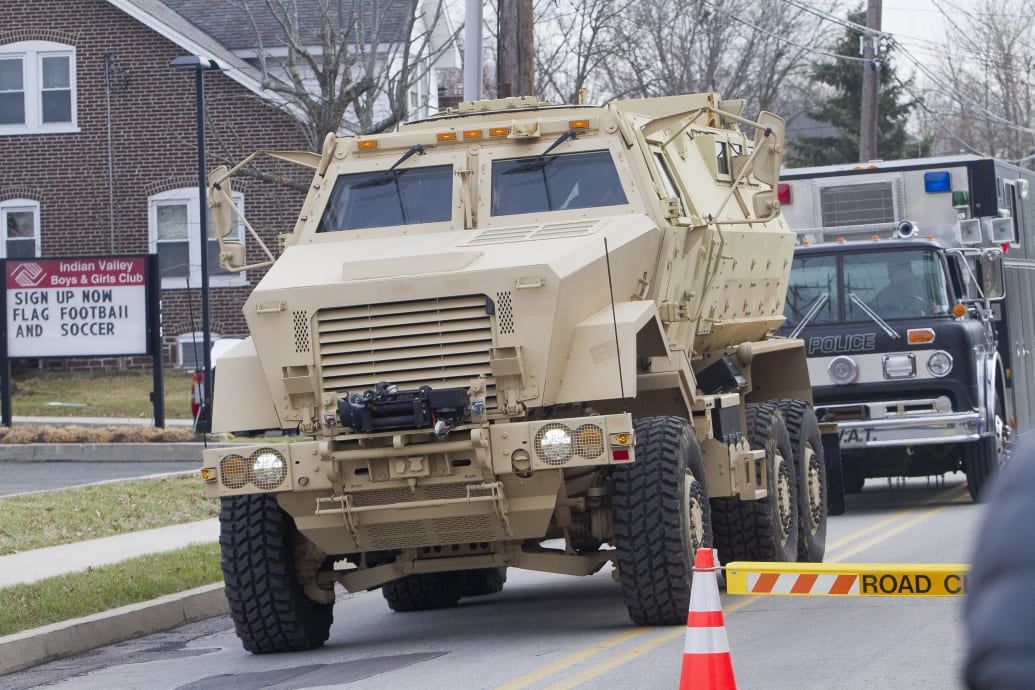
A police armored vehicle is seen near a home in a suburb of Philadelphia in 2014.
Brad Larrison/Reuters

Federal records of how much military gear has actually been given to local police are inconsistent, poorly maintained and sometimes missing altogether. But between 2006 and 2014, the available records reveal that more than $1.4 billion worth of equipment was distributed. While the 1033 Program is the most significant source of military gear for police in general, it is not the only source of military equipment for police: There are other similar federal and state grant programs, and many big-city police departments have massive equipment budgets of their own with which they can purchase military-grade hardware.

The 1033 Program often requires receiving agencies to use the equipment within the first year after getting it, according to research done by the American Civil Liberties Union, even if a situation may not truly need it. That requirement exists alongside the proliferation of heavily armed SWAT teams and other military-style units in U.S. police departments, officers’ veneration of the revenge-killing comic-book character “The Punisher” and adoption of its logo, as well as militaristic training programs such as “killology.”

Together, research has shown, those influences lead police to emphasize the use of force to solve problems they encounter in the community. The equipment comes at no cost to the departments, but they have to pay to maintain it, which can be very expensive. To justify the costs, and help defray them, police often use the gear to serve search warrants targeting drug crimes. That can make the departments eligible for additional federal grants – and for a share of the value of any property and money seized during drug raids.

As a result, supposedly free weapons and vehicles can lead some police to use aggressive deployment strategies that make civilian casualties more likely. Other departments may already have a military-style mindset and are taking advantage of an opportunity to stockpile more equipment.

These increasingly aggressive deployment strategies of militarized police disproportionately harm communities of color, for instance in Maryland, where SWAT raids consistently target majority-Black neighborhoods.

Mario Anzuoni/Reuters
SPORTS
3 Washington Redskins Co-Owners Want Out, But Daniel Snyder Remains All-In

BY SCOTT MCDONALD ON 7/5/20

Former NFL Player Burgess Owens Wins Utah’s Fourth Congressional District Primary

Things are changing quickly with the NFL's Washington Redskins and their mascot of the last 88 years. Just days after two major sponsors threatened to pull their millions of dollars, three co-owners now want out of their shares.

And none of them are named Daniel Snyder.

The three minority owners in the team—Robert Rothman, Dwight Schar and Frederick W. Smith—hold a collective 40 percent ownership, and they have reportedly hired an investment firm to help them sell their shares of the club, the Washington Post reported.

Snyder owns the majority of the team, and the other three co-owners are "not happy being a partner." The Washington Redskins are worth about $3.4 billion, according to Forbes' latest calculations. That ranks seventh in the National Football League.
 
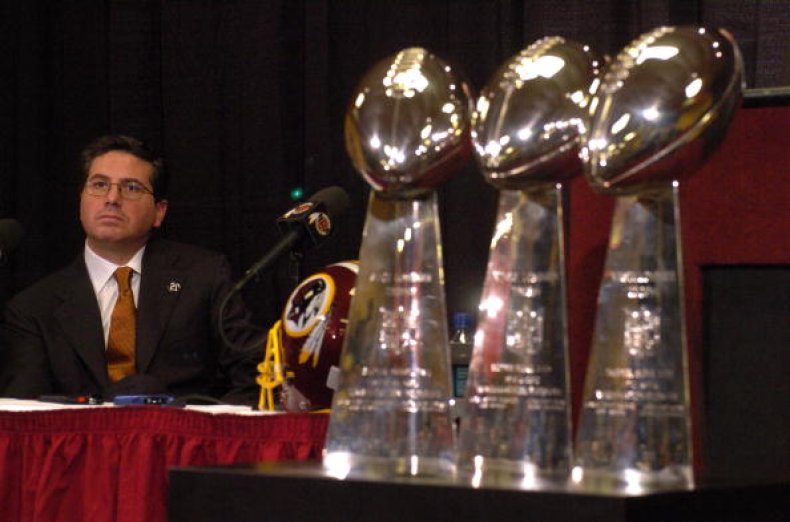
Washington Redskins owner Daniel Snyder sits next to his franchise's three Super Bowl trophies during a press conference in Ashburn, Virginia. Snyder now has three co-owners who want out of their ownership.PHOTO BY LARRY FRENCH /GETTY IMAGES

The latest news comes after a sequence of events over the last week that has forced the team to reexamine the name "Redskins" and whether it should be changed.

A group of investors on Wednesday sent letters to the team's top three sponsors—FedEx, Nike and Pepsi—urging them to pull their sponsorships if the team did not change their name from Redskins to something else. The next day, FedEx sent a letter to the team that threatened a yanking of sponsorship dollars.

Why is FedEx important? FedEx holds the naming rights to the team's stadium, and pulling sponsorship could cost the Washington NFL franchise many millions of dollars if the team doesn't comply. Not to mention, the team would scramble to recuperate those dollars with another sponsor—one not likely to throw down cash unless a name change was made.

And within a few hours of the FedEx decision, Nike pulled all of its Redskins merchandise from the Nike.com website. Not only did a search of "Washington Redskins" take users to an empty landing page, Washington was omitted from the list of NFL teams on Nike's website.

On Wednesday, 87 different investors and shareholders, whose total net worth is $620 billion, signed the letters urging the them to pull their sponsorships unless the Redskins change their nickname.

"This is a broader movement now that's happening that Indigenous peoples are part of," said Carla Fredericks, who is director of First Peoples Worldwide and director of the University of Colorado Law School's American Indian Law Clinic. "Indigenous peoples were sort of left out of the civil rights movement in the late 1960s in many respects, because our conditions were so dire on reservations and our ability to engage publicly was very limited because of that. With social media now, obviously everything is very different."

FedEx made the first move.

"We have communicated to the team in Washington our request that they change the team name," FedEx said in a statement.

Then Nike pulled the Redskins gear.

READ MORE
Nike Pulls Redskins From Online Site After FedEx Demands a Name Change
AOC Slams Redskins, Says 'Change Your Name' if Team Wants 'Racial Justice'
Washington Redskins Urged to Lose Name, or Millions in Sponsorships

This isn't the only time in history the Redskins have faced opposition to the name. Native American groups in the late 1960s began efforts to end any harmful stereotypes or images of Native American life, especially in the sports world. By the early 1970s, there became a growing plea from activists for the Redskins to drop their name, or change its mascot altogether.

Although requests for sports teams to change their mascots from Indians and similar names somewhat dissipated throughout the 1980s, it began picking up steam again following the 1991 season, when the Redskins advanced to the Super Bowl XXVI in Minneapolis.

About 3,000 demonstrators showed up at the game to protest the Redskins name—the largest such protest at the time. Later that year, a Native American group filed a petition to have the team's nickname removed from trademark.

A federal appeals board sided with the petitioners, but the Redskins appealed the ruling. The board ruled that the team's name was belittling to Native Americans.

In 2004, a poll of 768 self-identified Indians showed that only nine percent of them were offended by Washington's nickname, and it's a survey that owner Daniel Snyder has used to this day as a way to defend the Redskins organization and brand.

Lawsuits have continuously been filed against the Washington Redskins, but the organization has never wavered. Snyder even said in 2013 that he would never change the team's name.

After the death of George Floyd on May 25 while in custody of police, protests against his death—and police brutality against Blacks, in general—swept the nation. There have also been protests for equality of all races, including Native Americans.

In the letter from the investors to Nike, it stated, "the use of the R-word as the name and mascot of the Washington National Football League team is offensive and hurtful to American Indian and Alaska Native people and causes direct, harmful effects on the physical and mental health and academic achievement of the American Indian and Alaska Native populations, particularly youth; and ... despite the team's arguments to the contrary, the R-word is not a term of honor or respect, but rather, a term that still connotes racism and genocide for Native peoples and for all others who know of this history and recognize that it is wrong to characterize people by the color of their skin."
Bullying and Harassment Increase for Some Workers in Pandemic Lockdown: Opinion

By Elisa Martinuzzi, Bloomberg Opinion | June 23, 2020 INSURANCE JOURNAL


Working from home should have liberated employees from toxic workplace behavior such as bullying and harassment. Amid the lockdowns, gone are undesired office encounters, business trips, round-the-clock conferences and much after-hours socializing. Yet, far from ending misconduct, the pandemic lockdowns have displaced it at best and fueled it at worst.

Early anecdotal evidence in the financial services industry — which has all too often silenced victims of harassment — does not paint a pretty picture. SteelEye, which makes surveillance tools for securities trading and communications in banking, told me its clients have witnessed a notable increase in potential impropriety amid a surge in activity and heightened stress in financial markets. While the alerts mostly flag potential insider-trading and market abuse, offensive or hostile language that points to bullying and harassment has shown up too, according to SteelEye’s Chief Executive Officer Matt Smith.

Suzanne McKie, a London-based employment lawyer, whose clients work predominantly in finance, concurs. She told me that she has heard of more occurrences of harassment than before lockdown. This intimidation has not been physical, but it has moved to WhatsApp and text messages on personal phones, which are just as, if not more, difficult for employers to monitor.

McKie says she is also seeing a distinct uptick in complaints of gender harassment and racial intimidation. For example, her clients have reported being excluded from meetings and bullied over video calls – provocations that would have been harder to do in an office with bystanders present. Abruptly leaving a meeting room, for example, is not as easy as hanging up a video call.

Also specific to the coronavirus crisis, McKie says, managers have used furlough as a form of bullying minorities, either by forcing them to take it or by denying the option when it’s been requested. (In the latter case, the hope is this will lead the employee to resign.)

According to another London-based employment lawyer, whose clients also work predominantly in finance, remote working during the pandemic has given rise to harassment in two key ways. First, virtual communication provides a degree of anonymity that can lead people to act in ways they would not do so in person — similar to how the internet and social media produced cyber-bullying, which then became an issue in schools.

Second, stressful conditions from the pandemic have led some working relationships to break down. Inappropriate comments that denigrate an individual, be it over the phone, by text message or by e-mail, are proliferating, the lawyer told me.

If history is any guide, economic vulnerability can breed harassment. In the U.S., workplace harassment charges spiked in the Great Recession to a two-decade record, says Alexandra Kalev, an associate professor in sociology and anthropology at Tel Aviv University. Using data from the U.S. Equal Employment Opportunity Commission, Kalev calculated that the rate of harassment charges in 2008 shot up to 33 per 1,000 employees, a jump that was four times higher than the rate of increase in the decades before. Harassment rises in line with insecurity, Kalev explains.


And right now we are all more vulnerable. Some jobs that have been lost may never return. Those fortunate enough to stay employed are still concerned about their future financial wellbeing. And we are worrying about our physical survival and that of our loved ones, as Covid-19 infection rates continue to ebb and flow. Add in the stress of coping with closed schools and remote working, and it’s easy to see how many people may be at their wits’ end.

Crucially, just as many are at their most strained emotionally, the boundaries between work and private life have blurred, which can facilitate harassment. Take the explosion of video calls and meetings. Colleagues, as well as customers and other contacts, are now regularly brought into the intimacy of our homes. Working out of our kitchens and living rooms can lead people to let their guard down and be more informal or in some cases inappropriate. A comment about a nice bookcase in the background can all too easily be followed by unsolicited remarks about a person’s appearance or by an improper joke – an uncomfortable situation I have experienced myself.

McKie says that some firms have postponed investigations into harassment cases due to the pandemic, which is not an encouraging sign. In the U.S., some states, such as Connecticut, have extended deadlines to conduct mandatory sexual harassment training that were introduced after the #MeToo movement.

Company executives should pay attention. As many people continue working remotely and others begin transitioning back to the office, employers will have to prioritize rooting out improper behavior and mistreatment of employees. Industries like finance have to improve their dire record on harassment.

Bullying and harassment perpetuate inequality in organizations, typically by preventing women and minority groups, who are most often targets, from advancing. This behavior hurts productivity, damages mental and physical health, produces absenteeism and high staff turnover and distracts management.

There is no quick fix. Filling management positions with more women — one commonly cited solution — is no panacea. A recent study into harassment in Sweden, the United States and Japan found that women promoted into leadership positions can face even more harassment.

But employers can step up by putting more effort into offering anti-harassment training and following up on complaints. At a time like this, Kalev says, companies need to send a strong anti-harassment message and get more people involved in rooting out misconduct.

Bystander training, for example, can teach staff to speak up when they spot inappropriate behavior. This should be beefed up online and reinforced as an important way to empower employees and establish health work cultures. Companies can also create easier, non-adversarial reporting mechanisms for employees to share concerns and complaints. Longer term, Kalev and her coauthor Frank Dobbin, a professor of sociology at Harvard, also suggest creating task forces and publishing data that reveal the extent to which harassment permeates a firm.

As company executives shift their focus from the health crisis to returning to work, employment conditions need to be firmly in their sights. Concerns about harassment can’t go ignored.


Copyright 2020 Bloomberg.
Fidelis, Aon and Marsh Develop Marine Cargo Clause Aiming to Combat Modern Slavery


June 22, 2020 INSURANCE JOURNAL
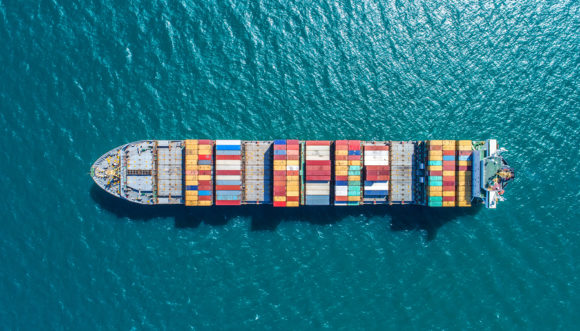

A group of brokers and insurers in the London market has come together to announce a new approach to keeping the products of modern slavery out of the export supply chain.

Fidelis, Aon and Marsh have developed a clause which makes it a condition of marine cargo policies that the insured complies with applicable legal and regulatory obligations in respect of forced and child labor.
“Forced labor in all its forms is an extreme expression of inequality and injustice. The insurance industry is committed to do all it can to prevent association with the abhorrent practices of modern slavery. We sometimes think that slavery is a thing of the past, but it is not – it is real and present in all societies and we want to do our part to root it out,” said Charles Mathias, group executive director & group chief risk officer, Fidelis Insurance.
About Fidelis Insurance

Fidelis Insurance Holdings Limited is a privately owned, Bermuda‐based holding company, which, through its subsidiaries, is a global provider of property, bespoke and specialty re/insurance products. The core operating subsidiaries of Fidelis have financial strength ratings of A (Excellent) by A.M. Best Company, Inc. and A‐ by Standard & Poors.

Source: Fidelis
THE SLAVE TRADE IS THE ORIGIN OF CAPITALISM
Some Facts About London’s Role in Insuring the Slave Trade

By Guy Faulconbridge | June 19, 2020 INSURANCE JOURNAL


London is facing up to its role in insuring the slave trade as part of a sweeping global reassessment of history and racism.

This reappraisal was triggered by the death of George Floyd, a black man who died after a Minneapolis police officer knelt on his neck for nearly nine minutes while detaining him.

For centuries, London has maintained a pre-eminent role in financing global trade and on Thursday the Lloyd’s of London insurance market apologized for its “shameful” role in the 18th and 19th Century Atlantic slave trade.

About 17 million African men, women and children were torn from their homes and shackled into one of the world’s most brutal globalized trades between the 15th and 19th centuries. Many died in merciless conditions.

By the late 18th Century, Britain was the leading slaver nation, carrying about 40% of Africans transported between 1761 and the abolition of the trade in 1807.

Update: Lloyd’s of London Apologizes for Its ‘Shameful’ Role in Atlantic Slave Trade

Lloyd’s grew to dominate the shipping insurance market, a key element of Europe’s global scramble for empire, treasure and slaves, who were usually in the 18th Century included in insurance policies in the general rate for ship cargo.


Other major traders were Portugal/Brazil, with about 32% of the market, and France, with about 17%. American and Dutch ships were also involved, with around 6% and 3% respectively.


How important was slavery to British maritime insurance?

There is a lack of documentary evidence from the time, but historians have estimated that the slave and West India trades combined accounted for 41% of British marine insurance in the 1790s.

(For more information: Insuring the Transatlantic Slave Trade.)

“Between a third and 40 percent of London marine insurance in the 18th Century was accounted for by the slave trade and by the movement of slave grown produce across the Atlantic,” said Nick Draper, former director of the Centre for the Study of the Legacies of British Slave-ownership.

“Those ships bringing sugar to Britain had a valuable cargo and the ships themselves were valuable and often coming through enemy waters because Britain was at war for long periods.”


Who were the big players?

There were three main marine insurers in the 18th Century: London Assurance, Royal Exchange and Lloyd’s of London.

“Lloyd’s had the dominant insurance business – probably had 80-90 percent of the market,” said Draper.

“By 1807 when the slave-trade was abolished, it was relatively unimportant to marine insurance and by the 1830s when slavery was abolished the sugar economy in turn had become less important. We were shipping then huge amounts of raw slave-grown cotton, for example, back to the UK from the American south.”
How did it work?

Slaves were seen as cargo by the insurance market of the time and generally included in the general insurance rate.

Often slaves were termed as a “parcel” whose value was determined by ethnicity, size, height, age, gender and health.

Slaves were also classified by underwriters as “perishable goods,” alongside cattle. Underwriters and courts dealt with slave losses arising from revolt as the equivalent of damage and losses caused by livestock panicking during a tempest.

“Most insurance policies for the slave trade excluded the death of enslaved people from disease or insurrection – they were insuring the ship against the perils of the sea,” said Draper. “But they were not insuring so that people were disembarked at the other end in a healthy condition.”

(Reporting by Guy Faulconbridge; editing by Alexander Smith)

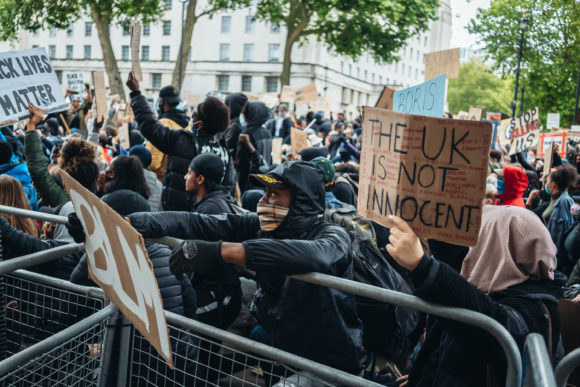
Photograph: Black Lives Matter protest in London on June 6, 2020 during the coronavirus lockdown.

Related:
Update: Lloyd’s of London Apologizes for Its ‘Shameful’ Role in Atlantic Slave Trade


Copyright 2020 Reuters. Click for restrictions.