It’s possible that I shall make an ass of myself. But in that case one can always get out of it with a little dialectic. I have, of course, so worded my proposition as to be right either way (K.Marx, Letter to F.Engels on the Indian Mutiny)
Thursday, August 06, 2020
China Helped Saudis Build Secret Nuclear Site For Extracting Yellowcake: WSJ
When it comes to America's allies in the Middle East, Washington has long "looked the other way" while they recklessly pursue questionable weapons technology. Think Pakistan's nuclear program at a time when the Reagan administration prioritized fighting the Soviets in Afghanistan, or Israel's estimated 100 to possibly 200 undeclared nukes.
This has more recently been the case with Saudi Arabia, where the kingdom has long been rumored to pursue nukes to gain dominance over Shia rival Iran. And now this willful looking the other way on banned weapons is coming back to bite Washington hard.
"Saudi Arabia has constructed with Chinese help a facility for extracting uranium yellowcake from uranium ore, an advance in the oil-rich kingdom’s drive to master nuclear technology, according to Western officials with knowledge of the site,"The Wall Street Journal writes in a bombshell investigative report.
So this is where US foreign policy has arrived: no, there's no yellowcake in Niger and never was, but we now have America's global rival China helping our Sunni Wahhabi 'ally' construct a secret nuclear site while lying about it all along. Despite mounting evidence, the Saudi Energy Ministry issued a statement saying it “categorically denies” that it's built an extraction facility.
However, there was this admission out of Saudi Crown Prince Mohammed bin Salman back in 2018: he said at the time “if Iran developed a nuclear bomb, we will follow suit as soon as possible.”
The Saudis maintain they are only in pursuit of a peaceful nuclear program, which happens to be Iran's same position as well.
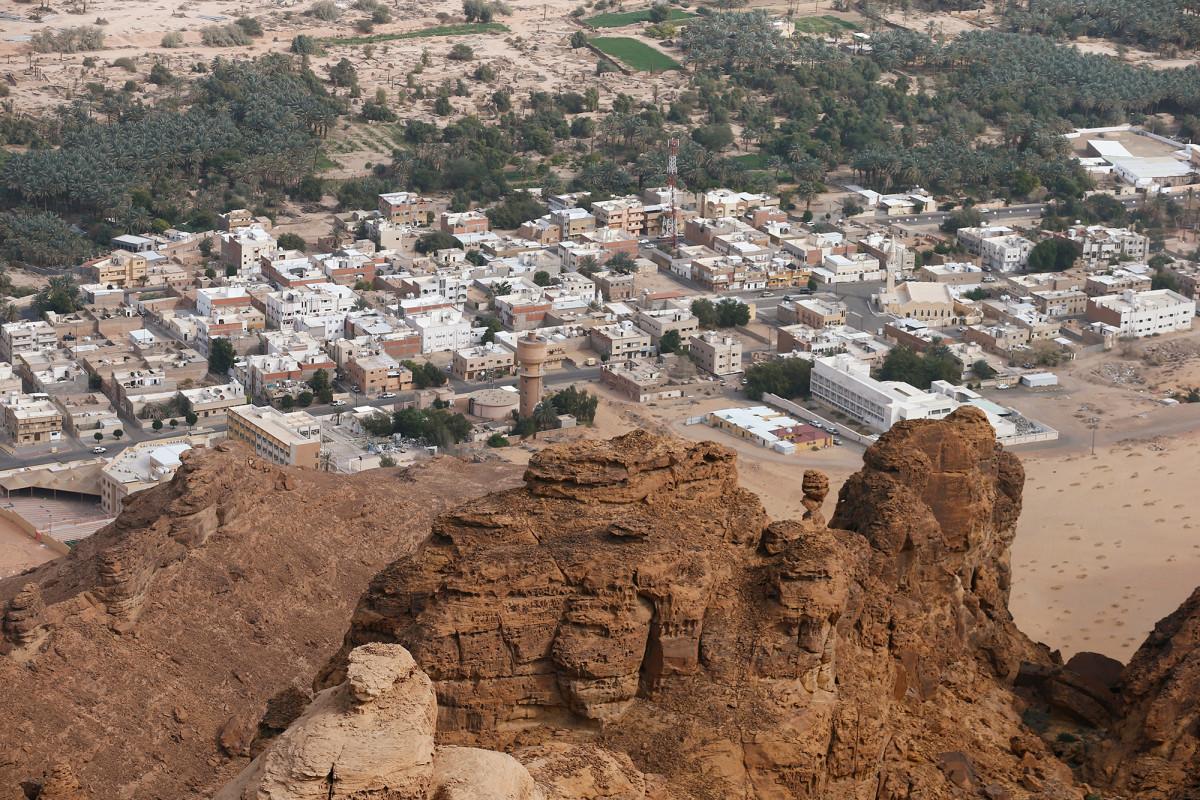
The WSJ identified the location based on intelligence sources and unnamed Western officials as in a desert area outside al-Ula in northwest Saudi Arabia. "The facility, which hasn’t been publicly disclosed, is in a sparsely populated area in Saudi Arabia’s northwest and has raised concern among U.S. and allied officials that the kingdom’s nascent nuclear program is moving ahead and that Riyadh is keeping open the option of developing nuclear weapons," WSJ continues.
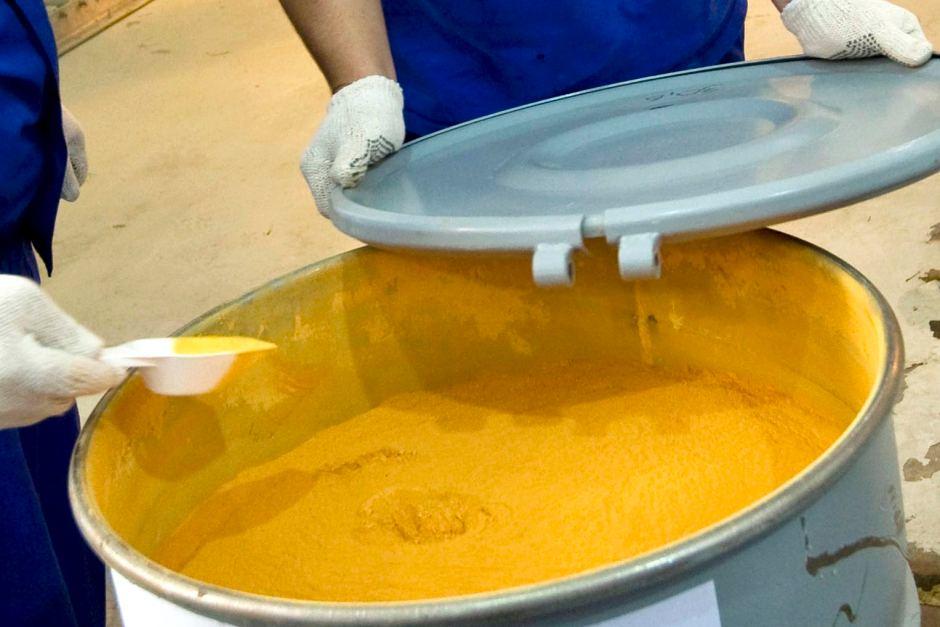
Barrel filled with yellowcake uranium, file image via ABC.net.au
Currently it's public knowledge that The China National Nuclear Corp. and the China Nuclear Engineering Group Corp., which signed memorandums of understanding with the Saudi government in 2017 for uranium exploration, are working closely with Riyadh.
The new reports suggest these are instrumental in assisting with the secret nuclear facility.
Saudi Arabia has built a secret facility for extracting uranium yellowcake from uranium ore, Western officials say, a step forward for Riyadh's nascent nuclear program. It happened with a little help from their friends in Beijing.@wstrobel@mgordonwsjhttps://t.co/exkL9rgTsc
Given the US has invaded at least one Mideast country on false charges it had Yellowcake Uranium in its possession, it'll be interesting to see if there's even so much as a statement of public censure directed at Riyadh out of the administration. We won't hold our breath, given it seems such condemnations are reserved only for the likes of Assad or Gaddafi or the Iranians.
But now that China has apparently entered the mix, things could get sticky, even with Washington's closes Gulf ally the Saudis.
Destruction of a Billionaire (Part 1)
From the Slope of Hope, an excerpt from my book Panic Prosperity and Progress about a germane period in financial history related to the Hunt family and their attempt to corner the silver market..........
The stunning bull market in precious metals in the late 1970s, followed by its swift collapse, has a fascinating and remarkable history. The roots of the event date back to the dark days of the Great Depression, when President Roosevelt issued Executive Order 6102 which outlawed the “hoarding” (that is, the ownership in almost any form) of gold by any person or other entity within the United States.
Prior to this order, gold was intricately intertwined in the nation’s currency. U.S. dollars were convertible into gold on demand, and this convertibility helped constrict the velocity of money severely. Roosevelt recognized that inflating the money supply was essential to turning the economy around, so he took the extraordinary step of criminalizing private ownership of gold as one of the steps to decouple the precious metal from the nation’s currency.
The President signed the order on April 5, 1933, only weeks after his first term in office began, and the order gave the nation’s citizens until May 1 to turn in all their gold in exchange for $20.67 per ounce in cash. This seems like an extraordinarily low price today, but in inflated-adjusted dollars, it equals about $400 per ounce. Some exceptions were made to the order: those who used gold as a component of a professional service (such as artists, dentists, and jewelers) could buy and use gold, and rare, collectible coins were spared the melt-down process that other coins would undergo.
Although they were supposed to obediently turn in their coins, the wealthier citizens of America who had meaningful amounts of gold simply stored it away overseas, usually to Switzerland. In spite of the severe penalties sanctioned in the order, there actually wasn’t a single successful prosecution of anyone in the country for violating the order.
Melting Down Saint-Gaudens
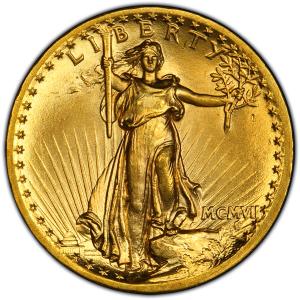
The U.S. Mint had been producing gold coins, as it had for many years, including a $20 gold coin designed in 1907 by famed sculptor August Saint-Gaudens. The coin was called a Double Eagle, and it is considered to this day to be the most beautiful coin ever minted by the United States. It was 90% gold and 10% copper, and its gold content was equal to its $20 face value.
Many of the coins had been minted since the design was completed in 1907, and they were still being produced by the U.S. Mint even after the executive order banning gold had been signed by the President. The new coins were not distributed, however, and by late 1934 all but two of the coins had been ordered to be melted down. The two officially-saved coins were presented to the U.S. National Numismatic Collection and, as far as the U.S. Mint knew, those were the only 1933 Saint-Gaudens Double Eagle coins in existence, as the others had been assumed melted back into gold bars already.
After May 1 passed and the Treasury had paid everyone their $20.67/ounce for the gold that was turned in, the Treasury ratcheted up the official price of the metal to $35 per ounce, an increase of 70%. This had two immediate effects: first, it meant that all the citizens who had dutifully turned in their gold found themselves with paper money that was suddenly worth a lot less, and second, the government had an instant 70% profit on all the gold it had bought from the citizens. The profits were used to fund the Exchange Stabilization Fund that was sanctioned by the Gold Reserve Act of 1934.
One individual who failed to submit his substantial gold holdings (5,000 ounces) to the government was an attorney named Frederick Campbell. The federal government charged Campbell with his failure to turn in his gold, but the judge refused to prosecute Campbell with the crime based on a technicality: since the order was signed the President Roosevelt, as opposed to the Secretary of the Treasury, it was deemed invalid. Campbell did ultimately have to sell his gold to the Treasury, but he did not have to endure a criminal prosecution for his initial failure to do so.
As for the Saint-Gaudens coins, those will return to our story later, and many years after 1934 was over.
The Hunt Fortune
Not that many years before the Great Depression, the seeds of a great American family fortune were being planted. Haroldson Lafayette (H.L.) Hunt had been born in 1889 in Illinois, and although his father provided a very comfortable existence to H.L. in his teenage years, the lad decided to strike out on his own. So, at only 16 years of age, he headed west and took up whatever jobs he could find. He was a logger, a farm worker, and even a mule team driver. He took up any job he could find, but all the while, he was developing his real proficiency: playing poker.
H.L. was intellectually sharp and had a successful gambler’s instinct for risk and reward. He was fearless about betting big, whether early in his life when he had very little money, or later in his life when he was fabulously wealthy. He also seemed to have extraordinarily good luck for most of his business life, which was an excellent attribute for someone inclined to taking large risks. Only six years after he left home, H.L. got word that his father had died, so after receiving his inheritance, he decided he could finally become more ambitious and start his own business.
His first enterprise, cotton farming in southeast Arkansas, didn’t hold his attention very long, and he reverted back to gambling: both the kind with cards and, with his inheritance, land speculation. He met his first wife, Lyda, and they moved to El Dorado, Arkansas, where there was word of newly-found oil.
In what would become consistent with his usual good luck, H.L. struck oil with his very first well, and he expanded his new enterprise, the Poor Boy Drilling Company. He sold the firm at a handsome profit in 1925 and proceeded to Florida and its well-publicized land boom. There he met and fell in love with another woman and, not to be inconvenienced by the fact he was already married, got married to her as well. He managed to emerge from Florida’s land speculation successfully, avoiding the collapse, and he and his second wife established a home in Shreveport, Louisiana, about one hundred miles away from his first family.
H.L. then got word from a friend of a promising oil lease in East Texas, so he ventured out there to try his luck at some Texas drilling. With typical Hunt luck, not only did the drilling prove successful, but Hunt Oil would soon found itself to be the leading independent producer of crude oil in the nation, having located itself on one of the biggest oil fields ever found.
Crude oil was only a dollar a barrel in those days, but once the Great Depression had fully gripped the country, and the ocean of oil from East Texas began flooding the market, the price dropped to an almost incomprehensible fifteen cents per barrel. In spite of the low value for the commodity, Hunt Oil thrived, and H.L. moved his first family – the one in El Dorado, Arkansas – down to Dallas, Texas.
In 1955 his first wife, Lyda, died, and he married yet another woman, Ruth Ray, with whom, as his mistress, he already had four children. Thus, with three different women, H.L. Hunt had fifteen different children which, in his mind, would be beneficial to the world, as he was spreading his “genius gene” to all of his offspring.
The Hunt Children
As his children reached adulthood, H.L. looked to them to help grow the family business. His first son from his first marriage, Hassie, seemed to have his father’s knack for finding oil and making shrewd deals. By the age of 25, Hassie already was a successful oil entrepreneur in his own right, but due to an onset of severe psychological problems, he was sent to a variety of treatment centers to remedy the malady. Unfortunately, the most forward-thinking approach to the problem at the time was a full frontal lobotomy which, once complete, rendered Hassie largely incapacitated for the rest of his life.
Thus, H.L.’s second son, Bunker, also from the first marriage, found himself in the lead role. Unfortunately, H.L. didn’t have the fondness for Bunker that he had for Hassie, and he made his feelings abundantly clear to anyone who would listen. Bunker was desperate to prove himself to his father, but his luck seemed just as bad as his father’s seemed good: as he traveled around the globe, looking for promising oil discoveries, he hit dry hole after dry hole. He was losing millions of dollars of the family fortune, and his failings only amplified his father’s distaste for Bunker.
That all changed with the Sarir Field in Libya. Bunker had secured leases on two tracts in Libya designated simply Concession #2 and Concession #65. Due to a need for cash, he sold half his interest in #65 to British Petroleum, and it was subsequently discovered that the area in question contained the largest oil field ever discovered in history: somewhere between 11 and 13 billion barrels of oil. Bunker suddenly found himself with a $5 billion asset, and his father’s grousing about his stupid son came to an immediate and very understandable halt.
The Next Best Thing to Gold
Even with oil priced at a mere $2 per barrel in 1961, Bunker was now the world’s richest man. Bunker parlayed his newfound fortune into many other businesses over the years, including cattle, sugar, restaurants, and millions of acres of real estate. By 1970, both his father H.L. and Bunker himself were breathtakingly rich.
Around this time, Bunker got a visit from a commodities broker who asked him one simple but thought-provoking question, as he gestured to various objects sitting around his house: “Bunker, do you believe you’re going to have to pay more for these things next year than you did this year?” When Bunker acknowledged the prices would probably be higher, the dealer suggested a solution to the problem at hand: silver.
The notion of precious metals as a store of value goes back for thousands of years in human history, but the most obvious choice, gold, was off-limits. FDR’s 1934 prohibition of gold from private ownership in the United States was still in place in 1970, even though most of the people who lived when the order was established had long since died. Silver, however, the “poor man’s gold”, was an interesting alternate candidate.
For one thing, silver was cheap. An ounce of pure silver could be had for less than a barrel of crude oil, and it had many industrial uses. Besides its utility in jewelry and industrial applications, it also was a stable, simple investment tool. If inflation was going to get worse, as Bunker was convinced it would, what better place to allocate paper dollars than the “hard money” of silver?
There were other factors in the world that made purchasing silver seem sensible. In 1970, the world seemed to be a mess, and it looked like it was going to get a lot messier. There was a war raging in Vietnam, the United States was full of protesting hippies, and there the persistently-unstable Middle East. From Bunker’s lofty vantage point, the world looked like it was on a very bad path, and he wanted to protect his fabulous fortune from the wretched road the world seemed to be traveling.
Thus, Bunker and his younger brother Herbert started accumulating silver, buying 200,000 ounces in the first few years of the 1970s. This represented a minuscule fraction of a percent of their wealth, but it was the start of what would ultimately become a vast accumulation of the precious metal.
(Kitco News) - Donald Trump Jr. tweeted Tuesday that Pebble Mine should not be built due to environmental risks.
The U.S. Army Corps of Engineers issued a final environmental analysis last month supporting the mine, a reversal from the Obama administrations previous decision stating that the mine should not be built. Opponents to the mine cite risks to salmon runs, as well as preserving the natural beauty of the area. Northern Dynasty's Pebble Project is located in southwest Alaska.
The chief of staff for Vice President Mike Pence, Nick Ayers, also opposes Pebble Mine.
As a sportsman who has spent plenty of time in the area I agree 100%. The headwaters of Bristol Bay and the surrounding fishery are too unique and fragile to take any chances with. #PebbleMinehttps://t.co/4ffLdF4Qqe
If permitted, the Pebble mine will be North America’s largest mine, according to a study by the Center for Science in Public Participation. On the Northern Dynasty's website the current resource estimate for the project is 6.5 billion tonnes in the measured and indicated categories containing 57 billion lb copper and 71 million oz gold.
The mine plans calls for a pit 1,970 feet (600 meters) deep, as well as a new road, pipeline and power plant.
Donald Trump Jr. is an avid hunter.
England’s first wild beavers in 400 years allowed to stay on river home
Emily Beament, PA Environment CorrespondentAugust 6, 2020, 1:10 a.m. England’s first wild breeding population of beavers for 400 years have been given the permanent right to stay in their Devon river home.
Conservationists have welcomed the “groundbreaking decision” by the Government to allow the beavers, who now number up to 15 family groups, to remain on the River Otter where they have been living wild for some years.
It means the future is secure for the first ever reintroduction of an extinct native mammal to England, Devon Wildlife Trust said.
But the wildlife experts urged the Government to make decisions on the wider future of beavers in England that will enable them to return to other rivers to create wetlands, boost wildlife, reduce flooding and improve water quality.
And they want to see funding to support land managers to make space for the animals, who engineer their landscape through building dams and can cause damage to trees and flood parts of fields.
The Government said the beavers on the River Otter would be allowed to remain permanently and continue to expand their range naturally.
The Environment Department will consult later this year on the management of beavers in the wild and a national approach for any further releases.
The move comes after the first official Red List of British Mammals listed beavers as an endangered native species.
Beavers were hunted to extinction four centuries ago in Britain for their meat, fur and gland secretions used for medicine and perfume, but a family of beavers were found to be living on the River Otter in Devon in 2013.
After the animals were threatened with removal by officials, Devon Wildlife Trust stepped in to lead a five-year trial to examine the impacts of wild beavers on the river, landscape and community.
A report on the trial earlier this year found their dam-building helped reduce flooding for some at-risk homes, created wetlands which supported fish, insects, birds and endangered water voles, and improved water quality.
There were localised problems for some landowners, but they were successfully managed with support and intervention from the trust, the conservationists said.
Their presence on the river catchment, which runs from the Blackdown Hills down to the south coast at Budleigh Salterton, has even boosted local tourism, the trial found.
Peter Burgess, director of conservation at Devon Wildlife Trust, said of the move to let them stay: “This is the most groundbreaking government decision for England’s wildlife for a generation.
“Beavers are nature’s engineers and have the unrivalled ability to breathe new life into our rivers and wetlands. Their benefits will be felt throughout our countryside, by wildlife and people.”
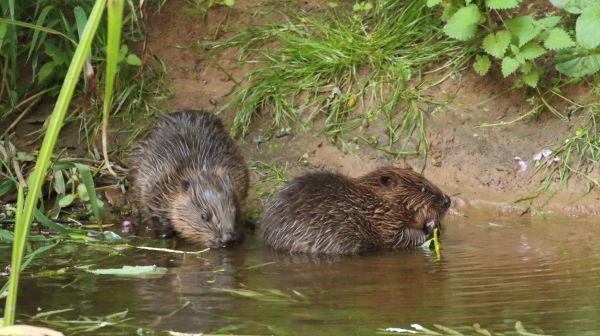
The beavers have been breeding successfully for years on the river (Mike Symes/Devon Wildlife Trust/PA)
Devon Wildlife Trust’s Mark Elliott said it was “brilliant news”, but added: “It’s now vital that decisions are made on the national status of beavers that allows them to be reintroduced into other river systems in England.
“There also needs to be funding to support landowners who wish to allow beavers to restore wetlands on their land, and to assist landowners who do not wish beavers to affect their farming practices.
“This is vital if we are to see beavers welcomed back into the English landscape after such a long absence.”
There are thought to be other beavers living wild on English rivers, having escaped or been released without licence, and a number of pairs are in enclosures to help manage flooding or create wetlands in nature reserves.
The species has been given protected status in Scotland, where it returned through an official trial and illegal releases or escapes.
Environment Minister Rebecca Pow said the reintroduction trial in Devon had been highly successful.
“We are firmly committed to providing opportunities to reintroduce formerly native species, such as beavers, where the benefits for the environment, people and the economy are clear.
“But we also understand that there are implications for landowners, and take care to ensure that all potential impacts are carefully considered, and today we can confirm a new Government consultation on our national approach and management will open later this year,” she said.
Natural England chairman Tony Juniper said: “Reintroductions of iconic species like the beaver will be an important part of the nature recovery network.
“We now look forward to working towards the next stages of management of beaver more widely across England.”
England's first wild population of beavers for 400 years has won the right to stay in a Devon river. The government said the breeding beavers - comprising up to 15 family groups - can remain in the River Otter, where they were discovered in 2013. It helped reduce flooding for some at-risk homes, created wetlands for other animals, improved water quality and even boosted local tourism. HuffPost UK England's First Wild Beaver Families Win 'Right To Remain' On River Otter
50 million face masks bought by the UK for NHS workers — from a company with links to a government adviser — have been recalled because they don't fit properly
A man sits on a bench at Earl's Court Underground Station in London in May 2020. REUTERS/Simon Dawson Fifty million face masks bought by the UK for the National Health Service are being recalled because the straps aren't tight enough.
Ayanda Capital supplied the FFP2 respirators as part of a £252 million ($331 million) deal, signed in April, to provide personal protective equipment.
The masks use ear-loop fastenings rather than ties around the head, which may not be tight enough for health workers.
The government says that it will no longer be used over concerns the masks do not have "adequate fixing," court documents show.
The deal was arranged by Andrew Mills, an adviser to the UK government, who sits on the board of Ayanda Capital.
Fifty million face masks bought by the UK government for frontline healthcare workers are being recalled because the straps aren't tight enough.
The FF2 respirators were supplied to the National Health Service (NHS) by Ayanda Capital as part of a £252 million ($331 million) deal, signed in April, to provide personal protective equipment (PPE) to health workers, court documents show.
However, the government has said that the masks use fastenings around the ears rather than the head, meaning they may not fit tightly enough, the BBC reported.
The deal was brokered by Andrew Mills, a businessman and adviser to the UK Department for International Trade, who also sits on the board of Ayanda Capital. Mills told the BBC that his position as a government adviser did not play a role in the decision to contract Ayanda Capital.
The government recalled the masks after The Good Law Project, a nonprofit legal-rights organization, launched a legal challenge over the government's PPE contracts. The group published the government's decision on its website Thursday.
The masks "will not be used in the NHS" because "there was concern as to whether the[y] … provided an adequate fixing," the UK government said, according to the project.
The masks alone are worth between £156 million and £177 million ($205 million and $233 million), the legal-rights group estimated.
A man wearing a FFP2 respirator on a train in Stuttgart, Germany, on April 15, 2020. Christoph Schmidt/picture alliance via Getty Images
In legal filing made public by the project on Thursday, lawyers for Ayanda Capital said that "the FFP2 masks supplied by our client met contractual requirements."
Ayanda Capital also supplied the NHS with 150 million Type IIR masks, but these have not been recalled.
The Department of Health and Social Care told Business Insider it was unable to comment due to ongoing legal proceedings.
However, a UK government spokesperson told the BBC: "There is a robust process in place to ensure orders are of high quality and meet strict safety standards, with the necessary due diligence undertaken on all government contracts."
In a statement published by the BBC, Ayanda Capital said: "The masks supplied went through a rigorous technical assurance programme and meet all the requirements of the technical specifications which were made available online through the government's portal."
"There are provisions in our contract for product to be rejected if it did not meet the required specification as per the contract. These provisions have not been activated."
Neil Young sues Donald Trump's campaign over repeated use of songs
After years complaining over Donald Trump using his songs at political rallies, Neil Young has filed a suit seeking damages. Other musicians to object range from Adele and Rhianna to Mick Jagger and Elton John.
Canadian-American singer, Neil Young, has sued US President Donald Trump's re-election campaign – for using his music.
In the copyright infringement suit, it is stated that the plaintiff (Young) "in good conscience cannot allow his music to be used as a 'theme song' for a divisive, un-American campaign of ignorance and hate."
"Imagine what it feels like to hear Rockin' in the Free World after this President speaks, like it is his theme song. I did not write it for that," Young had written in an earlier complaint on July 3 on the "Neil Young Archives" website.
Trump's campaign is yet to respond to Young's lawsuit, which is seeking $150,000 in damages for each infringement.
Young first objected to the use of his tunes in 2015 during Trump's first shot at the presidency. At the time, Trump's campaign ended up inking licensing agreements with the American Society of Composers, Authors and Publishers (ASCAP) and Broadcast Music, Inc. (BMI), to use pop songs at events.
Young's lawsuit follows an open letter from the Aritsts Rights Alliance (ARA), asking politicians to obtain permission before using their songs at campaign events. Signatories included Mick Jagger, Keith Richards, Elton John, Sia, REM's Michael Stipe, Aerosmith's Steven Tyler, Sheryl Crow and Lionel Richie.
The open letter argued that the unauthorized use of their songs in political contexts without permission could confuse and disappoint fans and even "undermine an artists' long-term income."
The family of late rock musician Tom Petty has already issued a cease-and-desist order against Trump's campaign after the Tom Petty and the Heartbreakers song I Won't Back Down was played at the rally in Tulsa.
"Trump was in no way authorized to use this song to further a campaign that leaves too many Americans and common sense behind… Tom Petty would never want a song of his to be used in a campaign of hate. He liked to bring people together," his family said in a statement.
While still alive, Petty had explicitly objected to Republican George W. Bush using the exact same tune in the 2000 campaign.
MUSIC IN US PRESIDENTIAL CAMPAIGNS George Washington: 'God Save Great Washington' George Washington was the first presidential candidate to use a specific song in his election campaign. "God Save Great Washington" is considered the personal anthem of the first President of the United States. The melody of the British anthem "God Save The King" was given new words without further ado, the president's name replacing the word "king." MORE PHOTOS 123456
The Rolling Stones have also threatened to sue Trump's re-election campaign after their hit classic You Can't Always Get What You Want was played at the Tulsa rally. "The BMI have notified the Trump campaign on behalf of the Stones that the unauthorized use of their songs will constitute a breach of its licensing agreement", the band said.
Legal experts have in the past questioned whether such objections would be likely to stand up in court, however, arguing that people would not necessarily infer that a musician supported a politician simply because one of their songs was played at a rally.
am/msh (AP, Reuters, AFP)
'Outraged' Chinese want ByteDance to 'put up a fight' over TikTok sale
China is unlikely to accept an acquisition of TikTok's US operations by Microsoft and said it will prevent any deal forced by Trump. DW spoke with Rui Ma, a China tech expert, about a sale seen as "theft" by the Chinese.
DW: Do you understand why many people are worried that the Chinese owner of TikTok can be forced by Beijing to share the data they collect on worldwide users?
Rui Ma: This has been a concern alluded to by multiple US government officials, including Secretary [of State, Mike] Pompeo and [trade] advisor [Peter] Navarro. Whether or not TikTok users are fully aware of or believe this is a concern of a different matter.
Why should one be less worried about Facebook or Amazon or other US giants? They also collect and sell personal data?
I don't think that people are OK with US companies doing this either, but the argument is that a foreign government having the data will have more adverse consequences, possibly to national security and sovereignty.
If this deal happens, China will likely lose control over its first true global internet sensation. How do the Chinese feel about that?
The general Chinese public seems very outraged over the matter, and are demanding that ByteDance put up more of a fight, even insulting the CEO Zhang Yiming and calling him a sellout. Investors and entrepreneurs I speak to are very worried but also resigned, since they believe that for the foreseeable future the situation will not improve, and that geopolitical matters are out of their hands.
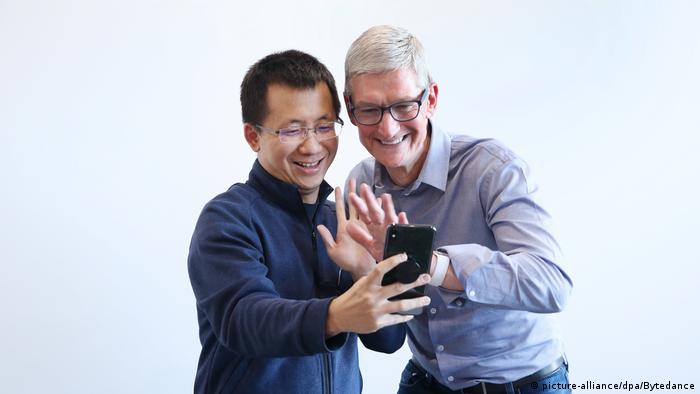
ByteDance CEO Zhang Yiming, pictured left while receiving a visit from Apple CEO Tim Cook, was lambasted on Chinese social media for having "surrendered" to US pressure
Does this stir up nationalistic feelings within the younger Chinese community?
There are nationalist reactions, but also there are people saying that this is tit-for-tat since there are some US companies that haven't been allowed to operate in China.
Why is TikTok so popular around the world?
In a nutshell, it uses an algorithm to figure out how to entertain you, versus other platforms that use either your friend connections — people you follow — or your stated interests to suggest content to you. TikTok does it invisibly, without you having to do anything.
Over the course of time, would a Microsoft-run TikTok be different form the original app?
If there were a clean break, whereby there is zero relationship between ByteDance and the portions of TikTok that are [going to be] owned by Microsoft, there will definitely be a divergence, because even if the algorithms didn't change, the values of the variables would change depending on the data it gets. There's also the question of operations, where the team running the product will be very different and presumably have differing strategies for growing the user base.
Rui Ma is a highly respected voice on tech in China and expert on ByteDance with years of experience working in the technology space in China. Living in California, she is a venture partner at 500 Startups, a leading accelerator and seed investment fund in technology companies, where she is in charge of all investment activity in the Greater China region. Moreover, she's co-hosting the weekly podcast ThechBuzzChina. The interview was conducted by Ines Pohl https://www.dw.com/en/chinese-public-outraged-over-tiktok-sale-forced-by-trump-urge-bytedance-to-put-up-a-fight/a-54459787 Watch video02:34 How Does TikTok Make Money?
GERMANY Local slaughterhouses struggle to keep ethical farming alive
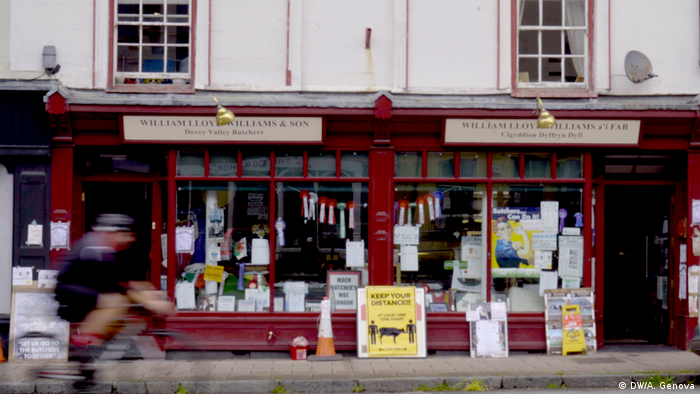
The coronavirus pandemic has focused fresh attention on local supply chains, as well as the dangers of mass meat production. But without small-scale abattoirs, environmentally friendly farming could be at risk. At the height of the coronavirus lockdown, the Welsh high street where William Lloyd Williams' has his butcher's shop was virtually deserted. Yet Williams was inundated with customers keen to buy meat with a fully traceable supply chain.
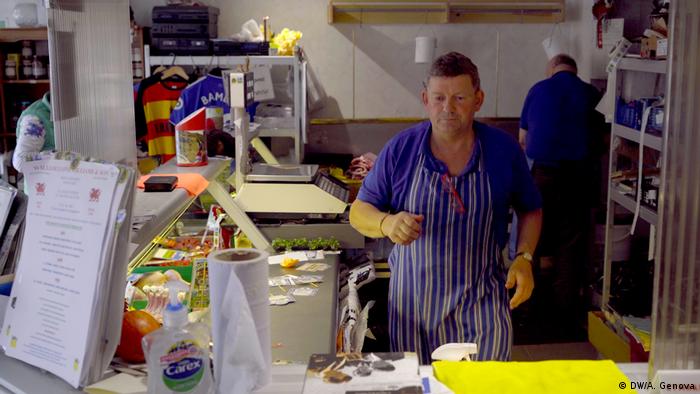
Williams slaughters local livestock in his small abattoir next to the farmland in Machynlleth's bucolic Dyfi Valley where he keeps his own cows and sheep. The shop itself is only a short walk away.
"Wil has got a field so the animals have no stress," says Joy Neal, from nearby Glandyfi. "He is kind to the animals and provides good meat for local people and I think he is much appreciated!"
Consumers often prefer not to think about how their meat was killed. But Neal is reassured that it comes from a local abattoir. "There are very few of them left and I feel very strongly about this one," she says.
Williams' abattoir has been in his family since the 1950s. He learned his craft from his father, carrying sheep heads out at the age of eight, and began training properly aged 17.
His business has survived foot-and-mouth disease, BSE or "mad cow disease" — both of which cost the UK agricultural industry billions of pounds — and now COVID-19.
But it's been a struggle. In the 1980s, there were seven local abattoirs in Montgomeryshire county, now Williams' is the only one. Across the UK, there was a 99% decrease in local abattoirs between 1930 and 2017, according to the Sustainable Food Trust (SFT), which launched The Campaign for Local Abattoirs in 2018.
William Lloyd Williams butchers' in Machynlleth is transparent about the supply chain behind the meat it sells
These small businesses aren't profitable enough to compete with supermarkets, and a growing burden of paperwork and regulation hasn't helped. The SFT says much regulation is drawn up with large abattoirs in mind and is "unnecessary or inappropriate for small abattoirs."
"We've destroyed that latticework of localized infrastructure which used to be in place," says STF founder Patrick Holden. "That's not to say we can't rebuild this in a new way after COVID, but you can't achieve that unless the links between the primary producer and the consumer are in place. Abattoirs are particularly critical because you can't have local and welfare friendly meat of any description unless you have local abattoirs."
Gentler on livestock, and the planet
According to data from the UK Food Standards Agency, most welfare problems associated with the farm-to-slaughterhouse chain occur in transport. Standards set by the Royal Society for the Prevention of Cruelty to Animals state that livestock should be slaughtered as close as possible to its point of origin.
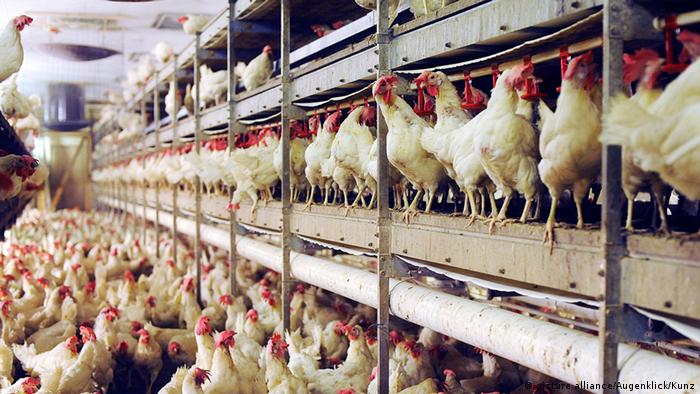
And the factory-farming model isn't just bad for animal welfare. It relies heavily on antibiotics due to the risk of disease when animals are packed together in large numbers, and huge quantities of grain and protein-rich soya that is grown in agrochemical-dependent monocultures, leading to soil degradation, pollution and biodiversity loss.
The farmers whose meat Williams sells are listed on a sign in his shop window that changes week-by-week. All the livestock he slaughters is grass-fed on farms within a 20-mile radius, most fewer than 10 miles away.
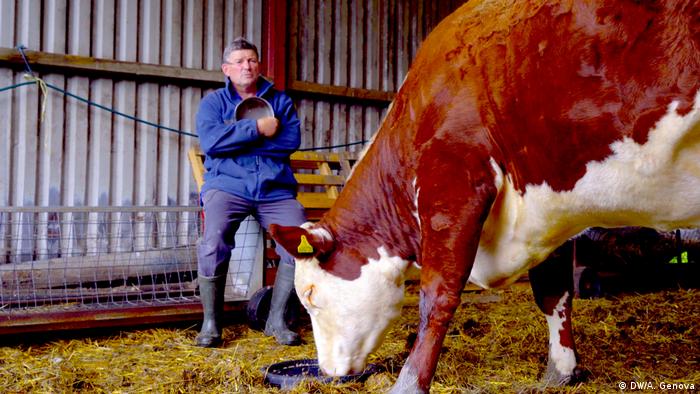
"I house the animals the night before so they're rested; they're on clean straw and water and it is short work from field to abattoir," he says. "Because of the nature of the task, one of the most important things is there must be no cruelty involved whatsoever."
Wil Lloyd says avoiding cruelty is central to how he raises and slaughters his beloved cattle
Political recognition
While historically there has been little support from the UK government to preserve local abattoirs, the All-Party Parliamentary Group for Animal Welfare (APGAW) released a report in June 2020 recognizing their importance.
A spokesperson for the UK's Department for Environment, Food and Rural Affairs told DW it was "currently carrying out a review of the relevant regulations and will consider the APGAW report as part of this."
In 2018, the Welsh government introduced the Small Slaughterhouse Food Business Investment Scheme to help the sector, while an amendment made to the British Agriculture Bill currently being debated adds slaughtering to the list of ancillary activities eligible for financial assistance.
"It's a great feeling to have gained this valuable recognition," says Williams. "However, there is still much to be done."
And the pandemic has made the urgency of this all the more apparent.
"If you look at industrial systems of rearing animals they do contribute to the emergence, spread and amplification of disease," says Peter Stevenson, of Compassion in World Farming.
Factory-style meat-processing plants around the globe have become COVID-19 hotspots, likely because of their frigid temperatures and cramped conditions, according to animal rights group Peta UK.
Williams hopes the pandemic has helped customers understand why local food is so important. "And to have local meat you need a local abattoir," he says.
Selling a story
Local operations cannot compete with industrial farming on price. But there are myriad costs that don't show up on supermarket price tags, both environmental and in terms of local economies that suffer when food production shifts to large, centralized operations.
Wil Lloyd and local farmer John Jones at Wil's abattoir in Machynlleth. Inside the car is half a heifer belonging to John, which Wil slaughtered the previous week
"Big retailers talk about economies of scale but what this really means is that these large food systems are an extractive industry, they're mining the social and human capital that used to be a feature of resilient food systems," Holen says. "It's a short-term gain and a long-term cost and we're just beginning to wake up to that now."
Animal farming is responsible for 14.5% of global greenhouse gas emissions and cattle raised for meat and dairy accounts for 65% of that, according to the United Nations. Yet done right, rearing livestock can contribute to healthier soils that take carbon dioxide out of the atmosphere and keep it in the ground.
Eating meat less often, and sourcing from ethical produces when we do, can dramatically reduce its environmental impact, and for a growing number of consumers, knowing where food comes from is important. This story of provenance is one that Williams, and his father before him, have been telling for decades.
"Farmers are not selling the product, they're selling the story: 'These are my children, and this is the abattoir that is five miles away.' Once that story goes beyond 20 miles, the product is not animal friendly, and the value is less," Williams says.
HOW CORONAVIRUS MIGHT CHANGE FARMING Factory farming on the out
While scientists don't yet know exactly how COVID-19 originated, recent pandemic virus threats such as swine flu and bird flu almost certainly evolved at pig and chicken factory farms. With a link already established between intensive animal agriculture and an increased pandemic risk, it might be the moment to rethink factory farming at its current scale.