It’s possible that I shall make an ass of myself. But in that case one can always get out of it with a little dialectic. I have, of course, so worded my proposition as to be right either way (K.Marx, Letter to F.Engels on the Indian Mutiny)
Thursday, August 06, 2020
New insight into the evolution of complex life on Earth
LANCASTER UNIVERSITY
IMAGE: SULFOLOBUS ACIDOCALDARIUS THRIVES IN GEOTHERMAL MUD POOLS LIKE THIS ONE IN NEW ZEALAND view more
CREDIT: LANCASTER UNIVERSITY
A novel connection between primordial organisms and complex life has been discovered, as new evidence sheds light on the evolutionary origins of the cell division process that is fundamental to complex life on Earth.
The discovery was made by a cross-disciplinary team of scientists led by Professor Buzz Baum of University College London and Dr Nick Robinson of Lancaster University.
Their research, published in Science, sheds light on the cell division of the microbe Sulfolobus acidocaldarius, which thrives in acidic hot springs at temperatures of around 75?C. This microbe is classed among the unicellular organisms called archaea that evolved 3.5 billion years ago together with bacteria.
Eukaryotes evolved about 1 billion years later - likely arising from an endosymbiotic event in which an archaeal and bacterial cell merged. The resulting complex cells became a new division of life that now includes the protozoa, fungi, plants and animals.
Now a common regulatory mechanism has been discovered in the cell division of both archaea and eukaryotes after the researchers demonstrated for the first time that the proteasome - sometimes referred to as the waste disposal system of the cell - regulates the cell division in Sulfolobus acidocaldarius by selectively breaking down a specific set of proteins.
The authors report: "This is important because the proteasome has not previously been shown to control the cell division process of archaea."
The proteasome is evolutionarily conserved in both archaea and eukaryotes and it is already well established that selective proteasome-mediated protein degradation plays a key role in the cell cycle regulation of eukaryotes.
These findings therefore shed new light on the evolutionary history of the eukaryotes.
The authors summarise: "It has become increasingly apparent that the complex eukaryotic cells arose following an endosymbiotic event between an ancestral archaeal cell and an alpha-proteobacterium, which subsequently became the mitochondria within the resulting eukaryotic cell. Our study suggests that the vital role of the proteasome in the cell cycle of all eukaryotic life today has its evolutionary origins in archaea."
IMAGE: NOSTRILS LOCATED ON THE TOP OF THE SNOUT AND CURVED TEETH, PERFECTLY ADAPTED FOR CATCHING SLIPPERY PREY: THE SKULL OF TANYSTROPHEUS HAS SEVERAL CLEAR ADAPTATIONS FOR LIFE IN WATER. view more
CREDIT: EMMA FINLEY-JACOB
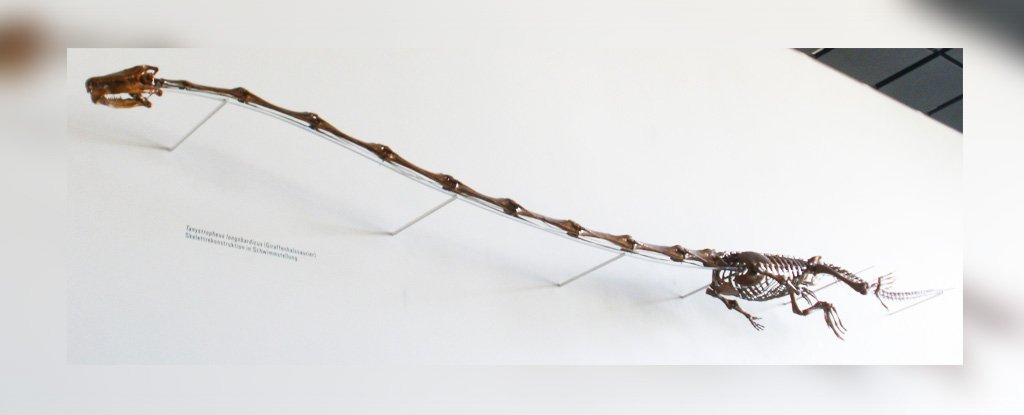
Its neck was three times as long as its torso, but had only 13 extremely elongated vertebrae: Tanystropheus, a bizarre giraffe-necked reptile which lived 242 million years ago, is a paleontological absurdity. A new study led by the University of Zurich has now shown that the creature lived in water and was surprisingly adaptable.
For over 150 years, paleontologists have puzzled over Tanystropheus, its strangely long neck and whether it lived mostly underwater or on land. An international team led by the University of Zurich has now reconstructed its skull in unprecedented detail using synchrotron radiation micro-computed tomography (SRμCT), an extremely powerful form of CT scanning. In addition to revealing crucial aspects of its lifestyle, this also shows that Tanystropheus had evolved into two different species.
Underwater ambush predator
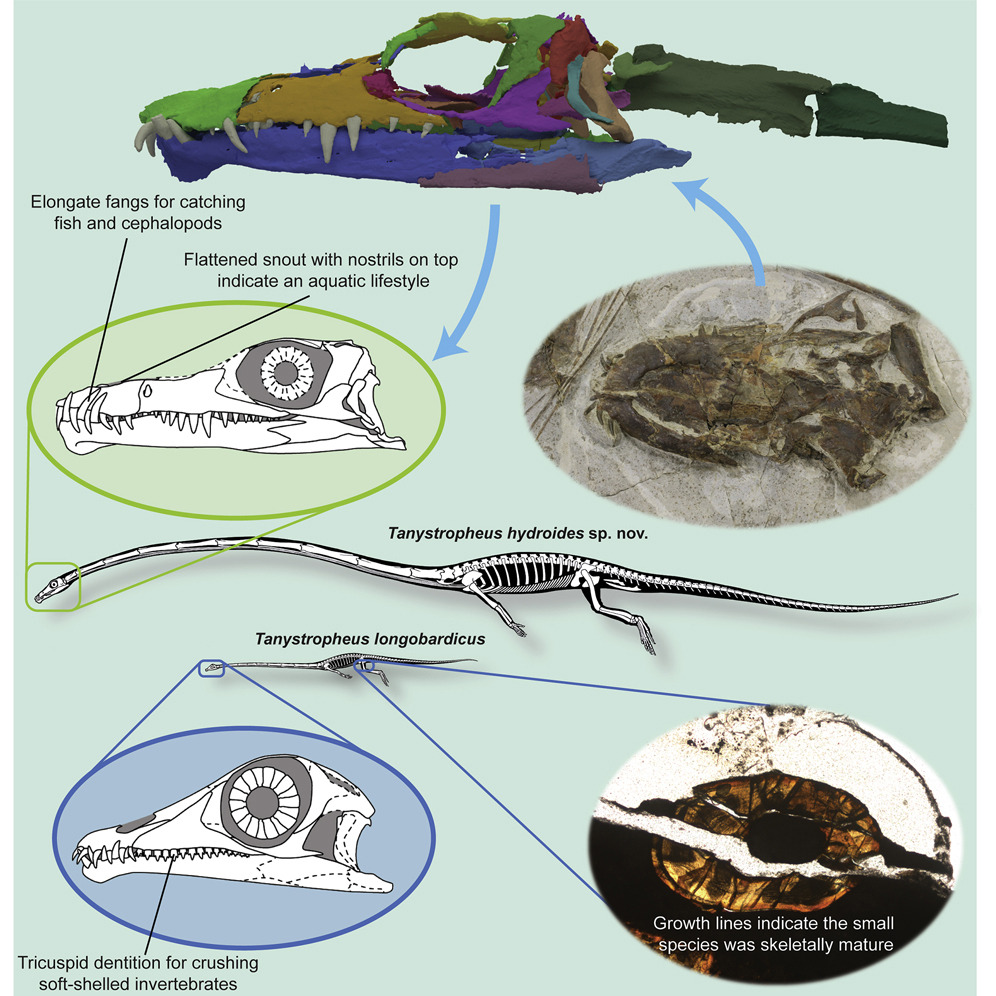
The researchers were able to reconstruct an almost complete 3D skull from a severely crushed fossil. The reconstruction reveals that the skull of Tanystropheus has several very clear adaptations for life in water. The nostrils are located on the top of the snout, much like in modern crocodilians, and the teeth are long and curved, perfectly adapted for catching slippery prey like fish and squid. However, the lack of visible adaptations for swimming in the limbs and tail also means that Tanystropheus was not a particularly efficient swimmer. "It likely hunted by stealthily approaching its prey in murky water using its small head and very long neck to remain hidden," says lead author and UZH paleontologist Stephan Spiekman.
Two species living together
Tanystropheus remains have mainly been found at Monte San Giorgio on the border between Switzerland and Italy, a place so unique for its Triassic fossils that it has been declared a UNESCO World Heritage Site. Two types of Tanystropheus fossils are known from this location, one small and one large. Until now, these were believed to be the juveniles and adults of the same species.
However, the current study disproves this assumption. The reconstructed skull, belonging to a large specimen, is very different from the already known smaller skulls, particularly when it comes to its dentition. In order to see whether the small fossils actually belonged to young animals, the researchers looked at cross sections of limb bones from the smaller type of Tanystropheus. They found many growth rings which form when bone growth is drastically slowed down. "The number and distribution of the growth rings tells us that these smaller types were not young animals, as previously considered, but mature ones," says last author Torsten Scheyer. "This means that the small fossils belonged to a separate, smaller species of Tanystropheus."
Specialists in different food sources
According to Spiekman, these two closely related species had evolved to use different food sources in the same environment: "The small species likely fed on small shelled animals, like shrimp, in contrast to the large species which ate fish and squid." For the researchers, this is a really remarkable finding: "We expected the bizarre neck of Tanystropheus to be specialized for a single task, like the neck of a giraffe. But actually, it allowed for several lifestyles."
Reconstructions of the skeletons of Tanystropheus hydroides (large species, newly named) and Tanystropheus longobardicus (small species). The outline of a 170 cm tall diver serves as the scale.###
Fossil mystery solved: Super-long-necked reptiles lived in the ocean, not on land
Twenty-foot-long specimens described as separate species from their cousins, named after mythology's Hydra
FIELD MUSEUM
IMAGE: AN ILLUSTRATION SHOWING TANYSTROPHEUS HYDROIDES HUNTING. view more
CREDIT: EMMA FINLEY-JACOB
A fossil called Tanystropheus was first described in 1852, and it's been puzzling scientists ever since. At one point, paleontologists thought it was a flying pterosaur, like a pterodactyl, and that its long, hollow bones were phalanges in the finger that supported the wing. Later on, they figured out that those were elongated neck bones, and that it was a twenty-foot-long reptile with a ten-foot neck: three times as long as its torso. Scientists still weren't sure if it lived on land or in the water, and they didn't know if smaller specimens were juveniles or a completely different species--until now. By CT-scanning the fossils' crushed skulls and digitally reassembling them, researchers found evidence that the animals were water-dwelling, and by examining the growth rings in bones, determined that the big and little Tanystropheus were separate species that could live alongside each other without competing because they hunted different prey.
"I've been studying Tanystropheus for over thirty years, so it's extremely satisfying to see these creatures demystified," says Olivier Rieppel, a paleontologist at the Field Museum in Chicago and one of the authors of a new paper in Current Biology detailing the discovery.
Tanystropheus lived 242 million years ago, during the middle Triassic. On land, dinosaurs were just starting to emerge, and the sea was ruled by giant reptiles. For a long time, though, scientists weren't sure whether Tanystropheus lived on land or in the water. Its bizarre body didn't make things clear one way or the other.
"Tanystropheus looked like a stubby crocodile with a very, very long neck," says Rieppel. The larger specimens were twenty feet long, with their necks making up ten feet of that length. Oddly for animals with such long necks, they only had thirteen neck vertebrae, just really elongated. (We see the same thing with giraffes, which have only seven neck bones, just like humans.) And their necks were rather inflexible, reinforced with extra bones called cervical ribs.
In the same region where many of the big Tanystropheus fossils were found, in what's now Switzerland, there were also fossils from similar-looking animals that were only about four feet long. So not only were scientists unsure if these were land-dwellers or marine animals, but they also didn't know if the smaller specimens were juveniles, or a separate species from the twenty-footers.
To solve these two long-standing mysteries, the researchers used newer technologies to see details of the animals' bones. The large Tanystropheus fossils' skulls had been crushed, but Stephan Spiekman, the paper's lead author and a researcher at the University of Zurich, was able to take CT scans of the fossil slabs and generate 3D images of the bone fragments inside.
"The power of CT scanning allows us to see details that are otherwise impossible to observe in fossils," says Spiekman. "From a strongly crushed skull we have been able to reconstruct an almost complete 3D skull, revealing crucial morphological details."
The skulls had key features, including nostrils on top of the snout like a crocodile's, that suggested Tanystropheus lived in the water. It probably lay in wait, waiting for fish and squid-like animals to swim by, and then snagged them with its long, curved teeth. It may have come to land to lay eggs, but overall, it stayed in the ocean.
Rieppel wasn't surprised that evidence pointed to a water-dwelling Tanystropheus. "That neck doesn't make sense in a terrestrial environment," he says. "It's just an awkward structure to carry around.
The digitially reconstructed skull of Tanystropheus, using CT scans of the crushed skull pieces.
So that answered one question, about where Tanystropheus lived. To learn whether the small specimens were juveniles or a separate species, the researchers examined the bones for signs of growth and aging.
"We looked at cross sections of bones from the small type and were very excited to find many growth rings. This tells us that these animals were mature," says Torsten Scheyer, the study's senior author and a researcher at University of Zurich.
"The small form is an adult, which basically sealed the case," says Rieppel. "It's proven now that these are two species." The researchers named the larger one Tanystropheushydroides, after the long-necked hydras in Greek mythology. The small form bears the original name Tanystropheuslongobardicus.
"For many years now we have had our suspicions that there were two species of Tanystropheus, but until we were able to CT scan the larger specimens we had no definitive evidence. Now we do," says Nick Fraser, Keeper of Natural Sciences at National Museums Scotland and a co-author of the paper. "It is hugely significant to discover that there were two quite separate species of this bizarrely long-necked reptile who swam and lived alongside each other in the coastal waters of the great sea of Tethys approximately 240 million years ago."
The animals' different sizes, along with cone-shaped teeth in the big species and crown-shaped teeth in the little species, meant they probably weren't competing for the same prey.
"These two closely related species had evolved to use different food sources in the same environment," says Spiekman. "The small species likely fed on small shelled animals, like shrimp, in contrast to the fish and squid the large species ate. This is really remarkable, because we expected the bizarre neck of Tanystropheus to be specialized for a single task, like the neck of a giraffe. But actually, it allowed for several lifestyles. This completely changes the way we look at this animal."
This "splitting up" of a habitat to accommodate two similar species is called niche partitioning. "Darwin focused a lot on competition between species, and how competing over resources can even result in one of the species going extinct," says Rieppel. "But this kind of radical competition happens in restricted environments like islands. The marine basins that Tanystropheus lived in could apparently support niche partitioning. It's an important ecological phenomenon."
"Tanystropheus is an iconic fossil and has always been," adds Rieppel. "To clarify its taxonomy is an important first step to understanding that group and its evolution."
Racial disparities in high-cost cancer treatment for children
JAMA ONCOLOGY
What The Study Did: This observational study looked at whether race and socioeconomic factors were associated with children enrolled in national clinical trials receiving high-cost proton radiotherapy for treatment of cancer.
Authors: Daphne A. Haas-Kogan, M.D., of the Dana-Farber Cancer Institute in Boston, is the corresponding author.
Editor's Note: The article includes conflicts of interest and funding/support disclosures. Please see the article for additional information, including other authors, author contributions and affiliations, conflict of interest and financial disclosures, and funding and support.
###
Media advisory: The full study is linked to this news release.
Tasmanian devil research offers new insights for tackling cancer in humans
WASHINGTON STATE UNIVERSITY
PULLMAN, Wash. - A rare, transmissible tumor has brought the iconic Tasmanian devil to the brink of extinction, but new research by scientists at Washington State University and the Fred Hutchinson Cancer Research Center in Seattle indicates hope for the animals' survival and possibly new treatment for human cancers.
The study, published in Genetics on Aug. 1, found a single genetic mutation that leads to reduced growth of a transmissible cancer in Tasmanian devils in the wild.
"This gene is implicated in human prostate and colon cancers," said Andrew Storfer, professor of biological sciences at WSU. "While the findings hold the most immediate promise to help save the world's few remaining Tasmanian devils, these results could also someday translate to human health."
The research team, led by Storfer and Mark Margres, now a postdoctoral fellow at Harvard University, studied the genomes of cases of devil facial tumor disease, or DFTD, that regressed spontaneously -- that is, the cancer began disappearing on its own.
They were surprised to find the mutation contributing to tumor regression doesn't change the gene function but instead, turns on a gene that slows cell growth in the tumor. At least, it behaves that way in the lab.
Current human cancer therapies focus on removing every trace of a tumor, often through toxic or debilitating treatments, said David Hockenbery, a cancer biologist at Fred Hutch who contributed to the study.
"If there were ways that tumors could be tricked into regressing without having to administer cytotoxic drugs or deforming surgeries, it would be a major advance," he said.
While infections cause up to 20 percent of all human cancers - such as gastric cancer from Helicobacter pylori and cervical cancer from human papillomavirus - for Tasmanian devils, the cancer is the infection.
DFTD spreads between the animals when they bite each other during common social behaviors. Since the mid-1990s, the disease has decimated the natural population of the carnivorous marsupials, which are now found only on the island state of Tasmania, off the southeastern coast of Australia.
Storfer's lab leads a National Institutes of Health-funded team of researchers from the U.S. and Australia to improve conservation efforts for Tasmanian devils and increase understanding of the co-evolution of the tumor and its host.
Though ferocious with each other, Tasmanian devils take mild handling by people without much fuss, making it easy for investigators to humanely capture the animals, collect tissue samples and tag them for monitoring before release back into the wild.
As the researchers work to save the devils, they also have an unprecedented opportunity to watch tumors naturally evolve and sometime regress without drugs or surgery.
"Although this disease is largely fatal, we're seeing tumors just disappear from an increasing number of individual animals," Storfer said.
The team is looking at the effects of other promising mutations in regressed tumors as well.
"We hope to learn something that could be applied to understanding and possibly treating a number of human cancers in the future," Storfer said.
###
This research was supported by the National Institutes of Health, the National Science Foundation and the Washington Research Foundation.
NTU develops peptide that makes drug-resistant bacteria sensitive to antibiotics again
Peptide also kills multidrug-resistant bacteria on its own
NANYANG TECHNOLOGICAL UNIVERSITY
IMAGE: SCIENTISTS AT NTU HAVE DEVELOPED A SYNTHETIC ANTIMICROBIAL PEPTIDE THAT MAKES DRUG-RESISTANT BACTERIA SENSITIVE TO ANTIBIOTICS AGAIN. ON ITS OWN, THE PEPTIDE CAN ALSO KILL BACTERIA THAT HAVE GROWN RESISTANT... view more
CREDIT: NTU SINGAPORE
Scientists at Nanyang Technological University, Singapore (NTU Singapore) have developed a synthetic peptide that can make multidrug-resistant bacteria sensitive to antibiotics again when used together with traditional antibiotics, offering hope for the prospect of a combination treatment strategy to tackle certain antibiotic-tolerant infections.
On its own, the synthetic antimicrobial peptide can also kill bacteria that have grown resistant to antibiotics.
Every year, an estimated 700,000 people globally die of antibiotic-resistant diseases, according to the World Health Organisation. In the absence of new therapeutics, infections caused by resistant superbugs could kill an additional 10 million people each year worldwide by 2050, surpassing cancer[1]. Antibiotic resistance arises in bacteria when they can recognise and prevent drugs that would otherwise kill them, from passing through their cell wall.
This threat is accelerated by the developing COVID-19 pandemic, with patients admitted to hospitals often receiving antibiotics to keep secondary bacterial infections in check, amplifying the opportunity for resistant pathogens to emerge and spread[2].
The NTU Singapore team, led by Associate Professor Kimberly Kline and Professor Mary Chan, developed an antimicrobial peptide known as CSM5-K5 comprising repeated units of chitosan, a sugar found in crustacean shells that bears structural resemblance to the bacterial cell wall, and repeated units of the amino acid lysine.
The scientists believe that chitosan's structural similarity to the bacterial cell wall helps the peptide interact with and embed itself in it, causing defects in the wall and membrane that eventually kill the bacteria.
The team tested the peptide on biofilms, which are slimy coats of bacteria that can cling onto surfaces such as living tissues or medical devices in hospitals, and which are difficult for traditional antibiotics to penetrate.
In both preformed biofilms in the lab and biofilms formed on wounds in mice, the NTU-developed peptide killed at least 90 per cent of the bacteria strains in four to five hours.
In separate experiments, when CSM5-K5 was used with antibiotics that the bacteria are otherwise resistant to, more bacteria was killed off as compared to when CSM5-K5 was used alone, suggesting that the peptide rendered the bacteria susceptible to antibiotics. The amount of antibiotics used in this combination therapy was also at a concentration lower than what is commonly prescribed.
The findings were published in the scientific journal ACS Infectious Diseases in May.
Assoc Prof Kimberly Kline, a Principal Investigator at the Singapore Centre for Environmental Life Sciences Engineering (SCELSE) at NTU, said: "Our findings show that our antimicrobial peptide is effective whether used alone or in combination with conventional antibiotics to fight multidrug-resistant bacteria. Its potency increases when used with antibiotics, restoring the bacteria's sensitivity to drugs again. More importantly, we found that the bacteria we tested developed little to no resistance against our peptide, making it an effective and feasible addition to antibiotics as a viable combination treatment strategy as the world grapples with rising antibiotic resistance."
Prof Mary Chan, director of NTU's Centre of Antimicrobial Bioengineering, said: "While efforts are focussed on dealing with the COVID-19 pandemic, we should also remember that antibiotic resistance continues to be a growing problem, where secondary bacterial infections that develop in patients could complicate matters, posing a threat in the healthcare settings. For instance, viral respiratory infections could allow bacteria to enter the lungs more easily, leading to bacterial pneumonia, which is commonly associated with COVID-19."
How the antimicrobial peptide works
Antimicrobial peptides, which carry a positive electric charge, typically work by binding to the negatively-charged bacterial membranes, disrupting the membrane and causing the bacteria to die eventually. The more positively charged a peptide is, the more efficient it is in binding to bacteria and thus killing them.
However, the peptide's toxicity to the host also increases in line with the peptide's positive charge - it damages the host organism's cells as it kills bacteria. As a result, engineered antimicrobial peptides to date have met with limited success, said Assoc Prof Kline, who is also from the NTU School of Biological Sciences.
The peptide designed by the NTU team, called CSM5-K5, is able to cluster together to form nanoparticles when it is applied to bacteria biofilms. This clustering results in a more concentrated disruptive effect on the bacterial cell wall when compared to the activity of single chains of peptides, meaning it has high antibacterial activity but without causing undue damage to healthy cells (See Image 1 in Note to Editors).
To examine CSM5-K5's efficacy on its own, the NTU scientists developed separate biofilms comprising methicillin-resistant Staphylococcus aureus, commonly known as the MRSA superbug; a highly virulent multidrug-resistant strain of Escherichia coli (MDR E. Coli); and vancomycin-resistant Enterococcus faecalis (VRE). MRSA and VRE are classified as serious threats by the US Centers for Disease Control and Prevention[3].
In lab experiments, CSM5-K5 killed more than 99 per cent of the biofilm bacteria after four hours of treatment. In infected wounds on mice, the NTU-developed antimicrobial peptide killed more than 90 per cent of the bacteria.
When CSM5-K5 was used with conventional antibiotics, the NTU team found that the combination approach led to a further reduction in the bacteria in both lab-formed biofilms and infected wounds in mice as compared to when only CSM5-K5 was used, suggesting that the antimicrobial peptide made the bacteria sensitive to the drugs they would otherwise be resistant to.
More importantly, the NTU team found that the three strains of bacteria studied (MRSA, VRE and MDR E. coli) developed little to no resistance against CSM5-K5. While MRSA developed low-level resistance against CSM5-K5, this made MRSA more sensitive to the drug it is otherwise resistant to.
Prof Chan said: "Developing new drugs alone is no longer sufficient to fight difficult-to-treat bacterial infections, as bacteria continue to evolve and outsmart antibiotics/ It is important to look at innovative ways to tackle difficult-to-treat bacterial infections associated with antibiotic resistance and biofilms, such as tackling the bacteria's defence mechanisms. A more effective and economic method to fight bacteria is through a combination therapy approach like ours."
The next step forward for the team is to explore how such a combination therapy approach can be used for rare diseases or for wound dressing.
###
The research on the CSM5-K5 antimicrobial peptide was funded by NTU, the National Research Foundation, the Ministry of Education, and the Ministry of Health.
Note to Editors:
Paper 'Combined Efficacy of an Antimicrobial Cationic Peptide Polymer With Conventional Antibiotics to Combat Multidrug-Resistant Pathogens' published in ACS infectious diseases, 6(5), 1228-1237.
DOI: 10.1021/acsinfecdis.0c00016
Media contact:
Foo Jie Ying Manager, Corporate Communications Office Nanyang Technological University Email: jieying@ntu.edu.sg
About Nanyang Technological University, Singapore
A research-intensive public university, Nanyang Technological University, Singapore (NTU Singapore) has 33,000 undergraduate and postgraduate students in the Engineering, Business, Science, Humanities, Arts, & Social Sciences, and Graduate colleges. It also has a medical school, the Lee Kong Chian School of Medicine, set up jointly with Imperial College London.
NTU is also home to world-class autonomous institutes - the National Institute of Education, S Rajaratnam School of International Studies, Earth Observatory of Singapore, and Singapore Centre for Environmental Life Sciences Engineering - and various leading research centres such as the Nanyang Environment & Water Research Institute (NEWRI) and Energy Research Institute @ NTU (ERI@N).
Ranked amongst the world's top universities by QS, NTU has also been named the world's top young university for the past seven years. The University's main campus is frequently listed among the Top 15 most beautiful university campuses in the world and it has 57 Green Mark-certified (equivalent to LEED-certified) building projects, of which 95% are certified Green Mark Platinum. Apart from its main campus, NTU also has a campus in Singapore's healthcare district.
Bone-anchored leg prostheses also prove to be a valuable procedure after 5-year follow-up
Despite 'stoma' problems it has lasting benefits in terms of daily functioning, mobility and quality of life
RADBOUD UNIVERSITY MEDICAL CENTER
After above-knee amputation, there is the option of a prosthesis that is placed in the thigh bone (osseointegration). Despite the fact that bone-anchored prostheses have been used for thirty years, researchers at the Radboud University Medical Center have now published the first long-term evaluation of such a prosthesis. It turns out that the procedure is not without stoma problems, but that these can usually be treated with simple measures and that the osseointegration implant system leads to a permanent improvement in mobility and quality of life.
This study was published yesterday in the latest edition of Journal Of Bone And Joint Surgery.
Options for the attachment of the prosthetic leg after amputation
Bone-anchored prostheses offer a number of important advantages over traditional 'socket' prosthetics, which must fit snugly over the stump and be held in place by a suction or suspension system. To place a bone-anchored prosthesis, a 14 cm steel pin must first be inserted into the remaining portion of the femur bone. In a few weeks this coated pin grows into the bone, after which an adapter is attached that protrudes a few centimeters through the skin (via a stoma). The wearer can attach or detach the artificial leg to this part with a quick coupling connector.
Strong improvement in mobility and quality of life despite complications
In this study, clinical researcher David Reetz and surgeon Jan Paul Frölke, along with their colleagues from the rehabilitation and orthopedics department at Radboudumc, looked at 42 patients who had received such a prosthesis, and performed a follow-up study of the five years after surgery. A full follow-up was obtained in 39 of the 42 patients. The most common complication was infection, in 77% of patients - mostly superficial and in the first two years. The vast majority (95%) were mild to moderate infections that did not require surgical treatment. Fourteen patients experienced irritation around the stoma where the pin protrudes through the skin, and they underwent minor surgery to re-shape the soft tissue.
After receiving their implants, patients increased the number of hours per week they could use their prosthesis: from an average of 56 hours with their previous socket prosthesis to 101 hours with the bone-anchored prosthesis. The bone-anchored prostheses also improved health-related quality of life (HRQoL): on a 100-point scale, the average score increased from 33 to 75.
Frölke: "We received a lot of skeptical reactions from colleagues who didn't believe in it, even after we published excellent results after 2 years of follow-up. Thanks to the trust that patients placed in us, we have continued and we can now conclude that this is the new gold standard in people with sleeve-related problems including about half of all people with a leg amputation. "
Next steps
This study adds to existing evidence showing other benefits of bone anchored prostheses, including more natural and stable control of the prosthesis, improved walking and sitting conditions and avoidance of the many problems associated with the sleeve prosthesis, such as blisters.
Reetz notes, "Next steps in clinical research should include studies aimed at optimizing the stoma using a unified registry system, and further developing the implant design and safety of bone-anchored prostheses in patients with vascular disease. This is by far the largest group but has not been taken into account in this study. "
###
Flexible management of hydropower plants would contribute to a secure electricity supply
A study by the UPV/EHU-University of the Basque Country and BC3 explores ways of ensuring power supply in a future without nuclear and coal-fired stations
UNIVERSITY OF THE BASQUE COUNTRY
IMAGE: THE POSSIBILITIES OFFERED BY HYDRAULIC ENERGY TO ENSURE SECURITY OF ELECTRICITY SUPPLY ARE BEING STUDIED IN DEPTH. view more
CREDIT: DIEGO CERVO / STOCKFRESH
Researchers from the UPV/EHU's Institute of Public Economics and BC3, the Basque Centre for Climate Change, have been cooperating for several years on the study and projection of so-called security of electricity supply in Spain. The country is regarded as an "electricity island" owing to its scant interconnection with neighbouring countries. This feature underlies the projections of the country's power demand, generation capacity, and supply over the coming decades. Drawing on these projections the researchers evaluate the degree of security of supply and assess how it will change in response to the sources of electricity that are gradually abandoned or promoted. The scientific journal Energy has recently published the second article relating to this study in which another two BC3 researchers have taken part.
Starting from known values of power consumption and generation the group of researchers developed a model to project the evolution of these two variables in 2020, 2030, 2040 and 2050. "Other authors have made projections of electricity consumption and reckon that it will grow one decade after another, a bit more than 1% per year. With respect to electricity sources, for the next 10 years the projections indicate that coal and nuclear will undergo a sizeable reduction, and by 2040 these two technologies will cease operation," said José Manuel Chamorro-Gómez, from the UPV/EHU's Institute of Public Economics. The former loss in generation capacity will be offset by an increase in renewables. Further, "the capacity of all the renewable plants due to come into operation will be greater than the one now available of non-renewable generation, but everything seems to suggest that the security of supply will nonetheless be affected", added the researcher.
By their very nature, renewable power sources are intermittent, uncertain, and non-dispatchable. All of these features impinge on the system and increase the risk that a fraction of demand will not be met by the available sources, which renders the supply less secure. "Right now, the existing system does not guarantee 100% of supply in any scenario, but in our models we have seen that the potentially unmet fraction will be much bigger in the future, and supply shortages will be more frequent," said the researcher.
In this study they explored thoroughly the possibilities offered by a source of renewable energy that lends itself to a more flexible management, namely hydropower. "Hydro plants can be adjusted by the people in charge of operating them; the flow of water to the turbine can be regulated at any moment, which, no doubt, would partly alleviate the risk of a supply shortage. Furthermore, hydro stations with reversible turbines play a dual purpose: in addition to increasing power generation at times of higher demand, when this is lower the turbine can be used to pump water upwards to the reservoir (by using electricity); this way, water can be stored and used later on to generate electricity once more when demand increases again. According to our results, that would alleviate, to a certain extent, the risk of being unable to meet demand when it surges," he argued.
However, the authors also refer to the environmental aspects that have to be taken into account when addressing and planning the use and operation of hydro stations. "From the viewpoint of power generation, water is obviously a resource, but this resource is of course in a context. The impact that power plants and reservoirs have on river basins is undeniable. So the administrations or policy makers above the station operators have to set the rules of the game, and these rules need to be clear in terms of ecological flows, discharge frequencies and other parameters," said Chamorro.
Besides the resource of hydro plants, the researcher listed another series of measures that could be adopted to fully address demand, thus guaranteeing security of supply. "Firstly, much research is being conducted on electricity storage. If you can come up with a system in which, say, you store the electricity generated by the wind during a period of low demand, you will have a way of using it when needed. Or you can encourage consumers to use their household appliances during non-peak hours when the price of electricity is lower. Furthermore, electric vehicles could feed their charge into the grid at a given moment to supplement supply. Progress is being made in different aspects to achieve a system in which demand peaks are met as fully as possible," he concluded.
###
Additional information
José Manuel Chamorro-Gómez, a member of the UPV/EHU's Institute of Public Economics, and Luis María Abadie-Muñoz, researcher at the Basque Centre for Climate Change (BC3), keep a close cooperation from long ago in studies about energy and climate economics. Sébastien Huclin and Dirk-Jan van de Ven, two experts in hydraulic resources at BC3, collaborated in their latest piece of work.
Fuel from disused tyres
Research from the UPV/EHU-University of the Basque Country is seeking a solution for used tyres by means of catalytic pyrolysis
UNIVERSITY OF THE BASQUE COUNTRY
Used tyres pose a serious environmental risk owing to the damage that may be caused when they are stored in the environment. They are emerging in ever greater numbers from one year to the next in developed countries so revalorizing them is a subject that is attracting great interest and is being spurred on by the increasingly stringent regulations in terms of their management.
"Pyrolysis is a hugely interesting alternative when it comes to revalorizing tyre materials in order to obtain alternative fuels and petrochemical products with high added value. In this context, pyrolysis involves degrading the rubber of the tyre by applying heat in the absence of oxygen. The products and their yield depend on the conditions in which the pyrolysis is carried out," said Miriam Arabiourrutia-Gallastegui, lecturer in the UPV/EHU's PROCAT-VARES (Catalytic Processes-Waste Valorization) group.
In a paper recently published in the journal Renewable and Sustainable Energy Reviews, the research group analysed the most important advantages in valorizing used tyres using catalytic pyrolysis. "The main interest in valorizing tyre waste by pyrolysis is based on the potential of the products obtained: gas, liquid and a solid known as char. The yield and composition of each of them depend on the pyrolysis conditions," said Arabiourrutia.
"Liquid is the main product obtained in catalytic pyrolysis. This liquid is basically what is of the greatest interest because it could be used as fuel if it were to be incorporated, for example, into a refinery. Its composition is complex and includes compounds of different types (aromatics, paraffins, olefins and naphthenes), plus sulphur compounds that limit its direct use as a fuel. So the interest in catalytic pyrolysis tends to be linked to the improvement in the properties or yield of this part. So with respect to catalytic pyrolysis great interest has been placed in the production of chemical products, such as aromatic compounds (benzene, toluene, etc.), because they have commercial applications," explained the UPV/EHU researcher.
"Pyrolysis gases can also be used as fuel to produce energy. Finally, char is the solid left behind that is not degraded and mainly comprises the carbon black present in the tyre; carbon black is the compound that provides the tyre with its anti-abrasive properties. The possible activation of char for use as activated carbon is being explored; it could be reused as carbon black in the manufacture of tyres," Arabiourrutia added.
"In the process we used and based on the use of the conical spouted bed reactor, catalytic pyrolysis has certain, very specific conditions: the time the gases generated remain in the reactor is short and that promotes a series of reactions which, for example, lead to the production of a high yield of the liquid part. We have also seen that, more than anything, this process enables the liquid product obtained to be used in refineries to obtain fuel," stressed Miriam Arabiourrutia-Gallastegui.
As the researcher pointed out, "thanks to all these pieces of work we are gradually adjusting and improving the pyrolysis process to try and bring about a distribution of products with a more suitable composition with a view to their potential application as fuel or raw material to obtain compounds of interest".
###
Additional information
The PROCAT-VARES group is involved in proposals, progress and innovation in processes of interest in terms of energy and the environment. The aim is to develop lines of research that are a benchmark on an international level in Chemical Reaction Engineering, are highly topical and focus on sustainable development. This activity involves training researchers and technologists, transferring knowledge to the international scientific and technological community in the form of publications, and collaborating with the industrial sector in matters combining subjects of academic, technological, social and industrial interest.
'Roaming reactions' study to shed new light on atmospheric molecules
UNIVERSITY OF NEW SOUTH WALES
A detailed study of roaming reactions - where atoms of compounds split off and orbit other atoms to form unexpected new compounds - could enable scientists to make much more accurate predictions about molecules in the atmosphere, including models of climate change, urban pollution and ozone depletion.
In a paper published today in the journal Science, a team of researchers from UNSW Sydney, University of Sydney, Emory University and Cornell University showed in unprecedented detail exactly what happens during roaming reactions of chemical compounds.
Professor Scott Kable, an atmospheric scientist who is also the head of UNSW's School of Chemistry, likens the study to lifting the hood on roaming reactions and seeing for the first time how the parts fit together. He says the study will give scientists new tools to understand the machinations of reactions in the atmosphere.
"Chemical reactions, where atoms are rearranged to make new substances, are occurring all the time in our atmosphere as a result of natural emission from plants and animals as well as human activity," Prof Kable says.
"Many of the key reactions in the atmosphere that contribute to photochemical smog and the production of carbon dioxide are initiated by sunlight, which can split molecules apart.
"For a long time, scientists thought these reactions happened in a simple way, that sunlight was absorbed and then the molecule explodes, sending atoms in different directions.
"But, in the last few years it was found that, where the energy from the sun was only just enough to break a chemical bond, the fragments perform an intimate dance before exchanging atoms and creating new, unanticipated, chemical products - known as roaming reactions.
"Our research shows these 'roaming' reactions exhibit unusual and unexpected features."
Prof Kable says in an experiment detailed in the paper, the researchers looked at the roaming reaction in formaldehyde (CH2O) and were surprised to see instead, two quite distinct signals, "which we could interpret as two distinct roaming mechanisms".
Professor Joel Bowman, who oversaw simulations of the roaming reactions at Emory University in the US, observed that that "detailed modelling of these reactions not only agree with the experimental findings, they provide insight into the motion of the atoms during the reaction". Simulations of the experiment were also carried out at Cornell University (US).
Professor Meredith Jordan from University of Sydney says the experiments and theory results suggest roaming reactions straddle the classical and quantum worlds of physics and chemistry.
"Analysing the results with the incredible detail in both experiments and simulations allowed us to understand the quantum mechanical nature of roaming reactions. We expect these characteristics to be present in all roaming reactions," she says.
The results of this study will provide theoreticians with the data needed to hone their theories, which in turn will allow scientists to accurately predict the outcomes of sunlight-initiated reactions in the atmosphere.
Prof Kable says the study could also benefit scientists working in the areas of combustion and astrophysics, who use complex models to describe how molecules interact with each other in gaseous form.
First record of invasive shell-boring worm in the Wadden Sea means trouble for oyster
ROYAL NETHERLANDS INSTITUTE FOR SEA RESEARCH
IMAGE: MUD BLISTERS CAUSED BY POLYDORA WEBSTERI. view more
CREDIT: DAGMAR LACKSCHEWITZ
In October 2014, the suspicion arose that the parasite worm Polydora websteri had found its way to the Wadden Sea. Following years of research, that suspicion has now been confirmed: the worm, that likely originates from the Asian Pacific, has arrived in European waters. Researchers from the German Alfred Wegener Institute (AWI) and the Royal Netherlands Institute for Sea Research (NIOZ), confirm in a publication in Marine Biodiversity, that they have found the shell-borer in oysters near Sylt and Texel and speculate that it is likely to have spread much further.
'Trouble maker' leaves oyster unsellable
The worm Polydora websteri is a known 'trouble maker' that causes mud blisters as it bores its way through an oyster's shell, leaving the oyster vulnerable for predators in the wild, and unsellable on the market. Thieltges: 'The worm manoeuvres between the inner and outer world of the oyster. It isn't strictly speaking a parasite as it leaves the oyster's body in peace, but by attacking its shell, it drains the energy of the oyster that now needs to focus on its repair.' Wild populations of Pacific oysters, exotic species that were themselves introduced to the Wadden Sea ecosystem in the 1970s and '80s, have till now been rather safe from predators. The worm might change this. The oysters might be weakened and their shell softened, making them easier prey for crabs and birds. On the long-term, this could mean a shift in the ecosystem.
While the worm might form a big threat to aquaculture farming, it is also likely that aquaculture itself acted as the primary vector of introduction. NIOZ researcher and co-author David Thieltges: 'A large part of the invasive species in the marine ecosystem arrive with the import of commercial species and the transfer of farmed specimens between aquaculture sites.' The worm's favourite host, the Pacific oyster, is traded and cultured globally. By moving the oyster, the worm, though not -intended, becomes an international traveller as well. The researchers, including Thieltges and AWI-scientist Andreas Waser, found the first Polydora websteri in the direct vicinity of an oyster farm that imports juvenile oysters from a nursery in southern Ireland. Their travel path illustrates the global character of the trade. Thieltges and Waser: 'This site of the first record was also the site with the highest infestation. We suspect that the arrival of the worm in the northern Wadden Sea may be related to the oyster imports.'
Polydora websteri drilling mud blisters in a Pacific oyster.
Here to stay and to be reckoned with
Once introduced, the further spread of invasive species can continue either via dispersal of larval stages or human-aided secondary vectors such as fouling on ship hulls. This may explain that the worm was also found during sampling at the Mokbaai on Texel, an island without oyster farms. Thieltges underlines, that it is unlikely that the worms found near Texel came from Sylt. 'That they made their way from Sylt to Texel, along almost 500 kilometres of coastline, seems rather unlikely. We think there might be a different origin.'
An option would be that larval stages of the worms found in the Dutch Wadden Sea came from Zeeland where there is commercial oyster aquaculture. However, the team still needs to investigate whether the worm is already present in Zeeland as well.' Thieltges: 'Sampling at other places in the Netherlands and in Europe together with genetic research is now needed to establish the origin and distribution of the worm. We don't know its exact origins yet, but we know that it's here and that it is very likely to keep extending its range.'