It’s possible that I shall make an ass of myself. But in that case one can always get out of it with a little dialectic. I have, of course, so worded my proposition as to be right either way (K.Marx, Letter to F.Engels on the Indian Mutiny)
Thursday, April 22, 2021
RACIST HEALTHCARE USA
Blacks, Hispanics, impoverished have worse survival rates among teens, adults under 40 with cancer
DALLAS - April 22, 2021 - Being Black or Hispanic, living in high-poverty neighborhoods, and having Medicaid or no insurance coverage are associated with higher mortality in men and women under 40 with cancer, a review by UT Southwestern Medical Center researchers found.
"Survival is not different because of biology. It's not different because of patient-level factors," says Caitlin Murphy, Ph.D., lead author of the study and an assistant professor of population and data sciences and internal medicine at UT Southwestern. "No matter which way we looked at the data, we still saw consistent and alarming differences in survival by race - and these are teens and young adults."
Other findings based on an analysis of Texas Cancer Registry data from 1995 to 2016 showed:
- Black men with non-Hodgkin lymphoma had a 57 percent survival rate compared with 75 percent for white men.
- The survival rate for Black patients with testicular cancer was 88.7 percent, compared with 96.6 percent for white patients. Survival decreased as poverty increased for these highly treatable cancers among all race and ethnic groups.
- Men with private insurance had survival rates 20 percent higher for testicular, colorectal, and kidney cancer, and non-Hodgkin lymphoma than for men with no insurance or with Medicaid.
"By far the strongest predictor or association was race. In particular, the Black race was consistently associated with lower survival, even if patients are not poor and have insurance," Murphy says.
The study, published in the Journal of the National Cancer Institute, included 55,000 female and more than 32,000 male cancer patients ages 15 to 39, a population in which few studies have been conducted as the average age of most cancer patients is 66. The Texas Cancer Registry, established in 1995 by the Texas Department of State Health Services, is one of the largest cancer registries in the United States.
Senior author Sandi Pruitt, Ph.D., associate professor of population and data sciences, says the numbers show a need for greater investments in health care coverage and neighborhood revitalization.
"Where Black teens and young adults are with cancer survival today is worse than it was for white kids about 10 years ago. It's unreal," Pruitt says. "I think it is underappreciated how much the conditions in which we are born and live impact our health, and, in this case, the health of a very special and underserved population - teens and young adults with cancer. Persistent poverty and racism, combined with the low rate of health insurance which is common in Texas, are part of the context that leads to the worse survival for certain population groups we've observed in this study."
The authors call for future research and interventions to address the disparities, including better health insurance coverage, greater inclusion of teens and young adults in clinical trials, more collection of biospecimens from underserved teens and young adults, programs and policies designed to be anti-racist, and additional studies comparing risk factors, treatment, and outcomes.
###
This study was supported by the U.S. Department of Defense (award number CA181215).
About UT Southwestern Medical Center
UT Southwestern, one of the premier academic medical centers in the nation, integrates pioneering biomedical research with exceptional clinical care and education. The institution's faculty has received six Nobel Prizes, and includes 23 members of the National Academy of Sciences, 17 members of the National Academy of Medicine, and 13 Howard Hughes Medical Institute Investigators. The full-time faculty of more than 2,800 is responsible for groundbreaking medical advances and is committed to translating science-driven research quickly to new clinical treatments. UT Southwestern physicians provide care in about 80 specialties to more than 105,000 hospitalized patients, nearly 370,000 emergency room cases, and oversee approximately 3 million outpatient visits a year.
MERS DNA vaccine induces immunity,protects from virus challenge in preclinical model
Dose-sparing regimens and intradermal delivery have important implication for rapid clinical development of effective, well-tolerated and easy-to-distribute vaccines against MERS and other emerging coronaviruses.
IMAGE: WISTAR DRS. DAVID WEINER AND AMI PATEL view more
CREDIT: THE WISTAR INSTITUTE
PHILADELPHIA -- (April 22, 2021) -- A synthetic DNA vaccine candidate for Middle East respiratory syndrome coronavirus (MERS-CoV) developed at The Wistar Institute induced potent immune responses and afforded protective efficacy in non-human primate (NHP) models when given intradermally in abbreviated, low-dose immunization regimen. A similar vaccine candidate was previously shown to be safe and tolerable with a three-dose intramuscular injection regimen in a recently completed human phase 1 study and is currently in expanded studies of phase 1/2a trial.
New results were published today in JCI Insight.
"While several vaccine products are being advanced against MERS and other coronaviruses, low-dose delivery and shortened regimes are crucial to rapidly induce protective immunity, particularly during emerging outbreaks, as the current SARS-CoV-2 pandemic has emphasized," said David B. Weiner, Ph.D., Wistar executive vice president, director of the Vaccine & Immunotherapy Center (VIC) and W.W. Smith Charitable Trust Professor in Cancer Research, who led the study.
Researchers evaluated the immunogenicity and protective efficacy of their MERS synthetic vaccine when delivered intradermally using a shortened two-dose immunization schedule compared with intramuscular delivery of higher doses in NHP.
"Given that human efficacy trials for MERS vaccines may be challenging due to the low number of yearly cases, animal models such as our NHP model are valuable as a bridge with human data coming from early-phase clinical trials," said Weiner.
In this study, Weiner and team report robust antibody neutralizing antibodies and cellular immune responses in all conditions tested. A rigorous virus challenge experiment showed that all vaccination groups were protected against MERS-CoV compared to unvaccinated control animals. However, the low-dose regimen with intradermal delivery was more impactful in controlling disease and symptoms than the higher dose delivered intramuscularly in NHP models.
"To our knowledge, this is the first demonstration of protection with an intradermally delivered coronavirus vaccine," said Ami Patel, Ph.D., Caspar Wistar Fellow at the Vaccine & Immunotherapy Center and one of the lead authors of the paper. "Intradermal delivery of synthetic DNA vaccines has significant advantages for rapid clinical development. It can be dose sparing and has higher tolerability in people compared with intramuscular injection. The positive results of this study are important not only for the advancement of this MERS vaccine but also for development of other vaccines."
"Our team is also advancing a COVID-19 vaccine through clinical trials, and we were able to do so in a very short time thanks to our previous experience developing the MERS vaccine," added Weiner.
Importantly, no evidence of adverse effects on the lungs was observed in any of the dosing groups compared to unimmunized control animals. Through the assessment of a large panel of blood cytokines, researchers showed significant decrease in all mediators of inflammation, which further suggests the vaccine prevents the destructive inflammation induced by coronaviruses.
"In the past twenty years, three new coronaviruses have emerged and caused human outbreaks. The current SARS-CoV-2 pandemic has further emphasized the importance of rapid infection control for coronaviruses and other emerging infectious diseases," said Emma L. Reuschel, Ph.D., a staff scientist in the Weiner lab and co-first author on the study. "Vaccine candidates that are simple to deliver, well tolerated, and can be readily deployed in resource-limited settings will be important to achieve control of infection."
###
Co-authors: Ziyang Xu, Faraz I. Zaidi, Kevin Y. Kim, Regina Stoltz, and Kar Muthumani from The Wistar Institute; Dana P. Scott, Friederike Feldmann, Tina Thomas, Rebecca Rosenke, Dan Long, Jamie Lovaglio, Patrick W. Hanley, and Greg Saturday from National Institutes of Allergy and Infectious Diseases, National Institutes of Health, Hamilton, MT; Janess Mendoza, Stephanie Ramos, Laurent Humeau, and Kate E. Broderick from INOVIO Pharmaceuticals, Inc.
Work supported by: Funding from the Intramural Research Program, National Institutes of Allergy and Infectious Diseases, and the Coalition for Epidemic Preparedness Innovations (CEPI).
Publication information: Intradermal delivery of a synthetic DNA vaccine protects macaques from Middle East respiratory syndrome coronavirus, JCI Insight (2021). Online publication.
The Wistar Institute is an international leader in biomedical research with special expertise in cancer research and vaccine development. Founded in 1892 as the first independent nonprofit biomedical research institute in the United States, Wistar has held the prestigious Cancer Center designation from the National Cancer Institute since 1972. The Institute works actively to ensure that research advances move from the laboratory to the clinic as quickly as possible. wistar.org
Among COVID-19 survivors, an increased risk of death, serious illness
Major study details numerous long-term effects of COVID-19, pointing to massive health burden
IMAGE: A NEW STUDY FROM WASHINGTON UNIVERSITY SCHOOL OF MEDICINE IN ST. LOUIS SHOWS THAT EVEN MILD CASES OF COVID-19 INCREASE THE RISK OF DEATH IN THE SIX MONTHS FOLLOWING DIAGNOSIS... view more
CREDIT: SARA MOSER
As the COVID-19 pandemic has progressed, it has become clear that many survivors -- even those who had mild cases -- continue to manage a variety of health problems long after the initial infection should have resolved. In what is believed to be the largest comprehensive study of long COVID-19 to date, researchers at Washington University School of Medicine in St. Louis showed that COVID-19 survivors -- including those not sick enough to be hospitalized -- have an increased risk of death in the six months following diagnosis with the virus.
The researchers also have catalogued the numerous diseases associated with COVID-19, providing a big-picture overview of the long-term complications of COVID-19 and revealing the massive burden this disease is likely to place on the world's population in the coming years.
The study, involving more than 87,000 COVID-19 patients and nearly 5 million control patients in a federal database, appears online April 22 in the journal Nature.
"Our study demonstrates that up to six months after diagnosis, the risk of death following even a mild case of COVID-19 is not trivial and increases with disease severity," said senior author Ziyad Al-Aly, MD, an assistant professor of medicine. "It is not an exaggeration to say that long COVID-19 -- the long-term health consequences of COVID-19 -- is America's next big health crisis. Given that more than 30 million Americans have been infected with this virus, and given that the burden of long COVID-19 is substantial, the lingering effects of this disease will reverberate for many years and even decades. Physicians must be vigilant in evaluating people who have had COVID-19. These patients will need integrated, multidisciplinary care."
In the new study, the researchers were able to calculate the potential scale of the problems first glimpsed from anecdotal accounts and smaller studies that hinted at the wide-ranging side effects of surviving COVID-19, from breathing problems and irregular heart rhythms to mental health issues and hair loss.
"This study differs from others that have looked at long COVID-19 because, rather than focusing on just the neurologic or cardiovascular complications, for example, we took a broad view and used the vast databases of the Veterans Health Administration (VHA) to comprehensively catalog all diseases that may be attributable to COVID-19," said Al-Aly, also director of the Clinical Epidemiology Center and chief of the Research and Education Service at the Veterans Affairs St. Louis Health Care System.
The investigators showed that, after surviving the initial infection (beyond the first 30 days of illness), COVID-19 survivors had an almost 60% increased risk of death over the following six months compared with the general population. At the six-month mark, excess deaths among all COVID-19 survivors were estimated at eight people per 1,000 patients. Among patients who were ill enough to be hospitalized with COVID-19 and who survived beyond the first 30 days of illness, there were 29 excess deaths per 1,000 patients over the following six months.
"These later deaths due to long-term complications of the infection are not necessarily recorded as deaths due to COVID-19," Al-Aly said. "As far as total pandemic death toll, these numbers suggest that the deaths we're counting due to the immediate viral infection are only the tip of the iceberg."
The researchers analyzed data from the national health-care databases of the U.S. Department of Veterans Affairs. The dataset included 73,435 VHA patients with confirmed COVID-19 but who were not hospitalized and, for comparison, almost 5 million VHA patients who did not have a COVID-19 diagnosis and were not hospitalized during this time frame. The veterans in the study were primarily men (almost 88%), but the large sample size meant that the study still included 8,880 women with confirmed cases.
To help understand the long-term effects of more severe COVID-19, the researchers harnessed VHA data to conduct a separate analysis of 13,654 patients hospitalized with COVID-19 compared with 13,997 patients hospitalized with seasonal flu. All patients survived at least 30 days after hospital admission, and the analysis included six months of follow-up data.
CAPTION
A new study from Washington University School of Medicine in St. Louis shows that even mild cases of COVID-19 increase the risk of death in the six months following diagnosis and that this risk increases with disease severity. The comprehensive study also catalogues the wide-ranging and long-term health problems often triggered by the infection, even among those not hospitalized.
CREDIT
Sara Moser
The researchers confirmed that, despite being initially a respiratory virus, long COVID-19 can affect nearly every organ system in the body. Evaluating 379 diagnoses of diseases possibly related to COVID-19, 380 classes of medications prescribed and 62 laboratory tests administered, the researchers identified newly diagnosed major health issues that persisted in COVID-19 patients over at least six months and that affected nearly every organ and regulatory system in the body, including:
Respiratory system: persistent cough, shortness of breath and low oxygen levels in the blood.
Nervous system: stroke, headaches, memory problems and problems with senses of taste and smell.
Mental health: anxiety, depression, sleep problems and substance abuse.
Metabolism: new onset of diabetes, obesity and high cholesterol.
Gastrointestinal system: constipation, diarrhea and acid reflux.
Kidney: acute kidney injury and chronic kidney disease that can, in severe cases, require dialysis.
Coagulation regulation: blood clots in the legs and lungs.
Skin: rash and hair loss.
Musculoskeletal system: joint pain and muscle weakness.
General health: malaise, fatigue and anemia.
While no survivor suffered from all of these problems, many developed a cluster of several issues that have a significant impact on health and quality of life.
Among hospitalized patients, those who had COVID-19 fared considerably worse than those who had influenza, according to the analysis. COVID-19 survivors had a 50% increased risk of death compared with flu survivors, with about 29 excess deaths per 1,000 patients at six months. Survivors of COVID-19 also had a substantially higher risk of long-term medical problems.
"Compared with flu, COVID-19 showed remarkably higher burden of disease, both in the magnitude of risk and the breadth of organ system involvement," Al-Aly said. "Long COVID-19 is more than a typical postviral syndrome. The size of the risk of disease and death and the extent of organ system involvement is far higher than what we see with other respiratory viruses, such as influenza."
In addition, the researchers found that the health risks from surviving COVID-19 increased with the severity of disease, with hospitalized patients who required intensive care being at highest risk of long COVID-19 complications and death.
"Some of these problems may improve with time -- for example, shortness of breath and cough may get better -- and some problems may get worse," Al-Aly added. "We will continue following these patients to help us understand the ongoing impacts of the virus beyond the first six months after infection. We're only a little over a year into this pandemic, so there may be consequences of long COVID-19 that are not yet visible."
In future analyses of these same datasets, Al-Aly and his colleagues also plan to look at whether patients fared differently based on age, race and gender to gain a deeper understanding of the risk of death in people with long COVID-19.
###
This work was supported by the U.S. Department of Veterans Affairs, the Institute for Public Health at Washington University and two American Society of Nephrology and Kidney Cure Fellowship Awards.
Al-Aly Z, Xie Y, Bowe B. High dimensional characterization of post-acute sequalae of COVID-19. Nature. April 22, 2021. DOI: 10.1038/s41586-021-03553-9.
Washington University School of Medicine's 1,500 faculty physicians also are the medical staff of Barnes-Jewish and St. Louis Children's hospitals. The School of Medicine is a leader in medical research, teaching and patient care, consistently ranking among the top medical schools in the nation by U.S. News & World Report. Through its affiliations with Barnes-Jewish and St. Louis Children's hospitals, the School of Medicine is linked to BJC HealthCare.
During pandemic's first 9 months, depression and anxiety increased sharply among Americans
Surveys of 1.5 million Americans reveal reports of anxiety and depression rose sharply in 2020, Boston College researchers find
Chestnut Hill, Mass. (4/22/2021) - Confirming anecdotal evidence that the spread of the coronavirus has strained Americans' mental health, Boston College researchers found reports of anxiety increased to 50 percent and depression to 44 percent by November, 2020 - rates six times higher than 2019 - according to a new report in the journal Translational Behavioral Medicine.
Among U.S. adults aged 18-29, the impact on mental health was even more severe. Rates of anxiety and depression increased to 65 percent and 61 percent, respectively, of the respondents in that age group, according to the report.
Use of prescription medication, counseling services, and unmet need for mental health services also rose significantly, according to the co-authors of the new study, Boston College developmental psychologist Rebekah Levine Coley and economist Christopher F. Baum, who reviewed survey data from nearly 1.5 million U.S. adults.
Rates of mental health disorders were highest among young, less-educated, single parent, female, Black and Hispanic respondents, Coley and Baum report. Disparities between young versus older and less educated versus more educated adults rose over time. Young, female, and moderately educated respondents also reported higher unmet needs for services.
"Disparities in estimates of mental health disorders and mental health treatment indicate a striking disequilibrium between the potential need for and the use of mental health services during the COVID-19 pandemic," said Coley, a professor in the Lynch School of Education and Human Development. "Rising mental health challenges are being borne largely by young, less advantaged people of color, and women, with the potential for expanded interruptions to optimal functioning and societal recovery from COVID-19."
Despite extensive anecdotal evidence of rising mental health challenges posed by the pandemic, little prior evidence had systematically assessed rates of mental health disorders or use of mental health symptoms through the course of the COVID-19 pandemic, said Coley.
"We discerned a need to track rates of depression and anxiety, as well as rates of use of mental health services and reports of unmet need for such services between April and November, 2020," she said. "We also sought to assess whether the rates of mental health disorders and service use varied across key demographic groups in the U.S."
The researchers analyzed data gathered between April and November 2020 as part of the U.S. Census' Household Pulse Survey, a series of cross-sectional surveys conducted weekly. Survey respondents self-reported their symptoms of anxiety and depression, use of medication, use of counseling services, and unmet need for services. Coley and Baum analyzed these surveys to track trends in mental health disorder symptoms and access to and use of mental health services.
While the researchers expected to see increases in the rates of depression and anxiety, they were surprised by the magnitude of the increases, Coley said.
"The fact that prevalence rates were six times higher than national norms from 2019 was striking, as was the fact that these increases were born primarily by younger adults, aged 18-29 years, whose rates of anxiety and depression were nearly twice as high as those of older adults, aged 70 and above," Coley said.
The analysis reveals a need for continued study of the pandemic's impact on mental health.
The findings suggest the need for increased access to mental health services and other supports to help adults face the economic, social, and psychological stressors of the COVID-19 pandemic, Coley said. There is also a need to assess whether rising mental health challenges continue to grow as the pandemic rages on, and to delineate the longer-term effects of the social, economic, and psychological disruptions caused by COVID-19. For young adults particularly, the pandemic may have interrupted higher education plans and the initiation of careers and social and financial independence, with unknown long-term repercussions.
"The myriad stressors imposed by the COVID-19 pandemic have impaired mental health and well-being," said Baum, who also holds an appointment at BC's School of Social Work. "Although evidence from early in the pandemic revealed elevated rates of mental health conditions, research had not documented whether psychological disorders have continued to rise as the pandemic has persisted, or for whom they have risen most dramatically."
###
Why blasphemy is a capital offence in some Muslim countries
Execution for a Facebook post?
The Prophet Muhammad never executed anyone for apostasy, nor encouraged his followers to do so. Nor is criminalising sacrilege based on Islam’s main sacred text, the Koran. In this essay, Ahmet Kuru exposes the political motivations for criminalising blasphemy and apostasy.
Half of the world’s 49 Muslim-majority countries have additional laws banning apostasy, meaning people may be punished for leaving Islam. All countries with apostasy laws are Muslim-majority except India. Apostasy is often charged alongside blasphemy.
\Junaid Hafeez, a university lecturer in Pakistan, had been imprisoned for six years when he was sentenced to death in December 2019. The charge: blasphemy, specifically insulting Prophet Muhammad on Facebook.
According to the U.S. Commission on International Religious Freedom, Pakistan has the world’s second strictest blasphemy laws after Iran. Hafeez, whose death sentence is under appeal, is one of about 1,500 Pakistanis charged with blasphemy, or sacrilegious speech, over the last three decades. No executions have taken place.
Since 1990, however, 70 people have been murdered by mobs and vigilantes who accused them of insulting Islam. Several people who defended the accused have also been killed, including one of Hafeez’s lawyers and two high-level politicians who publicly opposed the death sentence of Asia Bibi, a Christian woman convicted for verbally insulting Prophet Muhammad. Though Bibi was acquitted in 2019, she fled Pakistan.
Blasphemy and apostasy
Of 71 countries that criminalise blasphemy, 32 are majority Muslim. Punishment and enforcement of these laws varies. In Iran, Pakistan, Afghanistan, Brunei, Mauritania and Saudi Arabia, blasphemy is punishable by death. Among non-Muslim-majority cases, the harshest blasphemy laws are in Italy, where the maximum penalty is three years in prison.
Junaid Hafeez was a lecturer in English literature at Bahauddin Zakariya University in Multan, Pakistan. Appointed in 2011, he soon found himself targeted by an Islamist student group who objected to what they considered Hafeez's "liberal" teaching. On 13 March, 2013 Hafeez was arrested – accused of using a fake Facebook profile to insult the Prophet Muhammad in a closed group called "So-Called Liberals of Pakistan". Imprisoned without trial for six years, much of that time spent in solitary confinement, the academic was finally sentenced to death in December 2019
This class of religious laws enjoys considerable popularity across the Islamic world. According to a 2013 Pew survey, about 75% of respondents in Southeast Asia, the Middle East and North Africa, and South Asia favour making Sharia, or Islamic law, the official law of the land.
Among those who support Sharia, around 25% in Southeast Asia, 50% in the Middle East and North Africa, and 75% in South Asia say they support "executing those who leave Islam" – that is, they support laws punishing apostasy with death.
The ulema and the state
My 2019 book Islam, Authoritarianism, and Underdevelopment traces the root of blasphemy and apostasy laws in the Muslim world back to a historic alliance between Islamic scholars and government.
Starting around the year 1050, certain Sunni scholars of law and theology, called the "ulema", began working closely with political rulers to challenge what they considered to be the sacrilegious influence of Muslim philosophers on society.
For three centuries, Muslim philosophers had been making major contributions to mathematics, physics and medicine. They developed the Arabic number system used across the West today and invented a forerunner of the modern camera.
A conspiracy against Sunni Islam? For three centuries, Muslim philosophers had been making major contributions to mathematics, physics and medicine, developing the Arabic number system used across the West today and inventing a forerunner of the modern camera. Yet the conservative ulema felt these philosophers were inappropriately influenced against Sunni beliefs by Greek philosophy and Shia Islam. Their views were reinforced by the brilliant and respected Islamic scholar al-Ghazali, who declared two long-dead leading Muslim philosophers, Farabi and Ibn Sina (a.k.a. Avicenna), apostates for their unorthodox views on God’s power and the nature of resurrection. Their followers, al-Ghazali wrote, could be punished with death
The conservative ulema felt that these philosophers were inappropriately influenced byGreek philosophyandShia Islamagainst Sunni beliefs. The most prominent in consolidating Sunni orthodoxy was the brilliant and respected Islamic scholaral-Ghazali, who died in the year 1111.
In several influential books still widely read today, al-Ghazali declared two long-dead leading Muslim philosophers, Farabi and Ibn Sina (a.k.a. Avicenna), apostates for their unorthodox views on God’s power and the nature of resurrection. Their followers, al-Ghazali wrote, could be punished with death.
As modern-day historians Omid Safi and Frank Griffel assert, al-Ghazali’s declaration provided justification to Muslim sultans from the 12th century onward who wished to persecute – even execute – thinkers seen as threats to conservative religious rule.
This “ulema-state alliance”, as I call it, began in the mid-11th century in Central Asia, Iran and Iraq and a century later spread to Syria, Egypt and North Africa. In these regimes, questioning religious orthodoxy and political authority wasn’t merely dissent – it was apostasy.
Wrong direction
Parts of Western Europe were ruled by a similar alliance between the Catholic Church and monarchs. These governments assaulted free thinking, too. During the Spanish Inquisition, between the 16th and 18th centuries, thousands of people were tortured and killed for apostasy.
Blasphemy laws were also in place, if infrequently used, in various European countries until recently. Denmark, Ireland and Malta all recently repealed their laws. But they persist in many parts of the Muslim world.
In Pakistan, the military dictator Zia ul Haq, who ruled the country from 1978 to 1988, is responsible for its harsh blasphemy laws. An ally of the ulema, Zia updated blasphemy laws – written by British colonisers to avoid interreligious conflict – to defend Sunni Islam specifically and increased the maximum punishment to death.
From the 1920s until Zia, these laws had been applied only about a dozen times. Since then they have become a powerful tool for crushing dissent. Some dozen Muslim countries have undergone a similar process over the past four decades, including Iran and Egypt.
Dissenting voices in Islam
The conservative ulema base their case for blasphemy and apostasy laws on a few reported sayings of Prophet Muhammad, known as hadith, primarily: "Whoever changes his religion, kill him."
But many Islamic scholars and Muslim intellectuals reject this view as radical. They argue that Prophet Muhammad never executed anyone for apostasy, nor encouraged his followers to do so.
Nor is criminalising sacrilege based on Islam’s main sacred text, the Koran. It contains over 100 verses encouraging peace, freedom of conscience and religious tolerance.
In chapter 2, verse 256, the Koran states, "There is no coercion in religion". Chapter 4, verse 140 urges Muslims to simply leave blasphemous conversations: "When you hear the verses of God being rejected and mocked, do not sit with them."
By using their political connections and historical authority to interpret Islam, however, the conservative ulema have marginalised more moderate voices.
Reaction to global Islamophobia
Debates about blasphemy and apostasy laws among Muslims are naturally influenced by international affairs. Across the globe, Muslim minorities – including the Palestinians, Chechens of Russia, Kashmiris of India, Rohingya of Myanmar and Uighurs of China – have experienced severe persecution. No other religion is so widely targeted in so many different countries.
Instead, I find, such harsh religious rules can contribute to anti-Muslim stereotypes. Some of my Turkish relatives even discourage my work on this topic, fearing it fuels Islamophobia. But my research shows that criminalising blasphemy and apostasy is more political than it is religious.
The Koran does not require punishing sacrilege: authoritarian politics do.
Ahmet T. Kuru is Porteous Professor of Political Science at San Diego State University, and FORIS scholar at Religious Freedom Institute. Author of "Secularism and State Policies toward Religion: The United States, France, and Turkey" and co-editor of "Democracy, Islam, and Secularism in Turkey", his works have been translated into Arabic, Bosnian, Chinese, French, Indonesian, and Turkish.
Putin On Coup And Lukashenko’s Assassination Plot: They Crossed All The Lines
BelarusFeed 2021-04-21
Russian President Vladimir Putin denounced Western silence on the “coup d’etat attempt in Belarus.” He stated this during his annual address to the Federal Assembly in Moscow on Wednesday, 21 April. Photo: press service of the President of Russia
Putin stressed that Russia intends to defend its own interests within the framework of international law, as other countries do.
“In the world, unfortunately, it seems that everyone is used to the practice of politically motivated, illegal sanctions in the economy. These are rough attempts to impose their own will on others by force. Today, this practice is growing into something much more dangerous. I mean the recently known direct attempt to organize a coup d’etat in Belarus and the assassination of the president of this country,” he said.
At the same time, it is characteristic, Putin continued, that even such flagrant actions do not find condemnation of the so-called collective West.
“Nobody seems to notice this. Everyone pretends that nothing is happening at all. You can think whatever you want about Ukrainian President Yanukovych, who was also almost killed and removed from power in an armed coup, or Maduro in Venezuela … You can have any point of view regarding the policy of Belarusian President Lukashenko. But the practice of organizing a coup d’etat, plans for political assassinations, including those of high-ranking officials, are too much! All lines have been crossed!”
In fact, it was a massive cyberattack, Putin said. “And all those confessions of the detained conspirators, that they planned to block Minsk, including the city infrastructure, a complete shutdown of the capital’s energy system. […] What would have happened if the coup d’etat attempt had been actually undertaken? How many people would have suffered? What would have happened to Belarus if such a coup took place, no one cares, as no one thought about Ukraine when the coup was carried out in this country.”
At the same time, Vladimir Putin emphasized the peacefulness of the Russian authorities, despite the unfriendly actions against it.
“In some countries, a nasty custom has been introduced: for any reason, and most often for no reason at all, to criticize Russia. In the sports sphere. In this regard, we behave in an extremely restrained manner, I will say directly without irony, modestly, we often do not respond at all not only to unfriendly actions but also to outright rudeness,” he said.
The Russian President assured that he did not want to burn the bridges and wants to have friendly relations with the world community
“But if some interpret our good intentions as indifference or weakness and intend to burn or blow up bridges himself, they should know: Russia’s response will be asymmetrical, rapid and harsh. The organizers of any provocations that threaten the fundamental interests of our security will regret their deeds like never before!”
On Saturday, 17 April, Alexander Lukashenko said that political analyst Alexander Feduta and lawyer Yury Zenkovich were involved in plotting the assassination attempt on him and his sons. “Then we found out about the involvement of foreign intelligence services. Most likely, the CIA, the FBI, I do not know which of the Americans exactly. We learned about their plans to come to Minsk and to organize an assassination against the president and his children,” said Lukashenko.
Later that day, the state-run ONT TV channel aired a report with a commentary by the KGB Chairperson Ivan Tertel that the special services “managed to prevent attempts of an armed coup in Belarus and elimination of government officials”. The official said that Alexander Feduta, Yuri Zenkovich and Grigory Kostusev were members of the criminal group. The ONT reported that “the conspirators plotted the coup for the summer of this year, June or July”.
The Federal Security Service (FSS) of Russia confirmed the information of the KGB of Belarus and stated that it had participated in the operation to detain Feduta and Zenkovich in Moscow. According to the agency, they arrived in the city after consultations in the U.S. and Poland to meet with “opposition-minded generals of the Belarusian Armed Forces.” At the same time, according to the FSS, seizing power by force in Belarus was planned for 9 May.
“Any suggestion that the U.S. government was behind this or was involved in the attempted assassination of Lukashenko is completely false,” said the U.S. State Department representative.
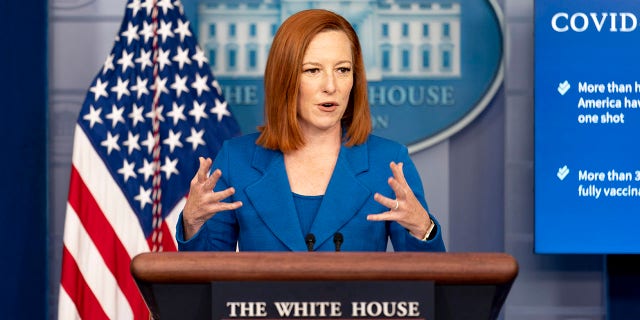
White House press secretary Jen Psaki on Wednesday denied that the United States was involved in an alleged plot to assassinate contested Belarusian President Alexander Lukashenko.
"I can confirm there's no basis in fact there," Psaki said when asked about the allegation.
The Russian military intelligence agency FSB said late last week that it arrested two men, including one with a dual citizenship in the United States and Belarus, who planned a military coup in Belarus and to assassinate Lukashenko.
White House press secretary Jen Psaki speaks during a press briefing at the White House in Washington, Monday, April 19, 2021. (AP Photo/Andrew Harnik)
Lukashenko later alleged that the U.S. was behind the alleged plot. He said he was "surprised" that "the Americans behave this way" and that "no one can set the task of eliminating the president, except the top political leadership," according to his office's website.
Russia's President Vladimir Putin on Wednesday lamented the fact Western officials had not addressed the alleged plot against Lukashenko.
"It is typical that even such flagrant actions have not been condemned by the so-called collective West. Nobody seemed to notice. Everyone pretends nothing is happening," Putin said. "[T]he practice of staging coups d’état and planning political assassinations, including those of high-ranking officials — well, this goes too far. This is beyond any limits."
Psaki also responded to more general broadsides that Putin launched against Western countries in her press briefing Wednesday.
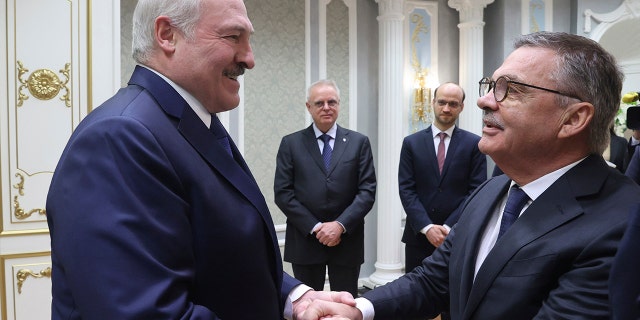
Belarusian President Alexander Lukashenko, left, greets International Ice Hockey Federation President Rene Fasel during their meeting in Minsk, Belarus, Monday, Jan. 11, 2021. White House Press Secretary Jen Psaki denied Lukashenko's allegation that the U.S. was behind a plot to assassinate him. (Nikolai Petrov/BelTA Pool Photo via AP)
"I don't think we take anything President Putin says personally. We have tough skin," she said.
The United States officially categorizes Belarus, an ally of Russia, as an authoritarian country. The U.S. does not recognize the result of the 2020 presidential election. Secretary of State Anthony Blinken called it "fraudulent."
"As a result of government suppression surrounding the fraudulent August 2020 Presidential elections in Belarus and its aftermath, there are more than 340 political prisoners detained in Belarus today," Blinken said in a statement Monday. "The United States calls on the Belarusian authorities to immediately and unconditionally release all those unjustly detained or imprisoned."
On Tuesday, U.S. Ambassador to Belarus Julie Fisher met with Belarus opposition leader Sviatlana Tsikhanouskaya in Lithuania. Tsikhanouskaya is in self-imposed exile in the neighboring country, according to Reuters.
"It is important that the international community speak up and speak out about what’s happening, that we pay close attention, and that we call for the immediate release of all political prisoners in Belarus," Fisher said, according to Reuters
Bizarre Belarus “coup plot” has all the hallmarks of a classic Kremlin drama
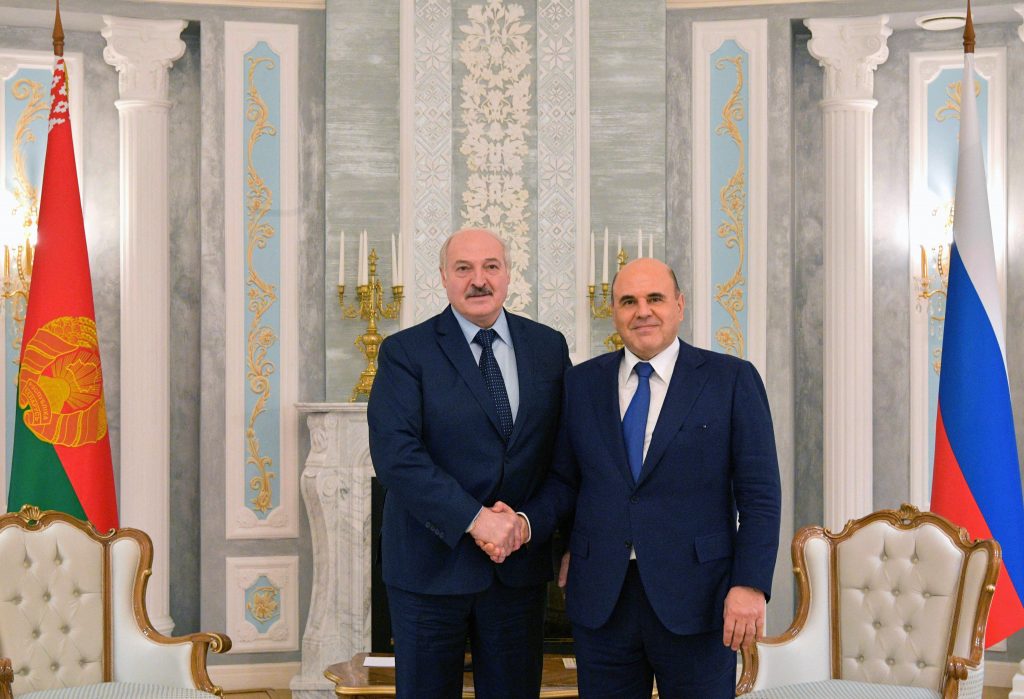
Belarus President Alyaksandr Lukashenka and Russian Prime Minister Mikhail Mishustin meet in Minsk on April 16. (Alexander Astafyev/POOL/TASS via REUTERS)
One way to look at Belarus ruler Alyaksandr Lukashenka’s claim last week that he was the target of a US-backed coup and assassination attempt is that this is just the latest in a series of conspiratorial rants by an increasingly beleaguered dictator.
But as is often the case in the former Soviet Union, upon closer examination, there appears to be at least some method behind all the madness.
Lukashenka’s claim that the plot was approved “by the top political leadership” in the United States came just days after Russia’s Federal Security Service had arrested two Belarusians, including one with US citizenship, and accused them of plotting to carry out a coup during the May 9 Victory Day parade in Minsk.
Yuras Zyankovich, a Belarusian-born lawyer who also holds US citizenship, and Alyaksandr Fyaduta, who served as Lukashenka’s spokesman in the 1990s, were extradited to Belarus.
The Belarusian KGB said the alleged plot was connected to an online discussion on Zoom last summer among experts, opposition figures, and former law enforcement officials who were discussing the country’s political situation and possible future scenarios.
The immediate context surrounding the arrests and coup plot allegations suggests that these developments are part of a broader operation designed to advance Russia’s strategic goals both in Belarus and vis-a-vis the West.
News of the “coup plot” came as Lukashenka prepares to visit Moscow for talks with Kremlin leader Vladimir Putin on April 22. On the eve of Lukashenka’s visit, Putin raised the alleged plot in his bellicose state-of-the-nation speech on April 21, claiming that what he called “unjust sanctions” against Belarus are escalating into “something more dangerous: a coup attempt in Belarus.”
As speculation mounted over the coming meeting in Moscow, Lukashenka released an oblique statement on the state-run Telegram channel Pul Pervovo on April 17 announcing that he has made “the most principled decision of my quarter-of-a-century presidency,” adding that “it will be serious” and he will “formalize” the decision soon. This has led to speculation that some form of deeper integration between Russia and Belarus could be imminent.
The broader context surrounding the recent arrests and coup allegations is also important. The “exposure” of the alleged plot comes at a time when Russia is visibly expanding its political, economic, and military footprint in Belarus with the clear aim of achieving Moscow’s long-standing objective of turning its smaller but strategically vital
One way to look at Belarus ruler Alyaksandr Lukashenka’s claim last week that he was the target of a US-backed coup and assassination attempt is that this is just the latest in a series of conspiratorial rants by an increasingly beleaguered dictator.
But as is often the case in the former Soviet Union, upon closer examination, there appears to be at least some method behind all the madness.
Lukashenka’s claim that the plot was approved “by the top political leadership” in the United States came just days after Russia’s Federal Security Service had arrested two Belarusians, including one with US citizenship, and accused them of plotting to carry out a coup during the May 9 Victory Day parade in Minsk.
Yuras Zyankovich, a Belarusian-born lawyer who also holds US citizenship, and Alyaksandr Fyaduta, who served as Lukashenka’s spokesman in the 1990s, were extradited to Belarus.
The Belarusian KGB said the alleged plot was connected to an online discussion on Zoom last summer among experts, opposition figures, and former law enforcement officials who were discussing the country’s political situation and possible future scenarios
The immediate context surrounding the arrests and coup plot allegations suggests that these developments are part of a broader operation designed to advance Russia’s strategic goals both in Belarus and vis-a-vis the West.
News of the “coup plot” came as Lukashenka prepares to visit Moscow for talks with Kremlin leader Vladimir Putin on April 22. On the eve of Lukashenka’s visit, Putin raised the alleged plot in his bellicose state-of-the-nation speech on April 21, claiming that what he called “unjust sanctions” against Belarus are escalating into “something more dangerous: a coup attempt in Belarus.”
As speculation mounted over the coming meeting in Moscow, Lukashenka released an oblique statement on the state-run Telegram channel Pul Pervovo on April 17 announcing that he has made “the most principled decision of my quarter-of-a-century presidency,” adding that “it will be serious” and he will “formalize” the decision soon. This has led to speculation that some form of deeper integration between Russia and Belarus could be imminent.
The broader context surrounding the recent arrests and coup allegations is also important. The “exposure” of the alleged plot comes at a time when Russia is visibly expanding its political, economic, and military footprint in Belarus with the clear aim of achieving Moscow’s long-standing objective of turning its smaller but strategically vital Western neighbor into a pliant and obedient vassal. It also comes when Belarusian society is increasingly distancing itself from Russia and embracing the West amid an unprecedented wave of pro-democracy protests.
At the most basic level, claims of a US-backed coup advance Moscow’s goal of increasing Belarusian isolation from the West and increasing its dependence on Russia. It also appears to be an attempt to foreclose any attempt by Lukashenka to return to his pre-August 2020 game of tacking between Moscow and the West in order to achieve the maximum degree of geopolitical flexibility.
The main objective here may have been to send a clear and unambiguous message to the Belarusian strongman: you are in Russia’s sphere of influence now and you have no place else to turn. Judging from his subsequent comments, Lukashenka appears to have received the message loud and clear.
In his public statements, Lukashenka has not only accepted Russia’s narrative about the arrests and the plot, but has also built on them enthusiastically. According to his evidence-free account, not only was there a US-backed plot to overthrow the Belarusian government, but also a conspiracy to assassinate him and his children.
Lukashenka has claimed that Putin raised the issue of the alleged US-backed plot in a recent phone call with US President Joe Biden. “I am grateful to Putin. When he was talking with Biden, he asked him this question,” Lukashenka reportedly commented. Kremlin spokesman Dmitry Peskov later confirmed Lukashenka’s account.
In addition to advancing Moscow’s geopolitical goals in Belarus, this “coup plot” also feeds into Moscow’s perennial goal of establishing a “whataboutism” narrative with the West at a time when Russia is under increasing scrutiny for massing troops on the Ukrainian border. It also follows news of new US sanctions over the SolarWinds hack against US federal agencies and interference in the 2020 US election. And it comes in the midst of an escalating diplomatic crisis with the Czech Republic, which expelled Russian diplomats last week over claims that Russian military agents were behind a deadly 2014 explosion at a Czech arms depot.
Despite US denials and a lack of any real evidence to support it, the alleged coup plot gives Moscow the ability to advance a narrative that it is not guilty of anything more nefarious than the West’s own actions. Indeed, Russian Foreign Ministry Spokeswoman Maria Zakharova claimed that the recent Czech decision to expel Russian diplomats was an effort by the West to distract attention from the alleged coup plot.
The Belarusian “coup plot” comes right out of the Kremlin playbook of using dramaturgy, subterfuge, and disinformation to muddy the waters, establish false equivalency narratives, and create facts on the ground to advance Moscow’s imperial and revanchist geopolitical goals. It is important for Western policymakers to remain clear-eyed amidst all this Kremlin-generated fog.
The essence of the conflict between Russia and the West is a normative struggle between a Western system based on the rule of law and accountability against an alternative advanced by the Putin regime that is based on kleptocracy and autocracy. It is a battle being played out in Russia’s neighboring countries, including Belarus, and inside Russia itself.
The West is on the right side of history in this struggle and must not allow itself to be distracted from this essential truth by the Kremlin’s dramaturgy and subterfuge.
In his public statements, Lukashenka has not only accepted Russia’s narrative about the arrests and the plot, but has also built on them enthusiastically. According to his evidence-free account, not only was there a US-backed plot to overthrow the Belarusian government, but also a conspiracy to assassinate him and his children.
Lukashenka has claimed that Putin raised the issue of the alleged US-backed plot in a recent phone call with US President Joe Biden. “I am grateful to Putin. When he was talking with Biden, he asked him this question,” Lukashenka reportedly commented. Kremlin spokesman Dmitry Peskov later confirmed Lukashenka’s accoun
In addition to advancing Moscow’s geopolitical goals in Belarus, this “coup plot” also feeds into Moscow’s perennial goal of establishing a “whataboutism” narrative with the West at a time when Russia is under increasing scrutiny for massing troops on the Ukrainian border. It also follows news of new US sanctions over the SolarWinds hack against US federal agencies and interference in the 2020 US election. And it comes in the midst of an escalating diplomatic crisis with the Czech Republic, which expelled Russian diplomats last week over claims that Russian military agents were behind a deadly 2014 explosion at a Czech arms depot.
Despite US denials and a lack of any real evidence to support it, the alleged coup plot gives Moscow the ability to advance a narrative that it is not guilty of anything more nefarious than the West’s own actions. Indeed, Russian Foreign Ministry Spokeswoman Maria Zakharova claimed that the recent Czech decision to expel Russian diplomats was an effort by the West to distract attention from the alleged coup plot.
The Belarusian “coup plot” comes right out of the Kremlin playbook of using dramaturgy, subterfuge, and disinformation to muddy the waters, establish false equivalency narratives, and create facts on the ground to advance Moscow’s imperial and revanchist geopolitical goals. It is important for Western policymakers to remain clear-eyed amidst all this Kremlin-generated fog.
The essence of the conflict between Russia and the West is a normative struggle between a Western system based on the rule of law and accountability against an alternative advanced by the Putin regime that is based on kleptocracy and autocracy. It is a battle being played out in Russia’s neighboring countries, including Belarus, and inside Russia itself.
The West is on the right side of history in this struggle and must not allow itself to be distracted from this essential truth by the Kremlin’s dramaturgy and subterfuge.
Brian Whitmore is a Nonresident Senior Fellow at The Atlantic Council’s Eurasia Center, an Adjunct Assistant Professor at The University of Texas at Arlington, and host of The Power Vertical Podcast.