Thursday, December 16, 2021

Migrants push past outnumbered French police to make perilous Channel crossing

By Pascal Rossignol, Manuel Ausloos and Stephane Mahe
© Reuters/PASCAL ROSSIGNOL Migrants launch their dinghy from the shores of northern France in attempt to reach Britain

WIMEREUX, France (Reuters) - In the early hours of Thursday on a beach in northern France, a small group of police with torches tries to stand in the way of dozens of migrants heading for the sea carrying a grey dinghy.

It's tense. The police are outnumbered. The migrants - who hope to make it to Britain on the final stretch of their long journeys fleeing war and poverty - are screaming.

© Reuters/STEPHANE MAHE Migrants launch their dinghy from the shores of northern France in attempt to reach Britain

During the standoff, some of the migrants shout: "Help us, we want go to UK, please!" Some are standing in front of the police to try to block their way and allow others to carry the boat into the water

.
© Reuters/STEPHANE MAHE Migrants launch their dinghy from the shores of northern France in attempt to reach Britain

They eventually push past the police, who stand aside.

"Thank you, thank you," says one woman, blowing kisses in the direction of the police. One young man says, on his way to the dinghy: "I have a dream, go UK, I have a dream, I have a wish.
"
© Reuters/STEPHANE MAHE Migrants launch their dinghy from the shores of northern France in attempt to reach Britain

The migrants, including children, some crying, jump onto the dinghy. One child was covered from her feet to her neck in a black garbage bag in an apparent effort to protect her from the water. She wore a bright pink coat and grey woollen hat to keep her warm.

© Reuters/STEPHANE MAHE Migrants launch their dinghy from the shores of northern France in attempt to reach Britain

The dinghy then headed out into the Channel - one of the world's busiest, and dangerous, shipping lanes - towards England.

The arrival of migrants on rickety boats has been a growing source of tension between France and Britain, especially after 27 migrants drowned last month.

Britain says France is not doing enough to police its beaches, while France accuses Britain of having lax labour laws that entice illegal immigrants.

On the beach in Wimereux, near Calais, the police - about 10 - seem resigned. "They just want to go to England, that's it," one said of the group of mostly Kurdish migrants.

Migrants push past outnumbered French police to make perilous Channel crossing

One migrant gave up and turned around, saying jumping on this overloaded dinghy was too risky.

A while later, another dinghy, with about 40 people on board, set out from the same beach.

(Reporting by Stephane Mahe, Manuel Ausloos, Pascal Rossignol; Writing by Ingrid Melander; Editing by Janet Lawrence)
Young Americans motivated to make change: AP-NORC, MTV poll


WASHINGTON (AP) — There are plenty of reasons for Sebastian Garcia to feel downbeat about the future.


After his family immigrated from Mexico, he was raised on a farm in northwest Texas, where he says there aren’t many racial slurs he hasn’t heard. When the now-24-year-old graduated from college, he decided to become an educator. But the first few years of his teaching career have been upended by the coronavirus pandemic, which forced his public school system to close for months.

Garcia and his peers, meanwhile, have had to navigate the worst economic conditions since the Great Depression, weighed down by student loans that have made affordable housing and access to healthcare out of reach.

Despite the challenges of what Garcia describes as the endless pursuit of the American Dream, he says he's confident that better things are ahead. He's part of a broader trend among millennials and Generation Z Americans who say they are more likely to be optimistic about the future and their ability to create change than their older counterparts, according to a new poll from MTV and The Associated Press-NORC Center for Public Affairs Research.

The poll measured attitudes among Gen Z Americans ages 13 through 24, as well as 25- to 40-year-old millennials and 41- to 56-year-old Gen X Americans.

“I know that as long as there are people willing to work hard and push through the hard times, you can persevere,” Garcia said. “Me and my family are proven facts of that.”

The poll finds 66% of Gen Z and 63% of millennial Americans think their generation is motivated to make positive change, compared with 56% of Gen X Americans. Those generations are also more likely than Generation X to feel they can impact what the government does, with 44% of Gen Z and 42% of millennials saying they can at least a moderate amount, compared with only 31% of Gen X.

For Jonathan Belden, 29, being optimistic about the future and potential for positive change is necessary as a father of five.

“Despite the challenges, in many regards, the U.S. is the only place where we have as much of an opportunity without hindrance," the New Mexico resident said. “And I want my kids to grow up in a place where they can succeed at whatever they do."

While members of all three of these generations have mixed views of the state of the country and the future, the poll shows Gen Z and millennials are not as negative about the world that their generation is facing.

Despite the fact that millennials, some of whom are now creeping toward middle age, are reaching milestones like marriage, parenthood and homeownership later in life than previous generations, close to half of them reported that their standard of living is better than their parents’ at the same age. For Gen Z, about half likewise think their standard of living is better than what their parents had, while just about a quarter think it is worse.

Additionally, about half of Gen Z and millennials say the world they face is worse than other generations, compared with about 6 in 10 Gen X.

Along with less pessimism and motivation to create change, many Gen Z and millennials put stock in progressive policies aimed at race, class and gender disparities
.

Roughly half of Gen Z and millennials say they favor a universal basic income, while about a quarter are opposed. Among Gen X, about a third are in favor and roughly as many are against.

About 3 in 10 Gen Z and millennials favor reducing funding for law enforcement agencies, while about 4 in 10 are opposed. Opposition is much higher among Gen X, with 56% against.

And while few across the three generations oppose prohibiting workplace discrimination on the basis of gender identity, millennials and Gen Z are more likely than Gen X to support that policy.

Despite a clear divide in policy attitudes, Gen Z and millennials are more optimistic than Gen X that Americans can come together and work out their political differences (45% and 41%, compared with 33%).

“Where I find the most hope is when I talk to people and we find the common ground,” Belden said. “When that happens, even if there are differences, it helps me to feel like there is actually good in people and in the world and that it’s not going to hell in a handbasket.”

Garcia agreed, saying that while the past few years have been hard, “I know eventually one day, maybe not today, maybe not next year, but we will eventually overcome it.”

___

The AP-NORC poll of 3,764 teens ages 13-17 and adults ages 18-56 was conducted Sept. 1-19 using a combined sample of interviews from NORC’s probability-based AmeriSpeak Panel, which is designed to be representative of the U.S. population, and interviews from opt-in online panels. The margin of sampling error for all respondents is plus or minus 3.3 percentage points. The AmeriSpeak panel is recruited randomly using address-based sampling methods, and respondents later were interviewed online or by phone.


Farnoush Amiri, The Associated Press
N.L. rebuilding 'from scratch' systems downed by cyberattack using backups: official

ST. JOHN'S, N.L. — Details released this week about Newfoundland and Labrador’s efforts to recover from a cyberattack on its health-care system provide clues about the incident and how the government may have responded, experts say.

© Provided by The Canadian Press

David Diamond, head of Newfoundland and Labrador's largest health authority, told reporters Tuesday that the systems taken out in the Oct. 30 cyberattack were being "rebuilt from scratch, from backups."

Brian Honan, a cybersecurity consultant and former special adviser to Europol’s Cyber Crime Centre, said when victims of ransomware attacks have to completely rebuild systems, it's typically because they did not obtain a decryption key from the perpetrators — or the key they received doesn't work as expected.


Mark Sangster, vice-president of industry security strategy at eSentire, a cybersecurity firm in Waterloo, Ont., said officials may have decided to rebuild the systems because they wanted to be sure the hackers hadn't left behind any hidden back doors through which they might enter again.

It's an expensive and arduous job to take on, he added. "When you rebuild from scratch, I can tell you that's a brave decision to make and one that companies or organizations don't take lightly," Sangster said in an interview Wednesday.

Ransomware is a type of software often used in cyberattacks. Hackers break into a network and then trigger the software to encrypt data. The hackers then demand a payment in exchange for a key that would decrypt the data, thus holding the network and its users hostage.

The Newfoundland and Labrador government has been tight-lipped about the attack on its health-care networks, refusing to say if it has been in contact with the perpetrators, if a ransom has been demanded or paid, or even if the attack involves ransomware at all.

They also have not said if any data was lost, though Honan said there likely was if systems are being rebuilt from backups.

"When you restore from your backup, you're restoring from the point of time the backup was done," he said in an interview Wednesday. "Any data or any information that would have changed, updated or added since the backup was done would be lost."

Officials confirmed Tuesday the hackers stole personal information from health-care employees or patients in all four of the province's health regions as well as social insurance numbers belonging to 2,514 patients — 1,025 of whom are still alive. Diamond said those social insurance numbers were likely collected by mistake.

"I challenge that statement," Sangster said, adding that the health authority is on the hook for collecting the data in the first place, whether it was a mistake or not. "Whether or not you need it, whether or not you use it every day, that's just inexcusable."

Both Honan and Sangster questioned the Newfoundland and Labrador government's choice to reveal so little about the attack and its orchestrators. Sangster said he believes the Conti ransomware gang is behind the attack.

Conti launched a ransomware attack against Ireland's health-care system in May that experts have compared to the one against Newfoundland and Labrador. The hackers got in when an unsuspecting worker clicked on an Excel spreadsheet attached to an email, according to a report released last week by Ireland's Health Service Executive.

The Irish government promptly and publicly denounced the attack and said they would not pay a ransom. The perpetrators handed over a decryption key without payment, and within two months of the attack, 94 per cent of the affected servers were decrypted, the report says.

Honan, who is chief executive officer of cybersecurity firm BH Consulting in Dublin, said that kind of transparency helped reassure people. "It also enabled other health-care providers around the world to learn from the HSE so that they could better protect their own systems," he added.

This report by The Canadian Press was first published Dec. 15, 2021.

Sarah Smellie, The Canadian Press


Webb Telescope placed on top of Ariane 5 rocket

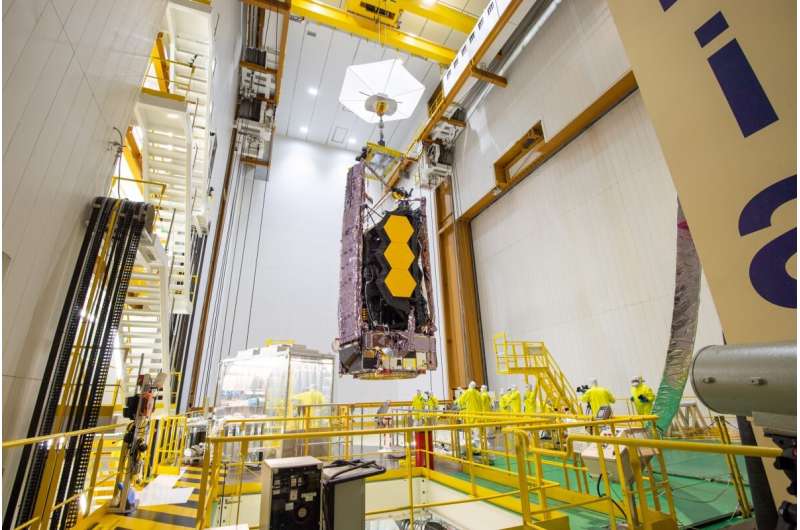
NASA's Webb Telescope placed on top of Ariane 5 rocket
Credit: ESA-M.Pedoussaut

On Saturday, Dec. 11, NASA's James Webb Space Telescope was secured on top of the Ariane 5 rocket that will launch it to space from Europe's Spaceport in French Guia

After its arrival in the final assembly building, Webb was slowly hoisted nearly 130 feet and then perfectly aligned on top of the Ariane 5, after which technicians bolted Webb's  adapter down to the rocket. This whole process was performed under strict safety and cleanliness policies, as it was one of the most delicate operations during the entire launch campaign for Webb. A custom 'shower curtain,' already installed between the two platforms where technicians worked to connect Webb to its launch vehicle, served as the walls of a clean room to keep the observatory dirt-free.

The next step ahead is to encapsulate Webb inside the Ariane 5's specially adapted fairing.

Webb will be the largest, most powerful telescope ever launched into space. As part of an international collaboration agreement, the European Space Agency (ESA) is providing the telescope's launch services using the Ariane 5 launch vehicle. Working with partners, ESA was responsible for the procurement of the launch services by Arianespace and for the development and qualification of Ariane 5 adaptations for the Webb mission.

Webb is an international partnership between NASA, ESA, and the Canadian Space Agency.James Webb Space Telescope moved to meet its rocket

More information: webb.nasa.gov

Provided by NASA's Goddard Space Flight Center 


NASA’s Parker Solar Probe Has ‘Touched’ the Sun by Entering Its Atmosphere

The Editors 
© NASA The fastest spacecraft in the solar system is revealing all of the sun’s biggest secrets.

NASA’s Parker Solar Probe has become the first spacecraft to touch the sun.

Researchers announced the milestone December 14 in a virtual press conference held by the American Geophysical Union Conference.

Results from the probe's journey could answer big picture questions about our sun and other stars.

NASA’s Parker Solar Probe has passed through the sun’s atmosphere—a feat no other spacecraft has achieved. Data from these flybys could help researchers answer critical questions about how the star generates solar wind and shed light on the inner workings of distant stars across the universe.

“I’m thrilled to say that we've officially touched the sun,” Justin Kasper, a researcher at BWX Technologies, Inc. and the University of Michigan, said December 14 in a virtual press conference held by the American Geophysical Union.

The spacecraft, which launched from Florida’s Cape Canaveral Space Force Station in 2018, is designed to withstand incredible amounts of heat and radiation. The record-breaking probe—built and operated by John’s Hopkins University Applied Physics Laboratory (JHUAPL)—is also the single fastest object humans have ever constructed, with an orbital speed of about 430,000 miles per hour.
Understanding the Alfvén Critical Surface

During Parker’s eighth flyby on April 28, 2021, the probe passed in and out of a region called the Alfvén critical surface, the team announced. This boundary marks the separation between the sun’s atmosphere, or corona, where solar material is still trapped by gravitational and magnetic forces, and the surrounding layer of solar wind.

Researchers have worked to map the extent of this boundary for more than half a century, with recent estimates placing it somewhere between 4.3 to 8.6 million miles from the surface of the sun.“We have been wondering about this for six decades now," Nour Raouafi, a project scientist for the Parker Solar Probe Mission at JHUAPL, said during the press conference. "But now, we are there."

Data collected during the April 28 flyby, which took the craft within 8.1 million miles of the Sun’s surface, revealed that conditions within the sun’s atmosphere were dramatically different than those outside it.

“Inside the corona, the sun’s magnetic field grew much stronger and then dominated the movement of the particles there,” said Kasper, who is the lead investigator for the spacecraft's Solar Wind Electrons Alphas and Protons (SWEAP) project and one of the authors of a paper in Physical Review Letters about the discovery. "Instead of waves just gushing out from the sun, which is what we normally see in the solar wind, waves there were moving back and forth.”

The team is hopeful the data will eventually help solve three outstanding questions about the sun.

First, scientists have long known that the sun’s corona is millions of degrees hotter than its surface, which hovers around 6,000 degrees Fahrenheit. This temperature spike seems to defy the laws of physics. As Parker passes through the sun’s corona, it could shed light on how this heating occurs.

Another quirk: The magnetic field in the sun’s corona is so strong it slows down the rate at which the sun spins. Scientists suspect the rate at which this spin down occurs could be related to the location of the Alfvén critical surface, Kasper explained. “Now that we know the location of the [Alfvén critical surface], this will allow us to determine how solar activity changes over long timescales as the sun ages and slows down,” he said.

© NASA/Johns Hopkins APL/Naval Research Laboratory This image, taken by the Parker’s WHISPR camera, shows the spacecraft traveling through coronal pseudostreamers, the massive structures visible during a solar eclipse.

These measurements could also provide insight about the origins of solar wind and reveal how different types of solar wind form. Understanding these processes could help researchers better predict dangerous solar weather events which could disable Earth-orbiting satellites and wreak havoc on our planet's power grid. (See: the Carrington Event of 1859.)

The flyby revealed clues about the shape of the boundary layer, too. Since the spacecraft passed through the Alfvén critical surface multiple times, researchers can infer that it doesn’t uniformly wrap about the star. Instead, it appears to be made up of a kaleidoscope of twirling peaks and troughs, likely shaped by solar activity.

Finally, during this flyby, the spacecraft sped through a feature called a pseudostreamer. These massive tendrils of solar material are the same features seen emanating from the blotted sun during a solar eclipse. “Flying through this region was like flying through the eye of the storm,” Kasper said. “The conditions quieted, the density of the atmosphere dropped significantly, and the sun's magnetic field was stronger.”
Solar Switchbacks

Parker has also shed light on the origins of a solar feature called switchbacks. Since scientists first observed these curly-cue structures in the mid-90s, researchers have sought to understand their origins, including how and where exactly they form.

Now, scientists can begin to piece together answers to these questions. Measurements collected by Parker’s instruments during this latest flyby revealed an usually high number of helium ions within the switchbacks, which suggest that they could originate on or near the sun’s surface. The spacecraft also spotted a magnetic funnel-like feature, which emanates from the sun’s photosphere and appears to align with the switchbacks. The team theorized that these magnetic funnels may also generate the solar winds that sweep across the solar system.
On the Horizon

Parker is just getting started. The spacecraft’s next flyby will occur in January, 2022. (The closest flyby of the entire mission will take the spacecraft as close as 4 million miles from the sun’s surface and is scheduled for 2025.) And it’s perfect timing, too, because the sun is entering the height of its activity cycle and will likely generate more space weather.

“The data to come will allow us a glimpse into the region that’s critical for superheating the corona and pushing the solar wind supersonic speeds,” Kelly Korreck, a program scientist and Parker Solar Probe team member at NASA’s headquarters, said during the press conference. “These types of measurements from the corona will be critical for understanding and forecasting extreme space weather events that can disrupt telecommunications and damage satellites around the Earth.”

Toyota gives robots a soft touch and better vision to amplify our intelligence


Brian Cooley 

Thanks to decades of sci-fi movies, it's easy to think of robots as human replacements: Metal arms, hinged legs and electronic eyes will do that. But the future of robots may center on extending and boosting us, not so much replacing us. While that concept isn't entirely new, it came more sharply into focus recently when I visited Toyota Research Institute's headquarters in Los Altos, California. That's where robots amplifying humans is the mission.

© Toyota Research Institute

The softer side of robots: TRI has developed soft touch robot "hands" that can not only handle things elegantly but also identify them.
© Provided by CNET Don't be fooled by the humanoid layout of many robots. Their real value may be in amplifying more than replacing us. Toyota Research Institute's Max Bajracharya shows CNET's Brian Cooley one of its development robots. 

"People here are passionate about making robots truly useful," says Max Bajracharya, VP of robotics at TRI and veteran of Google's robotics unit, Boston Dynamics and NASA's Mars rover team. Today he develops robots in mock-ups of home kitchens and grocery store aisles. "How can we really help people in their day-to-day lives?" TRI isn't charged with getting robots on the market but with figuring out the problems preventing that from happening.

One tangible example is a soft touch sensing gripper developed at TRI that allows a robot to handle delicate things the way we do, with a progressive, nuanced sense of pressure and recognition.

 Provided by CNET The softer side of robots: TRI has developed soft touch robot "hands" that can not only handle things elegantly but also identify them. Toyota Research Institute

These soft grippers are like padded hooves with cameras on the inside that can figure out the perfect amount of force needed to grip something and can also help identify an object, essentially by touch. "Replicating our body is incredibly complex if you think about how many sensors we have" in our skin and the superlative "wetware" processor in our skull that makes sense of them all, according to Bajracharya.

Video: Track out-of-stock items with online robots (CNET)

This work in soft touch is about more than just grabbing and holding. AI and smartphone pioneer Jeff Hawkins subscribes to a theory that much of how we understand the world is achieved by comparing "memory frames" of how we've moved through it, either via literal touch or through virtual contact with concepts like liberty and love. That kind of learning about the world seems to have strong echoes in TRI's work.

TRI has also given its robots the ability to understand clear or reflective surfaces, something anyone with a cat knows can be remarkably hard. Transparencies and reflections can confuse a robot into thinking something is or isn't there when the opposite is true. From grocery aisles full of clear containers to homes full of mirrors, the places where this breakthrough can advance robotic relevance are numerous.
 Provided by CNET Recognizing a transparent object as actually being there is a sensing task that humans take for granted and one that robots are tricked by. Toyota Research Institute

But the bigger goal remains a symphony of people and robots. "What you don't see today is humans and robots really interfacing together, which really limits how much robots can amplify humans' ability," says Bajracharya. That's where TRI turns AI on its head with something they call IA, or Intelligence Amplification. Simply put, it views robots as leveraging humans' superior intelligence and multiplying it with a robot's superior abilities in strength, precision, persistence and repeatability. Toyota has been focused on enhancing human mobility since a major announcement in 2017 by CEO Akiyo Toyoda at an event in Athens that I helped moderate.

All of this brings up the relatability of robots: I've long felt that they will need to be as relatable as they are capable to achieve maximum adoption, since humans can't help but anthropomorphize them. That doesn't mean being as adorably useless as Kuri, which took CES by storm in 2017 before vanishing 18 months later, but it does mean establishing some kind of relationship. "Some people actually prefer a robot because it's not a person," says Bajracharya, speaking of robots in home or health care settings. "But some people are very concerned about this machine in their environment" due to fear of the unknown or concerns that it will displace human workers.

The history of robotics is still only at its preface. But nuanced skills that amplify humans' savvy about the world while robots take over some of what dilutes our time and effort appear to be a formula for the next chapter.

Robot hand moves closer to human abilities

Robot hand moves closer to human abilities
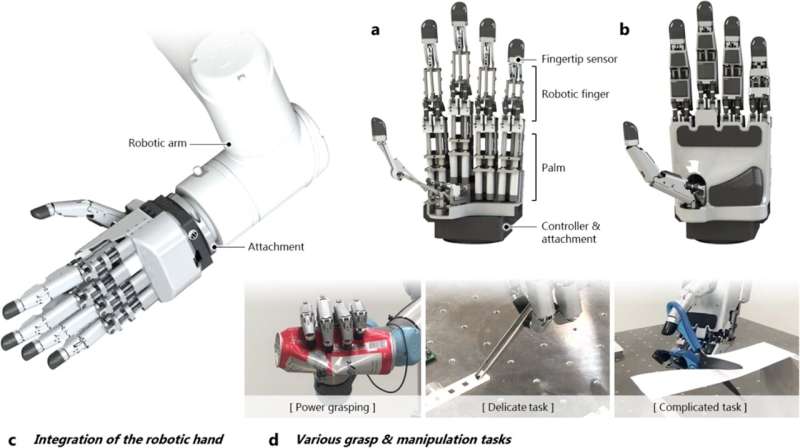
Fig. 1: Overview of the ILDA. a Configuration of the ILDA hand composed of five
 robotic fingers with fingertip sensors, the palm side integrating the actuators, 
and the controller and attachment. b ILDA hand with covers. c Ease of 
attachment of the ILDA hand to a developed robotic arm. d Actions performed
 using the ILDA hand such as grasping and manipulating everyday life tools, 
showing delicate and strong grasping. Credit: DOI: 10.1038/s41467-021-27261-0

A team of researchers affiliated with multiple institutions in Korea has developed a robot hand that has abilities similar to human hands. In their paper published in the journal Nature Communications, the group describes how they achieved a high level of dexterity while keeping the hand's size and weight low enough to attach to a robot arm.

Creating  hands with the dexterity, strength and flexibility of  is a challenging task for engineers—typically, some attributes are discarded to allow for others. In this new effort, the researchers developed a new robot  based on a linkage-driven mechanism that allows it to articulate similarly to the human hand. They began their work by conducting a survey of existing  and assessing their strengths and weaknesses. They then drew up a list of features they believed their hand should have, such as fingertip force, a high degree of controllability, low cost and high dexterity.

The researchers call their new hand an integrated, linkage-driven dexterous anthropomorphic (IDLA) robotic hand, and just like its human counterpart, it has four fingers and a thumb, each with three joints. And also like the human hand, it has fingertip sensors. The hand is also just 22 centimeters long. Overall, it has 20 joints, which gives it 15 degrees of motion—it is also strong, able to exert a crushing force of 34 Newtons—and it weighs just 1.1.kg.

Motions of the ILDA hand
 
Power grasping tests of the ILDA hand
Grasping various objects.

The researchers created several videos that demonstrate the capabilities of the hand, including crushing soda cans, cutting paper using scissors, and gently holding an egg. They also show the robot hand pulling a film off of a microchip, manipulating a tennis ball and lifting a heavy object. Perhaps most impressive is the ability of the hand to use a pair of tweezers to pick up small objects.

The researchers note that the hand is also completely self-contained, which means it can be easily fitted to virtually any robot arm. They also suggest that its abilities make it ideal for applications such as applying tiny chips to circuit boards.

Cutting a paper using scissors.
Handling small objects using tweezers
A highly dexterous robot hand with a caging mechanism
More information: Uikyum Kim et al, Integrated linkage-driven dexterous anthropomorphic robotic hand, Nature Communications (2021). DOI: 10.1038/s41467-021-27261-0
Journal information: Nature Communications 
© 2021 Science X Network

Engineers develop a robotic hand with a gecko-inspired grip

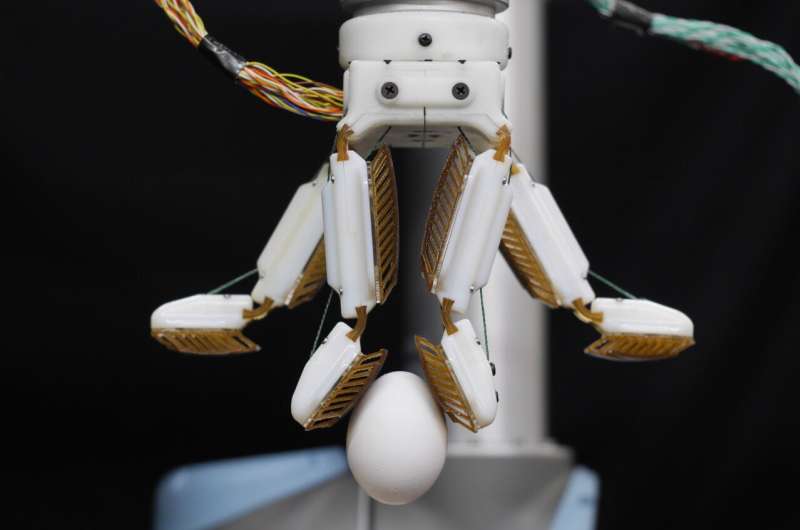
A robotic hand with a gecko-inspired grip
A close-up of the hand performing a highly hyperextended pinch on only the top
 surface of an egg. Credit: Biomimetics and Dextrous Manipulation Lab

Across a vast array of robotic hands and clamps, there is a common foe: The heirloom tomato. You may have seen a robotic gripper deftly pluck an egg or smoothly palm a basketball—but, unlike human hands, one gripper is unlikely to be able to do both and a key challenge remains hidden in the middle ground.

"You'll see robotic hands do a power grasp and a precision grasp and then kind of imply that they can do everything in between," said Wilson Ruotolo, a former graduate student in the Biomimetics and Dextrous Manipulation Lab at Stanford University. "What we wanted to address is how to create manipulators that are both dexterous and strong at the same time."

The result of this goal is "farmHand," a robotic hand developed by engineers Ruotolo and Dane Brouwer, a graduate student in the Biomimetics and Dextrous Manipulation Lab, at Stanford (aka "the Farm") and detailed in a paper published Dec. 15 in Science Robotics. In their testing, the researchers demonstrated that farmHand is capable of handling a wide variety of items, including raw eggs, bunches of grapes, plates, jugs of liquids, basketballs and even an angle grinder.

FarmHand benefits from two kinds of biological inspiration. While the multi-jointed fingers are reminiscent of a human hand—albeit a four-fingered one—the fingers are topped with gecko-inspired adhesives. This grippy but not sticky material is based on the structure of gecko toes and has been developed over the last decade by the Biomimetics and Dextrous Manipulation Lab, led by Mark Cutkosky, the Fletcher Jones Professor in Stanford's School of Engineering, who is also senior author of this research.

Using the gecko-adhesive on a multi-fingered, anthropomorphic gripper for the first time was a challenge, which required special attention to the tendons controlling the fingers of farmHand and the design of the finger pads below the adhesive.

From the farm to space and back again

Like gecko's toes, the gecko adhesive creates a strong hold via microscopic flaps. When in full contact with a surface, these flaps create a Van der Waals force—a weak intermolecular force that results from subtle differences in the positions of electrons on the outsides of molecules. As a result, the adhesives can grip strongly but require little actual force to do so. Another bonus: They don't feel sticky to the touch or leave a residue behind.

"The first applications of the gecko adhesives had to do with climbing robots, climbing people or grasping very large, very smooth objects in space. But we've always had it in our minds to use them for more down-to-earth applications," said Cutkosky. "The problem is that it turns out that gecko adhesives are actually very fussy."

FarmHand going through a series of manipulations demonstrating its
 diverse performance capacity.

The fuss is that the gecko adhesives must connect with a surface in a particular way in order to activate the Van der Waals force. This is easy enough to control when they are applied smoothly onto a flat surface, but much more difficult when a grasp relies on multiple gecko adhesive patches contacting an object at various angles, such as with farmHand.

Pinching and buckling

Below the adhesives, farmHand's finger pads help address this challenge. They are made of a collapsible rib structure that buckles with little force. No matter the location or angle of contact, the ribs consistently buckle so as to ensure equal forces on the adhesive pads and prevent any single one from slipping prematurely.

"If you move these ribs, the buckling results in a similar force no matter where you start," said Brouwer. "It's a simple, physical behavior that could be deployed even in spaces outside of robotics, perhaps as shoe tread or all-terrain tires."

The hand's tendons are crucial as well because they enable a hyperextended pinch. While many robotic hands and clamps will pinch objects in a "C" shape, like picking something up with only the tip of your fingers, farmHand pinches with the end of its fingers pressed pad to pad. This gives the adhesives more surface area to work with.

Getting the design just right was especially hard because existing  have difficulty predicting real-world performance with soft objects—another factor in the heirloom tomato problem. But the researchers benefited immensely from being able to 3D print and test many of the hard and soft plastic components in relatively quick cycles. They go as far as to suggest that their success may not have been possible—or at least much slower—only five years ago.

Further improvements to farmHand could come in the form of feedback features that would help users understand how it is gripping and how it could grip better while the hand is in use. The researchers are also considering commercial applications for their work.

Cutkosky is also a member of Stanford Bio-X and the Wu Tsai Neurosciences Institute.

Gecko-inspired adhesives help soft robotic fingers get a better grip

More information: Wilson Ruotolo et al, From grasping to manipulation with gecko-inspired adhesives on a multifinger gripper, Science Robotics (2021). DOI: 10.1126/scirobotics.abi977

Journal information: Science Robotics 

Provided by Stanford University 


Mind-controlled robots now one step closer

robot
Credit: CC0 Public Domain

Tetraplegic patients are prisoners of their own bodies, unable to speak or perform the slightest movement. Researchers have been working for years to develop systems that can help these patients carry out some tasks on their own. "People with a spinal cord injury often experience permanent neurological deficits and severe motor disabilities that prevent them from performing even the simplest tasks, such as grasping an object," says Prof. Aude Billard, the head of EPFL's Learning Algorithms and Systems Laboratory. "Assistance from robots could help these people recover some of their lost dexterity, since the robot can execute tasks in their place." 

Prof. Billard carried out a study with Prof. José del R. Millán, who at the time was the head of EPFL's Brain-Machine Interface laboratory but has since moved to the University of Texas. The two research groups have developed a  that can control a robot using  emitted by a patient's brain. No  or touch function is needed; patients can move the robot simply with their thoughts. The study has been published in Communications Biology

Avoiding obstacles

To develop their system, the researchers started with a  that had been developed several years ago. This arm can move back and forth from right to left, reposition objects in front of it and get around objects in its path. "In our study we programmed a robot to avoid obstacles, but we could have selected any other kind of task, like filling a glass of water or pushing or pulling an object," says Prof. Billard. 

The engineers began by improving the robot's mechanism for avoiding obstacles so that it would be more precise. "At first, the robot would choose a path that was too wide for some obstacles, taking it too far away, and not wide enough for others, keeping it too close," says Carolina Gaspar Pinto Ramos Correia, a Ph.D. student at Prof. Billard's lab. "Since the goal of our robot was to help paralyzed patients, we had to find a way for users to be able to communicate with it that didn't require speaking or moving." 

An algorithm that can learn from thoughts 

This entailed developing an algorithm that could adjust the robot's movements based only on a patient's thoughts. The algorithm was connected to a headcap equipped with electrodes for running electroencephalogram (EEG) scans of a patient's . To use the system, all the patient needs to do is look at the robot. If the robot makes an incorrect move, the patient's brain will emit an "error message" through a clearly identifiable signal, as if the patient is saying "No, not like that." The robot will then understand that what it's doing is wrong—but at first it won't know exactly why. For instance, did it get too close to, or too far away from, the object? To help the robot find the right answer, the  is fed into the algorithm, which uses an inverse reinforcement learning approach to work out what the patient wants and what actions the robot needs to take. This is done through a trial-and-error process whereby the robot tries out different movements to see which one is correct. The process goes pretty quickly—only three to five attempts are usually needed for the robot to figure out the right response and execute the patient's wishes. "The robot's AI program can learn rapidly, but you have to tell it when it makes a mistake so that it can correct its behavior," says Prof. Millán. "Developing the detection technology for error signals was one of the biggest technical challenges we faced." Iason Batzianoulis, the study's lead author, adds: "What was particularly difficult in our study was linking a patient's brain activity to the robot's control system—or in other words, 'translating' a patient's brain signals into actions performed by the robot. We did that by using machine learning to link a given brain signal to a specific task. Then we associated the tasks with individual robot controls so that the robot does what the patient has in mind."

Next step: A mind-controlled wheelchair

The researchers hope to eventually use their algorithm to control wheelchairs. "For now there are still a lot of engineering hurdles to overcome," says Prof. Billard. "And wheelchairs pose an entirely new set of challenges, since both the patient and the robot are in motion." The team also plans to use their algorithm with a  that can read several different kinds of signals and coordinate data received from the brain with those from visual motor functions. Teaching robots to think like us: Brain cells, electrical impulses steer robot though maze

More information: Iason Batzianoulis et al, Customizing skills for assistive robotic manipulators, an inverse reinforcement learning approach with error-related potentials, Communications Biology (2021). DOI: 10.1038/s42003-021-02891-8

Journal information: Communications Biology 

Provided by Ecole Polytechnique Federale de Lausanne

Russian businessman on U.S. sanctions list claims court win over Google


By Alexander Marrow
© Reuters/TATYANA MAKEYEVA Konstantin Malofeev, chairman of the board of directors of the Tsargrad media group, speaks during an interview with Reuters in Moscow

MOSCOW (Reuters) - A Russian businessman on a U.S. sanctions list claimed victory over Google in a court case on Thursday and said the U.S. tech giant now faced a potentially heavy fine.

Alphabet's Google had appealed a Russian court order that it unblock the YouTube account of Tsargrad TV, a Christian Orthodox channel owned by businessman Konstantin Malofeev, or face a daily 100,000 rouble ($1,358) fine that would double each week Google failed to comply.

Tsargrad said the Ninth Moscow Arbitration Court of Appeal upheld the fine. Malofeev also confirmed the verdict to Reuters, but the court could not be reached for comment despite repeated attempts by phone and email.

Google did not respond to a request for comment.

The case reflects Russia's waning tolerance of foreign technology giants, several of which it has fined this year for failing to delete content Moscow deems illegal.

Tsargrad said the fine would stop compounding when it reached 1 billion roubles ($13.6 million), which it estimated would happen in mid-March next year. After nine months, the 1 billion rouble limit would be removed, it said.

The two parties have engaged in talks since the case first came to light in mid-2020, but Tsargrad said in August it had abandoned talks for a settlement and accused Google of dragging its feet in negotiations.

Google said in May the proposed penalty was "out of all proportion" and the decision created uncertainty for foreign investors.

The United States and European Union imposed sanctions on Malofeev in 2014 over accusations that he funded pro-Moscow separatists fighting in Ukraine, which he denies. Russia considers such Western sanctions illegal.

Malofeev told Reuters before the latest court decision that the choice facing Google was either to continue to break Russian law or reinstate his channel and face no penalty. "Breaking the law is never part of the investment climate," he said.

YouTube also drew the ire of Russian state-backed broadcaster RT on Thursday after blocking its new RT DE channel on the day of its launch.

($1 = 73.6310 roubles)

(Reporting by Alexander Marrow and Angelina Kazakova; Editing by Edmund Blair)
France says facial recognition company Clearview breached privacy law

By Mathieu Rosemain 

PARIS (Reuters) - France's data privacy watchdog CNIL has ordered Clearview AI, a facial recognition company that has collected 10 billion images worldwide, to stop amassing and using data from people based in the country.

In a formal demand disclosed on Thursday, the CNIL stressed that Clearview's collection of publicly-available facial images on social media and the Internet had no legal basis and breached European Union rules on data privacy.

The regulator said the software company, which is used as a search engine for faces to help law enforcement and intelligence agencies in their investigations, failed to ask for the prior consent of those whose images it collected online.

"These biometric data are particularly sensitive, notably because they are linked to our physical identity (what we are) and allow us to be identified in a unique way," the authority said in a statement.

It added that the New York-based firm failed to give those concerned proper access to their data, notably by limiting access to twice a year, without justification, and by limiting this right to data racked up during the 12 months before any request.

Clearview did not immediately reply to a request for comment.

EU law provides for citizens to seek the removal of their personal data from a privately-owned database. The CNIL said Clearview had two months to abide by its demands or it could face a sanction.

The decision follows several complaints, among them one by advocacy group Privacy International. It follows a similar order by its Australian peer, which told Clearview to stop collecting images from websites and destroy data collected in the country.

The U.K. Information Commissioner's Office, which worked with the Australians on the Clearview investigation, also said last month it intended to fine Clearview 17 million pounds ($22.59 million) for alleged breaches of data protection law.

($1=0.7526 pounds)

(Reporting by Mathieu Rosemain)
The Log4j security flaw could impact the entire internet. Here's what you should know

A critical flaw in widely used software has cybersecurity experts raising alarms and big companies racing to fix the issue.

© 207766680/cendeced - stock.adobe.com

By Jennifer Korn 

The vulnerability, which was reported late last week, is in Java-based software known as "Log4j" that large organizations use to configure their applications -- and it poses potential risks for much of the internet.

Apple's cloud computing service, security firm Cloudflare, and one of the world's most popular video games, Minecraft, are among the many services that run Log4j, according to security researchers.

Jen Easterly, head of the Department of Homeland Security's Cybersecurity and Infrastructure Security Agency (CISA), called it "one of the most serious flaws" seen in her career. In a statement on Saturday, Easterly said "a growing set" of hackers are actively attempting to exploit the vulnerability.

As of Tuesday, more than 100 hacking attempts were occurring per minute, according to data this week from cybersecurity firm Check Point.

"It will take years to address this while attackers will be looking... on a daily basis [to exploit it]," said David Kennedy, CEO of cybersecurity firm TrustedSec. "This is a ticking time bomb for companies."

Here's what you should know:

What is Log4j and why does it matter?

Log4j is one of the most popular logging libraries used online, according to cybersecurity experts. Log4j gives software developers a way to build a record of activity to be used for a variety of purposes, such as troubleshooting, auditing and data tracking. Because it is both open-source and free, the library essentially touches every part of the internet.

"It's ubiquitous. Even if you're a developer who doesn't use Log4j directly, you might still be running the vulnerable code because one of the open source libraries you use depends on Log4j," Chris Eng, chief research officer at cybersecurity firm Veracode, told CNN Business. "This is the nature of software: It's turtles all the way down."

Companies such as Apple, IBM, Oracle, Cisco, Google and Amazon, all run the software. It could present in popular apps and websites, and hundreds of millions of devices around the world that access these services could be exposed to the vulnerability.

Are hackers exploiting it?

Attackers appear to have had more than a week's head start on exploiting the software flaw before it was publicly disclosed, according to cybersecurity firm Cloudflare. Now, with such a high number of hacking attempts happening each day, some worry the worst is to yet come.

"Sophisticated, more senior threat actors will figure out a way to really weaponize the vulnerability to get the biggest gain," Mark Ostrowski, Check Point's head of engineering, said Tuesday.

Late Tuesday, Microsoft said in an update to a blog post that state-backed hackers from China, Iran, North Korea and Turkey have tried to exploit the Log4j flaw.


Why is this security flaw so bad?

Experts are especially concerned about the vulnerability because hackers can gain easy access to a company's computer server, giving them entry into other parts of a network. It's also very hard to find the vulnerability or see if a system has already been compromised, according to Kennedy.

In addition, a second vulnerability in Log4j's system was found late Tuesday. Apache Software Foundation, a nonprofit that developed Log4j and other open source software, has released a security fix for organizations to apply.


How are companies are trying to address the issue?

Last week, Minecraft published a blog post announcing a vulnerability was discovered in a version of its game -- and quickly issued a fix. Other companies have taken similar steps.

IBM, Oracle, AWS and Cloudflare have all issued advisories to customers, with some pushing security updates or outlining their plans for possible patches.

"This is such a severe bug, but it's not like you can hit a button to patch it like a traditional major vulnerability. It's going to require a lot of time and effort," said Kennedy.

For transparency and to help cut down on misinformation, CISA said it would set up a public website with updates on what software products were affected by the vulnerability and how hackers exploited them.


What can you do to protect yourself?

The pressure is largely on companies to act. For now, people should make sure to update devices, software and apps when companies give prompts in the coming days and weeks.


What's next?

The US government has issued a warning to impacted companies to be on high alert over the holidays for ransomware and cyberattacks.

There is concern that an increasing number of malicious actors will make use of the vulnerability in new ways, and while large technology companies may have the security teams in place to deal with these potential threats, many other organizations do not.

"What I'm most concerned about is the school districts, the hospitals, the places where there's a single IT person who does security who doesn't have time or the security budget or tooling," said Katie Nickels, Director of Intelligence at cybersecurity firm Red Canary. "Those are the organizations I'm most worried about -- small organizations with small security budgets."
Kronos ransomware attack could impact employee paychecks and timesheets for weeks

Ultimate Kronos Group, one of the largest human resources companies, disclosed a crippling ransomware attack on Monday, impacting payroll systems for a number of workers. After noticing "unusual activity" on Saturday, Kronos noted that its systems were down and could remain that way for several weeks.


By Jennifer Korn 

Kronos has a long list of notable customers across the public and private sector, including the city of Cleveland, New York's Metropolitan Transportation Authority (MTA), Tesla and MGM Resorts International. It also works with many hospitals across the country.

Some employers find themselves having to make contingency plans in order to pay workers, such as shifting to paper checks. And some impacted employees have been unable to access payroll systems.

The ransomware attack impacts Kronos Private Cloud solutions, a data storing entity for several of the company's services, including UKG Workforce Central, which is used by employees to track hours and schedule shifts.

"UKG recently became aware of a ransomware incident that has disrupted the Kronos Private Cloud, which houses solutions used by a limited number of our customers. We took immediate action to investigate and mitigate the issue, have alerted our affected customers and informed the authorities, and are working with leading cybersecurity experts," a Kronos spokesperson told CNN Business.

"We recognize the seriousness of the issue and have mobilized all available resources to support our customers and are working diligently to restore the affected services," the spokesperson added.

It is still possible in most cases to log hours on the offline Kronos timesheet system, though it is unclear when these systems will come back online.

"[E]very employee will get paid for every hour they work. We have complete confidence that we will be able to determine how many hours employees work and pay them for those hours and we continue to ask employees to keep time the way they always have," MTA spokesperson Tim Minton told CNN Business.

News of the ransomware incident came after a security flaw in widely used software across the internet, called Log4j, was made public late last week, opening the door in many companies' systems to hackers. Kronos has not confirmed that the ransomware attack is linked to the Log4j vulnerability and did not respond to CNN Business's request for comment on a possible connection.

A separate banner on Kronos' website, which was not part of the HR company's specific messaging on the ransomware attack, warned about the potential impact of the Log4j vulnerability and noted that the company had "invoked emergency patching processes" to address it.

In addition to the potential payroll issues, there's also data privacy concerns. The city of Cleveland said in a statement Monday that Kronos alerted it that sensitive information may have been compromised in the attack. Employee names, addresses and the last four digits of social security numbers may have been stolen by the hackers inside Kronos's network.

In an FAQ page on its site about the security incident, Kronos said its "investigation is ongoing, and we are working diligently to determine whether customer data has been compromised."