It’s possible that I shall make an ass of myself. But in that case one can always get out of it with a little dialectic. I have, of course, so worded my proposition as to be right either way (K.Marx, Letter to F.Engels on the Indian Mutiny)
Thursday, February 05, 2026
Babies are born with a sense of rhythm, study suggests
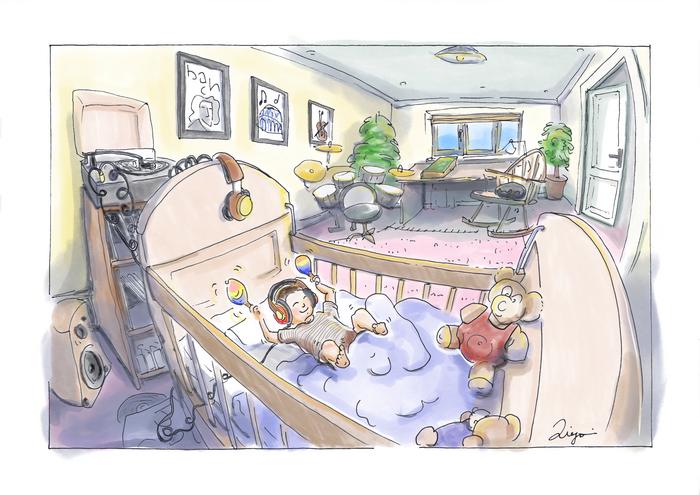
Newborns listening to Bach music predicted rhythm, but not melody, according to their brain waves
Credit: Diego Perez-Lopez, PLOS, CC-BY 4.0 (https://creativecommons.org/licenses/by/4.0/)
Babies are born with the ability to predict rhythm, according to a study published February 5th in the open-access journal PLOS Biology by Roberta Bianco from the Italian Institute of Technology, and colleagues.
It’s anticipating a beat drop, key change or chorus in a song you’ve never heard. Across all cultures, humans can inherently anticipate rhythm and melody. But are babies born with these behaviors, or are they learned? Research shows that by approximately 35 weeks of gestation, fetuses begin to respond to music with changes in heart rate and body movements. However, newborns’ ability to anticipate rhythm and melody is not fully understood.
To understand babies’ musical aptitudes, researchers played J.S. Bach’s piano compositions for an audience of 49 sleeping newborns. Musical stylings included 10 original melodies and four shuffled songs with scrambled melodies and pitches. While the babies listened, the researchers used electroencephalography — electrodes placed on the babies’ heads — to measure their brainwaves. When the babies’ brain waves showed signs of surprise, it meant they expected the song to go one way, but it went another.
The newborns tended to show neural signs of surprise when the rhythm unexpectedly changed; in other words, the miniature maestros had generated musical expectations based on rhythm. Previously, this result had been observed in non-human primates. The researchers found no evidence that the newborns tracked melody or were surprised by unexpected melodic changes, a skill that comes at an unknown exact point later in development.
According to the authors, understanding how humans become aware of rhythm can help biologists understand how our auditory systems develop. Future studies can investigate how exposure to music during gestation affects acquisition of rhythm and melody.
The authors add, “Are newborns ready for Bach? Newborns come into the world already tuned in to rhythm. Our latest research shows that even our tiniest 2-day old listeners can anticipate rhythmic patterns, revealing that some key elements of musical perception are wired from birth. But there’s a twist: melodic expectations—our ability to predict the flow of a tune—don’t seem to be present yet. This suggests that melody isn’t innate but gradually learned through exposure. In other words, rhythm may be part of our biological toolkit, while melody is something we grow into.”
In your coverage, please use this URL to provide access to the freely available paper in PLOS Biology: https://plos.io/3Nk3IG7
Citation: Bianco R, Tóth B, Bigand F, Nguyen T, Sziller I, Háden GP, et al. (2026) Human newborns form musical predictions based on rhythmic but not melodic structure. PLoS Biol 24(2): e3003600. https://doi.org/10.1371/journal.pbio.3003600
Author countries: Italy, Hungary, Germany
Funding: R.B. is funded by the European Union (MSCA, PHYLOMUSIC, 101064334, https://marie-sklodowska-curie-actions.ec.europa.eu/). G.N. and F.B. are funded by the European Research Council (ERC, MUSICOM, 948186, https://erc.europa.eu/homepage). T.N. is funded by the European Union (MSCA, SYNCON, 101105726, https://marie-sklodowska-curie-actions.ec.europa.eu/). B.T., G.P.H., and I.W. are funded by the Hungarian National Research Development and Innovation Office (ANN131305, FK139135, and K147135, respectively, https://nkfih.gov.hu/english-nkfih). The funders did not play any role in the study design, data collection and analysis, decision to publish, or preparation of the manuscript.
Growth trajectories in infants from families with plant-based or omnivorous dietary patterns
JAMA Network Open
About The Study:
In this cohort study, infants from vegan households had growth patterns similar to those from omnivorous households, with a higher odds of early underweight that decreased by age 24 months. In the context of developed countries, these findings seem reassuring. Further research should examine vegan diet quality and the impact of nutritional counseling during pregnancy and infancy in supporting optimal infant development.
Corresponding Author: To contact the corresponding author, Kerem Avital, MPH, email kerema@post.bgu.ac.il.
Editor’s Note: Please see the article for additional information, including other authors, author contributions and affiliations, conflict of interest and financial disclosures, and funding and support.
# # #
Embed this link to provide your readers free access to the full-text article
About JAMA Network Open: JAMA Network Open is an online-only open access general medical journal from the JAMA Network. On weekdays, the journal publishes peer-reviewed clinical research and commentary in more than 40 medical and health subject areas. Every article is free online from the day of publication.

No comments:
Post a Comment