Sunday, March 13, 2022

IF DRUGS ARE BANNED AS PERFORMANCE ENHANCERS WHAT ABOUT FOOT TECHNOLOGY

Controversial Nike Vaporfly running shoes slash female athletes’ personal best times more than men’s
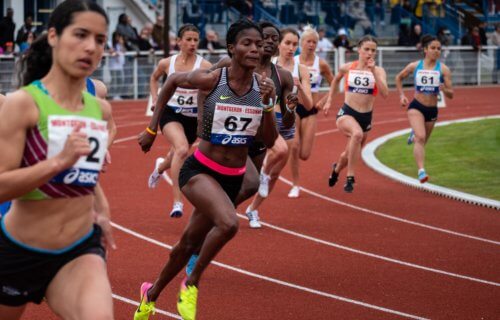
MONACO — New state-of-the-art running shoes have enabled female elite long-distance athletes to improve their personal best times more than male athletes, research reveals. Top runners, particularly women, have reduced their best times by up to three percent since the introduction of the controversial Nike “advanced shoe technology” five years ago, according to the findings.

When Nike introduced the shoes in 2017, the question arose whether the new design would significantly affect performances in professional sports. The study finds that the footwear did indeed reduce running times for elite competitors.

Researchers analyzed seasonal best times for elite male and female runners over three race distances — ten kilometers, half-marathon, and marathon races — between 2012 and 2019. They found a statistically significant decrease in race times after 2017, which coincided with the premiere of the Nike Vaporfly 4% shoe.

Female athletes appeared to gain the most benefit from the new design, which features a thicker, lighter foam and a rigid plate along the midsole. Their seasonal best times between 2016 and 2019 decreased anywhere from 1.7 to 2.3 percent, compared to 0.6 to 1.5 percent for the men. For example, the new shoe technology improved women’s marathon times by about two minutes and ten seconds, a 1.7 percent boost in performance.

“As far as chronometric performance is concerned, it is in our opinion a major advancement,” says study lead author Dr. Stéphane Bermon, director of the World Athletics Health and Science Department in Monaco, in a statement. He says the mechanics behind the improvements in performance remain something of a mystery.

Why are Nike Vaporfly running shoes controversial?

Dr. Bermon explains that one advantage of the new shoe technology is that it uses the latest generation of lightweight foam in the midsole, which provides the runner with a higher energy return. The embedded stiff plate in the midsole also contributes to maximizing energy return in each step: The shoe works to propel the runner forward with a little less effort.

The statistical gender gap was unexpected, Bermon admits. One advantage could come down to weight differences between the sexes. “Women are lighter and could possibly benefit more from the enhanced rebound effect achieved by the foam/stiff plate combination. Their slightly different running pattern, compared to men, could represent a more favorable condition for this footwear technology to play its ergogenic role,” he says.

A statistical analysis conducted in 2018 had already suggested a three to four percent decrease in half marathon and marathon race times based on hundreds of thousands of self-reported results. However, the present study was the first to look at the top seasonal best times for elite athletes.

While the research included a majority of results from East African runners, including Ethiopian and Kenyan athletes, who have come to dominate the sport, the study notes that non-East-African elite runners enjoyed similar improvements in performance. “These results confirm that advanced footwear technology has benefits to the elite male and female distance runners,” Dr. Bermon says.

“Whether this technology will be banned or simply controlled, as it is currently, is still to be decided by World Athletics,” he adds. He says further research is needed to understand whether mass adoption of the new footwear by both recreational and elite runners causes more or fewer injuries.

The study is published in the journal Frontiers in Sports and Active Living.

SWNS writer Stephen Beech contributed to this report.

End of the office? 1 in 3 won’t consider a new job unless they can work remotely

NEW YORK — The pandemic has fundamentally changed the American workweek, a new study reveals. In fact, only one in 15 remote workers expects to be back in an office for five days a week.

In a recent survey of 2,000 fully remote or hybrid-remote employees, more than a third (35%) say they wouldn’t even consider a new job unless it includes the option to work remotely.

Don’t fix what’s not broken

More than three-quarters have found simple pleasures in working from the comfort of their home. That includes more frequent coffee or snack breaks (54%), extra time with family (51%), the casual dress code (50%), and more comfortable seating (50%).

Conducted by OnePoll on behalf of Rippling, the survey also finds that more workers still prefer some time in an office. In all, 39 percent preferring a hybrid work environment, compared to 24 percent who prefer working completely remote.

While employees in tech or computer science are the most excited for a hybrid role (50%) however, arts and entertainment employees would rather be completely in-office (54%).

Future Work

Remote work isn’t always rosy

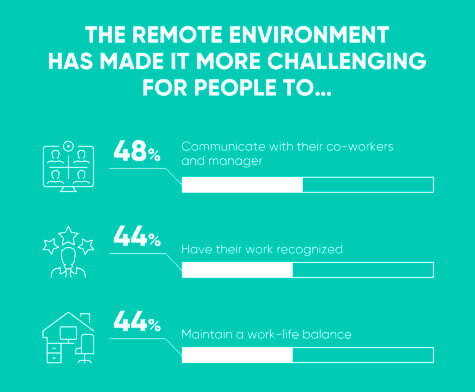
Despite the benefits and comforts of remote work that many respondents cited, it does come with challenges. The remote environment has made it more challenging for people to communicate with their co-workers and manager (48%), have their work recognized by their peers (44%), and maintain a work-life balance (44%).

These challenges can be particularly apparent when workers leave or start new roles remotely. This is important for employers in a tight market to consider, because eight in 10 remote workers believe they can predict whether they’ll like a new job based on the onboarding process.

Respondents identified some problems they’ve faced while starting and onboarding with a new job from afar. Seven in 10 find it a hassle to obtain the necessary software and office equipment, and the same amount say getting to know their co-workers and manager is now more difficult.

Employees who’ve transitioned to a new team within the same company have also faced difficulties, including staying in touch with their former colleagues and manager (70%).

“For the foreseeable future, companies will need to find ways to support a distributed workforce, but it’s still a heavy lift for many organizations. For example, oftentimes companies struggle to onboard a remote employee, whether it’s sending them a computer or enrolling them in the proper benefits,” says Rippling’s VP of Human Resources Christine Maxwell in a statement. “This survey makes clear that companies need to adapt and find modern solutions to support their workforce.”

Future Work

What do employees want?

The Great Resignation has brought on great expectations for people in the workforce, with seven in 10 employees revealing they expect reimbursement for certain expenses. More than a third expect to be reimbursed for office furniture, and half would expect the company to pay for additional software that facilitates remote working.

“Companies must continue to adjust to this new normal and catch up to the new needs within a business. It’s a struggle for companies to simply collect a laptop when a remote employee departs the company. That didn’t exist when everyone was in the office five days a week,” adds Maxwell.


“Today businesses can automatically store, ship and retrieve employee computers with a click of a button. There are dozens of different problems that you can easily automate, and taken together, improve the experience for your employees and make a significant impact on the business.”

BONES FOR BONERS
ANCIENT HUMANS LOST THEIR PENIS BONE FOR A COUNTERINTUITIVE REASON


Penis bones are found in certain species of mammal, but not all.


MATILDA BRINDLE


ONE OF THE WEIRDEST and most wonderful products of evolution is the penis bone or baculum. The baculum is an extra-skeletal bone, which means it is not attached to the rest of the skeleton but instead floats daintily at the end of the penis. Depending on the animal, bacula range in size from under a millimeter to nearly a meter long, and in shape, varying from needle-like spines to fork-like prongs.

The walrus baculum, which could easily be mistaken for a 2ft-long club, is around 1/6th of its body length, whereas the diminutive centimeter-long baculum of the ring-tailed lemur is only around 1/40th of its body length.

Bacula is found in certain species of mammal, but not all. Most primate males have a baculum, so humans are rather an oddity in that they don’t have one. In a handful of extraordinary circumstances human males have formed bones in the soft tissue at the end of their penises, but this is a rare abnormality, rather than a baculum.

In a study published in 2016 in Proceedings of the Royal Society B, my colleague Kit Opie and I examined how the baculum developed in mammals by studying how it is distributed across different species in light of their pattern of descent (known as phylogenetics).

We showed that the baculum first evolved after placental and non-placental mammals split, around 145 million years ago, but before the most recent common ancestor of primates and carnivores evolved, around 95 million years ago. Our research also shows that the common ancestor of primates and carnivores had a baculum. This means that any species in these groups without a baculum, such as humans, must have lost it over the course of evolution.

So, why on Earth would an animal need a bone in its penis in the first place? Scientists have come up with a few theories as to why a baculum might be handy. In certain species, such as cats, a female’s body doesn’t release its eggs until she mates, and some argue that the baculum may help to stimulate females and trigger ovulation. Another, somewhat colorfully named, theory is the vaginal friction hypothesis. This essentially argues that the baculum acts as a shoehorn, enabling a male to overcome any friction and squeeze himself into a female.


Is that it?Shutterstock

Finally, it has been proposed that the baculum helps prolong intromission, otherwise known as vaginal penetration. Far from simply being a nice way to spend an afternoon, prolonging intromission like this is a way for a male to prevent a female from sneaking off and mating with anyone else before his sperm have had a chance to work their magic. This theory brings a whole new meaning to the term “cock-blocking”.

We found that, over the entire course of primate evolution, having a baculum was linked to longer intromission durations (anything over three minutes). On top of this, males of primate species with longer intromission durations tend to have far longer bacula than males of species where intromission is short.

Another interesting discovery was that males of species facing high levels of sexual competition for females have longer bacula than those facing lower levels of sexual competition.

But what about humans? If the penis bone is so important in competing for a mate and prolonging copulation, then why don’t we have one? Well, the short answer to that is that humans don’t quite make it into the “prolonged intromission” category. The average duration from penetration to ejaculation for human males is less than two minutes.

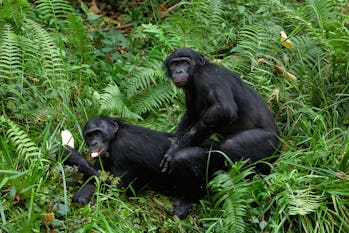
But bonobos only copulate for about 15 seconds at a time and they still have a baculum, even if it is very small (about 8mm). So what makes us different? It’s possible that this comes down to our mating strategies. Human males (generally) have minimal sexual competition as females typically only mate with one male at a time. Perhaps the adoption of this mating pattern, in addition to our short intromission duration, was the last straw for the baculum.

Scientists are only just beginning to piece together the function of this most unusual bone. What seems to be clear is that changes in the primate baculum are driven, at least partly, by a species’ mating strategy. The picture that seems to be emerging is that, under high levels of sexual competition, bigger is better when it comes to the penis bone.

This article was originally published on The Conversation by Matilda Brindle at UCL. Read the original article here.

High-protein diets may decrease testosterone levels in men, leading to ED, fertility struggles

WORCESTER, England — Gym buffs who knock back protein shakes and devour lean meats are lowering their chances of having kids, warns a new study. Following a high-protein diet may reduce men’s testosterone levels, which can lead to erectile dysfunction and low sperm counts, say scientists.

Men who are looking to build muscle or lose weight are often encouraged to consume large amounts of lean meats, fish and protein shakes. But now scientists at the University of Worcester say pilling on the protein could cost them dearly, decreasing their testosterone levels by more than a third.

Cutting out carbs, which has become increasingly popular with celebs like Kim Kardashian, also comes at a price, the researchers report.

“Most people eat about 17 percent protein, and the high protein diets which caused low testosterone were all above 35 percent, which is very high,” says lead researcher Joseph Whittaker, a doctoral student at the university, in a statement per South West News Service. “So for the average person, there is nothing to worry about, however for people on high protein diets, they should limit protein to no more than 25 percent.”

Not having enough testosterone has also been linked to chronic diseases like heart diseasediabetes and Alzheimer’s. In contrast, healthy testosterone levels are very important for strength, muscle building, and athletic performance.

Results from 27 studies involving a total of 309 men were compiled by the researchers. Those who followed a high protein, low carb diet had much lower levels of testosterone compared to others. Having more than 35 percent protein reduced testosterone levels by 37 percent, which is medically referred to as hypogonadism, the researchers found.

Too much protein and not enough carbs also increased cortisol, commonly known as the body’s stress hormone, which is released during the “so-called fight or flight” response. High levels of cortisol have been found to suppress the immune system, leaving people vulnerable to viral and bacterial infections like colds, flus and COVID-19.

Packing on the protein can also cause “rabbit starvation,” where the body turns too much protein into ammonia which is toxic at high levels. This condition, sometimes called “protein poisoning,” was first discovered by Roman soldiers who were forced to survive on rabbits during the siege of Villanueva del Campo. Many of them developed severe diarrhea and died.

“The finding that low carbohydrates diets increase cortisol is very interesting, as these diets have become incredibly popular over recent years, with many celebrities such as Kim Kardashian, LeBron James, and Meagan Fox, promoting them,” Whittaker says. “However further work needs to be done in this area, to know if this is necessarily bad.”

The findings are published in the journal Nutrition and Health.

Report by South West News Service writer Tom Campbell

BOOK EXCERPT
How a Nobel-winning biophysicist launched the career of the “Queen of Carbon”

Mildred Dresselhaus laid the foundations for countless advances in nanotechnology


By MAIA WEINSTOCK
SALON
PUBLISHED MARCH 13, 2022
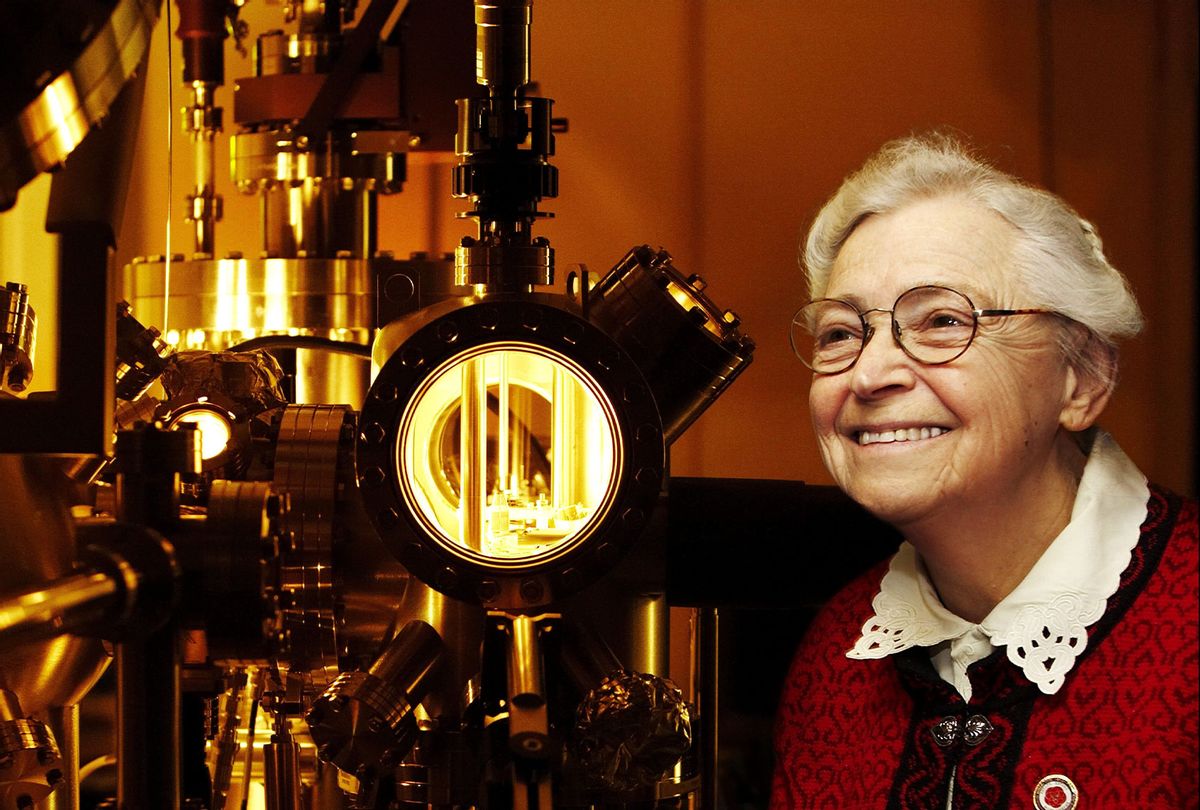
Dr. Mildred Dresselhaus with an ultra high vacuum surface analysis system for imaging and characterizing thin film organic and inorganic materials and devices in the soft semiconductor lab, Massachusetts Institute of Technology. Mildred Dresselhaus, USA, LOreal-UNESCO Award For Women in Science, 2007 Laureate for North America, 'For her research on solid state materials, including conceptualizing the creation of carbon nanotubes'. (Micheline PELLETIER/Gamma-Rapho via Getty Images)

Excerpt adapted from "Carbon Queen: The Remarkable Life of Nanoscience Pioneer Mildred Dresselhaus" by Maia Weinstock. Copyright 2022. Reprinted with permission from The MIT PRESS.

The late 1940s encompassed a unique period for women in science in the United States. After scores of women had entered scientific, technological, engineering, and mathematical fields for the first time to support the war effort, American women were routinely discouraged from pursuing STEM careers in the postwar era. Many top colleges and universities refused to admit women as students until the late 1960s or early 1970s. Women of color were particularly hard to find in labs and in scientific journals during the mid-twentieth century.

This was the climate in which Mildred "Millie" Dresselhaus found herself when she first enrolled as an undergraduate at Hunter College in New York City in 1948. Dresselhaus would eventually become a decorated MIT physicist, making highly influential discoveries about the properties of materials. Based on her far-reaching foundational research, scientists and engineers have made enormous advances at the nanoscale—discovering structures like spherical carbon "buckyballs," cylindrical carbon nanotubes, and 2D carbon sheets known as graphene that have made products from aircraft to cellphones stronger, lighter, and more efficient. But her rise to science stardom from humble beginnings was improbable, and Dresselhaus began her college experience with low expectations.

As a child, Dresselhaus had her fill of science inspirations, including issues of National Geographic she bought with pocket change, as well as books such as "Microbe Hunters," a dramatic account of medical victories by Paul de Kruif, and "Madame Curie," a biography of two-time Nobel laureate Marie Curie by her daughter, Eve Curie. There were also clandestine visits to the Hayden Planetarium, into which Dresselhaus would regularly sneak on account of being unable to pay admission.

Yet academic research was not something she could envision for long-term pursuits. Although she had earned high marks at a top magnet school for girls, she was told that only three career paths were open to her: teaching, secretarial work, and nursing. In fact, Dresselhaus' top priority entering college was to improve on the financial situation that her parents, poor immigrants from Eastern Europe, had struggled through during the Great Depression—a condition so dire that they sometimes had difficulty putting food on the table. In high school, Dresselhaus made great strides toward her goal by developing a lucrative tutoring business. And so, when she first enrolled at Hunter College, she planned to become a teacher. But what actually happened was a little more extraordinary.

With advanced standing due to strong high school grades, Dresselhaus thrilled to take on a healthy serving of electives, mostly in math and science, in her first year at Hunter. But things changed quickly for her as a sophomore. It was at this time that she met and instantly bonded with someone who would serve as a teacher, a role model, a friend, and even something of a mother figure during their many decades in contact.

An eminent exemplar

Rosalyn Sussman Yalow is best known as the second woman to win the Nobel Prize in Physiology or Medicine, a feat she accomplished in 1977 for her development of the radioimmunoassay technique, a way to use radioactive labeling to measure concentrations of biological and pharmacological substances in blood. (Yalow shared the Nobel with two others for unrelated work; her longtime collaborator, Solomon Berson, had died and was therefore ineligible for the prize.) The first woman to win the medicine prize, Gerty Cori, had done so exactly three decades earlier, when she shared the 1947 Nobel with her colleague (and husband) Carl Cori and with Argentine researcher Bernardo Houssay for their collective work on sugar metabolism.

For Yalow, the first American-born woman to win any Nobel in science, her path to success was like an ant's course to its nest—meandering but with a singular objective: translating her scientific acumen into a career focused on research. When Yalow met her future protégé, just two years after Cori received her Nobel in Stockholm, she was struggling to find a place for herself within the scientific community.

Yalow in fact had attended Hunter College a decade prior and in the process became the institution's first physics graduate. In an effort to pry open a door to a research career, she worked briefly as a secretary before following an opportunity to teach—and earn a PhD in nuclear physics—at the University of Illinois. But research positions remained largely closed to women—and Jews—during the mid-1940s, especially after World War II veterans returned from service. She eventually landed a full-time research position at what was then the Bronx Veterans Administration Hospital, where she would remain for the next four decades until her retirement. But prior to finding that research home, Yalow returned to her alma mater as a way to tread water while she figured out her next move. She served as an adjunct professor at Hunter for only a few years, but her timing was incredibly consequential for the trajectory of one student in particular. Were it not for Yalow and her star pupil overlapping for approximately sixteen months at a city college in the country's largest metropolis, the course of Dresselhaus' history would have been drastically different.

In February 1949, Dresselhaus enrolled in an introductory-level physics course that covered the basics in Yalow's specialty, nuclear physics. The class, she said, "totally knocked me over," and with enrollment in the single digits, student and teacher got to know each other well. They bonded immediately, in what Dresselhaus later described as "sort of love at first sight." While Dresselhaus found in Yalow a scientist who shared her passion for inquiry and provided strong academic and career encouragement, Yalow saw a bit of herself in the whip-smart Dresselhaus, who shared a drive to follow her academic interests, regardless of whatever rules—actual or understood—she had to bend in order to do so.

Yalow became a trusted mentor who would nurture Dresselhaus in ways large and small throughout her career. The strongest means of early support was encouraging her to forget teaching and pursue research. "She was the one who was most influential in leading me to attend graduate school and to go to the best schools and to study with the best scholars," Dresselhaus said of Yalow. "She [told] me that I could make it even though I was a woman, and she did warn me that the road ahead for women in science might be more difficult, but not to be deterred."

To supplement her course work, Yalow suggested that Dresselhaus attend colloquia hosted by the Columbia University Department of Physics, home to individuals like Willis Lamb and Polykarp Kusch, who would go on to share a Nobel Prize for work on electrons and hydrogen, and to Chien-Shiung Wu, an expert in radioactive decay whose monumental experiment on the conservation of parity would lead to a Nobel for two of her male colleagues. Yalow also invited Dresselhaus to her home on at least one occasion. "That was amazing; no other teacher ever did that," Dresselhaus said.

In truth, encourage may not be the most accurate word to describe Yalow's early support. According to Dresselhaus, once her mentor recognized her talent, she all but insisted that Dresselhaus change her plans for the future. "Rosalyn was quite a domineering person," she recalled after winning the prestigious Kavli Prize in 2012. "She just gave orders, and I pretty much did what she said." In a New York Times interview that same year, Dresselhaus said of Yalow, "You met her and she said, 'You're going to do this.' She told me I should focus on science. She left the exact science unspecified but said I should do something at the forefront of some area."

The two had different personalities. Dresselhaus was generally accommodating, quick to avoid confrontation, and always seeking places where she could quietly make a positive mark, whereas Yalow was singularly headstrong. This could be a positive attribute for someone striving for leadership, especially at a time when women were still seen as inferior to men in science (and many other realms). "She has to be that way," Dresselhaus explained to Yalow biographer Eugene Straus. "If she weren't that way she wouldn't be what she is today. That very strong focus. The world is gray, but she is able to make black and white out of it, and that's always helped her."

Yet when she took someone under her wing, as she did with Dresselhaus, Yalow was extremely loyal. "There are sides of Rosalyn that the public doesn't see but I've seen," Dresselhaus noted in a 2002 interview. As an example, Dresselhaus recalled that after college but still very early in her career, Yalow would, whenever possible, bring her husband, Aaron, to Dresselhaus' brief, ten-minute American Physical Society talks—along with shopping bags brimming with goodies. "She can be very motherly," Dresselhaus added.

Dresselhaus did take Yalow's exhortations to heart and changed her focus from education to physical sciences. Although she was fascinated with physics and chemistry, she continued as well with a strong mathematics course load and was seriously considering math as an alternate focus.

A scientist takes flight

Yalow left Hunter to pursue full-time research at the Bronx VA during Dresselhaus' junior year, but she encouraged Dresselhaus to apply for fellowships in research programs that would lead to graduate degrees. Of course, Dresselhaus was pulling her own weight, acing her courses and generally making it difficult for anyone without prejudice to turn her away.

With lavish praise from Yalow and other Hunter faculty, Dresselhaus secured several opportunities for advanced study as she neared graduation. She accepted a Fulbright fellowship in physics at Cambridge University in the UK and a spot in a graduate program at Radcliffe College.

On the evening of June 21, 1951, nearly a thousand young women and men gathered to celebrate the completion of their degrees earned at Hunter College. For most in the audience, the occasion marked the last stop in their formal education; for a rarefied few, it was just the beginning.

Dresselhaus was one of only five students in her class to graduate summa cum laude—with highest distinction. In her graduation program, she was listed with numerous honors. But perhaps the most memorable aspect of the day was her interaction with the ceremony's featured speaker: Mina Rees, director of mathematical sciences in the US Office of Naval Research and the future first female president of the American Association for the Advancement of Science (AAAS). After the ceremony, Rees congratulated Dresselhaus specifically. She passed on her strong approval of Dresselhaus' career plans, and encouraged her to continue with her studies. "It was," said Dresselhaus of the exchange, "a nice pat on the back."

Nearly four decades later, in 1990, Mildred Dresselhaus visited the White House to accept the U.S. Medal of Science from President George H.W. Bush, "for her studies of the electronic properties of metals and semimetals, and for her service to the nation in establishing a prominent place for women in physics and engineering." Yalow, her mentor, had won the award two years prior. In 1998, Dresselhaus followed in Rees' footsteps, becoming president of the AAAS, the ninth woman elected to that prestigious position. She would earn the nickname, "Queen of Carbon," for decades of work that expanded our understanding of materials, but she was equally known as a beloved professor who encouraged women and other underrepresented students in STEM.

As a budding scholar, Dresselhaus benefited greatly from the philosophy of her alma mater, Hunter College: "I learned a lot of things there, in terms of the responsibility of an individual to society, that it's not enough to only take, but you have to give," she said. In the give-and-take of academic mentorship, Dresselhaus received much from her interaction with the inspiring Rosalyn Yalow—and to the world she gave much in return.

Excerpt adapted from "Carbon Queen: The Remarkable Life of Nanoscience Pioneer Mildred Dresselhaus" by Maia Weinstock. Copyright 2022. Reprinted with permission from The MIT PRESS.

MAIA WEINSTOCK
Maia Weinstock is an editor, writer, and producer of science and children's media whose work has appeared in Scientific American, Discover, SPACE.com, BrainPOP, and Scholastic's Science World. She is Deputy Editorial Director at MIT News, a lecturer at MIT on the history of women in STEM, and creator of LEGO's “Women of NASA.”

ICYMI CTHULHU STUDIES

Octopus ancestors lived before era of dinosaurs, study shows

Octopus ancestors lived before era of dinosaurs, study shows
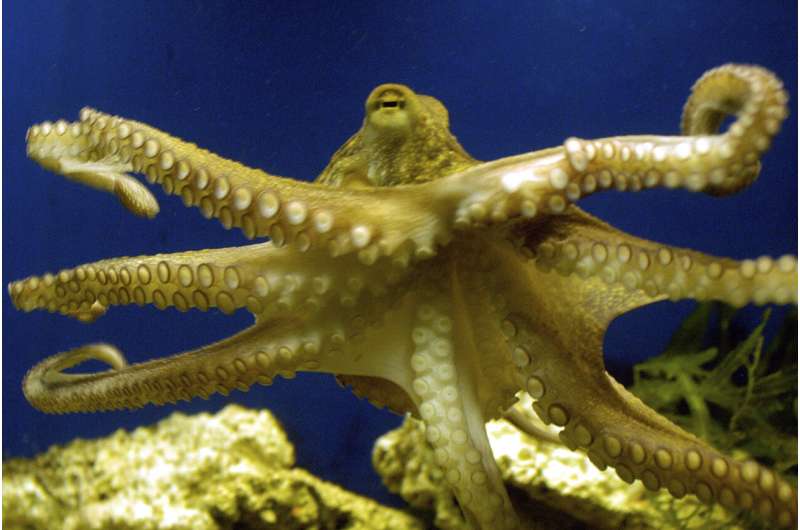
An octopus swims at the zoo in Frankfurt, Germany on Friday, Nov. 25, 2005. In research 
published Tuesday, March 8, 2022, in the journal Nature Communications, scientists have
 described the oldest known fossil ancestor of octopuses – an approximately
 330 million-year-old specimen found in Montana. Credit: AP Photo/Bernd Kammerer, File

Scientists have found the oldest known ancestor of octopuses – an approximately 330 million-year-old fossil unearthed in Montana.

The researchers concluded the  lived millions of years earlier than previously believed, meaning that octopuses originated before the era of dinosaurs.

The 4.7-inch (12-centimeter) fossil has 10 limbs—modern octopuses have eight—each with two rows of suckers. It probably lived in a shallow, tropical ocean bay.

"It's very rare to find soft tissue fossils, except in a few places," said Mike Vecchione, a Smithsonian National Museum of Natural History zoologist who was not involved in the study. "This is a very exciting finding. It pushes back the ancestry much farther than previously known."

The specimen was discovered in Montana's Bear Gulch limestone formation and donated to the Royal Ontario Museum in Canada in 1988.

For decades, the fossil sat overlooked in a drawer while scientists studied fossil sharks and other finds from the site. But then paleontologists noticed the 10 tiny limbs encased in limestone.

The well-preserved fossil also "shows some evidence of an ink sac," probably used to squirt out a dark liquid cloak to help to evade predators, just like modern octopuses, said Christopher Whalen, an American Museum of Natural History paleontologist and co-author of the study published Tuesday in the journal Nature Communications.

The creature, a vampyropod, was likely the ancestor of both modern octopuses and , a confusingly named marine critter that's much closer to an octopus than a squid. Previously, the "oldest known definitive" vampyropod was from around 240 million years ago, the authors said.

The scientists named the fossil Syllipsimopodi bideni, after President Joe Biden.

Whether or not having an ancient octopus—or vampire squid—bearing your name is actually a compliment, the scientists say they intended admiration for the president's science and research priorities.New species of extinct vampire-squid–like cephalopod is the first of its kind with ten functional arms

More information: Christopher Whalen, Fossil coleoid cephalopod from the Mississippian Bear Gulch Lagerstätte sheds light on early vampyropod evolution, Nature Communications (2022). DOI: 10.1038/s41467-022-28333-5. www.nature.com/articles/s41467-022-28333-5

Journal information: Nature Communications 

© 2022 The Associated Press. All rights reserved. This material may not be published, broadcast, rewritten or redistributed without permission.

EVEN CAVE PEOPLE LONGED FOR THE OLD DAYS: ANCIENT TOOL RECYCLING DRIVEN BY STONE-AGE SENTIMENTALITY

They just don't make hand axes like they used to.


By Cassidy Ward

Photo: Bar Efrati


Between comic book movies and the recent slate of live action adaptations of popular franchises from the ‘80s and ‘90s, nostalgia has become a multi-billion-dollar industry. Countless think pieces have explored why recent generations look back on the past so fondly, but the answer to that question might be older than we thought.

A recent study by Bar Efrati from the Department of Archaeology and Ancient Near East Cultures at Tel Aviv University, and colleagues, takes a hard look at flint tools crafted by prehistoric humans between 300,000 and 500,000 years ago. They found that ancient humans frequently recovered, restored, and recycled tools made by previous generations, not out of any sense of convenience, but because of nostalgia and sentimentality. Their findings were published in the journal Scientific Reports.

Scientists have known for a while that flint tools were reworked and reused at different times in the historical record. The best evidence for this behavior is a phenomenon known as double patina which, when found, clearly demonstrates the refashioning of the same piece of flint over time.

“In the case of flint, it basically creates a colorful layer which is different in texture, shine, and color from the actual color of the flint. It’s caused by sun exposure, running water, the properties of the flint itself, and the sediment it’s buried in,” Efrati told SYFY WIRE.

After a piece of flint is fashioned into a tool, its surface begins acquiring that patina. It might be used for a time and then discarded as the individual or group using it moves on. Sometime later, it might be found by another group or individual and reshaped. The reshaping process removes the patina in some places, revealing the natural surface of the flint again. When scientists find flint tools today, they can clearly see two distinct patina patterns, indicating that a tool was recycled.

Photo: Bar Efrati

What was previously unclear was why ancient humans were gathering and recycling old tools. One possible reason is pure convenience. Why build a tool from scratch, if there’s a pretty good one sitting in front of you that just needs a little cleaning up? Efrati indicated that convenience likely played a part in why prehistoric humans recycled tools, but probably wasn’t the main reason.

Another reason tools might be recycled is if raw materials are in short supply, but that wasn’t the case at the Revadim open-air site on the southern coastal plain of Israel, where this study was carried out. In fact, there is still a robust supply of fresh flint available at the site today.

“Revadim was rich with flint,” Efrati said. “Fresh flint was the main way they chose to make their tools. Recycling of old items was happening together with the making of fresh ones, but fresh tools were dominant in terms of quantity.”

The distribution of new versus recycled clearly demonstrates that the people in the area knew how to make new tools, had plenty of raw materials available, and preferred making new tools to recycling old ones. If it was truly more convenient to recycle an old tool then we might expect that to be the dominant form discovered at the site, but that isn’t the case.

“There was more than just the function that made them collect and use tools again. The sentimentality, the recognition of someone else making something. They chose to recycle them,” Efrati said.

Researchers also found that recycled tools were minimally reshaped. In most cases, individuals found tools which were already the right size and shape for what they needed, and the modifications were minor. The implication is not only that ancient peoples recognized and appreciated the work of their own ancestors, but they took pains to preserve the initial form of the tools as much as possible.

In some ways, it’s the ancient equivalent of watching your favorite childhood cartoons on the VHS tape you recorded off the family TV, complete with Super Soaker and Lunchables commercials because that’s the way they were meant to be seen.
LOOK UP!
WORM MOON: YOU NEED TO SEE THE LAST FULL MOON OF WINTER THIS MONTH


The harbinger of spring.
Shutterstock
ELIZABETH HOWELL


MARCH’S Full Moon falls just two days before spring arrives in the northern hemisphere. It will probably still be frosty outside in northern parts of the United States, but the Moon is still worth a few shivers for the view.

Watch for this month’s Worm Moon on March 18. If you’re clouded out or otherwise unavailable that night, the Moon will still look nearly full if you look at the sky the night before or the night after.

WHAT IS THE WORM MOON?

March’s Full Moon is most commonly called the Worm Moon, but there are a lot of spring-type names associated with this month’s Moon. Depending on the North American tribe tradition you follow, you may also call it the Crow Moon, the Crust Moon (referring to crusty, springtime snow), or the Sap or Sugar Moon (referring to the best time to harvest sap or sugar from trees).

As you can tell, the United States has a tradition of naming its Full Moons after the monikers from various Native American Tribes. These names became more widely known to non-Native Americans in the 1930s, when the Old Farmer’s Almanac began publishing weather forecasts and astronomical discussions for newer American settlers.

To be sure, different world cultures have different associations for the March Moon, so you may use another name for the Full Moon. Even the Worm Moon’s naming is very particular; NASA says that it was only the more southern United States tribes that called the March Full Moon a Worm Moon, which makes sense when you think about it. Worms can’t be active in frosty weather.


The positioning of the Sun, Moon, and Earth causes certain Moon phases throughout the month. NASA/JPL-Caltech

HOW TO SEE THE MARCH 2022 FULL MOON

The Full Moon reaches its peak brightness at 3:17 a.m. Eastern on Friday, March 18, which gives everyone a great astronomical treat at nightfall to enjoy during the weekend.

Full Moons stay above the local horizon all night, and with March’s still short days you’ll have many hours to enjoy the view. The Moon will appear nearly full the day before and the day after its official Full Moon phase, so if you’re lucky you might get a few nights of moongazing.

HOW MUCH BRIGHTER IS THE MOON DURING A FULL MOON?

Full Moons happen when the Moon, in its 27-day orbit around the Earth, arrives at a point in its path during where it’s directly opposite the Sun. Naturally, the Earth is in between the Sun and the Moon at this time, which can occasionally lead to a lunar eclipse. This time, however, the Sun’s light will flow around the Earth and fall upon the face of the Moon.

A Full Moon, at magnitude -12.92, is six times brighter than a Half Moon. You admittedly won’t see much else in the sky when the Moon is full. You will still spot bright stars such as Sirius (-1.46) and the various planets visible this month (such as Venus, Jupiter, and Saturn) — but the only thing outshining the Full Moon in our sky will be the Sun.

WHEN IS THE NEXT FULL MOON?

The Moon’s 27-day orbit is slightly less than the length of every Gregorian calendar month, the calendar system the United States and most other countries use. This timing oddity means that sometimes we can see more than one Full Moon in a month, and more than 12 Moons in a year. Neither will happen in 2022, though.

April’s single Full Moon will still be a fun show to watch. The Pink Moon reaches its peak on Saturday, April 16 at 2:55 p.m. Eastern.


Forget mammoths, study shows how to resurrect Christmas Island rats

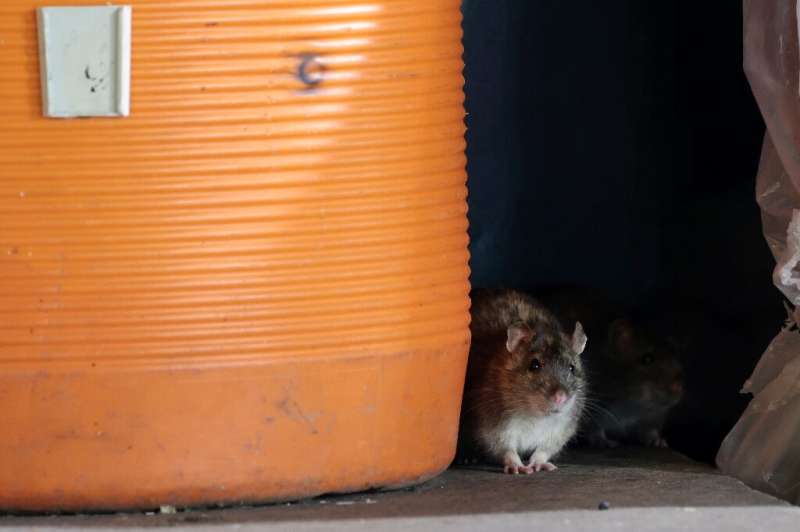
A team of researchers used the brown rat, commonly used in lab experiments and seen in this photo, as a modern reference species
A team of researchers used the brown rat, commonly used in lab experiments and seen in
 this photo, as a modern reference species to help reconstruct the genome of the extinct 
Christmas Island rat.

Ever since the movie Jurassic Park, the idea of bringing extinct animals back to life has captured the public's imagination—but what might scientists turn their attention towards first?

Instead of focusing on iconic species like the woolly mammoth or the Tasmanian tiger, a team of paleogeneticists have studied how, using gene editing, they could resurrect the humble Christmas Island rat, which died out around 120 years ago.

Though they did not follow through and create a living specimen, they say their paper, published in Current Biology on Wednesday, demonstrates just how close scientists working on de-extinction projects could actually get using current technology.

"I am not doing de-extinction, but I think it's a really interesting idea, and technically it's really exciting," senior author Tom Gilbert, an evolutionary geneticist at the University of Copenhagen, told AFP.

There are three pathways to bringing back extinct animals: back-breeding related species to achieve lost traits; cloning, which was used to create Dolly the sheep in 1996; and finally genetic editing, which Gilbert and colleagues looked at.

The idea is to take surviving DNA of an extinct species, and compare it to the genome of a closely-related modern species, then use techniques like CRISPR to edit the modern species' genome in the places where it differs.

The edited cells could then be used to create an embryo implanted in a surrogate host.

Gilbert said old DNA was like a book that has gone through a shredder, while the genome of a modern species is like an intact "reference book" that can be used to piece together the fragments of its degraded counterpart.

His interest in Christmas Island rats was piqued when a colleague studied their skins to look for evidence of pathogens that caused their extinction around 1900.

It's thought that black rats brought on European ships wiped out the native species, described in an 1887 entry of the Proceedings of the Zoological Society of London as a "fine new Rat," large in size with a long yellow-tipped tail and small rounded ears.

Key functions lost

The team used brown rats, commonly used in lab experiments, as the modern reference species, and found they could reconstruct 95 percent of the Christmas Island rat genome.

That may sound like a big success, but the five percent they couldn't recover was from regions of the genome that controlled smell and immunity, meaning that the recovered rat might look the same but would lack key functionality.

"The take home is, even if we have basically the perfect ancient DNA situation, we've got a really good sample, we've sequenced the hell out of it, we're still lacking five percent of it," said Gilbert.

The two species diverged around 2.6 million years ago: close in evolutionary time, but not close enough to fully reconstruct the lost species' full genome.

This has important implications for de-extinction efforts, such as a project by US bioscience firm Colossal to resurrect the mammoth, which died out around 4,000 years ago.

Mammoths have roughly the same evolutionary distance from modern elephants as brown rats and Christmas Island rats.

Teams in Australia meanwhile are looking at reviving the Tasmanian tiger, or thylacine, whose last surviving member died in captivity in 1936.

Even if gene-editing were perfected, replica animals created with the technique would thus have certain critical deficiencies.

"Let's say you're bringing back a mammoth solely to have a hairy elephant in a zoo to raise money or get conservation awareness—it doesn't really matter," he said.

But if the goal is to bring back the animal in its exact original form "that's never going to happen," he said.

Gilbert admitted that, while the science was fascinating, he had mixed feelings on de-extinction projects.

"I'm not convinced it is the best use of anyone's money," he said. "If you had to choose between bringing back something or protecting what was left, I'd put my money into protection."

Forget mammoths—These researchers are exploring bringing back the extinct Christmas Island rat
More information: Jianqing Lin, Probing the genomic limits of de-extinction in the Christmas island rat, Current Biology (2022). DOI: 10.1016/j.cub.2022.02.027. www.cell.com/current-biology/f … 0960-9822(22)00249-4
Journal information: Current Biology 
© 2022 AFP
REVEAL DIGITAL COLLECTIONS
The East Village Other

The East Village Other, a countercultural newspaper founded in 1965, published interviews with Timothy Leary and Allen Ginsberg.


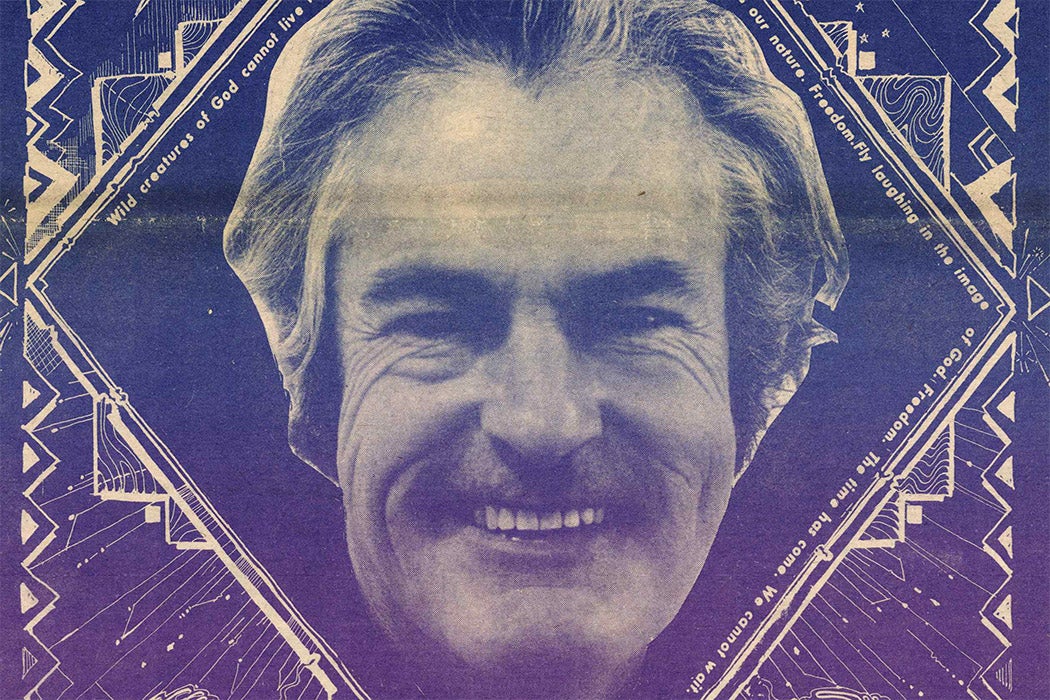
Timothy Leary on the cover of the September 15, 1970 issue of The East Village Other
via JSTOR

By: Jeremy Guida
June 3, 2021

The East Village Other (EVO) was founded in 1967 by a number of people who became well-known authors of the Underground Press: Allan Katzman, Walter Bowart, and John Wilcock. At its peak, the paper published 60,000 copies of individual papers. The EVO blends psychedelic interests with revolutionary politics. It regularly published interviews with Timothy Leary and Allen Ginsberg. It also became known for the sex ads that populated much of the back of the newspaper.

One regular column featured the images and biographies of East Village females. Titled “Slumgoddess,” the column regularly depicted scantily-clad (and often nude) images of local, sexually liberated and counterculturally inclined women. Although the subject of much controversy, Allan Katman felt that the sex ads in the back of the paper played an important role for the “lonely people of New York,” who relied on the paper for human companionship. The paper also became well-known for publishing underground comics. Well known artists like R. Crumb and Art Spiegelman published work with the EVO.

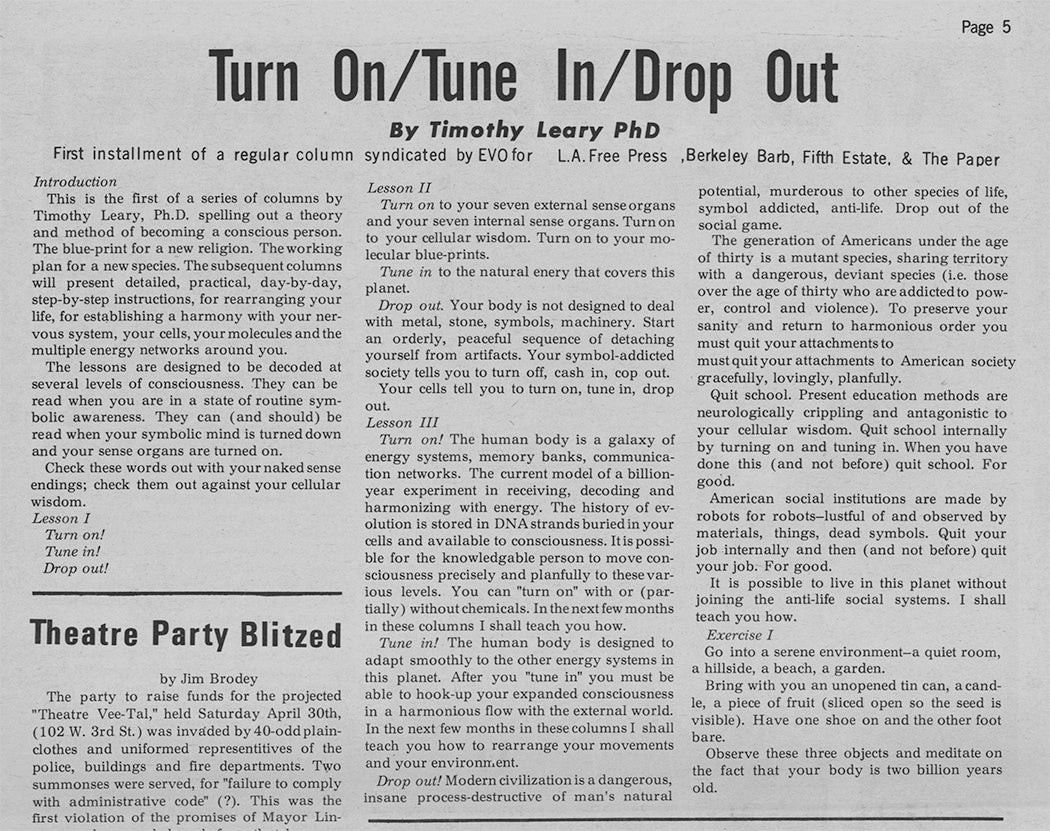
From Volume 1, Issue 12

The EVO was largely responsible for initiating the Underground Press Syndicate (UPS), a nation-wide syndication network that made it possible for papers in small towns to emerge all over the country. In May 1966, the East Village Other began a column that would be syndicated across the country in five other underground papers. Timothy Leary started the column “Tune in / Turn on / Drop out” in part to help his defense in a recent drug charge. Leary intended to help readers achieve consciousness expansion without the use of drugs. The column was short lived, but appears to have sparked the idea for the UPS. Allan Katzman suggested the more explicit idea for an underground syndicate in the EVO in June 1966. Walter Bowart of the EVO claimed to have come up with the name spontaneously. After seeing a United Parcel Service truck drive by during an interview he replied, “We’re… ah… UPS – the Underground Press Syndicate.”
The paper is an excellent resource for anyone studying the personalities and events characteristic of the American counterculture.

For a small fee, papers in the UPS could reprint any articles from any other members’ papers free of charge. This provided enough content for underground publishers in small cities and towns to produce a paper. The idea that editors could reprint any article from other member papers reflected a belief popular among underground authors and writers that copyright laws were obtrusive and out of date.

Because of the EVO’s longevity (it lasted until 1972), popularity, location, and role in the UPS, the paper is an excellent resource for anyone studying the personalities and events characteristic of the American counterculture. The EVO carried on a close relationship with Timothy Leary. As the counterculture was amping up in the late 1960s, Leary was finishing his time at the Millbrook estate in upstate New York where he was running “experiments” with LSD. The paper followed closely his numerous run-ins with the law, advertised on behalf of the campaign to raise bail when he was finally arrested, and when the Weather Underground broke Leary out of a California prison, the EVO announced on its cover, “Proud Eagle Flies Free.” (September 15, 1970).

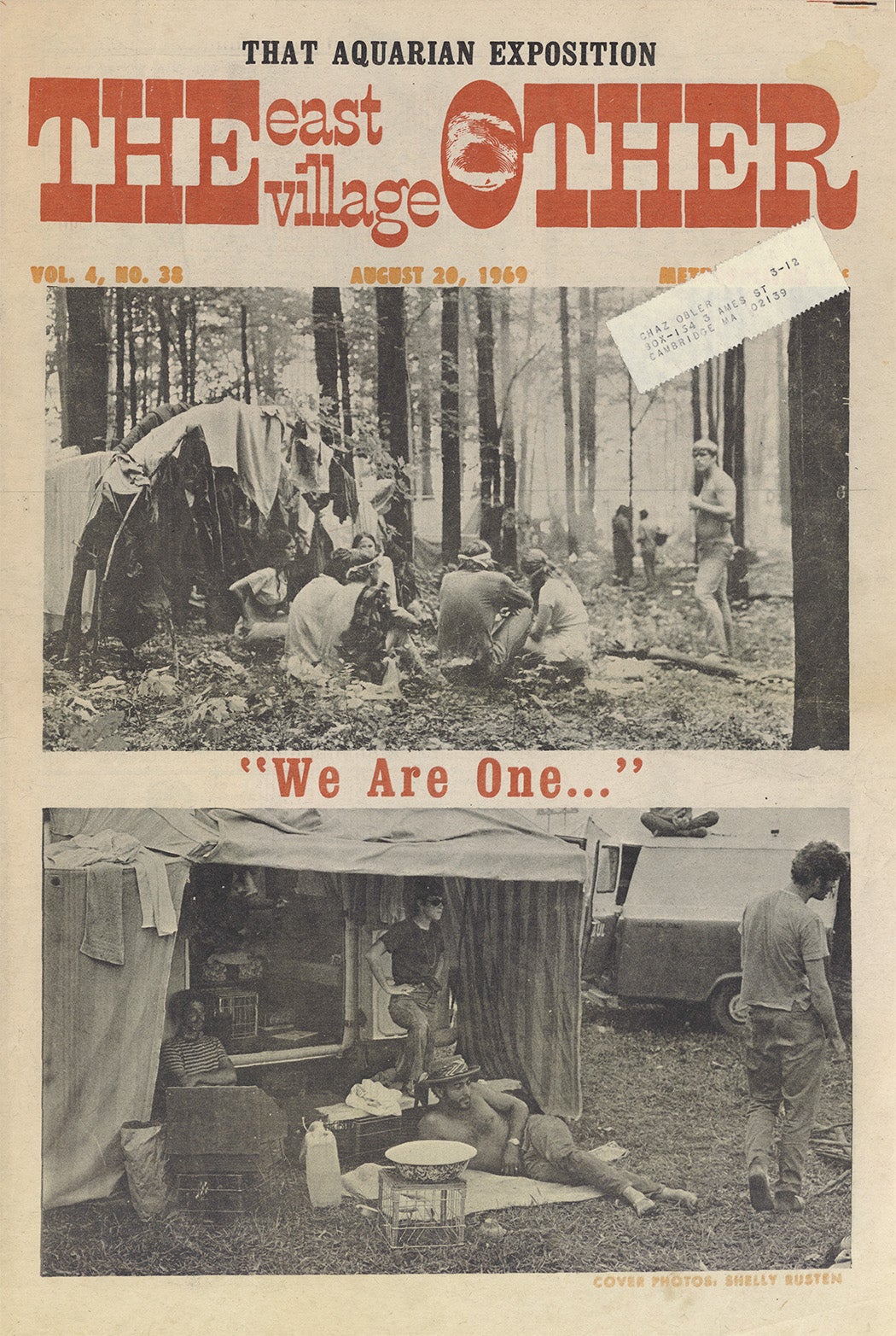
The cover of Volume 4, Issue 38

The EVO is also an excellent resource for documentation of countercultural events. Take the March on Washington, where tens of thousands of activists stormed and occupied the front steps of the Pentagon. The paper helped Ed Sanders, a member of the band The Fugs and an owner of the Peace Eye Bookstore, raise funds to perform the Exorcism of the Pentagon that took place at the march. Perhaps because of its proximity, the EVO advertised and documented to a greater extent than many other papers the best-known countercultural event, Woodstock, also known as “The Aquarian Exposition.” The paper printed advertisements for the festival and a thorough review of the event by John Hilgerdt (August 13, 1969, August 20, 1969). For Hilgerdt, Woodstock was only the beginning of a mass countercultural movement. He writes, “A few thousand of the absolutely most together and peaceful and beautiful heads in the world are gathered in a grand tribal new beginning… All the petty bullshit that before kept us apart vanished and for the first time we were free” (August 20, 1969, 7).

The EVO provides documentation of the activities of one of the most active countercultural communities in the US in New York’s East Village. Although there were remnants of the counterculture that lived on after the EVO had closed its doors, by the time the paper ceased publication, the countercultural movement had already begun to fade. Because the paper was one of the earliest underground papers, and because its lifespan covers the rise and fall of the counterculture, the paper is a good resource for gauging the general attitudes of the counterculture. It’s an excellent resource for those studying the aesthetics of the counterculture, especially comics, and its proximity to New York and role in the UPS make it an excellent reference for those interested in countercultural leaders and in many of the events that have become emblematic of the counterculture more generally. 

Read The East Village Other and other countercultural publications in the Independent Voices archive from Reveal Digital.

The East Village Other
By: Multiple Authors
Volume 1, Issue 12

The East Village Other
By: Multiple Authors
Volume 5, Issue 42

The East Village Other
By: Multiple Authors
Volume 4, Issue 38