Friday, June 10, 2022

Ukraine war sparks debate over Finland’s ‘Achilles heel’


The region's unique status is the object of intense debate since the Russian invasion of Ukraine - Copyright AFP/File TIMOTHY A. CLARY

Elias HUUHTANEN
By AFP
Published June 10, 2022

Sprayed between Sweden and Finland, the autonomous Aland Islands are a picturesque archipelago once part of Russia and demilitarised since 1856.

But the region’s unique status is the object of intense debate since Russia’s invasion of Ukraine rattled neighbouring Finland into applying for NATO membership in May.

Under international treaties signed after the Crimean War, no troops or fortifications can be placed on the strategic Baltic Sea islands.

“It is the Achilles’ heel of Finland’s defence,” Alpo Rusi, a professor and former presidential advisor, told AFP.

Home to about 30,000 mostly Swedish-speaking Finns, the area is characterised by rocky islands, lush green forests, old stone churches and wooden architecture — all under the watchful eye of a Russian consulate.

“We have always thought, ‘Who would want to attack us when we have nothing worth taking?’,” 81-year-old Ulf Grussner told AFP.

“But that has changed with Putin’s war on Ukraine”, said the pensioner, one of many here who want Aland to remain demilitarised.

In June, a poll showed 58 percent of Finns would approve of a military presence on Aland, which celebrated the 100th anniversary of its autonomy on Thursday.

“There is concern over whether Finland could react fast enough militarily in the event of a sudden intrusion on Aland,” Rusi said.

Armies wrestled for control of the archipelago in both World Wars.

“Why should we trust the idea … that troops would not rush to control Aland as fast as possible,” said Charly Salonius-Pasternak, a researcher at the Finnish Institute of International Affairs.

– Aland rejects troops –


Alanders, on the other hand, are keen to protect their special status and have so far firmly rejected the idea of ending the demilitarisation.

“Why should we change it? I think it’s a stabilising factor in the Baltic Sea area that we are demilitarised,” Veronica Thornroos, 59, premier of the Aland government, told AFP.

Besides, if the archipelago were attacked, Finland would defend it “very quickly”, she said.

The Finnish government has said it has no intention of touching Aland’s special status.

Sia Spiliopoulou Akermark, director of the Aland Peace Institute, meanwhile noted that the “Aland regime” of autonomy, cultural guarantees and demilitarisation is a “complex knot” that should be considered as a whole.

– Russian presence –


Like the rest of Finland, Aland was part of the Russian empire from 1809 to 1917.

At the time, the archipelago was viewed as an important outpost in the defence of Saint Petersburg and control of the Baltic Sea.

Finland gained independence from Russia in 1917, and was granted sovereignty over Aland in 1921 despite protests from the islands’ Swedish-speaking majority.

The Nordic country went on to fight two bloody wars against the Soviet Union during World War II.

As part of their peace deal, the demilitarisation of Aland was to be monitored by a Soviet consulate in the archipelago’s main town of Mariehamn.

The consulate still exists to this day, although it is now run by Russia.

A group of locals gather every day outside the high metal fence protecting the consulate, to protest Russia’s war in Ukraine.

“They have no business being here. Russia is always a threat”, one of the protestors, Mosse Wallen, 71, told AFP.

– Putin’s property –


Russia also owns a seaside property north of Mariehamn in Saltvik, which was acquired in the 1947 peace deal.

“They gave my mother three days to move out”, said Ulf Grussner, whose idyllic childhood home is now fenced in by the consulate.

Grussner’s father was a German geologist, and the peace deal stipulated that all German possessions in Finland were to be ceded to the Soviets.

In 2009, ownership of a piece of the property was transferred to the Russian presidency.

Concern has mounted in Finland in recent years over Russian property deals across the country.

Grussner feared that Russia might intend to use his family’s property and the demilitarisation as a “pretext” to increase its presence in the area.

“It is far-fetched, but on the other hand it’s not impossible,” he said.


POPULAR FRONT REDUX
French left seeks comeback against Macron in parliamentary polls


Issued on: 10/06/2022 - 


Jean-Luc Melenchon narrowly missed out on the second round of the April presidential vote but now leads the broad left-wing coalition NUPES 
Geoffroy VAN DER HASSELT AFP

Sainte-Genevieve-des-Bois (France) (AFP) – France's first left-wing alliance in 25 years is on a mission to block centrist President Emmanuel Macron's plans for pro-business reforms by winning a big chunk of seats in this month's parliamentary polls.

Hard-left firebrand Jean-Luc Melenchon narrowly missed out on the second round of the April presidential vote, but is determined for a rematch as he leads the freshly-formed New Ecological and Social Popular Union (NUPES) coalition into battle.

Comprising Melenchon's France Unbowed (LFI) party, as well as the Greens, Communists, and Socialists, the alliance deal hopes to thwart Macron's domestic agenda, in particular the plan to raise the retirement age to 65.

"Nothing was decided (in the presidential elections)," Melenchon told around 100 supporters at Sainte-Genevieve-des-Bois, a small town to the south of Paris, on Tuesday.

Macron beat far-right leader Marine Le Pen in the second round with 58.55 percent of the vote, but Melenchon and his allies argue many voters backed Macron in the second round just to stop the far-right from acceding to power.

Immediately after the second round, Melenchon asked voters to elect him prime minister by handing him a majority in the parliamentary polls, a two-round election on June 12 and 19.

A majority of seats for NUPES would force a clunky "cohabitation" -- where the prime minister and president hail from different factions.

For the past two decades, elected presidents have avoided such a scenario and been rewarded with a majority of the 577 seats in the lower-house National Assembly.

-'End hell'-

But an opinion poll published Thursday shows Macron's alliance Ensemble (Together) winning between 260 and 300 seats, potentially falling short of an absolute majority, for which 289 seats are needed.

According to the Ipsos Sopra Steria poll, NUPES may win between 175 and 215, turning the left coalition into the main force of opposition to Macron.

"There is a need for change," said a Socialist city councillor who asked not to be named at the meeting in Sainte-Genevieve-des-Bois.

"The NUPES in power would bring a breath of fresh air -- the voice of working class areas, of young people," she added.

Held in a park surrounded by social housing, the meeting with Melenchon in Essonne aimed to whip up support for NUPES candidates in a department where the parties now part of the coalition failed to win any constituencies in 2017.

"He (Melenchon) speaks with the heart, he goes straight to the point," Ali, 52, who asked for his last name not to be used, told AFP. He lives in the area and defines himself as "an immigrant but also French".

"What we offer is another vision of the world, of society," Melenchon told supporters in Paris last week.

"I'm not saying we will create a paradise from one day to the next, but I guarantee we will immediately put an end to hell," he added.

-'Gaul Chavez'-

The French perceive Melenchon as having "all the criteria of a populist candidate: a discourse that speaks to them tinged with demagogy," said head of studies for the Paris-based think tank Jean Jaures Foundation Jeremie Peltier in a report.

"Jean-Luc Melenchon is a Gaul Chavez," Finance Minister Bruno Le Maire recently told French daily Le Figaro, referring to Venezuela's since deceased leader Hugo Chavez.


The NUPES left-wing coalition is made up of Melenchon's France Unbowed party, the Greens, Communists and Socialists 
Sameer Al-DOUMY AFP/File

The former Marxist came under fire this week for tweeting "the police kill", after officers shot a woman dead in a car in northern Paris Saturday after the vehicle failed to stop when summoned by officers.

But Melenchon defended his comments and congratulated himself for sparking debate on the use of force by the police in France through what he said was a deliberately provocative tweet.

Criticism of Melenchon also emanates from the left, in particular from some of his former Socialist colleagues -- despite the presence of the Socialist Party (PS) in the coalition.

Melenchon left the PS in 2008 to form his own movement, the Left Party, and his rise on the left has been a bitter pill to swallow for some in his former party, attached to a left-of-centre politics at odds with Melenchon's radical brand.

In the context of a "low intensity campaign", abstention will play a crucial role in the vote, said political sociologist Vincent Tiberj from Sciences Po Bordeaux University.

"When an election fails to mobilise people, it affects those who only vote occasionally -- such as the working classes and the young -- and thus voters of the far-right National Rally and NUPES," he added.

© 2022 AFP

Lost photos from Spanish civil war reveal daily life behind anti-fascist lines

Rediscovered work by two Jewish women has gone on display in Madrid for first time

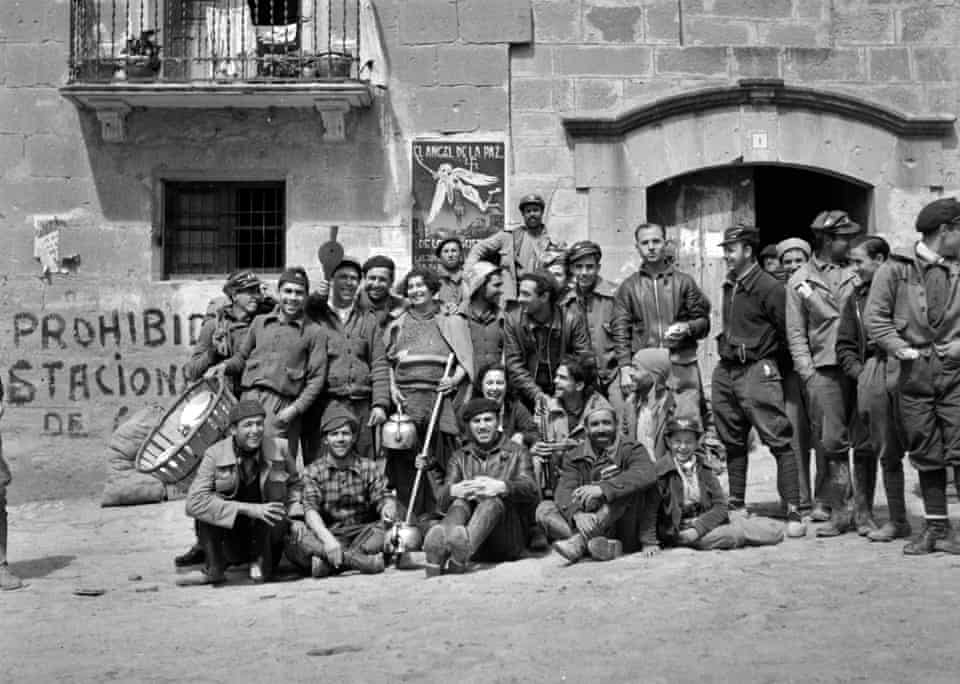
Anarchist Fighters Aragón, March 1937
. Photograph: Kati Horna / IISH / Ministerio de Cultura y Deporte. Centro Documental de la Memoria Histórica

by Guy Lane
Fri 10 Jun 2022

Photographs by two Jewish female photographers who worked behind anti-fascist lines during the Spanish civil war have gone on display in Madrid after 80 years. For decades the negatives and prints, many of which have never been published, were believed to be lost or destroyed. They are now on show in the capital for the first time.

As the Spanish civil war neared a conclusion in 1939, anarchists of the Confederación Nacional del Trabajo and Federación Anarquista Ibérica (CNT-FAI) fighting in Barcelona took steps to preserve records of their struggle and achievements. Apprehensive of the war’s outcome, they sealed documents and 2,300 photographs, 5,000 negatives and almost 300 photographic plates in 48 wooden crates, which they smuggled out of the city away from the fascist bombardment, destined for the safe haven of the International Institute of Social History (IISH) in Amsterdam.


Barcelona, 1936.
 
Photograph: Margaret Michaelis / IISH / National Gallery of Australia

Years later, having travelled via Paris, Harrogate and Oxford, the crates, known as the Amsterdam boxes, duly arrived. They remained sealed while the anarchists pursued undercover lives during the decades of the Franco regime. When they were finally opened in the 1980s the records and documents inside were inventoried but the photographic material was overlooked.


One of the Amsterdam boxes on display in Madrid

Now, thanks to the detective work of the art historian and curator Almudena Rubio, who has been researching the IISH archive since 2015, it has become possible to identify the output of two foreign photographers, both Jewish women, who travelled to Spain to take sides in the war: Margaret Michaelis, of Polish-Austrian descent, and Kati Horna, from Hungary and a friend of the photojournalist Robert Capa, a compatriot.


Anarchist fighters. Photograph: Margaret Michaelis / IISH / National Gallery of Australia

Michaelis had studied photography in Vienna in the 1920s and went on to work in Berlin until she and her husband, a prominent anarchist, were arrested on separate occasions by the Nazis.

After his release, the couple moved to Barcelona in 1933, where she established her own studio and worked as a portraitist and advertising and architecture photographer.


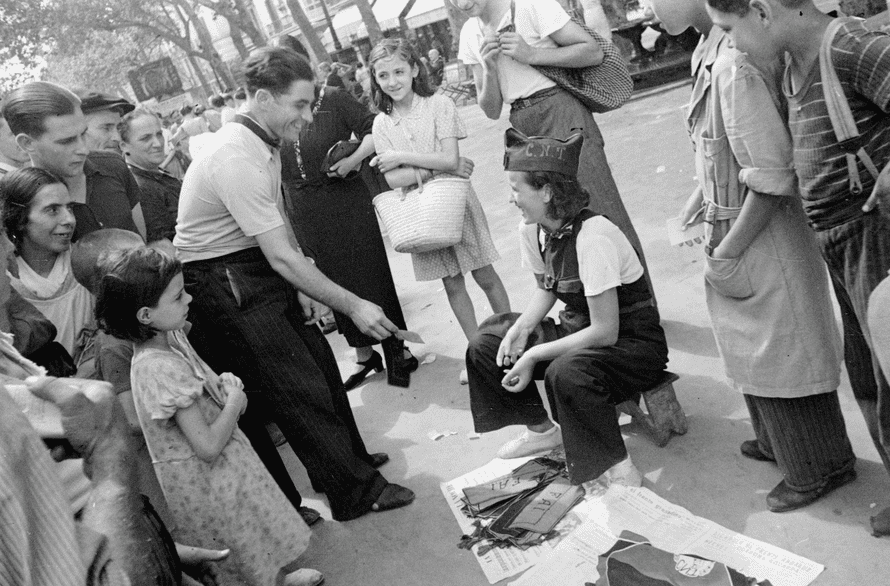
C
NT-FAI street activity in Barcelona, 1936
Photograph: Margaret Michaelis / IISH / National Gallery of Australia

After the outbreak of the civil war Michaelis worked for the foreign propaganda office of the anarchists and contributed pictures to the newly established propaganda commissariat of Catalunya, which sought to maintain morale while encouraging anti-fascist action.


Emma Goldman visits Albalate de Cinca in Aragón. 
Photograph: Margaret Michaelis / IISH / National Gallery of Australia

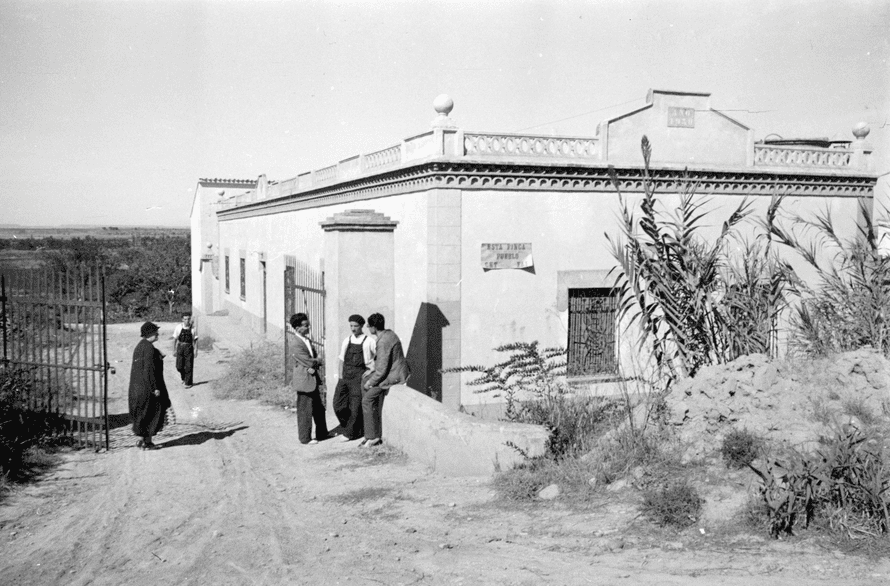
Among Michaelis’s newly published pictures, all shot with a Leica, are scenes of street actions in Barcelona by anarchist militants; views of daily life in Albalate de Cinca and Valencia; reportage from a visit to L’Alcora, a village that had abolished the use of money; rare photographs of the veteran anarchist Emma Goldman (memorably branded by J Edgar Hoover “the most dangerous woman in America”); and the arrival of the British Red Cross in Portbou.


A collectivised church in Aragón converted into a carpentry workshop. 
Photograph: Kati Horna / IISH / Ministerio de Cultura y Deporte. 
Centro Documental de la Memoria Histórica

As Michaelis left Spain, Horna arrived in January 1937. She, too, was a trained photographer, and had left Germany in 1933. On arrival in Spain after four years in Paris, she committed herself to the social revolution, working for the foreign propaganda office of the anarchists.
 
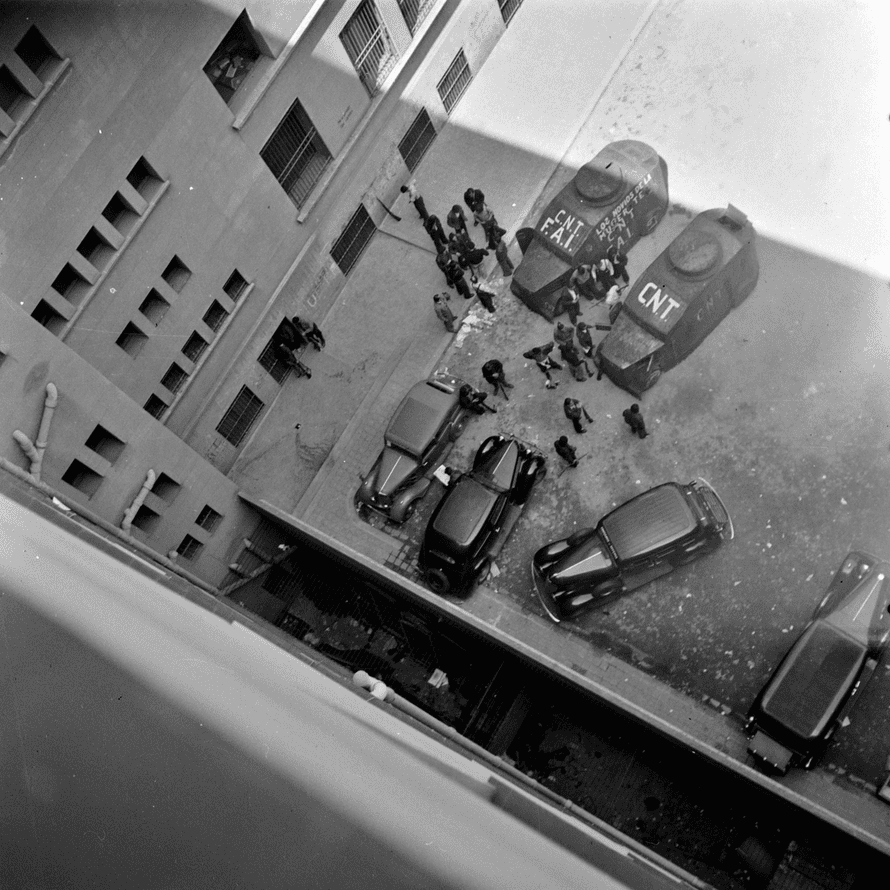
Anarchist vehicles of the CNT-FAI in Barcelona, 1937.

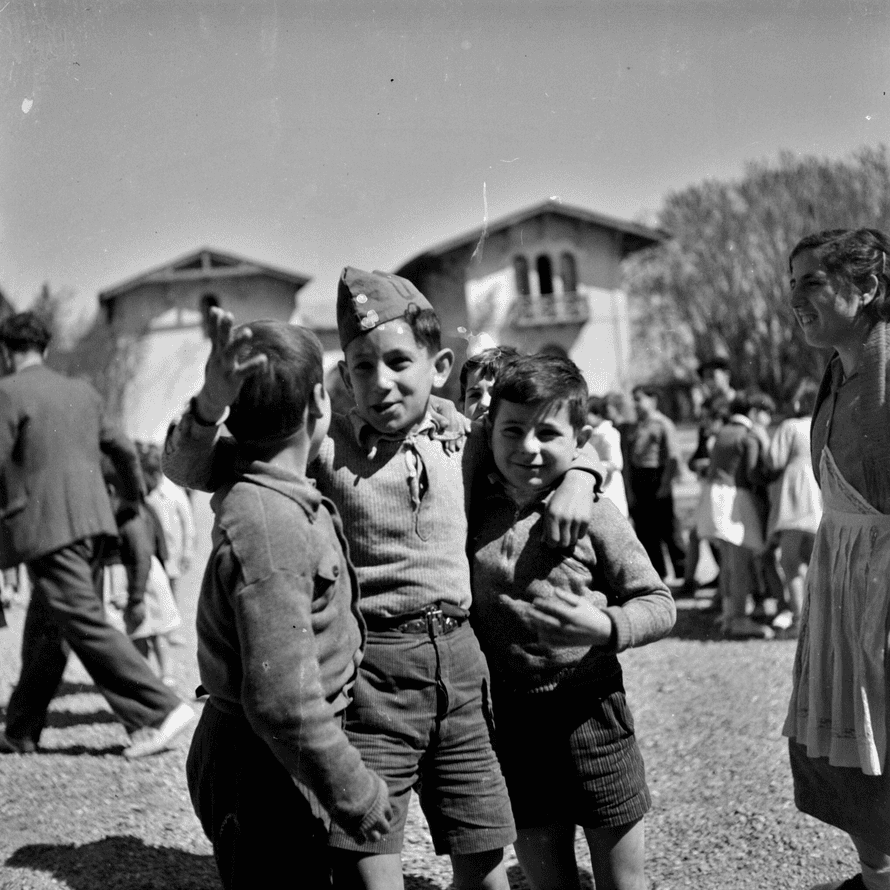
Children in Barcelona, 1937. 
Photographs: Kati Horna / IISH / Ministerio de Cultura y Deporte. 
Centro Documental de la Memoria Histórica

She soon established herself as the official photographer of the SPA, an anarchist photo agency, and her pictures were published in such anarchist titles as Umbral, Mujeres Libres and Tierra y libertad.

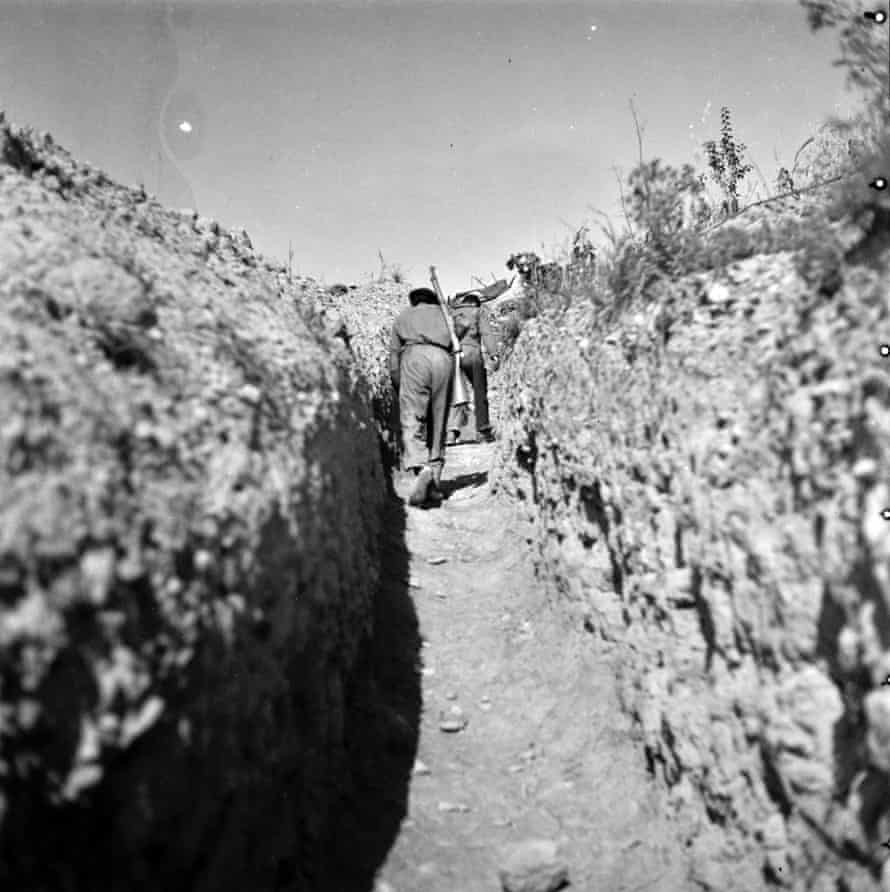
Horna’s work, like Michaelis’s, was designed to support the social revolution and counteract Francoist propaganda that attempted to discredit the anti-fascist movement. Rolleiflex in hand, she visited a camp set up to look after children removed from the war zone; she recorded humane and sanitary conditions in a prison in Modelo; she pictured a collectivised church in Aragón converted into a carpentry workshop; she saw villagers having free haircuts at a collectivised barbershop; she scrambled through a trench on the Aragón front.

Rubio, whose painstaking research has unearthed the photographs, has no doubts about their importance. “The legacy of the work of Michaelis and Horna is unique, precisely because it shows us the rearguard revolutionary experience, neglected by official historiography, that was instigated by the anarchists of the CNT-FAI. At the same time, it allows us to reconstruct in more detail the life of the two photographers during the civil war, and better to appreciate their work in antifascist Spain.”


In the trenches on the Aragón front,f
ighters on the Aragón front, 1937. 
Photographs: Kati Horna / IISH / Ministerio de Cultura y Deporte. Centro Documental de la Memoria Histórica


Both photographers believed their work had been lost or destroyed in the ruins of Franco’s bombs. Now, for the first time, the pictures are seeing the light of day.

The Amsterdam Boxes: Kati Horna and Margaret Michaelis in the Civil War is at the Calcografía Nacional in Madrid as part of PhotoEspaña until 27 July. The exhibition will travel to Huesca (Aragón) and Barcelona
Protect schools, home security, hunters: Amend the Second Amendment


Paul F. deLespinasse
Thu, June 9, 2022

Recent massacres have again drawn attention to the tragedies enabled by the Second Amendment, as interpreted by the courts.

This amendment is one of the most problematical parts of the Constitution: "A well-regulated militia, being necessary to the security of a free state, the right of the people to keep and bear arms shall not be infringed."

In 2008, downplaying "well-regulated" and "militia," and reversing precedents, the Supreme Court ruled 5-4 that the amendment protects individuals' right to have guns. Abusing this right, a few people have used military-style "assault" weapons, rapidly firing hundreds of shots, to kill hundreds of people including many young children.

Attempts to prohibit owning these weapons have been stymied by legislators claiming devout allegiance to the Second Amendment.

The Second Amendment diverts attention from the costs and benefits of legislation attempting to make gun ownership "well-regulated." Instead of focusing on proposals' merits, it sidetracks us into arguments about constitutionality.

If there were no Second Amendment, legislators could focus on the benefits and costs of proposed legislation. But repeal is impossible. People wanting guns for self-defense or hunting fear that repeal would "let the camel's nose into the tent" — a "slippery slope" argument. What if legislatures decided to ban all guns?

Some gun owners, however, now believe that we should ban assault weapons. This would become possible if, rather than trying to repeal the Second Amendment, we amend it. A tightly drafted change could protect the right to own hunting rifles and handguns for self-protection, subject to reasonable regulations, but leave regulation or prohibition of more powerful weapons completely up to legislatures.

An amended Second Amendment would guarantee that the whole camel could not get into the tent. It would eliminate the danger that future Supreme Court majorities might uphold legislation banning handguns and hunting rifles. And it would allow proposals to prohibit ownership of assault weapons to be considered on their merits.

Such an amendment — unequivocally protecting the right to own handguns and hunting rifles — could not be dismissed as anti-gun. True, these kill a lot more people than assault weapons, but they do it in many small daily episodes (rather like car accident fatalities) rather than in a small number of mass slaughters (like passenger plane crashes).

They destroy many lives, but do not enable unhappy people to gain attention by committing large-scale atrocities. They don't inflict comparable damage to the national psyche.

Amending the Constitution is usually harder than merely enacting laws. But here the opposite could be true. Meaningful legislation is now impossible. But opposition to amending the amendment should be minimal since the changes would eliminate fears of legislation or court decisions banning handguns and hunting rifles.

Opponents of revising the Second Amendment may argue that banning assault weapons would not reduce the number of mass shootings, but this is refuted by recent experience in Australia, the United Kingdom and other countries.

They might also argue that we need better treatment for mental illness, which is an excellent idea in its own right but a distraction here. There is just as much mental illness in countries with far fewer mass atrocities. The availability of assault weapons in the U.S. is obviously the critical variable here.

A few might argue that privately owned, military-scale weapons are needed so we can overthrow our government if it becomes tyrannical, but this idea is terribly misguided. Regimes resulting from forcefully overthrowing a government are invariably worse than their predecessors.

And for those who are concerned, there are effective ways to protect ourselves from tyranny, at much lower cost, nipping bad tendencies in the bud: civic education and widespread attention to and participation in public affairs.

We shouldn't let a vital part of public policy depend on the whims of future Supreme Court majorities. Amending the Second Amendment could be a win-win, protecting schools, home security and hunters.


Paul F. deLespinasse is professor emeritus of political science and computer science at Adrian College. He can be reached at pdeles@proaxis.com.

This article originally appeared on The Daily Telegram: Paul deLespinasse: Amend the Second Amendment

Asteroid samples contain 'clues to origin of life': Japan scientists


Kyoko HASEGAWA
Thu, June 9, 2022, 


Asteroid dust collected by a Japanese space probe contains organic material that shows some of the building blocks of life on Earth may have been formed in space, scientists said Friday.

Pristine material from the asteroid Ryugu was brought back to Earth in 2020 after a six-year mission to the celestial body around 300 million kilometres away.

But scientists are only just beginning to discover its secrets in the first studies on small portions of the 5.4 grams (0.2 ounces) of dust and dark, tiny rocks.

In one paper published Friday, a group of researchers led by Okayama University in western Japan said they had discovered "amino acids and other organic matter that could give clues to the origin of life on Earth"

"The discovery of protein-forming amino acids is important, because Ryugu has not been exposed to the Earth's biosphere, like meteorites, and as such their detection proves that at least some of the building blocks of life on Earth could have been formed in space environments," the study said.

© JAXAMinerals of the Ryugu sample, reported on June 10, 2022 by Japan Aerospace Exploration Agency (JAXA).

The team said they found 23 different types of amino acid while examining the sample collected by Japan's Hayabusa-2 probe in 2019.

The dust and rocks were stirred up when the fridge-sized spacecraft fired an "impactor" into the asteroid.

"The Ryugu sample has the most primitive characteristics of any natural sample available to mankind, including meteorites," the Japan Aerospace Exploration Agency (JAXA) said in a statement.

It is believed that part of the material was created about five million years after the birth of the solar system and has not been heated above 100 degrees Celsius (210 degrees Fahrenheit).

Another study published in the US-based journal "Science" said the material has "a chemical composition that more closely resembles the Sun's photosphere than other natural samples".

Kensei Kobayashi, an astrobiology expert and professor emeritus at Yokohama National University, hailed the discovery.

"Scientists have been questioning how organic matter -- including amino acids -- was created or where it came from, and the fact that amino acids were discovered in the sample offers a reason to think that amino acids were brought to Earth from outer space," he told AFP.

Another mainstream theory about the origin of amino acids is that they were created in Earth's primitive atmosphere through lightning strikes, for example, after Earth cooled down.

kh/kaf/jta
Taliban arrest Afghan fashion model, say he 'insulted' Islam


FILE - Ajmal Haqiqi, right, watches as Mahal Wak, center, practices modeling, in Kabul, Afghanistan, Aug. 3, 2017. The Taliban have detained a famous Afghan fashion model along with three colleagues, including Haqiqi, accusing them of disrespecting Islam and the Holy Quran. Haqiqi — known among Afghans for his fashion shows, You Tube clips, and modeling events — appeared handcuffed in videos posted to Twitter on Tuesday, June 7, 2022, by the Taliban’s General Directorate of Intelligence, DCI. (AP Photo/Rahmat Gul, File) (ASSOCIATED PRESS)More

RAHIM FAIEZ
Wed, June 8, 2022, 

ISLAMABAD (AP) — The Taliban have arrested a well-known Afghan fashion model and three of his colleagues, accusing them of disrespecting Islam and the Quran, the Muslim holy book, according to videos released by Afghanistan's new rulers.

Ajmal Haqiqi — known for his fashion shows, YouTube clips and modeling events — appeared handcuffed in videos posted on Twitter by the Taliban intelligence agency on Tuesday.

In one widely circulated and contentious video, Haqiqi is seen laughing as his colleague Ghulam Sakhi — who is known to have a speech impediment that he uses for humor — recites verses of the Quran in Arabic, in a comical voice.

After the arrests, the Taliban released a video of Haqiqi and his colleagues, seen standing in light brown jail uniforms and apologizing to the Taliban government and religious scholars.

The video was accompanied by a tweet in the Dari language, saying: “No one is allowed to insult Quranic verses or sayings of the Prophet Muhammad.”

Later Wednesday, Amnesty International released a statement, urging the Taliban to “immediately and unconditionally” release Haqiqi and his colleagues.

Amnesty has documented several arbitrary detentions by the Taliban in Afghanistan, often accompanied by coerced statements in an attempt to stifle dissent in the country and deter others from expressing their views.

Samira Hamidi, Amnesty's South Asia campaigner, denounced the arrests and said that by detaining “Haqiqi and his colleagues and coercing them into apologizing," the Taliban have undertaken “a blatant attack on the right to freedom of expression." Her statement also condemned the Taliban's "continued censorship of those who wish to freely express their ideas.”

In Kabul, Taliban officials did not immediately respond to requests for comment and it was not clear what measures the model and his colleagues face under the Taliban-run judiciary.

The families of the arrested models could also not immediately be reached for comment.

Since they seized power last August in Afghanistan during the final weeks of the U.S. troop pullout from the country, the Taliban have imposed strict measures and edicts according to their harsh interpretation of Islamic law, particularly curbing the rights of women and minorities.

The moves have raised international concerns that the radical Islamic group intends to rule as it did the last time the Taliban held power in Afghanistan, in the late 1990s. The Taliban consider criticism and anything perceived as disrespectful of Islam as a punishable crime.

Amnesty said that since their takeover, the Taliban “have been using intimidation, harassment, and violence on anyone who has expressed support for human rights or modern values, especially human rights defenders, women activists, journalists, and members of academia among others."

The rights group also urged the Taliban as the de facto authority in Afghanistan to “abide by international human rights law and respect everyone’s right to freedom of expression without discrimination.”


Morocco's gender-challenging artists take to the stage


Kaouthar Oudrhiri
Thu, June 9, 2022,


Men in make-up and wigs twirl on stage in colourful robes to applause in Morocco, resurrecting the musical art of "Aita" and challenging gender stereotypes in the conservative Muslim-majority kingdom.

Members of the all-male "Kabareh Cheikhats" troupe, including singers, actors and dancers, hope their unique performances of an art once dominated by women can revive the tradition.

"This art, based on oral histories, traces its roots back to the 12th century and draws its poetic strength from daily life," said writer and poet Hassan Najmi.

The group travels across the North African nation mapping out the many varieties of Aita, a genre that has long been popular in the countryside.


Recently back from a tour of the United States, they staged a boisterous performance that brought the audience in a packed theatre in Rabat to their feet, with men and women dancing in the aisles.

The music narrates traditional life and describes Morocco's spectacular nature, as well as talking frankly of love and sex.

When Morocco was under the grip of French rule from 1912 to 1956, Aita became a form of anti-colonial resistance, expressed in dialects the authorities had no chance of understanding.

The songs had gained royal recognition in the late 19th century, under Sultan Hassan I.

"At that time, authorities paid particular attention to this music as they could use it as a vehicle for propaganda," said Najmi.

- 'Strong women' -

Famous female "cheikhate" singers were invited to parties and national ceremonies up until the 1990s.

But social and cultural changes in Morocco -- including a shift among some to more conservative religious values -- knocked them off their pedestal.


"They became symbols of debauchery," said Najmi. "This contempt is the fruit of hypocrisy and double-talk of a segment of society."

Amine Naouni, one of the troupe's actors, said Kabareh Cheikhats unapologetically pays tribute to the "strong women" of the past.

"In the show we haven't invented anything," Naouni said. "All we do is revisit things that already existed in society."

The group's founder, Ghassan El Hakim, said the aim was to promote appreciation for the "precious" heritage.

"That's what motivates our work," the 37-year-old said. "Six years after the troupe was born, we're still learning, we're constantly researching."

The show starts with an "Aita jabalia" from the country's mountainous north, followed by one from the one-time capital Fez, then another from the Doukkala-Abda plains that are the music's heartland.

- 'To live together' -


The idea of men dressing up or impersonating women in theatre is not new to Morocco.

Naouni, 28, said he had worried about being "judged" at first. "With time, that feeling went away," he said.

Najmi said men used to dress up as cheikhates at weddings.


"We used to see men in make-up, dressed in caftans and dancing sensuously at parties, and it wasn't seen as a problem," said Najmi. "It was seen as normal, as public space was closed to women."

But the Kabareh is a new take on old traditions.

Hakim said members of his group were keen to challenge fixed categories.

"At each performance, I see the communion of the spectators," he said.

"Everyone appreciates the moment, despite our differences, so I tell myself that it's possible to live together, not just for the duration of a show."

But the shows have provoked condemnation by some on social media.

Naouni however believes those reactions "are limited" to the internet.

"It's easy to pour out your hate behind a screen, but in real life it's different," he said.

ko/agr/fka/par/pjm/oho


Texas Legislators Propose Law against Drag Shows … And Not Guns

Kalyn Womack
Wed, June 8, 2022


Texas has been making strides for a while now to “protect” children from anything and everything LGBTQ+ related. But instead of drafting gun laws to protect kids from school shooters like in Uvalde, lawmakers have proposed new legislation to ban drag shows, according to NBC News.

video went viral of a group of kids attending a drag show in Dallas. Per NBC, the event titled “Drag the Kids to Pride Drag Show” was intended to be family friendly, given most drag shows have age restrictions. During the event, a crowd of protestors gathered outside. After the video circulated, Republican representatives wasted no time responding to it.

In a tweet, Rep. Marjorie Taylor Green equated drag shows to strip clubs, claiming it should be illegal to bring children either because it “intentionally confuses children about gender/sexuality.” Texas Rep. Bryan Slaton said the law was necessary to protect children from “perverted adults obsessed with sexualizing young children.”

More on the drag show ban from NBC News:

Podcast host Allie Beth Stuckey, who has over 357,000 followers on Twitter, went as far as suggesting the parents, performers and bar owners “should be charged with sexual abuse of children.”

LGBTQ activists and some Democratic lawmakers slammed the prospective ban.

“First it was CRT. Then it was trans kids playing sports. Now it’s....drag?” Michigan State Senator Mallory McMorrow said on Twitter, using the acronym for Critical Race Theory. “None of these things fix inflation, bring healthcare costs down, or save kids from gun violence. It’s just the fear tactic of the month for the GOP. And it’s embarrassing.”

What a way to celebrate Pride Month.

Before this, state legislators had banned nearly every book from schools and libraries discussing gender identity and sexuality. Also, Gov. Gregg Abbott issued an order to investigate families who allow their children to undergo gender-affirming medical care, per NBC.

The conspiracy that LGBT individuals are “grooming children” has drawn more action from lawmakers than a literal mass shooting. Just a week ago, 19 students of Robb Elementary School in Uvalde, Texas were shot and killed by a gunman. Instead of floating a bill to address the purchase and use of firearms, legislators seem to be distracted by something far less lethal.
Israeli settlers at risk of losing special West Bank status


IsraA section of the West Bank Jewish settlement of Efrat, seen on Thursday, June 9, 2022. Israeli settlers in the occupied West Bank may soon have a taste of the military rule that Palestinians have been living under for 55 years. A looming end-of-month deadline to extend legal protections to Jewish settlers has put Israel’s government on the brink of collapse and drawn widespread warnings that the territory could be plunged into chaos.
(AP Photo/Maya Alleruzzo)

JOSEPH KRAUSS
Fri, June 10, 2022, 

JERUSALEM (AP) — Israeli settlers in the occupied West Bank may soon get a taste of the military rule that Palestinians have been living under for 55 years.

If Israel’s parliament does not act, a special legal status accorded to the settlers will expire at the end of the month, with wide-ranging consequences. Lawyers who live in the settlements, including two members of Israel’s Supreme Court, will no longer be allowed to practice law. Settlers would be subject to military courts usually reserved for Palestinians and would lose access to some public services.

While few expect things to reach that point, the looming deadline has put Israel’s government on the brink of collapse and drawn dire warnings.

“Without this law, it would be a disaster,” said Israel Ganz, governor of the Benyamin Regional Council, a cluster of settlements just outside Jerusalem. “The Israeli government will lose any control here. No police, no taxes.”

For over half a century, Israel has repeatedly renewed regulations that today extend a legal umbrella to nearly 500,000 settlers — but not to the more than 2.5 million Palestinians in the West Bank. After failing to pass on Monday, the bill will be brought for another vote in the Knesset next week in a last-ditch effort to save the governing coalition — and the legal arrangement.

The law underpins separate legal systems for Jews and Palestinians in the West Bank, a situation that three major human rights groups say amounts to apartheid. Israel rejects that allegation as an attack on its legitimacy.

“This is the piece of legislation that enables apartheid,” said Jessica Montell, director of the Israeli human rights group HaMoked, which provides legal aid to Palestinians.

“The whole settlement enterprise depends on them enjoying all the rights and benefits of being Israelis even though they are in occupied territory.”

An overwhelming majority in the Knesset support maintaining the separate systems. The main reason the bill didn’t pass was that the nationalist opposition — which strongly supports it — paradoxically refused to vote in favor in an attempt to bring down Israel’s broad-based but fragile coalition government. In a similar vein, anti-settlement lawmakers voted in favor of the legislation to keep the coalition afloat.

Israel captured the West Bank in the 1967 Mideast war and has built more than 130 settlements there, many of which resemble small towns, with apartment blocks, shopping malls and industrial zones. The Palestinians want the West Bank to form the main part of their future state. Most countries view the settlements as a violation of international law.

Israel refers to the West Bank by its biblical name, Judea and Samaria, and considers it the heartland of the Jewish people. Prime Minister Naftali Bennett supports settlement expansion and is opposed to Palestinian statehood. Israel officially views the West Bank as disputed territory whose fate is subject to negotiations, which collapsed more than a decade ago.

The emergency regulations, first enacted in 1967 and regularly renewed, extend much of Israeli law to West Bank settlers — but not to the territory itself.

“Applying the law to the territory could be considered as annexing the territory, with all the political consequences that Israel did not want to have,” said Liron Libman, a research fellow at the Israel Democracy Institute and a former top Israeli military prosecutor.

Failure to renew the bill by the end of this month would have far-reaching consequences.

The Israel Bar Association requires lawyers and judges to reside in the country. Without the law’s carve-out, settlers would not be able to practice law in Israeli courts. That would include two Supreme Court justices, one of whom recently upheld an order to forcibly relocate hundreds of Palestinians.

The bill's lapse could also result in more settlers who run afoul of the law being tried in military courts — something Israel authorities have long tried to reserve for Palestinian suspects.

The settlers could lose their ability to use national health insurance for treatment inside the West Bank, and the ability to update their status in the population registry and get national ID cards — something routinely denied to Palestinians.

The law also provides a legal basis for Israel to jail thousands of Palestinians who have been convicted by military courts in prisons inside Israel, despite international law prohibiting the transfer of prisoners out of occupied territory. The law’s lapse could force Israel to move those prisoners back to the West Bank, where there is currently only one Israeli prison.

The various consequences are seen as so catastrophic that many Israelis expect the bill to pass or the government to be replaced. It’s also possible that Israeli authorities, who often bend to the settlers’ demands, will find workarounds to blunt the worst effects.

“I’m not worried,” said Ganz, the settler leader. “It’s like when you owe the bank 1 million dollars, you are worried about it, but when you owe 1 billion, the bank manager is worried.”

Asked if the separate legal systems amount to apartheid, Ganz said: “I agree with you, 100%.”

His preferred solution is that Israel annex what’s known as Area C, the 60% of the West Bank where, under interim peace accords, Israel already exercises complete control. Area C includes the settlements, as well as rural areas that are home to some 300,000 Palestinians, according to the U.N.

Most Palestinians live in Areas A and B — scattered, disconnected population centers where the Palestinian Authority exercises limited self-rule.

“It’s strange that different populations in the same area have different laws,” Ganz said. “So we have to bring Israeli law to everyone here in Area C.”

Two years ago, Israel’s then-prime minister Benjamin Netanyahu flirted with annexation before putting it on hold as part of an agreement with the United Arab Emirates to normalize relations.

The Palestinians, and much of the international community, view annexation as a violation of international law that would deal a fatal blow to any hope for a two-state solution, still widely seen internationally as the only way to resolve the Israeli-Palestinian conflict.

Netanyahu, now opposition leader, and his allies strongly support the West Bank bill but hope its defeat will speed his return to power. The coalition cannot pass it on its own because a handful of lawmakers — mainly Palestinian citizens of Israel — refuse to vote for it.

The law may have been designed with an eventual partition in mind. But many Palestinians see its longevity as proof that Israel was never serious about a two-state solution.

“They could have easily undone the occupation by just not passing this law, time and again,” said Diana Buttu, a Palestinian lawyer and former adviser to the Palestinian Authority. “It gets passed by the left and it gets passed by the right. That’s why this idea of two states is such a fiction.”

Associated Press reporter Alon Bernstein in Jerusalem contributed to this report.


CUBA CRISIS REDUX
Niacaragua authorizes entry of Russian troops, planes, ships


FILE - In this Sept. 5, 2018 file photo, Nicaragua's President Daniel Ortega and his wife and Vice President Rosario Murillo, lead a rally in Managua, Nicaragua. Nicaragua’s Sandinista-controlled congress has cancelled nearly 200 nongovernmental organizations this last week of May 2022, ranging from a local equestrian center to the 94-year-old Nicaraguan Academy of Letters, in what critics say is President Daniel Ortega’s attempt to eliminate the country’s civil society. (AP Photo/Alfredo Zuniga, File) (ASSOCIATED PRESS)More

Thu, June 9, 2022

MEXICO CITY (AP) — The government of Nicaraguan President Daniel Ortega has authorized Russian troops, planes and ships to deploy to Nicaragua for purposes of training, law enforcement or emergency response.

In a decree published this week, and confirmed by Russia on Thursday, Ortega will allow Russian troops to carry out law enforcement duties, “humanitarian aid, rescue and search missions in emergencies or natural disasters.”

The Nicaraguan government also authorized the presence of small contingents of Russian troops for “exchange of experiences and training.”

Russia’s foreign ministry spokeswoman, Maria Zakharova, told the Russian news outlet Sputnik that the measure was “routine.”

“We are talking about a routine — twice a year — procedure for the adoption of a Nicaraguan law on the temporary admission of foreign military personnel to its territory in order to develop cooperation in various areas, including humanitarian and emergency responses, combatting organized crime and drug trafficking,” Zakharova said.

She noted the law also authorizes troops from the United States, Mexico and other Central American countries for such purposes.

Ortega has been a staunch ally of Russia since his days in the leadership of the 1979 revolution that ousted dictator Anastasio Somoza. Ortega served as president from 1985 to 1990, before being re-elected to power in 2007.

Ortega’s government arrested dozens of political opposition leaders, including most of the potential presidential candidates, in the months before his re-election to a fourth consecutive term last year. His government has shut down dozens of nongovernmental groups that he accuses of working on behalf of foreign interests to destabilize his government. Tens of thousands of Nicaraguans have been chased into exile.
Mexico president trades barbs with Cuban-American senators


Mexico's president 
Andres Manuel Lopez Obrador attends a book signing session in Los Angeles

Wed, June 8, 2022, 

MEXICO CITY (Reuters) - Mexican President Andres Manuel Lopez Obrador took swipes at Cuban-American Senators Marco Rubio, Ted Cruz and Bob Menendez during a regular press conference Wednesday morning, piling on from criticism lobbed in recent days.

Lopez Obrador has accused the three senators, and other Cubans living in the United States, of wielding power to continue the United States' embargo on Cuba.

The president cited Cuba on Monday as part of his reasons for not attending the U.S.-hosted Summit of the Americas this week, as the nation, along with Venezuela and Nicaragua, were not invited due to concerns over human rights violations.

Rubio tweeted about Lopez Obrador in Spanish on Tuesday, saying: "Glad to see that the Mexican president, who has handed over sections of his country to drug cartels and is an apologist for tyranny in Cuba, a murderous dictator in Nicaragua and a drug trafficker in Venezuela, will not be in the U.S. this week."

Lopez Obrador addressed the tweet on Wednesday, denying drug cartel issues in Mexico and, instead, hurling criticism at the three senators.

"I want proof," he said. "Because I have proof that (Ted Cruz) has received money from those in favor of gun manufacturing in the United States (to lobby against) a ban on sales."

Cruz and his campaign have received more than $440,000 from gun lobbies across his political career, according to governmental transparency watchdog OpenSecrets.
Terrified law clerks at the Supreme Court are lawyering up as the investigation into the leaked draft opinion overturning Roe v. Wade fuels hostility: report

Kelsey Vlamis
BUSINESS INSIDER
Wed, June 8, 2022

ABOLISH THE SUPREME COURT

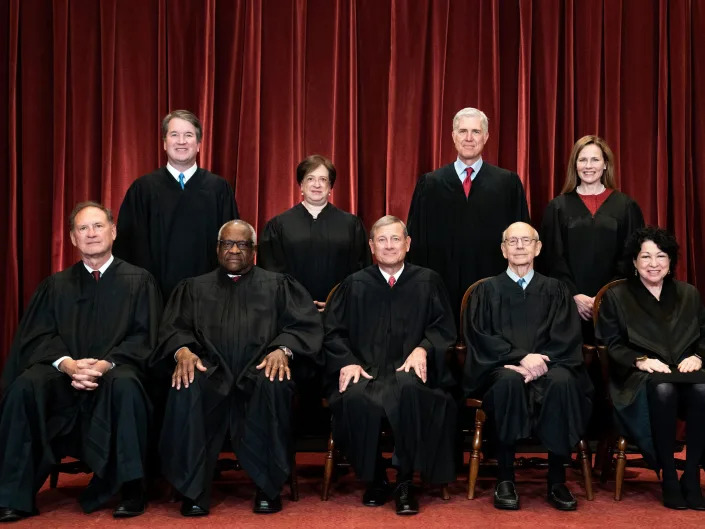
Seated from left: Samuel Alito, Clarence Thomas, John Roberts, Stephen Breyer and Sonia Sotomayor, Standing from left: Brett Kavanaugh, Elena Kagan, Neil Gorsuch and Amy Coney Barrett.Erin Schaff-Pool/Getty Images

The Supreme Court is investigating a leak of a draft opinion that would overturn Roe v. Wade.


Law clerks, afraid for their professional futures, are seeking legal advice on the probe.


The tensions add to reports of increasing hostility among the high court, including the justices.


Tensions are continuing to rise at the Supreme Court since a draft opinion that would overturn Roe v. Wade leaked last month, breaking longstanding precedent and prompting criticisms from justices.

As an investigation into the leak unfolds, the justices' law clerks are afraid and frantically consulting with lawyers, according to a report from NPR's Nina Totenberg, who has covered legal affairs and the high court for decades.

"I don't know how on earth the court is going to finish up its work this term," one source close to the court told NPR. The source said the clerks in a way act as diplomats between the justices, who at this point in the year would usually be working together to address disagreements on cases.

But, the source said, in addition to growing mistrust among the justices, the clerks are so terrified their professional lives are under threat as the leak investigation unfolds that communication between them is strained.

Chief Justice John Roberts announced an investigation into the leak after Politico published the 98-page draft opinion last month. The draft showed a majority of justices were set to overturn the landmark 1973 Roe v. Wade decision that enshrined the constitutional right to an abortion.

While the leak itself may not be an actual crime, CNN reported last week clerks have been asked to turn over their cell phone data and sign sworn affidavits, in which lying would be illegal.

Clerks are now "lawyering up" and consulting with law firms as a result, NPR reported Wednesday. The outlet added that clerks seeking legal advice also raises ethical questions, since some of the firms they are consulting have cases before the Supreme Court.

Concerns among the clerks piles on increasing animosity that has been reported amongst the justices.

Justice Sonia Sotomayor, in a dissenting opinion published Wednesday, went as far as to call out a "restless and newly constituted Court," seemingly a nod to the recent Trump-appointed justices.

Shortly after the leak Justice Clarence Thomas said it was an "unthinkable breach of trust" and suggested he'd lost trust in the court as an institution. And in an appearance following the leak, Justice Samuel Alito declined to say whether he and the other justices were still friendly enough to be able to have a meal together.