Monday, November 07, 2022

US: Protect Louisiana, Texas land for rare burrowing snake


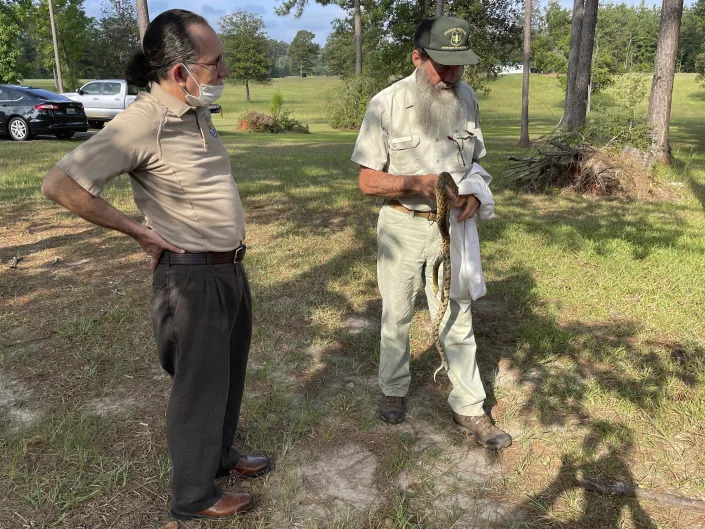
This photo provided the U.S. Fish and Wildlife Service shows U.S. Forest Service biologist Steve Shively holding “Mr. Snake,” a threatened Louisiana pinesnake kept for education and outreach, on July 11, 2022, at the USFS office in the Evangeline Unit of the Calcasieu District of Kisatchie National Forest, near Alexandria, La. The U.S. government has proposed protecting four areas in Louisiana and two in Texas as critical habitat for the constrictor, which eats pocket gophers and takes over their burrows in longleaf pine savannas. 
(Ian Fischer/U.S. Fish and Wildlife Service via AP)

JANET McCONNAUGHEY
Mon, November 7, 2022 

NEW ORLEANS (AP) — Four areas in Louisiana and two in Texas should be protected as critical habitat for a rare snake that eats pocket gophers and takes over the rodents' burrows, the federal government says.

Louisiana pinesnakes, which produce the largest eggs and hatchlings of any U.S. snake, have been protected as threatened since 2018.

Their decline is largely due to the drastic reduction and fragmentation of grassy longleaf pine savannas with sandy soil. And since Louisiana pinesnakes' 5-inch-long (12.7-centimeter) eggs are so big that they lay only three to five at a time, losses are hard to replace.

The snakes grow to 5 feet long (1.5 meters) but are hard to count because they spend more than half their time underground. They also are camouflaged on brown pine needles, with black, brown and russet patches on a buff to yellowish background.

National forests cover most of four areas that the U.S. Fish and Wildlife Service has proposed as critical habitat. Private land — including some covered by conservation agreements — comprises all of the smallest, in Texas, and virtually all of the biggest, in north Louisiana where the largest known population lives.

Critical habitat is a limited protection, affecting only contracts using federal money or requiring federal permits. Other critical habitat decisions have sparked challenges by landowners and dissension over what lands qualify for such designation.

In north Louisiana's Bienville Parish, private owners hold more than 99% of a proposed area about the size of Milwaukee — roughly 95 square miles (246 square kilometers). The smallest area, about 8 square miles (20 square kilometers) in Scrappin’ Valley, Texas, is all privately held.

However, the Scrappin’ Valley land is already managed for endangered little red-cockaded woodpeckers, which also need open-canopied pine savannas, said Don Dietz, consulting biologist for a family that owns 70% of the land.

“Red-cockaded woodpeckers eat a lot of ants, which need the open area below. So the habitat is essentially the same,” Dietz said.

Noah Greenwald, endangered species director at the environmental nonprofit Center for Biological Diversity, said, “Far too few private landowners care about nature and ensuring species like the Louisiana pinesnake survive. When it does happen it's really great."

The Fish and Wildlife Service said two of seven known pinesnake populations are in Texas, but Dietz was dubious. He said he tried unsuccessfully for a decade to trap Louisiana pinesnakes to prove they lived in Scrappin' Valley.

“I want to believe there’s some out there, but in Texas there may not be,” Dietz said.

Other populations live in Louisiana's Bienville, Grant, Natchitoches, Sabine, and Vernon parishes, the federal agency said.

Big Cypress State Park makes up about 0.5% of the proposed Bienville unit. Another 8.4 square miles (22 square kilometers) are part of a conservation agreement benefiting the snake, according to Fish and Wildlife's economic analysis.

The Weyerhaeuser Co. announced in 2020 that it had a 30-year agreement to manage land in Bienville Parish for the Louisiana pinesnake.

Weyerhaeuser said it is working to understand how the federal proposal “would overlap and potentially impact the acres of critical habitat we are currently protecting for the Louisiana pinesnake.”

The company said in 2020 that state and federal biologists helped it identify two areas totaling about 2.8 square miles (7.25 square kilometers) as the most important for the snake. It said it would convert about 440 acres (180 hectares) from loblolly to longleaf pine and keep another 1,383 acres (560 hectares) with an open canopy and grassy forest floor.

Wildlife and Fisheries wouldn’t say whether Weyerhaeuser's longleaf conversion and open canopy areas are within the proposed federal critical habitat.

Wherever they are, it “isn’t really enough to help the Louisiana pinesnake on Weyerhaeuser land," Greenwald said. Louisiana pinesnake populations need blocks of more than 11 square miles (28.5 square kilometers) of mostly unfragmented habitat, according to the federal analysis.

Also proposed as critical habitat in Louisiana are about 89 square miles (230 square kilometers) in Rapides Parish, more than 68 square miles (176 square kilometers) in Vernon Parish and about 41 square miles (106 square kilometers) in Grant Parish. Different parts of the Kisatchie National Forest make up most of each.

The second Texas area would cover nearly 25 square miles (65 square kilometers) in Angelina and Jasper counties, mostly in the Angelina National Forest.

___

To see all of AP’s environmenta
CRIMINAL CAPITALI$M

Richard Branson must face lawsuit in U.S. over Virgin Galactic space travel problems


Billionaire entrepreneur Richard Branson departs with his crew prior
 to boarding at Spaceport America

Jonathan Stempel
Mon, November 7, 2022 

NEW YORK (Reuters) - A U.S. judge on Monday said British billionaire entrepreneur Richard Branson must face shareholder claims he concealed problems in Virgin Galactic Holdings Inc's spaceship program, and sold hundreds of millions of dollars of stock at inflated prices.

While dismissing most claims in the proposed class action, U.S. District Judge Allyne Ross in Brooklyn said shareholders could try to prove that Virgin and Branson defrauded them into overpaying for the space tourism company's shares, which now trade more than 90% below their February 2021 peak.

Shareholders can sue over July 2019 statements that Virgin had made "great progress" overcoming "hurdles" to commercial spaceflight, despite a near-disastrous test flight five months earlier when its rocket plane Unity suffered critical damage.

Branson must also defend his July 2021 statement that his own just-completed flight on Unity, where he soared 50 miles (80.47 km) above the earth, had been "flawless" though Unity had strayed from its assigned airspace.

In a 55-page decision, Ross said shareholders also could sue over approximately $301 million of stock that Branson sold the month after the flight.

Lawyers for Virgin and Branson did not immediately respond to requests for comment.

In seeking a dismissal, they said there was no proof of intent to defraud, and that the defendants had thoroughly disclosed safety and design issues in developing commercial space travel, "unquestionably a high-risk proposition."

Laurence Rosen, a lawyer for the shareholders, declined to comment.

Virgin is based in Tustin, California, and went public in October 2019 by merging with a special purpose acquisition vehicle, Social Capital.

The lawsuit covers shareholders who owned the stock of either from July 10, 2019, to Oct. 14, 2021, when Virgin grounded Unity and delayed its commercial space travel service. Its shares fell 16.8% the next day, to $20.01.

Branson, 72, is worth $3.7 billion, according to Forbes magazine.

In Monday afternoon trading, Virgin shares were up 5 cents at $4.97.

The case is Kusnier et al v. Virgin Galactic Holdings Inc et al, U.S. District Court, Eastern District of New York, No. 21-03070.

(Reporting by Jonathan Stempel in New York; Editing by Matthew Lewis)
Italy directs NGO rescue ship with 89 migrants to port


Mon, November 7, 2022 

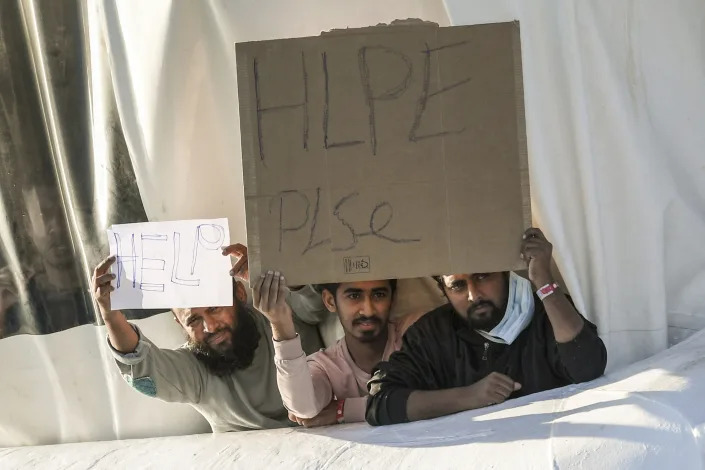
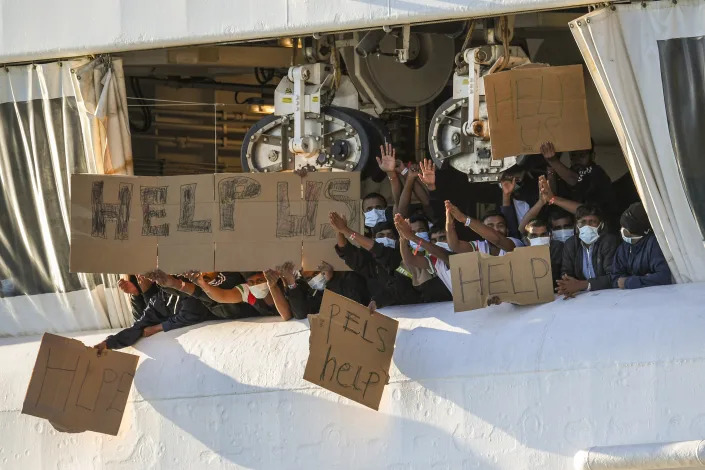
MILAN (AP) — After waiting at sea for days, the German humanitarian group Mission Lifeline said Monday that Italy has directed its migrant rescue ship with 89 people on board to proceed to the port of Reggio Calabria.

The 25-meter (80-foot) ship Rise Above entered Italian waters over the weekend without consent because of storm-swollen seas, after rescuing 95 people in the central Mediterranean. Six were evacuated at sea due to medical emergencies.

"We are relieved that waiting on the high seas is over. The situation on board has become more and more critical in the past few days and hours," Mission Lifeline spokeswoman Hermine Poschmann said. “We expect that the Italian authorities give everyone access to a legally compliant asylum procedure and that people do not have to stay on our ship any longer than necessary.”

Italy has refused to assign migrant rescue ships with a port of safety as it takes a hard line with nongovernmental organizations operating in the central Mediterranean. Instead, it has been instructing them to ports, where authorities allow only vulnerable people to disembark. Italian authorities insist the boats must then return to international waters with those not deemed vulnerable.

The far-right-led government of Premier Giorgia Meloni is insisting that countries whose flag the ships fly take on the migrants, and that the burden shouldn't fall on Italy alone.

Poschmann said that Mission Lifeline has asked Germany to take in more people.

Two other NGO-run boats are docked in Catania, one with 35 people that Italy won't allow to disembark, the other with 214 people. Both ships are refusing to leave, saying that under international law all people rescued at sea are vulnerable and entitled to a safe port.

A fourth ship, the Ocean Viking operated by SOS Mediterannee, remains in international waters off Sicily with 234 rescued people. Its first rescue was 17 days ago.


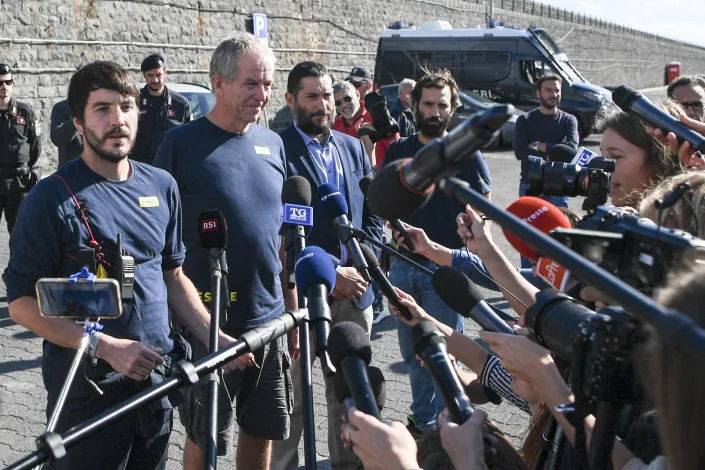
Riccardo Campochiaro, lawyer of the German charity organization SOS Humanitarian, talks to reporters during a press conference at the port of Catania, Sicily, southern Italy, Monday, Oct. 7, 2022. The captain of the German organization's rescue ship, the Humanity 1, refused Italian orders to leave the Sicilian port Sunday after Italian authorities refused to let 35 of the migrants on his ship disembark — part of directives by Italy's new far-right-led government targeting foreign-flagged rescue ships. 

AP Photo/Salvatore Cavalli


FASCISM U$A
Trump and his far-right allies have stoked a dangerous climate that increases the likelihood of violence far beyond midterms, extremism experts warn


John Haltiwanger
Mon, November 7, 2022 

Political violence experts warn that Trump and his allies are fomenting a dangerous climate.


They're normalizing "aggression and violence" against political opponents, an extremism researcher said.


"Republican campaign ads have been riven with violent language and imagery," an expert on political violence said.

A home invasion and violent attack against House Speaker Nancy Pelosi's husband prompted renewed concerns about the contentious political climate in the US and the potential for more political violence surrounding the midterm elections.

Pelosi is one of the Democrats most vilified by former President Donald Trump and his far-right allies. Experts on extremism and political violence warn that Trump and his MAGA compatriots are fomenting a dangerous climate that increases the likelihood that opponents of the GOP will be targeted with violence, underscoring that the threat extends well beyond midterms.


"I am quite concerned about violence surrounding the midterms, but I think it would be a mistake to assume that the threat of violence stops after the midterm elections," Kurt Braddock, a professor of public communication at American University who studies far-right extremism, told Insider. "Regardless of the outcomes of the elections, certain beliefs and norms have been cultivated (particularly among the far-right elements of the Republican party) that tacitly approve of aggression against targets on the left."

Since Trump entered the White House in 2017, far-right politicians and pundits have "grown increasingly emboldened to use language that — purposefully or incidentally — normalizes aggression and violence against political enemies," Braddock said, emphasizing that the effects of that normalization don't end with the midterms.

"It's an issue we will be contending with for some time," Braddock said.

Shannon Hiller, the head of the Bridging Divides Initiative at Princeton University, told Insider that she's confident US elections will remain safe and secure — including the midterms.

"What I'm more concerned about is the post-election period, when these persistent, unfounded claims of election fraud and calls for violence could intersect to spur individuals to violent action," Hiller added, "This is part of what our research showed following the 2020 election — where local officials of both parties faced really awful threats and harassment especially in states where leaders pushed these unfounded claims. It's one reason why we call on all officials and leaders across the country to reject this type of rhetoric."

'Millions of Americans believe violence is justified'


An explosion caused by a police munition is seen while supporters of President Donald Trump gather in front of the US Capitol Building in Washington DC on January 6, 2021.
REUTERS/Leah Millis

Throughout Trump's presidency, top experts on democracy and political violence offered routine warnings that he was stoking a dangerous climate in the US that could spiral out of control. The fatal riot at the US Capitol on January 6, 2021, which was largely provoked by Trump's lies about the election, offered ample evidence that their concerns had been well-founded. Nearly two years after the Capitol riot, they haven't stopped ringing alarm bells — particularly as Republicans continue to target their opponents with incendiary rhetoric.

"Republican campaign ads have been riven with violent language and imagery," Rachel Kleinfeld, a senior fellow at the Carnegie Endowment for Peace and expert on political violence, told Insider. Kleinfeld emphasized that pro-Trump Republicans have not just been going after Democrats, but also anyone in the party perceived as disloyal to Trump (often referred to as RINOs, or "Republicans in name only").

Republicans like Reps. Adam Kinzinger and Liz Cheney, who refused to embrace Trump's effort to overturn the election and sit on the House January 6 select committee, have faced levels of demonization similar to prominent Democrats like Pelosi, as well as death threats.

"It's actually hard to get regular people to commit violence, but it's made easier when people are made to seem less than human, they are turned into threats, and violence is posited as defensive. MAGA politicians have been doing all three," Kleinfeld, who testified before the House committee investigating January 6, said.

David DePape, the man accused of attacking Paul Pelosi with a hammer, allegedly broke into the couple's San Francisco home looking for the House Speaker and intended to take her hostage. DePape allegedly told police he was "sick of the insane fucking level of lies coming out of Washington, DC" and that he wanted to have a little chat with the speaker. San Francisco's District Attorney Brooke Jenkins said the attack was "politically motivated."

Kleinfeld said the attack Pelosi's husband was an example of stochastic terrorism, or an act of violence in which the perpetrator is inspired by language or rhetoric that dehumanizes and demonizes the targeted group or individual. As one of the most powerful Democrats in Washington for years, Pelosi has been one of the biggest targets of violent far-right rhetoric and conspiracy theories.

Prominent far-right figures, including Trump and Fox News' Tucker Carlson, have spread conspiracy theories about the Pelosi attack — suggesting, without evidence, that there's more to story. It's part of a broader trend.

DePape had shared an array of conspiratorial content on social media, including posts that echoed Trump's false claim the 2020 election was stolen.

"We are now at a point where millions of Americans believe violence is justified as a defensive measure, and are convinced by movements such as Q that their enemies are satanic or inhuman," Kleinfeld said, adding, "A religious revival of Q imagery has been traveling the country with General Michael Flynn, Trump's son, and other supporters in advance of the midterms, spreading this belief that a fight between good and evil is underway. This is dangerous stuff."

'Politi
cal violence is here to stay'


A member of the Proud Boys wearing a t-shirt that reads "death to liberals" stands with other Proud Boys in Freedom Plaza during a protest on December 12, 2020 in Washington, DC.
Stephanie Keith/Getty Images

Braddock, the far-right extremism researcher at American University, said it's clear that the attacker was targeting the House Speaker and that the perpetrator was "motivated by ideas that are often amplified by elements of the far-right," which includes elected officials and pundits.

Trump devotees treat Pelosi — the highest-ranking Democrat in office during Trump's presidency — as the "prime villain in far-right disinformation and conspiracies," Braddock said, adding that this was especially clear on January 6 when "right-wing extremists" stormed the Capitol building and sought her out. The attack on Paul Pelosi followed the same track, but on a smaller scale.

By sowing doubts about the integrity of US elections and lashing out at people tied to his legal woes — and warning that there will be "big problems" if he's indicted — Trump continues to speak to "a part of his constituency who are looking for a reason to become violent," Braddock warned.

Trump has a massive audience and millions of people listening to what he says. Even if he doesn't mean to incite violence, when Trump uses provocative language it's "likely that at least a few of his devoted followers will interpret what he says as actual calls to violent action," Braddock said.

"This form of political violence is here to stay. It is clear that many parts of the right-wing have no problem amplifying information that paints political adversaries to be 'dealt with,'" Braddock said, "Until those parts of the right-wing disavow manifest violence and abandon rhetoric that normalizes it, we will continue to see these kinds of attacks."
Mississippi governor responds to probe of Jackson water woes


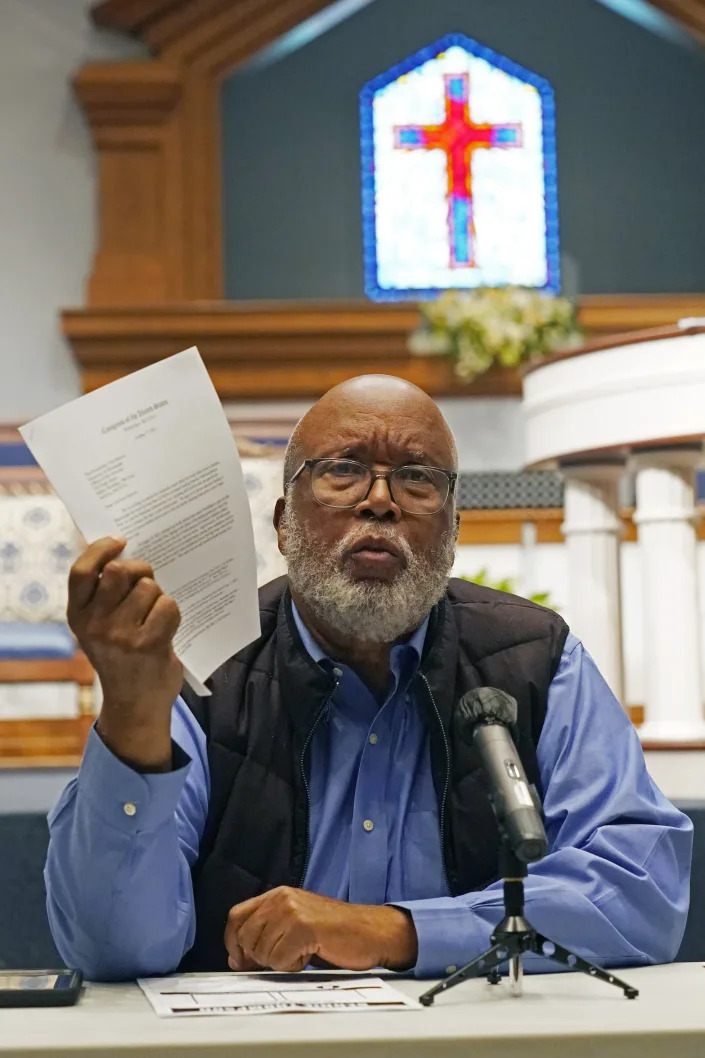
U.S. Rep. Bennie Thompson, D-Miss., displays a letter to Mississippi Gov. Tate Reeves that expresses concern over what he believes is the inadequate federal funding from the American Rescue Plan Act and the Bipartisan Infrastructure Law to address the failing water system in Mississippi's majority-Black capital city, Jackson, Miss., on Monday, Oct. 24, 2022, at a town hall meeting hosted by the NAACP. Reeves responded Monday, Nov. 7, to a congressional probe into the crisis that left 150,000 people in the state's capital city without running water for several days in late summer.
 (AP Photo/Rogelio V. Solis, File)More


MICHAEL GOLDBERG AND EMILY WAGSTER PETTUS
Mon, November 7, 2022 at 5:34 PM·4 min read

JACKSON, Miss (AP) — Mississippi Gov. Tate Reeves Monday released his response to a congressional investigation of the crisis that left 150,000 people in the state's capital city without running water for several days in late summer.

Reeves said Jackson has received a disproportionate amount of funding for its water system based on the city's size. He also said local officials only have themselves to blame for the water woes.

“(M)y administration is deeply committed to ensuring that all federal funds received by Mississippi for drinking water systems upgrades have been in the past and will continue to be in the future made available and distributed among Mississippi’s more than 1,100 water systems on an objective and race-neutral basis,” Republican Reeves said in a letter dated Oct. 31 and addressed to Reps. Bennie Thompson of Mississippi and Carolyn Maloney of New York.

The two Democrats sent Reeves an Oct. 17 letter requesting details of where Mississippi sent money from the American Rescue Plan Act and the Bipartisan Infrastructure Law, including “the racial demographics and population sizes of each” community that received aid. They also requested information on whether Jackson, which is 80% Black, has faced “burdensome hurdles” to receive additional federal funds.


Comparing census data against the recipients of state water loans, Reeves wrote “there is no factual basis whatsoever to suggest that there has been an ‘underinvestment’ in the city or that it has received disproportionately less than any other area of the state.” In 2021, Jackson accounted for 68% of all loans dispersed, Reeves wrote.

Mississippi received about $1.8 billion in ARPA money, and the Legislature put $750 million of that toward competitive grants for Mississippi’s water systems. Officials announced last week that they approved Jackson’s request for $35.6 million in federal funds to help pay for seven water and sewer projects.

Thompson and Maloney said in a joint statement Monday that recent federal aid to Jackson can be traced to more federal involvement. They said they received the governor's letter Monday.

“The Governor’s response to our letter is a clear acknowledgment that the City of Jackson, and its water systems, are in desperate need of resources to supply clear water to the city’s residents," Thompson and Maloney said. “Democrats have passed infrastructure funding for this exact purpose, and the Biden Administration has orders in place to maximize the delivery of these resources to communities of greatest need — including Jackson — to overcome generational disinvestment in communities of color from every level of government.”

They also pointed to an ongoing EPA civil rights investigation into whether Mississippi state agencies discriminated against Jackson in the distribution of water infrastructure funds.

Reeves wrote that Jackson tax collections increased from 2003 to 2020, but numbers cited by the governor did not account for the decreased buying power because of inflation. Reeves wrote that Jackson’s property tax collections were about $60 million in 2003 and $79 million in 2020. An inflation calculator shows that $60 million in 2003 would be worth about $84 million in 2020 — so, although the numbers were up, the buying power was down.

Reeves also wrote that Jackson sales tax collections increased during those years, but he did not mention that part of the increase was because Jackson residents voted in 2014 to approve an additional 1% sales tax to help pay for infrastructure improvements.

"Enforcement efforts” against Jackson by federal regulators are proof of city mismanagement, he said. The Environmental Protection Agency issued a notice in January that Jackson’s water system violated the federal Safe Drinking Water Act.

In September, federal attorneys threatened legal action if the city did not agree to negotiations related to its water system. Jackson Mayor Chokwe Antar Lumumba said last week that negotiations are continuing. While the EPA said current samples indicate Jackson’s water quality meets federal standards, testing continues and legal action against the city is still a possibility.

Through a spokesperson, Lumumba declined to comment on the governor's letter Monday.

Jackson has had water problems for years, and the latest troubles began in late August after heavy rainfall exacerbated problems in the main treatment plant, leaving many customers without running water. Jackson had already been under a boil-water notice since late July because the state health department found cloudy water that could make people ill.

Reeves said the city has been unable to run its billing system and hire enough skilled personnel to manage the system.

Running water was restored within days, and a boil-water notice was lifted in mid-September, but Thompson and Maloney's letter to Reeves said “water plant infrastructure in the city remains precarious, and risks to Jackson’s residents persist.”

Thompson and Maloney said their letter marked “the start of a joint investigation” by the House Homeland Security and the Oversight and Reform committees into the water crisis. If Democrats lose their majority in the midterm elections, it is unlikely the probe would continue without bipartisan interest.

___

Michael Goldberg is a corps member for the Associated Press/Report for America Statehouse News Initiative. Report for America is a nonprofit national service program that places journalists in local newsrooms to report on undercovered issues. Follow him on Twitter at twitter.com/mikergoldberg. Follow Emily Wagster Pettus on Twitter at http://twitter.com/EWagsterPettus.
MONOPOLY CAPITALI$M

U$ patients can spend more than $3,000 per pen for the exact same life-changing arthritis drugs that people in some European countries get for free


Hilary Brueck
Mon, November 7, 2022 a

Lawyer Priti Krishtel is one of the MacArthur Foundation's "genius" award winners for 2022.John D. and Catherine T. MacArthur Foundation

Drugmakers routinely add new patents to old drugs in order to prolong monopolies.


The practice is called building "patent thickets" and it can make drugs too expensive for patients.


A "genius" health justice lawyer says drug companies are "gaming" the US patent system.


Patients in the US are paying a sticker price upwards of $3,000 per pen for blockbuster arthritis drug Humira, the country's top-selling drug. Meanwhile, prices in Europe have decreased dramatically, ever since Humira's principal patent expired in 2018.

In the US, Humira's manufacturer, AbbVie, has used what are sometimes called "patent thickets" to prevent generic versions of the medicine — an anti-inflammatory which treats several debilitating diseases, including severe arthritis, Crohn's disease, and ulcerative colitis — from entering the market. By creating a vast thicket of patents which aren't protecting much that's integral to the way the drug works (for example, changing the dose, or tweaking the way the product is manufactured) drugmakers like AbbVie are able to hold on to their drug monopolies for decades after they should've expired.

Priti Krishtel, a leading health justice lawyer and cofounder of the Initiative for Medicines, Access, and Knowledge (I-MAK), told Insider these patent thickets are a clear distortion of the way the US patenting system was designed to work — and they must be weed-whacked out if the country is ever going to achieve fairer prescription drug prices for consumers.

"What we see in a case like Humira is a company like AbbVie has filed for over 300 patents, received over 160 patents on this drug, and so they're able to keep lengthening the monopoly period, they're able to keep blocking competition here in the US," Krishtel said.

Patents are far from the only reason that there's such a big price difference for this treatment between the US and Europe – but advocates like Krishtel believe it is an important one. The US doesn't really regulate or negotiate the prices of drugs like countries in Europe do, so the main way American drug prices become lower over time is through generic competition. What AbbVie is doing with Humira subverts that system, Krishtel said. (Abbvie did not respond to Insider's requests for comment.)

Krishtel won the MacArthur Foundation "genius" award in October for her decades-long work building a worldwide movement to illuminate and contest what she sees as predatory drug patenting.

Humira's price has risen by 500% in the US

About one in four Americans say they skip or skimp on prescriptions for themselves or their immediate family members every year, because of how much their drugs cost, according to Kaiser Family Foundation polling. Insurance or manufacturer coupons may lower the cost of prescriptions substantially — but the system doesn't always work. Sometimes, the steep cost of medicines in the US is fatal.

"I just don't think that people should have to pay their life savings for life-saving medicines," Krishtel said.

In Europe, generic forms of the drug formerly known as Humira (adalimumab) have been on the market for four years. Users on that continent now routinely pay up to 90% less than they used to, whether they still choose to buy the brand name version of the drug, or pick up one of its new off-brand competitors.

Humira prices in the US, however, have skyrocketed by more than 500% since the drug first hit the market 20 years ago, and have increased by 60% since its primary patent expired, ballooning Medicare spending on the drug.

And AbbVie is far from the only manufacturer playing this patenting game.

Drugmakers routinely file new patents related to their bestselling old drugs, changing how they're dosed, released or manufactured, even though no significant changes have been made to how they work. This enables big drugmakers to continue their monopolies on the market, for many years after their original patents expired — "exploiting" the patent system, as the US House Committee on Oversight and Reform reported in 2021.

'Basically the same drug,' but more expensive than ever


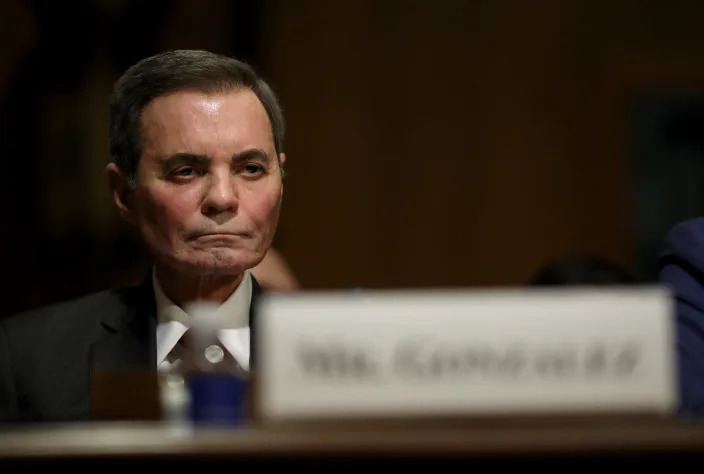
Richard Gonzalez, chairman and CEO of AbbVie Inc., 
the company that makes Humira.
Win McNamee/Getty Images

Now that cheaper generics compete with Humira in Europe, one injection pen may cost a patient nothing (in places like Scotland, where all prescriptions are taxpayer-funded), $10 (in Germany, where there's a strict cap on co-payments) or $225 a year (in Sweden, where co-payments vary, but are also capped), according to an independent report published in 2021.

Humira's primary US patent expired in 2016, but no generic is available yet, and the brand-name drug is so expensive that some US employers fly their Humira-users across the border to Mexico or Canada, just to save on prescription costs, Bloomberg Law reported in 2020. (Of course, the price any US patients actually pay for their prescriptions fluctuates dramatically, depending on their insurance coverage.)

The CEO of AbbVie told Congress in 2021 that "the drug is basically the same drug" it has always been. And yet, from 2016-2021, the price of Humira shot up more than four times faster than inflation, according to I-MAK.

Humira certainly isn't the only drug "gaming the US patent system" she added, it's just the "worst offender." Similar issues exist for other medicines, including life-saving cancer drugs, HIV therapies, and diabetes treatments, according to a recent I-MAK report titled "Overpatented, Overpriced."

"Basically, the higher the percentage of the company's revenue that the drug makes up, the more incentive they have to play these patent games and extend their control of the market," she said.

Krishtel isn't naive about how the US patent system might be reformed — she doesn't think that the US can just replicate how Europe does healthcare.

"We're going to have to design a health system that works for Americans, and that is designed by Americans," she said.

That might include more legislation from Congress, or more oversight of the patent and trademark office, she said, offering a few suggestions.

But "central to any vision of health equity for our country has to be patent reform," she said. "There's no way around that."

Read the original article on Insider
Women managers have improved Vatican more than men, pope says
By Philip Pullella - Yesterday 

Pope Francis visits Bahrain© Reuters/POOL

ABOARD THE PAPAL PLANE (Reuters) -Pope Francis said on Sunday that women he has appointed in the Vatican have proved they can be better managers than men and that there was too much male chauvinism in the Roman Catholic Church and society at large.

The pope made his comments during an airborne news conference on the plane returning to Rome from his four-day trip to Bahrain.

"I have noticed that every time a woman is given a position (of responsibility) in the Vatican, things improve," he said.

Francis was asked about the women at the forefront of protests in Iran, but he did not answer the question, pivoting to the topic of the role of women in general.

Speaking of women he has appointed to managerial roles, he mentioned Sister Raffaella Petrini, the deputy governor of Vatican City, who is effectively the most powerful woman in the Vatican, in charge of some 2,000 employees.

"Things have changed for the better," he said, referring to the management skills of Petrini, who was appointed last year.

He also cited the impact of five women he appointed to a department that oversees Vatican finances.

"This is a revolution because women know how the find the right way to go forward," he said.

Francis condemned male chauvinism, acknowledging there was still too much of it around the world, including in his native Argentina.

"Women are a gift. God did not create man and then give him a puppy dog to play with. He created man and woman," he said. "A society that is not capable of (allowing women to have greater roles) does not move forward."

Francis has also appointed women as deputy foreign minister, director of the Vatican Museums, deputy head of the Vatican Press Office, as well as four women as councillors to the Synod of Bishops, which prepares major meetings.

(Reporting by Philip Pullella; editing by Barbara Lewis)

Pope says women's rights fight is 'continuous struggle', condemns mutilation


Pope Francis visits Bahrain
Sun, November 6, 2022 
By Philip Pullella

ABOARD THE PAPAL PLANE (Reuters) -Pope Francis said on Sunday the fight for women's rights was a "continuous struggle", and condemned male chauvinism as deadly for humanity and female genital mutilation as a crime that must be stopped.

Speaking to reporters on the plane returning from a four-day trip to predominantly Muslim Bahrain, he also praised women he has appointed to managerial jobs in the Vatican, saying they had improved things there.

He made no mention of campaigns to let women move on beyond that and become clergy - the pope and his predecessors have said the question of women priests is closed.

Francis was responding to a question about women protesting in Iran but turned to the topic of women's rights in general.

"We have to tell the truth. The struggle for women's rights is a continuing struggle," he said, listing historic struggles such as the fight for the right to vote.

"We have to continue struggling for this because women are a gift. God did not create man and then give him a lapdog to play with. He created both equal, man and woman," he said.

"A society that is not capable of (allowing women to have greater roles) does not move forward," he added.

Francis denounced male chauvinism, acknowledging there was still too much of it around the world, including in his native Argentina. "This chauvinism kills humanity," he said.


He also condemned as a "criminal act" female genital mutilation (FGM), repeating a major call he made in February on the U.N. International Day of Zero Tolerance for Female Genital Mutilation.

According to the United Nations, FGM is concentrated in about 30 countries in Africa and the Middle East but is also practiced by immigrant populations elsewhere. More than four million girls are at risk of undergoing FGM this year, the U.N. says.

He spoke of women he has appointed to managerial roles in the Vatican, mentioning by name Sister Raffaella Petrini, a nun who as the deputy governor of Vatican City is effectively the most powerful woman there.

"I have noticed that every time a woman is given a position (of responsibility) in the Vatican, things improve," he said.

He also cited the impact of five women he appointed to a department that oversees Vatican finances.

"This is a revolution (in the Vatican) because women know how the find the right way to go forward," he said.

Francis also has appointed women as deputy foreign minister, director of the Vatican Museums, deputy head of the Vatican Press Office, as well as four women as councillors to the Synod of Bishops, which prepares major meetings.

The Church teaches that only men can become priests because Jesus chose men as his apostles.

(Reporting by Philip Pullella; editing by Barbara Lewis and Andrew Heavens)

Pope calls female genital mutilation a crime that must stop


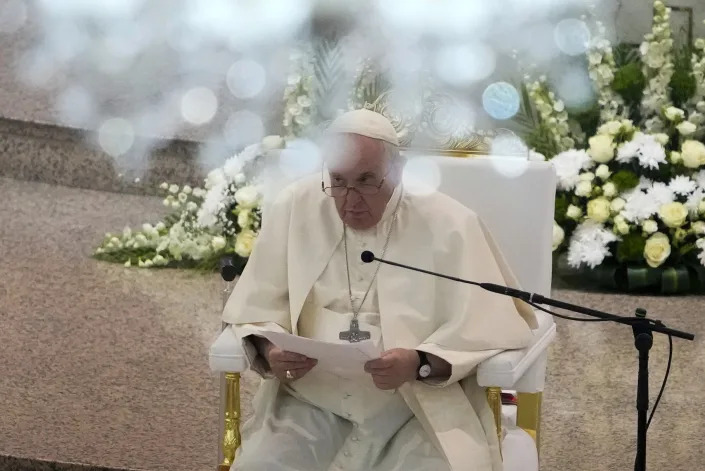
Bahrain PopePope Francis attends a prayer meeting and Angelus with bishops, priests, consecrated people, seminarians and pastoral workers, at the Sacred Heart Church in Manama, Bahrain, Sunday, Nov. 6, 2022. Pope Francis is making the November 3-6 visit to participate in a government-sponsored conference on East-West dialogue and to minister to Bahrain's tiny Catholic community, part of his effort to pursue dialogue with the Muslim world. (AP Photo/Alessandra Tarantino)More

NICOLE WINFIELD
Sun, November 6, 2022


ABOARD THE PAPAL PLANE (AP) — Pope Francis called female genital mutilation a “crime” on Sunday and said the fight for women’s rights, equality and opportunity must continue for the good of society.

“How is it that today in the world we cannot stop the tragedy of infibulation of young girls?” he asked, referring to the ritual cutting of a girls' external genitalia. “This is terrible that today there is a practice that humanity isn’t able to stop. It’s a crime. It’s a criminal act!”

Francis was responding to a question about women’s right en route home from Bahrain. He was asked whether he supported the protests in Iran sparked by the death in custody of 22-year-old Mahsa Amini, who was detained by morality police after allegedly violating the country’s strict dress code for women.

Francis didn’t directly respond, but gave a lengthy denunciation of how women in many cultures around the world are treated as second-class citizens or worse and said: “We have to continue to fight this because women are a gift.”

“God ... created two equals: man and woman,” the pope said.

Francis has done more than any pope to give more decision-making roles to women in the church. He has appointed several women to key governing positions, including the No. 2 in the Vatican City State administration as well as several other high-ranking management roles. He has also named women — laywomen and religious sisters — as consultors to Vatican offices dominated by male clergy, including the one that chooses bishops.

“I have seen in the Vatican, that whenever a woman enters to work, things improve,” he said.

He said society would do well to follow suit, noting that his native Argentina remains a “macho” culture, but that such attitudes “kill” humanity.

“A society that cancels women from public life is a society that grows poor,” he said.

Francis was also asked about new cases of clergy sex abuse and cover-up that have emerged in the French church, with evidence that a bishop was allowed to quietly retire in 2021 despite having been found guilty by a church investigation of having spiritually abused two young men by making them strip during confession. More victims have reportedly come forward since the scandal was first reported.

Francis didn’t reply when asked if such church sanctions should be made public going forward. But he insisted that the church was on the right path, even reviewing bad past canonical investigations and redoing them. He said the church was committed to not hiding abuse even if there are still some in the church “who still don’t see clearly, who don’t share” the need for justice.

“It’s a process we’re doing with courage, and not all of us have courage,” he said. “Sometimes there’s the temptation of making compromises -- we are enslaved by our sins.”

But he said the goal was toward further clarity, noting that he had recently received two reports from victims lamenting their abuse and how their cases had been “covered up and then not adjudicated well by the church,”

“I immediately said ‘Study this again, do a new judgment.’ So we’re now revising old judgments that weren’t well done,” he said. “We do what we can. We’re all sinners.”

___

Associated Press religion coverage receives support through the AP’s collaboration with The Conversation US, with funding from Lilly Endowment Inc. The AP is solely responsible for this content.

Video shows Ted Cruz getting hit with a White Claw can and booed at during a Houston Astros victory parade

Lauren Frias
Ted Cruz Yankee Stadium
Senator Ted Cruz, R-Texas, left, waves to spectators while attending Game 4 of an American League Championship baseball series between the New York Yankees and the Houston Astros, Sunday, Oct. 23, 2022, in New York.AP Photo/John Minchillo
  • Police said a man threw a White Claw can at Sen. Ted Cruz during the Houston Astros parade Monday.

  • Cruz was on a parade float celebrating the team's World Series win when he was struck by the can.

  • Houston Police arrested the man in connection with the incident. He faces assault charges.

A 33-year-old man was arrested after he threw a White Claw can at Sen. Ted Cruz during the Houston Astros victory parade on Monday, police said.

The senator from Texas made an appearance at the parade in Houston celebrating the Astros' World Series win over the weekend when "the beer can struck the Senator in the chest/neck area," according to Houston police.

"Nearby HPD officers arrested the male without further incident," police said in a statement. "He was taken to jail and faces assault charges."

Video of the incident showed a man blocking the can apparently before it made contact with the senator. The crowd can be heard booing throughout. Police said Cruz did not require medical attention.

In a statement to Insider, Cruz thanked law enforcement and said he was thankful that the man had a "noodle for an arm."

"As always I'm thankful for the Houston Police and Capitol Police for their quick action," Cruz said in a statement to Insider. "I'm also thankful that the clown who threw his White Claw had a noodle for an arm."

Editor's note: November 7, 2022: This story has been updated to reflect with a statement from Sen. Cruz, who said that he was struck by a White Claw can, not a beer can.

NO-ONE WOULD WASTE GOOD BEER ON CRUZ

In California's conservative Little Saigon, a progressive unravelling among Vietnamese Americans switches up Orange County politics and raises the stakes for Republicans

Hanna Kang
The Washington Post 
Mon, November 7, 2022

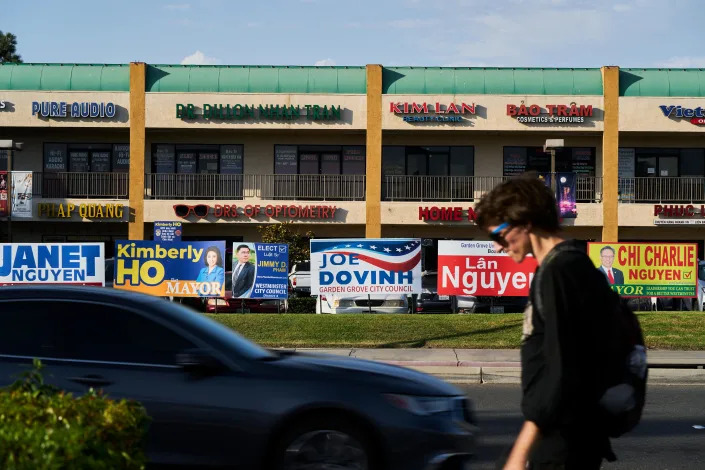
Political signs for Vietnamese American candidates for local office are displayed outside the Asian Village shopping center in the Little Saigon neighborhood of Westminster, California.
Bing Guan via Getty Images

The race in California's 45th House district has put a spotlight on its conservative Vietnamese American voter bloc in Little Saigon.

Vietnamese American voters have long leaned conservative while the Asian American vote nationwide for decades trended Democratic.

But experts and voters say the Vietnamese vote isn't monolithic.


WESTMINSTER, California – Drive down Bolsa Avenue during election season and there's no denying that the Vietnamese American identity is well represented on the ballot.

Colorful signs that clutter every major street corner and line the strips of grass in front of modest, beige stucco mini-malls feature candidates with Vietnamese surnames: Ho, Nguyen, Ta.

Home to the largest Vietnamese diaspora, Little Saigon is an ethnic enclave of expatriate Vietnamese located in the heart of suburban Orange County, California, just a few miles south of Disneyland. Centered in the city of Westminster, Little Saigon has fingers into the adjacent cities of Fountain Valley, Garden Grove, and Santa Ana.

"When we talk about representation, the Vietnamese community is very well represented, especially in the last ten years or so," Julie Vo, policy director at the Orange County Asian & Pacific Islander Community Alliance, told Insider. Westminster is the first city in the nation to have a Vietnamese American majority on the council, she added. It's also the first to elect a Vietnamese American mayor.

Aside from being an ethnic hub, Little Saigon — located in the 45th Congressional District — is the center of the region's political gravity. The enclave's large concentration of Vietnamese voters is crucial to elections, especially in a battleground district where races are decided by only a few percentage points. The Vietnamese vote was instrumental in Republican Rep. Michelle Steel's success in 2020 when she defeated then-incumbent Democrat Harley Rouda by about two percentage points.

Due to cultural and historical reasons, Vietnamese voters — in Orange County and elsewhere — have long leaned conservative while the Asian American vote nationwide has for decades trended Democratic. In 2020, more than half (53%) of voters in Little Saigon backed Donald Trump while the rest of Orange County supported Joe Biden by a 10 percentage point margin. Out of the six ethnic groups in the 2022 Asian American Voter Survey conducted this summer, Vietnamese Americans were the only enclave with a higher favorability rating for Trump (49%) than Biden (41%).

But these figures fail to explain the whole story, according to experts. What often goes under the radar is that the Vietnamese vote, let alone the Asian American vote, isn't monolithic. The political transformation of the Vietnamese community in Orange County – powered by young, independent, and issue-based voters – is breaking the surface.

"One of the things that we've seen about the Vietnamese community pretty consistently is there's this perception of the community as being reliably conservative," Dan Ichinose, research director of progressive engagement organization OC Action, told Insider. "But what we've seen pretty clearly is that the Vietnamese community is home to diverse political perspectives."

Little Saigon's Republican beginnings

Here in Little Saigon, where an abundance of traditional shops and eateries dot the three square mile stretch centered along Bolsa Avenue and the perpendicular Brookhurst and Magnolia Streets, the residents of Little Saigon — many of whom fled communist Vietnam — take comfort in the sights, tastes and sounds that remind them of home.

But before these public spaces popped up, anti-communist sentiment was the glue that held the neighborhood together. The first wave of refugees fled Vietnam after the fall of Saigon in 1975 and the next wave — the "boat people" who fled by sea — followed a couple of years later.

First-generation Vietnamese who escaped a Communist-led country would be more averse to progressive or liberal politics, said Madalene Mielke, president of the Asian Pacific American Institute for Congressional Studies. They're also deeply religious, she told Insider, and hugely invested in the idea of the American dream.

"You're talking about people who are now voting in America who come from a place where they didn't have democracy," she said. "There's distrust in government from the country they originally were coming from."

It's people like Marie Suchy, 47, whose mother was rescued in Operation New Life, a US Air Force airlift effort that evacuated Vietnamese from South Vietnam before and after the government's collapse and flew them to Guam. Her mother went into labor during the evacuation and Suchy was born shortly after on April 29, 1975, the day before Saigon fell.

She's always voted Republican because of her family history and conservative upbringing, and she'll be voting no differently this year.

"I was raised in an era where it was mostly conservative views," Suchy told Insider. "I pay for everything on my own, and I don't make a lot. I don't have a college degree. But I have earned my way to be where I'm at right now. I feel like many people in today's society feel entitled, and that entitlement needs to go away."

Vietnamese Americans' conservative bent could also be explained by Orange County's history as a conservative bastion, a place once described by Ronald Reagan as where "all the good Republicans go to die."

"Part of what it takes to be accepted politically would be to be conservatives," Sara Sadhwani, professor of politics at Pomona College, told Insider. "Having settled in Orange County at the time that they did, Orange County, until very recently, and still now, as we can see in the competitiveness of this race, has been a Republican stronghold."

But things are changing.

Young progressives unraveling the political fabric


While the first generation of Vietnamese immigrants has, for the most part, stayed loyal to the Republican Party, the second and third generations who have no memory of Vietnam's communist regime, are progressive.

More than 65% of Vietnamese age 49 and under in Orange County were registered as Democrats as of Election Day in 2020.

"We see generational differences between refugees for whom anti-communist politics are important and native-born children whose politics are more informed by their experiences growing up here," Ichinose said.

But there are teething pains that come with trying to unravel the community's political fabric. In a nationally-watched race between a Korean American incumbent and a Taiwanese American challenger in a district where Asian American voters make up a third of its electorate, Vietnamese Americans' anti-communist sentiment is being utilized for political gain.

Fliers sent by Republican incumbent Michelle Steel's campaign to Vietnamese voters living in the 45th District portray her Democratic challenger Jay Chen as a Communist sympathizer. Signs that say "China's Choice Jay Chen" have popped up on light poles and chain-linked fences around buildings.

It's an artful and deliberately planned out strategy of trying to "red-bait" him, experts say.

"There's no question that this is an intentional strategy to red-bait Jay Chen," Connie Chung Joe, CEO of Asian Americans Advancing Justice – Los Angeles, told Insider. "It's going to resonate with the older immigrant Vietnamese which she's targeting."

But that's where Steel's messaging falls short. From a larger perspective, Joe said, Steel's strategy is short-sighted because it only reaches the immigrant Vietnamese conservative subgroup.

Lanae Jackson, senior vice president for social policy and politics at the center-left think tank Third Way, agrees. With young Asian voters whose politics are largely informed by anti-Asian racism, Steel's play doesn't resonate in the way she wants it to.

"I think the politics around China are particularly tricky," Jackson told Insider. "Overall, when we talk about making things in America and trade policy, demonizing China is a useful political tool. But that definitely might play out differently with Asian voters, particularly those who are sensitive to the fact that hate crimes against Asian communities have been rising pretty substantially over the past couple of years."

Younger voters identify more as progressive on issues such as healthcare, the citizenship process, protecting the environment, gun control, abortion, and social justice.

Vincent Tran, a 27-year-old Fountain Valley resident, told Insider "red-baiting" doesn't focus on the current needs of Vietnamese Americans, such as affordable housing, affordable education, healthcare, and reproductive health.

"All of the stuff that's being sent out right now is pretty much focused on people's nationalities and allegiances," he said. "But I think if these candidates actually spoke on issues that the community cares for, it would radically shift how we see the Vietnamese population."

Even his immigrant parents — registered Republicans — toss the fliers when they receive them in the mail, he said. Tran's father came to the US in the early 1980s as one of the "boat people," and his mother came through the Orderly Departure Program, through which Vietnamese were allowed to leave the country for family reunions and humanitarian reasons.

"Red-baiting has been a traumatic tool that's been used in the community to ostracize people, and folks don't want to associate with it anymore," Tran said. "I think it's very disheartening because they are treating this community as a very "one issue" type community, not addressing complex issues."

Moving away from the establishment GOP

Former Westminster vice mayor and one-term state Rep. Tyler Diep was a registered Republican until last year when he reregistered to non-party preference. He said the aftermath of the January 6 attack on the Capitol triggered the change.

"As we got toward the later part of 2021, I started getting a sense that a lot of Republican leaders were backtracking and downplaying the severity of what happened," he told Insider.

He'll still be voting for the Republican candidate, incumbent Michelle Steel, but it isn't because of the party she identifies with. Diep said he looks at the candidate's presence in the district and the issues they stand for.

"I've known Michelle for over 15 years," he said. "And candidate familiarity is important. I want to see if a candidate cares about Little Saigon or not. How often do they come around? What have they done in the past to support the aspirations of the Vietnamese community abroad?"

And the fact that the Vietnamese vote isn't monolithic is well-illustrated in Diep's own family: his sister is a lot more liberal in her political views and doesn't look at the Republican Party the same way he does.

"It's not that I was trying to get her to think about what it means to be a progressive, or what it means to be a conservative," Diep said. "She picked up everything on her own, and then came to the conclusion that the Republican Party is not for her. She's not a Democrat either. She's just not ideologically aligned with what the Republican Party stands for."

The power of independent, issue-based voters

Both Steel and Chen would have been rarities here in Orange County, even a few decades ago. But the district's emergence as one of the most politically consequential races in the midterms and its Vietnamese American electorate — that could swing the vote — is a testament to how much Orange County has changed.

These swing independent voters make up nearly a quarter of the 45th District. Nationwide, over 40% of Vietnamese voters identify as independent. And the fact that the Asian American demographic is rapidly growing not because of birth, but because of immigration, means that they're up for grabs and that neither party can afford to rely on identity politics.

"More recent immigrant populations of Asian Americans who are newer to voting may be more likely to flip because they aren't attached to one party or the other," Jackson told Insider. "They wouldn't necessarily have a pattern of decades of picking one side or the other to rely on, and may be more apt to look at an individual candidate."

That's exactly what Linda Nguyen did in 2020. Nguyen, who sits on the Asian Business Association of Orange County's board of directors, voted for Biden in 2020 because she had encountered anti-Asian hate sentiments on three different occasions under the Trump administration. But it was tough making that decision, Nguyen told Insider.

"I vote based on policies over candidates," she said. "It was tough because fiscally, I'm a little more conservative, so of course, I lean Republican in that sense. But it just really depends on the policies, and the anti-Asian hate sentiments led me to voting for Biden."

What's most on her mind this election cycle? Inflation and the rising cost of living.

"That's what my friends and I are talking about," she said.

When asked whether she would support a Democrat or a Republican in 2024, Nguyen said she's not sure yet. But it definitely won't be Trump.

"That's a tough one," she said. "It really depends on the candidate, and if there was a different Republican candidate, I would definitely consider it."
U.S. looks to companies to fund more of energy transition at COP27


COP27 climate summit in Egypt

Mon, November 7, 2022 
By Valerie Volcovici and Sarah McFarlane

SHARM EL-SHEIKH, Egypt (Reuters) - The United States wants businesses to pay countries to stop burning coal via carbon markets, in a proposal it will announce at the United Nations climate conference this week, people familiar with the matter said.

The initiative, expected to launch on Wednesday at the COP27 Summit in Egypt, proposes that companies buy carbon credits and the proceeds be used to fund renewable energy projects in countries seeking to replace fossil fuels such as coal, the people said.

Top U.S. climate diplomat John Kerry has been canvassing companies in sectors including banking, consumer goods, shipping and aviation on the proposal, the people said. The idea is that companies would participate voluntarily.

The U.S. State Department did not immediately respond to a request for comment.

Voluntary carbon markets are expanding rapidly, whereby credits are generated by activities including tree planting and solar power projects, although concerns persist about these credits being outside regulated markets. The voluntary market was valued at around $2 billion in 2021, almost quadruple the previous year, according to data provider Ecosystems Marketplace.

One incentive for a company to participate in the proposed scheme is that it could help reduce its own emissions balance sheet, assuming the company has operations in a country that is phasing out coal. Companies do not necessarily have big operations that they need to decarbonize in countries looking at transition deals such as Indonesia and Senegal, however.

Fossil fuel producers are excluded from participating in the proposed scheme, the people said, although the industry has been one of the largest users of carbon markets to date.

"Crediting of energy transition in a country is an interesting concept but some of the restrictions on participation need to be worked on if it is going to have any scale," said Dirk Forrister, chief executive of the International Emissions Trading Association.

"Right now, the idea is it should be narrowly applied to be bought by non-fossil fuel companies like tech companies and banks, which would restrict private sector demand."

(Additional reporting by Kate Abnett; Editing by Mark Potter)

Biden’s climate envoy Kerry wants to tap companies to fund developing world’s move off fossil fuels: report

Rachel Koning Beals -

 peter dejong/Agence France-Presse/Getty Images

WASHINGTON WATCH

The U.S. reportedly wants to launch a carbon credit program to tap the might of the world’s largest companies to fund a transition off coal, especially, but also oil and gas in developing countries. The financing would help those nations switch to alternatives such as wind, solar, hydrogen and other energy options.

Related video: U.S.-UAE $100 billion clean energy deal is part of a 'new approach' to climate change, says professor
Duration 3:58

The plans were reported in the Financial Times, which said it had talked to policy officials working closely with John Kerry, the Biden administration’s lead representative at a major U.N. climate conference just underway in Egypt, known as COP27.

Read: What is COP27? Key issues for markets to watch as U.N. climate talks kick off in Egypt

The report said Kerry is trying to gin up support from other governments, companies and climate experts to develop a new framework for carbon credits to be sold to businesses. With carbon credits, there is financial incentive to create fewer emissions, and lighter emitters can sell their credits to heavier emitters.

President Joe Biden will attend COP27 on Friday. MarketWatch reached out to the White House for a comment on the Financial Times article.

Kerry and team hope to unveil the plan this week, the report said. It will remain voluntary, according to the FT, but is seen pressuring more companies to join as they also face the likelihood of increased regulatory requirements when it comes to reporting their own emissions. Many also shoulder increased pressure to prove to employees and investors that they won’t sit out what some call the “green” Industrial Revolution for too long.

The U.N. has said that rich nations have made welcome pledges to clean up their greenhouse gas emissions, but are moving too slowly. Most wealthy nations, and many private companies, have vowed to flip to net-zero emissions by 2050, with some setting a plan to cut emissions in half as soon as 2030.

These efforts are part of the 2015 Paris climate accord, which set out to limit global warming to no more than 1.5 degrees Celsius. In reality, emissions are still rising, with atmospheric levels of the three main greenhouse gases (carbon dioxide, methane and nitrous oxide) all reaching new record highs in 2021.

Related: At COP27, U.N. chief tells climate summit to ‘cooperate or perish’

The credits would be certified by an independent, but yet unnamed, accreditation body. Companies would then be able to buy the credits to offset their own carbon emissions. The proceeds could then fund new clean energy projects.

Under the plans, according to the FT, regional governments or state bodies would earn carbon credits by reducing their power sector’s emissions as fossil fuel infrastructure such as coal-fired plants were cut and renewable energy increased.

U.S. officials hope the plan will combat global warming by unlocking “tens of billions” of private capital to fund the energy transition in emerging economies, according to a person familiar with the discussions, the FT said.

Carbon credit markets have existed for years, so the Kerry plan would advance yet another framework. To date, largely unregulated credit markets have faced controversy, in part for double counting and lack of transparency. The staunchest advocates for exiting fossil fuels sooner versus later regularly charge that credit programs don’t do enough to cut demand for burning coal, oil and gas in the first place. Others say they are a key tool among many as the world transitions to cleaner energy.

A primary focus of the roughly two weeks of talks in Egypt will be on how wealthy nations can financially resolve the added burden they put on developing nations when it comes to resource use, deforestation and the health and economic costs of pollution.