Monday, June 05, 2023


Can there be an energy transition?

June 5, 2023

The shape of human civilization in the future will depend a lot on how we manage the global energy economy over the next few decades. I think the most likely scenario is that we’ll carry on using a lot of fossil fuels, which will create climate chaos and therefore civilizational chaos. The likeliest path out of that will be agrarian localism or a small farm future, because in most places most other choices will have been foreclosed. Another possible scenario is that globally we’ll find some way to pull back from the present brink of climate chaos politically, and cut global energy use dramatically. In the absence of cheap and abundant energy I believe that will also lead to agrarian localism. Two possibilities, then – what we might call the hard and soft paths to a small farm future.

Another possibility is that we successfully transition to low carbon energy supplies at roughly similar levels of abundance, price and versatility to the existing fossil energy economy. No small farm future in this eventuality. I think it would lead to other grave problems in the longer term, but from where we currently are they look like nicer problems to have.

So a big question is whether it’s possible to make that low carbon transition. Actually, it’s more than ‘a big question’ – I think it’s the fundamental question of our epoch. It doesn’t augur well that we give so little attention to it in our political culture and that, when we do, so many people seem to assume an affirmative answer is a foregone conclusion.

The question of food futures that I discuss in my forthcoming book Saying NO to a Farm-Free Future is a sub-category of this larger energy question, albeit a critical one. If we can engineer a step-change in the availability of low-carbon electricity worldwide over the next couple of decades, then it may prove possible to manufacture a lot of food in factories using hydrogen-oxidising bacteria. I’m not sure it would be a great idea for other reasons, but a key technical hurdle to its very possibility would have been overcome.

How big is that if? Well, I’m not an energy expert, but while I was writing my book I spent a while casting around for people who’ve addressed it and came up with names like Simon Michaux and Vaclav Smil, whose answer – to put it technically – is that it’s a pretty darned big if. This influenced my approach in Saying NO.

Since signing off on the manuscript, I’ve come across some critiques of Michaux’s analyses – for example, this one by Nafeez Ahmed (which has the added bonus of showing me I’m not the only person who hurls long, convoluted analyses off into cyberspace). And also some arguments that I came across via Auke Hoekstra on Twitter that transitioning the global energy economy to 100% renewables by 2050, or even by 2035, may be possible – as discussed in this review paper, of which Hoekstra is a co-author.

So maybe I was wrong. Maybe an abundant clean energy, farm-free future awaits.

A read-through of the 100% renewables paper doesn’t convince me of that, though. Now, as I’ve said, I’m not an energy expert and a lot of this paper is pretty techy, but here’s a selection of issues raised in it or in papers it cites where it strikes me that the authors may be downplaying the extent of the challenge:

  • There are ‘seasonal mismatches’ between energy demand and renewable supply that are ‘largely unsolved’ although ‘some pathways have been proposed and additional research needed’
  • Many projections of a renewable transition don’t fully specify or don’t even include industrial transition, especially relating to petrochemicals
  • The great majority of studies focus on the Global North and not the Global South – where there are more people and less money for transition
  • Although less electricity capacity is usually needed for a given job than via the fossil route, this is more than offset by the demand for economic development and energy increase in the Global South
  • There are likely to be supply chain bottlenecks, time lags and ‘material challenges’ as the transition is scaled up

More on some of those points in future posts, I hope. Two other arguments in the paper that caught my eye were that heating/cooling at the individual building level was inefficient, with district systems being preferred, and that mini/micro offgrid systems would need to be integrated into larger electricity grids to deliver energy growth. I’d be interested in readers’ comments on those points.

Overall, this looks like a young field, still at the stage where a subset of university-based scholars are talking up an emerging field, making a case for more research, modelling possibilities, foreseeing difficulties and juggling with options for overcoming them. Which is all fine, except that if you’re proposing to fully transition the entire global energy infrastructure within twelve or twenty-seven years from now, and you haven’t even agreed the outlines for how in theory you might be able to do it, it makes the prospects for that transition on the ground in the real world seem … questionable.

An important aspect of energy transition is the much-discussed Energy Return on (Energy) Invested (EROI or EROEI). While critics of renewable energy often highlight its low EROEI relative to fossil fuels, the 100% renewables paper pushes back against this in a few ways. On Twitter, Hoekstra is less guarded, describing EROI as an ‘utterly useless’ concept. Maybe so for a mechanical engineer, but not so much for a farmer or a finance minister, I’d suggest. This explainer from Nate Hagens lays out pretty well the contexts in which EROI is and isn’t useless. The important aspects are economic and, ultimately, sociological, more than physical. Hagens argues that the upfront costs (immediate and historic), the high time discount and the intermittency of renewables counts against them in terms of full-system adoption.

That ‘full-system adoption’ phrase is important. A lot of the renewable transition case is implicitly based on marginal costs. In other words, if you’re planning to build some new electricity capacity to add a few more gigawatts to your existing grid, it may well be the case that a renewable option such as wind or solar is the cheapest way to go. But that’s not the same as saying that switching the entire generating capacity to renewables is cheapest. Hagens mentions this paper that shows a global transition to renewable energy over the next thirty years would be costlier in EROI terms than business as usual.

That could be a significant problem from a business point of view in terms of where the smart investment money is going to go. It’s probably an even more significant problem geopolitically. Take the big global players – the USA, Western Europe, Russia, China, India, Japan and a few others – who at best enjoy wary allyship and at worse are only a flashpoint or two away from outright war with each other or with other rivals. Suppose one of them were to tell another that they should take an upfront hit and transition their energy economy to renewables, no matter that its population would feel the economic pain in the near-term and only reap the full dividend long into the future. Tom Murphy has a good post about the economics of this.  The answer would be ‘you first’.

Some might think that’s just a matter of ‘soft’ human reality that’s remediable, unlike ‘hard’ physical reality. But that’s where our vaunting of science over society goes wrong. Hoekstra says that “as soon as EROI is much higher than 1 it stops being an issue”. Well, how much higher? An EROI of 1.1 is the equivalent of buying 550 litres of fuel every time you fill the 50 litre tank of a car, and throwing 500 litres away. I imagine that could prove a pretty big issue in a lot of people’s lives. Presently, according to the data Hagens presents, globally we’re at an EROI of about 11, which would likely go down to 3 in a 100% renewables scenario. Hagens doesn’t think society as presently constituted could function at that level. Sounds plausible to me, but I wouldn’t know. I’m just a jobbing social scientist turned homesteader. But if it’s true that at present we’re essentially throwing away one unit of unusable energy for every eleven units of usable energy we get, whereas in future we’ll be throwing away one for every three that we get, that doesn’t sound like useless information to me.

Now, it’s possible that some new tech will emerge that changes the transition picture. Again, I wouldn’t know (jobbing social scientist, homesteader…) So if you told me there’s joyful news and we’re on the point of replacing lithium with sodium-ion batteries which will lower the discount rate on renewable electricity, or whatever, I’d be none the wiser. But I do harbour the suspicion that being none the wiser is partly the point with some of the narratives around this tech. It looks a bit like a bait and switch tactic that diverts attention from grosser human realities and towards tech arcana where it’s easier to nerd out on the possibilities. Or pull the wool.

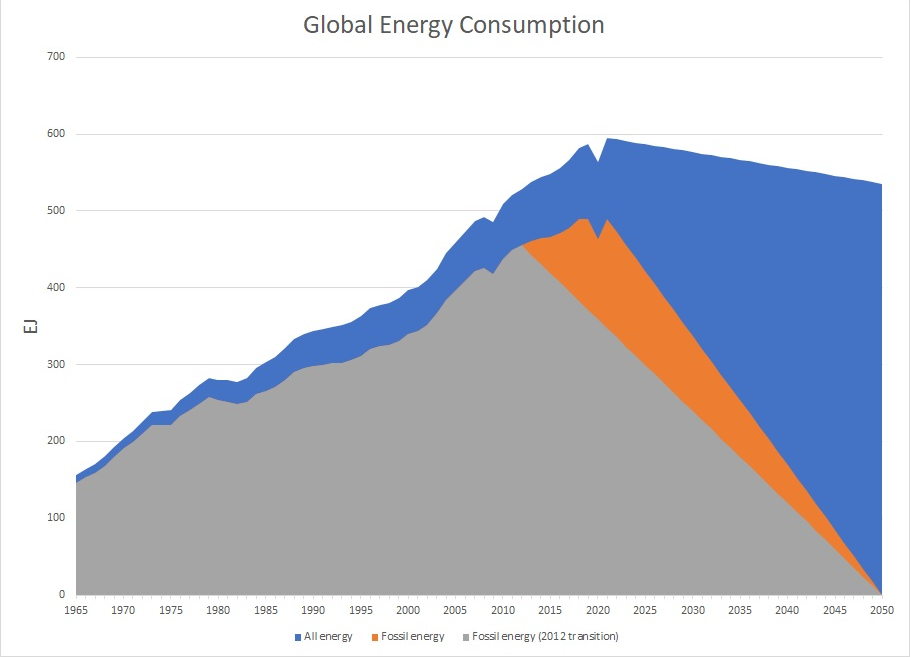
Let’s look at those grosser human realities. In the graph below I indicate total global energy consumption from 1965 to 2021, split between fossil and non-fossil energy sources, and then project that forward to 2050 on the (generous, I think) assumption that by 2050 we’ll need only 91% of current global energy consumption to keep us happily ticking along, but we’ll need to transition completely to non-fossils between now and then.
Global energy consumption


Source: BP Statistical Review of World Energy

The graph suggests that to achieve a 100% renewables transition by 2050 we’ll need to lose on average 16.9 exajoules of fossil energy consumption from the global energy mix each and every year between now and then. That’s more than the entire fossil energy consumption of the fifth largest energy-using country globally, Japan (15.5 EJ).

Let’s play that out in an imaginary scenario on a country by country basis. The 2022 energy figures haven’t been released yet, but if the graph is going to fit that orange downslope we have to hope that something like 16.9 EJ of fossil fuel consumption will have been swiped out last year. We can start the game gently by taking out the entire fossil fuel consumption of Japan in 2022, although that already puts us a little bit behind the curve.

Next let’s send a delegation to Moscow and ask Mr Putin to eliminate his country’s entire fossil energy use within a period of about 18 months. They’ll need good negotiating skills, but anyway.

Then let’s hop over to the USA and ask the new president, now they’ve bedded in for a bit, to cut 16.9 EJ of fossil energy consumption in their country every year for the rest of their presidential term, with another year on top so their successor can take a bit of the heat (or, in fact, remove it).

After that, India – we’ll give Mr Modi or his successor just over 18 months to cut out all the fossil fuels.

Then the big one. China gets nearly eight years to cut all its fossil energy. Good thing Mr Xi is president for life.

So now it’s 2037, we’ve taken out just the top five fossil fuel using countries and we’re about halfway there. Next year we need to take out another 16.9 EJ of fossil energy – let’s target the entire African continent, giving its governments one year to cut their collective 18 EJ of fossil fuel use, which will help us catch up with what we lost by swiping only Japan in 2022.

After that, we can aggregate various random countries to lose 16.9 EJ each year, every year, for the run up to 2050 by swiping their entire fossil energy consumption. Maybe Canada and Indonesia in 2039. The UK, Turkey and Italy in 2040. And so on until we’ve rounded up the last few stragglers. Job done.

When you frame energy transition technically in terms of things like bringing sodium-ion batteries to commercial scale or optimising inverter-based resources, it all sounds vaguely feasible. When you frame it in terms of taking out roughly the equivalent of the entire fossil energy consumption of the world’s fifth biggest energy consumer every single year for the next thirty years it all sounds vaguely impossible.

And while we’re knocking out all that fossil consumption, we’d have to be building up the renewables consumption – that big area of blue opening up on the right of the graph. Currently renewables account for 7% of total energy consumption and 38% of non-fossil fuel energy consumption, amounting to about 40 EJ of consumption annually. To make the 100% renewables transition, globally we’d have to add the equivalent of nearly half the world’s existing renewables consumption every year from now until 2050. Bear in mind, incidentally, that all this is just to keep global energy use roughly where it is at the moment. Not to transition low-energy and low-income countries to high-energy and high-income ones. And not to find a whole load of extra capacity with which to energise microbial food manufacturing.

You’ll see another downslope in grey on the graph starting in 2012. I picked that year because it was when I started this blog. Back then a few people told me that I was being over-dramatic about a small farm future, because the world would soon be transitioning to clean energy. Sometimes I’ve almost believed that myself. The graph gives a sense of how much that hasn’t happened in the intervening years. Still, that transition, the one that was around the corner in 2012 is now just past history. Or rather past non-history. All that matters now is the transition that’s just around the corner in 2023. Is it possible that will happen, by 2050? Well, we’re taught never to say some future eventuality is impossible. I’m not sure it’s always great advice, but anyway I would say that the transition is all but impossible, yes. And I think it would be better if collectively humanity acknowledged it. Because then all the smart people who are devoting themselves to modelling a 100% transition to renewables and scorning those who say otherwise could redeploy their technical skills towards making the soft path towards a small farm future as soft as it can possibly be.

My fear is that our societies aren’t going to give up on the hope of a 100% renewable transition, meaning – unfortunately – that the likeliest future we face is the hard path to agrarian localism.

Chris Smaje

Chris Smaje has coworked a small farm in Somerset, southwest England, for the last 17 years. Previously, he was a university-based social scientist, working in the Department of Sociology at the University of Surrey and the Department of Anthropology at Goldsmiths College on aspects of social policy, social identities and the environment. Since switching focus to the practice and politics of agroecology, he's written for various publications, such as The Land , Dark Mountain , Permaculture magazine and Statistics Views, as well as academic journals such as Agroecology and Sustainable Food Systems and the Journal of Consumer Culture . Smaje writes the blog Small Farm Future, is a featured author at www.resilience.org and a current director of the Ecological Land Co-op. Chris' latest book is: A Small Farm Future: Making the Case for a Society Built Around Local Economies, Self-Provisioning, Agricultural Diversity, and a Shared Earth.

bneGREEN: Europe saves €100bn from the switch to renewables due to the Ukraine war

bneGREEN: Europe saves €100bn from the switch to renewables due to the Ukraine war
Due to the Russian-induced energy crisis, Europe poured investment into renewables in the last year resulting in a €100bn saving in energy bills. / bne IntelliNews
By Ben Aris in Berlin June 5, 2023

European electricity consumers will save some €100bn on their energy bills due to the rapid expansion of renewable energy sources caused by the Russian induced energy crisis, the International Energy Agency (IEA) said in a report.

It is estimated that from 2021 to 2023, the installation of new solar photovoltaic (PV) and wind capacity will result in savings of around €100bn.

The addition of low-cost wind and solar installations has displaced approximately 230 TWh of expensive fossil fuel generation since Russia's invasion of Ukraine, consequently reducing wholesale electricity prices across all European markets. Without these capacity additions, the average wholesale electricity price in the European Union would have been 8% higher in 2022, the IEA concluded.

The decrease in Russian natural gas deliveries to the European Union following the invasion of Ukraine resulted in an 80% decline in pipeline deliveries from 2021 to 2022. This decline coincided with reduced hydro and nuclear power output in Europe. As a result, the prices of natural gas and hard coal shot up, with the average monthly natural gas price surging ten-fold and the price of hard coal quintupling between January 2021 and August 2022. These price hikes led to unprecedented levels of power generation costs from natural gas, reaching nearly €800/MWh for open-cycle gas turbines and €500/MWh for combined-cycle gas turbines.

The wholesale electricity spot market in the European Union serves as the benchmark for most electricity supply contracts, driving prices up for all consumers. The price is determined by the costliest generator required to meet demand at any given moment. Due to the substantial increases in natural gas and coal prices in 2021-2022, consumers in the wholesale market, including retailers and large companies without fixed-contract energy portfolios or strong hedging positions, had to purchase electricity at rates up to 15-20 times higher than the averages of the period between 2015 and 2020.

To counter these challenges, the European Union added nearly 90 GW of solar PV and wind capacity in 2021 and 2022. This additional capacity displaced almost 10% of hard coal and natural gas generation, effectively driving out the most expensive power plants from the market and reducing prices for all consumers. It is projected that an additional 60 GW of solar PV and wind capacity will come online in 2023, further increasing displacement to nearly 20% this year.

By analysing the relationship between hourly generation from hard coal and natural gas and wholesale electricity spot prices in several large EU economies in 2021 and 2022, a scenario was modelled to estimate the potential savings with the addition of more wind and solar PV capacity in 2023. The results indicate that without the growth in PV and wind capacity between 2021 and 2023, average wholesale electricity prices would be higher by approximately 3% in 2021, 8% in 2022 and 15% in 2023. This would lead to an overall increase in the cost of electricity supply for the entire European Union, amounting to roughly €100bn.

Notably, the savings achieved through new renewable energy capacity in Spain alone surpass the country's allocated budget of €6.3bn for a European Commission-approved temporary intervention aimed at reducing wholesale electricity prices. Similarly, the savings derived from Germany's new renewable generation capacity would cover the government's recent proposal to support electricity prices for energy-intensive industries until 2030.

The acceleration of renewable energy deployment since 2021 has provided a cost-effective solution to the economic challenges posed by the energy crisis. Long-term contracts secured through policy mechanisms and regulations ensure stable prices for most wind and solar PV power generators in Europe, shielding them from volatile electricity prices. These measures also help protect consumers from rising electricity costs.

“The total investment cost of deploying PV and wind capacity over 2021-2023 is expected to amount to about €200bn. Almost 50% of this investment cost will likely be returned in the form of savings on power consumers’ bills by as early as the end of 2023, while these power plants will continue to provide benefits for the next 20-25 years,” the IEA said.  

According to the IEA accelerated case forecast, savings could have been about 15% higher if EU capacity had been increased more rapidly, through quicker implementation of policies supporting the deployment of technologies with short lead times (i.e. distributed solar PV) and a reduction in red tape for projects at the advanced stages of permitting.

German Chancellor Scholz roasts pro-Russian hecklers in an uncharacteristically fiery speech

German Chancellor Scholz roasts pro-Russian hecklers in an uncharacteristically fiery speech
German Chancellor Olaf Scholz responded to pro-Russian hecklers with an uncharacteristically rousing speech that condemned Russia's Putin as a warmonger and murderer of children and pensioners. / bne IntelliNews
By bne IntelliNews June 5, 2023

German Chancellor Olaf Scholz shocked observers after he put down hecklers at a speech in Berlin, delivering a fiery speech that condemned Russian President Vladimir Putin as a “warmonger” and a “murderer” on June 3.

Scholtz was delivering a speech at a Berlin festival when he began to be heckled by around 100 pro-Russian protesters that said that Germany was inflaming the conflict and warmongering. They said Scholtz was a "liar" and "bandit" and demanded an end to military aid for Ukraine.

Germany has a large population of some 8mn Russia immigrants that have opposed the government’s stance of supporting Ukraine “come what may”, according to German Foreign Minister Annalena Baerbock.

Uncharacteristically, Scholtz hit back with some raw rhetoric, unusually for the Chancellor, who has been very cautious in almost all his public statements on the Russia-Ukraine conflict.

“Warmonger!? First of all, the warmonger is Putin. He invaded Ukraine with 200,000 soldiers,” Scholtz hit back. “He is risking the lives of his own citizens for an imperialistic dream. Putin wants to destroy and conquer Ukraine!”

“And he killed countless citizens, children and elderly in Ukraine!” Scholtz passionately retorted. “That is murder, to say it very clearly.”

When the hecklers continued to shout, Brandenburg Prime Minister Ditmar Woidke told them to continue their demonstration in Moscow's Red Square.

Uganda’s Ghetto Kids make Britain’s Got Talent history – here’s the reality of ‘orphanages’ around the world

Screen grab/Britain's Got Talent on YouTube

THE CONVERSATION
Published: June 5, 2023 

A group of talented young dancers from Uganda warmed hearts around the world after earning the coveted “golden buzzer” on Britain’s Got Talent. The Ghetto Kids are a dance troupe of children between the ages of five and 13 growing up in a child care institution in Uganda. Putting on electrifying performances that showed off their personalities and impressive choreography, the children made it to the final.

The attention on Ghetto Kids presents a chance to acknowledge the lived realities of approximately 5.4 million children worldwide growing up in institutional care. For many of these children, there are deeply troubling reasons for their entry into care, and many have challenging childhoods away from their families.

The Ugandan Care Leavers Association has released a balanced yet strong critique of the promotion of Ghetto Kids on Britain’s Got Talent. The campaigners recognise that the public support of Ghetto Kids is well intentioned. But they highlight, through sharing their own experiences, how detrimental the lifelong impact of institutional care can be.

Institutional care refers to large numbers of children accommodated in one home and cared for by a relatively small number of staff. They differ from smaller scale residential children’s homes that often care for around five to ten children, offer more family-like care and are embedded in the community. The Ghetto Kids home looks after over 30 children, and the founder, Daouda Kavuma, has stated on the show that he has ambitions to grow this number.

Globally, it is estimated that four out of five children living in institutional settings actually have family. Save the Children’s research found that 98% of children in institutional care in central and eastern Europe, 94% in Indonesia, and 90% in Ghana have at least one living parent.

Despite this, many organisations that care for these children still refer to themselves as orphanages. The word evokes stories of caring for a relinquished child. This is a powerful narrative for organisations in low income countries to increase charitable donations.

Studies have revealed that numerous children are victims of exploitation and trafficking into institutions. In some cases, orphanage owners recruit or traffic children to establish “voluntourism” programs. They can profit from overseas volunteers who pay to spend time with “orphans”.

The orphan myth

In my research in Thailand parents told my colleagues and I that they were dissuaded from visiting their children in the homes. This was to avoid the parents encountering donors who believed the children were orphans. Researchers describe this false narrative as the “orphan myth”.

There is no evidence that the Ghetto Kids home engages in these exploitative practices, but Britain’s Got Talent risks perpetuating this myth in how it frames their story. Press coverage, and the children themselves, refer to the home as an orphanage. However, Kavuma Dauda, the founder of the troupe, has only said that “some” of the children are orphans. (Britain’s Got Talent did not respond to The Conversation’s request for comment.)

In many countries, children are rarely placed into care due to orphanhood or concerns about abuse. More often, the driver is poverty and resources. In Thailand we found that parents often placed their children in care to ensure access to basic needs, food, healthcare and education.

For a family living in poverty, the experiences of children from organisations like Ghetto Kids – attending university, finding career success or international dance fame – might present an opportunity to give their children a better life. However, these opportunities can come at a significant cost: a childhood apart from their families.

The harms of institutional care

Decades of research has highlighted the negative outcomes for children in institutional forms of care around the world. The staff-to-child ratio in institutions often affects the staff’s ability to nurture the children. This is often compounded by the staff members being on shift patterns that result in inconsistent care. Children in some settings can experience an estimated 50 to 100 different caregivers in the space of a year.

A systematic review of the literature concluded that institutional care has a negative impact on children’s attachment. Other studies have reported lower IQ scores and impaired physical growth in institutionalised children compared to those in family based care. This has led researchers to argue that institutional care can be considered a form of child maltreatment, and described this as a form of structural neglect.

These findings were reinforced in a systematic literature review by the Lancet Commission in 2020, which unequivocally concluded that institutionalised children in alternative care experience impairment in their physical, social, cognitive and emotional development.

Read more: Ghetto Kids: what's behind the moves of the Ugandan dance troupe that stormed the world

Care reform

In their statement on Ghetto Kids, the Ugandan Care Leavers association called for an end to the promotion of institutional care without considering alternatives that enable children to stay connected to their families and communities.

This alternative lies in governments developing child welfare policies and practices informed by the UN guidelines on alternative care. These state children should only be placed away from their families when necessary and that alternatives to institutions with large numbers of children should be developed.

As a result, countries including Kenya and Rwanda have started to reform national care to support children to remain in their families, or be placed into small scale children’s homes or foster care placements if that’s not possible.

Read more: Kenya takes next steps to replace children's homes with family care

This reform is also happening in Uganda, where activists from the care leavers association and other nongovernmental organisations are working with the government to ensure that children’s rights to family life, enshrined in the UN convention on the rights of the child and the African charter on the rights and welfare of the child, are met.

Author    
Justin Rogers
Lecturer in Social Work, The Open University
Disclosure statement
Justin Rogers has previously received research funding from The British Council and The Martin James Foundation. He is also a part of the Open University's Centre for the Study of Global Development.
Partners

Moscow's Hand: How does information warfare affect the politics of Russia's neighbours?


By Andrey Poznyakov

Since Russia's invasion of Ukraine, propaganda and disinformation have been perceived as a major threat in a number of countries. Why do these materials play such a role and even become a tool of domestic politics?

Since Russia's invasion of Ukraine, propaganda and disinformation have been perceived as a major threat in a number of countries. Why do these materials play such a role and even become a tool of domestic politics?

Information warfare is increasingly high on the political agenda of Russia's neighbours. Politicians talk about propaganda and disinformation. Analysts note that it is local political forces that are particularly active in promoting pro-Kremlin views.

A fierce internal political struggle with references to information warfare, accusations of propaganda and the use of materials that opponents believe to be Russian disinformation is unfolding in Georgia and Moldova. Both countries aspire to EU membership and are on their way to it. In both countries the Russian vector is opposed to the Western one and the government is accused of undermining the nation's European aspirations.

In Georgia this confrontation looks particularly acute due to the polarisation of the media and society", explains Dustin Gilbreath, Deputy Director of Science at the Caucasus Research Resource Centre. He draws attention to the fact that according to recent opinion polls, support for the country's European aspirations is breaking records. But anti-Western agitation is threatened by the involvement of public figures:

"When the Georgian Dream government repeats explicitly anti-Western lines, regularly insulting American officials and insulting EU officials, saying that America is trying to drag Georgia into war, few people believe these narratives, but some have come to believe them. These lines of disinformation, meanwhile, are mostly coming from people inside the country, and mostly amplified by officials of the Georgian Dream government. And this is a major problem."

Shakh Aivazov/Copyright 2023 The AP. All rights reserved
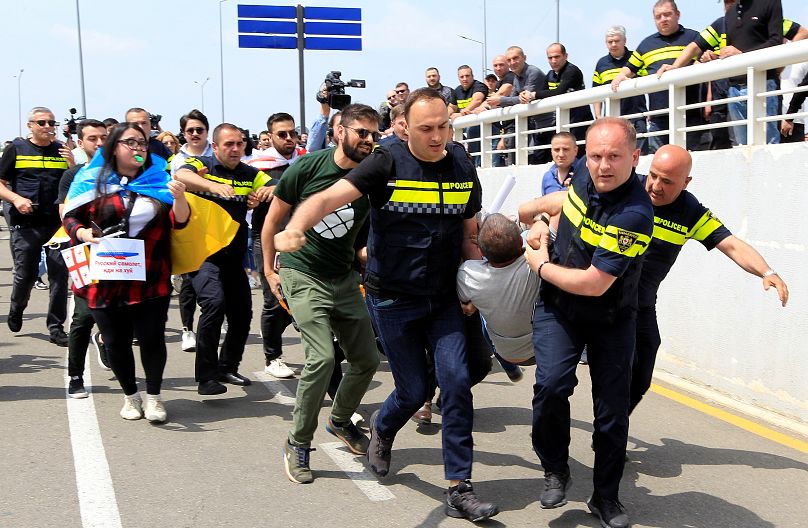
Police officers detain an activist during a protest against the resumption of air links with Russia at the International Airport outside Tbilisi, Georgia, May 19, 2023Shakh Aivazov/Copyright 2023 The AP. All rights reserved

According to Gilbreath, the outcome of the Russian invasion of Ukraine will play an important role for Georgia. Tbilisi is confident that this aggression is similar to the events of the Russian-Georgian war. Should Moscow win, other neighbouring countries could remain forever within the orbit of Russian influence. The Kremlin's military failures offer hope for a strengthening of sovereignty.

Russia's soft power

Moscow is trying to influence Georgian politics with soft power, not in a positive way but in a negative way, says independent journalist and political observer Razi Zhante. It means that Moscow is not trying to create a positive image of Russia but is trying to create a negative image of the Western world, saying how European values are in contradiction to traditional Georgian ones, claiming LGBT threat and playing on other forms of intolerance

At the same time, Zhante believes that no media or disinformation can already reverse the main trend in Georgia, where 80% of citizens want to join the EU, and the Kremlin understands that:

"Russia is not even trying to change Georgians minds, it's actually working in some kind of leadership. That is exactly what is happening now. Right now we really need to follow what is happening in Georgia and we will probably have turbulent, tense weeks and months ahead of us, during which the geopolitical, historical path of the country is at stake and it may come under the Russian influence."

Such a scenario, according to Jeantet, poses the threat of a further authoritarianisation of governance. Society is not ready to accept the rejection of European integration and will find itself in inevitable conflict with the authorities, which, in turn, will be ready to resort to more and more violent methods of containment of protest, relying on Russian support.

Moldovan split

Pro-Russian materials have become a major component in the political struggle in Moldova. Here politicians also complain about the propaganda in the context of the split between supporters of the European and pro-Russian vectors of development. This conflict reflects the revanchist aspirations of the former regime," Felix Hett of the Friedrich Ebert Foundation in Moldova says:

"The biggest threat, from the point of view of the current Moldovan government, is the return to power of the old kleptocratic, oligarchic and Russia-oriented political forces. And I think this is the biggest problem in the sense that they are using or are using these Russian narratives to promote their own domestic political agenda."

Andreea Alexandru/Copyright 2023 The AP. All rights reserved
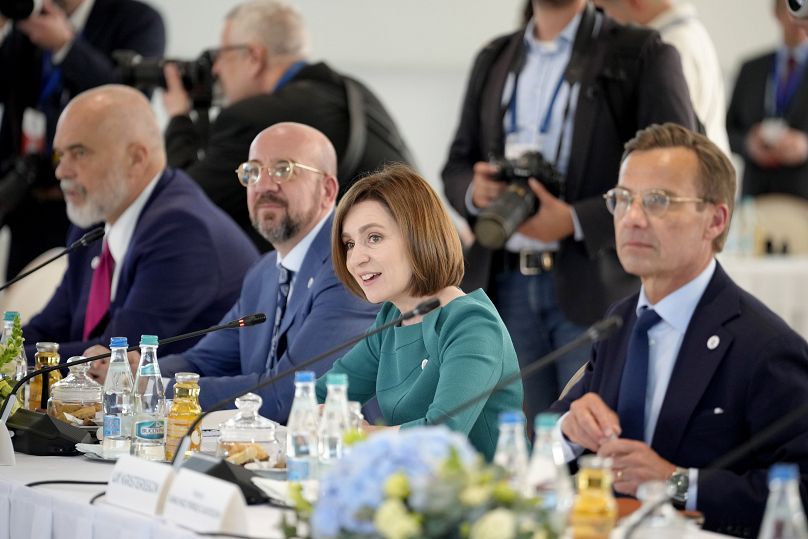
Moldova's President Maia Sandu, center, attends a round table meeting during the European Political Community Summit at the Mimi Castle in Bulboaca, Moldova, June 1, 2023Andreea Alexandru/Copyright 2023 The AP. All rights reserved

Hett notes that Moldovans in a polarised environment find one source of information that they trust. At the same time, official sources and the government often do not enjoy such trust, and the difficult social and economic situation exacerbates the conflict. This, according to the analyst, is the main difficulty in combating the alleged disinformation and propaganda.

In a society that has both close ties to Russia and the EU, Hett believes the focus should be on restoring trust in state institutions.

Moldovan President Maia Sandu, who has become the main voice of the country's European choice, proposes to bring the fight against Russian propaganda to the state level and create a "Centre for Patriotism" for this purpose. She has previously accused Moscow of preparing a coup and attempting to destabilize the situation in the country. Russia rejects these claims, stating that it does not interfere in the internal affairs of other states.

US Air Force Completes Flight Tests for New Energy Laser Beam Director Concept

A test aircraft carries HARDROC beam director illuminated by 
a low-power scoring laser. Photo: US Air Force

 JUNE 5, 2023

The US Air Force Research Laboratory (AFRL) has completed flight tests for a new beam director concept that can be integrated with aircraft-based directed energy laser systems.

The Hybrid Aero-Effect Reducing Design with Realistic Optical Components (HARDROC) is a low-power, sub-scale turret deploying a laser beam from an airborne vehicle traveling at high speed.

During the tests, HARDROC was evaluated for various aerodynamic flow control techniques associated with optical and mechanical distortions during energy laser firing.

“Using advanced computational fluid dynamic, or CFD, simulation techniques, we were able to demonstrate significant reduction in aero-effects across a wide range of speeds and look angles,” HARDROC Program CFD Lead Dr. Scott Sherer explained.

“We effectively utilized a substantial amount of computational hours provided by the Department of Defense High Performance Computing Modernization Office to establish which flow-control techniques could work, which techniques were worth pursuing and which were not.”

‘Instrumental’ Data Collected

The HARDROC team comprises experts from the AFRL Aerospace Systems Directorate in Wright-Patterson AFB, Ohio, and the Directed Energy Directorate in Kirtland AFB, New Mexico.

The AFRL is working with the Albuquerque-based High Energy Laser developer MZA Associates on the program.

“Advancing to flight-testing was a huge undertaking and accomplishment of the HARDROC team,” Directed Energy Directorate Aero-Effects and Beam Control Co-Principal Investigator Dr. Matthew Kemnetz stated.

“Data from these flight tests will be instrumental to airborne beam director development efforts moving forward.”


Advancing the Air Force’s Next High-Power Laser

According to the US Air Force, demonstrating the HARDROC aerodynamics modifications with realistic optical components was crucial to employ the system’s overall effectiveness.

“The biggest question in our mind was whether these flow-control techniques could be used with the sensitive optical components required for an advanced directed energy system. HARDROC answered that question with an emphatic yes,” Johnson said.

MZA assisted through this phase to provide AFRL with a sub-scale system that can be tested in a wind tunnel and live aircraft experiments.

The resulting platform was trialed in an environmental chamber and wind tunnel before being deployed on a business jet in 2022.

“The successful flight demonstration of the HARDROC turret clears one of the key remaining technological hurdles for operation of high-power lasers on high-speed aircraft for a variety of Air Force missions,” Aerospace Systems Directorate Technical Advisor Dr. Mike Stanek stated.

“Integration of the low-SWaP (size, weight and power) HARDROC turret would allow less laser power to be lost to aero-effects, thus enabling mission performance compared to other types of integration strategies.”


MEP Eva Kaili denies role in European Parliament corruption scandal

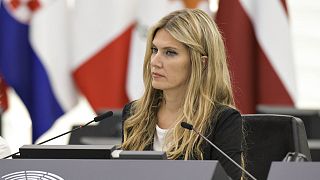
Eva Kaili has been charged with corruption, participation in a criminal organisation and money laundering.
Eva Kaili has been charged with corruption, participation in a criminal organisation and money laundering.   -  Copyright  European Union, 2022.
By Euronews

Eva Kaili, the former European Parliament vice president who was arrested in December, broke her silence with three interviews in European newspapers.

Eva Kaili, the MEP at the centre of the European Parliament corruption scandal, broke her silence over the weekend in three separate interviews with European newspapers, defending herself against the criminal charges she faces.

The former European Parliament vice president was arrested last December and charged with participation in a criminal organisation, corruption and money laundering.

The investigation centres on a cash-for-favours scheme that allegedly involved bribes paid by Qatar and Morocco to influence policy-making inside the European Parliament.

The probe has brought charges against six individuals in Belgium and Italy, including three sitting lawmakers, and raised serious questions of foreign interference and illicit lobbying.

But Kaili, the most high-profile of the suspects, insisted on her innocence in interviews published in the Spanish newspaper El Mundo, Italian newspaper Corriere della Sera and French newspaper Libération.

They were published after the MEP was released from electronic surveillance following four months in prison and nearly two months monitored at her home.

The interviews occurred before a court order that she not speak to the press, Libération reported.

'I know I look guilty'

Kaili told the French newspaper that she indeed found hundreds of thousands of euros in the home she shared with partner Francesco Giorgi after his arrest last year.

She gave that cash to her father to bring back to his hotel, which was found by Belgian authorities. Police apprehended the father but he was later released without charges.

"I just wanted to get this money that didn't belong to me out of my house. I can't explain it differently. I know I look guilty," she told Libération.

Kaili told Corriere della Sera that she was put in solitary confinement after her arrest, denouncing the conditions in Belgian prisons as "inhumane."

She also defended her previous meetings with Gulf countries, stating that as a parliament vice president in charge of relations with the Middle East, she often met ambassadors and ministers and planned official visits.

Weeks before her arrest, the lawmaker delivered a speech before the hemicycle in which she strongly defended Qatar's track record on human rights in the context of the 2022 FIFA World Cup.

She told El Mundo that she would be delighted if "someone could explain to me how what I have said differs from European politics."

Kaili claimed that Belgian secret services monitored her due to her work on the parliament's committee investigating the use of Pegasus spyware in Europe, claiming that this was the "real scandal."

She also accused Belgian authorities of trying to force her to name people in the case in exchange for a deal, stating that if she had pleaded guilty she could have gone back to her daughter.

Her lawyer, Sven Mary, told Euronews earlier this year that the Belgian authorities had not found any new evidence to justify Kaili’s imprisonment. Shortly after, she was released from prison with electronic surveillance.

Last month, the MEP was no longer required to wear an electronic bracelet.

The Belgian Federal Prosecutor's office told Euronews that they would not react to Kaili's comments but specified that the matter would be decided by the justice system.

A spokesperson added that Kaili had been allowed to see her daughter twice a month, which he said is the standard in preventive detention.

France’s Spectacular Abbey Mont-Saint-Michel Celebrates 1,000th Birthday
June 05, 2023 
Associated Press
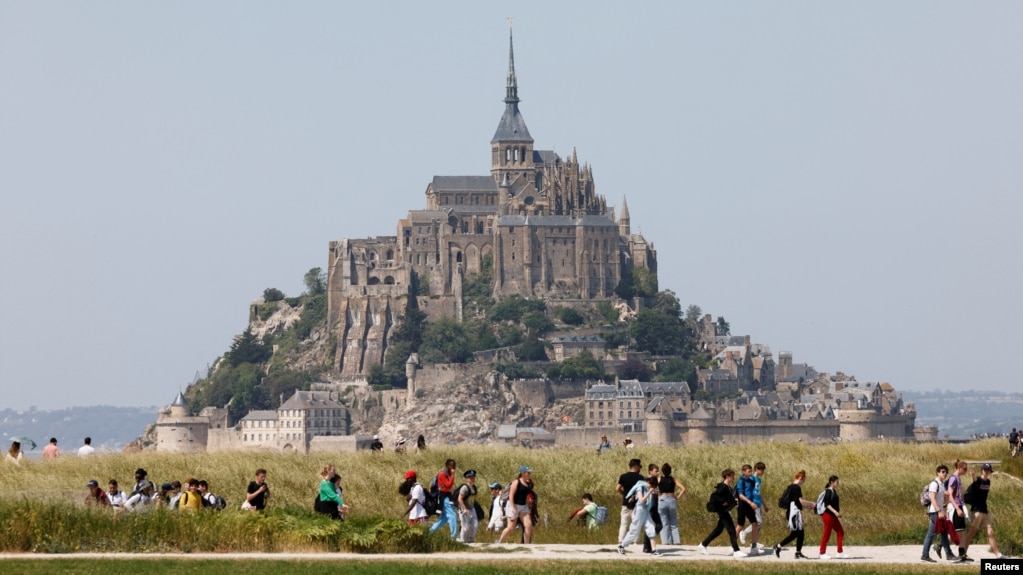
People walk past France's Mont-Saint-Michel during the French President's two-day visit in Normandy, in Le Mont-Saint-Michel, June 5, 2023.

PARIS —

France’s beloved abbey of Mont-Saint-Michel has reached a ripe old age. It’s been 1,000 years since the laying of its first stone.

The millennial of the UNESCO World Heritage site and key Normandy tourism magnet is being celebrated until November with exhibits, dance shows and concerts. French President Emmanuel Macron is heading there on Monday.

Macron plans to deliver a speech and to see a new exhibit tracing the Romanesque abbey’s history via 30 objects and pieces, including a restored statue of Saint Michael.

Legend has it that the archangel Michael appeared in 708, duly instructing the bishop of nearby Avranches to build him a church on the rocky outcrop.

The exhibit, two years in the making, opened last month. It covers the complex process of building what is considered an architectural jewel on a rocky island linked to the mainland only by a narrow causeway at high tide.

Four crypts were constructed on the granite tip along with a church on top. The exhibit explains how the original structure, built in 966, became too small for pilgrims, spurring on the builders to create the 11th century abbey that stands to this day.

France has spent more than $34 million over 15 years to restore the building, and the work is nearing completion. Authorities have also tried in recent years to protect the monument’s surrounding environment from the impact of mass tourism.

One of the most popular French destinations outside Paris, Mont-Saint-Michel island attracted 2.8 million visitors last year, including 1.3 million for the abbey. It was not closed to visitors for the presidential visit, but local authorities were taking measures for it to go as smoothly as possible.
India investigates rail disaster as trains crawl through crash site

By Jatindra Dash
June 5, 2023

Summary
Crash in Odisha state claims at least 275 lives
Worst Indian train disaster in over two decades
Families search hospitals, mortuaries for relatives
Crash site track reopens to train services


KHARAGPUR, India, June 5 (Reuters) - The official investigation into India's deadliest rail crash in over two decades began on Monday after preliminary findings pointed to signal failure as the likely cause for a collision that killed at least 275 people and injured 1,200.

The disaster struck on Friday, when a passenger train hit a stationary freight train, jumped the tracks and hit another passenger train passing in the opposite direction near the district of Balasore, in the eastern state of Odisha.

Following non-stop efforts to rescue survivors and clear and repair the track, trains resumed running over that section of the line on Sunday night.

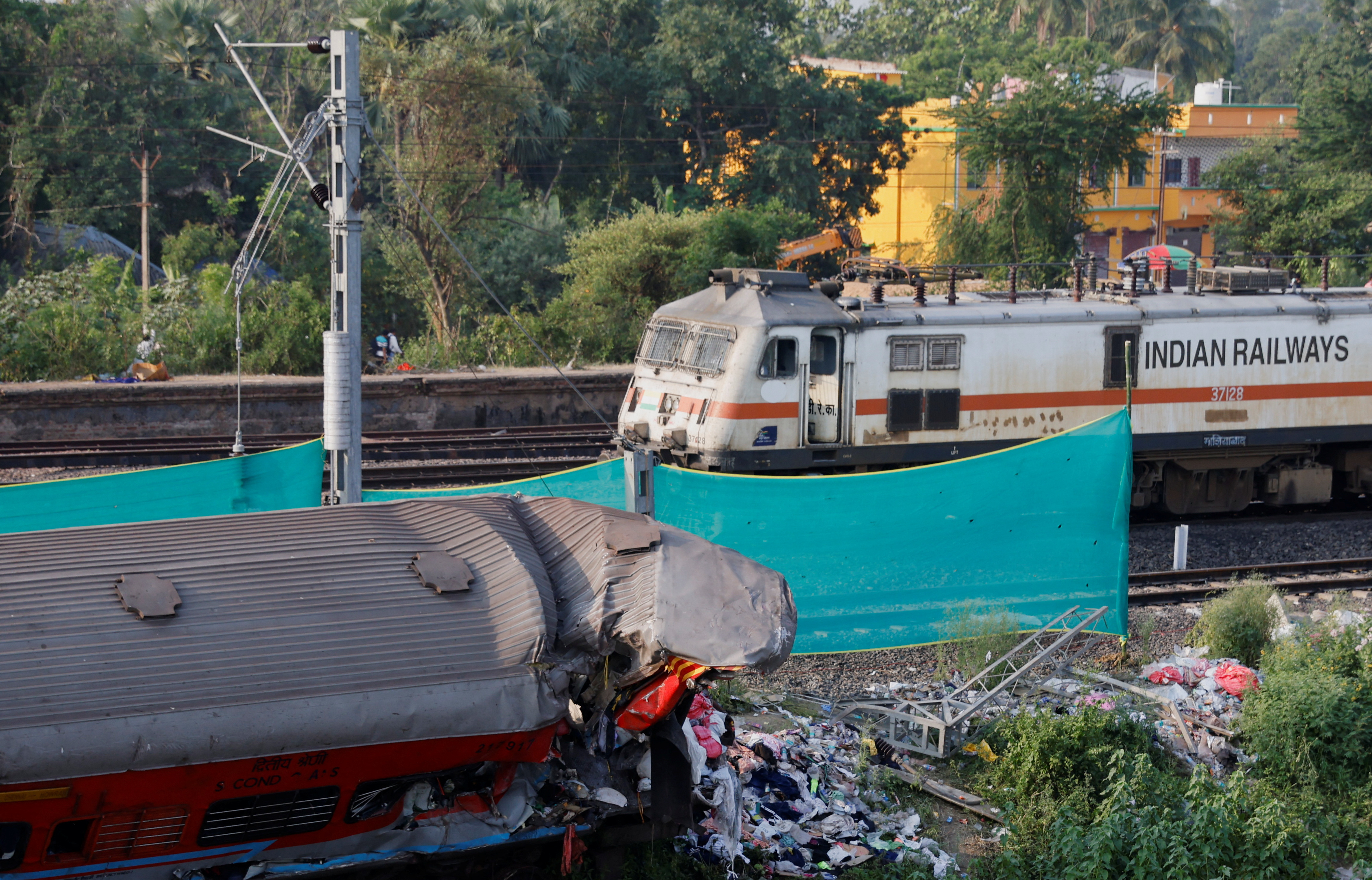
Trains were passing slowly by the derailed and mangled compartments, while repair work continued at the track side.

Some 120 km (75 miles) further north, at Kharagpur in West Bengal state, railway officials and witnesses gathered to submit evidence to a two-day inquiry, led by A.M. Chowdhary, commissioner of railway safety for the south-eastern circle.

"Everyone involved at the site have been asked to join the inquiry. The probe will take time and we are looking at all possible angles," Chowdhary told reporters.

India's Railway Board has recommended that the federal Central Bureau of Investigation (CBI) take over the probe into the cause of the disaster.

Chowdhary said he will submit his report to the Railway Board while the CBI investigation could run simultaneously.

Railway police also filed a complaint, seen by Reuters, without naming anyone under the Indian Penal Code sections dealing with causing "grevious hurt" or "endangering life" by negligence.

Reuters Graphics

Preliminary investigations indicated the Coromandel Express, heading southbound to Chennai from Kolkata, moved off the main line and entered a loop track – a side track used to park trains – at 128 kph (80 mph), crashing into the stationary freight train.


 A train moves past a damaged coach, after the tracks were restored, at the site of a train collision following the accident in Balasore district in the eastern state of Odisha, India, June 5, 2023. REUTERS/Adnan Abidi


That crash caused the engine and first four or five coaches of the Coromandel Express to jump the tracks, topple and hit the last two coaches of the Yeshwantpur-Howrah train heading in the opposite direction at 126 kph on the second main track.


At state capital Bhubaneswar's biggest hospital, the All India Institute of Medical Sciences (AIIMS), authorities set up large television screens with pictures of the dead to help desperate families who are scouring hospitals and mortuaries for friends and relatives.

Pradeep Jena, chief secretary of Odisha, told reporters that 170 bodies had so far been identified, more than half of the total toll.

Others were still searching for their relatives.

"We've checked all the hospitals but couldn't find the body. We are really exhausted," said a man, displaying a picture of his missing cousin Anjarul Hoque.

There was also an incident of a double claim for a dead body at the hospital in Bhubaneswar.

Afuy Shaikh and Dilip Kumar Sabar both sought to claim the body with tag number 63. Police officials said that a DNA test would be required if identification was inconclusive.

"We have to move towards normalization... Our responsibility is not over yet," said railway minister Ashwini Vaishnaw, his voice choking with emotion.

Reuters Graphics

The Chennai-bound Coromandel Express was due to resume running on Monday for the first time since the accident but the service was cancelled shortly before departure.

Aditya Chaudhary, chief public relations officer of South Eastern Railway, said this was due to a shortage of train coaches.

Reporting by Jatindra Dash, additional reporting by Subrata Nagchoudhary, Francis Mascarenhas, Krishn Kaushik and Tanvi Mehta; Writing by Sudipto Ganguly; Editing by Simon Cameron-Moore and Toby Chopra