Wednesday, October 11, 2023

Canada’s Healthcare System In Spotlight: Health Ministers Discuss Overcrowded ERs and Access to Care

BNN Breaking


Charlottetown’s serene beauty and relaxed atmosphere took on a more serious tone this week as provincial and territorial health ministers convened there. The purpose of their meeting? To address the rising concerns about the healthcare system in Canada, voiced by those at its heart – doctors and nurses. From overcrowded emergency rooms to difficulties in accessing care, these issues have sparked an urgent call to action.

Doctors and Nurses Raise the Alarm

Four groups representing doctors and nurses have sounded the alarm, pointing to systemic issues that threaten patient care and the sustainability of the healthcare system. But these aren’t just institutions calling for change; these are the very individuals who interact with patients daily, witnessing first-hand the challenges and bottlenecks that patients face.

A Push for Medical Homes


The Canadian Medical Association is advocating for the establishment of medical homes, or collaborative care clinics. Here, healthcare professionals, including doctors, nurses, and other specialists, work as part of an integrated team. This model promotes continuity of care and ensures that all Canadians have access to these primary-care networks.

Related video: Keeping connections post-pandemic remains critical for mental health (Global News)   Duration 5:42   View on Watch

The Privatization Dilemma

While the discussions about medical homes continue, nurses have raised another issue – the creeping privatization in healthcare. Their concern lies in the use of expensive private-agency nurses to fill vacant positions. They argue that public funds should be invested in the publicly delivered healthcare system, rather than used to line the pockets of private agencies.

Addressing the Shortage of Healthcare Workers

Another key issue on the table at the Charlottetown meeting is the shortage of healthcare workers. Suggestions to address this range from training more workers domestically to importing them from abroad. The challenge lies in striking the right balance, ensuring that quality of care isn’t compromised in the quest to fill vacancies.

As the discussions continue, the federal health minister is set to participate in the meetings on Thursday. The outcomes of these deliberations could shape the future of healthcare in Canada, impacting not just healthcare professionals but every Canadian who relies on these services.

Canada’s Immigration Tribunal Grants Entry to Sikh Man Involved with Khalistani Militants

Provided by BNN Breaking


A Landmark Ruling

In an unprecedented decision, Canada’s immigration tribunal has ruled in favor of a Sikh man from India who was accused of aiding Khalistani militants. The tribunal stated that the man, whose identity remains confidential due to legal reasons, provided shelter and food to the militants out of necessity and fear of retribution.

Unveiling the Case

The case centers around a Sikh man accused of supporting Khalistani militants, who have been fighting for a separate Sikh state in India. This man, fearing retribution from both the militants and the Indian government, sought asylum in Canada. The Canada Border Services Agency (CBSA), however, argued that he should be ineligible for refuge due to his involvement in what they termed ‘subversion by force’.
Historical Context

The Khalistani movement, which seeks to establish a separate Sikh state in the Indian region of Punjab, has been a source of tension between India and Canada. Numerous Sikh immigrants and their descendants in Canada support the Khalistani cause, leading to strained diplomatic relations between the two nations. This case is particularly significant as it reveals the complex issues surrounding political asylum and reflects the broader geopolitical dynamics between India and Canada.


Related video: Justin Trudeau on discussion spree with world leaders amid India-Canada diplomatic row without evidence (ANI Video)   Duration 3:58

Implications and Future Ramifications

This landmark ruling could potentially set a precedent for similar cases in the future. It may also impact Canada’s diplomatic relations with India, which has previously accused Canada of harboring Khalistani extremists. The decision could further strain the rapport between these two countries, potentially affecting trade and diplomatic negotiations. The ruling also underscores the human rights concerns that surround the issue of political asylum, placing Canada’s immigration policies under the spotlight.

Birchcliff Energy reports death of contract worker in Alberta
Story by Reuters •6h

 (Reuters) - A contract worker has died in a water storage pit at a Birchcliff Energy facility in northwest Alberta, the Canadian oil and gas producer said on Wednesday.

The Calgary-based company said circumstances surrounding the incident are under investigation, but that it appeared the contractor may have drowned. Emergency services attended the scene on Tuesday evening.

Birchcliff did not release the contractor's name.

"We have commenced an investigation into the cause of this tragic accident," said Birchcliff CEO Jeff Tonken.

Birchcliff produces around 80,000 barrels of oil equivalent per day from operations focused on the Montney and Doig resource plays in Alberta.

Birchcliff shares were down 0.1% at C$7.87 in Toronto.

(Reporting by Sourasis Bose in Bengaluru and Nia Williams in British Columbia; Editing by Sherry Jacob-Phillips and Rod Nickel)


MISSING MEN IN THE LABOUR MARKET 


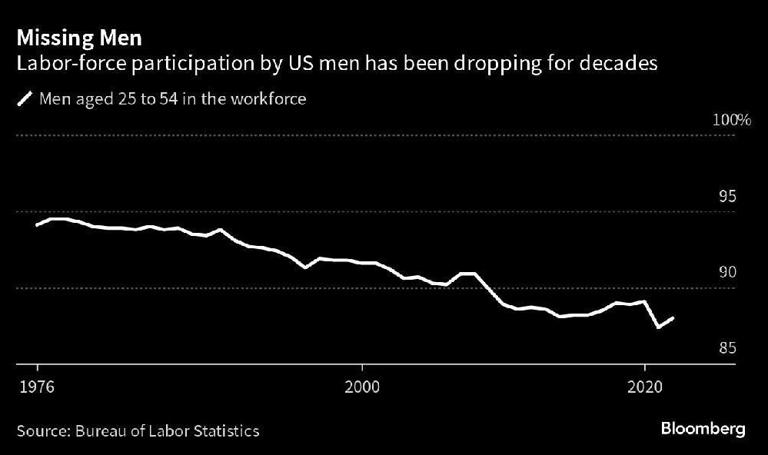
It’s a question that’s puzzled economists for decades: why have men been increasingly missing from the United States labour market since the 1960s?

The answer — at least partly — is that more millennial men are going to college than baby boomers. And new research from the Federal Reserve Bank of San Francisco shows that as these younger men graduate, they’ll increasingly enter the workforce and the decline in participation should slow.

The share of younger millennial men not working is about twice that of boomers at the same age, according to the report published Tuesday, but the gap closes substantially as they approach middle age. A greater share of young men today have a post-secondary degree, signalling that as they age, they’ll enter the workforce.

While men generally participate in the workforce more than women, trends for the two groups have diverged: Women are surging into jobs while for men aged 25 to 54 years old, participation’s fallen more than eight percentage points in the past six decades.

“As these younger generations age and make up more of the prime-age population, this may” increase participation rates and help economic growth, researchers including Leila Bengali, Evgeniya Duzhak and Cindy Zhao wrote in the report.

Laura Curtis, Bloomberg


Posthaste: More Canadian bosses starting to admit work from home is here to stay

Story by Victoria Wells •  Financial Post

Only 55 per cent of Canadian business leaders think staffers will return to the office full time within the next three years.

\Many chief executives in Canada would like to see employees back in the office five days a week, but appear to be realizing that those days might be over for good.

Only 55 per cent of Canadian business leaders think staffers will return to the office full time within the next three years, according to the latest CEO Outlook report from KPMG LLP. That’s a big drop from last year, when 75 per cent of CEOs expected employees to be back at their desks. Executives globally are more optimistic about a full return, with 64 per cent still expecting one.

Yet, Canadian CEOs remain eager to get people back, and to do so, 77 per cent say they’ll hand out pay raises, promotions and plum assignments to employees who make an effort to show up at their desks more often. But even that percentage is muted when compared to CEOs around the world, of which 88 per cent say they would offer such incentives to ensure more in-office days.

The research lines up with other studies that have shown Canadians spend more of their workweeks at home than employees in other countries. On average, Canadian staffers work from home 1.7 days a week, while workers in the United Kingdom do so 1.5 days and those in the United States stay home 1.4 days a week, according to recent research by a German think tank.

A slower return-to-office isn’t the only workplace issue Canadian executives are grappling with these days. Labour shortages , especially among skilled workers, continue to weigh heavily on leaders. Recession fears had many CEOs signing off on layoffs last year, but now 88 per cent say they’re expecting to hire more people over the next three years. But finding those staffers is proving to be a challenge, and more than three-quarters of executives say a lack of qualified labour poses a threat to business.

Increased immigration hasn’t been the solution many have hoped for, either. More than eight in 10 leaders of small and mid-size businesses say they still can’t find the skilled workers they need, the KPMG survey said. Meanwhile, 72 per cent are focusing their recruiting efforts outside the country in an effort to fill open positions.

Economic factors appear to be working against their efforts, however. Almost three-quarters of CEOs say the high cost of living in Canada, exacerbated by a housing crunch, is making it harder for them to woo and keep talent, including foreign workers.

Leaders are eyeing the impacts of high interest rates and living costs in their growth outlooks, and 75 per cent believe financial pressures will eat into their company’s prosperity in the coming years. They’re also watching geopolitical developments with concern, KPMG said. But it’s technology that is proving most worrisome to CEOs, and even causing them to lose sleep, KPMG said. They fear technological advancements will transform their industry and market before they can adapt.

Still, executives remain largely optimistic about the economy and their companies’ growth prospects, and 80 per cent say they feel good about growing their business over the next three years, while 89 per cent remain confident in the economy.

“CEOs are tackling demanding, evolving and complex challenges, yet remain resilient and confident in their outlook,” Elio Luongo, chief executive and senior partner at KPMG in Canada, said in a release. “They are reassessing their strategic priorities and redoubling their efforts on talent management and technology, while weighing the macroeconomic and geopolitical impacts on their organizations and people.”

Feds pump $12.5M into environmental literacy initiatives

Story by The Canadian Press •

The federal government is offering $12.5 million for environmental literacy projects aimed at young Canadians as part of its long-term efforts to tackle climate change.

The money will come from the federal Environmental Damages Fund, which redirects the money companies pay from court penalties and settlements to projects that repair environmental damage as well as further education and awareness, among other things.

“Nearly every aspect of a young person's future will be affected by climate — their jobs, their homes, energy use, transportation, food, water, health, personal security, and more,” said Environment and Climate Change Minister Steven Guilbeault in a press release. He described environmental literacy as “key to understanding and further developing innovative solutions to climate change” and arming Canadians with the “skills and information they need to thrive in a future shaped by climate challenges.”

Eligible projects must focus on either green learning spaces, developing learning materials, improving research on environmental literacy or integrating environmental education into teacher training and professional development, according to the funding announcement.

Applicants could include environmental non-governmental organizations, youth organizations, research institutions, teachers’ associations, and other groups as long as they are a registered charity. A portion of the funding is set aside for Indigenous organizations — such as national or provincial organizations, tribal councils, and communities — which don’t need to be on the list of charities.

Environment and Climate Change Canada is in conversations with “several philanthropic organizations” that have signalled “strong interest” in co-funding projects, which could help the federal government’s $12.5 million go even further, department spokesperson Samuel Lafontaine said in an emailed statement to Canada’s National Observer.

The interested philanthropic organizations have asked not to be named just yet, said Lafontaine. Once ECCC determines which projects are eligible, the philanthropic organizations can choose where to make their contributions, he explained. The names of the organizations will be made public when the projects are announced.

“Overall, the goal is to empower people living in Canada, especially youth, with relevant and accessible information to better understand environmental issues and ultimately translate this knowledge into everyday lifestyle choices,” said Lafontaine. “This information and increasing knowledge about environmental issues will indeed also help tackle misinformation and disinformation.”

The department is accepting applications until Oct. 31.

Climate education is top of mind for a group of senators who are working to connect interested senators with climate experts and briefing materials to improve their knowledge and ability to assess legislation through a climate lens.

Natasha Bulowski, Local Journalism Initiative Reporter, Canada's National Observer

Alberta Opposition moves ahead with public consultations on province quitting CPP

 Provided by The Canadian Press


EDMONTON — Alberta’s Opposition NDP is moving ahead with town-hall consultations next week on the government’s proposal to have the province quit the Canada Pension Plan.

NDP Leader Rachel Notley says more than 23,000 Albertans have already responded to her party's survey, with more than 90 per cent rejecting the idea of ditching the CPP.

Premier Danielle Smith announced almost three weeks ago that virtual town-hall consultations and an online survey would be held this fall by a panel headed up by former Alberta finance minister Jim Dinning.

“All this will be rolled out in the next few weeks,” Dinning told reporters Sept. 21.

The government has since started a $7.5-million advertising campaign and the online survey.

The government survey, however, does not ask respondents whether they want to leave the CPP. It instead asks them how they would like an Alberta plan to be structured.

Both plans are based on a recent third-party report commissioned by the government that estimates an Alberta pension plan could deliver higher benefits and lower costs.

The report, by pension analyst firm LifeWorks, calculates Alberta deserves 53 per cent, or $334 billion, of CPP assets should it leave around 2027.

Smith’s government is promising higher returns and lower contribution costs based on that calculation.

However, economists and the CPP Investment Board estimate Alberta would be in line for 20 per cent or lower of CPP assets, not to mention the politics of having the federal government agree to give up more than half the CPP to one province.

Notley said Smith’s government is not being honest with Albertans on the estimates or on the benefits and pension security that would flow from such an unrealistic base figure.

“They have done nothing honest on this issue,” Notley told reporters in Calgary on Tuesday.

“They have lied to Albertans about what the cost would be of pulling out of CPP. They lie to Albertans about how much money Albertans would be entitled to start up our own pension plan. 

“So, I am deeply skeptical about what would happen in the consultations that they would move forward.

“They're clearly trying to manipulate Albertans (and) they're using taxpayers’ dollars to do it.”

Savannah Johannsen, spokesperson for Finance Minister Nate Horner, responded in an email statement, saying, "The APP Engagement Panel’s virtual telephone town hall details will be posted on albertapensionplan.ca soon."

Johannsen added that the panel's aim "is to gather a full understanding of what Albertans think of the benefits and risks of an Alberta Pension Plan."

The NDP online consultation is set for Oct. 19 at 6:30 p.m.

The consultation is only one step of a long, potentially multi-year process.

Dinning’s panel is tasked with delivering a report on whether there is a provincial appetite for an Alberta pension plan.

If so, Smith said there would be a referendum and a majority of Albertans would have to give the OK and then the province would have to give three years' notice to set up the infrastructure for its own plan.

Polls and public surveys indicate a majority of Albertans want to stay with the CPP, but Smith says the potential benefits of an Alberta plan make it imperative she at least allow the discussion to go it alone.

No province has ever left the CPP, which was created in the mid-1960s. Quebec never joined the CPP at its inception.

This report by The Canadian Press was first published Oct. 10, 2023.

Dean Bennett, The Canadian Press

QUEEN OF CANADA QAnon CULT

Police seek to assure Sask. village residents that cult camped there poses no imminent danger

SEND HER BACK TO THE PHILIPPINES
Story by Dayne Patterson •

The people of Richmound are tense and anxious about members of a cult who are living at a former school in the village, according to the Saskatchewan RCMP.

But police say that despite issuing threats of public execution, the group does not pose an "imminent threat."

The group is led by Romana Didulo, who is known as a far-right QAnon conspiracy theorist but has dubbed herself the "Queen of Canada," among other titles, including the national Indigenous leader.

Didulo has amassed thousands of followers through social media, particularly on Telegram, a messaging app that has grown in popularity with the far right. She has also published hundreds of what she calls decrees, which cover topics like immigration, vaccine mandates and sexual education — with penalties that range from fines to death. 


The mobile RCMP detachment has been deployed to Richmound to manage rising tension among residents and a cult group housed in the former village school building. (Brad Miller)© Provided by cbc.ca

"The emotional climate in the community was escalated just in terms of opposition to the presence of this particular group," Chief Supt. Tyler Bates of the RCMP's south district management team told CBC Wednesday. 

He spoke from inside a mobile detachment that was brought to the village on Friday in response to the group's presence. 


Recommended video: 'Queen of Canada' cult threatens Sask. village with public executions (cbc.ca)   Duration 2:24   View on Watch


The RCMP expected that rising tension could lead to conflict, which is why they located the mobile detachment there. Bates said their predictions were correct, and police are now investigating an alleged assault "associated to this particular issue and the tension that exists." 

On Tuesday, there was a town hall at the Richmound Community Centre where RCMP tried to assure residents their safety was a priority as they investigate criminal complaints.

Richmound is located less than 20 kilometres from the Alberta border and is home to 118 people. Without the mobile detachment, the nearest RCMP response would come from Leader, Sask., about a 45-minute drive away, according to Bates. 

"We are here and we are present and we are responsive immediately," he said.

Didolu's group arrived about a month ago. Residents in Kamsack forced the cult out of their town in mid-September before the group was invited by the owner of the former Richmound School building to settle there.

Richmound villagers tried the same tactic those in Kamsack had used, protesting with signs and parading their cars near the school. They hoped to force the group to leave, but were unsuccessful.

Last week, followers of Didulo sent village administration at least four "cease and desist" emails, according to Richmound Mayor Brad Miller. 

They accused the mayor, village councillors, members of the fire department, RCMP and others of corruption, bullying and stalking — and threatened public execution for those found guilty of "crimes against humanity" or "treason."

"Whenever you have opposing perspectives and factions that escalate into threats and violence, there's always the possibility of escalation of criminality, so certainly we're taking that seriously," Bates said.

Bates said no charges have been laid but investigations are continuing.

Bates also said he couldn't comment on how long the RCMP would be in Richmound because it depends on different factors, such as ensuring the village is safe and completing ongoing investigations. 


Rise of the ‘Queen’: A Saskatchewan Village in Turmoil Over QAnon-Influenced Occupation


Provided by BNN Breaking


The tranquility of the small village of Richmound in Saskatchewan has been disrupted by a group of QAnon-aligned followers, led by a woman who refers to herself as the ‘Queen of Canada.’ This group, under the leadership of Romana Didulo, has occupied a private building and caused widespread alarm by issuing threats of public execution to residents and officials.

Unraveling the Didulo-led Crisis

The Didulo-led group, which boasts thousands of followers, has been active on social media, issuing decrees on a wide range of topics including immigration, vaccine mandates, and sexual education. The penalties for non-compliance, as stated by the group, can be as severe as death. The group’s activities escalated about a month ago when they arrived in Richmound after being expelled from another town. The occupiers have since sent threatening emails to the village administration, accusing officials of corruption and treason.

This ordeal has necessitated the intervention of the Royal Canadian Mounted Police (RCMP), which has deployed a mobile detachment to manage the escalating tension in the community. The RCMP is also investigating an alleged assault connected to the situation.

A Community Held Hostage

The RCMP’s involvement underscores the severity of the threats and the fear it has instilled in the village. The authorities are taking the threats seriously, and investigations are ongoing. The longevity of the group’s presence in Richmound hinges on the completion of these investigations and the restoration of safety within the village.

Residents have expressed growing concern over their safety and the potential impact of this crisis on their community. The seemingly relentless threats have left many villagers feeling besieged in their own homes. The village, which was once known for its calm and peacefulness, is now grappling with an unfamiliar wave of fear and uncertainty.

The ‘Queen of Canada’ and Her QAnon Ties

Didulo’s self-proclaimed title of ‘Queen of Canada’ and her association with the QAnon movement has drawn attention from national and international media. QAnon, a conspiracy theory born on the fringes of the internet, has been linked to several violent incidents in the past, raising concerns about the potential for further unrest in Richmound.

While the QAnon movement has been largely discredited, it continues to hold sway over a significant number of people. The situation in Richmound is a stark reminder of the enduring influence of such conspiracy theories and their potential to incite fear and chaos.

Looking Ahead: The Quest for Resolution

The situation in Richmound remains volatile, with the future uncertain. What is clear, however, is the urgent need for a resolution that ensures the safety and wellbeing of the village’s residents. As the RCMP continues its investigations, the villagers of Richmound wait in anticipation, hoping for a swift and peaceful resolution to this crisis.


CANADA

‘An advertisement for the nuclear industry’: Jonathan Wilkinson slammed for accepting nuclear waste strategy


Story by The Canadian Press •

 On Thursday, Natural Resources Minister Jonathan Wilkinson accepted the Integrated Strategy for Radioactive Waste, paving the way for a deep geological repository and multiple near-surface disposal facilities.

Justin Roy, a councillor for Kebaowek First Nation, an Algonquin First Nation opposing a low-level nuclear landfill site beside the Ottawa River, calls Wilkinson’s move both “concerning and disheartening,” he told Canada’s National Observer.

The near-surface disposal facility would be in Chalk River, roughly 180 kilometres northwest of Ottawa. The facility is a large above-surface mound that will house radioactive tools and protective equipment within a kilometre of the Ottawa River, a culturally significant river for the Algonquin Nation and a water source for millions. The Canadian Nuclear Safety Commission will decide in the coming weeks or months whether the near-surface disposal facility will get the go-ahead.

Roy interprets Wilkinson’s rhetoric in the press release as a green light for the near-surface disposal facility proposed by Canadian Nuclear Laboratories. 

“It just makes you think that the writing is on the wall when it comes to the[near-surface disposal facility], for sure,” he said.

The facility plan is undergoing “a thorough regulatory review process led by the Canadian Nuclear Safety Commission, including an assessment of any potential effects on the environment based on science, evidence, and Indigenous knowledge,” a statement from Natural Resources Canada said.

But Roy believes the commission is skirting Indigenous consultation and knowledge. He points to how Canadian Nuclear Laboratories, the company constructing the near-surface facility, did not change or edit its proposal to reflect Algonquin environmental assessments done over the past year, Roy said.

Roy is skeptical the Nuclear Safety Commission will heed the concerns of opposing Algonquin Nations. He thinks the commission is box-ticking Indigenous consultation off the checklist on the way to approval. The commission also did not make any edits or changes based on Algonquin concerns, Roy said.

Algonquin opposition will consider all options, including legal avenues if the near-surface disposal facility goes forward, Roy said.

The Chalk River facility will be the first in Canada, with Wilkinson’s press release pointing towards an expansion of “multiple near-surface disposal facilities,” setting the stage for a nuclear waste boom in Canada.

Ninety per cent of the waste is from Chalk River Laboratories, owned by Canadian Nuclear Laboratories, a private subsidiary of the Crown corporation Atomic Energy of Canada Limited. Canadian Nuclear Laboratories is owned primarily by AtkinsRéalis, formerly known as SNC-Lavalin.

Elizabeth May, co-leader of the Green Party of Canada, is concerned about the growing presence of the nuclear industry’s role in radioactive waste management, which may signal an expansion of nuclear energy through small modular reactors. Bruce Power has already announced it is planning to expand the largest operating nuclear power station in the world.

May fears AtkinsRéalis is positioning itself as a player in the nuclear industry with possible expansions in Quebec, New Brunswick and the Prairies. It’s a steep rise for the company: AtkinsRéalis only arrived on the nuclear scene once it bought Atomic Energy of Canada Limited for a “bargain, basement price” from the Harper government, May said.

“There's not a single indication in that press release from … Wilkinson that there's any caution or concern around the nuclear industry's plans,” she told Canada’s National Observer. 

May called Wilkinson’s acceptance “a veritable advertisement for the nuclear industry in Canada.”

Meanwhile, site selection for the deep geological repository to hold all of Canada’s intermediate and high-level nuclear waste will be decided in 2024.

The facility will be 500 metres underground, a depth roughly equivalent to the height of the CN Tower. Two sites are being looked at: one in South Bruce and another in northern Ontario near Ignace.

The underground repository is opposed by many First Nations in northern Ontario, with Nishnawbe Aski Nation, a political organization of over 50 First Nations, passing a resolution in 2022 against the proposed northern Ontario site.

However, Grand Council Treaty 3, an organization of Treaty 3 First Nations, has already made agreements with the Nuclear Waste Management Organization, which will develop the underground repository.

The Nuclear Waste Management Organization is also beginning to develop a new waste site for intermediate waste, such as pumps and filters, and non-fuel high-level waste derived from medical isotope production, Joshua Terry, Senior Communications Officer for the Nuclear Waste Management Organization told Canada's National Observer. It's unclear if the new facility will be another deep geological repository.

The Nuclear Waste Management Organization will begin the consent-based siting process for the intermediate waste site in the coming months. Communities involved in the siting process for the deep geological repository would have the opportunity to participate in consultations in the new site, but it is not required, Terry added.

— With files from Natasha Bulowski

Matteo Cimellaro / Canada’s National Observer / Local Journalism Initiative

Matteo Cimellaro, Local Journalism Initiative Reporter, Canada's National Observer

QUEBEC
Tattoo artist connects a new generation to North African Indigenous culture

CBC
Sun, October 8, 2023 

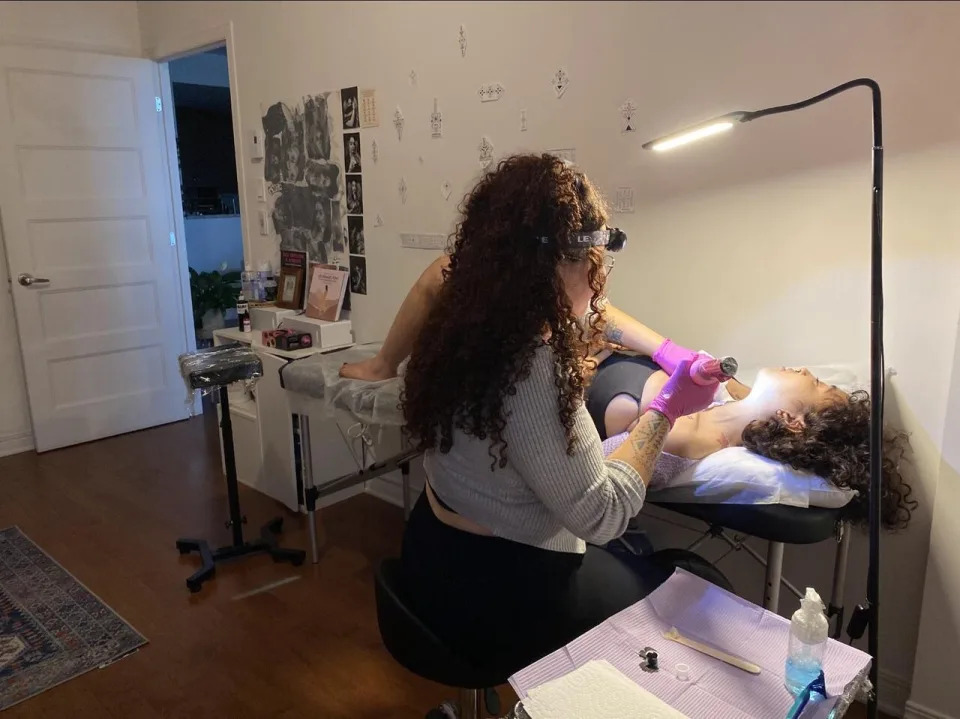
Tattoo artist Iness Aguin is completing her apprenticeship in Montreal, and tattoos clients using Amazigh symbols in her home studio in Laval, Que. (Fatima El Gahami - image credit)

Iness Aguin's tattoo studio isn't like most you'll find in the Montreal area.

The studio is inside her Laval, Que., apartment, and geometric figures adorn the wall. Among them, the yaz (âµ£) stands out, symbolizing freedom in Amazigh culture.

The space is filled with plants, books and other art pieces. Lo-fi music plays in the background.

There's an aura of healing, which goes beyond any individual client. Aguin is working to revive a traditional North African Indigenous tattoo style rarely practised here, despite Montreal's large population from the region.

"I wanted to reconnect with my roots since little has been taught to me about my own identity," says Aguin.

The tattooed symbols hold deep meaning and are seen as healing and spiritually powerful in Amazigh culture.

A graduate of fine arts at Concordia University, Aguin, 27, orients her artistic career through her identity. She is Kabyle, a Indigenous group from northern Algeria, and she's seeking to reappropriate her people's cultural markers that colonial powers had sought to erase.

The Kabyle are one of the groups that make up the Amazigh, who for thousands of years have lived in the Maghreb region of Africa. The Amazigh are known for their connection with nature, and a language and culture that is distinct from the majority Arab population.

Aguin became fascinated by how Amazigh tribes were largely matriarchal, which further set them apart from the Arab and Western worlds. In 2019, she travelled to Algeria and asked elder women about the meaning of their tattoos and why they got them. It was her way to keep the oral tradition alive.

"They shared a sense of shame as not being modern, civilized and going against religious rules," she said.

Aguin learned about the meaning of some Amazigh symbols while visiting Algeria in 2019. (Fatima El Gahami)

She brought what she learned about the tattoo style and the symbols' meaning back to Montreal, where she is a tattoo artist apprentice. She sees the art form as a way to protect the next generation from further losing a connection to their Amazigh identity, as there is little knowledge of the symbolism outside of the region.

Through her research, she created a guide for her clients to better explain the meaning of each symbol. It's her way of ensuring the symbols aren't simply appropriated by anyone for aesthetic reasons.

In the 10 months she has been practising, she's been heartened by all the support she received from Montreal's North African diaspora.

"People were curious," she says. "They asked questions about the symbols, the culture and then showed up to my studio to get tattooed just like their elders."

Aguin has a tattoo on her arm symbolizing protection, reconnection with her ancestors and attracting good fortune in life. On her sternum are symbols representing feminine energy and sensuality.

Keeping culture alive


Before starting the creative process with her clients, Aguin gets a feel for what the person likes and learns their personal story to choose which symbols to incorporate.

"Some share a folkloric story, others were meant for medicinal purposes or symbolized a new transition in life, for example being married," she says of the symbols she's studied.

She then uses a tattoo pen to mimic the traditional technique of tattooing with a sharp object like a needle or knife injected with ink made of plants, coal or minerals.

Aguin tattoos Youmna Siagh in her home studio. (Fatima El Gahami)

Youmna Siagh, 20, became a loyal client of Aguin's after learning about her through her sister.

''I was amazed by what my sister got tattooed and wanted to keep my culture alive too," Siagh says.

Siagh is Moroccan and Amazigh on her father's side. Growing up, she wasn't in touch with her culture but was able to learn more, including about traditional tattoos, while visiting Morocco in 2020.

"I went from being a tourist to a local in my home country," Siagh says.


Siagh shows her new tattoo on her collar. It's a crab, symbolizing love and gentleness. (Fatima El Gahami)

She now proudly wears her Amazigh tattoos. Aguin tattooed a crab, signifying love and gentleness, along her collar and lined it with ornamental stars.

"Iness creates special pieces of art in the world for each person," Siagh says.

Aguin sees the highest interest from young adults. She says one client, a young Algerian man, asked her for tattoos similar to those of his grandfather. He said his grandfather was tattooed from head to toe as a way to resist French colonizers during the 1950s, even though the practice was usually reserved for women.

"His grandfather empowered women, made a statement on the battlefield and now his son carries the tradition," Aguin says.

She hopes to inspire Indigenous people like her to reconnect with their identity through any way they see fit.

"There are many ways to do so. Art is the way for me," she says, adding that she would love to tattoo Indigenous people in Canada, as they share a similar history of colonization.

"It would be empowerment as a collective."