Wednesday, December 04, 2024

Trudeau’s Failure To Benefit Workers Has Empowered Conservatives

The state of labour in Canada, how we got here under Trudeau and where things may go if the Conservatives are elected.
December 4, 2024 ∙ 
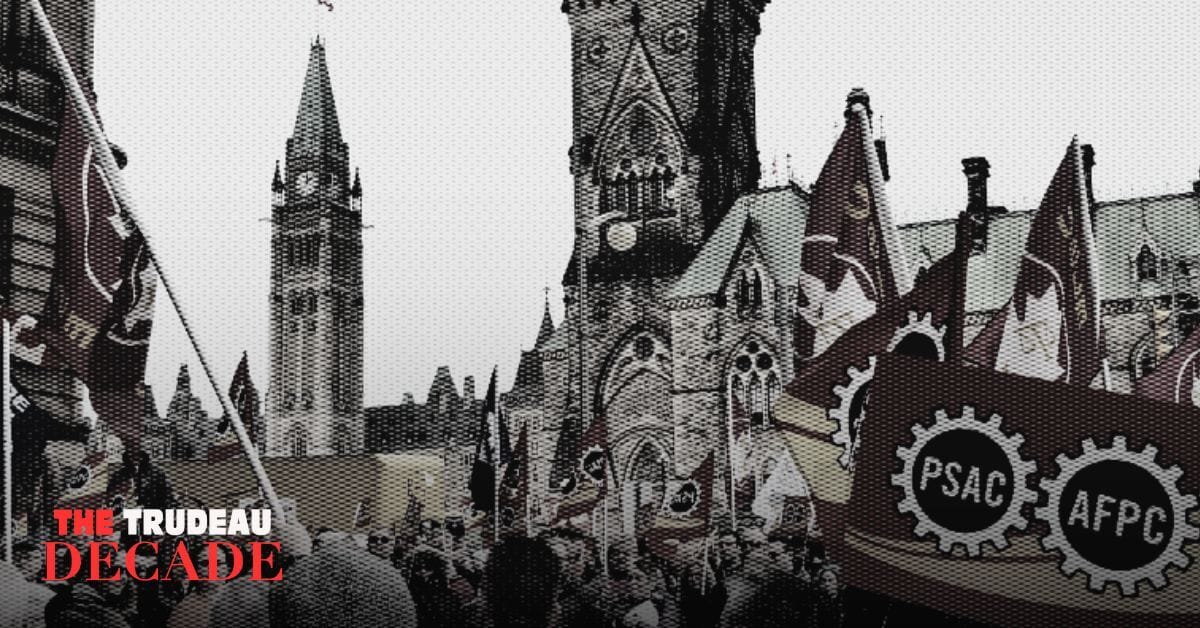
Image created by Maple stuff using a photo via the PSAC website, and then altering it with visual effects.


Where We Are

If a recent CBC poll is correct, there is a 94 per cent chance that Canada will elect a Conservative majority government by the end of next year. Unless something changes drastically between now and then, Pierre Poilievre will be prime minister in 2025. With a comfortable majority, his Conservative Party will be free to ram through its right-wing, anti-worker agenda.

The writing has been on the wall for some time, as the Liberals abandoned one progressive policy objective after another.

Poilievre has masterfully capitalized on widespread economic anxiety. While inflation has largely subsided, huge numbers of people continue to suffer through what many have termed a “cost-of-living crisis.”

The Liberals have refused to rein in skyrocketing housing prices, offering only individual “supply-side” solutions to this pressing social problem. Meanwhile, Poilievre has adeptly exploited housing insecurity to his advantage, despite a policy program offering little more than tax cuts and deregulation.

Relatedly, wealth and income inequality have continued to widen over the past several years. The Liberals chose to ignore this, tinkering around the edges with tax policy while deliberately letting the air out of a relatively strong post-pandemic economy. Though employment reached historic levels in 2022, unemployment has now creeped up to 6.5 per cent and wage growth has cooled.

Under the Liberals, meaningful action on climate change has been nowhere to be found. “Axing” the government’s carbon tax, perhaps Poilievre’s signature campaign promise, is the predictable right-wing populist response.

After COVID-19 exposed the gaping holes in our social safety net, the Liberals failed to act. Our health-care system remains understaffed and underfunded. Despite promising for years to reform Employment Insurance, the government reinstated the very same eligibility rules that left most unemployed workers without benefits pre-pandemic.

Expansions of the welfare state that the Liberals did manage — the beginnings of a national childcare program, a means-tested cash benefit in place of a dental program and the first steps toward pharmacare — now hang in the balance. Childcare might survive a Poilievre government, but the fate of the dental benefit and pharmacare are precarious.

Under pressure from the NDP, the government fulfilled one of labour’s long-standing demands and banned the use of strikebreakers in federally regulated workplaces. Yet whatever favour this curried with organized labour was almost immediately extinguished by the government’s various interventions undermining workers’ right to strike.

The NDP, as the nominal social democratic alternative, finds itself in an almost impossible political position. What progressive gains have been secured over the past several years were no doubt the result of NDP pressure, mostly through the supply-and-confidence agreement. Having recently propped up the government, however, it’s difficult to pivot to a posture of attack. The NDP consequently finds itself treading water.

Instead, it’s Poilievre’s Conservatives who fill the void of opposition.
How We Got Here

In 2015, the Liberals campaigned to the left of the NDP and promised renewed government investment following years of Conservative austerity and attacks on organized labour under prime minister Stephen Harper.

For workers, the government committed to overhauling the Canada Labour Code to strengthen minimum employment standards, eventually passing various minor reforms, including a paid sick leave provision. They also reintroduced card-check union certification in the federation jurisdiction.

The government’s economic response to COVID-19 gave some indication of what a more equitable society could look like. Income supports reduced poverty across the board. As the economy reopened, a brief period of labour market tightness allowed workers to bid up wages. At the same time, union density didn’t budge.

Like the Joe Biden administration in the United States, however, the Liberals quickly abandoned their commitment to “build back better” following the pandemic. Programs and services went underfunded. Temporary enhancements to social welfare were unwound while inflation ate away at workers’ purchasing power.

As prices spiked, Poilievre blamed the government’s supposedly reckless spending. This was always disingenuous. The pandemic necessitated massive government intervention to protect people from the virus and to prevent an economic depression. Had an avowedly right-wing party been in power, the economic stimulus would have almost certainly been smaller and the consequences much worse for working people. If anything, the government should have spent more.

Following the pandemic, low-wage employers balked at the leverage exercised by workers in a tight labour market. The Liberals essentially caved to this employer pressure by allowing businesses much greater access to temporary foreign workers. By loosening Temporary Foreign Worker Program restrictions, employers in sectors such as food and accommodation could depend on a steady stream of low-wage and highly exploitable workers without citizenship rights, rather than raise wages and increase investment.

Not only did this weaken workers’ bargaining power, it fanned the flames of the anti-immigrant backlash central to right-wing populism.

By failing to address the root causes of working class insecurity, the Liberals opened space for a right-wing Conservative pushback.
Where We Might Go

Finding a way out of this mess is the challenge we now face. The question is, how prepared is organized labour to fight back?

The Liberals have been adept at capitalizing on political divisions within the labour movement. Many unions, including large and influential ones such as Unifor, have for some time endorsed so-called “strategic voting,” which in practice often amounts to supporting Liberals to defeat Conservatives. The game isn’t worth the candle.

Strategic voting has driven a political wedge within the house of labour and weakened the movement’s traditional support for the NDP. Perhaps more importantly, this ill-conceived strategy has allowed the Liberals to secure union support while offering little in return.

Worse still, the Liberals’ various attacks on workers’ rights during their time in office have laid the groundwork for a Poilievre government to do much worse. Despite his pro-worker posturing, Poilievre has always been a card-carrying anti-unionist. If he and his party secure a majority in Parliament, don’t be surprised when the gloves come off. Some leaders of federal public sector unions already recognize this, and they’ll likely be the first in Poilievre’s crosshairs.

The success of Poilievre’s populist appeal to working class people should cause the labour movement to rethink its political strategy. At times, labour’s messaging on inflation and price-gouging has seemed almost indistinguishable from Poilievre. Detached from a left-wing program that prioritizes organizing rank-and-file workers, expanding the welfare state, and guaranteeing economic security for all, the left’s populist messaging may have simply echoed our conservative enemies.

Should the Conservatives win in 2025, a Poilievre government will be the devastating yet predictable culmination of 10 years of Liberal rule. Like centrists the world over, Canada’s Liberal Party could only hold the right-wing at bay for so long.

After failing to offer meaningful change to working-class Canadians, the Trudeau Liberals look destined to suffer the electoral fate of similarly feckless centrists across the West.

Union members should prepare themselves for the fight of their lives. What’s coming down the pike won’t be pretty and can only be stopped through solidarity and resistance.

Image created by Maple staff using photos from Frank Schwichtenberglicensed under CC BY-SA 4.0, and a screenshot via Prime Minister of Canada on YouTube, and then altering them with visual effects.
LGBTQ+ RIGHTS ARE HUMAN RIGHTS

'Wicked' film pulled from Kuwait cinemas, reportedly over LGBTQ cast

Kuwait has banned the Hollywood musical 'Wicked', reportedly over its LGBTQ cast, marking it latest in a series of films prohibited in the Gulf state.

The New Arab Staff
04 December, 2024


The renowned American singer Ariana Grande stars as Glinda alongside acclaimed British actress Cynthia Erivo, who identifies as bisexual [Getty]

The critically acclaimed musical Wicked has been pulled from cinema schedules in Kuwait just before its local release on Thursday, Kuwaiti media reported, making it the latest Hollywood film to be banned in the Gulf state.

While a reason for the ban has not been given, local media reports have suggested that the ban may be linked to the film's LGBTQ cast.

The film, directed by Jon M. Chu, is an adaptation of Broadway's reimagining of The Wizard of Oz. It premiered in the US and Canada last week, earning over $114 million in its first two days.

The renowned American singer Ariana Grande stars as Glinda alongside acclaimed British actress Cynthia Erivo, who identifies as bisexual, playing Elphaba.

The ensemble cast includes openly gay cast members such as Jonathan Bailey, Bowen Yang and Marissa Bode.

Last year, the Gulf state was among several Arab countries that banned the popular Barbie film to preserve "public ethics" and "social traditions".

Kuwait has emerged as one of the strictest Gulf states on film censorship, surpassing even Saudi Arabia, leaving many Kuwaitis to cross the border to watch films.

Later in 2023, it also banned the horror movie Talk to Me over the inclusion of Zoe Terakes, a non-binary transgender actor.


GENDER APARTHEID
Afghanistan: UN urges Taliban not to block women's medical training

The UN has raised concerns over a potential Taliban ban on women attending medical training facilities, saying it would threaten women's access to healthcare.

The New Arab Staff & Agencies
04 December, 2024

Women in Afghanistan are becoming increasingly forced out of education under Talban rule [Getty/file photo]

The UN mission to Afghanistan on Wednesday urged the Taliban government to reconsider a reported plan to ban women from attending medical training institutes, in the latest move to restrict women's education.

A health ministry source and managers from private medical institutes, which offer training in subjects such as midwifery and nursing, told AFP on Tuesday the public health ministry had issued a directive from the Taliban supreme leader to suspend women's attendance.

There has been no official Taliban government confirmation of the ban, but institute employees said they had been given 10 days to hold final exams before women would be barred.

The United Nations Assistance Mission in Afghanistan (UNAMA) said it was "extremely concerned" by the reports and urged the Taliban government to "reconsider implementing" the rule.

"If implemented, the reported directive poses further restrictions on women and girls' rights to education and access to healthcare," a statement said.

"Ultimately, it will have a detrimental impact on Afghanistan's healthcare system and on the country's development."

A senior health ministry source told AFP the ban would squeeze an already suffering health sector.

"We are already short of professional medical and para-medical staff and this would result in further shortages," the source said.

The ban would be the latest restriction on women's education since the Taliban swept to power in 2021 and imposed a strict interpretation of Islamic law.

Women and girls have been barred from secondary school and university as part of restrictions the UN has dubbed "gender apartheid".

Women students have since flocked to health institutes, which offer courses in a dozen health-related subjects, with some 35,000 enrolled, health ministry sources said.

The European Union on Wednesday also urged the Taliban to "reverse this discriminatory policy", calling it an "an unjustifiable attack on women's access to education".

Amnesty International warned a ban would "have devastating consequences for the health of women in the country that has one of the highest maternal mortality rates in the world".

The reports drew far-reaching criticism, including from Afghan cricket superstar Rashid Khan.

"Providing education to all is not just a societal responsibility but a moral obligation deeply rooted in our faith and values," Khan wrote in a post on Facebook.
Kemi Badenoch as Tory leader only promises more Islamophobia

Celebrating Badenoch's leadership as a victory for brown & black people overlooks the racist politics peddled by her party as it shifts further to the right.


Perspectives
Fatima Rajina
04 Dec, 2024
THE NEW ARAB


Kemi Badenoch has certainly highlighted why it is urgent that we move away from looking at her leadership through the limited lens of identity politics, writes Fatima Rajina. [GETTY]

Kemi Badenoch’s election as the first black woman to lead the Conservative Party marks a significant moment in Britain’s political history.

Under Boris Johnson, she advanced through a series of positions, most notably as Secretary of State for Women and Equality, Housing, Communities, and Local Government, before being renamed Minister of State for Levelling Up Communities.

She was named Secretary of State for International Trade under Rishi Sunak's cabinet, along with the added responsibility of Minister for Equality and Women. Badenoch kept her equalities brief but was transferred to the newly established Department for Business and Trade in a February 2022 cabinet upheaval.

Now, Badenoch’s political ascension to the top of the Conservative Party marks a new era. She is not only the first black woman to lead a political party, but she could also potentially be the first black woman to lead the UK in the future.

But why is her ascent to victory not filling me with joy?

In reality, her leadership presents a real danger for many communities. It symbolises the party’s further shift to the right and demonstrates how, in this climate, anyone spewing hate is electable.

When we pay attention to the times Badenoch has made media appearances, it has always been fraught. She appeared on Sky News alongside Trevor Phillips during her latest leadership contest. In the interview, she explicitly notes that people who come from countries that see Israel as an enemy should be flagged to the state. Why is a migrant/refugee’s status and access to Britain contingent upon the perception of another nation’s?

By centring Israel as the marker for who constitutes the right of entry, it positions migrants as anti-Semitic by default. This is a dangerous precedent to set as it would not only vilify migrants further, but it will make it possible for the far-right xenophobic policies to become acceptable to the wider public.

As Badenoch continues the conversation with Phillips about Israel, she proceeds to insinuate that Muslims are the problem, as they seem to dislike Israel more than others. Badenoch uses the example of northern Nigeria in particular - where there are more Muslims - in order to compare the difference in this religious group’s response to Israel compared to non-Muslims. Her regurgitation of the dangerous transnational Muslim subject is troubling because not only is she continuing her party’s legacy of maligning Muslims and framing them as inherently anti-Semitic, but she is also asserting what her policies on international politics could look like.

Anyone familiar with the Palestine solidarity movement will know it is not just made up of Muslims. But Badenoch’s centring of this group is an attempt to discredit the growing, diverse support for the Palestinian struggle. This specific association of the Palestinian movement with Muslims has been particularly peddled and legitimised because of the dehumanisation of Muslims through the two decades of the War on Terror discourse.

Additionally, support for Palestine has been intricately tied to the Prevent strategy, which trains public sector workers to look out for signs of so-called radicalisation/terrorism. There have been cases where young people have been referred under this strategy simply for showing support for Palestine.

Punitively punishing a people for rightfully resisting the occupation of their land does not amount to moral clarity but a depravity that can only be inherited from Europe and its viscerally violent imperial history.

Furthermore, Badenoch’s focus on Muslims and suggesting that ‘not all cultures are equally valid’ indulges civilisational ideas that require people to see some as beneath them.

At every turn, we should push back against the politics this new leader has been peddling on Muslims, and migrants, as well as Palestine solidarity activists by extension. This is not just because it further cements division, but because it is a window into how the state will eventually broaden its repressive tactics towards everyone. And this trajectory is clear, just look at her jibes at the Black Lives Matter movement, or her shunning of Critical Race Theory being taught in universities.

Indeed, any space that equips people with the understanding and skills or organise against oppression is deemed a target by the right-wing politics that Badenoch and her party represent. Whilst she may indulge in much of the culture war talking points to stay relevant and appeal to her voter base, she is also contributing in a dangerous climate of rising racism and anti-migrant hate, as well as fuelling the targeting of social justice movements.


Kemi Badenoch has certainly highlighted why it is urgent that we move away from looking at her leadership through the limited lens of identity politics, because this ‘historic’ moment is really a multiracial ascension to fascism. If anything, her election powerfully demonstrates that representation is where politics goes to die. Using racialised minorities as political fodder reflects the inadequacies of our elected officials. This system upheld by racialised people cannot cure the disease of Islamophobia; the solution can only be found in liberation politics.


Dr Fatima Rajina is a sociologist based at the Stephen Lawrence Research Centre at De Montfort University. Her work looks at British Muslim communities with a specific focus on the British Bangladeshi Muslim communities.
Follow her on Twitter: @DrFRajina
NAKBA 2.0

Israeli settlers raid occupied West Bank towns

Israeli settlers attacked two Palestinian towns early on Wednesday, setting fire to property and hurling stones.


The New Arab Staff & Agencies
04 December, 2024


Nablus Governor Ghassan Daghlas inspects homes and properties after they were burned and stoned by settlers during a settler attack on the town of Beit Furik, east of Nablus in the occupied West Bank. Settlers set fire to a car and a house
[Getty]

Israeli settlers on Wednesday wounded a Palestinian and set buildings on fire while raiding two villages in the occupied West Bank after a nearby settlement outpost was evicted by Israeli forces, Palestinian and Israeli sources said.

"Israeli civilians entered the village of Beit Furik" east of the Palestinian city of Nablus, the Israeli army said, adding that they "set property on fire, and hurled stones".

Local authorities told news agency AFP the attacks took place early on Wednesday morning.

The army said that the settlers reacted after Israeli forces "acted against illegal construction by Israeli civilians adjacent to the town of Beit Furik" on Tuesday night, triggering clashes during which the settlers injured two policemen with stones.

Nahi Hanani, deputy head of the Beit Furik council, told AFP that dozens of settlers attacked the village "setting fire to a truck in front of one house and another vehicle", early on Wednesday.

"They also set fire to a grocery shop in the village and another house was slightly damaged," he said.

The army said the Israelis also "set property on fire and threw stones" in Huwara, a town to the south of Nablus.

Rana Abu Hania, spokeswoman for Huwara's town hall, confirmed to AFP that one resident was injured when settlers attacked the town early on Wednesday.

"They burned two cars and the house of one citizen... The army also demolished a used car lot," said Abu Hania.

'They would have burned'

Yusef Awadi, a resident of Huwara, told AFP that settlers burned his brother's house Wednesday morning.

"They set fire to the Jeep and to the car outside... They entered the house, set it on fire, and then left," the 66-year-old said, adding that his brother Tayseer was hospitalised.

"He was hit on the head and... was transferred to Rafidia Hospital," Awadi told AFP, adding that had his brother's family not been awake, "they would have all burned with the house."

In a joint statement, the Israeli army and police said that eight suspects were arrested in the investigation into the Beit Furik and Huwara attacks, "for assaulting security forces, engaging in friction, and causing damage to property".

The army said that there were also clashes between the Israeli army and "about 20 Israelis" in Rujeib, a town closer to Nablus, on Tuesday evening.

The West Bank is home to some three million Palestinians as well as 490,000 Israelis who live in settlements that are considered illegal under international law.

Violence in the occupied Palestinian territory has soared since October 7 last year.

Israeli troops or settlers have killed at least 788 Palestinians in the West Bank since the start of the Gaza war, according to the Ramallah-based health ministry.

Palestinian attacks on Israelis have also killed at least 24 people in the West Bank in the same period, according to Israeli official figures.

Israel has occupied the West Bank since 1967.
Israel and the ICC: A Catch-22 for the West's rules-based order

By refusing to enforce ICC warrants, the West has hardened its support for Israel's genocide, relying on absurd justifications to do so, says Mouin Rabbani.


THE NEW ARAB

Just as legislation to suppress various freedoms initially singles out Palestinians and their supporters, here too Palestine serves as the canary in the coal mine, writes Mouin Rabbani
 [photo credit: Getty Images]

Shortly after the Palestinian Authority (PA) submitted its first and ultimately unsuccessful application to join the International Criminal Court (ICC) in 2009, a discussion with a European diplomat turned to the subject of Israeli impunity.

A successful Palestinian application, and eventual ICC investigation of Israeli conduct in the occupied territories would, according to my interlocutor, present European governments with a serious dilemma.

Specifically, it would force them to choose between their commitment to Israel and their professed commitment to international law and its newest creation, the ICC.

Left unstated, but more than implied, was that any such investigation would inevitably lead to indictments of Israeli leaders for a variety of crimes enumerated in the ICC’s Rome Statute.

In other words, European governments would be forced to either comply with their international obligations or reject them.

Related
ICC arrest warrants: Has Palestine birthed a post-Western world?
Voices
Alonso Gurmendi


Fifteen years later, that most European of dilemmas – choosing between principles sanctimoniously pontificated around the globe with incessantly wagging fingers, and putting said principles into practice oneself – has suddenly become all too real. Its resolution will surprise only the most extraordinarily naïve and gullible among us.

In many cases, those who last year cheered the Court for its dedicated professionalism, commitment to the rule of law, and courageous determination to dispense justice without fear or favour when it issued an arrest warrant for Russian President Vladimir Putin, have now found the same institution to be lacking in each and every one of these qualities. Their forked tongues bring to mind the proclamation by Peru’s early twentieth-century military strongman, Oscar Raimundo Benevides: “For my friends, everything; for my enemies, the law”.

Israel's so-called right to impunity

Just as a fish rots from the head, so the ICC’s host country, The Netherlands, led the pack. After its foreign minister, the comparatively centrist Caspar Veldkamp, proclaimed his far-right government’s fealty to the Court, his prime minister, former spy chief Dick Schoof, made the bizarre announcement that international fugitive Benyamin Netanyahu could visit The Netherlands without being arrested. For good measure, the country’s de facto ruler, professional Islamophobe Geert Wilders, announced that he would be travelling to Israel to meet with his soulmate, Netanyahu.

Not to be outdone, Hungary’s Viktor Orban invited Netanyahu to visit Budapest, assuring his favourite fugitive that he could do so with full impunity and immunity. Displaying a rare if entirely unintended flash of humour, German Foreign Minister Annalena Baerbock announced that her government would conduct a “careful examination” to determine what, if anything, an ICC arrest warrant actually entails. Before the study even got underway, multiple senior German politicians publicly dismissed the idea that it could lead to Netanyahu’s arrest on German soil.

The most interesting response came from France. Initially, its government issued a clear-cut statement that the ICC arrest warrants for Netanyahu and his former Defense Minister, Yoav Gallant, would like any others be respected in line with Paris’s obligations under the Rome Statute. Subsequently, the French foreign ministry suggested Paris need not necessarily comply with its obligations because Israel has refused to accept the Court's jurisdiction. Needless to say, this contortionist legal argument has yet to be made by French mandarins with regard to other states that reject ICC jurisdiction over their actions, such as Russia.

France’s reversal is said to have come in response to an Israeli demand, ritually amplified by US President Joe Biden in a telephone call with his French counterpart Emmanuel Macron, that Paris publicly revoke its position as part of the agreement to cease hostilities between Israel and Lebanon.

Israel and Washington’s success in this regard strongly suggests further and greater impunity will be extracted as part of an eventual albeit unlikely agreement to end Israel’s genocidal campaign in the Gaza Strip.

To be sure, a number of European states including Ireland, Belgium, and Norway took the extraordinary position that ICC arrest warrants require the arrest of indicted fugitives, and that ICC member states are obliged to comply with the Court’s rulings. Notably absent from this group is the British government, currently led by self-proclaimed human rights lawyer Keir Starmer.

It is tempting to portray European leaders’ disregard for the Netanyahu and Gallant arrest warrants as motivated by fear of crossing Israel and the United States, or by politicians’ loyalty to pro-Israeli funders.

In some cases, this assessment is undoubtedly correct. But the reality is that the majority of them — as during the past year of genocide — have been acting on one of the few convictions they possess: Israel’s sacred right to impunity in its dealings with the Palestinian people, and the categorical rejection of any measures that hold Israel accountable for its crimes against them.

For those in Israel’s corner, and particularly the United States, there are also larger principles at stake: a determination to dismantle international law, as well as the norms and principles that govern international conduct, and with them the institutions that serve as their custodians.

Israeli impunity is for various reasons an effective battering ram with which to promote and achieve these objectives. Just as legislation to suppress various freedoms initially singles out Palestinians and their supporters, here too Palestine serves as the canary in the coal mine.

Absolutely zero legal knowledge is required to recognise the spurious nature of the arguments put forward against the ICC arrest warrants. Elected politicians are perfectly capable of horrific crimes – indeed, Adolf Hitler was himself elected.

The right to self-defense – assuming for the sake of argument this is what Israel is engaged in – similarly does not incorporate a license to commit war crimes and crimes against humanity.

As for jurisdiction, the ICC has on multiple occasions determined that Palestine is a full and equal member of the Court. Therefore, and irrespective of any state’s refusal to accept ICC jurisdiction, any violations of the Rome Statute on Palestinian territory, whether perpetrated by Palestinians, Israelis, or for that matter Europeans or Americans, fall under the Court’s jurisdiction. On a related note, Israelis and Americans can also be charged for interfering with the administration of justice by the ICC.

Related
The UN must exorcise its colonial demons for Palestinian justice
Unfiltered
Sara Troian


The confrontation between the West’s rules-based international order, whose guiding principle remains “for my friends, everything; for my enemies, the law”, and international law and its institutions as understood by the broader international community is expected to significantly intensify in the years ahead.

The fate of Palestine, and with it of Israeli impunity, will form the bellwether with which to judge its outcome.


Mouin Rabbani is Co-Editor of Jadaliyya and a Non-Resident Senior Fellow at the Center for Conflict and Humanitarian Studies.
Follow Mouin on X: @MouinRabbani


More than 1,000 scientists sign open letter calling for Gaza ceasefire


MEMO
December 4, 2024 

Norwegian neuroscientist Edvard Moser delivers a speech at Tianjin Meijiang Convention and Exhibition Center in Tianjin, China on May 17, 2018
 [Visual China Group via Getty Images/Visual China Group via Getty Images]

More than 1,000 scientists worldwide, mainly psychologists and neuroscientists, have signed an open letter urging a ceasefire in Gaza and for the international community to pressure Israel to respect international humanitarian law, according to Spanish news agency, EFE.

Signatories include Nobel laureates, May-Britt Moser and Edvard Moser, from Norway and Susumu Tonegawa from Japan.

Several Spanish researchers, including Pablo Lanillos, a member of the Neuro Artificial Intelligence and Robotics group at the Cajal Institute, also signed the letter.

“This appeal is powerful because it comes from neuroscientists — people who study how the brain perceives and processes such conflicts,” Lanillos told EFE.

The letter is said to have condemned the violence committed by all sides, including the Hamas 7 October, 2023 attacks, the holding of hostages, and “innumerable war crimes” committed by Israel, which has killed more than 48,000 people in Gaza since the start of the conflict more than a year ago.

Without international pressure, extremists in power feel emboldened to carry out lethal intentions, perpetuating hatred and violence, the letter warns.

The scientists say that the region is trapped in a destructive cycle of violence and vengeance that undermines the possibility of peaceful co-existence, adding that “hatred, death and destruction” are taking over.

According to EFE, the letter says human psychology often exaggerates differences between groups in conflict but also points to a universal capacity for empathy and cooperation.

The scientists called on the international community to press Israel to end the war, including through stopping arms sales or re-evaluating cooperation agreements.

“We are not against the Israeli people,” the letter says. “We are for all peoples — Israeli, Palestinian and Lebanese.”

Israel’s current policies, they argue, have inflicted irreparable harm on Palestinians and jeopardised the safety of its own people.

The letter was started by researchers at the Sorbonne University in France and Princeton in the US.


Middle Eastern elites: PKK represents symbol of willpower and freedom

Middle Eastern political elites have emphasized that the Kurdistan Workers' Party (PKK) represents a school of willpower and struggle for freedom. They also highlighted the importance of achieving stability and development in the region.

Middle Eastern elites: PKK represents symbol of willpower and freedom
 26 November 2024 

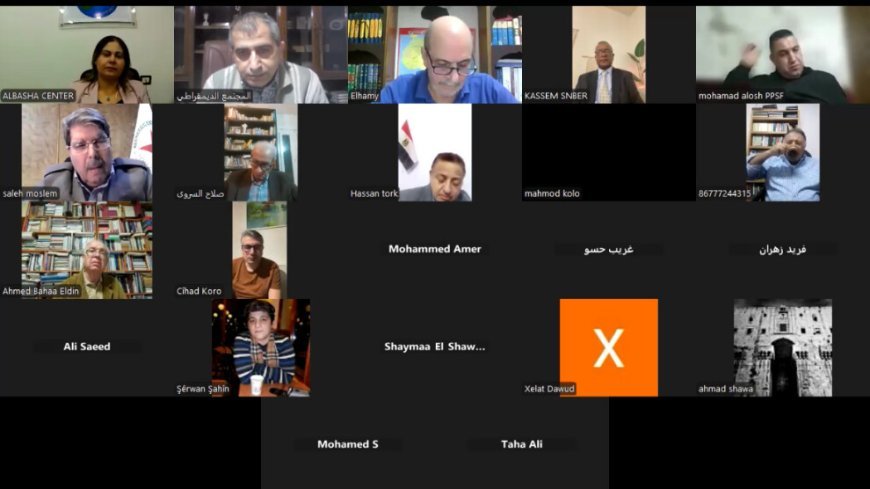
An online seminar organized by the Arab Initiative for the Freedom of Leader Abdullah Ocalan, with significant participation from Arab and Kurdish political leaders, shed light on the reality of political parties in the Middle East and North Africa, the major challenges they face, and ways to enhance their role amid rapid political, social, and economic transformations.

The seminar, moderated by Egyptian journalist Ilhami El-Meligy, coordinator of the Arab Initiative for the Freedom of Leader Abdullah Ocalan calan, discussed a range of important topics. These included diagnosing the current situation of political parties, proposing possible solutions to overcome crises, and reviewing historical and contemporary experiences. A common theme was the necessity of restoring the freedom of the international thinker leader Abdullah Ocalan.

The seminar provided a comprehensive analysis of the state of political parties in the Arab world, shedding light on the challenges they face and the reasons for their decline. It also presented forward-looking, actionable visions. Participants agreed that revitalizing the role of political parties requires intellectual and practical efforts to rebuild trust with the public and achieve the desired democracy.

Absence of achievement and vision

At the beginning of the seminar, journalist Ilhami El-Meligy spoke about the Arab Initiative for the Freedom of Leader Abdullah Ocalan, launched in Cairo as a platform for collective struggle for Leader Ocalan’s freedom. He highlighted Leader Ocalan's philosophy, which has had and will continue to have a profound impact on issues of freedom and development in the region.

El-Meligy emphasized that the initiative reflects the deep importance of freedom as a prerequisite for achieving peace and stability. He noted that the seminar coincided with the significant 46th anniversary of the founding of the PKK, a party that represents a school of willpower and struggle for freedom, as well as mounting challenges faced by the region’s peoples. This underscores the need for concerted efforts from national and democratic forces to achieve stability and justice.

The first speaker, Egyptian politician Farid Zahran, president of the Egyptian Social Democratic Party and a former presidential candidate, highlighted the fundamental issue facing political parties: the lack of achievements and clear visions to inspire the public.

Zahran pointed out that repression and authoritarianism by ruling regimes have rendered parties unable to serve as incubators for political dreams, leading to political stagnation. As societies grapple with pressing economic challenges, such as the struggle for basic needs, major issues have disappeared from public agendas.

Zahran argued that political parties’ primary mission should now be to present a comprehensive political project that addresses the challenges of fascism and authoritarianism. This project must build on past experiences and offer practical solutions inspired by historical models, such as European experiences in overcoming political and social crises.

Then, Mohammad Alloush, member of the political bureau of the Palestinian People's Struggle Movement, talked about the importance of international struggle in confronting imperialism and Western hegemony, considering that political parties had historically been an effective tool in facing these challenges.

Alloush praised the experience of the Kurdistan Workers' Party, which drew inspiration from internationalist ideas to strengthen its role in popular struggle. He also criticized the stagnation that had affected many parties, pointing out that the weak connection between the past, present, and future had led to their diminished impact.

He proposed solutions involving the redefinition of the roles of political parties and addressing the intellectual and practical shortcomings that hindered their work. He also emphasized the importance of parties being open to global transformations without abandoning their identity and core objectives.

After that, Ms. Nisreen Doku, co-chair of the Syrian Future Party, who addressed the situation of political parties in Syria. She pointed out that these parties had long suffered from political repression and military dictatorship, which made them unable to achieve their goals or influence the political scene.

She added that the Syrian revolution opened the door for the emergence of new parties, but these soon turned into a military conflict that undermined the possibilities of political work, in addition to the rise of extremist organizations like ISIS and Al-Qaeda. She stressed the necessity of ending the armed conflict and creating a stable political environment that would allow for political freedom and promote pluralism.

Doku spoke about the experience of the Autonomous Administration in NE Syria after liberating the region from ISIS mercenaries, where an administration was established to ensure the safety of citizens and meet their needs. Institutions were then formed to guarantee a dignified life for the people, along with a local governance system balancing military and political aspects. The space for political parties to operate was also opened, and citizens were able to express themselves, compete in managing municipalities and districts.

Dr. Salah Sarwi, Deputy Secretary-General of the Egyptian Communist Party, offered a different perspective on the reasons for the weakness of political parties in the Arab world. He pointed out that the absence of civil society values is one of the key factors that negatively impacted their role. He also discussed the impact of economic nationalization following the July Revolution in Egypt, arguing that it was accompanied by political nationalization, which led to state dominance over political activity.

He further noted that the fall of the Soviet Union and the rise of political Islam in the region caused significant shifts in political and intellectual structures. He emphasized that overcoming these challenges requires focusing on public issues, building broad political alliances that encompass diverse groups, and promoting values of democracy and civil engagement.

Hassan Tork, President of the Egyptian Democratic Unionist Party, discussed the recent Egyptian experience, considering the initiation of national dialogue a positive step toward enhancing the country's political life despite existing challenges, such as the influence of political money and nepotism.

He explained that Egypt has begun to improve its political status after the Brotherhood's rule, which witnessed sharp societal divisions. He emphasized that the greatest challenge lies in building a political culture that encourages democratic engagement and strengthens trust between the state and its citizens, noting that the path to a more open political system requires greater efforts.

Dr. Qasem Soneibar, leader in the Libyan Popular National Movement, focused his remarks on the situation in Libya. He noted that while political parties are numerous, they are ineffective due to issues such as militia rule, political Islam movements, and internal divisions.

In addition to the sharp divisions among factions and militias, he highlighted blatant foreign interventions, which have brought Libyans back to earlier eras when they sought independence from Western powers. He stated that these conditions have rendered Libyan parties incapable of playing their natural role.

The Libyan politician stated that the absence of a stable political structure has contributed to the worsening of crises, making a political solution more complex. He emphasized the importance of uniting ranks within Libya and the necessity for political parties and national movements to contribute to a project that restores the country's unity and ends the ongoing chaos.

After that, Ahmed Bahaa El-Din Shaaban, the Secretary-General of the Egyptian Socialist Party discussed the challenges faced by leftist movements. As a leftist politician, he focused on the crisis facing leftist movements, particularly the challenges confronting the Arab and global left. He noted that the isolation of leftist parties from the masses and the aging leadership have diminished their influence.

He explained that socialist ideology faces global challenges, especially under the pressures of rampant globalization, which has weakened labor and political movements. He suggested a collective struggle against globalization while working to renew political ideas to align with current social and economic transformations.

Gharib Hesso, the co-chair of the Democratic Union Party in Syria, discussed his party's experience. He stated that the party is based on the philosophy of international thinker Abdullah Ocalan and the democratic nation project to organize society and achieve a balance between political and military aspects. He noted that the party has faced accusations of terrorism from Turkey as well as political pressures from Damascus.

Hesso affirmed that despite these challenges, the party's project continues, aiming to establish a democratic, multi-ethnic Syria with a focus on building a pluralistic society that respects everyone's rights. He criticized political parties that adopt popular demands but abandon them upon coming to power, instead turning to control the state's economic resources.

Hesso stressed the importance of dialogue among various Syrian political forces, adding that the Democratic Union Party is open to dialogue, with a strong belief in the goal of a free and democratic Syria. He pointed out that the party has never sought a Kurdish state or any other independent state and criticized the obstacles and challenges he believes are closing the door to a Syrian national dialogue.

On the experience of political parties in Sudan, Ali Saeed Ibrahim, member of the Political Bureau of the Sudanese Communist Party, began by congratulating the Kurdistan Workers' Party on its anniversary. He also expressed solidarity with the Kurdish people's struggle for their rights.

The Sudanese politician highlighted a major issue in Sudan: certain regions are tied to specific leaders or sectarian figures rather than political parties. He noted that political parties have proposed programs that do not align with the interests of the Sudanese people and are now disintegrating and losing their popular bases, having previously been dominated by political Islam.

He stressed the importance of national dialogue as a means to resolve Sudan’s political crises, emphasizing that the challenges facing Sudanese parties require joint efforts from all sides to overcome differences and build a better political future.

The final remarks were delivered by Saleh Muslim, the former co-chair of the Democratic Union Party, who stated that political parties are tools to improve society's conditions. He emphasized that society must organize itself in some way to be capable of making decisions about its own life. He affirmed that the role of political parties is to advocate for the demands of the masses, warning that they lose their function when they deviate from this role.

Muslim also discussed the experience of the Democratic Union Party, saying its goal is to create free individuals who possess their own will. He argued that if society is aware of its responsibilities, it will be capable of determining its destiny. He criticized some political parties for clinging to slogans that date back a century.

Muslim acknowledged that authoritarian regimes inevitably hinder the development of strong political parties, as they use all possible means to protect their interests. However, he expressed confidence that, through the unification of parties, raising public awareness, and renewing ideas, these obstacles can be overcome. He also expressed the Democratic Union Party's readiness to share its experience with other parties willing to learn from it.

Recommendations

The seminar undoubtedly discussed numerous profound aspects of the crisis facing political parties in the Middle East, including social and economic transformations. Globalization and economic changes have posed significant challenges to political parties, impacting their ability to present comprehensive programs that align with these shifts.

External interventions by regional and international powers, for instance in countries like Libya and Syria, have also contributed to deepening the crises of political parties, further diminishing their role. Additionally, the lack of public trust was highlighted, with participants noting that parties have become incapable of regaining the confidence of the masses due to their lack of new visions and actionable projects.

Most participants proposed several solutions, emphasizing the need for a roadmap to activate the role of political parties. They stressed the importance of delivering a political message that balances realism and ambition, focusing on public issues, and fostering collective action by forming broad political alliances encompassing diverse currents to find shared solutions to major challenges.

The participants also highlighted the need for leadership renewal by giving opportunities to a new generation of young leaders to revitalize the parties. They emphasized supporting pluralism by promoting the values of democracy and political diversity as fundamental pillars for any stable political system.


TURKIYE'S WAR ON SYRIAN KURDISTAN

After Aleppo, what will happen to the Kurds of northwest Syria?

Analysis: 
With thousands having already fled the rebel offensive in Aleppo and surrounding areas, Syrian Kurds fear for their future in the country's northwest.


Paul Iddon
04 December, 2024
THE NEW ARAB

The momentous takeover of Syria’s second city, Aleppo, and surrounding areas on 29 November by the Islamist Hayat Tahrir al-Sham (HTS) and the Turkish-backed self-styled Syrian National Army (SNA) has significant ramifications for Syria and possibly the wider region.

More immediate, however, is its impact on the hundreds of thousands of Kurds who live in northwest Syria.

As Aleppo collapsed to the lightning HTS-led offensive, the Turkish-backed SNA seized on the momentum to capture the town of Tel Rifaat and surrounding villages from the Kurdish People’s Protection Units (YPG).
Related

Syria's rebel offensive: Why now and what could happen next?
Analysis
Shelly Kittleson


Tens of thousands of Kurds have fled from that area. They are enduring freezing winter conditions on their way to the relative safety of the Kurdish-administered territories east of the Euphrates River.

HTS originated as an offshoot of Al-Qaeda called Jabhat al-Nusra and has fought the regime of Syrian President Bashar al-Assad since the early years of the civil war that began in 2011. The group has established itself as Assad’s most formidable adversary in the conflict and has long controlled large parts of Syria’s strategic northwestern Idlib province.

The SNA consists of numerous armed groups that Turkey has used as proxies, mainly against the YPG and the larger multi-ethnic Syrian Democratic Forces (SDF), of which the YPG is the backbone. Turkey used these rebels to invade the northwestern Kurdish enclave of Afrin in 2018, displacing tens of thousands of its native population, primarily into the adjacent Tel Rifaat area. These same Kurds now find themselves displaced once again.

Aleppo city has two Kurdish-majority neighbourhoods, Sheikh Maqsoud and Ashrafiyeh. Altogether, there are approximately 500,000 Kurds in this large northwestern area west of the Euphrates River, now largely under HTS and SNA control.

“Kurds have had a bad experience with HTS folks from the Jabhat al-Nusra days,” Mohammed A. Salih, Non-Resident Senior Fellow in the Foreign Policy Research Institute and an expert on Kurdish and regional affairs, told The New Arab.

“The fundamental problem with many Assad opposition groups is that they are chauvinistic toward Kurds, perhaps as a result of decades of Baathist exclusionary nationalist teachings,” he said.

In Salih’s estimation, most of these groups are Islamist extremists, putting them at odds with the majority of Syria’s Kurdish minority.

“Kurds want to deal with a party in the opposition that is willing to take into account their demands for cultural and political rights as a distinct community within Syria,” Salih said. “And even though the majority of Syrian Kurds are Muslims, they are staunchly secular in their way of life and expect this to be respected.”

In his view, Kurdish civilians are undoubtedly in danger due to the current circumstances in Aleppo and other areas west of the Euphrates.


Analysts view the Turkish-backed SNA as a markedly more significant threat to Kurds than HTS. [Getty]

“Kurds cannot trust the HTS or the SNA,” Salih said. “They have good reason for this based on the ideological nature of these groups and their past records both in dealing with them and the non-Sunni, non-Arab and non-Turkmen populations of Syria,” he added. “It’s a very fluid and unpredictable situation.”

Consequently, he believes the “best option” for Kurds is to evacuate east of the Euphrates, where the SDF is in a much better position to protect them. Reports suggest that the YPG has begun pulling forces from the Kurdish-majority neighbourhoods in coordination with HTS to allow Kurdish residents to evacuate.

It’s unclear if HTS can provide security guarantees for any Kurds who decide to remain in their homes in the city.

“In Aleppo, it depends on whether the YPG can reach a reliable understanding with HTS there for Kurdish civilians not to be harmed. There is no guarantee for that,” Salih said.

“In reality, it is more likely that a humanitarian disaster will materialise as a result of the influx of tens of thousands of displaced people to SDF-controlled areas in west Euphrates, which are already stretched thin in terms of resources and governance capabilities,” he added.

Kyle Orton, an independent Middle East analyst, described the present situation for Kurds in northern Syria as “precarious” but believes they have a better chance of surviving under HTS rule than other Syrian minorities.

“In theory, HTS’s Islamist worldview is actually less of a menace to Kurds per se, those that do not have ties to the YPG, since Kurds are Muslims,” Orton told TNA. “Christians and particularly Alawis have the most to fear from HTS rule, again in theory.”

He noted that HTS has made a “concerted effort to present a tolerant face” towards minorities in areas it has controlled, such as Christians in Idlib.

Related
What the Turkey-Syria rapprochement might mean for Syria's Kurds
Analysis
Paul Iddon


“How long any of this lasts is anyone’s guess: whatever the formal status of HTS’s relations with Al-Qaeda, it is a jihadist-derived entity, and there is every reason for scepticism,” Orton said.

“Assuming HTS does not initiate a concerted campaign of persecution against Kurds in Sheikh Maqsoud and other Kurdish-majority areas it has captured, we should expect most people to stay put,” he added.

“Settled communities will endure great hardships to maintain their homes and only move when they really have no other choice.”

Both analysts see the Turkish-backed SNA as a markedly more significant threat to Kurds than HTS.

“What we are seeing is that there is an actual demographic change campaign against Kurds underway in areas west of the Euphrates, particularly those areas under the control of the SNA. The SNA represents the most anti-Kurdish faction among the anti-Assad opposition groups,” Salih said.

“Kurds in the Tel Rifaat and the entire Shahba region are in danger of retribution by SNA groups whose entire mission at this point at Turkey’s behest appears to be fighting Kurds,” he added. “A mass displacement of Kurds from these areas is already going on.”

Orton also believes the SNA is a “much more worrying” threat to Kurds.

“There is little discipline in SNA ranks, and its fighters carry a much more bitterly ethno-sectarian outlook,” he said. “The chances of indiscriminate attacks on Kurdish populations by the SNA are much higher, and even without a targeted assault, the SNA’s governance methods are much more predatory and chaotic,” he added.


A humanitarian disaster could materialise as a result of the influx of tens of thousands of displaced people to SDF-controlled areas in west Euphrates. [Getty]

“It will not be so easy to live a ‘normal’ life in areas the SNA administers, and there is every reason to expect a larger outflow of Kurds.”

As if matters couldn’t get any worse, this new crisis could unwittingly end up empowering remnants of the Islamic State (IS) if the SDF has to focus its attention and resources elsewhere. The US has partnered with the SDF against IS for a decade now. The SDF was the main fighting force against IS, dismantling the entirety of its territorial self-styled caliphate on Syrian soil by 2019.

“It has to be assumed that the SDF will take contingency steps to protect its borders, and to that extent, its focus on IS diminishes. Odds are that IS will try to make its presence felt in the current melee,” Orton said.

“It seems likely IS will make its move in the northwest, at the centre of the action, but it could well be within the SDF statelet, especially if developments extend the instability further east,” he added.

Salih also believes the post-29 November turmoil is “inevitably impacting” SDF priorities.

“If Kurds are under attack in northwestern Syria, SDF fighters will have less incentive to prioritise the fight against IS,” he said.

In Salih’s view, this situation “highlights a fundamental miscalculation” in America’s strategy toward Syria’s Kurds, namely focusing exclusively on their joint fight against IS. By doing so, Washington ignored the “dire governance and humanitarian conditions” in the SDF-controlled areas caused by Turkish strikes and now the mass displacement and killing of Kurds in northwest Syria.

“This approach is unsustainable and counterproductive,” Salih said. “If continued, it will only further bolster IS and recreate the conditions for its resurgence.”

Paul Iddon is a freelance journalist based in Erbil, Iraqi Kurdistan, who writes about Middle East affairs.

Follow him on Twitter: @pauliddon


'We feel abandoned': Fear rises among Aleppo’s Kurdish residents

The takeover of Aleppo by the Islamist rebel group Hay’at Tahrir al-Sham (HTS) has left the city’s Kurdish minority on edge. As Kurdish fighters reportedly withdrew from the area, a resident of the Kurdish quarter of Aleppo shared his concerns with the FRANCE 24 Observers team.

Issued on: 03/12/2024 - 
Aleppo's Kurdish district has been plunged into uncertainty since the arrival of HTS Islamist rebel groups. This image shows Kurdish fighters (left and right) and a Syrian islamist rebel (centre). 
© The Observers

By: Guillaume Maurice

On the night of November 29-30, Islamist rebel groups led by Hayʼat Tahrir al-Sham (HTS) seized control of Aleppo, Syria’s second-largest city. Within the Kurdish minority now trapped in the city, many fear reprisals from HTS, whose fighters include former members of the Al-Nusra Front, a group once linked to Al-Qaeda.

Read more  Key points on the rebel gains that reignited Syria's civil war

Since 2016, most of Aleppo has been held by Syrian President Bashar al-Assad’s army, except for the northern part which remained under the control of Syrian Kurdish forces.

This map shows areas of Aleppo under the control of the Islamist rebel HTS on December 2, 2024 in green. Zones controlled by the Kurdish-led SDF are shown in yellow. 
© LiveUaMap

The Sheikh Maqsoud district in northern Aleppo has been under the control of the Kurdish-led Syrian Democratic Forces (SDF) since the 2012–2016 Battle of Aleppo. The Kurdish forces navigated a complex web of alliances, clashing at times with Assad’s regime and fighting against other Syrian rebel factions.

When HTS advances were first reported, Kurdish fighters said they were ready to defend Sheikh Maqsoud. Some started converging towards Aleppo during the night.
Dans cette vidéo publiée le 29 novembre 2024 des membres de la minorité kurde d’Alep se disent prêts à défendre leur quartier de la ville, Cheikh-Maksoud. ©X/ofisa_agahi

As HTS fighters were taking control of Aleppo, clashes broke out between Kurdish fighters and members of both the HTS and the Syrian National Army (SNA), a coalition of Turkish-backed armed groups. Kurdish soldiers were reported captured.
This video, posted on December 1, 2024 and geolocated in northern Aleppo, shows Kurdish fighters being captured by HTS forces.

On December 1, the HTS issued a statement via Telegram calling on Kurdish fighters to evacuate Sheikh Maqsoud. “We propose that you leave Aleppo with your weapons, heading safely to northeastern Syria. We affirm that Syrian Kurds are an integral part of Syrian society, and should enjoy the same rights as the rest of the country's population,” the statement reads.

In this statement published on December 1, 2024, the Islamist rebel group HTS asks Kurdish forces to evacuate the city of Aleppo. In return, they agree not to attack Kurdish civilians in the city. 
© Telegram / aleamaliaat_aleaskaria

In response, the SDF commander-in-chief announced plans to evacuate Kurdish civilians from Aleppo.“We have intervened to establish a humanitarian corridor between our eastern regions and Aleppo [...] to protect our people from massacres,” reads the statement published on December 2.

But these announcements have done little to reassure Kurdish civilians in Aleppo.
'We don’t know what’s going to happen; we’re plunged into uncertainty'

A resident of Sheikh Maqsoud, who requested anonymity for security reasons, told The Observers he was deeply concerned.

We don’t know what’s going to happen; we’re plunged into uncertainty. We feel alone and abandoned.

I wasn’t in the area when the HTS attacked Assad’s forces in Aleppo, but I was nearby during their assaults on the Kurdish neighbourhood. The HTS used vehicles, shots were fired. There have been two or three attacks in the past few days.

Since Friday, we’ve had almost nothing to defend ourselves. We’ve received some support from the Syrian Democratic Forces, a few soldiers and weapons, but not much else, even though so many of us live here.

I don’t trust the Islamists’ promises not to harm us. They’ve already dismantled the Asayish –the Kurdish police force in the district. After that, they could easily turn violent.
'Are they just doing it opportunistically to expand their territory?'

For Broderick McDonald, a researcher at Oxford University, it is not clear how the HTS group will position itself vis-à-vis the Kurdish population, especially given the group's history.

This is part of HTS's strategy to make itself less confrontational with a whole host of different actors. It puts out statements not only to Kurdish groups but also to the government of Iraq, to the Russian government.

They are basically saying 'our fight is with Assad and as long as you do not align yourself with Assad, we don't have a problem with you.' Now, it's going to be difficult for them (the Kurds) to believe that, given the history of HTS. HTS has a track record of human rights abuses against many different minorities, including Kurds.

It is difficult to see how they will follow through on that. However it's interesting that HTS has tried as much as it can to avoid direct clashes with Kurdish groups. In fact, it's the SNA groups largely which are clashing or negotiating with the Kurds, much more than it is HTS itself.

There are still big questions: can you trust HTS to do this long term, or are they just doing it opportunistically to expand their territory? But by and large, I think they are trying their best to avoid getting into direct clashes with the Kurds and instead focusing their energy on the Assad regime.

As of the afternoon of December 2, videos circulating on social media showed Kurdish forces retreating from Aleppo toward the Kurdish-controlled regions of Raqqa and Manbij.
This video posted on Twitter on December 2, 2024 shows convoys of Kurdish forces withdrawing from Aleppo towards to the Kurdish-controlled regions of Raqqa and Manbij.

Sporadic clashes were reported later that day, though these accounts could not be independently verified.