What is left of the left in the new hyper-neoliberal India?
While celebrating the achievements of the left in post-colonial India, I hope to provide a critical assessment of the Indian left.1 To do this, I will rely on academic and left-activist writings, newspaper reports and recently de-classified CIA documents. My main point is that objective conditions are ripe for a resurgence of the left that, as the leader of the common people, is the only political force capable of fight for a society with popular democracy, substantive equality, ecological sustainability and economic-political sovereignty — a society where people and the planet are placed before the endless accumulation of big business profit.
Rising global interest in socialism
In India as elsewhere, obsessive obituaries of the left are constantly written. So, let me begin with some statistics.
Interests in anti-capitalism and socialism are growing in many parts of the world. A June 2021 poll indicated that 36% of Americans have a negative view of capitalism, including 46% of those aged 18-34 and 54% of those 18-24 (Gustavo, 2021). Conversely, 41% of respondents from all ages have a positive view of socialism. This number is higher for the youth: 52% for those aged 18-24 and 50% for those 25–34 (ibid).
According to a 2021 poll in Canada, 35% of Canadians favour “moving away from capitalism”, while only 25% oppose or strongly oppose this idea (Thompson, 2021). The European situation is not dissimilar.
In India, a 2018 survey2 found 72% endorse the ideals of socialism: 85% believe education should be free, 91% believe free healthcare is a human right, and 83% support the provision of an unconditional basic income for all residents. Recent research based on Lokniti surveys shows a consensus in support of left-leaning policies in India.3
There is a paradox here. While there is support for socialistic principles, the left appears to be in decline. The left is struggling to prove its relevance in a country such as India that, with widespread poverty and rampant social discrimination, should be fertile ground for left successes.4
Capitalism as the root cause of the Indian masses’ problems
India’s post-independence political-economic system built an independent capitalist economy and, to some extent, improved people’s conditions relative to colonial times. But it has largely failed to meet the needs of the masses (the bottom 80%).
Their problems are numerous and serious: unemployment, under-employment, low wages, an agrarian crisis (including forced and unfair land acquisition as well as rising input prices and stagnation in output prices), stagnant household income and income deflation, environmental problems, grotesque level of income and wealth inequality, attacks on secular-democratic rights, caste oppression, women’s subjugation, workplace abuses, attacks on labour rights, reductions in welfare spending and so on.
All these problems occur within India’s capitalist system, which is experiencing a crisis of profitability. Hyper-neoliberalism is a by-product of this crisis — it is a ruling class reaction to it.
Hyper-neoliberalism includes: the mindless sale of national assets and state-owned enterprises, the privatisation of government-provided education and healthcare, the dispossession of small-scale producers, increasing concentration of income and wealth in the hands of the top 1% and brutal attacks on people’s living standards. A feature of hyper-neoliberalism is that parties across the political spectrum practice neoliberalism.
In India as elsewhere, the fundamental cause of the problems facing workers and small-scale producers (including peasants) is capitalism. The neoliberal form simply magnifies the effects of capitalist class relations.
Because of these problems, there is a constant threat of people fighting back. So, the ruling class and its political representatives resort to three C’s: cheap concessions, in the form of private welfare (direct cash transfer to bribe individual voters); brutal physical and judicial coercion, along with the use of majoritarian identity politics to create division; and producing consent by promoting a false national pride and sense of who the enemies are.
The centre and left’s failure to significantly address people’s problems has led to attempts by a large section of the capitalist class and its political representatives to shift the blame for people’s problems from the capitalist class to a section of the people, such as minorities or those who fight for justice.
This has led to the emergence of a new hyper-neoliberal India. There has not only been a change in the political sphere. There has also been a change in the cultural sphere, where the super-wealthy are openly worshipped and courted by political representatives and a servile bureaucracy, while welfare for the masses is denigrated as revdi (sweet dish).
What is therefore urgent is the political mobilisation of the multi-caste, multi-religion, multi-regional, rural and urban working class and petty producers (including poor peasant men and women of this vast diverse country) against all factions of the capitalist-landlord propertied classes and their political formations. Such a mobilisation must defend people’s secular-democratic and economic rights as well as national sovereignty vis-à-vis imperialism.
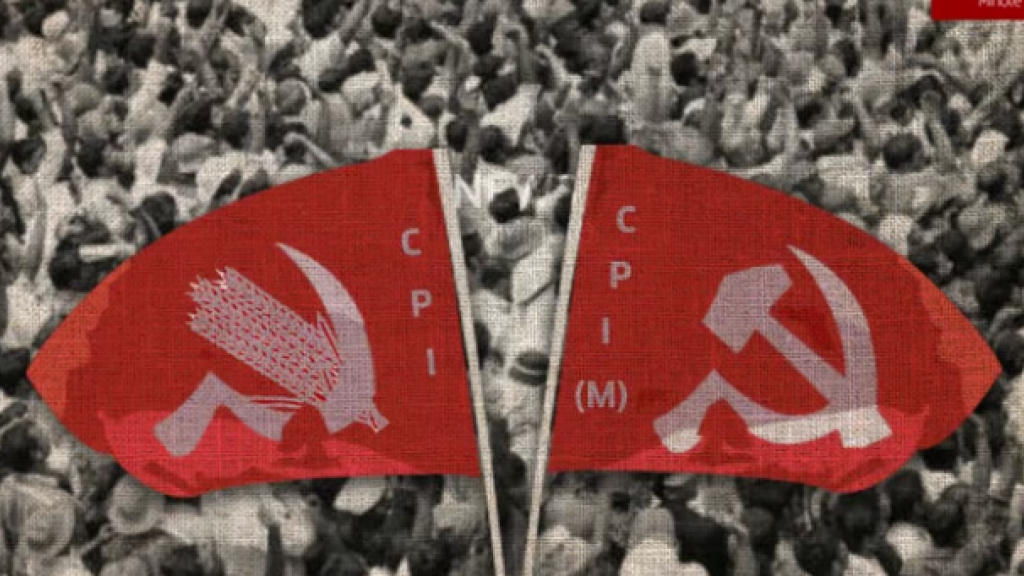
The question is how will they be mobilised? The answer is simply: only left parties can mobilise the masses to defend their rights. But can they? There are at least three streams on the Indian left: the mainstream left (the Communist Party of India, the Communist Party of India-Marxist, etc), the Naxalite left (which considers India as semi-feudal and semi-colonial), and the left that exists to the left of these two groups. Below I will mainly concentrate on the first stream.
The left’s achievements
India’s political culture would be poorer without the left. The Indian left is an important part of the country’s progressive and secular-democratic culture, and has produced countless political leaders and activists, artists, poets, writers, teachers, journalists, scientists, professors and rationalists.5
It has engaged in class struggle in its economic, political and ideological forms. It has been responsible for the decentralisation of governance and the introduction and implementation of many pro-poor government policies (for example land reforms and employment guarantee scheme) as well as the withdrawal of anti-people policies (such as anti-farmer laws).
The left has fought against political corruption (consider the legal fight against the electoral bonds scheme) and left leaders are generally not corrupt. What is internationally celebrated as the Kerala model is a distinct contribution of the Indian Left. Moreover, the left has organised huge strikes and protests by workers and peasants and other petty producers.
The left is the conscience of the nation and the main nationalist force — nationalist in the anti-imperialist sense of promoting the economic and political rights of the workers and petty producers who constitute the real nation. The left is a reason for India’s national pride — if a source of pride is when common people fight for their rights.
Not surprisingly, a proportionately higher percentage of lower-income people (“very poor”) and unskilled and agricultural workers vote for left parties compared to other parties. For example, if 7.5% of all voters voted for the left in 1996, a much higher percentage (11.3%) voted for the left from those defined as “very poor”. This is in stark contrast to the right: while 24.9% of all voters voted for the BJP and allied parties in 1996, only 16% from among the “very poor” voted for them.
Yet, the left’s influence, including electorally, is waning. According to Lokniti surveys its support base among shopkeepers, hawkers and semi-skilled workers has dropped since 2009. In rural areas the left is also not getting much support among sharecroppers, small farmers and unskilled service providers.6 The question is why, and what is to be done?
The left’s weaknesses
Informalisation, automation, business being against welfare, the left not having money to fight elections, common people being divided by bourgeois politics on the basis of religion and caste, etc are not the fundamental reasons for the left’s weaknesses. They are barriers but not limits. In fact, they are the reasons for the left’s very existence. Many of these reasons existed in pre-1917 Russia and exist all around the world today.
Some say that Marxist dogma and the idea of a Leninist vanguard party are stumbling blocks (Chakravarty, 2012: 471-472).7 But I do not think so. So what are the problems? I will focus on two: electoralism and neglect of class consciousness.
Electoralism/parliamentarism and management of the capitalist state
Vladimir Lenin wrote:
To decide once every few years which member of the ruling class is to repress and crush the people through parliament — such is the real essence of bourgeois parliamentarianism (Lenin, 1917).8
When we consider left parliamentarism, we see that in most places the left either only comes to people once every few years during elections or spends far too much time on elections. Moreover, left parties often win seats by making significant compromises and sacrificing the goal of class struggle. Electoral fetishism and reformism are two sides of the same coin.
Where the left has come to power, it has spent far too much time not only on elections but on managing capitalist state apparatuses at local and provincial levels. Management of the capitalist state apparatus means pursuit of capitalist — even neoliberal capitalist — policies, including forcible dispossession of petty producers for primitive accumulation. While in power, the left has acted like a right-leaning social democratic party trying to ensure capitalist accumulation at the expense of common people, perhaps with a thin veneer of welfarism.
There is a consensus within the left that provincial state apparatuses can be used as a tool for people-oriented development. This is an incorrect view of the capitalist state. Provincial branches are necessary elements of the capitalist state. There is a division of labour within the state, meaning state power is shared between national level and local and regional level apparatuses, all of which are guided by two principles: defending capitalist property relations and promoting capitalist accumulation.
Promoting neoliberalism at the provincial level while criticising it when the national government implements it has led to a crisis of identity on the left (Chakravarty, 2012: 469). Trade unions have been pacified and controlled by the left in power in order to make space for capitalist industrialisation (ibid).
Here are a few lines from a CIA report called India: Dim Prospects for the Communists, declassified in 2008:
“They have traded their class struggle philosophy for a share of parliamentary power and have gradually become integrated into the nation’s system of parliamentary democracy.” (p. iii)
“Their long-term prospects for eventually leading a national government are almost … remote.” (p. iii)
“Communist platforms on land reform, a self-reliant economy, a vigorous public sector, secularism etc do not substantially differ from Congress party’s. [Too much emphasis on parliamentary politics makes] it difficult for the Communists to achieve an identity apart from the Congress party.” (p. 4).
“By projecting themselves as simply left-leaning parties, the Indian Communists have lost their distinctive revolutionary character.” (p.3)
“Communist participation in the conventional parliamentary system of government has reduced the revolutionary consciousness of its followers.” (p.3)
“In states where Communists have held power, Marxist trade unions have been tightly controlled and have lost stature as militant organizations.” (p.3)
“In our judgement, the CPI and CPM have consistently reined in extremists in their affiliated front organizations in order to avoid attacks on the social and economic order of which the Communists have become a part.” (p. 3)
“India’s Communists are not a revolutionary threat, nor do they pose a serious challenge to US interests.” (p. iii)
Muted development of class or socialist consciousness
According to Friedrich Engels, left struggle happens in three forms: economic, political and ideological. A revolutionary movement is not possible without revolutionary theoretical consciousness. Yet, there is relatively little emphasis on theoretical work and theoretical consciousness within the Communist movement.
Much of the writing by left academics and ideologues appears to be oblivious towards Marxist world literature and, especially, theoretical literature. Partly as a result of electoralism, the left has failed to transform the democratic and trade union consciousness of workers and small-scale producers into class or socialist consciousness.9
The level of ideological education of members and followers of major Communist parties — that is, the level of theoretical consciousness — is not very high. Even the left’s view of capitalism’s crisis is reformist: poverty/inequality and restricted demand are said to explain it. The left fails to point to the crisis of profitability resulting from the rising organic composition of capital as an inherent feature of capitalism.
Yes, there are material and objective obstacles to the development of socialist consciousness. But note that criticisms of the system and radical theorisation of it can act as a material force:
The weapon of criticism cannot, of course, replace criticism of the weapon, material force must be overthrown by material force; but theory also becomes a material force as soon as it has gripped the masses. Theory is capable of gripping the masses as soon as it…becomes radical. To be radical is to grasp the root of the matter. (Marx).
If capitalism is the root of the problems, socialism is the main solution. Yet the idea of the struggle for socialism — with which the development of class consciousness is associated — is hardly raised in left discourse and political work. Consider left parties’ 2024 election manifestos. Socialism is not mentioned even once.
The left’s ideological and political work is shaped by the theoretical-political assumption that the goal of Communists is to merely have a more democratic and egalitarian capitalism for a near-indefinite period. The left is wedded to the idea of a non-socialist revolution. This is the most fundamental obstacle to a serious Communist movement, in part because it leads to class-collaborationism and reformism. The language of a socialist vision and revolutionary struggle for socialism is scarce.
A few months ago, just after I finished giving a talk, I asked when was the last time an Indian left leader publicly talked about socialism. I was told: “socialism is talked about in party circles.” No, the party circles are no substitute for people’s circles. Electoralism plus its little attempt to develop socialist class consciousness has resulted in the left’s isolation from the masses.
What is (not) to be done?
No to sectarianism, yes to temporary revolutionary compromises and united fronts
A non-sectarian approach must involve engaging in actual struggles. Doing so can require fighting capitalism alongside (not-so-) revolutionary groups. This may require making temporary revolutionary compromises. Lenin said, in launching class struggle, it is necessary to utilise
a conflict of interests (even if temporary) among one’s enemies, or any conciliation or compromise with possible allies (even if they are temporary, unstable, vacillating or conditional allies) (Lenin, 1920).10
“One of the biggest and most dangerous mistakes made by Communists … is the idea that a revolution can be made by revolutionaries alone.” (ibid)11
Yet, both sectarianism and opportunistic alliance with bourgeois parties as strategies must be avoided.
In India, there are crucial allies whom the working class must win over for it to really become the “national class”. They include the exploited poor peasants, the dalits and adivasis. Left parties — as parties of class conscious workers and semi-proletarians — must be the vanguard of the masses, but must not be bureaucratic in dealing with people:
A vanguard performs its task as vanguard only when it is able to avoid being isolated from the mass of the people it leads. (Lenin, 1922)
Being able to engage in temporary compromises that serve the long-term interest of revolution requires principled unity. I do not understand why the CPI and CPI-M are different parties. Left unity must produce a gradually expanding united front of left forces as representatives of the common people.
Forces may remain separate organisationally and engage in polemical battles for theoretical and political clarity as long as they need to, but they must strike together in action, including against hyper-neoliberalism.
Due to divisions within the left and the low level of class consciousness among many workers, there is a real need to form united fronts among left parties (if they cannot be united) and between them and other organisations (including non-party social movements) around specific issues.
But a united front is not a popular front, which is a multi-class alliance that subordinates the interests of workers to that of a fraction of the capitalist class. Electoral support to bourgeois parties as so-called lesser evils is an example of popular frontism. Why should others not vote for the left to keep the right at bay?
If the left does not have a solid base in a place, it must not engage in electoral politics. The left must only use the electoral terrain (as with any other terrain) to promote the independence of the exploited from the exploiters; that is, independence vis à vis bourgeois political parties and organisations.
Ideological education
There is a clear need for a huge ideological class struggle to prepare the masses for the struggle for a workers’ and poor peasants’ state, if such a demand is not to be idealistic, voluntaristic and adventurist. The left must establish Marxist reading groups and promote left magazines and journals, as well as left culture, art and documentaries. It must organise progressive and left public lectures, neighbourhood meetings, social work, workers and peasants’ cooperatives, etc.
Fight for reforms as part of the fight for socialism
The left does not have to be in government to speak on behalf of the masses and be relevant to their lives. In fact, the more the left is embedded in governing bourgeois state apparatuses, the less relevant it becomes to the masses, generally speaking, in terms of the long-term goal of socialist revolution. More specifically, the left must show its practical relevance to the masses in at least six ways:
1. The left must mobilise the masses to win concessions from employers (domestic and foreign) on the basis of strikes and protests. It must make use of transitional demands, such as an automatic inflation-adjusted living wage, that reflect the needs of the masses — whether or not the system can meet them.
The fight against imperialist companies and institutions, such as the World Bank and IMF, is absolutely fundamental.
2. The left must mobilise the masses to win concessions from the government at all levels, in the form of progressive policies that meet people’s needs.
These policies can include: food security, secure employment for all, inflation-adjusted living wages to be paid by state-owned enterprises and state apparatuses, increases in the relative wage, reduction in inequality, better prices for petty producers, protection from unfair dispossession of small-scale property, freedom from debt, free time (reduction in working hours), pensions, socialised and universal access to publicly-provided quality healthcare, education, housing, transportation and culture, and so on.
3. The left must make sure that policies for the private and public sector introduced under pressure from the left are implemented and reach the masses in a participatory, non-divisive, non-discriminatory and non-corrupt way. This would ensure that policies announced by a government do not end up as false promises.12
4. The left must impart education to the masses to develop solidarity among them. This includes education against practices of discrimination based on religion, gender, caste, etc and education in defence of ecological sustainability.
5. The left must intervene at the level of production and not just at the level of distribution of income or commodities. State intervention must promote de-commodification and not expand the sphere of commodity circulation. In particular, the left must demand selective nationalisation and re-nationalisation of important large-scale enterprises and militant defence of the public sector. It must demand universal provision of basic goods and services.
6. The left must engage in the fight against the authoritarianism of the extreme right. As long as there are capitalist class relations, there will be a tendency towards the emergence of fascistic politics expressed in the form of discarding the democratic shell of capitalism and attacks on the economic and political rights of the masses for the benefit of big business.
Fascistic forces must be opposed, but one must reject the class collaborationist idea that supporting other bourgeois parties can be a method of stopping these forces. Moreover, the fight against fascist tendencies cannot be reduced to a fight to replace a right-wing government with a more democratic-secular government, even if that might represent a step towards the development of a higher level of mass consciousness and organisation.
Nor can the fight against fascistic tendencies be confined to a fight for a higher form of capitalist society that is more democratic and less unequal, and where the state intervenes on behalf of the poor and regulates private businesses. The fight against the hyper-neoliberal attacks of right-wing forces on people’s lives can only be seen as a step in, and as a part of, the protracted fight for socialism.
Clearly, capitalists do not mind doing business with, and actively supporting, undemocratic and authoritarian forces, whether these forces have slaughtered religious minorities, crushed democratic rights or are striking at the root of national unity. This fact is reason enough to assert to the masses that capitalism has to go. But capitalism will only go when the left — class conscious toiling masses organised by Communists — overthrows it.
Fighting against the oppression of lower castes, religious and linguistic minorities, as well as of women, must be the ABC of left struggle; such fights must be part of the fight for a new society.13 Repression by state and non-state actors or informal police (fascist shock troops) must be countered not only ideologically but through local level people’s committees — the potential future cells of the workers’ and peasants’ state.
Extra-electoral struggle is the utmost priority
Elections should be mainly for communicating to people why the existing system fails to meet their needs, why it must be replaced and how. The left must mobilise its basic classes (workers and small-scale producers) in extra-electoral activities to fight for democratic rights, secularism and economic concessions, as a part of the fight for socialism.
It must also engage in electoral struggle, but that must be seen as only a small part of its overall political work, a prime aim of which must be the development of democratic-secular and trade union consciousness and the transformation of these forms of consciousness into Communist or class consciousness. This Marxist perspective must shape the left’s approach to the electoral fight against fascistic tendencies.
What takes place outside the parliamentary arena is decisive in left politics. To the extent that participation in the electoral arena advances the goal of independent working-class political action of workers and poor peasants, then it is worth taking part. If, however, such electoral involvement adversely impacts that goal, then the costs outweigh the benefits.
Conclusion
The left must not see common people as merely suffering people but rather as fighting people. In so far as they are suffering people, their suffering must not be seen in terms of lack of income but in class terms; that is, in terms of lack of access to productive assets, lack of control over production, and lack of control over the coercive power of the state.14
Left demands should not focus on cash transfers to individuals but on producing collective wealth (use-values), such as through state-provided education, healthcare, etc and large-scale enterprises under democratic workers’ control. The left must demand the building of workers’ and farmers’ cooperatives. The left must also demand inroads into the property rights of big capital, including through taxation on the wealthy 1%. It must demand democratic control by common people over the state’s functioning.
There are objective reasons why the left should have political relevance to the daily lives of the masses, particularly through winning concessions for them as a part of its struggle for a new society and new democracy beyond capitalism. These are the ways in which it can obtain electoral support.
The spread of communalist-fascistic ideology acts to counter the left movement. Therefore, an ideological-political struggle against it is important, but not enough. This ideology is rooted in the material concerns of the ruling class, which are ultimately incompatible with those of the masses. The fight against that ideology must therefore be linked to the fight for economic concessions.
Both these fights must be part of the fight against capitalist class relations. In fact, the arrival of fascistic tendency as a part of, and response to, the capitalist crisis and reaction (and the resultant miseries for common people) is an opportunity for the left to say to the masses: the ruling class and its political parties are failing not only to meet your economic needs but to support basic democratic values, and therefore must be replaced.
Historical experiences of struggles for socialism have shown that all the talk of revolution by stages — where the first stage supposedly involves an alliance with progressive sections of the capitalist class — only damages the independent struggles of the working class and other toiling masses and lead to their defeats. Where is Lenin’s April Theses in the Communist movement today? Unfortunately, the Indian Communist movement is still stuck at Lenin’s pre-1917 Two Tactics.
The fight for economic, political and ecological reforms within capitalism is important. In fighting for reforms, the Left must, however, keep in mind the historical lesson that Lenin provided:
We solved the problems of the bourgeois-democratic revolution in passing, as a ‘by-product’ of our main and genuinely proletarian-revolutionary, socialist activities. We have always said that reforms are a by-product of the revolutionary class struggle. We said — and proved it by deeds — that bourgeois-democratic reforms are a by-product of the proletarian, ie, of the socialist revolution. (Lenin, 1921)
Raju J Das is a professor at York University, Toronto. His recent books include Critical reflections on economy and politics in India, and Marx’s Capital, Capitalism and Limits to the State: Theoretical Considerations. For more details visit rajudas.info.yorku.ca.
- 1
This is the text of a public lecture delivered at the Trivandrum Press Club, organised by Public Policy Research Institute and Institute of Parliamentary Affairs, on December 13, 2024.
- 2
https://www.ipsos.com/en-in/indians-paradox-socialism-ipsos-global-survey
- 3
Verma, R. and Chibber, P. 2023. "Economic Ideology in Indian Politics: Why Do Elite and Mass Politics Differ?" Studies in Indian Politics 11(2) 274–288. "There has been a political consensus since independence on the centrality of the Indian state in the economic realm. …[N]o political party can turn its back on the extensive welfare state, which is closely tied to electoral mobilisation through leadership appeals" (Verma and Chibber, 2023: 287)
- 4
Joshua, A. 2021. The waning influence of the Left. The Hindu. https://www.thehindu.com/opinion/op-ed/the-waning-influence-of-the-left/article5912007.ece
- 5
Joy, S. 2024. Lok Sabha elections – 2024. Deccan Herald. https://www.deccanherald.com/elections/india/lok-sabha-elections-2024-modi-afraid-of-lefts-ideological-influence-cpis-d-raja-3007527
- 6
Verma, R. 2021. An uphill task for the Left. The Hindu. https://www.thehindu.com/opinion/op-ed/An-uphill-task-for-the-Left-Front-CPIM-in-India/article62116385.ece
- 7
Chakrabarti, A. 2012. The Indian Communist Movement at a Crossroads: A Marxian Assessment. Rethinking Marxism, 24(3), 458–474. https://doi.org/10.1080/08935696.2012.685288
- 8
Lenin, V. The state and revolution. https://www.marxists.org/archive/lenin/works/1917/staterev/ch03.htm
- 9
Socialist consciousness refers to the consciousness that the interests of the workers and poor peasants are fundamentally incompatible with the interests of the capitalists (or capitalists and large-scale rentier-landowners) and their state, and that therefore capitalism and the capitalist state must be overthrown.
- 10
Lenin, V. 1920. “Left-Wing” Communism: an Infantile Disorder https://www.marxists.org/archive/lenin/works/1920/lwc/ch08.htm. For more details on Lenin’s theory of temporary revolutionary compromise, see Das. R. 2024. Socialist politics and revolutionary compromise. Links. https://links.org.au/socialist-politics-and-revolutionary-compromise
- 11
Lenin, V. 1922. On the significance of militant materialism.https://www.marxists.org/archive/lenin/works/1922/mar/12.htm. Lenin says: "Without an alliance with non-Communists in the most diverse spheres of activity there can be no question of any successful communist construction."
- 12
False promises amount to lies, the aim of which is to merely calm and deceive the masses (who have also been deceived by non-fascistic bourgeois governments). Fascistic tendencies specialise in promising to deliver good things for the poor people, better than any other alternative political movement (bourgeois-democratic or leftist), without meaning to do anything or much. In the process, they recruit sections of the masses into, and gain support for, their mass reactionary movement. They cannot deliver what they promise because doing so would hurt the basic interests of capital, which they are servile supporters of.
- 13
On the conception of a new society beyond the rule of capital, see Das, R. 2020. Human suffering during the pandemic and the need for a new society. Links. https://links.org.au/human-suffering-during-pandemic-and-need-new-society
- 14
On the class view of society, see Das, R. 2017. Marxist class theory for a skeptical world. Leiden: Brill.
India: Pointers and challenges of recent election outcome (plus CPIML Liberation scores election wins)
First published at CPI(ML) Liberation.
Jharkhand and Maharashtra Assembly election results present two utterly contrasting pictures. The Bharatiya Janata Party's (BJP) desperate attempt to capture Jharkhand by riding on an unmitigated anti-Muslim hate campaign met with a spectacular defeat, but in Maharashtra the party managed to reverse the Lok Sabha results on a scale that defies any easy explanation. Alongside these two Assembly elections, there were also a good number of by-elections, including two Lok Sabha constituencies and as many as forty-eight Assembly constituencies spread over fourteen states. The Congress managed to retain the two Lok Sabha seats (the Nanded seat in Maharashtra by a very narrow margin though), but the BJP/National Democratic Alliance (NDA) managed to partially improve its strength in the Assembly by-elections. We must also note that the BJP/NDA gains in Uttar Pradesh have been won through administrative heavy-handedness and virtual disenfranchisement of large sections of Muslim voters.
In many ways the November election outcomes, and the Haryana and Jammu and Kashmir results preceding it, can be seen as an early reality check since the denting of the BJP's majority in the 2024 Lok Sabha elections. The Rashtriya Swayamsevak Sangh (RSS)-BJP establishment had drawn up elaborate plans to win this mini round and its plans worked in Haryana and Maharashtra. In both these states, the BJP success has been scripted by the strategic combination of Other Backward Class (OBC) consolidation and communal polarisation complemented by a clever local fragmentation of opposition votes and huge application of money power. The Lok Sabha elections had come as a warning bell for the BJP/NDA in Haryana ,and especially in Maharashtra, and the BJP made the fullest use of the post-parliamentary poll interregnum outsmarting and outpacing the INDIA coalition campaign.
We must also note that the BJP’s poll strategy was only an extension of the Operation Lotus campaign orchestrated by the Modi government to dethrone the Uddhav Thackeray government in 2022. The BJP could not possibly have won the Maharashtra elections in 2024 without first usurping power in June 2022 through making a complete mockery of the fundamental principles of parliamentary democracy. While there is a lot of discussion now about the impact of the Mukhyamantri Majhi Ladki Bahin Yojana [scheme involving welfare payment to eligible women] launched just four months before the announcement of the elections and the meticulous micromanagement done by the RSS, we cannot ignore the pivotal role that Adani played in calling the shots in Maharashtra. Also Maharashtra has never witnessed the brazen use of cash on such an astounding scale, the Election Commission of India itself admitting to confiscation of cash worth nearly 1,000 crore in these elections, nearly seven times more than the previous election figure.
But the strategy that worked for the BJP in Haryana and Maharashtra failed spectacularly in Jharkhand. The Modi government had deployed a very similar strategy in Jharkhand complete with the obstructionist role of the Governor’s office and the politics of vendetta and persecution that saw Hemant Soren being sent to jail ahead of the Lok Sabha elections. The crossing over of former CM Champai Soren to the BJP pointed to a deeper conspiracy to destabilise the Hemant Soren government before the Assembly elections by engineering large scale defections. Before defeating the BJP’s hate campaign in the election, the Hemant Soren government had to withstand this destabilisation design. From the politics of vendetta and destabilisation to hate campaigns and social engineering, all the BJP’s core strategies failed or backfired and the party has had to suffer a comprehensive defeat in Jharkhand.
Champai Soren has been the only BJP candidate to win from a Scheduled Tribes (ST) reserved constituency out of the total of Jharkhand’s 28 constituencies reserved for the state’s indigenous people. The BJP also lost in a big way in Godda-Deoghar region and in parts of Palamu and North Chhotanagpur divisions. Most reassuring has been the emphatic rejection of the BJP's hate agenda in Jharkhand which revolved around a sinister attempt to pit Adivasis against Muslims by scaring the Adivasi population about losing their land, livelihood and daughters to so-called “Bangladeshi infiltrators”. With the newly formed Jharkhand Loktantrik Krantikari Morcha [Jharkhand Democratic Revolutionary Front, a regional political party] led by Jairam Mahato effectively replacing the BJP ally All Jharkhand Students Union, the BJP found itself virtually bereft of any alliance worth its name. In contrast, the INDIA coalition parties comprising the Jharkhand Mukti Morcha (JMM, Jharkhand Liberation Front), Congress, Rashtriya Janata Dal (National People's Party) and Communist Party of India (Marxist-Leninist) complemented each other and put up a formidable social and political barrier to the BJP's hate-filled divisive agenda.
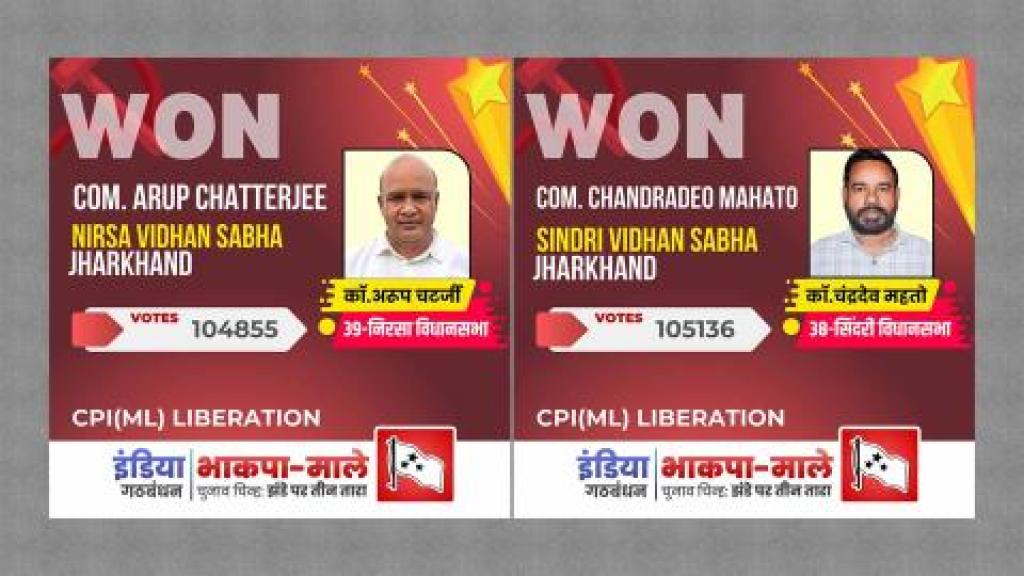
The unification of the erstwhile Marxist Coordination Committee with the CPI(ML) and the coming together of the legacies of Comrade AK Roy and the CPI(ML) movement played a significant role in pushing the BJP back in the Dhanbad-Bokaro region. Contesting for the first time as part of a coalition in Jharkhand Assembly elections, CPI(ML) fielded only four candidates in these elections with the JMM even forcing a “friendly contest” in one of these four seats. The loss of the party’s traditional Bagodar seat notwithstanding, the regaining of the Dhanbad district seats Nirsa and Sindri, the latter after a string of five successive defeats, has the potential of re-energising a left revival in Jharkhand and playing a bigger role in resisting corporate plunder and communal hate.
The left also picked up two seats in Maharashtra with the CPI(M) retaining the Dahanu (ST) seat in Palghar district and the Peasants and Workers Party winning the Sangole seat in Solapur district contesting outside of the Maha Vikas Aghadi (MVA, Grand Development Front) alliance. The by-elections in West Bengal held up the prospect of a broader unity of the left with the CPI(M) supporting the CPI(ML) in the industrial area seat of Naihati in the North 24 Parganas district adjacent to Kolkata. There are no signs yet of the left recovering its lost electoral ground, but with the BJP votes declining the left must persist in the attempt to forge a broader unity and build agitations on the burning issues facing the people.
The November results have come right before the impending winter session of the Lok Sabha and just on the eve of the 75th anniversary of the adoption of the Constitution of India and the fourth anniversary of the historic farmers’ movement. The indictment of the Adani group by the US Department of Justice has further exposed the Adani group and the corrupt Modi-Adani nexus. The left and the INDIA coalition must take the Maharashtra poll debacle in their stride and intensify the battle to save India's democracy from the continuing fascist assault and defend the rights and interests of the people in the face of India’s deepening economic crisis.
CPI(ML) Liberation election campaigns: A struggle for democracy and justice
First published at cpiml.net.
The CPI(ML) Liberation campaign for assembly elections in Jharkhand, and by-elections in four seats — one each in Bihar, Assam, West Bengal and Rajasthan — witnessed a vibrant participation of various sections of the people centring around the issues of immense hardships to the people, countering BJP’s pro-corporate crony politics and attempts of communal polarisation through spread of hatred and lies. Party candidates raised the issues of rights and livelihoods, and in defence of democracy and constitution.
Jharkhand
In Jharkhand, CPI(ML) contested four seats: Bagodar, Nirsa, Sindri and Dhanwar. Arup Chatterjee, a former MLA from Nirsa (Dhanbad) and a member of the party Central Committee, won the Nirsa assembly constituency with 104,855 votes, defeating BJP’s Aparna Sengupta. Chandradev Mahato won in Sindri defeating BJP’s Tara Devi. He received 105,136 votes. Vinod Singh and Rajkumar Yadav from Bagodar and Dhanwar, respectively, lost. In Bagodar, CPI(ML) polled 94,884 votes and in Dhanwar 32,187. The party had held a Bagodar seat since 1990, with the exception of a narrow margin defeat in 2014. Comrade Mahendra Singh represented Bagodar until his assassination after filing his nomination for the 2005 Assembly elections, the first election following the formation of the state. Comrade Singh had been representing this seat since then. Bagodar, Nirsa and Sindri were fought as part of the INDIA alliance, while in Dhanwar, JMM also fielded a candidate.
The CPI(ML)’s election manifesto for Jharkhand was released on November 3, and focused on defeating BJP to protect the resources of the state that the Modi-BJP regime wants to destroy and exploit for the benefit of its corporate cronies. It also noted that the Modi government has consistently targeted Jharkhand, disrespecting the 2019 state mandate. The BJP has weaponised institutions like the Enforcement Directorate (ED) and Central Bureau of Investigation (CBI) to undermine peoples’ rights and fuelled communal tensions. Promises regarding employment and reservation policy have been stalled.
The Jharkhand manifesto also focused on generating employment opportunities in the state and called for reversing the privatisation of mining, industry, and services. The improved budget allocations for education, ensuring quality schooling at the block level and accessible transportation for students was also a major pledge in the manifesto along with increased funding for education, health, sports, and universal housing and access to ration. The burning issue of environment and fight against deforestation, destruction of rivers, land-grab policies and productive lands being converted into residential zones and ever-growing mountains of debris that are disrupting Jharkhand’s ecosystem were raised prominently. It also called for strict enforcement of the Fifth Schedule to protect Jharkhand’s ecology and indigenous heritage.
Speaking at the INDIA Alliance rally in Sindri, CPI(ML) General Secretary Dipankar Bhattacharya said Sindri had been the historic centre of Comrade AK Roy’s struggle, represented subsequently by stalwarts like Binod Bihari Mahato and Anand Mahato. But because of an unfortunate division in the pro-Jharkhand state political camp this legendary cradle of the Jharkhand movement has fallen in the hands of the BJP. The time has come “to hold high the red flag in this citadel of the working class movement and free Sindri from the clutches of the corporate-communal nexus.”
The Jharkhand campaign also witnessed vibrant participation in Women’s Dialogues, led by All India Progressive Women's Association (AIPWA) leader Meena Tiwari, and Youth Dialogues that were a clarion call for rights and justice. Raja Ram Singh (Karakat MP), Sudama Prasad (Arrah MP) and leaders from Bihar also took part in campaigning in Jharkhand. Party ranks actively campaigned in all assembly seats in the state in support of INDIA bloc candidates with enthusiasm.
Complaint against BJP’s fake news
CPI(ML) filed an official complaint on November 10 against the BJP in Jharkhand for spreading false propaganda in violation of the Model Code of Conduct in the Sindri Assembly constituency. In a letter addressed to Rajiv Kumar, the Chief Election Commissioner, CPI(ML)’s Jharkhand State Secretary Manoj Bhakt said that the BJP has been running a disinformation campaign against CPI(ML) candidates and the party itself, including incitement to violence.
Comrade Manoj Bhakt, in the letter to the ECI demanded swift action against the BJP, urging it to remove the false videos and materials being circulated by BJP against CPI(ML). He stated that without prompt intervention, such misleading campaigns could severely impact the fairness of the electoral process.
The party thanked the people of Jharkhand for emphatically rejecting the BJP’s hate campaign and sinister agenda of inflicting Adani Raj on this resource-rich state by giving such an overwhelming mandate to the INDIA coalition.
Bihar
In the Tarari by-election, CPI(ML) leader Raju Yadav was the candidate supported by the INDIA alliance. The assembly seat became vacant after the sitting MLA Sudama Prasad won the Ara Lok Sabha seat, defeating the BJP’s RK Singh. CPIML was not able to retain this seat and Comrade Raju Yadav lost by a thin margin. He polled 68,143 votes.
During the campaign, a joint INDIA alliance rally was organised on November 11 in Tarari, which was joined by Dipankar Bhattacharya, Tejashwi Yadav and Mukesh Sahani.
A desperate BJP camp resorted to violence and intimidation of voters in Tarari at some booths. In booth no 223, village Dharmapura, feudal communal elements in support of BJP candidate attacked CPI(ML) voters with impunity. The incident was reported to local administration immediately but the ECI did not initiate any action against this brazen violation of the code of conduct to ensure free and fair polling. Lalan Yadav was seriously injured in this attack and had to be hospitalised for many days. While he was treated in the hospital, local police lodged a false case against the victim himself. Such an administrative bias is not new in Bihar. He was later set free when the Chief Judicial Magistrate refused to send him to jail and verbally scolded the police for this injustice. The police have not arrested any of the attackers so far.
WB, Rajasthan and Assam
In the West Bengal by-election, CPI(ML) fielded Debajyoti Mazumdar from the Naihati Assembly Constituency, supported by the Left Front. He received 7,593 votes. In Rajasthan, Shankar Lal Meena was the candidate for the Salumbar (ST). He received 1771 votes. In Assam, CPI(ML) leader Lakhikanta Kurmi contested Behali, securing 5093 votes.
The elections were again marked with rampant violations of model code of conduct and vicious, hate-filled false narratives by BJP leaders, as well as even more vitriolic and divisive propaganda through unofficial social media handles of the BJP-RSS establishment. On a number of occasions opposition parties made complaints to the ECI that went unheard. BJP leaders like Modi, Himanta Biswa Sarma and Adityanath spread lies in their speeches in Jharkhand but their divisive agenda was rejected as is evident in the final outcome of the elections.
The ruling establishment’s misuse of administrative machinery and huge amounts of black money is gradually corrupting the democratic nature of polity. A BJP general secretary was caught red handed distributing cash on the eve of election in Mumbai, but he was treated very softly.
The frequency of intimidation and threats to opposition parties voters’, with the help or direct involvement of police and administration, has increased to dangerous proportions. Polling day incidents in Uttar Pradesh pose a strong warning to all democracy loving people, with Muslim voters in many constituencies not allowed to exercise their voting right on filthy pretexts. Videos that went viral that day showed police harassing minority voters, including women. The ECI suspended seven police officials after one such incident was reported through a tweet by SP leader Akhilesh Yadav. But this was only an attempt at face washing, as voters in Muslim areas continued to be stopped from going to polling booths. This brazen crooked act of disenfranchising a huge minority population undoubtedly poses a direct threat to the democratic system. The bye-elections held in nine seats in Uttar Pradesh need to be investigated thoroughly, where some seats that are supposedly traditional Samajwadi Party strongholds were lost to NDA candidates because opposition voters could not exercise their democratic right to vote for the fear of life.


