Wednesday, January 08, 2025


UK Voter turnout: Evidence of a class divide?


By Dr. Tim Sandle
DIGITAL  JOURNAL 
January 7, 2025


Voters visit polling places to cast their ballots in the 2022 Primary Election on May 24, 2022 in Atlanta, Georgia - Copyright AFP/File Martin BUREAU

Turnout disparity in UK elections between graduates and non-graduates has widened to 11 percentage points. In 2024 this was twice as high as 2019. As well as the education premium, the gap between homeowners and renters rose to 21 points, signalling a probable divide by social class.

A new election law is needed to tackle rising voting inequalities and low turnout, or risk fuelling distrust and populism, according to the left-of-centre think tank Institute for Public Policy Research (IPPR). It is proposed this could include measures like automatic voter registration and a new civic duty to help at polling stations, akin to jury service. The measures fall short of a demand for compulsory voting (such as with the Australian model).

These findings are based on a detailed analysis of voter turnout in the four general elections since 2015. While voting inequalities across age and income have broadly remained the same, IPPR finds that the turnout gap between those who own their home and those who rent grew by nearly a quarter, to 19 percentage points, between the general elections of 2017 and 2024.

The think tank highlights a critical “blind spot” in the government’s current approach to combating populism (such as the rise of the right-wing Reform UK party). Unless ministers actively work to make democracy more inclusive, such populist movements will continue to gain traction, even if the economy is doing well.

Findings released by IPPR earlier this year revealed that only one in every two adults in the UK voted in this year’s general election – the lowest share of the population to vote in a general election since universal suffrage.

Ideas to remove barriers to voting include:

• Linking up with DVLA, DWP, Passport Office to prompt voter registration, or using National Insurance Numbers to register people automatically when they turn 16.
• Moving polling day to a weekend, as in Australia and New Zealand, or make election day a new public holiday.
• Allowing a wider range of photo IDs, or scrapping ID requirements altogether.
• Including the 5 million long-term tax-paying residents who are not citizens of the UK, Ireland, or Commonwealth nations.
• Basing constituency boundaries on the entire adult population of an area, not just registered voters.
• Lowering the voting age to 16.
• Making citizenship education compulsory in schools.
• Recruiting election-day poll workers from the population by lot, similarly, to recruiting for jury service.

Dr Parth Patel, IPPR associate director of democracy and politics, states: “We are close to the tipping point at which elections begin to lose legitimacy because the majority do not take part. That should be ringing more alarm bells than it is. We all know that elections aren’t perfect, but they are the only opportunity we get to express a desired future for ourselves and our country as a whole.”

Patel adds: “So many people today feel alienated from organised politics. The government may overlook non-voters, but populists don’t. Government can and should look to bring people back into democracy. Capping big money donations, automatically registering voters and creating a new civic duty to staff polling stations will help get voters back.”

To combat this ‘democratic deficit’ the IPPR is urging the introduction of an Elections Bill to address growing voting inequalities and revitalise democratic participation. Among its key proposals is a cap on individual and corporate donations to political parties at £100,000 per year.

In 2023, there were more donations over £1 million than ever before. Before 2017, such donations never totalled £10 million to a single party in a year — but since then, that mark has been passed four times. In 2023, £1 million-plus donations to the two main UK parties totalled close to £50 million, of which almost £39 million was given to the Conservatives, and just over £11 million to the Labour Party.

There are further calls for the rules to be significantly tightened around shell companies and ‘unincorporated associations’, which it says can easily be used to channel illegitimate or foreign funding into UK politics. It calls for ‘due diligence checks’ to establish the true origin of any funds channelled to political parties this way.
Iraqi archaeologists piece together ancient treasures ravaged by ISIS


By AFP
January 7, 2025


Nimrud's pre-Islamic artefacts were destroyed by jihadists, by Iraqi archaeologists are determited to restore them - Copyright Mexico's Attorney General's Office/AFP/File Handout

Waleed al-Akidi

A decade after jihadists ransacked Iraq’s famed Nimrud site, archaeologists have been painstakingly putting together its ancient treasures, shattered into tens of thousands of tiny fragments.

Once the crown jewel of the ancient Assyrian empire, the UNESCO-listed archaeological site was ravaged by Islamic State (IS) fighters after they seized large areas of Iraq and neighbouring Syria in 2014.

The precious pre-Islamic artefacts destroyed by the jihadists are now in pieces, but the archaeologists working in Nimrud are undaunted by the colossal task they face.

“Every time we find a piece and bring it to its original place, it’s like a new discovery,” Abdel Ghani Ghadi, a 47-year-old expert working on the site, told AFP.

More than 500 artefacts were found shattered at the site, located about 30 kilometres (19 miles) from Mosul, the city in northern Iraq where IS established the capital of their self-declared “caliphate”.

Meticulous excavation work by Iraqi archaeologists has already yielded more than 35,000 fragments.

The archaeologists have been carefully reassembling bas-reliefs, sculptures and decorated slabs depicting mythical creatures, which had all graced the palace of Assyrian King Ashurnasirpal II nearly 3,000 years ago.

Seen from above, the pieces of the puzzle gradually come together. Shards of what just several years ago was a single artefact are placed side by side, protected by sheets of green tarpaulin.

Bit by bit, the image of Ashurnasirpal II appears on one bas-relief alongside a winged, bearded figure with curly hair and a flower on its wrist, as the restoration brings back to life rich details carved in stone millennia ago.

Another artefact shows handcuffed prisoners from territories that rebelled against the mighty Assyrian army.

Partially reconstructed lamassus — depictions of an Assyrian deity with a human head, the body of a bull or a lion and the wings of a bird — lay on their side, not far from tablets bearing ancient cuneiform text.

– ‘Complex operation’ –

“These sculptures are the treasures of Mesopotamia,” said Ghadi.

“Nimrud is the heritage of all of humanity, a history that goes back 3,000 years.”

Founded in the 13th century BC as Kalhu, Nimrud reached its peak in the ninth century BC and was the second capital of the Assyrian empire.

Propaganda videos released by IS in 2015 showed jihadists destroying monuments with bulldozers, hacking away at them with pickaxes or exploding them.

One of those monuments was the 2,800-year-old temple of Nabu, the Mesopotamian god of wisdom and writing.

IS fighters wreaked havoc at other sites too, like the once-celebrated Mosul Museum and ancient Palmyra in neighbouring Syria.

The jihadist group was defeated in Iraq in 2017, and the restoration project in Nimrud began a year later, only to be interrupted by the Covid-19 pandemic and restart in 2023.

Mohamed Kassim of the Academic Research Institute in Iraq told AFP that “until now, it has been a process of collection, classification and identification.”

About 70 percent of the collection work has been completed at the Assyrian palace site, with about a year’s worth of fieldwork left before restoration can begin in full force, said Kassim, noting it was a “complex operation”.

His organisation has been working closely with Iraqi archaeologists, supporting their drive to “save” Nimrud and preserve its cultural riches, through training sessions provided by the Smithsonian Institution with financial support from the United States.

– One shard after another –

Kassim said that the delicate restoration process will require expertise not found in Iraq and “international support” due to the extent of the “barbaric” destruction in Nimrud.

“One of the most important ancient sites of the Mesopotamian civilisation,” according to Kassim, Nimrud is a testament to a golden age of “the art and architecture of the Assyrian civilisation”.

The site was first excavated by archaeologists in the 19th century and received international recognition for the immense lamassu figures that were taken to Europe to be exhibited in London’s British Museum and the Louvre in Paris.

Other artefacts from Nimrud have been on display in Mosul and Iraq’s capital Baghdad.

The site has also attracted figures like British author Agatha Christie, who visited there with her archaeologist husband.

On a recent tour of Nimrud, Iraq’s Culture Minister Ahmed Fakak al-Badrani hailed the “difficult” work carried out by archaeologists there, collecting broken pieces and comparing them to drawings and photographs of the artefacts they attempt to reconstruct.

The vast destruction has made it impossible, at least for now, to ascertain which antiquities were stolen by IS, the minister said.

And the process will take time.

Badrani said he expects that it will take 10 years of hard work before the marvels of King Ashurnasirpal II’s palace can be seen again, complete.

In Brazil, an Amazon reforestation project seeks to redeem carbon markets

“If capitalism is responsible for the climate crisis, I don’t think it will be able to solve it.”


By AFP
January 7, 2025

By planting native species that will thrive in the Amazon, Mombak hopes to restore credibility to a scandal-ridden carbon market - Copyright AFP STR


Anna PELEGRI

In the Brazilian Amazon, workers use metal tubes to sow seedlings in rapid succession, as part of an effort to reforest the jungle with millions of trees.

The project has financial backing from the United States and lucrative contracts with companies such as Google, Microsoft and the McLaren F1 team, who want to use the reforested area to offset millions of tons of carbon emissions.

By planting native species that will thrive in the Amazon, the Brazilian company Mombak hopes to restore credibility to a scandal-ridden carbon market at a crucial time for the warming planet.

“We identified a great opportunity in the market, which is the global goal of reducing emissions in the coming years”, said Mombak co-founder Gabriel Silva, at the Turmalina farm in the northern state of Para.

“The Amazon is the best place in the world to reforest,” he added, citing the loss of 60 million hectares since 2015.

– Tainted carbon credits –

The carbon market is based on the sale of credits to companies to offset their greenhouse gas emissions by financing reforestation or protecting existing carbon sinks that absorb CO2.

The idea behind carbon credits has, however, taken a major hit recently as scientific research has repeatedly shown claims of reduced emissions being hugely overestimated — or even entirely untrue.

The market has also been criticized as a tool for “greenwashing,” allowing companies to claim carbon neutrality while doing little to reduce their own emissions.

One reason reforestation projects have proven ineffective is that many focus on monocultures, such as eucalyptus, which weaken ecosystems over time.

Since its founding in 2021, Mombak has bought nine farms from landowners in the northern Brazilian state of Para to replant trees.

The first of these, Turmalina — a former cattle ranch — covers 3,000 hectares. It is located to the east of Belem, the capital of Para, which will host the UN COP30 climate conference in November.

– ‘Simulate nature’ –

In just 18 months, three million cuttings of 120 different indigenous species have been planted.

“We want to simulate nature,” to build a “resilient” forest, explained biologist Severino Ribeiro.

The first trees to be planted are those that grow best under the sweltering Amazon sun. Then it will be the turn of more fragile species, which thrive in their shade.

Some of the newly planted trees are already several meters tall.

Among them are 300,000 specimens of six species threatened with extinction according to the IUCN Red List. They include yellow ipe, a tree that is emblematic in Brazil.

Mombak aims to plant at least 30 million trees by 2032, across an area five times the size of New York’s Manhattan island.

The project is financed by private investors, as well as by organizations such as the World Bank.

The United States in November announced a $37.5 million loan to Mombak, during a visit by US President Joe Biden to the Amazon.

Contracts with companies include a precise tonnage of emissions to be offset over a specific period.

Microsoft’s contract aims to offset 1.5 million tonnes of carbon — one of the largest of its kind in the world, according to Mombak.

The amounts of the contracts are being kept secret, but Mombak says they need to be “high,” as these projects need “intensive capital” to be viable.

The Mombak project has yet to be validated by Verra, a US organization that is one of the main private certifiers of carbon credits.

Verra last year strengthened its methods after facing criticism that projects it had validated actually saved little or no carbon compared with their promises.


– Sensitive land question –


Professor Lise Vieira da Costa, an expert in carbon markets at the Federal University of Para, said she was “cautious” about newcomer Mombak, but saw encouraging signs in its project.

“The fact that it is betting on biodiverse reforestation is positive,” she said.

Da Costa also highlighted Mombak’s approach of buying land for reforestation, which “indicates a tendency to have fewer conflicts with the communities.”

Land ownership is a major challenge in the Amazon, where many lack titles for their land, creating a legal limbo that is exploited by farmers, ranchers and speculators.

Para courts have seen several cases of misappropriation of land related to carbon credit projects.

To reduce conflict with local communities, Mombak is currently only working on areas “acquired from private owners who have been established for decades, which makes it easier to verify documentation,” said Silva.

However, the company is interested in the Para government’s first tender for the reforestation of a 10,000-hectare public area.

“Brazil cannot achieve its emission reduction targets by simply reducing deforestation. We need to restore (deforested) areas by creating concessions” of land for the carbon market, said Para governor Helder Barbalho.

Forestry specialist Carlos Augusto Pantoja argues that funds allocated to reforestation should go to “the Amazonian people. They have the know-how and they need support.”

“If capitalism is responsible for the climate crisis, I don’t think it will be able to solve it.”


COP30

Brazil gears up for first climate conference in Amazon


By AFP
January 7, 2025


With 200 workers laboring seven days a week, the largest open-air market in Latin America reflects the transformation currently underway in the Brazilian city, which is preparing to host COP30 in November -- the first UN climate conference in the Amazon - Copyright AFP STR


Anna PELEGRI

After serving a customer a bowl of acai with fried fish in Belem’s market, Sandra da Costa wipes her hands excitedly.

“Finally, the long-awaited renovation is going to happen,” she says.

With 200 workers laboring seven days a week, the largest open-air market in Latin America reflects the transformation underway in the Brazilian city, which is preparing to host in November the first UN climate conference in the Amazon, a meeting called COP30.

But the challenge is immense for this northern metropolis of 1.3 million people, crisscrossed by canals.

It faces severe social inequality and lacks sufficient infrastructure, including accommodations for the 60,000 delegates expected to attend.

Record public investment is restoring monuments, transforming the abandoned port warehouses into leisure zones, and dredging the river bay to anchor two cruise ships, which will expand lodging options alongside two new hotels.

– Turning point –

“The COP30 will be a turning point for the city and the Amazon,” says Igor Normando, the 37-year-old mayor, to AFP.

“The world will learn the challenges of the Amazonian people, and see that there is nothing fairer than helping us,” says Normando atop the historic Forte do Presepio, overlooking an acai market where tons of the Amazonian fruit arrive every dawn.

The world’s largest tropical rainforest is critical in the fight against climate change, but increasingly suffers its effects, with fires and droughts growing more severe each year.

Experts view the UN conference, set for November 10-21, as a crucial chance for humanity to reverse the warming trend with firm commitments to reduce global emissions and preserve the forest.

– ‘Canopy of a tree’ –

At the new Parque da Cidade, a former airfield where COP30 events will take place alongside the convention center for official negotiations, references to nature and Indigenous cultures abound.

Among the metal structures set to host culinary and craft hubs, native flora like rubber trees are being planted. Excavators are also working to prepare the site for a lake.

Replacing asphalt with green spaces in one of Brazil’s least forested cities — despite it being in the Amazon — is another goal for local authorities.

The initiative gained momentum after President Luiz Inacio Lula da Silva declared in 2023 that COP30 meetings might even take place “under the canopy of a tree.”

– ‘Invisible City’ –

Belem is “two cities: the one everyone will see, including heads of state; and another that is invisible,” says historian Michel Pinho.

Max Moraes, a 56-year-old boatman from Vila da Barca, a stilt neighborhood struggling without basic sanitation while luxury apartment towers loom nearby, expresses outrage.

“Where is the money for the COP30 going? To help the population?” he asks skeptically while sitting on a wooden walkway above garbage floating in yellowish water.

Yet, in Vila da Barca, founded a century ago by fishermen and now coveted by real estate speculators, resistance is key, according to community leaders.

– ‘Urban Amazon’ –

“Our daily struggle is real,” says Inez Medeiros, a 37-year-old teacher and social leader from the neighborhood. “We want the COP30 to consider us because we also live in the Amazon, even if it’s an urban Amazon.”

After more than two decades of delays, the city recently delivered 100 social housing units, finally providing some families with decent homes.

Each victory brings motivation, Medeiros says.

Her next challenge: launching a small floating hotel to host COP participants, offering them a firsthand view of Belem, “beyond the spotlight.”


SPACE/COSMOS

NASA’s micro-mission Lunar Trailblazer will make macro-measurements of the lunar surface

The Conversation
January 6, 2025

Lunar Trailblazer is planned to launch in early 2025. Lockheed Martin Space

NASA’s upcoming Artemis II mission is slated to return astronauts to the Moon no sooner than April 2026. Astronauts were last on the Moon in 1972 during the Apollo 17 mission.

Artemis II will utilize NASA’s Space Launch System, which is an extremely powerful rocket that will enable human space exploration beyond Earth’s atmosphere. The crew of four will travel in an Orion spacecraft, which the agency launched around the Moon and successfully returned during the Artemis I mission.

But before Artemis II, NASA will send two missions to scout the surface of the lunar south pole for resources that could sustain human space travel and enable new scientific discoveries.

Planetary geologists like me are interested in data from Lunar Trailblazer, one of these two scouting missions. The data from this mission will help us understand how water forms and behaves on rocky planets and moons.
Starting with scientific exploration

PRIME-1, or the Polar Resources Ice Mining Experiment, will be mounted on a lunar lander. It’s scheduled for launch in January 2025.

Aboard the lander are two instruments: The Regolith and Ice Drill for Exploring New Terrain, TRIDENT, and the Mass Spectrometer for Observing Lunar Operations, MSOLO. TRIDENT will dig down up to 3 feet (1 meter) and extract samples of lunar soil, and MSOLO will evaluate the soil’s chemical composition and water content.

Joining the lunar mining experiment is Lunar Trailblazer, a satellite launching on the same Falcon 9 rocket.

Think of this setup as a multimillion-dollar satellite Uber pool, or a rideshare where multiple missions share a rocket and minimize fuel usage while escaping Earth’s gravitational pull.

Bethany Ehlmann, a planetary scientist, is the principal investigator of Lunar Trailblazer and is leading an operating team of scientists and students from Caltech’s campus. Trailblazer is a NASA Small, Innovative Mission for PLanetary Exploration, or SIMPLEx.

These missions intend to provide practical operations experience at a lower cost. Each SIMPLEx mission is capped at a budget of US$55 million – Trailblazer is slightly over budget at $80 million. Even over budget, this mission will cost around a quarter of a typical robotic mission from NASA’s Discovery Program. Discovery Program missions typically cost around $300 million, with a maximum budget of $500 million.
Building small but mighty satellites


Decades of research and development into small satellites, or SmallSats, opened the possibility for Trailblazer. SmallSats take highly specific measurements and complement data sourced from other instruments.

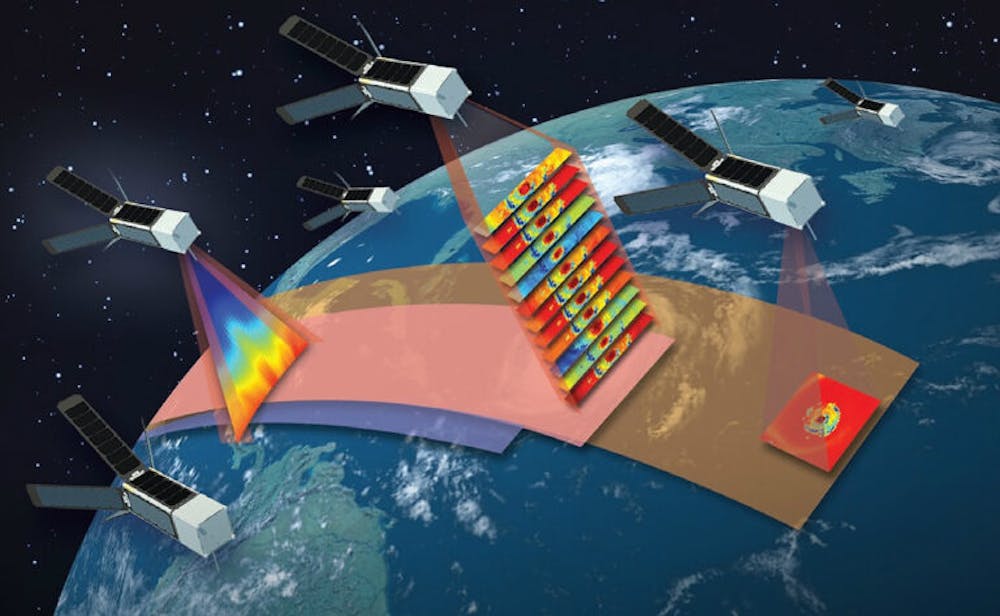
A diagram showing four small satellites scanning Earth's science and taking layers of science data.

Missions like NASA’s TROPICS use a network of small satellites to take more data than one satellite would be able to do alone. NASA Applied Sciences


Multiple SmallSats working together in a constellation can take various measurements simultaneously for a high-resolution view of the Earth’s or Moon’s surface.

SIMPLEx missions can use these SmallSats. Because they’re small and more affordable, they allow researchers to study questions that come with a higher technical risk. Lunar Trailblazer, for example, uses commercial off-the-shelf parts to keep the cost down.

These low-cost, high-risk experimental missions may help geologists further understand the origin of the solar system, as well as what it’s made of and how it has changed over time. Lunar Trailblazer will focus specifically on mapping the Moon.

A brief timeline of water discoveries on the Moon

Scientists have long been fascinated by the surface of our closest celestial neighbor, the Moon. As early as the mid-17th century, astronomers mischaracterized ancient volcanic eruptions as lunar mare, derived from the Latin word for “seas.”

Nearly two centuries later, astronomer William Pickering’s calculations suggested that the Moon had no atmosphere. This led him to conclude the Moon could not have water on its surface, as that water would vaporize.


However, in the 1990s, NASA’s Clementine mission detected water on the Moon. Clementine was the first mission to completely map the surface of the Moon, including the lunar poles. This data detected the presence of ice within permanently shadowed regions on the Moon in low resolution.

Scientists’ first water detection prompted further exploration. NASA launched the Lunar Prospector in 1998 and the Lunar Reconnaissance Orbiter in 2009. The India Space Research Organization launched its Chandrayaan-1 mission with the Moon Mineralogy Mapper, M3, instrument in 2008. M3, although not designed to detected liquid water, unexpectedly did find it in sunlit areas on the Moon.

These missions collectively provided maps showing how hydrous minerals – minerals containing water molecules in their chemical makeup – and ice water are distributed on the lunar surface, particularly in the cold, dark, permanently shadowed regions.
Novel mission, novel science


But how does the temperature and physical state of water on the Moon change from variations in sunlight and crater shadows?

Lunar Trailblazer will host two instruments, the Lunar Thermal Mapper, LTM, and an evolution of the M3 instrument, the High-resolution Volatiles and Minerals Moon Mapper, HVM3.

The LTM instrument will map surface temperature, while the HVM3 will measure how lunar rocks absorb light. These measurements will allow it to detect and distinguish between water in liquid and ice forms.


In tandem, these instruments will provide thermal and chemical measurements of hydrous lunar rock. They’ll measure water during various times of the lunar day, which is about 29.5 Earth days, to try to show how the chemical composition of water varies depending on the time of day and where it is on the Moon.

These results will tell researchers what phase – solid or liquid – the water is found in.
Scientific significance and what’s next


There are three leading theories for where lunar water came from. It could be water that’s been stored inside the Moon since its formation, in its mantle layer. Some geologic processes may have allowed it to slowly escape to the surface over time.

Or, the water may have arrived on asteroids and comets that collided with the lunar surface. It may even have been created by interactions with the solar wind, which is a stream of particles that comes from the Sun.

Lunar Trailblazer may shed light on these theories and help researchers make progress on several other big science questions, including how water behaves on rocky bodies like the Moon and whether future astronauts will be able to use it.

César León Jr., Ph.D. Student of Planetary Geology, Washington University in St. Louis

This article is republished from The Conversation under a Creative Commons license. Read the original article.


US company Firefly Aerospace to launch for Moon next week


By AFP
January 7, 2025

This undated handout image courtesy of Firefly Aerospace shows the fully assembled Blue Ghost Mission 1 lunar lander vehicle - Copyright NASA/JPL-CALTECH/AFP/File Handout

US company Firefly Aerospace said Tuesday it is aiming to launch a lander to the Moon next week under an experimental NASA program that partners with the commercial sector to reduce costs.

If successful, it would mark only the second time an American robot has touched down on the lunar surface since the end of the Apollo era.

“Buckle up! Our road trip to the Moon is set to launch at 1:11 a.m. EST on Wednesday, Jan. 15, aboard a @SpaceX Falcon 9 rocket,” Texas-based Firefly Space wrote in a post on X.

The company’s lander, Blue Ghost, stands 2 meters (6.6 feet) tall and 3.5 meters (11.5 feet) wide. It will aim to deliver gear for 10 science research projects and technology demonstrations to a volcanic feature called Mons Latreille, located within Mare Crisium on the Moon’s northeast near side.

Blue Ghost will spend 45 days traveling to the Moon, followed by a planned 14-day operational phase on the surface.

Firefly Aerospace was awarded a $93 million contract in 2021 under NASA’s Commercial Lunar Payload Services (CLPS) initiative.

The program has recruited newcomer space companies to deliver scientific and technological payloads to the Moon, with the goal of fostering a private lunar economy and establishing a sustained presence there as part of the broader Artemis program.

The first CLPS mission, conducted by Pennsylvania-based Astrobotic in January 2024, ended in failure.

The company’s Peregrine lander launched aboard a United Launch Alliance Vulcan rocket but was lost a few days later due to a fuel leak, ultimately burning up in Earth’s atmosphere.

A month later, Texas-based Intuitive Machines achieved a partial success. Its lander launched aboard a SpaceX Falcon 9 and successfully touched down near the Moon’s south pole on February 22.

However, it broke a leg upon landing and came to rest at an angle, preventing its solar panels from receiving enough sunlight to keep its radio powered. Still, the mission completed several tests, transmitted photos, and marked the first American lunar landing since the Apollo 17 mission in 1972.

To date, only five countries have successfully soft-landed spacecraft on the Moon: the Soviet Union, the United States, China, India, and Japan.

NASA eyes SpaceX, Blue Origin to cut Mars rock retrieval costs

By AFP
January 7, 2025


This NASA photo released on February 24, 2021, shows images from NASA's Mars 2020 Perseverance rover in Jezero Crater on February 21, 2021 
- Copyright NASA/JPL-CALTECH/AFP/File Handout

NASA announced Tuesday it may turn to Elon Musk’s SpaceX or Jeff Bezos’s Blue Origin to help reduce the soaring costs of returning Martian rocks collected by the Perseverance rover to Earth.

Originally planned to deliver 30 sample tubes to Earth by the 2030s, the Mars Sample Return mission has faced rising expenses and delays, prompting the US space agency to explore more streamlined solutions.

The pivot comes as China progresses towards a simpler “grab-and-go” sample return mission to the Red Planet “around 2028,” according to state media, potentially making it the first nation to achieve the feat.

Outgoing NASA Administrator Bill Nelson revealed Tuesday that the agency is evaluating two potential architectures for landing a robotic platform on Mars, with a final decision expected in mid-2026.

The first option uses NASA’s tried-and-true Sky Crane system, a robotic jetpack that famously lowered the Curiosity and Perseverance rovers onto the Martian surface in 2012 and 2021, respectively.

The second involves a “heavy lift lander” developed by a commercial partner to place the necessary hardware on the surface.

“You all know that SpaceX and Blue Origin have already been ones that have expressed an interest, but it could be others as well,” said Nelson.

Under both scenarios, the lander would carry a scaled-down Mars Ascent Vehicle — a lightweight rocket designed to launch samples into Mars orbit.

There, the Earth Return Orbiter, being developed by the European Space Agency (ESA), would intercept the payload for the journey back to Earth.

NASA is also revising its power strategy for the lander. Instead of solar panels, which are vulnerable to Mars’s dust storms, the agency plans to use a nuclear battery for heat and energy.

With the Sky Crane option, NASA estimates expenses could range from $6.6 billion to $7.7 billion — far less than the $11 billion projected under the original plan, as reported in an independent audit.

Partnering with commercial providers could reduce costs further, to between $5.8 billion and $7.1 billion, with the return expected between 2035-2039, compared to 2040 under the original plan.

The mission’s timeline depends on variables like annual congressional funding and whether NASA and ESA opt for a direct Mars-to-Earth flight or a detour to a “cislunar orbit” around the Moon, where samples would need retrieval.

Meanwhile, China’s simpler mission could deliver samples years ahead of NASA, marking a significant symbolic victory.

Nelson downplayed comparisons between the programs, emphasizing the complexity and scope of NASA’s effort. “You cannot compare the two — ours… is an extremely well thought-out mission created by the scientific community of the world,” he said.

Perseverance landed on Mars in 2021 to search for evidence of ancient microbial life from billions of years ago, when the planet was warmer and wetter.


Total eclipse of the Moon, Saturn’s rings ‘disappear’, meteors: Guide to southern sky 2025

The Conversation
January 6, 2025

Image: Blood moon lunar eclipse via Shutterstock.com


In addition to the annual parade of star pictures or constellations passing above our heads each night, there are always exciting events to look out for in the sky. The year 2025 is no exception and has its fair share of such events.

Though the night sky is more spectacular from a dark country sky, you can see the events outlined here even if, like many others, you live in a light-polluted city. For most events you do not need a telescope or binoculars.

Here are some of the highlights.

March and September: eclipses of the Moon

During the early morning of Monday 8 September, the full Moon will move into the shadow of Earth and be totally eclipsed. The Moon will turn a red or coppery colour, because sunlight is bent or refracted by Earth’s atmosphere onto the Moon. The bent light is red, as we are looking at the reflection of sunrises and sunsets from around the globe.

Total eclipses of the Moon are more common than those of the Sun. They can be seen from all the regions on Earth where it is night.


Unlike eclipses of the Sun, lunar eclipses are safe to watch with the unaided eye. They are also safe to photograph. A tripod will help, as will a camera or phone able to take timed exposures.

The eclipse starts with Earth’s shadow gradually covering the Moon over about an hour. Similarly, after totality the shadow takes about an hour to leave the Moon.

Seen from Australia’s east coast, the total eclipse will last from from 3:30am to 4:53am on September 8. From New Zealand, this will be from 5:30am to moonset; from South Australia or the Northern Territory, 3:00am to 4:23am, and from Western Australia 1:30am to 2:53am.

Earlier in the year, on the evening of Friday March 14, people in Aotearoa New Zealand will be able to see a totally eclipsed Moon as it rises above the horizon just after sunset. Watchers in eastern Australia will also get a brief glimpse of a partially eclipsed Moon after moonrise, for 34 minutes from Sydney, 43 minutes from Brisbane and 16 minutes from Cairns.


March: Saturn’s ‘disappearing’ rings

Gazing at Saturn and its rings through a telescope is always a thrill, whether you are seeing them for the first or the hundredth time. However, in early 2025 the rings will seem to vanish as Earth passes through the plane of the rings.


This phenomenon occurs twice during Saturn’s 29-year path around the Sun, that is, at roughly 15-year intervals. Unfortunately, on March 24, the date when this will occur, the planet will be too close to the Sun in the sky for us to observe.

However, in the evenings until mid-February and in the morning from late March we will be able to see Saturn with quite narrow, tilted rings.

Note that a small telescope is needed to see Saturn with or without its rings. If you don’t have one yourself, you can go on a night tour at a public observatory like Sydney Observatory or an observing session with a local astronomical group, such as those at Melbourne Observatory with the Astronomical Society of Victoria.

May and December: meteor showers


The Eta Aquariids seen from Chile in 2022. Petr Horálek / ESOCC BY


The two main meteor showers of the year are the Eta Aquariids and the Geminids.

In 2025, the Eta Aquariids are best seen on the morning of Wednesday May 7, while the Geminids will be most visible on the mornings of Sunday December 14 and Monday December 15.

This year, viewing conditions for both meteor showers are favorable, in the sense that there will be no bright Moon in the sky during those mornings. To see them, look towards the north-east (Eta Aquariids) and north (Geminids) before dawn starts brightening the sky.


The darker the sky you can find, the better. Keep away from street lights or any other light.
January, April and August: planets

The five planets you can see with the naked eye – Mercury, Venus, Mars, Jupiter and Saturn – move across the sky along a line called the ecliptic.

As the planets move, they sometimes appear to pass close to each other and take on interesting patterns. Of course, they only appear close from our point of view. In reality the planets are tens or hundreds of million kilometers apart.

In 2025, these patterns include:January 18–19: the brightest planet, Venus, is close to the ringed planet Saturn in the evening sky
April 1–15: Mercury, Venus and Saturn form a slowly changing compact group in the eastern sky near sunrise
August 12–13: Venus and Jupiter, the two brightest planets, are only separated by two moon-widths in the morning sky.
June and August: constellations

As the year progresses, different constellations appear in the evening sky. The perpetual chase of Orion and Scorpius (the hunter and the scorpion) across the sky was noted in 2024.

In 2025, keep an eye on the Southern Cross (known as Crux to astronomers) and Sagittarius (the archer).

The Southern Cross is the best-known constellation in the southern sky. It is easy to find, as it is made up of a compact group of bright stars in the shape of a cross.

Two pointer stars from the neighboring constellation of Centaurus, the centaur, also help to show its position. From Sydney and further south, the Southern Cross is always above the horizon. However, in the evenings, it is best viewed around June, when it is high in the southern sky.

The constellation Sagittarius is next to Scorpius. In the evenings, it is best placed for observation in August, as at that time of the year it is directly overhead.

A join-the-dots look at the brightest stars of the constellation gives the impression of a teapot, and it is often referred to by that name. Sagittarius is an important constellation for Australian astronomers, as it contains the centre of the Milky Way galaxy.

The information in this article comes from the 2025 Australasian Sky Guide. The guide has monthly star maps and has much more information to help with viewing and enjoying the night sky from Australia and Aotearoa New Zealand.

Nick Lomb, Honorary Professor, Centre for Astrophysics, University of Southern Queensland

This article is republished from The Conversation under a Creative Commons license. Read the original article.


Tuesday, January 07, 2025


Feathered fortunes: Bird diversity soars in China's Yangtze River Basin


Nanjing Institute of Environmental Sciences, MEE
Partial least squares structural equation modeling of the relationships between changes in bird diversity and the factors driving those changes in the YRB (A), upstream (B), midstream (C), and downstream (D). 

image: 

Partial least squares structural equation modeling of the relationships between changes in bird diversity and the factors driving those changes in the YRB (A), upstream (B), midstream (C), and downstream (D).

view more 

Credit: Eco-Environment & Health


A pivotal study reveals a significant rise in bird diversity across China’s Yangtze River Basin (YRB) over the past decade, driven by large-scale ecological restoration efforts. While the overall diversity of avian species has increased, challenges persist in downstream regions, where wetland degradation has led to a decline in bird populations. These findings highlight the success of restoration programs but also emphasize the urgent need for more targeted conservation strategies, particularly in vulnerable wetland areas.

The Yangtze River Basin (YRB), a critical ecological zone and a global biodiversity hotspot, faces increasing pressures from habitat degradation, climate change, and human activity. These factors have led to a worrying decline in biodiversity, threatening the region’s ecological balance and the essential services it provides. To address these challenges, understanding the drivers of bird diversity and the effectiveness of existing conservation measures is crucial. This study aims to fill that knowledge gap by examining long-term trends in bird populations within this vital region.

In a study (DOI: 10.1016/j.eehl.2024.10.001) published in the Eco-Environment & Health journal on November 1, 2024, researchers from Nanjing Institute of Environmental Sciences which is affiliated to the Ministry of Ecology and Environment of China, in collaboration with Princeton University, present a comprehensive analysis of bird diversity across 536 sites in the YRB from 2011 to 2020. The study employs a newly optimized Living Planet Index (LPIO), a unique tool that combines species abundance, richness, and information entropy to track changes in bird populations over time.

Using the LPIO, the researchers observed a 6.12% increase in bird diversity across the YRB from 2010 to 2020, marking a notable reversal from the global trend of biodiversity loss. This rise was most pronounced in terrestrial bird diversity, with substantial improvements in functional complexity throughout the watershed. However, the downstream region of the basin saw a 2.83% decrease in bird diversity, mainly due to the alarming decline in wetland bird species. The study underscores the role of large-scale ecological restoration programs in reversing biodiversity loss, but it also points to the critical need for more focused conservation efforts, especially in the wetland areas where degradation has been most severe.

“Our study provides compelling evidence that targeted conservation efforts can halt the decline of biodiversity,” says lead author Wei Liu. “The findings underscore the importance of continued monitoring and more effective wetland restoration strategies to ensure the long-term protection of avian biodiversity in the YRB.”

Looking ahead, the study’s outcomes advocate for a renewed focus on wetland conservation, stressing that strategic ecological restoration can yield significant benefits for biodiversity. The findings offer a model for other regions facing similar environmental challenges, illustrating how targeted conservation efforts can enhance biodiversity and protect the ecosystem services vital for human well-being and economic stability. By prioritizing habitat recovery—particularly in wetlands—there is a promising opportunity to restore balance in the YRB and beyond.

###

References

DOI

10.1016/j.eehl.2024.10.001

Original Source URL

https://doi.org/10.1016/j.eehl.2024.10.001

Funding information

This work was supported by the Biodiversity Investigation, Observation, and Assessment Program of the Ministry of Ecology and Environment of China.

About Eco-Environment & Health

Eco-Environment & Health (EEH) is an international and multidisciplinary peer-reviewed journal designed for publications on the frontiers of the ecology, environment and health as well as their related disciplines. EEH focuses on the concept of "One Health" to promote green and sustainable development, dealing with the interactions among ecology, environment and health, and the underlying mechanisms and interventions. Our mission is to be one of the most important flagship journals in the field of environmental health.


Crop switching for climate change in China


PNAS Nexus
China crop swtich 

image: 

Spatial variations in county-based crop fraction changes, defined as the fraction of crop-sown area over total cropland area.

view more 

Credit: Guan et al.


A study of Chinese agriculture recommends planting areas currently growing maize and rapeseed with alternative crops to reduce environmental costs while maximizing food production as the climate changes. 

Chinese food production has nearly doubled since the 1980s, mainly thanks to intensified nutrient usage and irrigation. Given that China’s demand for food is forecast to increase further, Qi Guan and colleagues modeled the country’s agricultural system under varying climate change scenarios in the 21st century, using a dynamic global vegetation model. The authors created scenarios that maximized crop production while minimizing leached nitrogen and water use under various climate futures. The scenarios also minimized disruptions to supply chains and sought to promote future food security. The optimal crop distributions increased productivity by 14.1%, reduced leached nitrogen by 8.2%, and reduced water use by 24.0% under future climate. Warming and increasing summer rain in northern China will make the area suitable for rice. Moving maize out of arid regions would save a significant amount of water. Drought-tolerant wheat could do well in the Northeast China Plain. Soy could thrive in northern and northwestern China, as well as the Yangtze Plain, and water-loving potatoes could do well in eastern and southern China. According to the authors, crop switching at the national scale is possible in China with coordinated actions, with large potential benefits.


Unveiling hidden climate dynamics: Researchers use mathematics of optimal transport to decode 21st-century climate change


Institute of Atmospheric Physics, Chinese Academy of Sciences
Wasserstein distance 

image: 

Schematic of Wasserstein distance

view more 

Credit: Zhiang Xie, Dongwei Chen, and Puxi Li


What happens when experts from vastly different disciplines—climate science, mathematics, and meteorology—join forces to tackle the same pressing question? A method called Wasserstein Stability Analysis (WSA) emerges, offering fresh insights into the subtle dynamics of climate change.

Zhiang Xie, from the Department of Earth and Space Sciences at Southern University of Science and Technology in China, teamed up with Dongwei Chen, a mathematician at Clemson University in the United States, and Puxi Li, a meteorologist from the Chinese Academy of Meteorological Sciences. Together, their interdisciplinary collaboration has redefined how we study climate change by introducing a new perspective on extreme events and probability distribution shifts.

Their study is recently published in Advances in Atmospheric Sciences.

 “Most of the time, climate studies focus on average temperatures or trends,” explains Zhiang Xie. “But we wanted to go deeper—beyond the averages—and look at how extreme events and other subtle patterns are changing.”

This curiosity led the team to adopt Wasserstein distance, a mathematical tool originally designed to measure the distance between probability distributions. “It’s like using a magnifying glass on the data,” says Dongwei Chen. “We're not just looking at what's typical; we're digging into the rare and the extreme.”

By applying their new WSA method to the 21st-century climate warming slowdown, the researchers uncovered a La Niña-like temperature shift in the equatorial eastern Pacific—something traditional methods had overlooked.

“This was a huge moment for us,” notes Zhiang Xie. “It’s exciting to see how combining mathematics with meteorology can reveal things we didn’t even know we were missing. For example, we also discovered how melting sea ice in the Arctic is loosening its grip on extreme warm events.”

The researchers credit their findings to their diverse backgrounds. “We all brought something unique to the table,” says Chen. “For me, it was about applying mathematical theory to real-world problems. For Zhiang and Puxi, it was about translating those findings into meaningful climate science.”

Li adds, “When you have experts from different disciplines working together, the questions themselves change. It's not just, ‘What is the mean temperature doing?’ but, ‘How are extreme events evolving, and why does it matter?’ That's the kind of innovation you get from collaboration.”

The team's WSA method opens up new possibilities for understanding the dynamics of climate change, particularly extreme weather events and threshold-specific shifts. “This is just the beginning,” says Li. “We’re now looking at how physical processes drive these changes in probability distributions, which could help us address the bigger challenges posed by climate change.”

Interdisciplinary collaborations like this provide new ways of approaching complex challenges, offering valuable insights into how we study and respond to one of humanity's most urgent issues — climate change.