Wednesday, January 08, 2025

Planning for spring’s garden? Bees like variety and don’t care about your neighbors’ yards

The Conversation
January 7, 2025 

Bee on a Flower (Photo: Keith McDuffee/flickr/cc)

In order to reproduce, most flowering plants rely on animals to move their pollen. In turn, pollinators rely on flowers for food, including both nectar and pollen. If you’re a gardener, you might want to support this partnership by planting flowers. But if you live in an area without a lot of green space, you might wonder whether it’s worth the effort.

I study bees and other pollinators. My new research shows that bees, in particular, don’t really care about the landscape surrounding flower gardens. They seem to zero in on the particular types of flowers they like, no matter what else is around.

To design a garden that supports the greatest number and diversity of pollinators, don’t worry about what your neighbors are doing or not doing. Just focus on planting different kinds of flowers – and lots of them.

Comparing different landscapes

To test whether bees are more plentiful in natural areas, my team and I planted identical gardens – roughly 10 feet by 6½ feet (3 x 2 meters) – in five different landscapes around eastern Tennessee that ranged from cattle pastures and organic farms to a botanical garden and an arboretum. All five gardens were planted in March of 2019 and contained 18 species of native perennials from the mint, sunflower and pea families.


Sampling bugs in one of the test gardens. Laura Russo, CC BY-SA

Over the course of the flowering season, we surveyed pollinators by collecting the insects that landed on the flowers, so we could count and identify them. The sampling took place in a carefully standardized way. Each week we sampled every flowering plant in every garden, in every landscape, for five minutes each. We used a modified, hand-held vacuum we called the “Bug Vac” and repeated this sampling every week that flowers were in bloom for three years.

We wanted to test whether the area immediately surrounding the gardens – the floral neighborhood – made a difference in pollinator abundance, diversity and identity. So we also surveyed the area around the gardens, in a radius of about 160 feet (roughly 50 meters).


To our surprise, we found the surrounding terrain had very little influence on the abundance, diversity and composition of the pollinators coming to our test gardens. Instead, they were mostly determined by the number and type of flowers. Otherwise, pollinators were remarkably similar at all sites. A sunflower in a cattle pasture had, by and large, the same number and types of visitors as a sunflower in a botanical garden.
Menu planning for pollinators

We used native perennial plants in our study because there’s evidence they provide the best nutrition for flower-visiting insects. We chose from three plant families because each offers different nourishment.


Plants in the mint family (Lamiaceae), for example, provide a lot of sugary nectar and have easily accessible flowers that attract a wide variety of insects. I’d recommend including plants from the mint family if you want to provide a large and diverse group of insects energy for flight. If you live in Tennessee, some examples are mountain mint, wood mint and Cumberland rosemary. You can easily search for perennial plants native to your area.
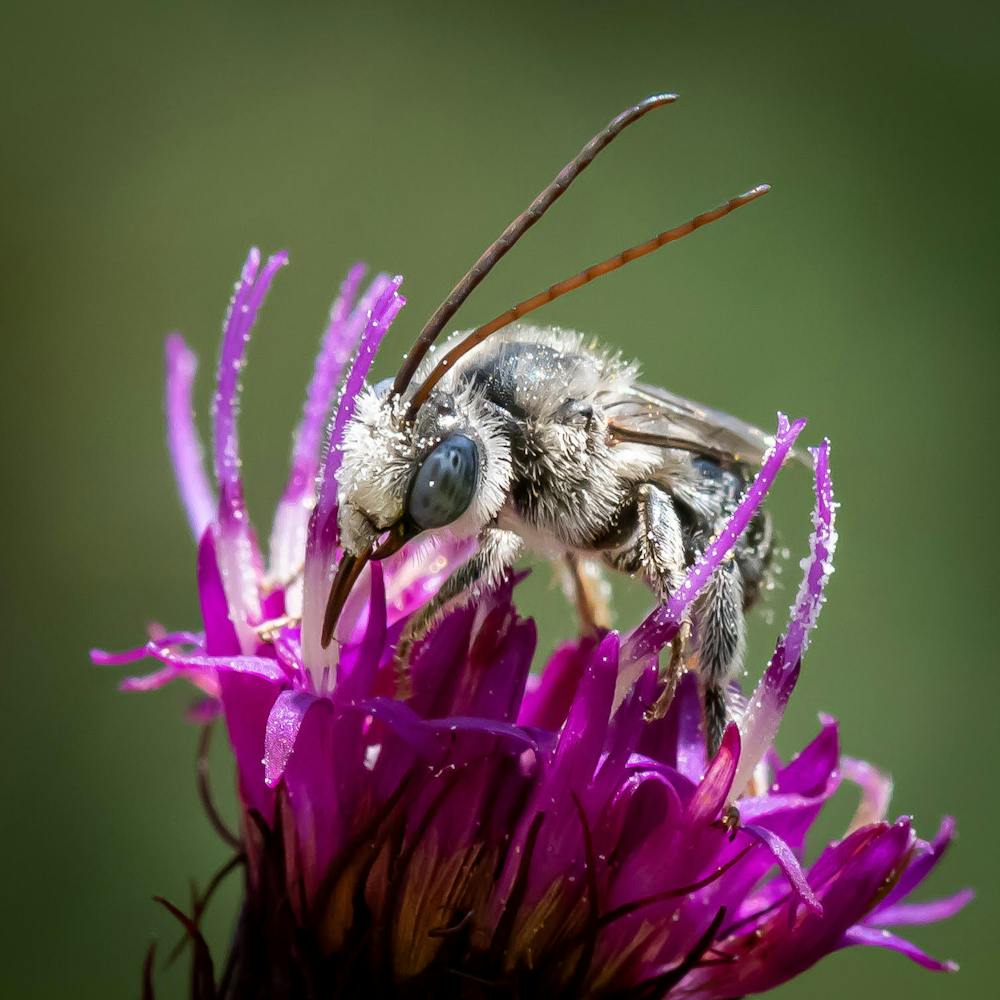

A long-horned bee and an ironweed plant helping each other out. Ryan Sepsy

While some pollinators enjoy nectar, others get all their fat and protein from eating just the pollen itself. Flowers from the sunflower family (Asteraceae), including asters and coreopsis, offer large quantities of both pollen and nectar and also have very accessible flowers. Plants from this family are good for a range of pollinators, including many specialist bees, such as the blue-eyed, long-horned bee (Melissodes denticulatus), which feasts primarily on ironweed (Vernonia fasciculata), also a member of the sunflower family.

If you want to offer flowers that have the highest protein content to nourish the next generation of strong pollinators, consider plants from the pea family (Fabaceae), such as dwarf indigo, false indigo and bush clover. Some of the plants in this family do not even offer nectar as a reward. Instead, they provide high protein pollen that’s accessible only to the most effective pollinators. If you include plants from the pea family in your garden, you may observe fewer visitors, but they will be receiving pollen with high protein levels.

Selecting a few native perennials from each of these three families, all widely available in garden centers, is a good place to start. Just as a diversity of food is important for human health, a mixture of flower types offers pollinators a varied and healthy diet. Interestingly, the diversity of human diets is directly linked to pollinators, because most of the color and variety in human diets comes from plants pollinated by insects.

Plant it and they will come

Maybe you’ve heard that insects worldwide are declining in number and variety. This issue is of particular concern for humans, who rely on insects and other animals to pollinate food crops. Pollinators are indeed facing many threats, from habitat loss to pesticide exposure.

Thankfully, gardeners can provide an incredible service to these valuable animals just by planting more flowers. As our research shows, small patches of garden can help boost pollinators – even when the surrounding landscape has few resources for them. The one constant in all our research is that insects love flowers. The more flowers and the more types of flowers, the more pollinators Earth will have.


Laura Russo, Assistant Professor of Ecology and Evolutionary Biology, University of Tennessee

This article is republished from The Conversation under a Creative Commons license. Read the original article.
BIG BROTHER

Brain monitoring may be the future of work – how it could improve employee performance

The Conversation
January 7, 2025 

Brain

Despite all the attention on technologies that reduce the hands-on role of humans at work – such as self-driving vehicles, robot workers, artificial intelligence and so on – researchers in the field of neuroergonomics are using technology to improve how humans perform in their roles at work.

Neuroergonomics is the study of human behavior while carrying out real-world activities, including in the workplace. It involves recording a person’s brain activity in different situations or while completing certain tasks to optimize cognitive performance. For example, neuroergonomics could monitor employees as they learn new material to determine when they have mastered it. It could also help monitor fatigue in employees in roles that require optimum vigilance and determine when they need to be relieved.

Until now, research in neuroergonomics could only be conducted in highly controlled clinical laboratory environments using invasive procedures. But engineering advances now make this work possible in real-world settings with noninvasive, wearable devices. The market for this neurotechnology – defined as any technology that interfaces with the nervous system – is predicted to grow to US$21 billion by 2026 and is poised to shape the daily life of workers for many industries in the years ahead.


But this advance doesn’t come without risk.

In my work as a biomedical engineer and occupational medicine physician, I study how to improve the health, well-being and productivity of workers. Neurotechnology often focuses on how workers could use wearable brain monitoring technologies to improve brain function and performance during tasks. But neuroergonomics could also be used to better understand the human experience at work and adapt tasks and procedures to the person, not the other way around.
Capturing brain activity


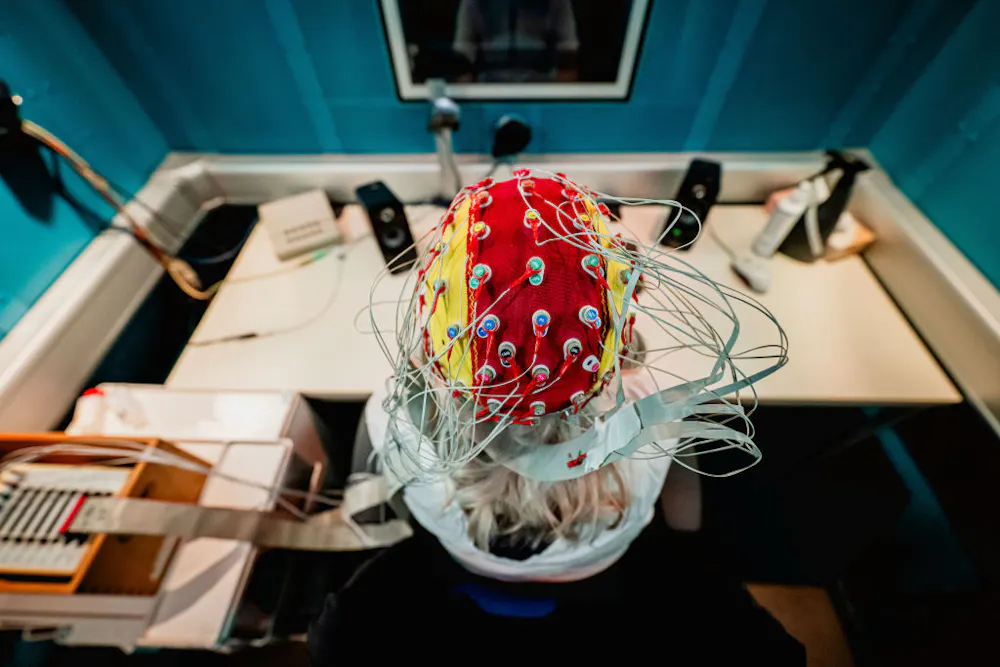
The two most commonly used neuroergonomic wearable devices capture brain activity in different ways. Electroencephalography, or EEG, measures changes in electrical activity using electrodes attached to the scalp. Functional near-infrared spectroscopy, or fNIRS, measures changes in metabolic activity. It does this by passing infrared light through the skull to monitor blood flow.

Both methods can monitor brain activity in real time as it responds to different situations, such as a high-pressure work assignment or difficult task. For example, a study using fNIRS to monitor the brain activity of people engaged in a 30-minute sustained attention task saw significant differences in reaction time between the beginning and the end of the task. This can be critical in security- and safety-related roles that require sustained attention, such as air traffic controllers and police officers.


Electroencephalography, or EEG, is one method of collecting brain activity. Jacob Schröter/picture alliance via Getty Images

Neuroergonomics also studies how brain stimulation could be used to improve brain activity. These include neuromodulation technologies like transcranial electrical stimulation, or tES; transcranial magnetic stimulation, or TMS; or focused ultrasound stimulation, or FUS. For example, studies have shown that applying tES while learning a cognitive training task can lead to immediate improvements in performance that persist even on the following day. Another study found that tES may also help improve performance on tasks that involve motor skills, with potential applications in surgical skills training, military tasks and athletic performance.
High-stakes ethical questions


The use of neurotechnology in the workplace has global implications and high stakes. Advocates say neurotechnology can encourage economic growth and the betterment of society. Those against neurotechnology caution that it could fuel inequity and undermine democracy, among other possible unknown consequences.

Ushering in a new era of individualized brain monitoring and enhancement poses many ethical questions. Answering those questions requires all stakeholders – workers, occupational health professionals, lawyers, government officials, scientists, ethicists and others – to address them.


How to protect the brain activity data of workers remains unclear. Stock via Getty Images Plus

For example, how should an individual’s brain activity data be protected? There is reason to suspect that brain activity data wouldn’t be covered by the Health Insurance Portability and Accountability Act, or HIPAA, because it isn’t considered medical or health data. Additional privacy regulations may be needed.

Additionally, do employers have the right to require workers to comply with the use of neuroergonomic devices? The Genetic Information Nondiscrimination Act of 2008 prevents discrimination against workers based on their genetic data. Similar legislation could help protect workers who refuse to allow the collection of their brain information from being fired or denied insurance.

Protecting workers

The data neurotechnology collects could be used in ways that help or hurt the worker, and the potential for abuse is significant.

Employers may be able to use neurotechnology to diagnose brain-related diseases that could lead to medical treatment but also discrimination. They may also monitor how individual workers respond to different situations, gathering insights on their behavior that could adversely affect their employment or insurance status.


Just as computers and the internet have transformed life, neurotechnologies in the workplace could bring even more profound changes in the coming decades. These technologies may enable more seamless integration between workers’ brains and their work environments, both enhancing productivity while also raising many neuroethical issues.

Bringing all stakeholders into the conversation can help ensure everyone is protected and create safer work environments aimed at solving tomorrow’s challenges.

Paul Brandt-Rauf, Professor and Dean of Biomedical Engineering, Drexel University

This article is republished from The Conversation under a Creative Commons license. Read the original article.


Op-Ed: The future of work — A shower cap full of electrodes on your head?

By Paul Wallis
DIGITAL JOURNAL
PublishedJanuary 7, 2025


Image by Andrea De Santis on unsplash

It’s called neuroergonomics, coming to an idiotic management team near you, eventually.

It’s about “studying brain performance at work and in everyday settings”. It’s sort of like surveillance, but much, much, dumber.

This tech is pretty basic. Its advocates use all the familiar sales pitches. There’s no indication of peer evaluation. It uses EEGs and metabolic monitoring, just a step up from last century. It also uses “transcranial magnetic stimulation”, which is used to provide “improvements during training”.

It’s also used for “mood control” and in treatments for depression, according to the Mayo Clinic.

If you think about the expression “at work”, a few things may have already come to mind, excuse the expression:

Most current jobs won’t exist anyway.

Strangely enough, cognitive training requires applied cognitive skills. How much cognition do you see in the world, let alone the workplace? Sounds more like a raffle.

Do you need neuro-anything when AI will do most of the work?

Neural science is in its somewhat brattish infancy at best.

This proto-level tech will be superseded pretty much immediately.

It’s likely to be extremely expensive. All that enthusiasm costs money, y’know.

You’ll be monitoring broke illiterates with the comprehension and literacy of an American.

There’s no information on whether management will be monitored.

The ethical issues are pretty well documented and very unimpressive. You can’t assume ethics will have any bearing on the actual use of the tech.

Imagine a performance review using this technology. It’s about the only thing that could be more farcical than the current performance reviews.

Highly stressed people in confined social spaces won’t do well with this tech. Lunatics, maybe. (It takes you six months to find out whether or not someone can do a job? Come off it, and you obviously can’t do your own job as a manager.)

Now’s my chance to endear myself to an entire sector –

Firstly – So what?

Who needs this tech?

The world seems to have survived without it.

Real-time monitoring of brainwaves seems like watching the dandruff pile up. Lacks depth. Imagine nitpicking about individual brainwaves.

It’s Management Science at its most mediocre.

(Have you guys ever managed anything at all, yourselves? Thought not.)

No thought seems to have gone into the environment in which this tech will be used. Add brain surveillance to the average hostile, insecure, partially insane workplace and what do you get? Nothing good, and nothing useful.

“A lawsuit with every headset” is far more likely than actual cost benefits.

The somewhat unsanitary stench of “B movie mind control cliches and plot lines” is hardly encouraging.

This tech could discriminate against individuals based on test outcomes. You can’t expect the science to help with that.

Remember this is the same science that will call anyone “neurodivergent” and pay itself lots to manage neurodivergence. The same science which has no comments to make on actual insanity and delusions at high levels.

How useful can this tech actually be to anyone?

There seem to be some performance metrics, mainly for people with medical conditions. Not in the workplace.

Why not?

Where are the usual “Aspiring halfwit Bozo Junior did a pirouette and back somersault on the differential equation and almost nobody got killed much”?

Imagine, O wary and wild-eyed reader:

You and your recently polished degree have had a stellar day at work. The strange owl-like neuro-person-thing even smiled at you as though you were worth smiling at. You take off your shower cap with electrodes and saunter effervescently back to your palatial cardboard box in Gangland.

Meh.

There’s too much to prove and nothing like enough proof.

__________________________________________________

Disclaimer
The opinions expressed in this Op-Ed are those of the author. They do not purport to reflect the opinions or views of the Digital Journal or its members.


OPINION

How the groveling Washington Post got it so terribly wrong

D. Earl Stephens
January 5, 2025 
RAW STORY


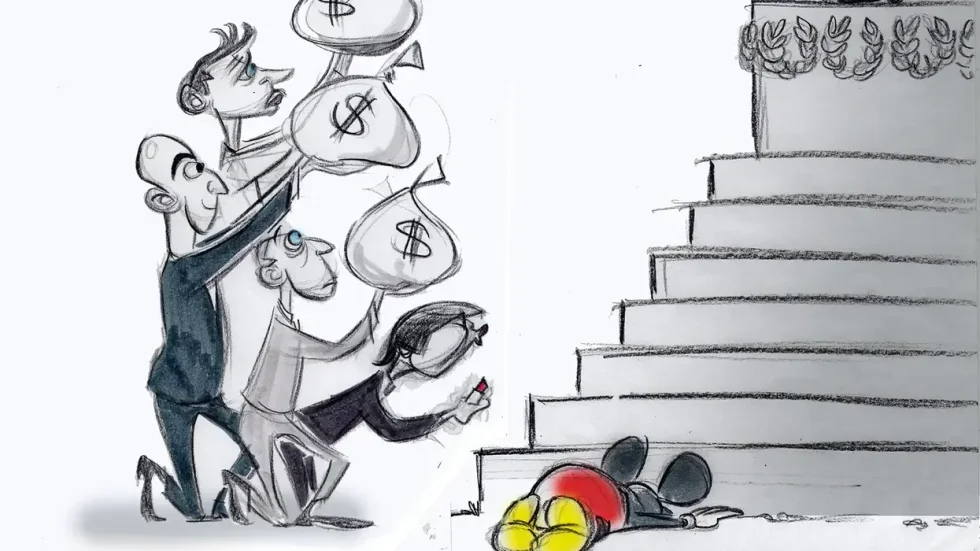
Rough of Ann Telnaes' cartoon killed by the Washington Post

On Thursday, October 25, 2024, I pronounced The Washington Post to be dead.

That was the day their wormy, billionaire owner, Jeff Bezos, crashed through the wall separating news from business — fact from fiction — and had his henchman in the newsroom pull an editorial that was set to run that weekend endorsing the person who didn’t lead an attempted coup, Kamala Harris, for president of the United States of America.

As I said in my piece:


Their failure to make this endorsement goes beyond a catastrophic lack of judgment, because we know they know that what they are doing is nothing but a gutless attempt to appease a would-be dictator, Trump.


On Friday, WaPo was at it again, and this time it cost them the services of Ann Telnaes, the newspaper’s Pulitzer Prize-winning editorial cartoonist, who said she was leaving the newspaper because it killed her cartoon (above) depicting Bezos of doing what he does best these days: falling at the fat, little feet of the despicable Trump.

Here’s how Telnaes put it on her Substack piece Friday night:


I’ve worked for the Washington Post since 2008 as an editorial cartoonist. I have had editorial feedback and productive conversations—and some differences—about cartoons I have submitted for publication, but in all that time I’ve never had a cartoon killed because of who or what I chose to aim my pen at. Until now.
The cartoon that was killed criticizes the billionaire tech and media chief executives who have been doing their best to curry favor with incoming President-elect Trump. There have been multiple articles recently about these men with lucrative government contracts and an interest in eliminating regulations making their way to Mar-a-lago. The group in the cartoon included Mark Zuckerberg/Facebook & Meta founder and CEO, Sam Altman/AI CEO, Patrick Soon-Shiong/LA Times publisher, the Walt Disney Company/ABC News, and Jeff Bezos/Washington Post owner.
While it isn’t uncommon for editorial page editors to object to visual metaphors within a cartoon if it strikes that editor as unclear or isn’t correctly conveying the message intended by the cartoonist, such editorial criticism was not the case regarding this cartoon. To be clear, there have been instances where sketches have been rejected or revisions requested, but never because of the point of view inherent in the cartoon’s commentary. That’s a game changer…and dangerous for a free press.


I encourage everybody to read the rest of her very good and short, tight explainer.

I congratulate Telnaes for taking this difficult but important stand.

I have long been one of those grumpy newspaper veterans leery of providing cover to the alleged journalists in these newsrooms who go along just to get along so they can keep collecting a dirty paycheck.


Rather than stand up to censorship, they excuse it. These are dangerous times, and if we can’t count on our press to call power to account, we really are finished.

Journalism is about one thing: Getting at the truth and reporting it with alacrity. If you know you are working at a place that’s dealing in confusing shades of gray rather than the black-and-white truth of things, then you are not a journalist, you are an enabler.

As I read Telnaes’ piece last night, and reread it again this morning, it brought to mind a sporty incident I was involved in with an editorial cartoon as the Managing Editor of Stars & Stripes 22 years ago during the run-up to the ill-fated War in Iraq.


Back then, early-March, 2003, the saber-rattling was at full pitch, and the George W. Bush administration was pushing hard behind the scenes to make sure that in the event of an invasion, our military had access to a “northern front” into Iraq to squeeze its forces and hopefully bring about a relatively quick end to any hostilities.

This northern front would only be possible if Turkey allowed the flow of some 60,000 U.S. troops through its country and across its border to the south into Iraq.

Through the years, the Turks had been prickly, on-again, off-again allies of the U.S., and were once again predictably driving a hard bargain to give us the access we alleged we so desperately needed in the event of war.


While the behind-the-scenes negotiating between the two countries was heating up, Stars & Stripes went out with an editorial cartoon in our Op-Ed pages that depicted Lucy as Turkey, Charlie Brown as the United States, and the football Lucy was holding as the northern front.

(I tried to find this darn cartoon but was unable to. And a note: Stars & Stripes is prohibited from producing its own editorials or editorial cartoons, and instead uses editorials and/or cartoons from a suite of wire services that are relevant to the troops on its Op-Ed pages.)

By publishing this cartoon, Turkish leadership took it as an inference from the United States that they, Turkey, were ready to pull out of any deal just as the U.S. (Charlie Brown) was about to finally secure the coveted front they alleged was paramount to its success in a war.


Well, this absolutely infuriated the Turks, who took their significant ire to the Pentagon. “HOW,” they screamed, “Can the United States military’s very own newspaper, Stars & Stripes, ridicule Turkey’s honor like this in the middle of these sensitive negotiations???”

Then-Secretary of Defense Donald Rumsfeld blew a fuse when he learned about the cartoon, and sent his high-ranking intermediaries in Department of Defense public affairs to come after Stars & Stripes hard for publishing this cartoon, and to let us know in no uncertain terms that we had played a part in costing the United States the coveted northern front.

Despite all their public bluster, Rumsfeld and his Pentagon knew full well there wasn’t a damn thing they could do about any of it, because Stars & Stripes was mandated by their bosses in the U.S. Congress to function as an editorially independent newspaper, with the mission of providing the same kind of news the troops and their families overseas would get if they were at home.

Most of all, it was a shining example of the difference between our two countries, in which one — the United States — had no control over a free and independent press, and the other — Turkey — believed these things could be suppressed.


This didn't stop Rumsfeld and his gang from emptying their clip at us editorial types at Stars & Stripes. They spent the first 15 minutes of the meeting lashing out at us and weren’t shy about ordering us to “stay in our lane.”

Finally, our publisher at the time decided very politely that he’d heard about enough out of them, and closed the meeting this way: “I find it sobering, and interesting, that the opinion contained in but one political cartoon can affect the fate of the most powerful military in the world’s plans to invade Iraq. Good to know who really has the power at this table ...”

Which takes me back to Telnaes’ piece where she types:


“As an editorial cartoonist, my job is to hold powerful people and institutions accountable.”


Amen.

Which should underline again just how catastrophic it is that the editorial department at The Washington Post has now gotten into the regular habit of censoring itself to appease the powerful.


Like I said, the Post is dead.

May they rest in peace.

NOW READ: Did Musk abuse the Visa program — and US workers?

D. Earl Stephens is the author of “Toxic Tales: A Caustic Collection of Donald J. Trump’s Very Important Letters” and finished up a 30-year career in journalism as the Managing Editor of Stars and Stripes. You can find all his work here.
'Strange overlaps': Journalist notes far-right leaders 'veer into the occult'

Brad Reed
January 7, 2025 
RAW STORY


(Shutterstock.com)

Journalist Anne Applebaum has noticed an odd international political alliance forming between far-right nationalists and traditionally left-wing wellness warriors who share a mutual loathing of the principles of the Enlightenment.

Writing in The Atlantic, Applebaum uses the recent example of Călin Georgescu, the Romanian presidential candidate who seems to have gamed TikTok algorithms to nearly make himself the president.

While Georgescu's embrace of mystical faith in his immune system over western medicine appears to be something out of New Age natural wellness videos, he also mixes it in with a conspiratorial nationalism and pro-Kremlin talking points that have become a staple of American right-wing influencers over the last decade.

Taken together, she believes some on the far left and far right have merged to create a unified coalition best embodied by President-elect Donald Trump's embrace of anti-vaccine conspiracy theorist Robert F. Kennedy Jr.

"Among their number are health quacks and influencers who have developed political ambitions; fans of the quasi-religious QAnon movement and its Pizzagate-esque spin-offs; and members of various political parties, all over Europe, that are pro-Russia and anti-vaccine and, in some cases, promoters of mystical nationalism as well," she writes. 

"Strange overlaps are everywhere. Both the left-wing German politician Sahra Wagenknecht and the right-wing Alternative for Germany party promote vaccine and climate-change skepticism, blood-and-soil nationalism, and withdrawal of German support for Ukraine. All across Central Europe, a fascination with runes and folk magic aligns with both right-wing xenophobia and left-wing paganism."

Applebaum notes that this newfound belief in mysticism has also coincided with voters who dismiss or even embrace criminality among their leaders, most infamously when Americans voted to elect Trump again even after dozens of felony convictions.

"In a world where conspiracy theories and nonsense cures are widely accepted, the evidence-based concepts of guilt and criminality vanish quickly too," she writes.

Read the full analysis here.


NOT SO STRANGE:


Right-wing think tank plans to target Wikipedia editors via malicious links: report

Daniel Hampton
January 7, 2025
RAW STORY


Wikipedia. (Photo credit: Robert Way / Shutterstock)

A right-wing think tank that helped draft Project 2025 plans to target volunteer editors on Wikipedia with malicious tracking links who it alleges are "abusing their position" by publishing antisemitic content, according to a report Tuesday in the Forward.

Documents obtained by the outlet say employees of the Heritage Foundation plan to use facial recognition software and a database of hacked usernames and passwords to find the editors, who mainly use pseudonyms.

The report comes after Wikipedia editors voted in June to label the Anti-Defamation League as a “generally unreliable” source of information on the Israel-Palestine conflict. The Wikipedia vote meant the ADL should usually not be cited in articles on that topic. Other unreliable sources, according to Wikipedia editors, include Russian state media, Fox News’ political coverage and Amazon reviews, according to CNN.

It also comes as tech billionaire and "first buddy" Elon Musk publicly asked people to stop donating to the site, which he called, "Wokepedia."

The Heritage Foundation reportedly sent a blueprint for its plans to Jewish foundations and other potential supporters.

"The slideshow says the group’s 'targeting methodologies' would include creating fake Wikipedia user accounts to try to trick editors into identifying themselves by sharing personal information or clicking on malicious tracking links that can identify people who click on them. It is unclear whether this has begun," according to the Forward.

This isn't the first time the think tank has been associated with dubious practices.

Heritage's Project 2025 transition plan would strip job protections for tens of thousands of career civil servants, potentially allowing them to be fired.

Staffers of the organization also flooded federal agencies with thousands of public records requests, seeking information on government employees' communications about topics like climate change, voting, and gender identity.
GOOD RIDDANCE

French far-right figurehead Jean-Marie Le Pen dies at 96


By AFP
January 7, 2025


Jean-Marie Le Pen brought the French far right to prominence - Copyright AFP Pierre VERDY

Jean-Marie Le Pen, the historic leader of France’s far right, died on Tuesday aged 96, his family told AFP.

Le Pen, who had been in a care home for several weeks, died at midday (1100 GMT) Tuesday “surrounded by his loved ones”, the family said in a statement.

Le Pen, the co-founder of the National Front, sent shockwaves through France in 2002 when he made it to the second round of the presidential election on a staunch anti-immigration platform.

He was often accused of racism and anti-Semitism, and infamously dismissed the Holocaust as a detail of history.

His daughter Marine Le Pen took the party’s leadership in 2011 and booted him out four years later, seeking to distance her movement from his extremist reputation.

The party, since renamed National Rally (RN), has made significant inroads.

It showed strong gains in last year’s European Parliament elections, and became the largest single party in a subsequent general election in France.

Jordan Bardella, RN party chief and the right-hand man of Marine Le Pen, said in a carefully-worded tribute that Jean-Marie Le Pen had “always served France”.

“As a soldier in the French army in Indochina and Algeria, as a tribune of the people in the National Assembly and the European Parliament, he always served France and defended its identity and sovereignty,” the 29-year-old said on X.

“Today I am thinking with sadness of his family, his loved ones, and of course of Marine, whose mourning must be respected.”


Key dates in the rise of the French far right

Agence France-Presse
January 7, 2025 

Marine Le Pen (L) and Jean-Marie Le Pen (AFP)

Here is a short history of the French far-right National Front, whose historic leader and co-founder Jean-Marie Le Pen died on Tuesday aged 96.

The party was later renamed the National Rally (RN) under the leadership of his daughter Marine Le Pen.


- 1972: birth of the National Front -


Jean-Marie Le Pen, a former paratrooper who served in Indochina and Algeria, becomes France's youngest MP ever when he is elected to parliament in 1956.

In 1972, he and other far-right figures found the National Front (FN) to capitalize on nostalgia for France's colonial past and its collaborationist World War II leader Philippe Petain.

In 1974, Le Pen makes the first of six bids for president, winning just 0.74 percent of the vote.

- 1983-1995: first victories -

In the 1980s, the FN chalks up several firsts, despite Le Pen describing the Nazi gas chambers as a "detail" of history, earning him one of several convictions for anti-Semitism.

In 1984, Le Pen is elected to the European Parliament and two years later makes a thunderous entry to the National Assembly, winning 35 seats. In 1995 the party wins control of three towns in its southeastern heartland.

- 2002: presidential 'earthquake' -Le Pen sends tremors through the French establishment in the 2002 presidential election, when he secures the coveted second spot in a run-off with Jacques Chirac.

Voters from across the spectrum band together behind the centre-right Chirac but Le Pen still pockets over four million votes in the second round.
- 2011: Rise of Marine Le Pen -


In 2011, Le Pen hands the reins of the party to his youngest daughter, Marine, who embarks on a mission to detoxify the FN brand and rid it of its overtly racist image.

This culminates in her sensational expulsion of her father from the party for anti-Semitism.

In 2012, she finishes third in the presidential election. But two years later the FN causes a shock by coming first in France's vote for European Parliament seats.


Marine Le Pen goes on to make it to the second round of the 2017 presidential election against centrist upstart Emmanuel Macron. She is ultimately punished by voters for threatening to take France out of the eurozone, finishing on 34 percent to Macron's 66 percent.

A year later, as part of her continued effort to modernise the party's image, Le Pen changes its name to the National Rally.
- 2022: Biggest right-wing party -


Marine Le Pen qualifies for the second round of the 2022 presidential election in a rematch with Macron but loses again in the run-off, this time with an improved 41.5 percent of the vote.

In parliamentary elections a month later, the RN scoops 89 seats -- a record for the party, up from just eight five years previously.

The RN becomes the second-biggest opposition party in parliament and the biggest on the right, further normalising its presence in the political landscape.

- 2022: Bardella mania -A fresh-faced former party spokesman, Jordan Bardella, is elected leader of the RN in November 2022 at the age of 27, the first time the party has been led by someone outside of the Le Pen dynasty.

Bardella, who grew up in a high-rise housing estate near Paris, leads the party to its first close-run win over Macron's party in the 2019 European elections, taking 23.34 percent of the vote.
- 2024: Eyeing power -

Five years later, Bardella chalks up another win for the RN in the elections for the European Parliament, trouncing Macron's alliance with 31.36 percent of the vote.


The results prompt Macron to call early legislative elections in a bid to catch his opponents off-guard and try to regain control of parliament -- but the gamble appears to backfire.

The RN leads the first round of the high-stakes election on June 30 with 29 percent of the vote.

Bardella hails a "clear verdict" from the French people but in the second round no political group wields an outright majority.

EU rules don’t prohibit Musk’s German far-right chat on X


By AFP
January 6, 2025


Elon Musk -- who owns X -- has provoked ire with his attacks on European leaders - Copyright AFP Joe Klamar

Elon Musk’s controversial plan for a live chat with a German extreme-right leader on X this week is allowed under European Union laws but will be scrutinised for potential violations of electoral interference rules, Brussels said on Monday.

The world’s wealthiest man — who owns the X social media platform — has provoked fury across Europe with a string of attacks on the continent’s leaders, including German Chancellor Olaf Scholz.

Musk has offered strong support to the extreme-right Alternative for Germany (AfD) ahead of snap elections in the country on February 23, and will host a discussion on X with the party’s leader Alice Weidel on Thursday.

His X platform is already under investigation under the European Union’s landmark content law — known as the Digital Services Act (DSA) — regarding how it tackles the spread of illegal content and information manipulation.

The EU’s digital spokesperson said a live discussion on X was not a violation of EU rules and insisted the DSA did not “censor any type of content”.

“Nothing in the DSA prohibits the owner of a platform or anyone to host a live stream and express his personal views,” spokesperson Thomas Regnier told reporters in Brussels.

“Mr Musk is allowed to express his personal views, his political opinions in the EU online and offline,” he added.

But Regnier noted that the ongoing probe of X “includes suspected breach in areas related to management of risks on civic discourse and electoral processes”.

He said the EU would “carefully” assess the live stream and could include it in its current investigation depending on whether any risks are identified.

Platform owners, he said, must ensure they are “not misused or giving a preferential treatment to certain types of content, or an increased visibility to just one type of content”.

Under the DSA, users have the right to opt out of seeing certain content, which means X should allow users to avoid any mentions of the AfD chat if they wish. The EU wants to know whether X uses its algorithms to promote far-right messages.

On January 24, the EU’s executive arm — the European Commission — will hold a discussion with German authorities, civil society organisations and the world’s biggest digital platforms, including X, to discuss the risks online ahead of Germany’s election.

The EU launched its probe into X in December 2023.

In July 2024 it formally accused the platform of misleading users with its blue checkmarks for certified accounts, of insufficient advertising transparency and failing to give researchers access to the platform’s data


European leaders hit back in Elon Musk meddling row


AFP
January 6, 2025


Starmer slammed the 'poison of the far-right' - Copyright AFP Dave Chan


Peter HUTCHISON, Joe JACKSON

European leaders expressed growing frustration with tech billionaire Elon Musk on Monday, as a major row escalated between members of Britain’s government and US president-elect Donald Trump’s key ally.

UK Prime Minister Keir Starmer slammed those “spreading lies and misinformation” following days of incendiary posts by Musk on his X platform over historical sex offences against children in northern England.

Musk, who is set for a role in Trump’s administration, then accused the centre-left Labour leader of being “deeply complicit in the mass rapes” and “utterly despicable”.

European leaders including French President Emmanuel Macron have also weighed in against Musk.

He said the SpaceX boss was “directly intervening in elections”, including in Germany where Chancellor Olaf Scholz has condemned the Tesla boss for backing an extreme-right party.

Norwegian Prime Minister Jonas Gahr Store said Monday he found it “worrying” that someone with so much wealth and influence was getting involved in the politics of European countries.

Much of Musk’s focus in recent days has been on Britain and historical scandals involving grooming gangs that first emerged during Starmer’s 2008-2013 tenure as the country’s top prosecutor.

The comments pose a major challenge for Starmer’s government, as it tries to fend off growing support for the far-right while also seeking to maintain good relations with Trump’s incoming administration.

Musk’s tirade, which included demands for a new public inquiry into the scandal, has prompted some UK opposition politicians to join in the criticism and call for a fresh national probe.


– ‘Lies’ –


The issue has long been seized upon by far-right figures including the imprisoned Tommy Robinson, one of Britain’s best known far-right agitators, whom Musk has praised and said should be released from jail.

Responding to media questions on the topic, Starmer insisted he was “not going to individualise this to Elon Musk” but said “a line has been crossed” with some of the online criticism.

“Those that are spreading lies and misinformation as far and as wide as possible, they’re not interested in victims, they’re interested in themselves,” Starmer told reporters, without naming Musk.

“I’m prepared to call out this for what it is. We’ve seen this playbook many times: the whipping up of intimidation and threats of violence, hoping that the media will amplify it.”

The grooming scandal involved the widespread abuse of girls in northern English towns, including Rochdale, Rotherham and Oldham.

A series of court cases eventually led to the conviction of dozens of men, mostly of South Asian origin. The victims were vulnerable, mostly white, girls.

Subsequent official reports into how police and social workers failed to halt the abuse in some cases found that officials turned a blind eye to avoid appearing racist.

None of the probes singled out Starmer for blame or found that he had tried to block prosecutions.


– ‘Erratic’ –


The issue reignited this month after it was reported that UK minister Jess Phillips had rejected Oldham council’s request for a government-led inquiry in favour of a locally led investigation.

Musk has called Phillips a “rape genocide apologist” and said she “deserves to be in prison”.

Starmer has rejected calls by the main opposition Conservative party and the hard-right Reform UK party for a new public inquiry, saying an earlier independent probe had been “comprehensive”.

Starmer said he had dealt with the problem “head-on” as a prosecutor and oversaw “the highest number of child sexual abuse cases being prosecuted on record”.

But Musk claimed Monday that Starmer and former prime minister Gordon Brown were among those complicit in the sex crimes, adding in one post that Brown “sold those little girls for votes”.

“Prison for Starmer,” he said in another.

Scholz on Saturday condemned Musk for “erratic” comments after the billionaire labelled the German leader an “incompetent fool” and came out in support of the Alternative for Germany (AfD) ahead of snap elections on February 23.

Musk surprised many people in Britain on Sunday when he appeared to U-turn on his support for Brexit cheerleader Nigel Farage, saying his anti-immigration Reform party “needs a new leader”.
Charlie Hebdo unveils special edition 10 years since attack


By AFP
January 6, 2025


Members of Charlie Hebdo pose during a photo session in Paris in March 2024 - Copyright AFP Anthony WALLACE

Adam PLOWRIGHT and Karine PERRET

French satirical newspaper Charlie Hebdo unveiled a special edition Monday to mark 10 years since an attack on its offices by Islamist gunmen that decimated its staff.

The front-page features a cartoon celebrating the atheist paper’s existence with the caption “Indestructible!”, while four inside pages show the results of a caricature contest to mock God and religious leaders.

“Satire has a virtue that has enabled us to get through these tragic years: optimism,” said an editorial from director Riss, who survived the January 7, 2015, massacre that left 12 people, including eight editorial staff, dead.

“If you want to laugh, it means you want to live. Laughing, irony, and caricatures are manifestations of optimism. Whatever happens, dramatic or happy, the desire to laugh will never cease.”

The 2015 attack by two Paris-born brothers of Algerian descent was said to be revenge for Charlie Hebdo’s decision to publish caricatures lampooning the Prophet Mohammed, Islam’s most revered figure.

The massacre of some of France’s most famous cartoonists signalled the start of a gruesome series of Al-Qaeda and Islamic State plots that claimed hundreds of lives in France and western Europe over the following years.

The edition unveiled to the media on Monday will go on sale on Tuesday when public commemorations by President Emmanuel Macron and Paris Mayor Anne Hidalgo are set to take place.

The weekly had called on cartoonists to submit their “funniest and meanest” depictions of God in a typically provocative and defiant contest for the special anniversary edition.

“Yes, we can laugh about God, especially if he exists,” said a headline over what the paper said were the best 40 out of more than 350 entries.

Along with some typically crude and sexually explicit images, one of them makes reference to the Prophet Mohammed with the caption “if I sketch someone who is drawing someone who is drawing someone who is drawing Mohammed, is that ok?”

It shows a cartoonist drawing a picture of another cartoonist who is working on a picture of cartoonist drawing a bearded figure who looks like Mohammed.

Another cartoon appears to show the leaders of the three Abrahamic religions — Christianity, Judaism and Islam — as a three-headed dog.


– Survey results –


This week’s edition also reproduces a small version of one of its most famous and controversial front covers from 2005, showing a Mohammed figure under the caption “Mohammed overwhelmed by fundamentalists.”

Mohammed can be seen covering his eyes and saying “it’s hard being loved by idiots”.

It was drawn by Cabu, one of France’s most famous cartoonists, who was shot at point-blank range 10 years ago when the masked gunmen burst into the paper’s heavily protected offices with AK-47 assault rifles.

The cartoon is used alongside a survey of attitudes in France towards press freedom, caricatures and blasphemy, carried out by the Ifop survey group in association with Charlie Hebdo.

It found that 76 percent of respondents believed freedom of expression and the freedom to caricature were fundamental rights, while 62 percent thought people had the right to mock religious beliefs.

The Charlie Hebdo killings fuelled an outpouring of sympathy expressed in a wave of “Je Suis Charlie” (“I Am Charlie”) solidarity with its lost cartoonists Cabu, Charb, Honore, Tignous and Wolinski among others.

But it also led to questioning and in some a furious backlash in some Muslim-majority countries against Charlie’s deliberately offensive, often crude humour which is part of a long-standing French tradition of caricaturing.

Since its founding in 1970, it has regularly tested the boundaries of French hate-speech laws, which offer protection to minorities but allow for blasphemy and the mockery of religion.

Free-speech defenders in France see the ability to ridicule religion as a fundamental right acquired through centuries of struggle to escape the influence of the Catholic Church.

Critics say the weekly sometimes crosses the line into Islamophobia, pointing to some of the Prophet Mohammed caricatures published in the past that appeared to associate Islam with terrorism.

“The idea is not to publish anything, it’s to publish everything that makes people doubt, brings them to reflect, to ask questions, to not end up closed in by ideology,” director Riss, who survived the 2015 attack, told Le Monde in November.

A front-page depiction of the Virgin Mary in August suffering from the mpox virus led to two legal complaints from Catholic organisations in France.


Algerians campaign to save treasured songbird from hunters

By AFP
January 5, 2025


Keeping goldfinches is common in Algeria, but conservationists are calling for the species to be safeguarded from illegal hunting and trading - 
Copyright AFP -


Abdelhafid Daamache

With its vivid plumage and sweet trill, the goldfinch has long been revered in Algeria, but the national obsession has also driven illegal hunting, prompting calls to protect the songbird.

Amid a persistent demand for the bird that many choose to keep in their homes, conservation groups in the North African country are now calling for the species to be safeguarded from illegal hunting and trading.

“The moment these wild birds are caged, they often suffer from serious health problems, such as intestinal swelling, due to abrupt changes in their diet and environment,” said Zinelabidine Chibout, a volunteer with the Wild Songbird Protection Association in Setif, about 290 kilometres (180 miles) east of the capital, Algiers.

Goldfinches are native to Western Europe and North Africa, and raising them is a cherished hobby in Algeria, where they are known locally as “maknin”.

The bird is considered a symbol of freedom, and was favoured by poets and artists around the time of Algeria’s war for independence in the 1950s and 60s. The country even dedicates an annual day in March to the goldfinch.

Laws enacted in 2012 classified the bird as a protected species and made its capture and sale illegal.

But the practices remain common, as protections are lacking and the bird is frequently sold in pet shops and markets.

A 2021 study by Guelma University estimated that at least six million goldfinches are kept in captivity by enthusiasts and traders.

Researchers visiting markets documented the sale of hundreds of goldfinches in a single day.

At one market in Annaba, in eastern Algeria, they counted around 300 birds offered for sale.

– Education campaigns –


Chibout’s association has been working to reverse the trend by purchasing injured and neglected goldfinches and treating them.

“We treat them in large cages, and once they recover and can fly again, we release them back into the wild,” he said.

Others have also called on enthusiasts to breed the species in order to offset demand.

Madjid Ben Daoud, a goldfinch aficionado and member of an environmental association in Algiers, said the approach could safeguard the bird’s wild population and reduce demand for it on the market.

“Our goal is to encourage the breeding of goldfinches already in captivity, so people no longer feel the need to capture them from the wild,” he said.

Souhila Larkam, who raises goldfinches at home, said people should only keep a goldfinch “if they ensure its reproduction”.

The Wild Songbird Protection Association also targets the next generation with education campaigns.

Abderrahmane Abed, vice president of the association, recently led a group of children on a trip to the forest to teach them about the bird’s role in the ecosystem.

“We want to instill in them the idea that these are wild birds that deserve our respect,” he said. “They shouldn’t be hunted or harmed.”

South Korea rival parties form plane crash task force


By AFP
January 7, 2025


Rescue personnel work near the wreckage of a Jeju Air plane after it crashed at South Korea's Muan International Airport, killing 179 people on board
 - Copyright AFP JUNG YEON-JE

South Korea’s rival parties agreed Tuesday to form a joint task force to probe the recent Jeju Air plane crash that left 179 people dead, as the transport minister offered to resign over the tragedy.

The Boeing 737-800 plane was flying from Thailand to Muan, South Korea, on December 29 carrying 181 passengers and crew when it belly-landed at a South Korean airport and slammed into a concrete barrier in a fireball.

With the exact cause of the crash still unknown, Tuesday’s unity move for a joint parliamentary task force came as transport minister Park Sang-woo offered to resign at a future date.

It also came after weeks of political turmoil, kicked off when President Yoon Suk Yeol briefly declared martial law last month.

“Our People Power Party and the Democratic Party… decided to establish a special committee,” the ruling PPP said in a statement sent to AFP.

It would “discuss the investigation into the causes” and provide support to grieving families of the dead, it said.

The opposition Democratic Party also confirmed to AFP it had “agreed” to form a joint probe team with the PPP to look into the accident.

The 15-member team consists of seven from the ruling party and seven from the opposition, as well as one from neither, according to the PPP.

Minister Park told reporters Tuesday he would “act appropriately” over the disaster and was “discussing the proper methods and timing”.

“As the minister responsible for aviation safety, I feel a heavy sense of responsibility regarding this tragedy,” he said.

The land, infrastructure and transport ministry spokesperson told AFP his comments were “the minister’s offer of resignation”.

– Feathers in engine –


South Korean and US investigators are still probing the cause of the crash of Jeju Air flight 2216, which prompted a national outpouring of mourning with memorials set up across the country.

Investigators have pointed to a bird strike, faulty landing gear and the runway barrier as possible issues.

The pilot warned of a bird strike before pulling out of a first landing, and then crashing on a second attempt when the landing gear did not emerge.

On Tuesday lead investigator Lee Seung-yeol told reporters that “feathers were found” in one of the plane’s recovered engines, but cautioned a bird strike does not lead to an immediate engine failure.

“We need to investigate whether it affected both engines. It is certain that one engine has definitely experienced a bird strike,” he said.

Authorities have raided offices at Muan airport where the crash took place, a regional aviation office in the southwestern city, and Jeju Air’s office in the capital Seoul.

It has also barred Jeju Air’s chief executive from leaving the country.

Jeju Air said Tuesday it plans to cut 188 international flights departing from Busan in the first quarter of the year to improve operational safety.

The announcement comes after it previously announced its plan to cut flight operations by 10 to 15 percent by March for safety reasons.