Tuesday, January 21, 2025


Required Reading: Hillbilly Elegy

under the principle that one must know thine enemy, Hillbilly Elegy must be required reading for American progressives, 

 January 21, 2025
Facebook

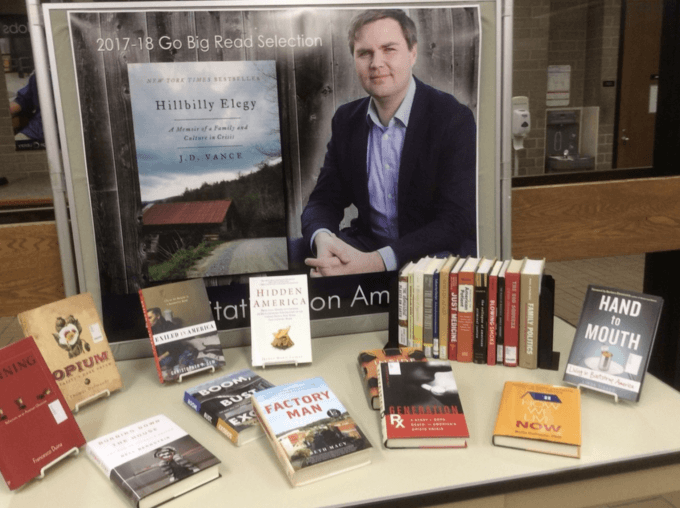
Photograph Source: college.library – CC BY 2.0

I doubt that many progressives in the United States have read J.D. Vance’s Hillbilly Elegy. Being based in the Philippines, a country located on the outer fringes of the empire, I certainly was unaware of the book even when it began to rise on the bestsellers’ lists at the beginning of the first Trump administration.

But since the author is likely to become president if something happens to Donald Trump, I figured I would choose for my airport reading the book that made his name and skip the reviews that have revisited it ever since he was nominated to be Trump’s running mate last August.

I was not prepared for how well-written it was. And as a sociologist, I really appreciated how Vance articulates the contradictions of the white working class in the Rust Belt Midwest and Appalachian region as he personally experienced them. This is an “us” versus “them” narrative by someone who finally got to become one of “them.” He vividly recounts his hurdling the many visible (being poor) and invisible (cultural) barriers that separate the working class from the upper and upper-middle classes. They really are worlds apart, in Vance’s view, and he attributes his being able to finally cross class lines to four things: luck, a grandmother that forced him to develop the grit to rise above his surroundings, his stint in the Marine Corps, and an upper-middle-class wife, who initiated him into what was an alien, stable, upper-middle-class family life. The excruciating combination of poverty, drugs, violence, and disorganized family life represented by a mother who’s an addict and floats from one man to the next are, he claims, common elements of a working-class culture that prevents the vast majority of his proletarian peers from leaving their milieu.

When Vance enters law school at Yale, despite his having graduated summa cum laude at Ohio State, he is completely at sea in an alien culture. The way people act is different, the way they speak is different, they are completely confident, not suffering the psychological injuries of working-class life. To him, there is really no such thing as meritocracy for the rich or nearly rich. While working class folks have to fill out forms that allow those in institutions to which they apply to see if they are “qualified,” the kids at Yale, Harvard, and other Ivy League haunts rely on their parents’ networks to get them into college and a good career that serves as a channel to the summits of business and government. The two tracks begin at birth and they increasingly diverge and go separate ways as people pass through life, one leading to permanent working-class misery, the other to upper-class nirvana.

Interestingly, Barack Obama, the president when Vance was writing the book, becomes the representative of “them,” and here it is worth quoting Vance: Obama, he writes, “feels like an alien to many Middletonians for reasons that have nothing to do with skin color [a dubious proposition]. Recall that none of my high school classmates attended an Ivy League school. Barack Obama attended two of them and excelled at both. He is brilliant, wealthy, and speaks like a constitutional law professor…Nothing about him bears any resemblance to the people I admired growing up. His accent—clean, perfect, neutral—is foreign; his credentials are so impressive that they’re frightening; he made his life in Chicago, a dense American metropolis; and he conducts himself with a confidence that comes from knowing that the modern American meritocracy was built for him.”

The problem, Vance writes, was that Obama’s coming across as so completely alien to the white working class became fodder for conspiracy theorists like Donald Trump (not named as one such theorist in the book) to depict him as a genuine alien. Although the mainstream press (even Fox News, he claims) always said Obama was a red-blooded American, this was of little relevance since most of the white working class feels that the media is in the pocket of the rich and increasingly rely on far-right echo chambers on the Internet.

Vance did not vote for Trump in the 2016 elections, but “despite all the reservations about Donald Trump…there were parts of his candidacy that really spoke to me: from his disdain for the ‘elites’ and criticism of foreign policy blunders in Iraq and Afghanistan to his recognition that the Republican Party had done too little for its increasingly working- and middle-class base.

Vance eventually became part of the MAGA movement that captured the Republican Party and drove traditional Republicans like former vice president Dick Cheney from the fold. His move from being a discontented young Republican to MAGA chieftain exemplifies a trend that Thomas Piketty captures in hard numbers in his book Capital and Ideology: that both the highly paid and wealthy “merchant right” traditionally represented in the Republican Party and the highly educated and economically well compensated “Brahmin left” that affiliated with the Democratic Party are seen from below as one “elite” with interests radically different from theirs. After capturing the Republican Party, Trump, Vance, and MAGA overwhelmed the other wing of the elite, the Democrats, in the 2024 elections.

Vance has, of course, evolved since he wrote the book into a firebreathing, fearmongering Trumpista. But sometimes Vance, the thoughtful author of Hillbilly Elegy, emerges, as when he and Tim Walz engaged in relatively respectful exchange during the vice presidential debate. For a friend who read Hillbilly Elegy when it first came out, it was hard to reconcile the early Vance that she claims wrote “honestly” about his troubled family history and the later demagogical Vance.

I think there is no Chinese wall between the early Vance and the current Vance. The way I read it, three contradictions run through Hillbilly Elegy. One is love for the solidarity of the working-class family and community and fear and anger at the multiple dysfunctions that pockmark them. The second is visceral suspicion and disdain for elite culture with a grudging recognition that “they” live much better lives and “are beating us in our own damned game.” The third is a yearning for the patriotism of the Saving Private Ryan type (Vance admits he “tears up” every time he sees the movie) and a realization that there is little in a contemporary America that is falling apart that can foster that nationalistic fire.

These were troubling contradictions that were seeking both a personal and a political resolution, and although he was initially dismissive of Trump, the latter eventually provided for him, as for many, that resolution—one that was, of course, facilitated by a not small dose of political opportunism on the part of an ambitious, up-and-coming politico.  But it is important not to see it, as many liberals do, as simply as a case of opportunism.

At the risk of oversimplifying, I think what makes MAGA so appealing to many in the white working class is that, however flawed some of its premises are, it promises to bring about a “reinvigorated” and “renewed” America free of these contradictions. And it is a movement that thrives not only on resentment but on hope, no matter how misplaced that hope may be when it comes to who is seen to represent it. Reading the wrenching personal experiences Vance relates in Hillbilly Elegy gave me a sense that MAGA is more than a far-right political movement. It is one of those millenarian movements that anthropologists talk about that tie individual redemption to collective salvation.

I would say that under the principle that one must know thine enemy, Hillbilly Elegy must be required reading for American progressives, for it provides important insights for the massive task of reconstructing the broad left after the 2024 catastrophe.


Walden Bello, a columnist for Foreign Policy in Focus,  is the author or co-author of 19 books, the latest of which are Capitalism’s Last Stand? (London: Zed, 2013) and State of Fragmentation: the Philippines in Transition (Quezon City: Focus on the Global South and FES, 2014).

What Donald Trump Has Revealed About Our Country


 January 21, 2025
Facebook

Youtube screenshot.

The rise of Donald Trump from a widely publicized, if failed, business boss to a two-term President has taught us a great deal about our society. He will teach us even more as his dictatorial regime, starting January 20th, 2025, further unravels what is left of the civilized norms, our democratic institutions, and the purported rule of law.

Democracy and the rule of law rest for their proper functioning on countervailing checks and balances and institutions that further a just society.  Look at how these bulwarks of democracy have enfeebled themselves to permit the ascension of Trump and Trumpism operating above the law and securing a hard autocracy that is slouching toward fascism.

1. The utter failure of Congress to safeguard and use its exclusive constitutional authorities vis-à-vis the executive branch is shameful. These include the declare war clause, the appropriations power, confirmation, information duties, critical oversight of the executive and judicial branches and the responsibility to provide wide access to the citizenry from whom it receives its delegated power by “We the People.”

The decline of Congress into a rubber stamp has reached a disgraceful depth where it will not enforce its subpoenas (over 125 Congressional subpoenas during Trump’s first term were defied with impunity) and will do nothing to curb rampant violations of statutes, the Constitution and treaties by administrations of both Parties.

However, Trump’s defiance of Congress and his usurpation of Congressional authority have been more overt, brazen and daily than his predecessors, including active and regular obstruction of justice by his White House.

2. The crumbling of the Democratic Party, the sole opposition to Trump’s GOP in an enforced two-party duopoly, has had a decades-long history of decay. For over fifty years, the Democratic Party has allowed campaign money to increasingly erode its fealty to working families, distancing itself ever more from the working class – the base of FDR’s repeated electoral victories. This has debased the recruitment of Party leaders to levels below mediocrity.

These “leaders” managed to turn a national party into a regional party abandoning half the country (the red states) including six mountain and prairie states that used to have Democratic Senators. It is hard to win national elections for the Presidency and workable majorities in Congress with such a decisive handicap.

This ditch that the Party dug for itself has led to scapegoating its losses onto the tiny Green Party while telling its doubting voters that they have nowhere to go. “Don’t you know how bad the Republicans are?” goes the immolating refrain.

3. The labor unions – weakened by job-exporting corporate globalization, automation, and weak, entrenched leadership have tied unconditionally its fortunes to the corporate Democratic Party which gives workers little or nothing in return. No labor law reform to facilitate organization, no real push for a livable wage, no rigorous regulation of workplace health and safety and little protection against corporate theft of private pensions. Lately, the AFL-CIO unions have been further inhibited by more of their members becoming Republican voters.  Labor leaders have not developed a counter strategy.

4. The legal profession, its bar associations and law schools – ideally the first responders against lawlessness – have been compromised by lucrative corporate clientele and the prospects of such riches. We have tested these institutions with repeated challenges to step up against government illegalities, to no avail. To say they are AWOL is to engage in impermissible understatement.

5. The organized church has traditionally been the custodians of the norms and standards that bind members of society together. The “Golden Rule” is one of the greatest precepts ever dedicated to guide human and institutional interactions. The Ten Commandments have served a similar secular purpose to the extent they are observed. Trump as the worst destroyer of norms in American history has chronically violated these principles in his personal, business and political careers.

When I asked the National Council of Churches why they don’t take the kinds of stands they took during the civil rights period in the 1960s, their reply was that they were deterred from such positions by the sizable minority of evangelical churches within their membership. Compare this to the approach of the Courageous Baptist Jimmy Carter!

6. The citizenry, as the ultimate savior of a just, practicing democracy, has been neglected and exploited by corporate power and indifference. There is a toll exacted on people who were never given a civic education and civic experience in elementary and secondary school. The citizenry pays the price of powerlessness when up against abusive treatment from corporate employers and corporate lobbyists. These same corporations envelop people in consuming spectator sports, mass corporate entertainment on their screens and now fingertip addictions to various forms of gambling – not exactly the preconditions for a thriving town hall turnout or a smart voting citizenry doing their pre-election homework.

Couple these dulling interfaces with the desperate daily effort of many people to pay their bills, the constant indebtedness, so many chronic illnesses and the drain of home health care in the only Western country without universal health insurance and one sees how little discretionary time or self-regard is left to perform civic duties.

What local and national citizen advocacy groups there are in the fields of action are impeded by being largely ignored by the mass media and excluded by elected and appointed officials (See The Incommunicados report at incommunicadoswatch.org).

Now is the time for assessing the assets of the citizenry and putting them to work. We still have the sovereign power, still out-number the opponents of democracy by a wide margin, still can rise to control those 535 members of Congress who can be summoned to citizen-shaped town meetings, still can see one percent of really active citizenry representing majority opinion, often liberal and conservative coalitions, turning tide after tide in Congress and much more.

For operating details, strategies and success stories, I can only refer you to three of my books: Unstoppable: The Emerging Left-Right Alliance to Dismantle the Corporate StateBreaking Through Power: It’s Easier Than We Think, and Let’s Start the Revolution: Tools for Displacing the Corporate State and Building a Country that Works for the People.  (In addition, also see the unprecedented 2016 Constitution Hall proceedings at BreakingThroughPower.org).

Yes, friends, like other worthwhile endeavors, an operating democracy takes work, but when it works its blessings are very impressive.

Ralph Nader is a consumer advocate, lawyer and author of Only the Super-Rich Can Save Us! 


Why the Alliance for the Wild Rockies is Taking Yellowstone National Park to Court Over Its Scientifically-Deficient Bison Management Plan


 January 21, 2025

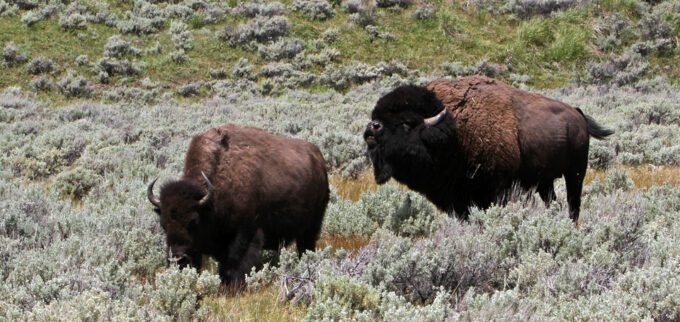
Yellowstone Bison. Photo: National Park Service.

One might think that the National Park Service and the State of Montana, the two entities charged with stewardship of American bison, our national mammal, could do a better job. The Alliance for the Wild Rockies and the Council on Fish and Wildlife think so, too, which is why we are challenging Yellowstone National Park’s recently released Bison Management Plan in federal court.

For context, tens of millions of wild bison once roamed across western North America. Today, wild bison occupy less than one percent of their former range.  Yet in spite of this, the Yellowstone Bison Management Plan does nothing to expand the range of the 5,000 wild bison that live almost exclusively in Yellowstone National Park.

Instead, the Park’s bison management plan is based on outdated and unscientific assumptions that result in thousands of bison being slaughtered to theoretically prevent them from infecting cattle with brucellosis, a disease that can cause cattle to abort.

The State of Montana, meanwhile, takes the position that almost all of the bison that cross the Park’s invisible boundaries at the wrong time and place should be killed.  Too bad no one told the bison that their natural annual migration was wrong.  The result has been about one-quarter of Yellowstone’s herd being slaughtered in years with deep snow for doing nothing more than following their genetic instincts to migrate to lower elevations in the winter for food.

Despite there never having been a documented case of bison transferring brucellosis to cattle, the government’s 25-year old management plan, originally issued in 2000, focused  on wild bison as a threat to the state’s cattle industry.

That, however, is no longer accepted science. The US Department of Agriculture’s Animal and Plant Health Inspection Service commissioned the National Academies of Science, Medicine, and Engineering to undertake an exhaustive study to determine if the Park’s brucellosis management was working.

Contrary to the original assumptions, the study found that over the past 20 years, it has been wild elk — not wild bison — that transmitted brucellosis to livestock 27 times.  Wild bison were not responsible for a single transmission.

However, when the Park Service prepared and approved its new plan in 2024, the agency completely ignored the National Academies’ recommendations to switch the focus for brucellosis management in the Greater Yellowstone Area from wild bison to wild elk.  Although the Park Service insists that it used the “best available science,” not a single alternative in the new plan’s Environmental Impact Statement addressed the proven source of brucellosis transmissions to livestock, which are elk, not bison.

Astoundingly, the Park Service also failed to analyze where and when natural Yellowstone bison migration paths might overlap with cattle grazing on Bureau of Land Management and Forest Service lands outside Yellowstone National Park.  Without this basic information, it’s impossible to know where cattle might possibly interact with wild bison. Consequently, we don’t know where — or even if — the Park and State’s aggressive and controversial management practices are needed to keep cattle separate from wild bison.

Additionally, and critically, after more than 20 years, the management tool most used by the government — the highly controversial “capture and slaughter” of thousands of bison — has failed to reduce the percentage of Yellowstone bison that test positive for brucellosis antibodies.  And yet the government just reauthorized the use of this tool that has proven to be ineffective at reducing brucellosis.

This is why we sued.  The Park’s new management plan fails to provide any rational reason whatsoever to continue hazing, capturing, and slaughtering the nation’s last herd of wild bison.  We are going to court to force the Park Service to follow the law, analyze these issues using the best available science, and stop the senseless harassment and pointless slaughter of our national mammal.

Please consider making a donation to the Alliance for the Wild Rockies to help us force the government to make management decisions based on science, not fear.  Mike Garrity is the Executive Director of the Alliance for the Wild Rockies.

Mike Garrity is the executive director of the Alliance for the Wild Rockies.