Thursday, January 23, 2025


94% of the grey matter in the brains of mothers undergoes changes during pregnancy


Universitat Autonoma de Barcelona


A study led by the UAB has analysed the brains of women during pregnancy for the first time using neuroimaging techniques. The study included non-pregnant mothers, whose partners were pregnant, to distinguish biological effects from those caused by the experience of being a mother. The research shows that there is a reduction and partial recovery of almost 5% of grey matter in 94% of the total grey matter volume of the brain, especially in regions linked to social cognition.
Researchers from the Universitat Autònoma de Barcelona (UAB), the Gregorio Marañón Health Research Institute and the Hospital del Mar Research Institute, together with other prestigious international institutions, have published the first longitudinal neuroimaging (Magnetic Resonance Imaging) study in a cohort of more than a hundred women seeking to become mothers for the first time. The findings reveal a dynamic trajectory in the brain during pregnancy and postpartum, significantly linked to the steroid hormone fluctuations inherent to pregnancy, and to the psychological well-being of the mothers. The article, led by Camila Servin-Barthet and Magdalena Martínez-García as first authors and coordinated by Òscar Vilarroya and Susana Carmona, has been recently published in the prestigious journal Nature Communications. This study, which received a grant of 972,414 euros from the ”la Caixa” Foundation to be carried out, represents a crucial advance in maternal brain research.
In total, the researchers have analyzed the brain of 179 women to study the structural changes that occur during the second and third trimester of pregnancy and the first six months postpartum, using a scan taken before conception as a baseline. For the first time, this cohort includes a group of non-gestational mothers as a control group: women whose partners underwent pregnancy during the study. The inclusion of this group of women made it possible to determine that the trajectory of brain changes is mainly attributed to the biological process of pregnancy, rather than to the experience of becoming a mother.
This work has revealed that, during the first pregnancy, gray matter volume in the brain is reduced by up to 4.9%, with a partial recovery during the postpartum period. These changes are observed in 94% of the brain, being particularly prominent in regions linked to social cognition. The study also demonstrates, for the first time, that the evolution of these morphological changes in the brain is associated with fluctuations in two estrogens (estriol-3-sulfate and estrone-sulfate), hormones that increase exponentially during pregnancy and return to basal levels after delivery. Specifically, the researchers observed that a greater increase and subsequent decrease in estrogen levels is associated with a greater decrease and subsequent recovery of brain gray matter volume.
Finally, in analyzing the possible influence of brain changes on maternal behavior, this study discovered that women with a higher percentage of gray matter volume recovery during postpartum reported a greater bond with their infant at 6 months postpartum, and that maternal well-being is a key factor that positively enhances the association between brain changes and maternal-filial bonding.
This study, which comprehensively characterizes normative brain changes during pregnancy and postpartum, stands out for both its sample size and rigorous methodological control, including carefully selected groups that allowed the distinguishing of pregnancy-specific changes from those linked to the experience of motherhood. The data obtained not only establishes a key reference for understanding the neurobiology of the maternal brain, but also serves as a basis for future studies analyzing other neuroimaging modalities and more diverse samples, including women with clinical conditions such as postpartum depression, allowing progress towards a more complete and applied understanding of the brain in this vital period.


Pregnancy triggers profound brain changes, enhancing maternal instincts and mental health


Scientists uncover how pregnancy transforms the brain, with gray matter changes that shape maternal instincts and well-being for the long haul.

Study: Pregnancy entails a U-shaped trajectory in human brain structure linked to hormones and maternal attachment. Image Credit: Maridav / Shutterstock

In a recent study published in the journal Nature Communications, researchers conducted a longitudinal study to investigate the neurological changes accompanying human pregnancy, particularly for first-time mothers.

Their study spanned pre-pregnancy, during pregnancy, and postpartum and discovered that gray matter (GM) volume evolves in a U-shaped pattern—it first declines during late pregnancy and then recovers in the six months postpartum. The study found that GM volume declined by 2.7% during the second trimester and 4.9% immediately before delivery, followed by a 3.4% recovery postpartum. Hormonal evaluations suggest that these changes are caused by pregnancy-associated estrogen fluctuations, with estriol sulfate and estrone sulfate identified as key factors rather than parenting experience.

Notably, maternal mental health was found to influence the relationship between postpartum GM recovery (volume) and maternal attachment. Specifically, maternal well-being mediated over 50% of the relationship between GM volume recovery and maternal attachment, highlighting its critical role. These findings provide the first evidence for the previously hypothesized U-shaped GM pattern, filling a significant neuroscience knowledge gap and forming the basis for future neuroimaging investigations to improve maternal mental health and well-being.

Background

Pregnancy is arguably the most transformative period in a female’s life, particularly in animals exhibiting parental care. Globally, more than 140 million females give birth yearly, with previous neuroimaging research identifying significant brain architecture remodeling accompanying the process. These studies suggest that brain remodeling helps equip pregnant women for motherhood by enhancing their maternal attachment.

Concurrent studies in murine (rodent) model systems have identified steroid hormone alterations that may facilitate maternal behaviors. A recent observation-driven hypothesis posits that human brains may undergo cortical gray matter (GM) volume evolution during pregnancy and that this volume change may follow a U-shaped pattern of initial loss (during pregnancy) and subsequent gain (postpartum). Unfortunately, this hypothesis or the factors influencing its manifestation (such as hormones, maternal experience, and mental health) have never been tested.

About the study

The present prospective study aims to address these knowledge gaps using cutting-edge Magnetic Resonance Imaging (MRI), neuropsychological assessments, and hormone analyses across the temporal pregnancy spectrum (before, during, and following pregnancy and birth). To ensure that the patterns observed were restricted to the maternal process, data from prospective mothers (termed ‘gestational mothers’; n = 127) were compared to nulliparous women (those with no pregnancy plans throughout the study; n = 32).

Furthermore, to unravel the role of physiological changes versus the parenting experience, data from gestational mothers were compared with those from ‘non-gestational mothers (n = 20),’ partners of gestational mothers who shared the parenting experience (baby upkeep) without being pregnant.

“This landmark design allowed us to uncover the brain trajectory that unfolds during the transition to motherhood, as well as its connection with steroid hormones and maternal attachment, filling a critical void in the human maternal brain literature.”

The study was carried out over five sessions – before conception, second trimester, third trimester, one month postpartum, and six months postpartum. Each session comprised a comprehensive MRI evaluation, urine sample collection (for hormone/endocrine assessments), and mental health questionnaires. The MRIs were optimized to scan and image global cortical GM volume, surface area, and thickness, providing a comprehensive assessment of brain changes.

MRI data in tandem with urine-derived steroid metabolite quantification was used to unravel the associations between brain structural evolution and gestational hormones. Among 49 hormones analyzed, only estriol sulfate and estrone sulfate showed significant negative correlations with GM volume changes, suggesting their role in triggering or modulating outcomes of interest. Finally, questionnaire data and mental health records were used to assess the parental experience and psychological well-being contributions to observed neurological evolution.

Study findings

This study is the first to confirm the increasingly popular hypothesis that GM volume evolves in a U-shaped pattern over the duration of pregnancy. GM volume declines during the second trimester (by 2.7%) and immediately before gestation (by 4.9%). These changes were symmetric across both brain hemispheres, with the most significant declines in the Default Mode and Frontoparietal brain regions.

GM volume recovered by 3.4% at six months postpartum but did not fully return to pre-pregnancy levels, suggesting possible long-term adaptations. While more extended follow-up periods are required to confirm this hypothesis, current study data suggest that GM volume changes during a woman’s first pregnancy may have lifelong effects, permanently equipping her for motherhood via enhanced maternal attachment. GM volumes remained unaltered in nulliparous and non-gestational cohorts.

Linked evolution analyses between neuroanatomical observations (MRI scans) and hormone quantification (analyzing 49 hormones) revealed that only two hormones, estriol sulfate, and estrone sulfate, were negatively correlated with GM volume in a temporally mirrored fashion, suggesting the role of sulfated estrogens in triggering or modulating outcomes of interest.

Finally, evaluations of the interplay between brain structural changes, maternal mental health (maternal well-being, postnatal depression, and perceived stress), and baby attachment revealed interesting results –

  1. Greater GM recovery postpartum was positively associated with reduced hostility toward the baby,
  2. Maternal well-being directly increased the extent of GM recovery postpartum (and, in turn, affected the first result), and
  3. Postnatal depression and perceived stress were not significantly associated with changes in maternal affection or GM volume.

Conclusion

The present study is the first to validate that women undergo substantial GM volume changes throughout their pregnancy, observed as a U-shaped pattern of initial pre-delivery loss and subsequent postpartum gain. Estrogens, specifically estriol sulfate and estrone sulfate, are likely the driver of these changes, with the parenting experience playing little to no role in brain structural modifications. Additionally, functional connectivity analyses revealed no significant changes in network modularity, segregation, or participation coefficient across the pregnancy period.

Maternal well-being was found to be the strongest determinant of postpartum GM recovery and, in turn, maternal attachment, mediating over half of the observed effect.

“By revealing the dynamic brain changes during pregnancy, the possible hormonal drivers behind these changes, and how their interplay impacts the mother’s psychological well-being, this study marks a crucial advance in maternal brain research.”

Journal reference:
  • Servin-Barthet, C., Martínez-García, M., Paternina-Die, M. et al. Pregnancy entails a U-shaped trajectory in the human brain structure linked to hormones and maternal attachment. Nat Commun 16, 730 (2025), DOI – 10.1038/s41467-025-55830-0, https://www.nature.com/articles/s41467-025-55830-0
'Ghost' Island Emerges From Ocean – And It's About to Vanish Again

Nature
20 January 2025
ByCarly Cassella
The tip of the transient island. 
(NASA Earth Observatory images by Wanmei Liang, using Landsat data from the US Geological Survey)


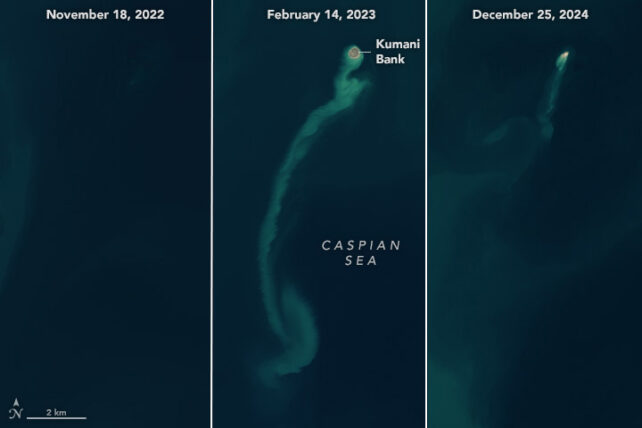
A 'ghost' island that suddenly appeared in the Caspian Sea in early 2023 is playing a centuries-long game of peekaboo with scientists, and it's about to vanish once again – if it hasn't already slipped beneath the waves.


Images from two NASA satellites show a time-lapse of the island's disappearing act, from its sudden emergence between January and February of 2023 to the tiny fragment left at the end of 2024
.
Satellite image of the Kumani bank appearing and slowly disappearing between 2022 and 2024.
 (NASA Earth Observatory images by Wanmei Liang, using Landsat data from the US Geological Survey)

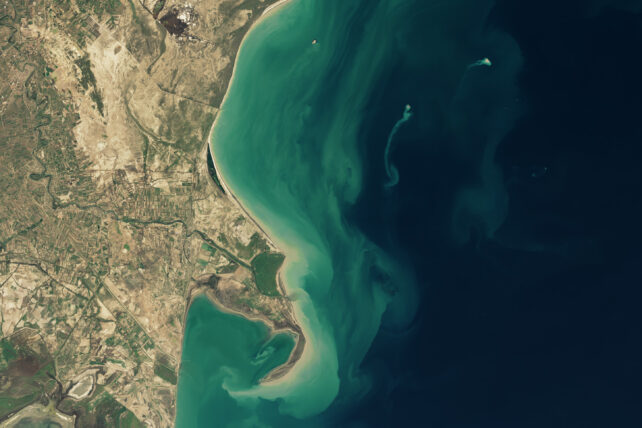
The island is located at the tip of the Kumani bank mud volcano, located underwater off the coast of Azerbaijan. On random occasions, when this volcano blows, an island of mud breaks through the waves and reforms about 20 kilometers (12.4 miles) from the mainland.


The temporary land mass was first documented in May 1861. But the next year, it was gone.


In the 20th century, the island came and went at least six further times, according to records. In fact, the blob of land rarely sticks around for longer than two years, before slipping beneath the waves.


Often, mud volcano eruptions are marked by huge, rocketing jets of fire, which are so intimidatingly violent, they can sometimes be mistaken for oil rig explosions.


In 2023, however, the ghost island peeked its head above the waves without much of a fuss

.
The location of Kumani Bank in the Caspian sea off the coast of Azerbaijan. (NASA Earth Observatory images by Wanmei Liang, using Landsat data from the US Geological Survey)

"A new island suddenly appeared last year, which is amazing," wrote geophysicist and mud volcano enthusiast Mark Tingay on Threads in November of 2024.


"But what is even more amazing is that nobody seemed to notice!"

By nobody, Tingay meant there were no official records of the island's appearance – just satellite images he had noticed last year while studying the mud volcano hotspot that is Azerbaijan. At the time, in 2023, Tingay said he couldn't find any news, social media, or internet mentions of the island's various names in Azeri, Russian, or English.

On January 10, 2025, NASA picked a picture of the ghost island as its image of the day.

This wasn't the only time that the Kumani island has caught scientists by surprise, either.

Tingay says the Kumani mud volcano also formed an island without a fireball in 1993, and it, too, went officially unreported. Satellite images, however, clearly show it was visible at that time.

"In this current information age, where everyone is so instantly connected, it is also rather incredible that an island can pop up just 20km off the coast and no one even says anything about it!" writes Tingay on Threads.

GREENWASHING PAKISTAN

Controversial canals

January 23, 2025 
DAWN

THE Punjab government’s contentious plans to build new canals to facilitate corporate farming in the province under the Green Pakistan Initiative in complete disregard for Sindh’s objections to the project have intensified the water conflict between the two provinces. The heat generated by the debate on the controversial scheme in the Senate on Tuesday is only a trailer of things to come unless a resolution of the conflict is found, and soon. The plan has already triggered protests across Sindh, bringing opposing political parties, civil society groups and nationalist organisations onto one platform to vehemently oppose it.

As the lowest riparian in the system, Sindh is rightfully worried about the new irrigation schemes due to insufficient water availability in the Indus basin system. On paper, as pointed out by a JUI-F senator during the debate, the 1991 Water Apportionment Accord has nearly 117 MAF water to distribute among the federating units, but in reality the water available in the system for apportionment is always far short of it. No wonder the Indus delta is struggling with the disastrous consequences of shrinking annual average ecological flow below Kotri Barrage, which has decreased to 14 MAF between 1999 and 2022 from 40.69 MAF between 1976 and 1998. Rapid climate change is exacerbating these shortages and their impact on agriculture and ecology of the province. Shortages apart, some of these schemes also face certain legal and technical issues since the water availability for these canals is not sanctioned in the 1991 accord. These issues could be overcome easily if surplus water was available in the system. But this is not the case, with climate change often resulting in lower-than-normal rainfall, causing drought or drought-like conditions across the country. Thus, the argument made by PML-N Senator Irfan Siddiqui in the upper house that the water accord permitted Punjab to build new canals using its permissible allocated share does not have a leg to stand on. The only way for the PML-N government to prevent this issue from getting out of hand is to heed the advice of lawmakers and others and bring the matter to the CCI for discussion and decision. Arbitrary decisions on such issues as the ones related to water sharing by the centre have done enough damage to interprovincial harmony. Continuation of this practice will further harm the federation.

Published in Dawn, January 23rd, 2025
Saudi Arabia plans $600bn in new US investment, trade over four years

WILL MBS GET A PARDON?!

 January 23, 2025 
Saudi Arabian Crown Prince Mohammed bin Salman meets President Donald Trump — Reuters File Photo


Saudi Arabian Crown Prince Mohammed bin Salman told President Donald Trump that the kingdom wants to put $600 billion into expanded investment and trade with the United States over the next four years, the Saudi State news agency said early on Thursday.

In a phone call between the two leaders, the crown prince said the Trump administration’s expected reforms could create “unprecedented economic prosperity”, the state news agency reported.

The report said Saudi Arabia wants its investments to capitalise on these conditions. It did not detail the source of the $600bn, whether it would be public or private spending nor how the money would be deployed.


The investment “could increase further if additional opportunities arise”, the agency quoted Bin Salman as telling Trump.

Trump fostered close ties with Gulf states including Saudi Arabia during his first term. The country invested $2bn in a firm formed by Jared Kushner, Trump’s son-in-law and former aide, after Trump left office.

Trump said following his inauguration on Monday that he would consider making Saudi Arabia his first destination for a foreign visit if Riyadh agreed to buy $500bn worth of American products, similar to what he did in his first term.

“I did it with Saudi Arabia last time because they agreed to buy $450bn worth of our product. I said I’ll do it but you have to buy American product, and they agreed to do that,” Trump said, referring to his 2017 visit to the Gulf kingdom.Follow Dawn Business on Twitter, LinkedIn, Instagram and Facebook for insights on business, finance and tech from Pakistan and across the world.

World

PAKISTAN

FO urges world to develop ‘concrete plan’ to rebuild Gaza, demands accountability for Israeli crimes


Abdullah Momand
January 23, 2025 
DAWN
FO spokesperson Shafqat Ali Khan speaking at the weekly press briefing with media on Jan 23, 2025. — DawnNewsTV

The Foreign Office on Thursday called on the international community to devise a “concrete plan” for the reconstruction of Gaza while demanding accountability for Israeli crimes that cost thousands of Palestinian lives.

Israel and Hamas agreed to a long-awaited ceasefire in Gaza which began on Sunday followed by a hostage and prisoner exchange, pausing the conflict after 15 months.

Estimates by the Palestinian health ministry show that more than 47,100 Gazans lost their lives to Israeli attacks since the conflict began, with the majority being civilians.

Meanwhile, about 90 per cent of Gaza’s 2.3 million residents were forcibly displaced due to the conflict, with some 92pc (436,000) of housing units in Gaza destroyed or damaged, in addition to 80pc commercial facilities, acording to Al Jazeera.

A drone view shows Palestinians sitting next to the rubble of destroyed houses and buildings, following a ceasefire between Israel and Hamas, in Rafah in the southern Gaza Strip, January 22, 2025. — Reuters

Speaking during a weekly press briefing in Islamabad, FO spokesperson Shafqat Ali Khan highlighted the importance of rebuilding the destroyed infrastructure in Gaza during the conflict.

“We urge the international community to develop a concrete plan for the reconstruction of Gaza in line with UNSC resolutions,” he said.

He also called for the accountability of Israeli crimes committed in this “brutal war”, saying it was an essential element in restoring international legitimacy.

Welcoming the ceasefire deal, Khan reiterated Pakistan’s support for a two-state solution and condemned the recent Israeli raid in the Jenin refugee camp of West Bank which resulted in the killing of 10 Palestinians.

He said, “Such actions potentially undermine the precarious ceasefire in Gaza and the international community should take note of it.”

‘No support for ISIS’


Separately, Khan denied claims of supporting the banned militant Islamic State (ISIS) group. He said, “We strongly reject Afghanistan’s allegations of supporting ISIS. We urge the Afghan administration to dismantle the terrorist camps of Tehreek-i-Taliban Pakistan (TTP).”

Earlier, Chief of Army Staff General Asim Munir said that the only points of contention between the two countries were the presence of the banned TTP in Afghanistan and cross-border attacks.

Security forces on Sunday killed five terrorists who were attempting to infiltrate Pakistan from Afghanistan, according to Inter-Services Public Relations (ISPR).
On migrant boat accidents

Regarding the Atlantic Ocean mig­rant boat tragedy, the FO spokesperson said that 25 Pakistanis had fortunately survived the accident, and the list of survivors was shared with the public.

“The incident was being further monitored and the Moroccan authorities fully cooperated fully in all matters,” he added.

The boat tragedy occurred in the waters bet­ween Mauri­tania and Moro­cco earlier this month. As per media reports, 44 out of a total of 65 Pakistani immigrants on board the ship either drowned or died after alleged torture.

On Indus Basin Treaty

While speaking on the Indus Basin Treaty, he said that Pakistan is fully committed to this agreement. “It is hoped that India will also ensure the implementation of this agreement,” he stated.

He also said that Pakistan and India were ready for any effort regarding the release of prison.
AMERIKA

Turn far right
January 23, 2025
DAWN


ON Jan 20, the moment Donald Trump — the geriatric comeback kid — took his oath as the 47th US president, the destiny of the world changed. It was as if he had drawn a Tarot card predicting the future.

Trump sees it as the sun: “positivity, success, and vitality”. To other world leaders, the card is the sinister tower, signifying “upheaval, trauma, sudden change, and chaos”.


Trump does not believe in the occult. He believes in a God who saved him from an assassin’s bullet to return to the White House with a miraculous mandate. As a misogynist, he can sport on his belt the coiffured heads of two female opponents — Hillary Clinton and Kamala Harris. He has the whole world at his feet. If his provocative utterances are to be believed, he intends to play football with it.

To his fellow Americans, regardless of their genealogy, Trump promises America a greatness beyond the envy of his rivals. To hostile foreigners, he offers ‘peace through strength’. That mantra is not new. It has been around for over millennia, since the time of Roman Emperor Hadrian (Pax per virtutem). It is now Trump’s battle cry.

Postwar American leaders have inverted it into ‘peace through war’, most recently in Iraq, Afghanistan and Ukraine.

Today, we are again caught in the middle.

Since the Russian assault on Ukraine in 2022, the US has committed $175 billion to Ukraine’s defence. Not all of it goes into Volodymyr Zelensky’s pockets. The Council on Foreign Relations has disclosed that much of it finances US activities and defence manufacturers in over 70 US cities. American largesse benefits America first.

“You furnish the pictures, I’ll furnish the war,” the press mogul William Hearst once said. Ukraine provides the war; the US military machine and over 40 Nato-connected countries furnish the weapons.

China foresees war of a different sort with the US. One stab in this direction has been announced by Trump on his first day in office. He revoked a presidential order signed by his predecessor Biden in 2021, decreeing that half of all new vehicles sold in the US by 2030 should be electric.

Trump is adamant: “The United States will not sabotage our own industries while China pollutes with impunity.” Yet, despite this bombast, Trump has admitted: “I’m for electric cars,” adding the confessional: “I have to be because Elon endorsed me very strongly.”

Elon Musk — the richest man in the world — has anointed himself as the First Buddy. His proximity to President Trump is undeniably close. The next few years will tell us who is in whose pocket. Meanwhile, Musk is exultant that Trump has endorsed his ambition to land a man on the planet Mars (coincidentally, the planet of war).

Reaching Mars is not such an impossible boast. In the 1960s, America planned to put a man on the moon by end 1969. The Soviet Union dented this ambition in 1961 by launching its cosmonaut Yuri Gagarin into space in a Vostok rocket. The Soviets lost out to the US though, when, in July 1969 within the deadline, two American astronauts stepped onto the moon’s surface.

Will Trump bring peace on earth? Which peace deal (Gaza or Ukraine) will secure him the Nobel Peace Prize? (Obama had been in power for less than eight months when he was awarded the Nobel Peace Prize for 2009.)

Many countries must be recalibrating their foreign policies to achieve a resonance with Trump’s foreign policy objectives.

Pakistan will need to, soon. It is not enough for the PTI to claim that Trump wants its leader out of jail. Nor for the PPP to rejoice that its leader had reportedly received an invitation to attend Trump’s inauguration.

Historians may recall that, following Kennedy’s assassination in November 1963, president Ayub Khan sent Mr Z.A. Bhutto to Washington on a condolence mission. Not satisfied with a perfunctory handshake from the new president Lyndon Johnson, Bhutto asked for a private meeting, claiming he had an important message from Ayub Khan. Johnson, despite his crowded schedule, met Bhutto on Nov 29.

His staff warned him that Bhutto was an “accomplished marathon talker”. Johnson was annoyed that the message Bhutto conveyed was no more than a vapid reiteration of Pakistan’s loyalty to the US. Johnson punished him by castigating Pakistan for its friendship with communist China.

Today, we are again caught in the middle. We were out of favour then and are out of favour now. The Nixon-China romance of the 1970s is a faded Valentine card. We must reconcile ourselves to the new reality. Stronger hands than ours will control our steering wheel.

The writer is an author.
www.fsaijazuddin.pk

Published in Dawn, January 23rd, 2025


Donald 2.0

Mahir Ali 
January 22, 2025
DAWN


YES, he’s back. And his second inaugural address, uncharacteristically mild in its delivery but predictably vile in much of its content, served as partial reminder of what the next four years portend for the United States and its imperial interests.

Last November, Donald Trump became the first contender since Grover Cleveland in the 19th century to score non-consecutive presidential victories.

Much of the blame for this twin atrocity can be attributed to the Obama and Biden administrations, which respectively facilitated his ascendancy by clinging to neoliberal imperatives in the wake of the global financial crisis, and then failed to learn lessons from their 2016 follies to avert a second coming.

In his farewell speech, Joe Biden sought to echo Dwight Eisenhower’s famous diatribe against the power of the military-industrial complex by verbally targeting the tech oligarchs.

In both cases, however, the question would be: if you were so perturbed by these phenomena, why did you not do anything about them while you held power?

Without directly taking credit, Trump on Monday mentioned in passing the previous day’s ceasefire in Gaza, citing the release of hostages as an achievement. It is widely accepted that pressure from the incoming US administration was crucial to sealing the deal. And anyone with an ounce of humanity can only welcome the halt of daily Israeli military killing sprees and the possible suspension of barriers to aid that are believed to have claimed upwards of 70,000 lives in 15 months, mainly those of women and children.

The ceasefire is to be welcomed, even though Benjamin Netanyahu has pretty much declared that it will only be temporary. The second phase of the truce, scheduled after 40 days, remains a tentative prospect.

Meanwhile, in his guise as a property magnate, Trump sees the rubble in Gaza as a positive prospect. He also remains dedicated to a Saudi-Israeli deal as a key supplement to the Abraham Accords achieved in his previous stint, but he may well be less invested in the token nod to a now passé ‘two-state solution’ that Riyadh might feel obliged to insist upon as a quid pro quo.

Here comes the beginning. And possibly the end.

Trump’s incoming oratory was clearly intended to insult his immediate predecessor, seated nearby (Donald did not bother to turn up when Joe took the oath four years ago), and other ex-presidents present. To her credit, Michelle Obama chose not to accompany her disappointing husband. And Alexandria Ocasio-Cortez refused to “celebrate a rapist”.

Trump hasn’t been criminally convicted on that particular charge, although his predilections are hardly a secret. Among his claims to fame is the fact that a felon has returned to the White House in a country where many of those convicted on similar charges aren’t allowed to vote even after they have served their prison sentences. Most of the more serious cases against Trump were abandoned after his election, but the charge of paying hush money to Stormy Daniels stuck, and guilt was established even though no penalties were pronounced.

This character is now the chief executive of the most powerful nation the world has ever known, accompanied by a bunch of equally immoral underlings attracted from Fox News or the US Congress.

On the very first day of his inevitably blighted leadership, Trump has cracked down on ‘undocumented’ immigrants (some of whom have been in the US for decades, contributing to its blighted economy). He has declared an emergency on the southern border, as well as an energy emergency that involves drilling for more oil and gas. The associated contributions to the climate catastrophe are both incalculable and unmentioned, even though Los Angeles is still smouldering.

There’s much more, of course — including a pledge to take back the Panama Canal, and to rename the Gulf of Mexico after the biggest bully in the region. Greenland and Canada were not in this instance mentioned as targets of expansion, but Elon Musk erupted in extraterrestrial joy when Trump brought up the idea of planting the Stars and Stripes on Mars.

It remains to be seen whether that, and several other tall claims by Trump, reach fruition, but presidential pardons have flowed freely from both the outgoing and incoming presidents, focusing on the Biden family and associates in the first case, and Jan 6, 2021 culprits, who sought to thwart democracy, in the second.

“The best lack all conviction, while the worst/ Are full of passionate intensity,” William Butler Yeats warned more than a century ago. Like many other alerts, it has gone unheeded.

What Trump failed to fit into scripted speech went into the longer and typically bizarre extempore peroration in the overflow room at the inauguration. He won’t come to his senses because he doesn’t have any. And what tomorrow may bring for the US and the world remains unwritten.

mahir.dawn@gmail.com

Published in Dawn, January 22nd, 2025


The curious case of Trump invitees

January 21, 2025
DAWN


The writer is Dawn’s correspondent in Delhi.


THERE was a time when the British embassy was the most informed diplomatic enclave in Delhi. Then the Soviets usurped the slot, and now the Americans are unbeatable at the game.

India has been both close and aloof with major countries without compromising its principles or seldom losing diplomatic graces. Relations with Pakistan were always difficult but rarely bereft of composure. It’s been embarrassing, therefore, to watch endless discussions about the prime minister of India being keen to attend Donald Trump’s inauguration only to be passed over for the invite.

One hopes for the sake of diplomatic dignity with which one grew up in Nehru’s India that the stories about denied invitations are untrue. The fact that the foreign minister is attending the event instead of Prime Minister Narendra Modi also doesn’t deserve to be played up as a great achievement.

All manner of global supremacists and right-wingers adorning the event was a good enough reason for proud nations rich or poor to shun the melee. Many did. Wide coverage is also being given to tycoon Mukesh Ambani being invited by Trump personally. We should wait for the American readout of the liaison.

The two have met before. Also, Ambani hosted Ivanka Trump at some international event in India. If memory serves, Mukesh and his brother Anil Ambani have been invitees also at the Clinton and Bush inaugurations, respectively.

On the other hand, Hillary Clinton has danced the bhangra at an Ambani wedding. American politicians are notorious for coveting money and Trump has already raised a few hundred million from the several events leading to Monday’s inauguration. How much useful foreign exchange India spent while being in the economic doldrums to catch Trump’s eye, is worth investigating.

What should not escape being marvelled at is how the fates of two Indian tycoons close to Modi differ in their relations with the US. Mukesh Ambani and Gautam Adani led the chorus that prompted business captains to back Modi over the Congress as prime minister after Manmohan Singh, and they succeeded. Both were seen as pals of Modi.

Then Adani fell afoul of the American establishment and now cannot visit the country for fear of being arrested in a corruption scandal. Ambani is buying Russian oil in rubles, and still getting invited to Trump’s second coming.


One hopes for the sake of diplomatic dignity with which one grew up in Nehru’s India that the stories about denied invitations are untrue.

When we were in school, the British queen was as dear to everyone as president Kennedy. Then the Soviets went one better and introduced Yuri Gagarin to captivate the world and become another beloved country. Kennedy was admired for saving the world from annihilation with a tricky working relationship he struck up with Nikita Khrushchev. Don’t humiliate your adversary, was Kennedy’s mantra for advancing global peace, now missing in international relations.

Reagan’s invectives on the evil Russian empire and Biden calling Putin names would have incurred Kennedy’s censure. That’s why Indians wept when he was killed. Also, India was too engaged with the newer and poorer democracies around the world to list friends by their economic or military clout.

The closest I have been to an American president was to Jimmy Carter in 1978 when his Air Force One flew yards above our heads at JNU’s open air tea shop called Kamal Complex. Fear of Delhi’s leftist campus has forever haunted the inept and biased Indian establishment.

The short-lived pro-US government of Morarji Desai was no different. Having breached the Congress’s unbroken run at the helm for the first time since independence, Desai wouldn’t take chances. He placed sharpshooters on the terrace of JNU hostels, possibly on prodding by Carter’s Secret Service.

The government had evidently forgotten that the Indian left including JNU students had campaigned for the pro-West Janata Party’s victory against a pro-Moscow Mrs Gandhi in 1977.

Anyway, after the plane roared past the university campus, which falls on the approach to the airport, an incensed student did try to throw a stone as high as he could. Faux dialectical discussion ensued wondering if it could have grazed Carter’s plane. The consensus arrived at was that a catapult occasionally used to scare away crows would have worked better.

A visitor who came close on the heels of Carter needed greater protection. The Shah of Iran had nowhere to go from Tehran for his condition was not any better than Sheikh Hasina’s on the eve of her overthrow by street power in Bangladesh.

Carter advised Desai to make the Shah feel a bit more wanted. The Shah came. Many Indians joined Iranian students in India to line the royal route with black placards. Some JNU protestors were thrashed by Kiran Bedi, then in charge of traffic police. The students were packed off to Tihar jail where for the next few days they performed street plays.

One day, the Shah visited the Mughal-built Red Fort from where the legendary peacock throne was spirited away by a previous Persian ruler. His last international reception at the Mughal monument presaged doom for those he had touched. The Shah was deposed and died disowned by his friends, including India.

Carter lost the election to Reagan. Desai was evicted by his own fractious party, paving the way for Mrs Gandhi’s return. The Soviets had emerged victorious from the turbulence in India but were not as lucky in Afghanistan and Iran where a CIA tip-off led to the mullahs decimating the pro-Moscow Tudeh Party.

The Cold War over, India promptly bartered the Non-Aligned Movement and Saarc for the West’s treasure chest. When George W. Bush was in bad odour throughout the world, including his own country, for invading Iraq, the Congress prime minister in 2006 welcomed him, telling the hugely relieved guest: “We love you in India.”

It inspired a memorable repartee when communist leader Prakash Karat offered a rare quotable quote. “Speak for yourself,” he told Manmohan Singh. Diplomatic flummery didn’t help India. It hasn’t helped Modi.

jawednaqvi@gmail.com

Published in Dawn, January 21st, 2025


Research shows PTSD, anxiety may affect reproductive health of women firefighters


Investigators at the Zuckerman College of Public Health led a study that found negative mental health conditions among women firefighters may reduce levels of key hormone associated with ovarian reserve.


University of Arizona Health Sciences

Lily Pesqueira 

image: 

Clinical diagnoses of PTSD and anxiety among women firefighters were associated with reductions in anti-Müllerian hormone levels, according to a study published in the Journal of Women’s Health.

view more 

Credit: Photo by Kris Hanning, U of A Health Sciences Office of Communications


TUCSON, Arizona — A new study led by University of Arizona Mel and Enid Zuckerman College of Public Health researchers in collaboration with fire service partners and other researchers around the country through the Fire Fighter Cancer Cohort Study showed that post-traumatic stress disorder and anxiety are associated with lower levels of anti-Müllerian hormone, a marker of ovarian reserve, among women firefighters.

The ovarian reserve is the number of healthy eggs in a woman’s ovaries that could potentially be fertilized. It is a measure of a woman’s fertility and ability to have children. 

“These findings highlight the negative effect that mental health conditions can have on health – specifically, reproductive health,” said first author Michelle Valenti, MPH, a doctoral student in epidemiology at the Zuckerman College of Public Health and program coordinator of the Fire Fighter Cancer Cohort Study’s Women Firefighter Study.

The paper “Evaluating the Effect of Depression, Anxiety, and Post-Traumatic Stress Disorder on Anti-Müllerian Hormone Levels Among Women Firefighters,” was published in the Journal of Women’s Health.

Firefighters are exposed to high stress and traumatic situations in addition to chemical exposures and have a higher prevalence of PTSD compared with the general population. Previous research showed that women firefighters have lower levels of anti-Müllerian hormone compared with women who are not firefighters; however, the reason why was unknown.

The research team, which included personnel at the Zuckerman College of Public Health’s Center for Firefighter Health Collaborative Research, led this analysis to determine whether anxiety, depression or PTSD were associated with anti-Müllerian hormone levels. They found that clinical diagnoses of PTSD and anxiety were associated with reductions in anti-Müllerian hormone levels of 66% and 33%, respectively.

These findings highlight a potential mechanism through which adverse mental health conditions could lead to adverse reproductive outcomes. Further research is needed to identify potential areas for intervention.

“The work of this AMH study within the broader context of the FFCCS is imperative to taking care of all of our firefighters,” said Capt. Caitlin St. Clair of the Puget Sound Regional Fire Authority. “These findings provide scientific leverage to fire departments to implement programs to reduce stress and improve the lives of our firefighter women.”

The Women Firefighter Study, a subgroup of the Fire Fighter Cancer Cohort Study, aims to identify causes of stress, cancer and adverse reproductive health effects in women firefighters that would inform effective interventions to mitigate these conditions.

“This study demonstrates the power of the Fire Fighter Cancer Cohort Study Women Firefighter Study to evaluate exposures that lead to adverse gynecologic conditions,” Valenti said. “The Women Firefighter Study would not be possible without our amazing fire service partners who have championed women firefighter research.”

Co-authors from the Zuckerman College of Public Health include senior author Jeff Burgess, MD, MPH, a professor and director of the Center for Firefighter Health Collaborative Research at the U of A Mel and Enid Zuckerman College of Public Health and a member of the BIO5 Institute; Leslie Farland, ScD, an associate professor and member of the BIO5 Institute; Yiwen Liu, PhD, an assistant professor of epidemiology and biostatistics; Shawn Beitel, program administrator for firefighter research; research technician Jordan Baker; and graduate student Kaiwen Huang.

In addition to St. Claire, other fire service research liaisons who contributed to the study include Capt. John Gulotta of the Tucson Fire Department, Capt. Jamie Kolar and Derek Urwin, PhD, of the Los Angeles County Fire Department, and many other firefighters.

This research was funded by the Federal Emergency Management Agency under award nos. EMW-2015-FP-00213 and EMW-2019-FP-00526.


Life satisfaction measurement tool provides robust information across nations, genders, ages, languages


Scale has potential to identify common themes in life satisfaction and inform strategies for boosting wellbeing around the world


PLOS

Life satisfaction around the world: Measurement invariance of the Satisfaction With Life Scale (SWLS) across 65 nations, 40 languages, gender identities, and age groups 

image: 

Data on almost 57,000 people from 65 countries suggests that the Satisfaction With Life Scale generally holds up well when applied across diverse groups of people.

view more 

Credit: AbsolutVision, Pixabay, CC0 (https://creativecommons.org/publicdomain/zero/1.0/)


Data on almost 57,000 people from 65 countries suggests that the Satisfaction With Life Scale (SWLS)—a widely used research tool—generally holds up well when applied across diverse groups of people, underscoring its potential value in research and policymaking. Viren Swami of Anglia Ruskin University, U.K., and colleagues present these findings in the open-access journal PLOS One on January 22, 2025.

Life satisfaction is linked to a broad range of life areas, such as physical health, employment, and mortality. The SWLS is a questionnaire that measures an individual’s life satisfaction, aiding research on the topic. The SWLS is generally known to be statistically useful for assessing life satisfaction within a given demographic group, such as people of a single nationality or in a specific age range.

However, it has been less clear how effective the SWLS is for comparisons across diverse groups, such as people of different nationalities, languages, gender identities, or age groups—a statistical quality known as “measurement invariance.” A major challenge for assessing the measurement invariance of a tool like SWLS is the need for a large, global-scale dataset.

To meet that challenge, Swami and an international team of colleagues turned to data from a project known as the Body Image in Nature Survey (BINS), which includes SWLS data collected from thousands of people worldwide from 2020 to 2022. They analyzed SWLS results for 56,968 BINS participants representing 65 different nations, 40 languages, and diverse gender identities and ages.

Their analysis suggests that, overall, the SWLS has universal applicability; it appears to be generally successful in capturing life satisfaction across nations, gender identities, age groups, and languages.

It also enabled identification of some common themes: for example, across nations, greater life satisfaction was significantly associated with greater financial security as well as being in a committed relationship or married. With respect to age, there was a small but significant association between older age and higher SWLS scores, and with respect to gender, women and men both reported higher SWLS scores than those who identified as another gender, although the researchers note that only 0.6% of their sample identified as another gender.

However, the SWLS does not achieve perfect measurement invariance for all demographic categories, in particular nation. On the basis of their findings, the researchers urge caution when applying the SWLS across nations. They outline potential directions for future cross-national research to inform strategies for improving life satisfaction worldwide.

The authors add: “Our results also show that there are large differences in life satisfaction across nations and languages, which in turn may help practitioners and policy-makers to promote better psychological well-being across the globe.” 


In your coverage, please use this URL to provide access to the freely available article in PLOS Onehttps://journals.plos.org/plosone/article?id=10.1371/journal.pone.0313107

Citation: Swami V, Stieger S, Voracek M, Aavik T, Abdollahpour Ranjbar H, Adebayo SO, et al. (2025) Life satisfaction around the world: Measurement invariance of the Satisfaction With Life Scale (SWLS) across 65 nations, 40 languages, gender identities, and age groups. PLoS ONE 20(1): e0313107. https://doi.org/10.1371/journal.pone.0313107

Author countries: U.K., Malaysia, Austria, Estonia, Türkiye, Nigeria, Iran, Bangladesh, Canada, Lebanon, Greece, Bahrain, Saudi Arabia, Ecuador, Brazil, Indonesia, Cyprus, Philippines, Lithuania, Czechia, Italy, Iceland, Croatia, Poland, Slovakia, Norway, U.S., France, Spain, Malta, Thailand, Australia, China, Taiwan, México, Ireland, The Netherlands, Tunisia, Nepal, Bulgaria, Germany, Romania, Israel, Hungary, Jordan, Palestine, Egypt, Switzerland, Argentina, Serbia, India, Slovenia, Kazakhstan, United Arab Emirates, South Korea, Pakistan, Colombia, Japan, Portugal, Chile, Oman, Ghana, Latvia, Costa Rica, New Zealand.

Funding: The author(s) received no specific funding for this work.