Saturday, February 22, 2025


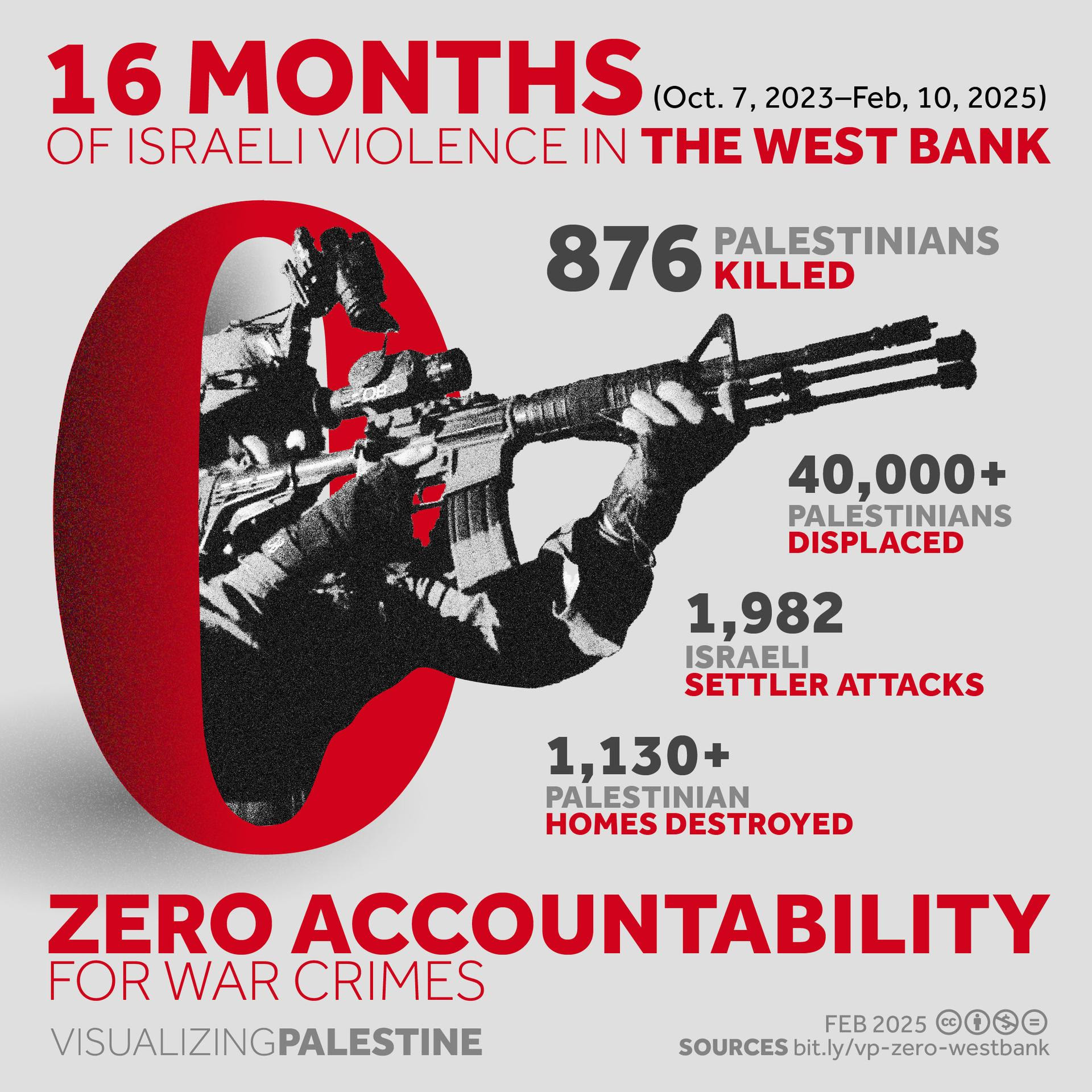
16 Months of Israeli Violence in the West Bank


For over a year now, Israel has been intensifying its military assaults on Palestinians in the occupied West Bank, from mass killings to attacks on healthcare workers, mass arrests, forced displacement, home demolitions, and military airstrikes.

In our latest visual, we bring attention to the ongoing violence the Israeli military and settlers have inflicted on Palestinians in the West Bank over the past 16 months.

On January 19, the Israeli army invaded and laid siege to Jenin refugee camp. The siege is part of a wider military offensive that Israel is carrying out across the northern West Bank. This offensive has led to the displacement of more than 40,000 Palestinians residing in the refugee camps of Jenin, Tulkarem, Nur Shams, and El Far’a, and represents the highest number of Palestinians displaced in the West Bank since 1967.

Each year surpasses the last in becoming the deadliest year for Palestinians as Israeli violence intensifies with impunity in the West Bank. With Israel’s accelerating annexation and settlement expansion, Palestinians face unrelenting and ongoing assaults on their land, homes, and lives. The Israeli government’s policies, backed by military force, settler violence, and unwavering U.S. support, have created a reality in which Palestinians are constantly struggling against erasure.

We know the reality is dim, but now is not the time for silence. Now is the time to speak up, to educate, and to challenge injustice. In the words of Toni Morrison, “There is no time for despair, no place for self-pity, no need for silence, no room for fear. We speak, we write, we do language. That is how civilizations heal.”Facebook

Visualizing Palestine is the intersection of communication, social sciences, technology, design and urban studies for social justice. Visualizing Palestine uses creative visuals to describe a factual rights-based narrative of Palestine/Israel. Read other articles by Visualizing Palestine, or visit Visualizing Palestine's website.


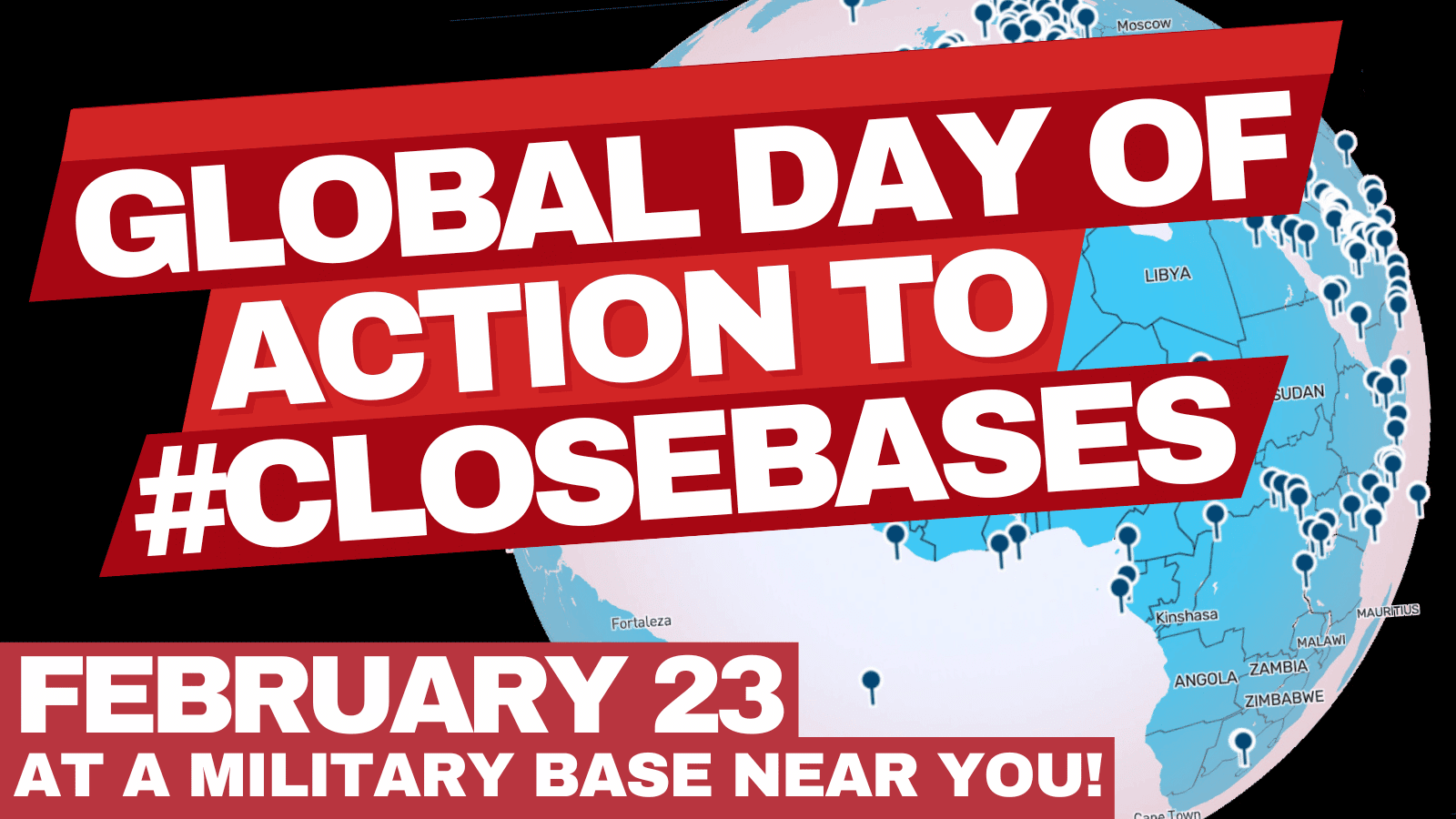
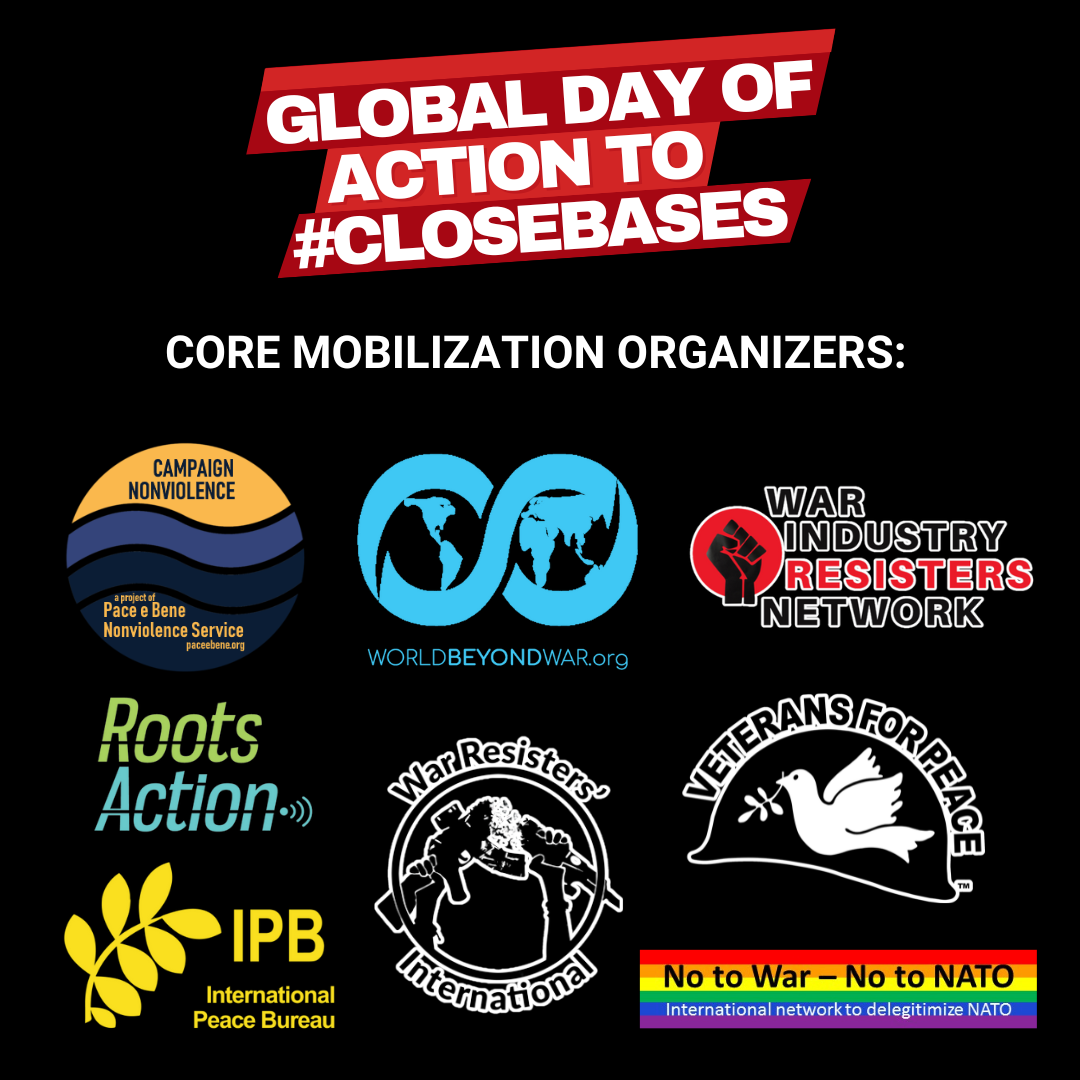
Feb. 23 is the Global Day of Action to Close Bases


Anti-military base actions of all kinds (protests, blockades, concerts, rallies, marches, lectures, poster displays, etc.) are happening on or about February 23, 2025, including near you!

Individuals and organizations all over the world have added events to the map, including in Australia, Cameroon, Canada, Colombia, Costa Rica, Denmark, Ecuador, England, Finland, Germany, Ireland, Japan, Mexico, Netherlands, Norway, Scotland, South Korea, United States, Venezuela, Wales, and online. More are still being added.

Check out the event nearest you at:

DAYTOCLOSEBASES.ORG

The Earth is coated in military bases, spreading like a pandemic: foreign ones, domestic ones, famous ones, secret ones — part of a growing and disastrous global increase in spending on wars and preparations for wars that makes wars more, not less, likely. And prime targets in wars are bases and anything near them.

Bases are many of the worst environmental disaster sites, polluting air, soil, and water, and generating horrific noise pollution.

Foreign bases are often mini-apartheid states with second-class status for locals and criminal immunity for militaries — a situation that can often be traced back to stolen land and other injustices.

Through public pressure, bases have been closed, plans for bases have been blocked, and bases have been converted to other purposes, superior environmentally, economically, and in terms of achieving peace.

Let’s build this movement right now!

See all the endorsers on the website.


The Struggle for a Zone of Peace Continues


US/NATO Out of Our Americas Network Launches


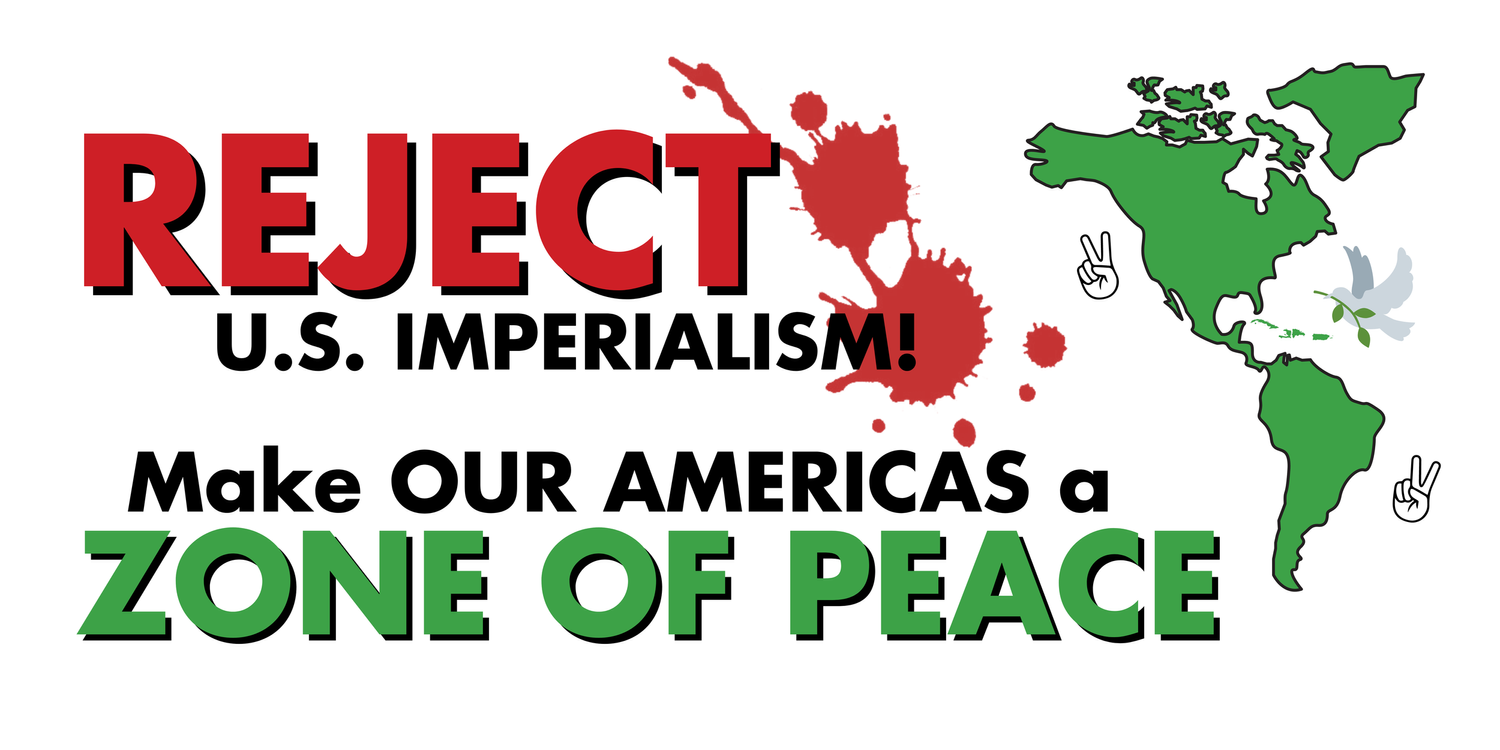
Today, the US/NATO Out of Our Americas Network officially launches, marking a bold and action-oriented next phase in the Zone of Peace campaign. This date, commemorating the assassinations of Malcolm X and Augusto C. Sandino, serves as a powerful reminder of the enduring struggle for sovereignty, self-determination, and liberation from colonialism, imperialism and all nefarious forces that impede peace. The Network is dedicated to building a coordinated, internationalist struggle to expel the U.S./EU/NATO Axis of Domination from the Americas and beyond.

The Zone of Peace campaign has been building and coordinating resistance against militarism, imperialism, and colonialism. Now, the US/NATO Out of Our Americas Network takes this struggle to the next level by emphasizing strategic, grassroots-led action to dismantle the structures of oppression that threaten the sovereignty and dignity of peoples across the hemisphere.

The Masses Will Lead the Way

The success of this historic task lies in the power of the people. It is the masses—workers, farmers, African and Indigenous communities, students, activists, and all those who believe in justice and people(s)-centered human rights—who will drive the expulsion of the U.S./EU/NATO Axis of Domination. Through concerted and unified anti-militarist, anti-imperialist, and internationalist actions, we will challenge the economic, political, and military interventions that perpetuate violence in our region.

The Network calls for principled unity across borders, recognizing that the fight against imperialism is a global struggle. From Guantanamo to Port au Prince, the southside of Chicago to the palenques in Guayaquil, and beyond, we stand in solidarity with all movements working to build a Nuestra América free from domination and exploitation.

A Call to Action

The launch of the US/NATO Out of Our Americas Network is not just a declaration of principles—it is a call to action. We invite individuals, organizations, and movements to join us in this critical effort. Together, we will:

  • Organize grassroots campaigns to resist U.S./NATO military bases and interventions

  • Build international solidarity to expose and oppose imperialist agendas.

  • Advocate for policies that prioritize peace, sovereignty, and people(s)-centered human rights over war by any of its names (sanctions, lawfare, etc)

  • Educate and mobilize communities to take collective action against forces that oppose the sovereignty of our region

Honoring the Legacy of Malcolm X and Sandino

On this historic day, we honor the legacies of Malcolm X and Sandino, whose unwavering commitment to justice and liberation continues to inspire us. Their sacrifices remind us that the struggle for a better world is ongoing, and it is our responsibility to carry their work forward.

The US/NATO Out of Our Americas Network is committed to building a future where the Americas are truly a Zone of Peace—a region free from foreign domination, where the rights and dignity of all peoples are respected.

Join us in this vital struggle. The time is now.

For more information, visit zoneofpeace.org.

The Black Alliance for Peace (BAP) seeks to recapture and redevelop the historic anti-war, anti-imperialist, and pro-peace positions of the radical black movement. Read other articles by Black Alliance for Peace, or visit Black Alliance for Peace's website.


Germany Issues Warning to US


Europe should make it clear to President Trump that failure to back “liberal democracies” will come at a price, Foreign Minister Annalena Baerbock has insisted


Germany issues warning to US
German Foreign Minister Annalena Baerbock. ©  Johannes Simon/Getty Images

Europe should not hesitate to put pressure on the US if it fails to fall in line with “liberal democracies,” German Foreign Minister Annalena Baerbock said on Friday. The diplomat made the remark following talks between the US and Russia that excluded representatives from the EU and Ukraine.

Speaking at a campaign rally in Potsdam on Friday, the Green politician stated, “We’re increasing pressure on the Americans [so they know] they have a lot to lose if they don’t stand on the side of Europe’s liberal democracies.”

With respect to EU-US relations, Baerbock warned against drawing any precipitous conclusions, remarking that “nothing has been decided there.”

“No one can decide about war and peace for the Ukrainians or us Europeans, and this is the clear German stance,” she insisted. Baerbock also warned against forcing Kiev into a “phony peace” or “capitulation,” which she said would only invite further “war and violence.”

A rift has opened up between Washington and Brussels since US President Donald Trump took office last month. Trump has taken a tougher stance on trade with the EU by threatening tariffs and demanded that its European-NATO partners boost spending on collective defense.

Addressing Munich Security Conference attendees last Friday, US Vice President J.D. Vance delivered a sobering speech to Europe’s political elites, suggesting that the biggest threat the continent is facing is one coming from within – the erosion of democracy.

“In Britain and across Europe, free speech, I fear, is in retreat,” the official stated, concluding that “if you’re running in fear of your own voters, there is nothing America can do for you.”

The speech sent shockwaves across governments, with leaders, including Germany’s Olaf Scholz, scrambling to rebuke Vance’s assertions.

The fallout was further highlighted when Washington and Moscow held high-level talks in Saudi Arabia this week without bothering to invite EU representatives. This perceived slight prompted an outpouring of anguish and indignation on the continent.

Trump blasted Ukrainian leader Vladimir Zelensky this week, branding him a dictator without elections, but a number of European leaders have rejected the US president’s assertion that he lacks legitimacy.

In an interview with Fox News on Friday, Trump said he sees no point in having Zelensky involved in peace talks with Russia. He also insisted that French President Emmanuel Macron and UK Prime Minister Keir Starmer “haven’t done anything” to put an end to the bloodshed in Ukraine for the three years since it started.

The RT network now consists of three global news channels broadcasting in English, Spanish, and Arabic. Read other articles by RT, or visit RT's website.

Terminating Neighbours (Again)

Second Endings

Soppy, soapy and interminable, the Australian series Neighbours, the staple for millions of British (and Australian) watchers for years, their tonic and medication from reality, is being terminated for the second time.

In 2022, steady followers and dedicated fanatics of this program of irritating suburban geniality were met with the news that Channel 5 would be concluding its support for a series that had incubated such Australian performers and thespians as Margot Robbie, Guy Pearce and Kylie Minogue.  Fremantle Media, the program’s producer, had failed to secure another broadcaster in the UK as a replacement, despite the 1.5 million regular viewers that would tune in each day it was run.

Then came Amazon MGM Studios, which decided to give a blast of oxygen to the 37-year-old relic that had already passed 9,000 episodes.  It took a mere four months to do so, possibly helped by the ratings for what was meant to be a farewell episode studded with stars.  The streaming service Prime Video became the conduit, the new program returning as Neighbours: A New Chapter.

Salvation jobs tend to be rare in show business, and the whole industry remains inherently and manically brutal.  A sure signal that Neighbours might be in trouble was the 2024 move by Amazon to cease its Freevee service, which had been responsible for broadcasting the revived variant globally.

The language being used in this latest withdrawal of support is an object study in euphemistic endings.  “We are sad to announce that Neighbours will be resting from December 2025,” read an official statement on the program on February 21.  But the viewers were assured that the axe, while inevitable in its deployment, would not do away with those episodes scheduled to run on the global Amazon Prime Video channel, and Australia’s Channel Ten four times a week until then.  These would still have “all the big soapie twists and turns that our viewers love”.

A spokesperson for Amazon, in confirming the company’s withdrawal of support, stood by the remit in saying little on the reasons behind the decision.  The language used was that of putting down a beloved pet that had endured that bit longer because of a noble intervention.  “Forty years is an incredible milestone and we are proud that Amazon MGM Studios was able to have a small part of bringing further episodes to Freevee and Prime Video customers over the last two years, spanning 400 episodes.”

Things were left to Neighbour’s executive producer, Jason Herbison, to soften matters and offer a sliver of hope.  First, there was the soap’s enduring popularity in the UK.  There was also the show’s first Daytime Emmy nomination in 2024.  “As this chapter closes, we appreciate and thank Amazon MGM Studios for all they have done for Neighbours – bringing this iconic and much-loved series to new audiences globally.  We value how much the fans love Neighbours and we believe there are more stories of the residents of Ramsay Street to tell in the future.”

These stories will remain either in cold storage or floating in purgatory unless an international backer can be found.  It fills barrels of irony that Australia’s longest running soap drama would need the broadcasting heft from overseas to sustain it.  The Australian backer, Channel Ten, claims that funding it alone will not pass muster.

Placed in that precarious situation, the program’s success does not merely depend on a steadfast series of ratings in one market.  Neighbours, with its sedate, soft treading approach to human relations in a fictional Melbourne suburb, appeals in a very specific way to British audiences.  For them, this is Australia imagined as sun, pools and conviviality.  Disputes irk but are eventually resolved.  As the BBC press release described it in October 1986, the show “is down-to-earth, centres on ordinary families, with a particular emphasis on young people and the problems they face.”

When the wedding of Scott and Charlene, played respectively by Jason Donovan and Kylie Minogue, aired in 1988, 19.7 million British viewers tuned in.  This was stupendous for a production that had initially been savaged for its corniness, comical awfulness and its seeming inertia.  It was also the sort of success that enraged critics for challenging the enduring supremacy of Britain’s own EastEnders and Coronation Street.

The actual city of the program’s setting is irreverent in terms of weather, teasing, toying and frustrating the visitor with lengthy spells of overcast doom, occasional spits of rain, and then, variable temperatures.  The latter phenomenon drives the local resident to travel equipped with a wardrobe of clothing options: raincoat, warm jacket, short sleeved shirts.  Ramsay Street, with its particular pretentious brand of sunny friendliness, should have been located in Sydney, though this remains the unmentionable heresy.

Taking the temperature of the broader public reaction to the decision, and bafflement abounds.  Why would, asked one follower of the program, take away “YOUR number one show!” screeched one at Amazon.  But Amazon, according to The Sun, was not happy with its broader returns.  It is a global beast with global appetites, a coded way of saying that success, to be genuine, had to be an American one.

An unnamed source (of course), told the paper that Fremantle had been given “two years to see if it worked, but sadly, they just didn’t get the viewers.”  Fremantle’s hunt for the cash for continued production will have to start in earnest, but short of returning to a British backer, the prospects look decidedly final for a show that has lasted well beyond its time.FacebookEmail

Binoy Kampmark was a Commonwealth Scholar at Selwyn College, Cambridge. He lectures at RMIT University, Melbourne. Email: bkampmark@gmail.comRead other articles by Binoy.


EU’s Von der Leyen Issued with Colonial Reparations Demand


Former colonies are not seeking a handout but an “appropriate apology,” the Grenadian prime minister has said


EU’s Von der Leyen issued with colonial reparations demand
European Commission President Ursula von der Leyen @ Nicolas Economou/NurPhoto via Getty Images

European Commission President Ursula von der Leyen has been told that former colonial powers must apologize and pay compensation for their historical involvement in the enslavement of Africans.

Addressing the 48th meeting of the Caribbean Community (Caricom) heads of government in Barbados on Thursday, which was attended by von der Leyen, Grenadian Prime Minister Dickon Mitchell urged Western leaders to recognize slavery as a crime against humanity and ensure appropriate reparations are made to prevent the recurrence of such atrocities.

“I don’t mean to be impolite,” Mitchell told von der Leyen. “But I will say it to you: the issue of reparations… is an issue we will take up with you.”

The transatlantic slave trade saw millions of Africans taken from their homeland, bought by European merchants, forcibly transported to the Americas and sold into slavery. Between 1517 and 1867, around 12.5 million people were forced to endure the so-called Middle Passage across the Atlantic, enduring cruel treatment and disease. Only about 10.7 million survived the journey, with nearly 40% sent to work on sugarcane plantations in Brazil.

Demands for reparations for slavery and colonialism have been ongoing for years but are gaining increasing support worldwide, especially among Caricom and the African Union (AU).

Caricom has outlined a reparations plan that includes calls for technology transfers and investments to address health crises and illiteracy. Meanwhile, the AU is in the process of developing its own strategy.

“We owe it to ourselves and future generations of humanity to ensure [slavery] is accepted as a crime against humanity, and that appropriate apology and compensation is paid, and that the international community accepts this should never happen again,” Reuters quoted Mitchell as saying.

Von der Leyen responded to Mitchell but did not mention reparations, only saying that “slavery is a crime against humanity… and the dignity and universal rights of every single human being is untouchable and must be defended by all means”.

Echoing Mitchell’s remarks, the Antigua and Barbuda Prime Minister, Gaston Browne, told the Guardian that the Caribbean states were not seeking “a handout” but an “apology for the wrongs of their forebears.”

No specific figures for reparations have been agreed upon yet, according to Caribbean leaders, but the priority is constructive collaboration on the issue. Following the event in Barbados, the issue of compensation was discussed during closed-door meetings, which were also attended by UN Secretary-General Antonio Guterres.

The RT network now consists of three global news channels broadcasting in English, Spanish, and Arabic. Read other articles by RT, or visit RT's website.


Every Accusation Is a Confession


Southcom's Double-Speak


Admiral Alvin Hosley demonstrated selective outrage over the fear of multipolarity in the Western Hemisphere. The Southcom commander confirmed the official US military doctrine for the Latin American and Caribbean (LAC) region on February 13, before the Senate Armed Services Committee.

In a poorly disguised assertion of US hegemony, Hosley envisioned, “an enduring commitment to democratic principles…to engender security, capability, democratic norms, and resilience that fuel regional peace, prosperity, and sovereignty.”

Threats to the vision of a Pax Americana

Foremost of the “threats to this vision” is the “methodical incursion into the region” by China, secondarily by Russia, and a distant third by Iran.

Hosley charged China with a “long-term global campaign to become the world’s dominant strategic power in the Western Hemisphere” and Russia with continuing support for “anti-American authoritarian regimes” and spreading “misinformation throughout the region.” Meanwhile, the “theocratic regime” in Iran, “seeks to build political, military, and economic clout in Latin America… where it believes cooperation is achievable.”

These “malign actions,” Holsey argued, run against US national interests, threaten our sovereignty, and pose a “global risk.” Not questioned, of course, is the US presence in the region as part of Washington’s official “full spectrum [world] dominance” posture.

Rather, he lauded US regional military programs: acquisitions of F-16s by Argentina and Black Hawk helicopters by Brazil, the International Military Education and Training program spanning 27 regional countries, and the Joint Exercise Program with over 10,000 participants from 38 countries.

Unlike the US with 76 regional military bases, neither China nor Russia has formal alliances, joint command structures, or large-scale military agreements in the region. In contrast, Colombia is a NATO “global partner,” Argentina and Brazil are “major non-NATO Allies,” and Chile is a key cooperator with NATO. The US is making Guyana a military hotspot, while the US occupation of Cuba with the Guantánamo naval base is rendered invisible.

Hosley also cited humanitarian assistance as “an essential soft power tool,” later adding “with empathy and compassion at the forefront.”

“Erosion of democratic capitalism”

The admiral’s double-speak continued with the claim that the Western Hemisphere suffers from an “erosion of democratic capitalism, which in too many countries is being replaced by…authoritarianism.” Not mentioned is the recent US support of Bukele in El Salvador, Bolsonaro in Brazil, Moreno, Lasso and Noboa in Ecuador, Boluarte in Peru, Añez in Bolivia, Uribe and Duque in Colombia, or Milei in Argentina.

China is accused of interfering in “our south,” a new euphemism of “our backyard,” but with the same chauvinistic implications. Hosley testified that Chinese presence “at strategic chokepoints such as the Panama Canal imperil the US’s ability to rapidly respond in the Indo-Pacific should a crisis unfold.” Might such a contingency include US military deployment to the Asia-Pacific, which has been the practice since at least 2003?

The admiral charged China’s Belt and Road Initiative (BRI) with doing what the US has consistently failed to do; namely going “beyond raw materials and commodities to include” infrastructure improvements. China accomplished becoming the region’s second major trading partner and the first specifically in South America in less than two decades, where the US had previously enjoyed nearly uncontested dominance for well over a century.

Hosley lauded the region’s abundant natural resources (20% of the world’s oil reserves, 25% of its strategic metals, etc.). That these are resources which US multinationals have been pillaging, leaving little in return, remained unstated.

Meanwhile, China is accused of chicanery by providing benevolent short-term benefits to leave regional countries “vulnerable to unsustainable debt, environmental degradation, and informational security risks.” In fact, “no country…owes Chinese creditors more than it owes other major creditor categories, including bondholders, Paris Club creditors, multilateral development banks (MDBs) or other creditors.”

And what are the security risks? Satellites for Venezuela and Bolivia? DeepSeek? Technology transfer? Millions of anti-COVID vaccines?

Outlandishly, the admiral asserted that “the malign activities, harmful influence, and autocratic philosophy of China are a direct threat to the democratic will.” In contrast, he claims the US “offers economic prosperity, sustainable development, and true partnership.” This would be laughable if it weren’t so tragically false. Consider Haiti, under US domination, where the country is in ruins and any pretence of democratic elections has long been dropped.

Predictably, Hosley also charged Russia with “malign” aims because it “seeks to undermine the US regional interests” by supporting “like-minded authoritarian regimes in Cuba, Nicaragua and Venezuela.”

His concern with Russia’s “state-controlled media to disseminate disinformation and propaganda,” is far eclipsed by the 6,200 journalists and the 707 non-state media outlets in more than 30 countries financed by USAID. This is without mentioning the Western giant media conglomerates that overwhelmingly dominate the world’s news reporting.

Transnational criminal organizations and Russian acolytes

Hosley reported that transnational criminal organizations (TCOs) engaged in drug trafficking are connected to the “death of thousands of US citizens.” Not only that but, “TCO-driven corruption and instability open space for China, Russia, and other malign actors to achieve strategic ends and further their agendas.”

Yet, as Mexican President Claudia Sheinbaum noted, organized crime and drug distribution are prevalent within the US itself, which is the largest market for illicit drugs and the source of most weapons used by the cartels to the south. She rhetorically asked: “Who is in charge of distributing the drug? Who sells it in the cities of the US?…Let them start with their country.”

Venezuela is presented as exemplifying the “devastating effects and consequences of authoritarian rule.” Citing the “widespread inability to access life-sustaining necessities” driving economic refugees from Venezuela, Hosley warned: “The large numbers of migrants transiting the region strains our Partner Nations.”

Nicaragua is accused of harbouring a global positioning system, a vaccination plant, and a police academy, all of which are collaborations with Russia, which – horrors – “enjoys the diplomatic status of an embassy.” The “repressive Ortega-Murillo regime” joined the BRI and a free trade agreement with China, including building “a massive solar power plant.”

“Instead of addressing the ongoing humanitarian crises,” the Cuban “authoritarian regime” is accused of “strengthening ties with our Strategic Competitors and adversaries.” Hypocritically, he mourns: “The long-suffering populace does not have sufficient access to medicine, food, and essential services.”

Outrageously omitted are the effects of draconian Yankee unilateral coercive measures (aka sanctions) on what Hosley calls the “ideological acolytes” of Russia. His narrative blames the victims for the severe consequences of Washington’s sanctions imposed to deliberately produce what the admiral laments.

“The challenge”

“Time is not on our side” were the possibly prescient words by the commander of Southcom to the senators about the LAC region, which is “on the front lines of a decisive and urgent contest to define the future of our world.”

This may be because the US is not prepared to accept that sovereign and independent nations enter into beneficial trade agreements about their raw materials and infrastructure and join multipolar bodies such as BRI and BRICS. The ultimate logic of US policy is to prevent the region from being part of a multipolar world. As the admiral admitted, “we have redoubled our efforts to nest military engagement with diplomatic, informational and economic initiatives.”Facebook
Francisco Dominguez is the national secretary of the UK-based Venezuela Solidarity Campaign,  Roger D. Harris is with the Task Force on the Americas, the US Peace Council, and the Venezuela Solidarity Network, based in North America. Read other articles by Francisco Dominguez and Roger D. Harris.