Saturday, February 22, 2025

American Revolutions: 9 Parts Locke, 1 Part Hobbes


 February 21, 2025
Facebook

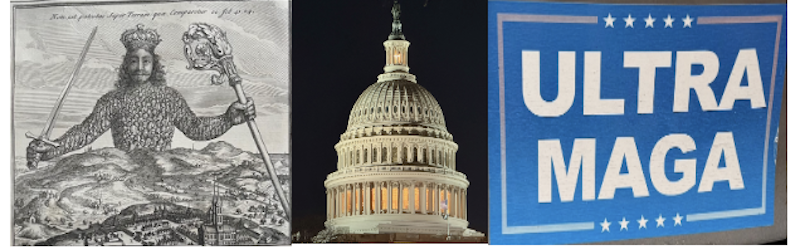
Left: Frontispiece to Hobbes’ Leviathan. Center: Photo of the Capitol at night by Nikolai Medish. Right: Ultra MAGA bumper sticker.

There are three Powers, three unique Forces upon earth, capable of conquering forever by charming the conscience of these weak rebels – men – for their own good; and these Forces are: Miracle, Mystery and Authority.

– The Grand Inquisitor in Dostoevsky’s Brothers Karamazov

An astute observer of the U.S. political scene recently quipped that Hobbes seems to be up by three touchdowns over Locke.

The reference point for this imagined Superbowl game is the centuries-old debate between the political philosophies of Thomas Hobbes (1588-1679) and John Locke (1632-1704), which I will get to shortly.

The unceremonious end of the “end of history”–which has unfolded steadily since 9-11 –and the fading of the Obama era’s alluring but naïve dream of “post-partisanship” – gives robust new leases on life to the study of history and political theory.  The human condition is neither post-historical nor post-political.

Contrary to progressives’ hope for the withering away of political and even geopolitical conflict, the nagging old problems of humanity – how best to govern complex societies and how growing societies can live together peacefully on a shared planet – have been resurfacing with a vengeance.

The United States is a case in point.  The superpower was once the gold standard of stability — indeed “country risk” around the world was implicitly gauged relative to zero risk in the U.S.

This was based on confidence that the U.S. had evolved a rock-solid system of democratic governance, with alteration of political power and cross-partisan commitment to compromise and rule of law, that allowed for resolution of policy conflicts within broad bounds of predictability.

But now risk is us. And the intensity of uncertainty is growing. The U.S. is a global risk radiator spreading instability to its neighbors and erstwhile allies. The amplitude of political debate is widening, with the hyper-partisan pendulum swings threatening to pull down the governing superstructure.

Pundits dispute whether a “presidential coup” is under way and whether we are in a “constitutional crisis,” possibly even a new American revolution.  The answer is emphatically “yes,” although some editorialists from left and right have tried to downplay the gravity of the moment.

In his last days in office, President Biden, whose political career was not known for much friction with big money interests — the military-industrial complex, Wall Street, Hollywood, Silicon Valley — warned that “an oligarchy … of extreme wealth” and a “tech-industrial complex” are taking shape and “posing real dangers” to the Republic.

Biden might have added that the digital apps and social media we have embraced for convenience as consumers have consumed us as citizens.  The medium is the message, and the message is mass manipulation.

To his credit, Biden had been presciently and wistfully talking about a contest for “the soul of America” for some time.  Upon exit, he apparently also realized that the U.S., after decades of giving other countries report cards on democratic deficit, kleptocracy and state capture, was failing these same tests.

As a German philosopher noted, the owl of Minerva, goddess of wisdom, “spreads her wings only with the falling of dusk,” that is, when it’s a bit late.

The escalating debates about Trump’s “ultra-MAGA” agenda are as much about the content of policies(such as immigration, free speech, gender equality, climate change, and downsizing government) as they are about the operating system of democracy itself — that is the inner workings of the political process — the separation of powers, checks and balances, elections and the other accepted methods of democratic conflict resolution.

Scale matters. The sheer quantity of litigation over President Trump’s increasingly muscular exercise of executive authority to advance his ultra-MAGA “Project-2025” policy agenda already implies a challenge to the political culture not seen since the height of the Nixon era.

Nixon’s legal training may have ultimately tempered his lawlessness – after all, he resigned – but Trump’s business and political career reveals no such self-imposed limits.  Emboldened by a divided Supreme Court’s sweepingly permissive 2024 decision on presidential powers and legal immunity, Trump’s l’etat-c’est-moi attitude toward heeding adverse judicial rulings means the country should brace for a high-impact constitutional collision.

This brings us to the political theory. Enter Hobbes and Locke, two archetypal political thinkers on constitutional arrangements. The 17th-century duo are staples of any introductory college course in Western political thought.

Hobbes and Locke represent philosophical counterpoints in “the British argument” — the arc of ideas about the nature and balance of political power starting from Magna Carta (1215) and subsequent negotiations over sovereign prerogatives and rights between the English kings and feudal barons, culminating centuries later in Glorious Revolution and the Westminster model of parliamentary constitutionalism and later the American experiment with a democratic republic.

Historical context is relevant. Hobbes and Locke wrote in the wake of the Protestant Reformation, with the absolute authority of Christian monarchs and the Catholic Church shaken to the root and at a time when modern “Westphalian” nation-states of Europe were first taking constitutional shape.

Hobbes and Locke were responding even more directly to the political strife and violence close to home, specifically the English civil wars of the mid-17th century, during which a king was executed and as many as 200,000 died, and the Thirty Years’ War (1618-1648) on the European continent leaving probably over 5 million dead. Add to those man-made disasters, the Great Plague of 1665-66, which claimed an estimated 15% of London’s population.

Their contemporary critics considered both these pioneering thinkers to be politically undesirable and dangerous. Both men feared for their lives and exiled themselves for safety over extended periods, Hobbes in France, Locke in the Netherlands.

In view of all these vicissitudes, what system of government made the most sense to them, and why? Put simply, Hobbes stood for the party of the king, and Locke for the party of parliament.

Hobbes, a poor vicar’s son, favored security and order; Locke, scion of a wealthy family, leaned into individual autonomy and civil liberties. While Hobbes endorsed a strong protective monarchy, Locke argued for rules-bound arrangements respecting civil and property rights of the governed.

Both Hobbes and Locke were liberal theorists in the philosophical sense that they were individualist, egalitarian and universalist, and they sought to describe well-ordered systems of government in which citizens could live long and prosper.

And both are associated with the idea of a high-level political compact between the governed and the sovereign, whether elected or not.

They saw themselves as empiricists and used the device of “the state of nature” – imagined societal origin stories about political pre-history – to illuminate the logic of why individuals would decide to cooperate and accept sovereign authority of one kind or another.

But here, in their inferences from origin stories, is one of the places they diverged sharply.  As Hobbes put it: in the state of nature, “the life of man [is] solitary, poor, nasty, brutish, and short.”  This is because “during the time men live without a common power to keep them all in awe, they are in that condition which is called war; and such a war, as is of every man, against every man.”

Hobbes invoked the Biblical image of a sea monster — Leviathan — to describe the “common power” and authority of the state to which people would accede to protect them from the perils of civil war.

By contrast, writing a few decades later, Locke underscored the possibility of popular consensus in a non-bellicose natural setting: “Men being…by nature, all free, equal, and independent, no one can be put out of this estate, and subjected to the political power of another, without his own consent.”  In his view, the basic principles of natural law and natural rights could flow logically from self-interested consensus in this primeval state.

For Locke, the state of nature was a place very much like overseas colonies of America, which he considered as terra nova despite the presence of indigenous peoples, virgin property which could be freely settled and upon which a new well-ordered state could be built.

Thus, while the pessimistic Hobbes emphasized the downside risk of chaos and the need for central authority, the more optimistic Locke embraced the upside potential of individual autonomy and democratic cooperation for managing the myriad conflicting interests of any society.

The Hobbes-Locke debate between security and autonomy – in a sense, a contest between Hobbesian nightmares and Lockean dreams — is always in play when it comes to the theory and practice of politics in a liberal democracy.

Hobbes can be seen as a wellspring of the communitarian idea, which could bend into forms of enlightened despotism. Locke’s thinking was a font of rights-based liberal legalism, which could morph into extreme individualist libertarianism.

This brings us back to America’s founding document, authored within a century of Hobbes’s and Locke’s deaths, one of the greatest dreams of human self-government ever articulated and implemented.

The fundamental logic of the U.S. Constitution can be seen as about nine parts Locke and one part Hobbes.  If the charter’s dominant DNA is unequivocally Lockean, it is still haunted by some recessive but potent Hobbesian genes.

It is axiomatic that the newly born American republic, having rejected fealty to George III, did not want a new dynastic monarch, at least not one by that designation. But there still had to be a chief executive apart from the legislature.

It is hugely significant that the text of the U.S. Constitution starts with the eminently Lockean subject line “We the People,” referring to us individuals, or at least some of us.

As a political statement, this was nothing less than paradigm-shifting in favor of popular sovereignty even if it took generations and often violent struggles to expand the types and categories of “People” included in the “We.”

Equally of Lockean nature is the first article of the great charter devoted to the new American parliamentary assembly, a bicameral Congress.  The party of parliament, not the king, got top billing and first ordinal placement.  On this basis alone, a strong argument can be made for legislative sovereignty, including power of the purse.  The Constitution further spells out an array of checks and balances across the three branches of government plus a Bill of Rights protecting individuals from state power. The power of Congress to impeach a misbehaving President is a key check in theory. This is all quintessentially Lockean.

All good so far for Team Locke.  Where does Hobbes come in?  There are at least three strands of Leviathan DNA in the Constitutional genome: states’ rights, Congressional delegation of authority to the President, and presidential powers themselves.

First, the federated states on behalf of their citizens, not the people directly, were the high contracting and ratifying parties of the constitutional compact.  As a structure, federalism is ambiguous with respect to the Hobbes-Locke debate because it involves “dual sovereignties.”  Federated decentralization seems more Lockean in principle, but left to their own devices some sovereign states — for example, those of the Confederacy or the post-Reconstruction South — could and did behave in more Hobbesian ways under cover of “states’ rights.”

It was originally understood that the Bill of Rights comprised a set of protections against acts of the Federal government, not the states. Thanks to a combination of political pressure, force of arms and judicial interpretation, the rights of free speech, assembly and other civil protections were eventually applied to the states as a matter of constitutional law.

Here, the 10th amendment, last in the Bill of Rights, is somewhat helpful because it provides that the powers not delegated to the central government “are reserved to the States respectively, or to the people.”  So “we the people” are explicitly in the power mix, although it has not always been entirely clear what residual powers we have and how “we” stand vis-à-vis the states.

An elephant in the room was slavery, an immoral property right — perversely Lockean and hyper-libertarian — in which the Constitution acquiesced until it was affirmatively amended, having first been abolished by Lincoln’s decree at the national level.

Thus, in practice, the Hobbesian coercive power of the central government could be, and has been, a crucial tool to police the states both for preserving the Union and for expanding and protecting of Lockean civil liberties.  Eisenhower’s use of the National Guard to enforce desegregation at the state level is often cited as another example of the sovereign flexing muscle against “states’ rights.”

The second major source of Leviathan-like powers for the chief sovereign relates to abdications from and delegations of Article 1 powers by Congress to the President.

There is no clearer example of self-inflicted abdication of legislative responsibility than the area of war powers, which Article 2 clearly assigns to Congress but in practice it has yielded to the sovereign purview of the President.  Since WW2, the U.S. has been engaged almost constantly in foreign wars and special operations at the discretion and direction of the President, with only tepid Congressional oversight.  Congress has never ended a war that a President preferred to continue or preempted one that a President wanted to start.

Another area of turbo-charged authority for the Hobbesian sovereign is emergency powers delegated by Congress to the President. The Brennan Center has catalogued over 150 statutory provisions across the U.S. Code delegating emergency executive powers to the President.  In most of these cases, presidents have wide latitude, if not full discretion, to make official findings of threats or other circumstances to trigger exercise of these powers.

Some of the major statutes in this category include the Alien Enemies Act, Insurrection Act, National Emergencies Act, the Communications Act, and International Emergency Economic Powers Act.  Congress has rarely exercised meaningful oversight over any of these areas and attempts at overarching statutory reform to tighten conditions of delegation have so far failed.

A third strand of Hobbesian DNA, the Presidency itself created a more direct and more controversial pathway to enormous Leviathan powers.

After all, there still had to be a chief executive even if it would not be a titular monarchy.  Among other things, the risk of foreign invasion and internal rebellion had to be countered by central power.  A much stronger central executive branch was needed precisely because the prior arrangement under the Articles of Confederation only loosely binding the rebellious colonies, was ineffective at maintaining order and advancing the common good among the future states. Federalists and anti-Federalists vigorously debated the issue.

Article 2 of the Constitution defines the scope of the Presidency and contains Hobbesian elements that are not always well appreciated. Indeed, the job description and the history of the office imply the existence of inherent and vast executive powers that are not fully spelled out.

This interpretation arises partly due to lack of parallelism in the so-called vesting clauses of Article 1 and Article 2.  The former says legislative powers are “vested herein,” the latter does not limit executive powers of the presidency in the same way.  It may look like mere semantics, but a comma can change the meaning of a legal phrase or at least open the door for colorable debate.

The doctrine of inherent presidential powers is largely predicated on this distinction, namely the absence of “vested herein” in the case of executive powers, which implies that sovereign powers inhering in the presidency, unlike the powers of Congress, which are granted and spelled out.  The phrase Commander in Chief, which is explicit in Article 2, also reinforces the sense of the President’s sovereign authority to invoke military-style emergency powers as needed to deal with threats.

Taken together, these features have given rise to the extreme and very Hobbesian-sounding legal theory of the “unitary executive.”

Liberals of various stripe have liked some exercises of such inherent presidential emergency powers and abhorred others.  For example, few Unionists complained about Lincoln’s suspension of the writ of habeas corpus allowing for detention of suspected rebels without process during the Civil War, while FDR’s infamous executive order interning Japanese-Americans during WW2 was first acceptedand later condemned.  Many of Trump’s executive orders follow in this Hobbesian and potentially autocratic political tradition.

It is noteworthy that in declaring emergencies the White House typically asserts its authority under both specific statutory powers granted by Congress as well as the broad inherent powers of the president.  For example, Trump’s E.O. entitled PROTECTING THE AMERICAN PEOPLE AGAINST INVASION starts: “By the authority vested in me as President by the Constitution and the laws of the United States of America, including the Immigration and Nationality Act (INA) (8 U.S.C. 1101 et seq.) and section 301 of title 3, United States Code, it is hereby ordered…”

The constitutional jurisprudence on these inherent powers is unsettled at best.  It would probably take a bolder Supreme Court than the one which granted broad presidential immunity to limit the type of emergency authority being invoked here.

In short, when Leviathan has felt the need to defend the Commonwealth, he has simply asserted the inherent authority to do so, and few including the courts would second-guess it or try to stop it. The national security omni-surveillance state that has evolved since the Cold War and 9-11 is fundamentally Hobbesian, not Lockean.

So, turns out, it can be quite difficult and perhaps undesirable for a democracy to be too Lockean in a relentlessly Hobbesian world.

Not surprisingly, Leviathan is itself a political football. Ultra-MAGA defenders claim to be overthrowing the Leviathan monsters of the deep state and political correctness.  For their part, Democrats denounce Trump’s crypto-monarchical march as a new far-right Leviathan claiming higher authority to ignore the rule of law. In the partisan debate, the specter of “Leviathan” is always the other guy’s abuse of state power.

Given Trump’s Bolshevik-style dismantling of the American state and his embrace of techno-libertarianism, the second coming of MAGA seems to combine extreme and deformations of Hobbes and Locke into a unitary schizophrenic presidency.

Our abiding fear must be that the unbridled constitutional power Lincoln invoked to preserve the union during the Civil War could be turned against the constitution itself.  Everything depends on the conscience and good faith of the chief executive who owns this awesome power to break the law.

Justice Robert Jackson in a famous dissenting opinion on why it would be constitutionally acceptableto suppress the First Amendment free speech rights remarked that the constitution is “not suicide pact.” A logical inference, which may be broader than Jackson’s intent, is that it was necessary to say this precisely because the great founding charter contains the latent seeds for its own undoing if left to extremists or faithless stewards.

Indeed, the most insidious risk to the constitution lies at the root of democracy itself, namely with We the People, presumably the ultimate Lockean safeguard.

What if an electoral majority of the people, impatient and social media-addled, have simply grown bored with limited government and opt for more Hobbesian authority in the name of security, order and “just getting things done,” in short succumbing to the autocratic temptation?

Perhaps enough the people will one day decide they have collectively made a big mistake. If so, how quickly and how effectively can they reverse course?  We are about to find out.

As the nation’s 250th anniversary approaches, if Team Hobbes is indeed up three touchdowns, Team Locke needs to up its game, both defense and offense, in Congress, the courts, the states and across the citizenry at large. It is high time for some turnovers and Hail Marys into the endzone in favor of limited government.

Mark Medish, a lawyer in Washington, D.C, is a former senior White House and Treasury official in the Clinton Administration.


Gaza Has Changed the Discourse on Popular Resistance, But Are We Truly Listening?


Palestinians and Israelis agree that the Gaza resistance was the main reason behind Israel’s forced decision to accept a ceasefire and begin its gradual withdrawal from the Gaza Strip.

The oddity is that Palestinians – dying, resisting, but remaining steadfast in Gaza – usually stand at the polar opposite of everything the Israeli government and military represent.

The same is true for the Israeli government. Yet, from the very start of the Israeli genocide, both sides entered into an undeclared agreement: the Israelis wanted to destroy the Palestinian resistance and take full control of Gaza, while the Palestinians wanted to thwart the Israeli objectives.

To carry out its mission, Israel has used over 85,000 tons of explosives, enlisting the support of the United States and other Western governments and intelligence.

To thwart the Israeli mission, Palestinians utilized everything they could muster to wage guerrilla warfare – a war of attrition made possible by the support of Gaza’s inhabitants, who paid the price of their sumoud through one of the most devastating genocides (Gazacide) ever recorded in history.

As hundreds of thousands of Palestinians began marching from south to north on January 27, they celebrated their return, defined as a collective victory against the Israeli war machine and a victory for the people themselves, who produced a new model of popular resistance.

The Israelis agree, though of course, they would not use the same language as the Palestinians. For Israel, the Gaza fighters are terrorists, and the Gazan population is the popular foundation that supports such terrorism. Thus, there was collective punishment throughout the war and constant plotting to ethnically cleanse them to Egypt, Saudi Arabia, Ireland, Morocco, Somaliland, and anywhere else.

Israel’s extremist National Security Minister Itamar Ben-Gvir described the Israeli agreement to the ceasefire as “total surrender,” which contrasts with the “total victory” strategy repeatedly mentioned by Israeli Prime Minister Benjamin Netanyahu throughout the war.

This defeat, or surrender, places Israel, in the words of retired Maj. Gen. Itzhak Brik, in an existential threat. Writing in Maariv, Brik does not deny that Israel’s loss of its military superiority represents the greatest danger faced by the state in decades.

“A state that relies on miracles and not on real military capability will not survive for long,” he wrote.

Brik’s views are shared by most of Israel’s political and military elites. Even Netanyahu himself has hinted at the impossibility of the Israeli position, due almost exclusively to the toughness of the Palestinian resistance.

Israel is engaged in an “existential war,” he said last March while addressing a cadet graduation ceremony, and Israel has to achieve “total victory.”

Outside the realm of Palestinian and Israeli discourses, however, we rarely engage in honest conversations about the subject. Those who defend the Israeli position in the West do so, as they often claim, in the name of democracy, civilization, and against, in the words of German Chancellor Olaf Scholz, “barbarity.”

The same contradiction can also be seen on the side of those who purport to speak in solidarity with Palestinians, if not speaking on behalf of Palestinians.

One constantly missing topic in many solidarity conversations about Palestine, and in media platforms that are wholly or partly sympathetic to Palestinians, is the subject of resistance.

Many pro-Palestine individuals behave as if the word “resistance” is a liability. Some may covertly support Palestinian resistance, but overtly ignore the issue altogether, as if it were not truly the single most important factor that has defeated all of Israel’s objectives – not just in Gaza, but in Lebanon as well.

In doing so, they also ignore Yemen, whose ability to disrupt Israel-linked shipping in the Red Sea represented the greatest geopolitical challenge to the US, which, in some ways, surpassed the tension between US and Chinese navies in the South and East China Seas.

Bryan Clark, a former Navy submariner and a senior fellow at the Hudson Institute, told the Associated Press last June that “this is the most sustained combat that the US Navy has seen since World War II.”

One could argue against or in favor of armed struggle on moral or philosophical grounds, or even for the sake of political expediency and pragmatism. However, doing so while denying facts altogether – that the Israeli army, per Israel’s own definition, ‘surrendered’ in Gaza – is a form of intellectual dishonesty.

Note how Ukrainian fighters are often celebrated in mainstream Western media, and even among many Western progressive groups, as heroic figures for challenging the Russian army. The ideological background of some of these groups is often ignored, and the fact that Ukraine is almost entirely dependent on Western arms and many other forms of support is treated as a nonissue.

Instead, they are presented as homegrown freedom fighters, repelling foreign occupation, defending ‘democracy’ and ‘civilization,’ and so on.

The same logic applies to Syria today, as it applies to numerous other examples, including the mujahideen of Afghanistan when they fought against Soviet military intervention – not US-Western military occupation.

Unfortunately, some so-called progressives bought into that propaganda, thus judging the morality of armed struggle based on the nature of the enemy on the other side of this struggle.

Palestinians have always been the main exception to any definition of freedom fighting, although their cause is arguably the most just of all causes. Not only are Palestinians fighting against military occupation, colonialism, and a racist apartheid system, but they are also fighting for mere survival as they endure an Israeli war of extermination and genocide, whose weapons are provided by most Western governments, and whose logic is constantly defended by Western media and so-called intellectuals.

Prior to the Gaza genocide, Palestinians were told repeatedly that armed struggle is neither strategic nor useful. They were often chastised for failing to see what is supposedly obvious to so many activists and writers, mobilizing and opining on Palestine thousands of miles away from the Gaza open-air prison or the West Bank’s concentration refugee camps.

The Israeli genocide in Gaza, which aimed at exterminating and ethnically cleansing the survivors of the Gazacide, left Palestinians with no options but to fight. The resistance in Gaza materialized what was meant to be a symbolic reference by Mahmoud Darwish in his seminal poem – ‘The Mask Has Fallen’:

The mask has fallen from the mask, from the mask, the mask has fallen.

You have no brothers, my brother, no friends, my friend, you have no castles.

You have no water, no medicine, no sky, no blood, no sail, neither forward nor backward.

Besiege your siege… there is no escape.

Your arm has fallen, so pick it up and strike your enemy…

There is no escape, and I fell near you, so pick me up and strike your enemy with me…

You are now free, free, and free…

Those who killed you or wounded you have ammunition in you, so strike with it.

It is as if Darwish was writing a prophecy, not a poem, and unbeknownst to all of his readers, that prophecy came true in Gaza.

While Gaza took on the responsibility of using its wounded body as ammunition – indeed, wounded and amputated fighters were seen fighting on the frontlines, from the lowest ranks to the top leaders – it is the responsibility of intellectuals to document these moments in all their detail.

This documentation, however, is not convenient for everyone, because doing so can be a dangerous feat in today’s environment, where the mere insinuation that Palestinians have the right to defend themselves under international law is considered an extremist act, and where figures like UN Secretary-General Antonio Guterres, along with numerous others, would be openly accused of belonging to Hamas.

However, the responsibility of the intellectual, aside from speaking truth to poweras Edward Said did, and challenging their role as orators to that of mobilizers, as Antonio Gramsci argued, is also to stand “for truth, no matter who tells it” according to Malcolm X.

Telling the truth should not be “a revolutionary act”, as George Orwell said; that if we indeed live in free, open societies where freedom of expression is a guaranteed right under various democratic constitutions. Sadly, this is not the case, and once again, Palestine remains the exception.

What is truly worrisome, however, is that if we continue to avoid the conversation that both Palestinians and Israelis are engaging in, we render ourselves completely irrelevant on an issue that requires deep and profound understanding. Without such understanding, no solidarity can carry much weight, and no amount of mobilization can make a difference.

Imagine the Israeli security cabinet making the ceasefire decision. Netanyahu is standing in front of one of his favorite visual media, a pie chart, which includes all the factors that support an Israeli acceptance of a ceasefire. Considering everything that we know about the war in Gaza, and judging by statements made by top Israeli active and retired military generals, it is certain that the Gaza resistance – coupled with Arab resistance elsewhere – was the main driver behind the Israeli decision.

While many are hindered by fears, the confines of our ideologies, and wishful thinking, some may want to pretend that the Gaza resistance was the least relevant factor in the outcome of the war. The truth of Gaza, however, should be obvious for anyone else to see.

By acknowledging the resistance, however, we are not necessarily arguing that armed struggle or any other form of struggle is morally superior to all others. We are simply stating a fact, and in doing so, we are asserting that Palestinians resorted to such a choice only after being ignored by the international community for decades.

Denying Palestinians the right to resist is more than mere intellectual dishonesty; it amounts to denying them agency altogether and placing them squarely in the category of victims. This gives Israel, and ourselves, all the power to kill them at will in the case of the former, and to fight for their rights on our own terms in the case of the latter.

If the Gaza war has taught us anything, it is that Gaza and the Palestinian people have proven to be the most central players in this ongoing tragedy. It is they, their resistance, and their political discourse that will eventually defeat the Israeli occupation and bring peace and justice back to Palestine. Any attempt at circumventing this fact represents utter disrespect for the Palestinian people and for the legacy of the tens of thousands of innocent civilians who were pulverized by the Israeli-US-Western war machine.

Dr. Ramzy Baroud is a journalist, author and the Editor of The Palestine Chronicle. He is the author of six books. His latest book, co-edited with Ilan Pappé, is Our Vision for Liberation: Engaged Palestinian Leaders and Intellectuals Speak Out. His other books include My Father was a Freedom Fighter and The Last Earth. Baroud is a Non-resident Senior Research Fellow at the Center for Islam and Global Affairs (CIGA). His website is www.ramzybaroud.net.


Cross-Cultural Comparative Politics: Social Science or Cold War Propaganda?


LONG READ

Orientation
What is the meaning of politics?

Nine questions for determining what is politics
In Part I of my article Seven Theories of Politics I posed ten questions for narrowing down what the range for defining what is politics.

Temporal reach

How far back into human history does politics go? Does politics go back to pre-state societies? Or does politics begin with state societies? Is politics possible before there were political parties?

Cross species scope

Is politics confined to the human species or does it ooze into the life of other species? If so, which ones? If politics crosses species, is it social species that are political? Is it possible to have animal societies which are social such as lions or wolves, but not political? Does a species need to be social to be political? Is being social a necessary but not sufficient condition for politics? Is being social a necessary and sufficient condition for politics? Or is being social neither a necessary nor sufficient condition? In other words, is it possible for a non-social species to have political relationships?

How much does evolutionary biology impact politics
?

At a macro level, how does natural adaptation impact human politics? In terms of men and women, how much does sexual selection determine politics? At the micro level, how much do genetics and brain chemistry determine the level and the interest and skill in politics? Or is politics primarily a creature of the socio-historical level of reality?

Spatial reach

Where does politics take place? Many political scientists limit politics to what is taking place within states. Is that casting the net too narrowly? Can there be politics through discussions in private  space? Is it politics when I get into a discussion about the viability of capitalism while I am at the unemployment line waiting for my check? Are there politics within families? Are there politics between lovers? Or are politics only about public affairs?

Am I being political if I ask my partner if she wants to go to the movies and propose a movie and she agrees to both proposals, is spontaneous agreement political? Suppose she said she wants to go to a movie but prefers another movie. We debate about it, and one of us persuades the other. Has the discussion become political? Suppose you and I are riding bicycles. We reach a crossroads where we have to decide whether to turn left or right. We each want to go in a different direction. Is the process of deciding this political?

Political agency

Who does politics? Is politics done only by politicians? If I argue with my neighbor about police brutality in my neighborhood, are my neighbor and I political beings in this discussion? Do I become political only when I vote on the issue in the next election? Do I become political when I bring police brutality to a town hall meeting next month? Or is the only person who is political the mayor who decides whether or not to make it part of his platform for his campaign next month?

What is the relationship between politics and power?

Can you have politics without having power? Can you have power without having politics? If power and politics are related, in what way? Are politics and power interchangeable? Is one a means to another? Is power the means and politics is the end? Is politics the means and power the end?

Politics, force and coercion

Let’s go back to this movie issue. Suppose Sandy has been drinking, and in the past she has been bad-tempered to her partner. She starts drinking while they are deciding on a movie. Sandy’s partner starts worrying and gives in to the movie Sandy wants to watch prematurely to avoid the risk of being yelled at. Is that politics?

This example is a small slice of a larger issue: what is the relationship between politics and force or the threat of force? Is violence an inherent part of politics or is politics what you do to win someone over without being violent?  Some political theorists like Bernard Crick say that politics is the art of compromising when you know you cannot get what you want. Others say that the whole political system is based on violence because the entire class system is based on exploitation and force. All attempts to change things must come up against this militaristic force which protects the rulers. Some say that the only force is political and that the state is the ultimate political actor because it has, in Weber’s words, a monopoly on the means of violence.

Interdisciplinary span of politics

How (if at all) is politics related to economics? What is the relationship between technology and politics?  Does the economy dictate politics? Does politics determine economics? Does technology determine politics or does politics determine technology? The same question could be asked about religion or mass media.

What, if any, is the relationship between theories of politics and political ideologies?

Is there a relationship between a consistent set of answers to these questions and whether you are a liberal or conservative? How will the answers of social democrats, communists and fascists be different than that of either anarchists on the left or libertarian capitalists on the right?

As it turns out, the field of cross-cultural politics I will be discussing gives very narrow answers to these questions and therefore leaves a great deal out.

  • Temporal reach – narrow, starts with class societies and leaves out tribal societies
  • Cross-species – narrow, limits it to the human species
  • Is politics biological? Narrow, politics is limited to the social, psychological
  • Spatial reach – narrow, limited to what happens in states
  • Political agency—limited to what politicians do, no one else
  • Relationship between politics and power, wide, used interchangeably
  • How is politics related to force or coercion? Narrow, understates force
  • Interdisciplinary span of politics – narrow, it excludes economics
  • Theories of politics and ideology -narrow, it tries to make politics scientific and above ideology

In Part II of my article, I identity seven theories of politics:

Old Institutionalists

Civil Republicans

  • Weberian political sociologists
  • Marxian political scientists
  • Rational choice theorists
  • Radical feminists
  • Bio-evolutionary

All the answers comparative politics gives to those questions primarily come from two schools, the old institutionalists and rational choice theorists. They pretty much leave out the other five schools.

Connection to past articles
About three years ago I wrote four articles about the ideological nature of political science. One article Anti-Communist Political Science: Propaganda for the Capitalist State was primarily about political science as it is practiced in the United States (not Europe). The second article, Invasion of the Body Snatchersconnects political science to neo-classical economics and shows how both support each other while blocking out an integrated approach called political economy. In my third article Dictatorship and Democracy I expose how Mordor political scientists were quite interested in dictatorships both in Europe and even within the United States in the 1930s. On the other hand, their interpretation of democracy was thin and lacked any subsistence. Lastly, my piece Totalitarian Anti-Communism showed the manipulation of the use of the word “Totalitarian” from the 1930s into the late 20th century. However, there is one topic that I did not cover in much detail and that is the subject of comparative politics. I did discuss it a bit in the last part of my first article but not in any depth. I would especially like to write about it now because while the field of comparative politics is not taken seriously outside the United States because its political manipulation is well-known, it still serves as propaganda for war and imperialism within the United States. It is as part of Yankee self-propaganda that discussing the field of comparative politics is still worth an analysis.

Sources for my criticisms of comparative politics
Sources for my criticisms of comparative politics are as follows. Ronald Chilcote wrote a very good criticism of comparative politics from a Marxian point of view. He was especially good at exposing the ideological nature in the field. For example he pointed out the connection between the social sciences and the CIA. Ido Oren was also really excellent at showing the connection between modernization theorists and the promotion of US foreign policy. Michael Latham’s book Modernization as Ideology
reveals how modernization theory was behind JFK’s international anti-communist program, Alliance for Progress. Lastly, Irene Gendzier’s book Development Against Democracy explains how the word “development” was used by comparative politics involved in foreign policy to railroad countries on the capitalist periphery away from socialist and communist transition programs.

Where are we going?
In this article I will show eight foundational problems with comparative politics:

  • Its characterization of capitalist societies as democratic;
  • Its characterization of states as governing rather than ruling;
  • Its relative exclusion of propaganda from political communication in the West;
  • Its ignoring the presence of how capitalism undermines political relations;
  • Its ignoring of the Secret Service and the rest of deep state in political decision-making processes;
  • Its blanket characterization of socialism with authoritarian;
  • Its neglect of anarchism as a legitimate part of socialism;
  • Its treatment of nation-states as autonomous and not determined by alliances and between larger, more powerful states and transnational capitalists.

Oligarchies vs Democracy

Those of you who were unlucky enough to take a political science class might have been exposed to a cross-cultural version of the same thing. I refer to the field of comparative politics. The first thing that struck my eye in looking at the table of contents of a college textbook on comparative politics was the different types of rule. According to mainstream theorists, there are only two kinds of rule, democratic and authoritarian. The United States and Western Europe are deemed “democratic” whereas Russia, China and Iran are deemed authoritarian.

The unpopularity of democracy in the West until the 20th century
One problem with this formulation is that it fails to address the unpopularity of democracy in Yankee history itself, not only among conservatives but liberals as well all the way to the end of the 19th century. In the 19thcentury when liberalism really took hold as a political ideology, liberals were not interested in democracy, and considered it “mob rule”. Most industrialized countries did not have the right to vote at the end of the 19th century. Back then farmer populist parties and socialist parties took their democracy seriously, bringing economics into it. The result was a “substantive democracy” championed by Charles Merriman and Charles Beard in the 1930s. But the rise of fascism and communism had shaken liberal confidence in the natural sympathy between democracy and capitalism. So in the 1940s Joseph Schumpeter introduced a weakened form of democracy as simply the circulation of elite politicians  that people choose between. The procedural democracy of Robert Dahl of the 1950s involved choosing between these elites through voting. There was nothing about economics.

In his book Strong Democracy, Benjamin Barber distinguishes “thick democracy” from the “thin democracy” of Dahl. My point is by the standards of thick democracy few if any Western countries are democratic. To call them democratic serves the ideological purposes of cold warriors and their desire to fight communism. Since democracy is a loaded virtue word, and authoritarian is a loaded vice word, a cold war opposition between the two is built into the entire field of comparative politics.

How many parties make a democracy?
What is striking is the criteria for what constitutes democracy when it comes to political parties. For comparative politics, a single party rule constitutes authoritarian rule. But the addition of just one more party, as in the American political system, we suddenly then have a democracy. Countries with many parties including most of Europe are also constituted as democracies. Aristotle argued that there were 3 forms of rule – monarchy, oligarchy and democracy. Oligarchy is the rule of the few. Given the actual nature of who controls the elections in the United States, it is most reasonable to say the United States and Western Europe are oligarchies, ruled by the ruling class, the upper class and the upper middle class. Taken together this is about 20% of the population, hardly a democracy. In the United States most of middle class, working class and poor have no representation and yet the country is called democratic.

One party – authoritarian

Two parties – democratic

Many parties – democratic

In other words, the difference between one and two parties is greater than the difference between two parties and many parties. In fact, the implication of those who defend the two-party system is that having many parties can be confusing and unwieldly. So we wind up with the two parties of the United States as a kind center of stability. This is so despite the fact that for about the last 50 years, forty percent or more people in the United States do not vote. Is this a sign that democracy in the United States doesn’t work? Not at all. Those who don’t vote are dismissed as ignorant, apathetic or pathological in some way. The reason people don’t vote is simply because neither party represents their interest is never present. When voting tallies are presented, the number of people who don’t vote is rarely presented. Voting tallies are presented like 50% vs 49% for the two parties as if that constituted all the people who could have voted. In fact, in the actual tallies the winning party gets 30% of the vote. The loser gets 29%. What is ignored is the highest tally: 40% who don’t vote. This is democracy? What we have here is an oligarchy. But in comparative politics, democracy is not a process that actually exists but a self-congratulating ideology for the ruling capitalist oligarchs who control both parties.

Governing vs Ruling
In comparative politics, “governing” is a taken for granted term for Western capitalist societies. “Ruling” is saved for countries suspected of not being democratic, like “authoritarian” countries. I prefer to take the governing word very seriously as it is used in cybernetic systems. Governing in cybernetic systems means steering a system which includes goals, communication within the system, adaptation to the environment, feedback systems which allow for adjustment and few forward system which results in planning. The human heart is a “governor” of the human body. By these standards the only type of society in which there was governing was the egalitarian politics of hunting and gathering societies. Simple horticulture societies in these societies decision-making was collective. They adapted and moved when the ecology dictated a change.

For the last 5,000 years, complex political systems had rulers. This means that political goals were rarely carried out, communication systems were blocked and muddled by self-interested bureaucracies. Adaptations to the environment were slowed down by the machinations of the short-term thinking of ruling classes. Feedback systems were ignored such as extreme weather and pollution. Feed forward mechanisms were clogged by myopic ruling classes who couldn’t think three months ahead – if that. In Joseph Tainter’s book The Collapse of Complex Societies he describes how inept the ruling classes can be. Calling complex societies “governing” is ridiculous when compared to hunting and gathering societies which prevailed for 90% of human history. We are ruled by oligarchies and this should be reflected in any political field that considers itself scientific.

The Exclusion of Propaganda from Political Communication in the West
In part, the reason we have the illusion of democracy and a governing class rather than rulers of an oligarchy is because of Western propaganda. There are many textbooks describing propaganda in the West. If you like videos more than books, check out Adam Curtis’ documentary, The Century of the Self. This video demonstrates how 100 years of psychological propaganda in the person of Edward Bernays and the brainwashing in the work of Ewen Cameron controlled the Mordor public. Despite this, the only mention of propaganda in my comparative politics textbook is when it comes of “authoritarian” regimes. No surprises here.

Comparative Politics Ignores Capitalism
Following the tradition of Mordor social sciences, just as political science excludes economics while neoclassical economics ignores politics, comparative politics ignores the economic system of capitalism when it discusses Western politics. They ignore economic exchange and act as if politics was merely system of law, voting, institutional systems of bureaucracies and foreign policies. Without saying so, countries that count as “democratic” have capitalist exchanges. The field of comparative politics theorists act as if there was a natural, unremarkable relationship between capitalism and democracy. But as Rueschemeyer, Stephens and Stephens have described in their book Capitalist Development and Democracy, it was not the capitalist merchants that brought representative democracy to the West, but the working class. Capitalist economic exchanges should be foundational to understanding political systems. Yet in my comparative poetics textbook that I’m reading, “political economy” is buried in the last chapter of the book.

Two reasons why capitalism should be included in politics
Capitalism should be foundational to politics because countries that have counted as politically “underdeveloped” have become so because of capitalist imperialism, as Gunder Frank pointed out decades ago. At the same time capitalist societies should be foundational to politics because it was under capitalist crisis that fascism emerged. The political ideology of fascism can never be understood without its roots in capitalism. There has never been fascism in human history before capitalism and there has never been fascism without the presence of capitalism.

The Deep State and International Pressure Groups are Not Included in the Decision-making Processes of Politics

Supposedly, democratically elected leaders of political parties govern their populations by carrying out “the will of the people”. I am countering this by saying these politicians represent the will of the oligarchs who rule over people. But the oligarchs do not just use political leaders to carry out their will. Besides capitalists that politicians have to answer to, there are agencies such as the FBI, the CIA as well as international pressure groups such as AIPAC, Five Eyes, and NED. None of these groups are mentioned in my comparative politics textbook as involving political decision making. The textbook on Political Psychology in International Relations writes as if political leaders make decisions for their nation by themselves. It is only in “authoritarian” societies that bureaucracies, revolutionary factions and terrorist groups come into play that constrain the decision-making will of the official political leaders.

Authoritarian Politics is Synonymous With Socialism 

When it comes to the West the field of comparative politics ignores the fact that its ruling oligarchy is run by capitalism. However, they have no problem declaring that authoritarian politics goes with a socialist “command economy”. Western countries that became socialist, such as Sweden and Norway, are presented as socialist democracies only because the presence of a market or capitalism. This made the naturally socialist authoritarian states more democratic.

Most military dictatorships are capitalists

Advocates of comparative politics ignore the fact that military dictatorships are often attempts by capitalists to hold on to power in the face of socialist uprisings. Most dictatorships are not socialist, but capitalist installations. In the case of socialism, the textbook cases that are trotted out are the old Soviet Union, Cuba or China. These countries have oligarchies as well. But whether or not they are more authoritarian than the capitalist West is much more complex than it first appears. Theories of comparative politics play down or ignore the relentless international class war any socialist system has to endure on a daily, weekly, monthly and yearly basis at the hands of the heads of state in the West along with their capitalist rulers. Capitalists in the West act as if the whole world is their private property. They treat any elected national leader (even if not a socialist) who has the nerve to set their own agenda for international trade as an enemy. All socialist leaders have to treat most any oppositional party in their country as potentially a tool of international capital. The extent to which socialist countries are authoritarian has a great deal to do with the pressure they experience from international capital.

What about “totalitarian”? 

Fortunately, this Cold War vice word is now internationally  discredited. However, the use of the term totalitarian to characterize socialist or communist countries, leaves out at least the following. If we grant that Sweden and Norway were once socialist, there has never been a socialist country with an advanced technology, communication systems, or advanced science. These societies have never had the ability to control the messages sent out to the population so that people were all thinking the same thing at the same time due to centralized control of propaganda. It is only advanced capitalist countries that have the capacity to do this. For example, Mordor’s media has roughly five corporations that all send out the same propaganda message in the case of Israel. People are severely punished by the police for supporting the Palestinians. All third parties in Mordor are blacked out. They cannot get into the “debates”. My point is that because of its control over mass media, capitalist control of the state is much closer to real totalitarianism than anything Stalin or Orwell ever dreamed up. The Soviet Union and China are poor countries. Their communist parties have no centralized control over their entire nation state. Peasants in both countries made up their own mind as to what was happening. Only in Mordor do you hear the same anti-working-class slogans against health care, or “welfare queens” from New York to San Francisco, from Houston Texas to Missoula in Montana. This is the power political propaganda holds to be internalized by people who imagine they are making up their own minds.

Comparative Politics Ignores Anarchism as Part of Socialism
The claim that all socialism is authoritarian ignores the 180-year history of the anarchist movement and its leaders from Proudhon to Bakunin to Malatesta, Kropotkin, to Lucy Parsons, Emma Goldman to Durruti. Anarchism was no intellectual movement. It was followed by thousands of people who fought in and out of labor unions and in the Russian and Spanish revolutions. This negligence on the part of comparative political theorists is ironic given that anarchism at its best is the purist form of democracy – direct democracy. If comparative political theorists understood the scale that the anarchists organized during the Spanish revolution of 1936-1939, they would be ashamed to think that what goes on in Western societies has anything to do with democracy, at least comparatively speaking.

Comparative Politics Ignores the International Pressures Within Larger States or Alliances Between other States

Comparative politics acts as if political decisions begin and end at national borders and with only official political leaders. But today’s nation-states have formed alliances with other nation-states. They have agreements about where they or won’t all act together. In the West we have the alliance of United States, England and Israel. None of those countries enacts a political decision by themselves. The same is true with China, Russia and Iran. Nation-states are interdependent, not independent actors.

Conclusion

I began this article with nine foundational questions of what politics is. I described how narrowly the field of comparative politics is in answering these questions. Then I identified seven theories of politics and showed how each of the seven theories of politics answers these nine questions differently. As it turned out, the field of political science uses only two of the seven theories: old institutionalism as rational choice theory.

Then I embedded within this article other articles I had written about how anticommunist domestic political science and neoclassical economics are in their studies and how international political science (comparative politics) is in carrying on that tradition. After that I named eight areas in which comparative politics are weak, including:

  • Its propagandistic use of the word “democracy”. I claim that no state society on this planet is democratic. They are oligarchies.
  • Its propagandistic use of the world governance. I identify with a cybernetic definition of governance, using the heart as an example. With this as criteria, no state system in the world governs a society. They all rule, not govern.
  • Comparative politics over-emphasizes the use of propaganda in “authoritarian” societies while barely even mentioning propaganda in capitalist ruling  oligarchies.
  • Comparative politics does not successfully integrate capitalism into the comparative systems it analyzes . One textbook tacks it on as a last chapter.
  • Comparative politics ignores the power of the institutions of the deep state and transnational capitalists in determining the decision-making capacities of politicians.
  • Its treatment of the term “authoritarian” is more or less synonymous with socialism. It plays down the existence of socialism in Scandinavian countries and communal councils in Venezuela.
  • Lastly, the use of the term “totalitarian” to depict Soviet Union, China and Cuba is completely false. In the case of the Soviet Union and China they were too poor to have a centralized state that could reach down to every peasant village and bombard them with propaganda. The foundation for this totalitarian state is a centralized media apparatus, mass transportation, a country that was electrified. Paradoxically it is Mordor’s control over its mass media where we see the closest approximation to totalitarianism.Facebook
Bruce Lerro has taught for 25 years as an adjunct college professor of psychology at Golden Gate University, Dominican University and Diablo Valley College in the San Francisco Bay Area. He has applied a Vygotskian socio-historical perspective to his three books found on Amazon. He is a co-founder, organizer and writer for Socialist Planning Beyond Capitalism. Read other articles by Bruce, or visit Bruce's website.


An Oct 7 Survivor Meets a Gaza Refugee


When I told Alaa, before the January 2025 ceasefire, that there would be an Israeli Jew named Noy whose brother was killed by Hamas on October 7 attending her Instagram Live fundraiser, I wasn’t surprised by her response. She couldn’t comprehend that Noy was pro-Palestinain and anti-Zionist.

“I’m scared,” she said. “Are they a fanatic? I am a peaceful person who doesn’t have political problems.”

Such is the dilemma of a Gaza refugee. They are not inert objects that are victims of random bombings. They are people caught in a whirlwind of a socio-political milieu of Zionists vs Palestinians. Even Alaa won’t give out the numbered zone she stays in, for fear of being targeted by Israel via quadcopter, missile, or ground troops. Nor do they want problems with Hamas, the traders, moneychangers, or the mafia that control the economy. One false move and they might lose a food package, a new tarp, or their lives. No collaboration or normalization is allowed. The only thing worse than challenging the established order is to be seen as fraternizing with the enemy. A friend of mine reminded me of a couple who had been murdered in the West Bank for doing so. So, I kept it all on the down low, and only Alaa, the Israeli (Noy) and I knew.

Alaa had already endured enough. Whether through the deaths of her husband, brother, or elder relatives, or the sickness of her children, and lack of food, clothing, or medicine, she had little left. Just the will to live, whatever charity the Israelis allowed to come through and what she could buy on the black market with the donations sent to her GoFundMe. I could feel every wince she made on video chat when the bombs were exploding all around her.

Noy is cool, calm, and collected regarding their brother’s death. Other families grieved for days, months and some now for over a year and may do so for the rest of their lives, but Noy’s family had a different approach to grief. They were modern Orthodox Jews with a devotion to custom and religious law like any other pious people. Faithful to the end, even when Noy’s brother Hayim was murdered by Hamas, they did not bend. Though Noy is a transgendered MA student, their mother Hannah, a religious feminist, and Hayim, a radical in thought as well as deed, they would not stop living the truth they thought. Everyone who knew Hayim suffered as if they knew Him. Still, pieces of their hearts that could not bear witness to the pain lay strewn about their politics.

Noy had no problem meeting a Gaza refugee. They were not afraid of the obvious tension that might arise. They had relocated to Germany for a student exchange program just before October 7. Now, they were caught between academics and family trauma. The life and death struggle of their people and their education.

Together Alaa and Noy endured the most feared thing their respective cultures could imagine—erasure from the Land. Each morning brought another sunrise and hints of genocide, whether real or exaggerated. Noy, looking on from the luxury of a German University. Alaa, from a world of mud, and rain. Noy, childless in that modern Western depopulation kind of way. Alaa, with two small children needing hospital visits and medicine. Noy, middle-class. Alaa, living like an undocumented worker in her own country.

Yet both families prayed daily. Alaa’s, the five compulsory devotions that Islam demanded of her: There is no God, but God, and Mohammad is His prophet…; and Noy’s, the twice daily Shema: “The Lord is God…the Lord is One. Love Him with all your Heart…Love Him with all your Soul…” Both declarations of their respective faiths. Both descended from Abraham’s piety millennia ago.

An acquaintance of mine, Robert Sarazin Blake, had written a song about Noy’s declaration of peace following their brother’s death. “Don’t use our death and pain to bring death and pain to families anywhere,” read the lyric Robert heard in Noy’s CNN news appearance that had gone viral on social media. A short plea for sanity after October 7th, before the people of Gaza started getting bombed to death.

Noy’s life lay halfway to the other side of the known Universe. Three different worlds: Europe, America and Palestine. Noy was watching the death and destruction of their people from Germany, the same place their grandparents fled from inorder to avoid the Holocaust. My life was one of a typical American: war somewhere else, genocide a news story online. No bombing or starvation threatened me. Noy’s family mourned under the wail of air-raid sirens. Alaa’s remaining family lay scattered among the refugee camps.

Noy agreed to join one of Alaa’s fundraisers on Instagram. An interview gave me the background I needed. Brother Hayim, a former Israeli soldier who saw the light and graduated to the rank of pro-Palestinian and anti-Zionist activist. He loved to play music. Had a band consisting of Jews that only played songs in Arabic, the language of Palestinian Jews, Christians, and Muslims alike. Hayim lived what the life of a Kibbutz was supposed to be: caring for neighbors and strengthening Israeli belonging and identity through community building. Hamas didn’t understand that many of the people they murdered cared for them. Noy wondered: “Maybe they did know and that’s why they killed them—to kill the hope for peace?” These Israelis wanted peace and had no fear of Palestinians. The innocent on both sides suffer the most during wartime.

One thin strip of land on the Mediterranean versus another; one religious identity versus another. Mohammad ascended to Heaven atop the ruins of the Jewish Second Temple and its Holy of Holies. Now add Christians, Samaritans, Druze, Sunni, Shia…etc. Only the languages have been simplified to two: Arabic and Hebrew.

The fundraiser barely started before falling apart. Alaa couldn’t charge her phone. The tightening restrictions on humanitarian aid led to a collapse in places to charge digital devices. We got six minutes and then all went black. I ended up interviewing Noy on Instagram Live, but no one joined us for more than a minute or two. In the end, it didn’t matter. Alaa won’t talk about politics anyway and that’s okay.

So all I have is Noy’s story. You can read Alaa’s here.

And, as luck would have it, Hamas and Israel reached a ceasefire in the middle of my writing and we pray, Noy, Alaa, and I, that this time it works, and we won’t have to meet under the same circumstances ever again.FacebookTwitter

Eros Salvatore is a writer and filmmaker living in Bellingham, Washington. They have been published in the journals Anti-Heroin Chic and The Blue Nib among others, and have shown two short films in festivals. They have a BA from Humboldt State University, and a foster daughter who grew up under the Taliban in a tribal area of Pakistan. Read other articles by Eros, or visit Eros's website.