Sunday, February 23, 2025

Trump Fires 2,000 USAID Workers And Puts Thousands Of Others On Leave

FIRINGS ARE NOT LAY OFFS, THEY INDICATE MALEFICENCE

The move was the latest and one of the biggest steps yet toward what President Trump and cost-cutting ally Elon Musk say is their goal of gutting the six-decade-old aid and development agency in a broader campaign to slash the size of the federal government.

Associated Press
Updated on: 24 February 2025 

Trump Fires 2,000 USAID Workers And Puts Thousands Of Others On Leave | Photo- AP

The Trump administration said Sunday that it was placing all but a fraction of staffers at the US Agency for International Development on leave worldwide and eliminating 2,000 US-based staff positions.

The move was the latest and one of the biggest steps yet toward what President Donald Trump and cost-cutting ally Elon Musk say is their goal of gutting the six-decade-old aid and development agency in a broader campaign to slash the size of the federal government.

The move comes after a federal judge on Friday allowed the administration to move forward with its plan to pull thousands of USAID staffers off the job in the United States and around the world. US District Judge Carl Nichols rejected pleas in a lawsuit from employees to keep temporarily blocking the government's plan.

"As of 11:59 p.m. EST on Sunday, February 23, 2025, all USAID direct hire personnel, with the exception of designated personnel responsible for mission-critical functions, core leadership and/or specially designated programs, will be placed on administrative leave globally," according to the notices sent to USAID workers that were viewed by The Associated Press.

At the same time, the agency said it was beginning a reduction in force that would eliminate 2,000 US-based staffers. That means many of the Washington-based staffers who are being placed on leave would soon have their positions eliminated.

The Trump appointee running USAID, deputy administrator Pete Marocco, has indicated he plans to keep about 600 mostly US-based staffers on the job in the meantime, in part to arrange travel for USAID staffers and families abroad.

USAID and the State Department did not immediately respond to messages seeking comment.

The move escalates a month-long push to dismantle the agency, which has included closing its headquarters in Washington and shutting down thousands of aid and development programs worldwide following an effort to freeze all foreign assistance. Trump and Musk contend that USAID's work is wasteful and furthers a liberal agenda.

Lawsuits by government workers' unions, USAID contractors and others say the administration lacks the constitutional authority to eliminate an independent agency or congressionally funded programs without lawmakers' approval.

The Trump administration efforts upend decades of US policy that aid and development work overseas serves national security by stabilising regions and economies and building alliances.

The notices of firings and leaves come on top of hundreds of USAID contractors receiving no-name form letters of termination in the past week, according to copies that AP viewed.

The blanket nature of the notification letters to USAID contractors, excluding the names or positions of those receiving them, could make it difficult for the dismissed workers to get unemployment benefits, workers noted.

A different judge in a second lawsuit tied to USAID has temporarily blocked the foreign funding freeze and said this past week that the administration had kept withholding the aid despite his court order and must at least temporarily restore the funding to programmes worldwide.


Read more  Trump's USAID shutdown halts life-saving programmes, threatens global security


Trump administration moves to fire or put on leave nearly all USAID workers

Humanitarian assistance experts have warned agency’s demise will harm vulnerable people and weaken US soft power.

A bouquet of white flowers placed outside the headquarters of the United States Agency for International Development, or USAID, on February 7, 2025, in Washington, DC, the United States [Manuel Balce Ceneta/AP]


Published On 24 Feb 2025

The administration of United States President Donald Trump is moving to fire or place on leave nearly all employees of the US Agency for International Development (USAID).

All USAID employees, with the exception of “designated personnel responsible for mission-critical functions, core leadership and/or specially designated programs”, will be placed on “administrative leave globally” from 11:59pm EST on Sunday (04:59 GMT Monday), the aid agency said in a notice on its website.

Recommended Storieslist of 4 itemslist 1 of 4
Why has Israel suspended the release of Palestinian prisoners?list 2 of 4
Some US agencies tell federal workers to ignore Musk emaillist 3 of 4
Germany’s CDU ahead in election exit poll, strong support for far rightlist 4 of 4
Follow the vote: Germany election live results 2025end of list

The process of laying off about 1,600 US-based personnel will take place concurrently, according to the notice.

“Individuals that are impacted will receive specific notifications on February 23, 2025, with further instructions and information about their benefits and rights,” the notice said.

“Designated essential personnel who are expected to continue working will be informed by Agency leadership February 23, 2025, by 5 pm EST [22:00 GMT].”

An earlier notice sent to employees had said about 2,000 US-based jobs would be eliminated.

No reason was provided for the discrepancy.


Trump's USAID freeze cripples Bangladesh NGOs and essential services

The move comes after a US judge on Friday cleared the way for the Trump administration to push ahead with its plans to call back thousands of USAID staffers from overseas within 30 days.

“For overseas personnel, USAID intends a voluntary Agency-funded return travel program and other benefits,” USAID’s website said in its notice.

“USAID is committed to keeping its overseas personnel safe. Until they return home, personnel will retain access to Agency systems and to diplomatic and other resources. In the coming week, we will provide details on how to retrieve personal items from the former USAID workspaces and return government issued devices.”

Led by tech billionaire Elon Musk’s Department of Government Efficiency, the Trump administration has moved to effectively dismantle the main agency for disbursing US humanitarian assistance abroad.

Musk – who has called USAID a “criminal organization” and a “viper’s nest of radical-left Marxists who hate America” – and other Trump allies have claimed the agency is rife with waste and fraud, and pursues a liberal ideological agenda that is outside the scope of its mission.

Former USAID officials and humanitarian workers have decried Trump’s move, warning that the demise of the aid agency will harm millions of vulnerable people worldwide and weaken US soft power.

“Eliminating US unique response capacity of crisis experts who help contain disease outbreaks, stabilise displaced populations – a shortsighted, high risk and frankly, stupid act,” Marcia Wong, a former deputy assistant administrator for USAID’s Bureau for Humanitarian Assistance, said on X.
Advertisement

USAID, established in 1961 by former US President John F Kennedy, is the world’s biggest single donor of humanitarian aid, disbursing more than half of Washington’s $72bn foreign aid budget in 2023.


Source: Al Jazeera


Op-Ed: China is Getting Stronger, But Taiwan Invasion in 2025 is Unlikely

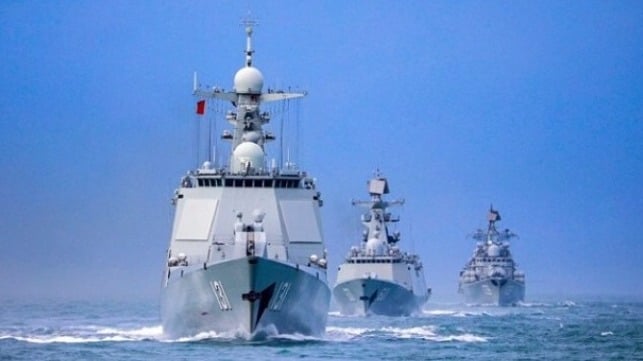
Chinese warships
PLA Navy file image

Published Feb 23, 2025 1:03 PM by The Strategist


[By Joe Keary]

Despite China’s rapid military improvements, it’s unlikely to use large-scale force against Taiwan in 2025. The Chinese leadership’s concerns over the quality of military command, economic weakening, uncertain social stability, and effects of the Trump administration will likely forestall any large-scale military maneuver.

However, China will continue to ramp up pressure against Taiwan in 2025.

On January 6, the United States’ new defense secretary, Pete Hegseth, told the Senate Armed Services Committee he believed a Chinese Communist Party fait accompli invasion of Taiwan was the pacing risk scenario for the Department of Defense. He reminded the committee that "Xi Jinping has openly expressed his intention to annex Taiwan to mainland China" and "has told his military to be prepared to use force to achieve such an outcome by 2027."

Like its successes in artificial intelligence, improvements in China’s military should not be underestimated. In several areas, China’s military is now reaching standards typical of the US military. China’s navy is transforming rapidly and by the end of 2025 is expected to have 395 ships, including three operational aircraft carriers. China is also improving its amphibious fleet, acquiring assault ships that can carry large numbers of landing craft, troops, fixed-wing drones, armored vehicles, and helicopters. In early 2025, there were reports of China building special barges that would support Taiwan landings.

China’s military now has the largest aviation force in the region, with new fighters and stealth aircraft that expand its ability to operate farther from its shores. It is also increasing its inventory of nuclear weapons and now has the world’s leading arsenal of hypersonic missiles. The army has increased the number of troops along the Taiwan Strait and improved its firepower, mobility, and rapid strike capabilities.

Throughout 2024, China’s military and coast guard continued to exercise Taiwan invasion and blockade scenarios. In May, following the inauguration of Taiwanese President Lai Ching-te, Beijing launched large-scale military exercises, surrounding Taiwan within two days. In October, it undertook a second series of drills, taking just one day to implement a mock blockade or quarantine of Taiwan. In December, China staged its largest show of force in decades, showing the world how it could repel a foreign force approaching Taiwan.

The military has dramatically improved its ability to conduct a blockade or invasion, but Beijing will still have doubts. During the release of the 2024 China Military Power Report, senior Pentagon officials said, "despite its rapid progress, the force has not yet demonstrated the type and scale of sophisticated urban warfare or long-distance logistic capabilities that would likely be required for operations against Taiwan." A lack of combat experience is a significant imposition for a force wanting to undertake complicated operations across the Taiwan Strait. Exercising will only get you so far.

Serious questions have also been asked about China’s officer corps and their ability to ‘judge situations, understand higher authorities’ intentions, make operational decisions, deploy troops, and deal with unexpected situations’. Corruption also remains an endemic issue, with China’s military experiencing a new wave of corruption-related scandals over the past two years that has led to the removal of two defense ministers and a high-ranking member of China’s Central Military Commission.

Domestic factors will also influence any decision to use military force. China is facing adverse demographic trends, including an aging population and low birth rates. There are other internal struggles, such as a trend of rising violence, following a string of indiscriminate mass attacks throughout 2024.

China is also seeking to manage a faltering economy, worsened by ballooning local government debt, a loss of investor confidence and the gradual collapse of its real estate sector. Beijing has struggled to stimulate domestic consumption, relying on its growing share of global exports to drive the economy. Researchers at Rhodium Group estimated that China’s GDP was only 2.4 to 2.8 percent higher in 2024 than a year earlier, well below the official claim of 5.0 percent growth.

China’s trade surplus reached a new high of nearly US$1 trillion in 2024. Beijing will be wary of the impact of a potential trade war with the United States. It will want to strengthen its trade relationships with other partners to reinforce its economy. China has already sought to recalibrate ties with Japan, India and Australia, while doubling down on its engagement with the Global South. Within this context, China will want to perform a careful balancing act over Taiwan. It will not want to damage international relationships by taking unnecessarily aggressive military actions.

Amid the problems, the leadership nonetheless probably has growing confidence that, if called upon, the military will be able to ‘resolve the Taiwan issue’. However, Xi probably hasn’t yet decided to use force against Taiwan.

2027 almost certainly remains a short-term goal for military modernization, not a date for a Taiwan invasion. Concerns over the economy and social stability will remain as key priorities for China’s leadership.

Xi will also want to carefully assess the Trump administration’s resolve on the Taiwan issue. Trump has hinted at a more transactional approach to Taiwan, suggesting it contribute more to its own security while still supporting Taipei’s right to self-defense. Trump is already threatening tariffs on Taiwan’s semiconductors.

In 2025, China’s military will continue to undertake exercises around Taiwan as part of a broader coercion campaign against Taipei. However, the likelihood of large-scale use of force against Taiwan in 2025 remains low.

Joe Keary is a senior analyst at ASPI. This article appears courtesy of ASPI's The Strategist, and may be found in its original form here

The opinions expressed herein are the author's and not necessarily those of The Maritime Executive.


Mysterious Airfield on Gulf of Aden is Now Fully Operational

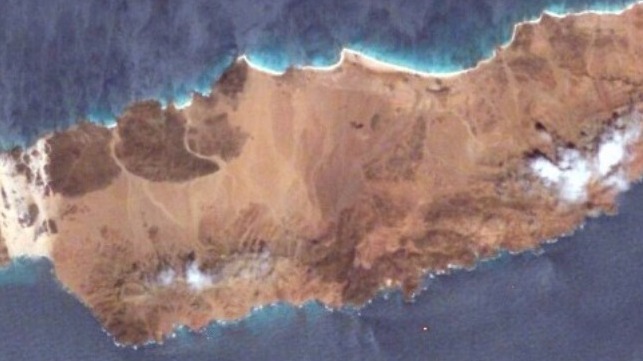
Abd Al Kuri
The eastern end of Abd el Kuri, before airfield construction began (NASA)

Published Feb 23, 2025 2:02 PM by The Maritime Executive


The airfield on Yemen’s Abd Al Kuri in the Socotra Archipelago now appears to be fully operational.

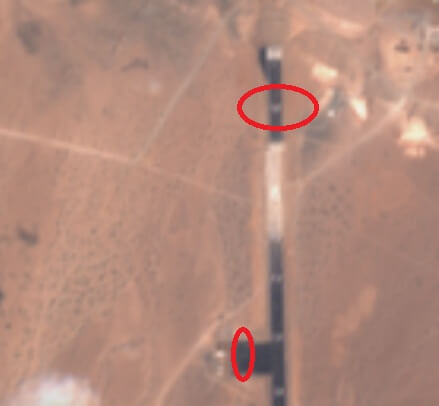
On February 16, the Sentinel 2 satellite caught a large transport aircraft on the northern end of the runway.  With the resolution available to common users, the aircraft configuration and wingspan is compatible with that of a C-17 transport aircraft.

The "missing" section of the runway at its northern end has been completed in concrete and now has white-painted runway markings similar to those applied to the rest of the runway. It appears that this section of runway has been constructed with concrete in order to bear the weight of heavy aircraft such as the C-17 on its impact with the runway at touch-down. Completing the whole runway in concrete to a similar load-bearing capacity would have been a considerable logistic challenge, given the lack of construction infrastructure and raw materials (including water) on the island.

Abd Al Kuri airfield on February 16, with a large transport aircraft on the northern end of the runway and the normal parking spot for a smaller regular aircraft visitor marked on the apron (Sentinelhub)

Over the last few weeks, the airfield has seen a regular visitor in the form of a smaller aircraft with a wingspan of less than 25 meters, which parks up on the airfield apron during its brief stay. It is not known where this aircraft is permanently based, or where the apparent operational activity on the island is being supported from. The new infrastructure may need to be protected by a garrison, and that in turn will need to be kept resupplied.

Iranian arms supplies to the Houthis using the sea lanes to the North of Abd Al Kuri appear to have resumed – if indeed they ever paused. On January 28, the U.S. Coast Guard Sentinel Class cutter USCGC Clarence Sutphin Jr (WPC 1147) intercepted a dhow in the Arabian Sea, with a consignment of ballistic missile and unmanned sea drone components, plus military-grade communication and network equipment and anti-tank guided missile launcher assemblies. From analysis of materiel seized on the dhow, the cargo appears destined for the Houthis. 

On February 12, the Yemeni Coastguard intercepted a vessel with a 40-foot container on board, destined for Hodeidah. It contained cruise missile fuselages and jet engines used in cruise missiles and suicide drones, reconnaissance drones, marine radars, a modern electronic warfare jamming system, and an advanced wireless communications system. If reconnaissance activities are being carried out from Abd Al Kuri, this will aid further such interceptions..  


Hungary Begins Construction of Sovereign Port in Northern Italy

THE REGION IS THE ORIGIN OF BROTHERS OF ITALY FASCISTS

Trieste port
Courtesy Adria Port Zrt.

Published Feb 23, 2025 2:32 PM by The Maritime Executive


Landlocked Hungary’s quest for access to the sea is nearing completion with the launch of construction of a new seaport in Trieste, Italy, 140 miles and two nations away from Hungary's border. Hungarian Deputy Foreign Minister Levente Magyar attended the groundbreaking ceremony last week in the company of the Italian Deputy Minister for Infrastructure, Edoardo Rixi.

Hungary announced the port project back in 2019 after the purchase of an 80-acre seafront site in Trieste. At the time, the transaction was valued at $32 million under a 60-year concession contract. The first phase of the port includes building a 250-meter quay wall, to be later expanded by about 400 meters, giving Hungary a total of 650 meters of coastline on the Adriatic Sea.

Adria Port Zrt., a Hungarian state-owned company, is entrusted with developing the Trieste Port project. The $209 million facility is expected to be operational by 2028. It will have capacity for 78,000 TEU of cargo a year. A logistics center is also planned at the site to streamline the movement of goods. Trieste is a strategic location for a Hungarian seaport, given its proximity and reliable rail and road connection to Hungary.

“Hungary exports cargo worth around $155 billion every year, with majority of them leaving Europe by sea. If the country does not have its own sea exit and seaport capacity, it will always be at the mercy of others. We would like to change this situation, because Hungary, as the 34th largest exporter in the world, must have channels to connect to global supply chains,” said Levente Magyar.

Hungary lost its sea access in 1920 after conceding defeat in the World War I. This led to the signing of the Trianon Treaty, which saw Hungary lose two-thirds of its former territory, including a vast coastline.

In the recent past, Hungary has intensified cooperation with its coastal neighbors for maritime access. Last month, Hungarian Minister for National Economy Márton Nagy met Bulgarian President Rumen Radev for economic talks. This saw the signing of cooperation agreements in the transport sector. The partnership will lead to the creation of a simplified logistics and transport corridor linking Hungarian businesses with Bulgarian ports and free zones in the Black Sea. The Hungarian government has said that Bulgaria is a critical partner for its energy security, providing a transit route for Russian, Turkish and Azerbaijani natural gas supplies by pipeline.  


Chinese Live-Fire Drills in Tasman Sea Disrupt Commercial Air Traffic

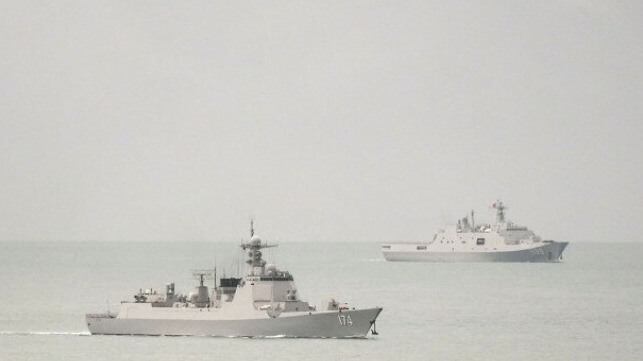
PLA Navy warships
PLA Navy file image

Published Feb 23, 2025 7:07 PM by The Maritime Executive


After the PLA Navy carried out two days of snap live-fire drills in the Tasman Sea, forcing the diversion of several passenger jets, China has expressed dismay at the Australian government's displeasure. 

"The relevant remarks from the Australian side are completely inconsistent with the facts," Chinese foreign ministry spokesman Wu Qian, stating that there was no impact on air traffic safety. "Australia, fully knowing this, made unreasonable accusations against China and deliberately hyped it up."

Last Tuesday morning, the Chinese PLA Navy radioed a direct warning to Flight UAE3HJ from Sydney to Christchurch and instructed the aircraft to change course. Air traffic controllers in Australia and New Zealand made the same recommendation to other airlines, and multiple flights were diverted around the area of the Chinese exercise. 

Naval forces may conduct drills in international waters at will, and Australia's government acknowledged that the PLA Navy had done nothing illegal. However, it is customary for safety purposes to give at least 12-24 hours of advance notice to civil aviation. 

Australian Defense Minister Richard Marles said Friday that Australia is still waiting on "a satisfactory answer from China as to the question of the notice."

China insists that no aircraft were at risk, and as a practical matter, planes were able to avoid the area. Still, Australia's pilots' association suggested that the location of the exercise could have been planned to be less disruptive. 

"It's a big bit of ocean and you would think that they could have parked somewhere less inconvenient whilst they flexed their muscles," Australian and International Pilots Association VP Captain Steve Cornell told DWS.


Scientists track evolution of pumice rafts after 2021 underwater eruption in Japan


Insights to inform disaster response after future eruption events


Tokyo Metropolitan University

Different types of pumice found on shorelines after the 2021 eruption, and attached biological species. 

image: 

 Different types of pumice found on shorelines after the 2021 eruption, and attached biological species.
From A to H, light-gray pumice, black pumice, brown pumice, gray-banded pumice, black-and-white-banded pumice, white pumice, pink pumice, and obsidian-bearing pumice. I, J, and K show goose barnacles, bryozoans, and coral. Scale bars in A-J are 50 mm; scale bar in K is 10 mm.

view more 

Credit: Tokyo Metropolitan Universit


Tokyo, Japan – Researchers from Tokyo Metropolitan University have carried out an unprecedentedly detailed survey of pumice rafts in the aftermath of the 2021 Fukutoku-Oka-no-Ba volcanic eruption in Japan. Using samples from 213 different locations, they considered raft density, the size and roundness of individual pumice, and biological species attached. Their findings revealed three phases in the evolution of drift pumice, involving rounding, fragmentation, and the diversification of attached biological organisms over time.

It is said that 85% of volcanic eruptions happen underwater. While their cousins on land might seem more vivid, the effects of underwater eruptions can be just as devastating: think shockwaves and tsunamis. In 2021, a volcanic eruption under the sea in Fukutoku-Oka-no-Ba in Japan caused mass disruption to ports, ships, and fisheries through the vast amounts of pumice that was produced, creating enormous “pumice rafts” which floated over the sea and deposited on land. Massive pumice raft events like this may be relatively rare, occurring once every ten years or so, but when they do, they can have a devastating effect on everyday lives and livelihoods. Understanding how pumice and pumice rafts evolve as they come over the sea is an important mission for scientists as they try to understand the risks and mitigate their impact on shoreline communities.

A team led by Assistant Professor Daisuke Ishimura have undertaken an unprecedentedly detailed survey of drift pumice from this event, sampled over a year from 213 different shoreline locations in Japan, Thailand, and the Philippines. Since the eruption happened close to an archipelago, it was possible to extensively sample pumice which had washed up over the many islands over time. They focused on the amount of deposit per area, the roundness of individual pumice, and the biological species which were found attached. Drift pumice is also known for its ability to transport species over vast distances; the researchers’ data shed a rare light on when and how this can occur.

The team found that the rafts evolved over three different phases. In the first sixty days or so, pumice rafts are densely packed, leading to lots of collisions between individual pumice as they float on the sea surface. Sharp edges are shaved off, and the pumice is rapidly rounded, as shown directly from the changes in roundness for samples taken after the event. The collisions also make it harder for organisms to attach to the pumice; only goose barnacles are found attached at this stage. After this first phase, pumice continue to fragment and the maximum size of pumice in the rafts decreases, along with the density of the raft as smaller pumice sink. However, newly fragmented pumice clearly tends to round quickly, as the roundness of the pumice remains constant. Bryozoans (simple aquatic invertebrates) join the goose barnacles, but the biodiversity remains relatively low. It is only in the third phase, after 210 days or so, that the biodiversity explodes. The density of pumice on the sea is now low enough that collisions are far less frequent, giving organisms like bivalves and coral a chance to make a home for themselves. This is around the time that rafts are no longer formed.

While individual aspects, like pumice becoming round on the sea, have been noted before, this is the first time that time lapse evidence has been used to put such processes on solid ground. The team hopes their findings inform disaster mitigation efforts in the aftermath of future events.

This work was supported by JSPS KAKENHI Grant Numbers JP21H00631, JP24K00173, JP22J14775, and JP22KJ2555, and a Sasakawa Scientific Research Grant from the Japan Science Society.


Evolution of pumice and pumice rafts after eruption. The team identified three phases of evolution of raft density, pumice size, roundness, and attached biological organisms.

Credit

Tokyo Metropolitan University

Israeli tanks enter West Bank for first time in decades as minister says Palestinians can't return

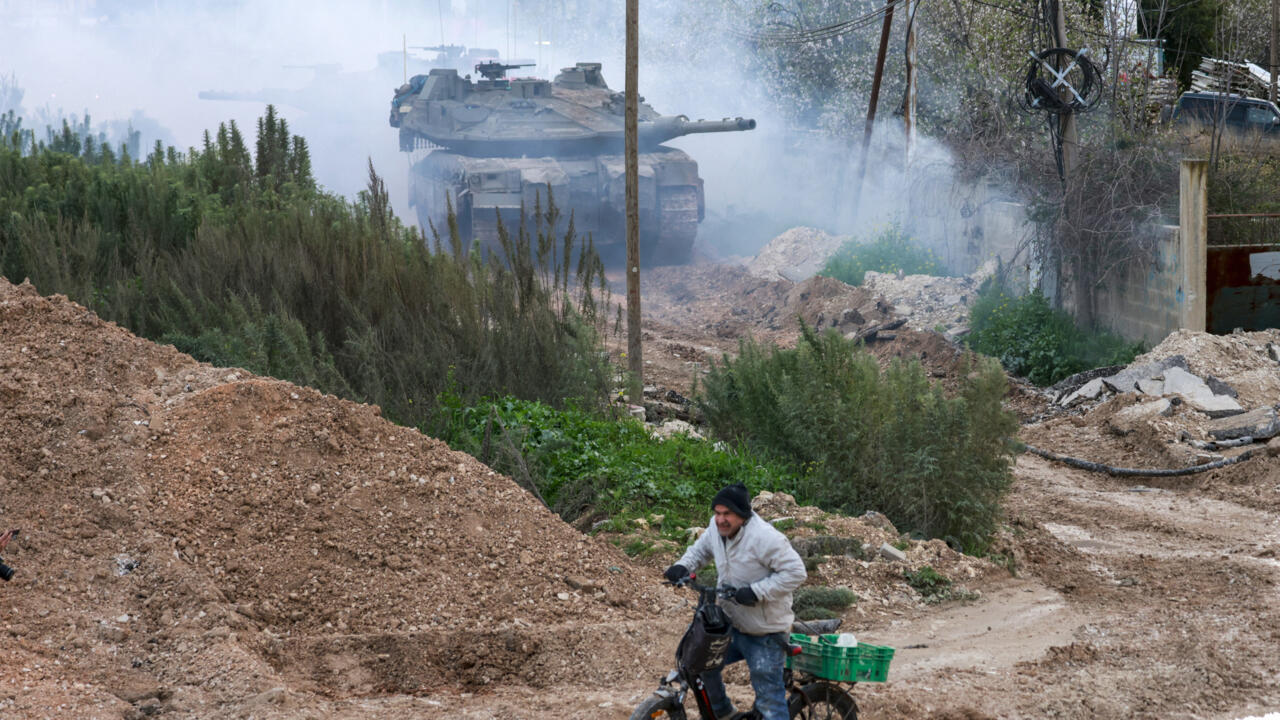
Israel sent tanks into the West Bank city of Jenin on Sunday in the first offensive of its kind in the area in more than two decades. Israeli Defense Minister Israel Katz said troops would remain in parts of the territory for a year, and that the tens of thousands of residents who have fled will not be "allowed" to return.


Issued on: 23/02/2025 - 
By: FRANCE 24
Video by Charlotte HUGHES

01:33
A man rides a bicycle as Israeli tanks enter the Jenin camp for Palestinian refugees in the occupied West Bank on February 23, 2025. © Jaafar Ashtiyeh, AFP


Israeli tanks moved into the occupied West Bank on Sunday for the first time in decades in what Palestinian authorities called a “dangerous escalation,” after the defense minister said troops will remain in parts of the territory for a year and tens of thousands of Palestinians who have fled cannot return.

Associated Press journalists saw several tanks move along unpaved tracks into Jenin, long a bastion of armed struggle against Israel.

Israel is deepening its crackdown on the Palestinian territory and has said it is determined to stamp out militancy amid a rise in attacks. It launched the offensive in the northern West Bank on January 21 — two days after the current ceasefire in Gaza took hold — and has expanded it to nearby areas.

Palestinians view such raids as part of an effort to cement Israeli control over the territory, where 3 million Palestinians live under military rule. The deadly raids have caused destruction in urban areas.

Israeli Defense Minister Israel Katz said he and Israeli Prime Minister Binyamin Netanyahu ordered the military to “increase the intensity of the activity to thwart terrorism" in all refugee camps in the West Bank.

“We will not allow the return of residents, and we will not allow terrorism to return and grow,” he said.

Earlier, Katz said he had instructed the military to prepare for “an extended stay” in some of the West Bank's urban refugee camps, from where he said about 40,000 Palestinians have fled, leaving the areas “emptied of residents.” That figure was confirmed by the United Nations.

01:55


The camps are home to descendants of Palestinians who fled or were forced to flee during wars with Israel decades ago. It was not clear how long Palestinians would be prevented from returning. Katz said the troops would stay “for the coming year.” Netanyahu said they would stay “as long as needed."

Tanks were last deployed in the territory in 2002, when Israel fought a deadly Palestinian uprising.

The Palestinian foreign ministry called the Israeli moves “a dangerous escalation of the situation in the West Bank,” and urged the international community in a statement to intervene in what it termed Israel's illegal “aggression.”

“Even if they stay, we will return to the camp at the end,” said Mohamed al-Sadi, one of those displaced from Jenin. “This camp is ours. We have no other place to go.”

Under interim peace agreements from the early 1990s, Israel maintains control over large parts of the West Bank, while the Palestinian Authority administers other areas. Israel regularly sends troops into Palestinian zones but typically withdraws them once missions are completed.

The UN says the current Israeli military operation is the longest since the Palestinian uprising of the early 2000s.

Violence has surged in the West Bank throughout the Israel-Hamas war in Gaza. Israel has carried out raids, but with fighting in Gaza and Lebanon on hold, Netanyahu has been under pressure from far-right governing partners to crack down on militancy in the West Bank.

01:31

More than 800 Palestinians have been killed in the West Bank since the war in Gaza erupted on October 7, 2023, with a Hamas attack on southern Israel. Israel says most were militants, but stone-throwing youths protesting the incursions as well as people not involved in confrontations have also been killed. In the most recent operation, a pregnant Palestinian woman was killed.

Jewish settlers also have carried out rampages in Palestinian areas in the territory. There has also been a spike in Palestinian attacks emanating from the West Bank. On Thursday, blasts rocked three empty buses in Israel in what police view as a suspected militant attack.

Read moreNetanyahu orders 'intensive' West Bank operations after Israel bus blasts

Israel captured the West Bank, Gaza and east Jerusalem in the 1967 Mideast war. Palestinians want all three territories for their future independent state.

The West Bank raids come at a sensitive time, as the truce between Israel and Hamas in Gaza remains tenuous.

With a week left in the ceasefire’s first phase, Israel and Hamas do not appear to have begun negotiations on its second one. The truce’s collapse could lead to renewed fighting in Gaza, where Netanyahu said 63 hostages remain, including the remains of a soldier captured in 2014.

“We are ready to return to intense fighting at any moment," Netanyahu said Sunday.

The US special envoy for the Middle East, Steve Witkoff, told CNN on Sunday he expects the second phase to go forward, adding: “We have to get an extension of phase one and so I’ll be going into the region this week, probably Wednesday, to negotiate that.” He told CBS he will visit Qatar, Egypt, Israel, the United Arab Emirates and Saudi Arabia.

11:26


Israel said early Sunday it was delaying the latest release of hundreds of Palestinian prisoners until it gets assurances that Hamas stops what Israel calls “humiliating” handovers of hostages.

The 620 prisoners should have been released shortly after six Israeli hostages in Gaza were freed Saturday — five of them in staged ceremonies criticized by the US and Red Cross as cruel.

Palestinian family members were distraught. “What have the prisoners done? We don’t know what happened. They killed our joy,” said one mother, Najah Zaqqot.

Meanwhile, Netanyahu faced new criticism over the war while speaking at a military graduation. As he held up a picture of Shiri Bibas and her young boys, Ariel and Kfir, whose remains were returned from Gaza last week, to demonstrate “what we are fighting against,” audience members called out “Shame!” and “Why didn’t you save them?” The prime minister didn’t react.

(FRANCE 24 with AP)
‘Worst is over’ as Chile’s ‘stolen’ babies reunite with mothers


By AFP
February 22, 2025


Adamary Garcia and her mother Edita Bizama reunited in Chile 41 years after her birth - Copyright AFP RODRIGO ARANGUA

Pedro Schwarze with Moisés Ávila in Houston and Jesús Olarte in Miami

Four decades after they were cruelly forced apart, US-raised Adamary Garcia and her birth mother fell into each other’s arms Saturday at the airport in Santiago, Chile.

Without speaking, they embraced tearfully: A rare reunification for one the thousands of Chileans taken from their mothers as babies and given up for adoption abroad.

“The worst is over,” Edita Bizama, 64, said as she beheld her daughter for the first time since her birth 41 years ago.

Garcia had flown to Santiago with four other women born in Chile and adopted in the United States.

Reports have estimated there were 20,000 such cases from 1950 to 1990 — most of them during the military dictatorship of Augusto Pinochet.

Garcia lives in Puerto Rico, where she works in the financial sector. On her way to reunite with her biological family, she spoke to AFP at a hotel in Houston.

She broke down in tears as she recounted how, as a child, she accidentally found out she was adopted, and then tried for years to shelve the knowledge, before finally making peace with it.

“I am fortunate. I have my mom and dad (in the United States), and now I have another mom and three brothers” in Chile, she said.

Last October, a DNA test confirmed her origins and Garcia arranged to meet her birth mom through the foundation Connecting Roots, which has so far reconnected 36 Chilean women with children taken from them against their will.

– ‘Trickery, threats and coercion’ –

Infants were taken from their mothers in Chile in a money-making scheme involving doctors, social workers and judges, according to investigations into the matter.

They were delivered to foreign adoptive parents, in some cases for as much as $40,000.

“How were these children taken? Some were (falsely) declared dead at birth, others were stolen from hospitals and institutions or taken from mothers who were manipulated and pressured into giving them up for adoption through trickery, threats and coercion,” Connecting Roots vice president Juan Luis Insunza told AFP.

Before Saturday’s reunion, Bizama recounted how she was bullied into giving up her newborn daughter by a social worker who told her she could not adequately care for another child.

She was 23 years old at the time, with two other children and a job as a domestic worker, she told AFP in her home city of San Antonio, some 100 kilometers (62 miles) from Santiago.

The father of the child had left her.

“Then they took the baby, and once everything (the paperwork) was done, they sent me away… I left, looking around, not knowing what to do. I wanted to run and find my baby, but it was already done.”

Bizama said she “never forgot” about Adamary, even though she did not know even her name.

“She was always here in my mind, in my heart. That’s why now I call her ‘daughter of my heart’.”

For Garcia, whose search started last year after she read an article about baby thefts in Chile, “it has been complex to process this new reality,” in which she regards both her birth and adoptive mothers as victims.

But from the first video call with Bizama, she said, she felt “only love.”

– ‘Out of the blue’ –

In Coconut Creek, Florida, the apartment of Adamary’s adoptive mother Doria Garcia’s abounds with photos of her daughter at different ages.

The 80-year-old Cuban-American told AFP how in 1984, she traveled to Chile to receive her three-month-old daughter, after completing “the usual procedures.”

“I have her little face ingrained in my memory: when they handed her to me, smiling,” the retired medical assistant recalled.

“And when I held her in my arms, I swear it felt like my heart was bursting.”

With pride she describes her daughter as a professional with a good job, but above all “happy.”

It was through Adamary’s journey that she learned about Chile’s stolen babies, she said, and expressed gratitude that her daughter has found a “family that, out of the blue, appears when she’s already 41 years old.”

burs-ps/mlr/acb


Cambodia to resume demining after US aid waiver

AFP
February 21, 2025


A deminer from the Cambodian Mine Action Centre examins an unexploded bomb unearthed by a worker during irrigation work in Svay Rieng province in early February 2025 - Copyright AFP/File TANG CHHIN Sothy

Cambodian deminers are to resume operations to clear unexploded munitions, after the United States granted a waiver to keep funding the work in the country, officials said on Friday.

Cambodia remains littered with unexploded bombs, many of which were dropped by American forces during the Vietnam War.

Cambodia was forced to partially suspend demining operations from late January after Washington suddenly halted funding following President Donald Trump’s order to freeze foreign aid for 90 days.

Heng Ratana, director general of the Cambodian Mine Action Centre (CMAC), told AFP on Friday that the US had granted a conditional waiver for funding to partner organisations supporting Cambodia’s demining projects.

He said he had sent deminers, who had been standing down for the past several weeks, back to the field and that operations to clear unexploded munitions would resume on Monday.

“We are happy to resume our mission to save lives,” Keo Sarath, manager of CMAC’s demining unit 5 headquarters, which is responsible for clearing along eastern provinces bordering Vietnam.

The United States has been a “key partner” and provided around $10 million a year to fund mine clearance in Cambodia.

Ly Thuch, a senior government minister and leading official in Cambodia’s Mine Action Authority, confirmed the US embassy had informed the foreign ministry about the continuation of demining funding.

He said deminers would soon be able to resume full-scale operations.

During the Vietnam War, then-US president Richard Nixon ordered a clandestine bombing campaign over large swathes of Laos and Cambodia, which helped fuel the rise of the Khmer Rouge.

After more than 30 years of civil war ended in 1998, Cambodia was left as one of the most heavily mined countries in the world.

Deaths from the war remnants are still common, with around 20,000 people killed since 1979, and twice that number wounded.

More than 1,600 square kilometres (620 square miles) of contaminated land still needs to be cleared in Cambodia.

Cambodia had aimed to be mine-free by 2025, but the government pushed the deadline back by five years because of funding challenges and new landmine fields found along the Thai border.

Trump tariffs leave WTO adrift in eye of the storm


By AFP
February 21, 2025


The WTO headquarters at the Centre William Rappard in Geneva, Switzerland - Copyright AFP Yuichi YAMAZAKI

Agnès PEDRERO

The World Trade Organization’s entire mission is overseeing global trade, but US President Donald Trump’s tariff offensive has left it adrift.

Cedric Dupont of the Geneva Graduate Institute, an international relations professor and an expert in trade policies, law and the WTO, told AFP that Trump’s moves had put the global trade body centre-stage but powerless to act.

– Why is the WTO being undermined? –

Dupont: “The basic idea of the WTO, to guarantee predictability in world trade, is totally ruined by Donald Trump’s attitude. Everyone is starting to wonder what is the point of having invested so much time in trade negotiations.

“It finds itself somewhat in the eye of the storm. The people working at the WTO must feel quite helpless and a little dejected.”

– Trump increased tariffs before; is the WTO more ready now? –

Dupont: “The WTO has been weakened for several years. This worsened during the first Trump administration, as the legal settlement of disputes was paralysed because there are not enough judges on the appellate body” — their appointment being blocked by Washington.

“With no avenues of appeal any more, procedures cannot be followed through, whereas at the start of the first Trump administration, this possibility was always available.

“The WTO is now even more helpless and can no longer resolve trade disputes involving the United States.

“What was strong about the WTO was that it allowed trade retaliation to bring its members back on track. This framework seems to have disappeared completely.”

– Does the US tariff offensive sink the multilateral trading system? –

Dupont: “The future of multilateralism in trade is clearly in question. Essentially it will depend not on the United States, but on other countries: to what extent are other countries going to continue working together within the WTO?

“There might be danger for the WTO with an inflationary spiral of customs duties, but maybe it’s also an opportunity for other countries to show this is not how problems should be resolved.

“However, if member states do not provide the impetus, the WTO will not move. The organisation itself has very little room for manoeuvre, unlike many UN agencies, such as the World Health Organization (WHO); or the World Bank and the International Monetary Fund.”

– Are tariff wars new for the WTO? –

Dupont: “There have always been customs threats. The WTO’s goal is to make sure protectionist moves are only temporary. The idea is to push countries to follow the rules — to maintain the organisation’s legitimacy. But it is unclear whether this will actually happen under the second Trump administration.”

– Could Trump withdraw from the WTO? –

Dupont: “I would sooner bet on him not doing so because the WTO is not expensive for the United States. The WTO’s overall budget is ridiculously low ($227 million in 2024) compared to the WHO ($3.4 billion in 2024).

“Trump might say that it doesn’t cost him much — and besides, he can depart from the rules and do whatever he wants, in some ways.

“The WTO can’t hurt him, because the appellate body is paralysed: there’s nothing that’s going to be legally binding. I think he’s pretty comfortable with that.”