Monday, February 24, 2025

New form of e-waste: Discarded robots are contributing to environmental pollution


By Dr. Tim Sandle
February 22, 2025
DIGITAL JOURNAL


Innovations in solar energy. Image by © Tim Sandle (Barbican, London).

Scientists have called on robots to be repurposed rather than recycled. This measure is to combat the rising scale of e-waste. Instead, the robotics industry should be creating robots that could be reprogrammed and repurposed for other tasks once their life span is completed, researchers from the University of Bristol have advised.

It is estimated that 80 percent of a robot’s environmental impact is decided during its initial design phase, experts argue it is essential that researchers, designers and manufacturers understand the limitations of recycling an electronic product at the end of its life.

To lower environmental pollution, the development process needs to consider the alternate options to create products that can be reused or more effectively recycled. Through this, the industry can edge towards a more sustainable lifecycle.

In most nations, robots and robotic systems are not classed as electronic waste. This needs to change and it is likely that, in the future, legislation will require robots to be recycled and reused. With this classification will come additional scrutiny of the robotics industry and the way it designs and plans end-of-life for electronic robotic products.

As with other electronic products, there are and will be a variety of options for what to do with a robot when it reaches the end of its primary life. Currently, many businesses, research centres and universities ‘hibernate’ their robotic electronic waste — where e-waste is stored for a period without being used – or it is simply discarded using conventional municipal waste collection systems.

The concept of repurposing, compared to reuse, refers to how robotic systems can be fully reprogrammed and integrated with new hardware. This results in a product which is still a robot, but one with a different utility to the original.

Helen McGloin from Bristol’s School of Engineering Mathematics and Technology explains further: “Regardless of being in industry, academia, or the general public, we are all aware of the growing piles of e-waste produced around the globe.”

McGloin adds: “This research summarises the growth of electronics waste levels and the hazards to the planet and people this is causing. The Global e-waste monitor produced by the UN highlights in 2019 alone 54 million metric tons of e-waste were produced, and this is expected to rise to 75 million metric tons by 2030.”

Greater efficiency of design and economics comes from repurposing. Here McGloin outlines: “While recycling may seem like an easy option to tackle electronic waste, it is so often miss-managed that alternatives must be sought…[we] look to challenge all those in the robotics industry to think creatively and pre-emptively into designing for a circular economy.”

Her team have highlighted a variety of challenges to implementing repurposing in the robotics industry such as assessing economic and environmental viability, proving technical capability of repurposing robots, addressing attitudes towards the circular economy through use of incentives and legislation.

The researchers will next investigate consumer attitudes towards secondhand robots, industry attitudes towards e-waste, right to repair, repurposing and the circular economy as well as the processes to repurpose robots and barriers to a circular economy in the robotics industry.

The recommendations appear in the journal Towards Autonomous Robotic Systems, in a paper titled “Consulting an Oracle; Repurposing Robots for the Circular Economy.”

Quantum literacy is Canada’s next tech gap. NAIT and Qubo want to fix it


ByJennifer Friesen
February 21, 2025


Photo by Planet Volumes on Unsplash

If the term “quantum computing” makes you think of sci-fi movies or expensive lab experiments, you’re not alone. But in reality, quantum technology is moving fast — and most industries aren’t ready.

That’s a problem, say Katanya Kuntz and A.J. Sikora, co-founders of Qubo Consulting Corp. Since their launch in 2023, the duo has been working to close the gap between quantum scientists and the business world, making the case that quantum literacy is no longer optional.

“The first movers are going to gain the majority of the opportunity,” says Sikora. “The people who sit on their hands and wait until a quantum computer breaks RSA encryption before they start investigating are going to struggle to get access to talent and technology.”

To get ahead of the curve, Qubo has partnered with the Northern Alberta Institute of Technology (NAIT) to launch two new certificate programs to make quantum more accessible to professionals across Canada.

What is quantum computing, and why does it matter?

Before diving into why quantum literacy is so urgent, let’s clear up one thing: what exactly is quantum computing?

For decades, computers have run on classical bits, which can be either zero or one — like flipping a light switch on or off. Quantum computers, on the other hand, use qubits, which can exist in both zero and one at the same time thanks to a principle called superposition. This allows quantum computers to process multiple possibilities simultaneously, instead of one at a time.

Then there’s entanglement, another uniquely quantum phenomenon that allows qubits to become linked, meaning a change to one qubit instantly affects another, no matter how far apart they are.

The result? Quantum computers have the potential to solve complex problems that would take today’s supercomputers millions of years to crack. This could revolutionize industries like drug discovery, finance, logistics, and cybersecurity.

“When I understood the magnitude of the paradigm shift that we’re going to see when quantum computers come online, I knew that everybody needed to know about this,” says Sikora. “I’m a pretty tech savvy guy — I have the latest iPhone — but I had never heard of this … and I don’t think your average businessman knows about this either. But I understood the potential impact on security and national sovereignty, so Katanya and I decided, ‘Let’s make an impact in this space.’”

Meet the experts making quantum accessible

Qubo’s mission is to make quantum computing, and other quantum technologies, understandable and actionable for business leaders, engineers, and policymakers.

Kuntz, a quantum physicist, has spent years explaining complex concepts to everyone from CEOs to grade-school students.

“Being a quantum scientist, I’ve had to go to a dinner party, and everyone’s going around the room saying what their career is — I drop ‘quantum physicist’ and half the people leave the room,” she jokes. “So I’ve had to be able to communicate what I do to a broad range of audiences, just in my own everyday life.”
Katanya Kuntz. Photo courtesy of the Wave Tech Centre

She also works on Canada’s first quantum communication satellite mission (QEYSSat) and has given outreach talks explaining quantum principles to fourth graders. And if she can make a bunch of kids excited about photons in space, why not help an executive understand how quantum computing affects their business?

Sikora, meanwhile, comes from an education and business background. His experience in training and curriculum design means Qubo’s programs are structured to actually teach people what they need to know.

“Katanya and I really have complementary skills, and it shows in some of these projects,” says Sikora. “There are a ton of quantum experts that can talk about quantum, but it’s how they explain quantum. It’s like, A) Is it applicable to me? And B) Can I understand it, even if it is?”
NAIT steps in with executive and engineering training

NAIT, a polytechnic focused on applied learning, is offering one of Canada’s first continuing education programs in quantum training for professionals.

The courses are offered through Continuing Education and Corporate Training, which allows NAIT to respond quickly to industry needs with non-credit programs designed for upskilling and reskilling.

“We want to stay in the forefront,” says Surinder Padem, program manager for digital literacy and IT training at NAIT. “And in continuing education, we can move quickly to bring programs in front of students as industry needs change.”

The two certificate programs — Quantum for Executives and Quantum for Engineers — are designed for different levels of technical experience.Quantum for Executives is a four-part series of one-hour “lunch and learn” sessions designed for business leaders who need a clear, non-technical introduction to quantum. It covers industry applications, cybersecurity risks, and why quantum is a game-changer across sectors.
Quantum for Engineers is a deeper dive, offering four two-hour sessions for technical professionals looking to understand quantum computing, sensing, secure communication, and data security. No prior quantum experience required.

Both programs are delivered live online, making them accessible across Canada. The first round kicks off on February 27, with additional sessions scheduled through the spring.

According to Sikora, the programs are ideal for tech professionals looking to specialize, such as software engineers, data scientists or analysts and hardware engineers. They’re also a fit for entrepreneurs, startup founders, and tech leaders looking for insights into how quantum will shape the industry. The courses also cater to government and policymakers making decisions around cybersecurity and national security.

But ultimately, Sikora notes, “anybody with a strong interest in emerging technologies” can benefit — whether they’re in the field or simply fascinated by what’s coming next.A.J. Sikora. Photo courtesy of the Wave Tech Centre
Don’t wait for quantum to disrupt your industry

Kuntz and Sikora say they designed the courses to be practical, engaging, and directly relevant to Canadian industries.

“Every time we have a conversation with someone, nine times out of 10, unless they’re a quantum physicist, I have to explain: what is quantum?” says Kuntz. “So that’s what these NAIT courses are doing. They’re starting that conversation.”

The urgency isn’t just theoretical. Earlier this year, Canadian quantum computing company Xanadu introduced Aurora, a modular photonic quantum computer designed for large-scale scalability. The company has long-term ambitions to develop fault-tolerant quantum computing, with earlier reports indicating a goal of reaching one million qubits by the end of the decade. While no updated qubit target has been confirmed, if that timeline holds, the shift to quantum could be closer than many expect.

“Do you see how the computer changed everything back in the 60s and the 70s?” asks Kuntz. “That’s the type of technology change that we’re talking about.”

Sikora warns that businesses slow to adopt quantum literacy could find themselves playing catch-up — especially when it comes to security.

“With computing power comes the risk that a quantum computer could come online that could break current encryption standards that we use,” he says. “So there are a couple of solutions available, and it’s important for businesses to understand what those threats and solutions are.”

With the United Nations declaring 2025 the International Year of Quantum Science and Technology, the momentum behind quantum is only growing.

And with the launch of NAIT’s new programs, Canadian professionals have a chance to get ahead of the curve before it’s too late.

For more information, visit here.


Written ByJennifer Friesen
Jennifer Friesen is Digital Journal's associate editor and content manager based in Calgary.

Venture capital investment in Canada hits more than $7B across 592 deals


By Jennifer Kervin
February 22, 2025


Photo by Warren on Unsplash

While seed-stage investment continues to struggle in Canada, late-stage investments were in the driver’s seat for this year’s venture capital (VC) deals.

According to the Canadian Venture Capital and Private Equity Association’s (CVCA) 2024 VC market overview, investments reached $7.86 billion across 592 deals — $1.4 billion of this taking place in the final quarter of the year.
Later-stage investments drive market activity

A handful of large-scale deals had an outsized influence on the year’s total investment. In fact, mega-deals (i.e., $50M and above) accounted for 62% of all dollars invested in 2024.

Clio’s $1.24 billion CAD growth-stage round was one of the biggest — not just of the year, but the largest round ever closed in Canada — highlighting the ongoing trend of investors favouring more mature companies with established track records.

The largest Q4 deal was from Montreal’s Blockstream, raising $290 million via convertible note.

Meanwhile, early-stage funding showed signs of strain. Seed-stage startups raised just $510 million across 201 deals, down nearly half from $958 million in 2023. The decline underscores the challenges newer companies face in attracting capital amid a shifting investment landscape.

“There’s no question that capital is available for later-stage companies, and we continue to see investors backing more mature companies and proven Canadian innovators,” Kim Furlong, CEO of the Canadian Venture Capital and Private Equity Association (CVCA), said in a statement.

“However, we are seeing ongoing constraints at the pre-seed and seed stages. This decrease is significant for future rounds of financing, ensuring a healthy pipeline of early-stage companies is critical to long-term ecosystem strength.”
The breakdown

The information and communications technology (ICT) sector dominated, drawing $4.49 billion across 285 deals. Life sciences followed with $1.38 billion, while cleantech secured $1.07 billion. These three sectors accounted for the bulk of total venture capital deployed in Canada over the year.

Bringing geography into the mix, Ontario, Quebec, and British Columbia accounted for 88% of all dollars invested and 76% of all deals closed in 2024. This translates into nearly $7 billion across 448 deals. Here’s how that looks for each province:Ontario ($2.5B, 252 deals)

Quebec ($2B, 108 deals)

BC ($2.5B, 88 deals)

Not far behind BC’s 88 deals is Alberta, which saw $698 million invested across 84 deals. How did the rest of Canada fare? Here’s a breakdown:Nova Scotia ($79M, 18 deals)
New Brunswick ($15M, 15 deals)
Saskatchewan ($31M, 13 deals)
Newfoundland and Labrador ($81M, 9 deals)
Manitoba ($2M, 4 deals)
Prince Edward Island ($1M, 1 deal)

On the exit front, Canadian companies saw $5.17 billion across 40 deals. Mergers and acquisitions made up the majority of exits, with the $3.26 billion acquisition of Fusion Pharmaceuticals by AstraZeneca standing out as the largest disclosed deal of the year.
What’s next for Canadian startups?

While later-stage companies continued to attract funding and exit opportunities, the slowdown in early-stage investment remains a concern for the long-term strength of Canada’s innovation pipeline.

Canada’s political and economic future is in a very headline-grabbing shift, and with a federal election most likely on the horizon, the question of how to increase and support innovation and high-growth companies has become an important policy debate.

As Furlong writes in her letter prefacing the overview, “We can no longer afford to stumble through conflicting policies and short-term fixes. It’s time to unleash Canada’s ambition with a bold, strategic plan, a concrete industrial policy that clears the path for private investment, empowers pension funds to grow the economy at home, and ensures Canada’s industries lead on the global stage.”
l


Written ByJennifer Kervin
Jennifer Kervin is a Digital Journal staff writer and editor based in Toronto.

Can Canadians get the world drinking tree sap?


Keena Al-Wahaidi
Business reporter
Reporting fromToronto
BBC
FEB 23, 2025
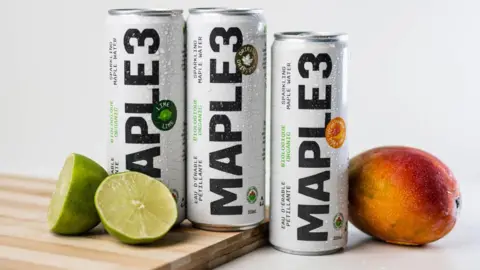
Maple3
Canadian brand Maple3 makes still, sparkling and flavoured maple water

While drinking tree sap does not immediately sound appealing, Canadian producers are hoping that it will be the next must-try soft drink around the world.

We have all heard of maple syrup, which is made by boiling down the sap of maple trees to produce a thick, sweet, golden-to-brown coloured syrup that is typically poured over pancakes.

What is far less well known is that you can drink the sap itself, which is called maple water. Clear in colour, it contains just 2% natural sugars, so it is only slightly sweet.

A small but growing number of producers in Canada are now selling this maple water in bottles or cartons, after first giving it a filter and pasteurisation to kill off any microbes.


"People feel like they're drinking the wild Canadian forest," says Yannick Leclerc of Maple3, a producer of maple water drinks, based in Quebec City.

Advocates point to the fact it is a natural drink, and makers hope that it can steal some sales from the existing similar product – coconut water. The latter is made from water that naturally forms inside coconuts.

As Canada is far and away the world's largest producer of maple syrup – accounting for more than 80% of production – it is understandable that the nascent maple water sector is also Canadian. Furthermore, it is centred on the province of Quebec, which makes 90% of Canada's maple syrup.
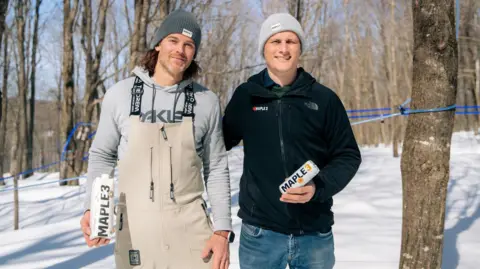
Yannick Leclerc
Yannick Leclerc, right, set up his company with business partner Stéphane Nolet


Mr Leclerc says that Maple3 is one of the pioneers of the sector. "Nobody [previously] thought about keeping the sap for its hydration purposes verses just boiling it into syrup."

He founded the company back in 2013 with business partner Stéphane Nolet. In recent years an increasing number of other producers have entered the marketplace.

Mr Leclerc claims that Maple3 has doubled its annual profits since 2021, with sales not just rising across Canada, but in 12 other countries, including France, Japan, Singapore and South Korea. Some 75% of its sales now come from overseas, and it sells both still and sparkling maple water, and fizzy versions with added natural fruit flavourings.

"It's more than just a local product at this point," adds Mr Leclerc.

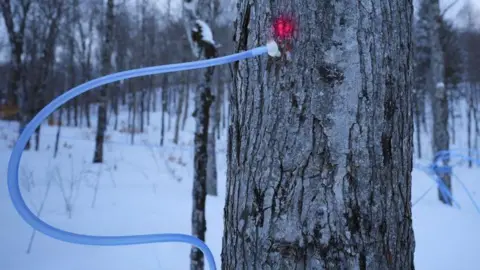
Getty Images
"Tapping" trees for sap involves drilling holes and attaching a pipe

For the maple water industry as a whole, one recent report predicts big growth. It estimated that global sales in 2024 totalled $506m (£409m), with that expected to jump to $2.6bn by 2033.

By comparison, worldwide sales of coconut water reached $7.7bn in 2023, with that expected to grow to $22.9bn by 2029. So maple water has a long way to catch up.

Meanwhile, the global value of the maple syrup market was $1.7bn last year, according to one study.

Beth Czerwony, a dietician with the non-profit medical centre Cleveland Clinic in Ohio, says the growing popularity of maple water is linked to its perceived health benefits.

"When the sap itself is filtered through the tree, it ends up absorbing a bunch of antioxidants," she says. "So they're gonna end up having a better performance and a faster workout recovery."

However, one medical study from 2019 concluded that maple water was "was not superior in rehydration" to normal water.

Jeremy Kinsella owns The Soda Pop Bros in Windsor Ontario, which sells soft drinks under its own brand name, as well as imports from around the world.

His family have been in the industry for nearly a century, and in his lifetime he has seen a fair share of trends come and go.

He says that if maple water is to go mainstream it needs the financial backing and promotion of one of the huge global soft drinks firms.

"It will take a larger soda manufacturer for it to really catch on," he says.

Mr Kinsella also says that the price of maple water is currently too high. "When it comes down to it, someone's looking at a can of Coke for a buck and they're looking at a can of maple water for three bucks, they're going to try it a couple of times and go back to Coke," he says.

Getty Images
It is hard to see maple water ever surpass the popularity of maple syrup


Marketing maple water more would certainly help it increase sales, says John Tomory, who helps run Pefferlaw Creek Farms in Uxbridge, Ontario. He and his brothers have been making maple syrup commercially for almost 10 years, and for the past four they have also been selling the sap to a Canada brand called Sap Sucker. This makes sparkling sap water with different added flavours, from lime to grapefruit, and lemon to orange.

Mr Tomory says he agrees with this approach to make the sap more interesting. "I know a lot of people have tried just selling the sap as it is, just basic sap from the tree and it's still, but they haven't really caught on," he says.

"So I think carbonating it and adding fruit flavour makes it more interesting. That's the real innovation."

Back at Maple3 in Quebec, Mr Leclerc also thinks that the sparkling version of the drink could be the more popular: "It has perks that a normal sparkling water doesn't have," he says, such as a more interesting flavour, without having all the bad stuff that [regular] soda has."


Loitering in this Dusty Realm — paintings and poems by Lao Shu

The Other China

書畫古今聚復散


Lao Shu 老樹 is the nom de plume of Liu Shuyong (劉樹勇, 1962-), a Beijing-based artist, writer, critic and professor in communications. His artistic voice is unique and personal, its tenor, whimsy and profundity evoke what for decades we have called The Other China — a cultural noosphere that is as undeniably local as it is universal.

***

China Heritage marked the last day of the Year of the Dragon with the Lao Shu 老樹 — see The Dragon Gives Way to the Snake — just as we welcomed the First Day of the First Month of the Year of the Snake in his company — Lofty Aspirations & Modest Wishes for the Year of the Snake.

As the New Year festivities come to an end with Lantern Festival, yet again we sought solace in Lao Shu’s art and words — see The Lantern Festival in the Year of the Snake, as well as in the presence of his cat. Below we join Lao Shu, and his quizzical cat companions.

捨身紅塵皆如是,
有無之間自徘徊。

Thus do we loiter in the Dusty Realm,
fleeting shadows in the welter of Being.

— Geremie R. Barmé
Editor, China Heritage
24 February 2025


Thus do we loiter in the Dusty Realm

Paintings and Poems by Lao Shu

Selected and translated by Geremie R. Barmé

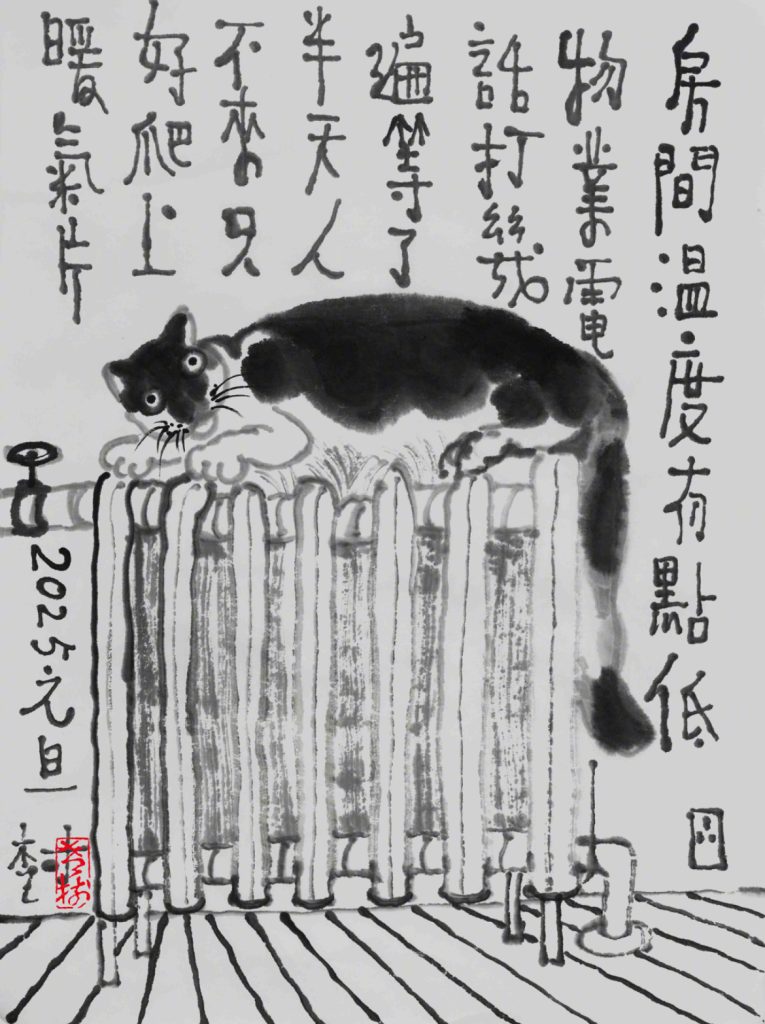
The temperature inside is on the chilly side,
and I’ve called management a few times.
Since no one’s come to do anything about it,
might just as well snuggle atop the heater.

— Lao Shu, New Year’s Day, 2025

Published on 12 February 2025

***

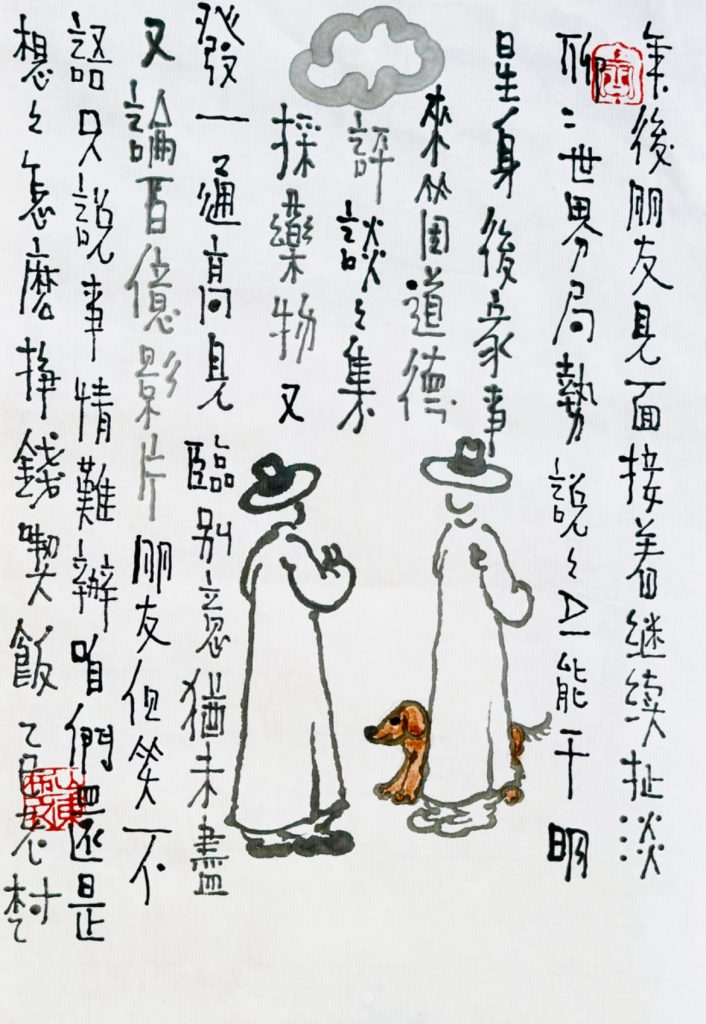
Bumped into a mate after New Year’s
and continued our bullshitting chin wag.
We touched on the international scene
and speculated about the capabilities of AI.
There was also all that celebrity gossip
just begging for our sage adjudication.
On we moved to the generic drugs scandal —
we had very perceptive things to say about that.
We lingered and I continued chatting away,
after all, there was also that billion-dollar movie.
My friend smiled indulgently but was shtum
before offering this: things really are tough as;
why not focus instead, he told me, on ways we
can make a cracker and fill our bellies.

— Lao Shu

Published on 13 February 2025

[Note: ‘Generic drugs’ 集採藥物 refers to widespread suspicions that generic locally made medicines used in hospitals are less efficacious than brand-name pharmaceuticals. ‘Billion-dollar movie’ 百亿影片 is a reference to the Nezha 2 哪吒之魔童鬧海, a record-breaking animated film. — Ed.]

***

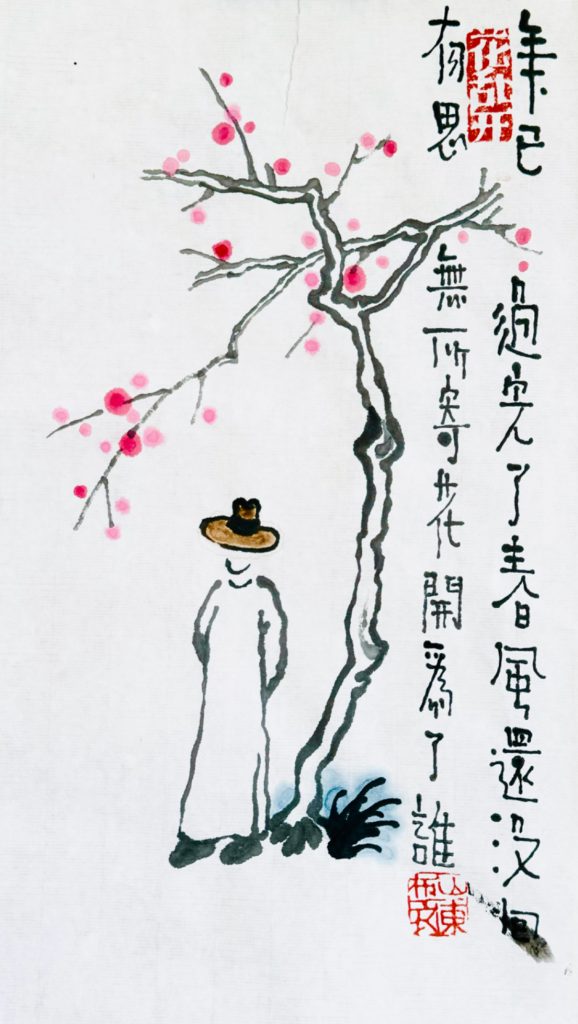
New Year’s is well and truly over,
the promise of spring still far off.
What use a head full of thoughts,
will anyone appreciate these blossoms?

Published on 14 February 2025

***

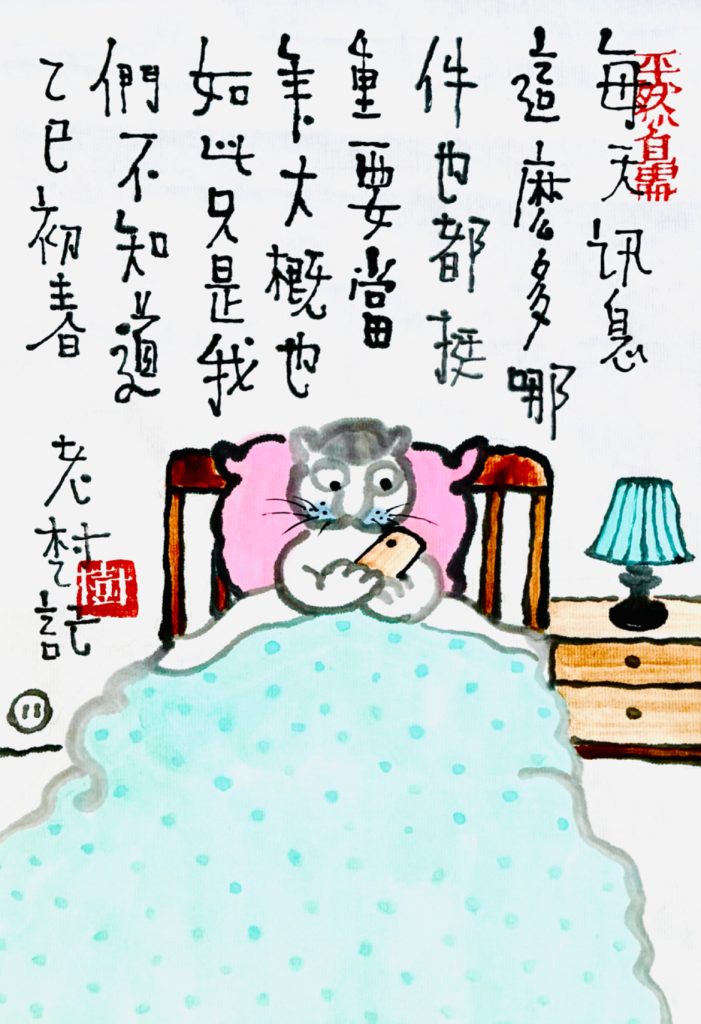
The flood of information is nonstop
and all of it seems so very important.
Spose it was also like this before,
then, tho, we simply didn’t have a clue.

— Lao Shu, recorded in Early Spring, Yisi Year of the Snake

Published on 15 February 2025

***

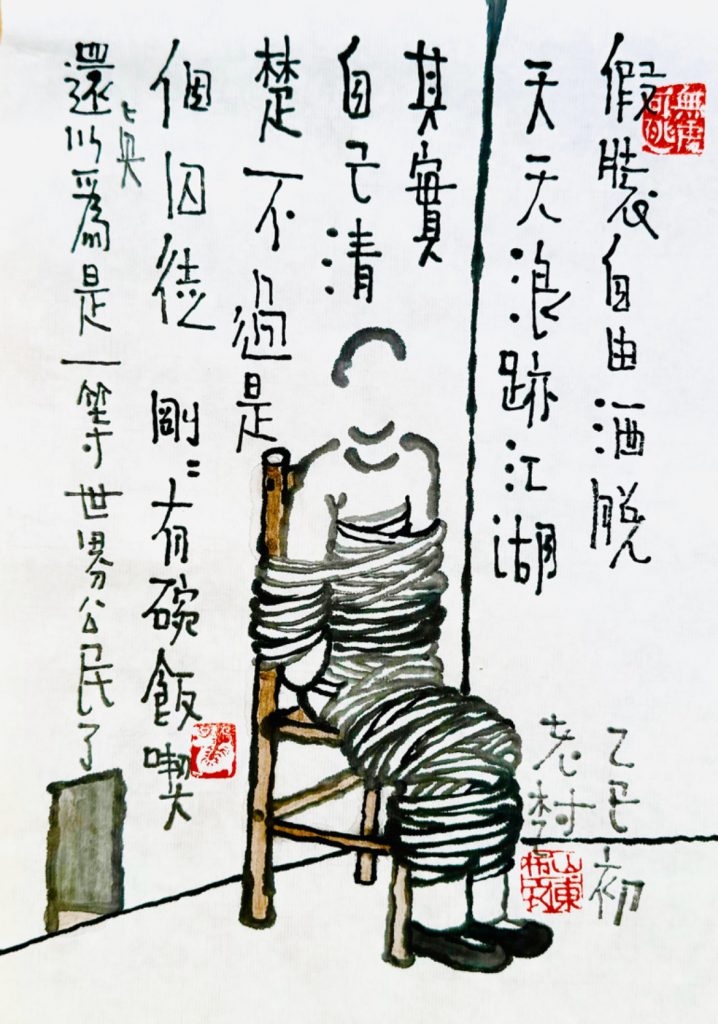
This slacker pose is just a put on;
making out to be a vagabond.
Of course, you know the truth:
you’re nothing but a prisoner.

剛剛有碗飯吃還真以為是一等世界公民了

— just because you can finally eat your fill, you’ve convinced yourself that
you’re a worthy member of the international elite.

— Lao Shu, early in the Yisi Year of the Snake

Published on 17 February 2025

***

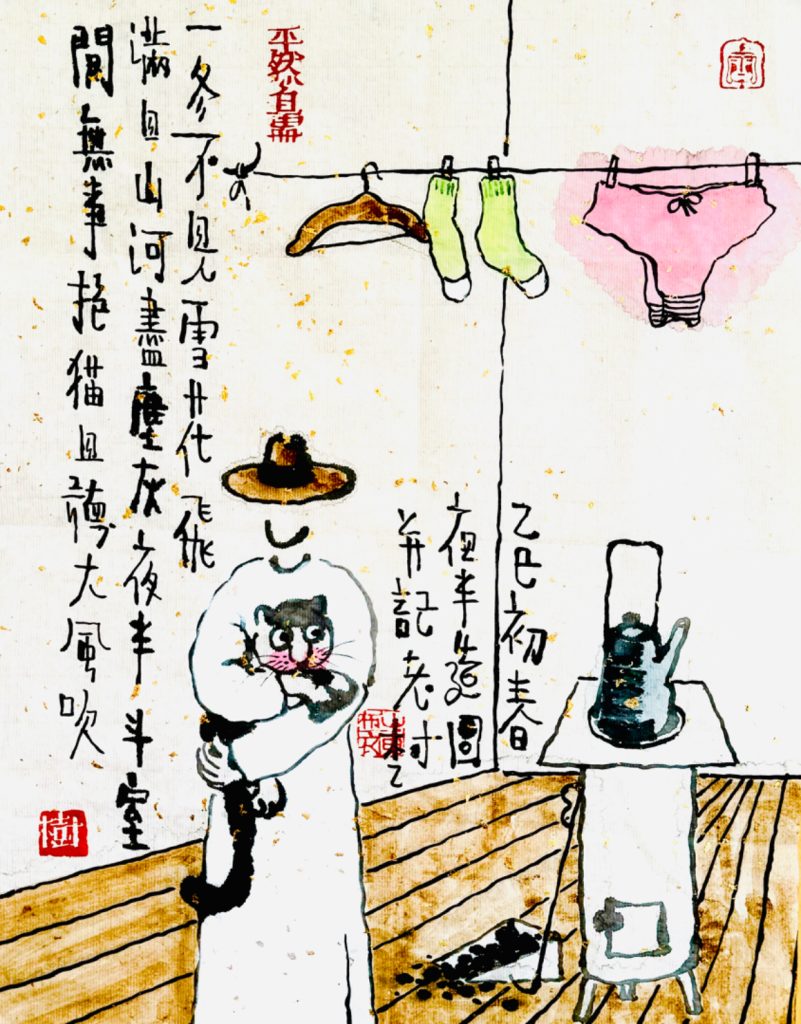
The winter’s passed without spotting dancing snowflakes.
Instead, everything in our wide world is covered in dust.
At a loose end in my garret in the middle of the night
I listen to the soughing wind with a cat in my arms.

— Lao Shu, a painting and note made in the middle of the night.
Early Spring, 
Yisi Year of the Snake [February 2025]

Published on 22 February 2025

***

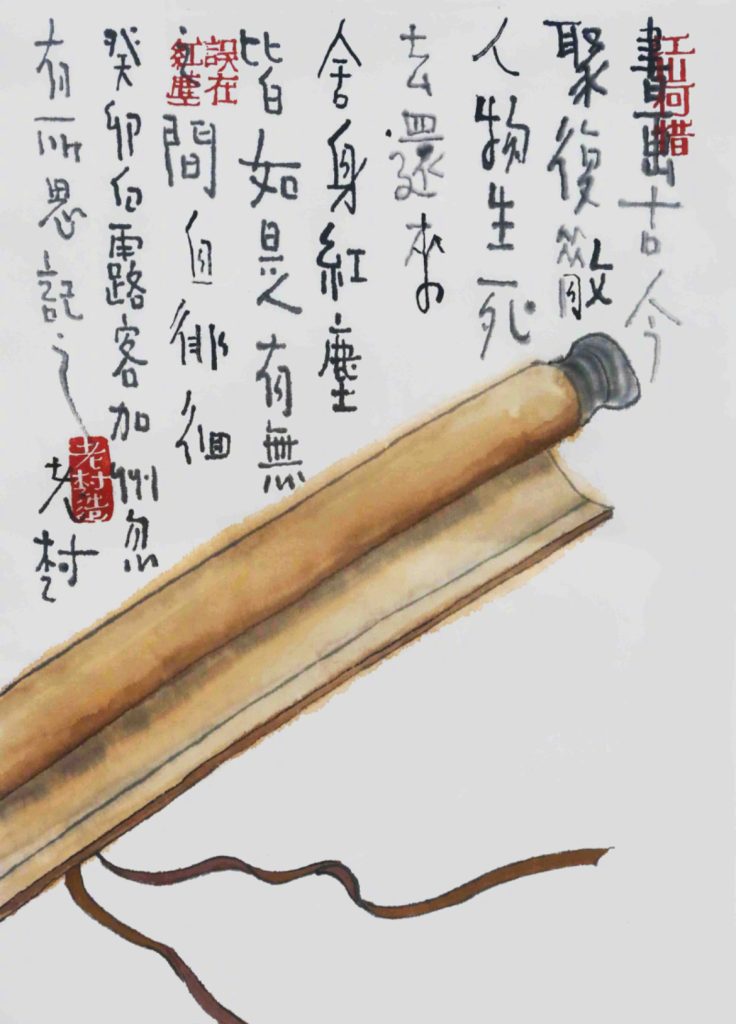
Art and words are all but the stuff of time.
People, too, travel in this eternal round.
Thus do we loiter in the Dusty Realm,
fleeting shadows in the welter of Being.

— these thoughts suddenly occurred to me while I was staying
with friends in California, so I recorded them in this manner.
Lao Shu, White Dew, 
Guimao Year of the Dragon [September 2025]

Published on 18 February 2025

***

Source:


Hidden for centuries, Chinese treasures finally see the light of day


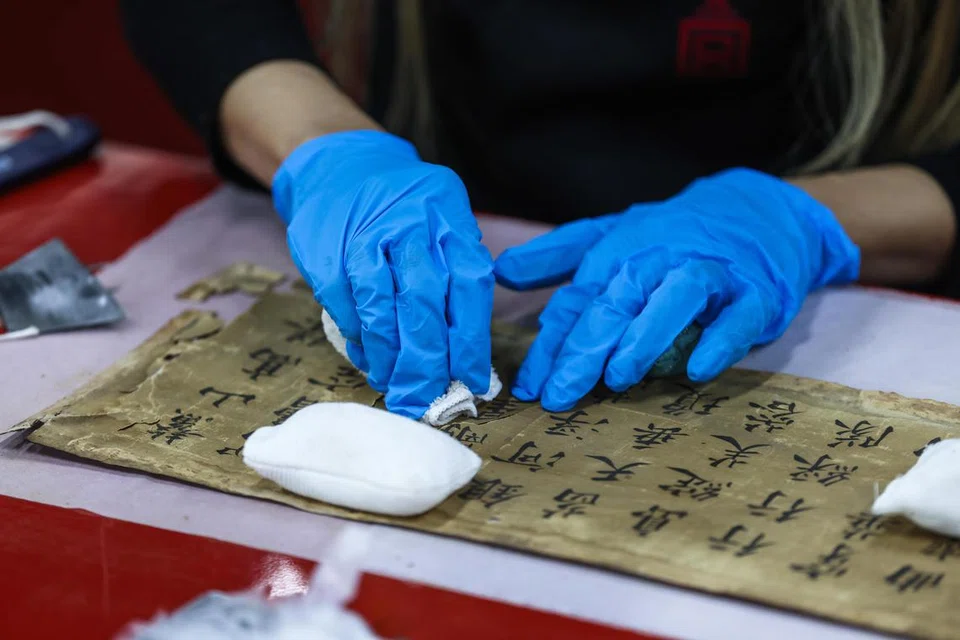
A restorer from the Heritage Conservation and Restoration Department restores a cultural relic in the Forbidden City.
PHOTO: EPA-EFE

UPDATED Feb 21, 2025, 

BEIJING - Depicting Taoist deities in a misty landscape, a Qing dynasty lacquer panel inlaid with jade and agate is among thousands of artefacts pulled out of museum storage in China to be restored, and one day, even showcased to the world.

“The bottom layer had shifted and loosened to the point where it was in a pulverised state,” said Ms Sun Ou, who restores inlaid lacquer artworks at the Forbidden City, the former imperial palace in the heart of Beijing.

“More than 100 pieces of inserts had fallen off and had to be reinforced again,” she told Reuters during a government-organised media tour at the cultural protection and restoration department of the Palace Museum at the Forbidden City.

The painstaking work to restore ornate treasures amassed by Chinese emperors in centuries past has accelerated in the past decade amid President Xi Jinping’s push to preserve China’s heritage and project its cultural power on the global stage.

The restoration and curation efforts come as the Palace Museum marks its 100th anniversary and prepares to open a new Beijing branch later in 2025 in a state-of-the-art venue that could double or even triple the number of pieces on display.


Ancient clocks are displayed at the Gallery of Clocks in the Forbidden City, on Feb 21, 2025.PHOTO: EPA-EFE

Of the nearly two million artefacts held by the Palace Museum – from centuries-old paintings to ancient bronze ware and rare ceramics – just 10,000 are currently showcased at a time.

A Hong Kong branch of the museum opened in 2022 displaying about 900 pieces.

The Palace Museum was established in 1925 by the then ruling Republic of China government, after the last emperor of China, Pu Yi, and his household were evicted.


A restorer from the Heritage Conservation and Restoration Department restores a cultural relic in the Forbidden City, on Feb 21, 2025.
PHOTO: EPA-EFE

In the decades that followed, the museum’s collection was threatened by theft, damage and even destruction during World War II, a Chinese civil war, and later the Cultural Revolution.

In the early 1930s, before Japanese forces swept across China, the Palace Museum authorities packed up many pieces – including imperial thrones – and moved them out of Beijing to other cities.

Then, in 1949, Chiang Kai-shek’s Republic of China government was defeated by Mao Zedong’s communist forces. As Chiang and his Nationalist Party fled to Taiwan, they took with them thousands of crates of relics that later came under the care of Taiwan’s version of the Palace Museum.

Today, the National Palace Museum in Taipei holds more than 690,000 items, more than 80 per cent of which are from the former Qing court, the Taiwan museum said. It said the items belong to Taiwan's government. 

REUTERS
South Korean fans soak up nostalgia with vintage Japanese superheroes


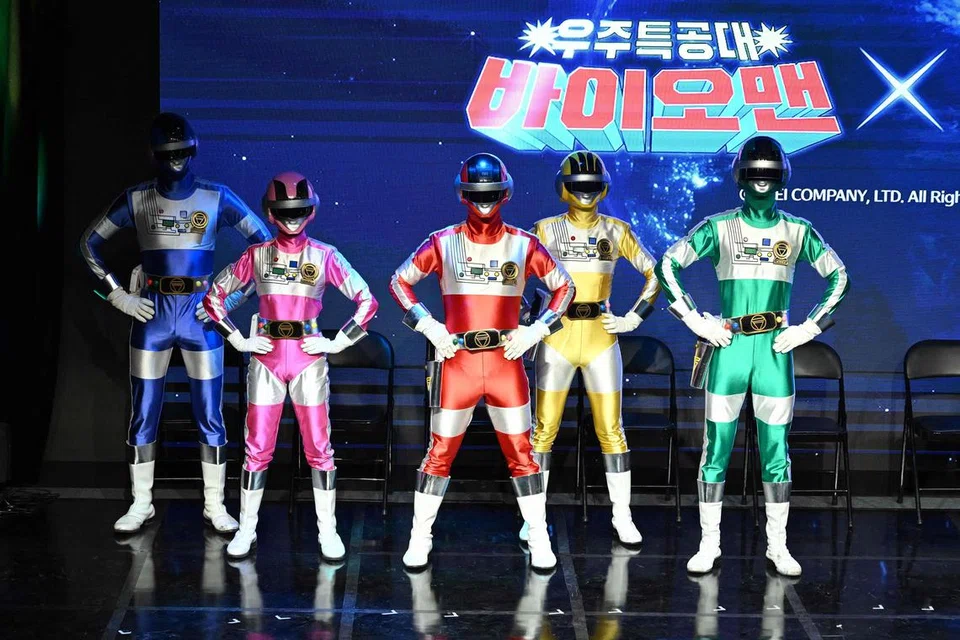
It has been decades since Japanese superhero series Choudenshi Bioman was last on TV.
PHOTO: AFP

UPDATED Feb 24, 2025,

SEOUL – Die-hard South Korean fans cheer and clap as their favourite superheroes strike poses in brightly coloured uniforms to the sounds of a soulful Japanese ballad, a nostalgic throwback to the days of videotape format VHS.

It has been decades since Japanese superhero series Choudenshi Bioman was last on TV, but its epic stories of good versus evil still resonate deeply for these South Korean millennials.

And while their masked heroes are now well into their sixties, a chance to meet them in person at a sold-out concert hall event in February in Seoul was too good to pass up – even with ticket prices starting at 300,000 won (S$280).

“Most of us here are office workers, and though the ticket price wasn’t cheap, it wasn’t beyond our means as lifelong fans,” said Mr Oh Myung-hoon, 39. “It wasn’t a matter of choice for fans like me. It was a must.”

Part of the Super Sentai series, better known to Western audiences as the inspiration for the Power Rangers phenomenon of the 1990s, Choudenshi Bioman and its companion shows tell the story of a group of people with special powers fighting supervillains intent on world domination.

The show was broadcast at a time of Japan’s transformation into a global cultural powerhouse, its animation and film studios producing content seen the world over.

But many South Korean fans of Choudenshi Bioman were initially not even aware the show was Japanese.


Cast members of Japanese superhero series Choudenshi Bioman and Hikari Sentai Maskman attending a fan meeting in Seoul on Feb 15.
PHOTO: AFP


Japanese imports banned


For decades, South Korea imposed sweeping restrictions on Japanese cultural imports because of historical tensions stemming from Tokyo’s colonial rule over the peninsula in the early 20th century.

It was not until 1998 – more than half a century after Korea’s independence – that Seoul began lifting its ban on Japanese media content.

Japanese superhero series – best known in South Korea through Bioman and Flashman – were among the few exceptions to the ban and imported on VHS tapes, making them a rare and cherished phenomenon in the 1980s and 1990s.

Even so, the authorities required all Japanese text in the series to be replaced with Korean and the voices dubbed, effectively erasing any trace of their Japanese origins.

This allowed the series to thrive in an era when anti-Japanese sentiment remained strong, media columnist Kim Do-hoon told AFP.

“The media that dominated my youth was all Japanese, like the animation Galaxy Express 999, but they had to appear Korean through dubbing,” the 49-year-old said.

“The 1970s and 80s were an era of peak anti-Japan sentiment, with the belief that anything related to Japan was bad.”

But “thanks to South Korea’s strong cultural exports and vibrant economy”, times have changed, he added.

Some scenes managed to avoid the censorship and showed Japanese-language characters in the background – puzzling South Korean children.

Ms Cha Jeong-in, a 39-year-old game developer, admits she was confused by the “unrecognisable letters”.

“I asked myself, ‘what is it?’” she told AFP. “I later learnt it was all made in Japan.”


Merchandise from Japanese superhero series Choudenshi Bioman on display during a fan meeting at a concert hall in Seoul on Feb 15.
PHOTO: AFP

Good triumphs over evil

For the actors who starred in the series, the heartfelt reception in Seoul was both exhilarating and perplexing – especially in a country where Japanese content was once heavily censored.

“I had never expected something like this to happen 40 years after filming, so I was really surprised,” said Mr Kazunori Inaba, who played Red Mask in Maskman.

The 68-year-old former actor, who now runs a ramen restaurant in Tokyo, said it was “difficult” for him to account for the devoted following his decades-old fantasy drama still enjoys in South Korea.

“If this work that we did can be a good bridge between Japan and Korea, then we have done a really good job,” he told AFP.

“I think heroes are really important, especially when you’re a child. As you grow up, you forget about them,” he said. “But rewatching them can help bring back the memories.”

Ms Cha said she spent US$1,500 (S$2,000) to travel to Seoul from the Philippines, where she now lives.

“I thought that if I missed this chance, I’d never be able to see them face to face in my lifetime because of their advanced age,” she told AFP.

“They all taught me that good always triumphs over evil and that I must not choose the path of wrongdoing,” Ms Cha said. “They instilled those values in me.” 

AFP
Scars of Iwo Jima: 80 years on, a war correspondent’s wounds refuse to heal

Roughly 70,000 American soldiers fought to take Iwo Jima. More than 6,500 were killed. Of the 20,000 or so Japanese defending the island, about 19,000 were killed in combat


Hannah Beech 
 24.02.25

American Marine Corps rocketeers attack Japanese positions in support of a leatherneck advance during the Battle of Iwo Jima on March 23, 1945.(Getty Images)

Iwo Jima has always been beautiful, a volcanic chunk of rock surrounded by cobalt sea. But a World War II battle 80 years ago this month turned the Japanese island into a byword for desperate, deadly combat — and for American triumph.

On February 23, 1945, a contingent of American Marines climbed to the top of Mount Suribachi, the highest point of Iwo Jima. Atop the rubble of war and volcanic eruption, they pitched forward and raised an American flag. A photographer for The Associated Press, Joe Rosenthal, snapped an image, indelible and iconic.

My father, Keyes Beech, was also there, on that lonely island flung in the Pacific Ocean. He was a technical sergeant attached to the US Marine Corps Fifth Division, a division that is no longer active in this more peaceful era. His job as a combat correspondent meant that he was to write about American valour and, hopefully, victory. But the conquest of Iwo Jima, despite the famous flag-raising four days into the battle, did not come for another month.

On the day the Stars and Stripes were unfurled on Mount Suribachi — twice, for good measure — my father told me he was jammed in a foxhole, trying not to get killed by the Japanese, something that would eventually happen to one of his friends, and then another, and then another.

Confined to an island then less than eight square miles, about the size of a busy international airport today, the Americans and Japanese were reduced to a kind of caged combat. Iwo Jima means “sulfur island” in Japanese, and the Japanese Imperial Army had fortified its caves with tunnels and other defences. The charred island smouldered. Its bluffs and beaches became a vast cemetery, volcanic ash and black sand burying the dead.

Roughly 70,000 American soldiers fought to take Iwo Jima. More than 6,500 were killed. Of the 20,000 or so Japanese defending the island, about 19,000 were killed in combat. Some died in a final banzai charge; others ended their own lives rather than surrender to the Americans. Two hid in the warren of caves until 1949, emerging to a changed world nearly four years after the war had ended.

On March 26, 1945, Iwo Jima became the first chunk of Japanese land to be formally captured by the Americans. Less than five months later, the Japanese emperor surrendered, ending an imperial march across Asia that cut short millions of lives. American bombs, both atomic and incendiary, had devastated Japan as well.

After the war was over, the United States built a military base on Iwo Jima. In 1968, the island was given back to Japan. The Japanese villagers who were evacuated in 1944,
as the island geared up for the coming battle, never returned. In 2007, the island was officially renamed Iwo To, as it was known before the battle, using a different pronunciation of the word “island”.

My father, like many veterans of that generation, did not talk much of World War II. He didn’t hold a grudge. He lived in Japan for about 30 years and married a Japanese woman, my mother.

He covered other battles in the Pacific, including ones Americans did not win. But Iwo, as he called it, pierced him. With American soldiers still fighting in the Pacific theatre, my father joined a war bond tour, lurching around the US with some of the flag-raising soldiers to drum up financial support for what turned out to be the waning days of World War II.

They drank far too much. It was the way back then. The term “post-traumatic stress disorder” didn’t exist.

When I was in middle school, we would drive in the Washington area, in our Nissan or our Plymouth — we had one car for each country — and we would sometimes pass the Marine Corps War Memorial, Rosenthal’s photo cast as a bronze statue. My father would go quiet. One hand stayed on the steering wheel. With his other, he would grip my hand. I knew to squeeze back.

New York Times News Service
Trumpism isn't a new world order. It's a sign of US imperial rot

The Trump administration's global retreat isn't about serving the American people; both Trump and US empire are steered by cronyism, says Alonso Gurmendi.


Alonso Gurmendi
20 February, 2025 
NEW ARAB

Trumpism is not reshaping world order. It is the result of the US botching the American Dream, leading to imperial decline, writes Alonso Gurmendi [photo credit: Getty Images]


Since starting his second term in office, US President Donald Trump and his team have not wasted any time in trying to fully refashion American politics.

This second Trumpism is characterised by a mass retreat from the world. His government has withdrawn the US from the World Health Organisation, frozen funding to USAID and signalled its desire to end the US commitment to European security.

It seems, in fact, that the only foreign policy front where Trumpism is willing to allow America’s active engagement in the world is in the facilitation of Israel’s genocide of the Palestinian people.

This withdrawal from the world is unprecedented. The North Atlantic Alliance has been one of the core geopolitical constants of the post-war world order, one that saw the United States emerge as one of two global superpowers, abandoning its former role as the regional hegemon of the Americas.

This transition was full of globalising promises and commitments. Especially after the Holocaust and Nuremberg, “Western Culture” was going to move away from the ultra-nationalist and supremacist principles of Nazi Germany and adopt a shared vision for “humanity”, led by US military, economic, and cultural might. In this vision, the UN would guarantee peace, including through a human rights declaration, and economic prosperity through the Bretton Woods system and the Marshall Plan.

Related
ICC arrest warrants: Has Palestine birthed a post-Western world?
Voices Alonso Gurmendi

Of course, these were institutions built during the collapse of Europe’s colonial empires.

Their notion of “humanity” was and is still incomplete. Colonised and racialised people were excluded from them by design. They were the result of a claim to universality based on Western racialised ideas of the Other, that hid both a rule of colonial difference and a colour line within its self-proclaimed cosmopolitanism.

Colonised and oppressed peoples had to fight this world order throughout the 20th century, often through the strategic use of its loftier – even if insincere – ideals, leading to decolonisation, feminism, the civil rights movement, human rights tribunals, human rights NGOs, and transitional justice. Thus, in a way, the rise of US Empire as the new model of Western imperialism, and resistance to it, created the world we live in today.
What was the US model really about?

It is only logical therefore to see this second Trumpism as a systematic, planned betrayal of those globalising ideals. Shocked European leaders talking about the importance of the North Atlantic Alliance, of the territorial integrity of Ukraine, of the value of democracy hint us to this conclusion.

But looking at this process from the perspective of the Global South, that never really had access to these supposed globalising ideals (and therefore could never be “betrayed” by the US), may reveal a different explanation: there is no plan, no broader architecture, no policy or goal. Trumpism is not the driving force of a new world order, but the result of the US imperial decline – another sign that the current world order is soon to end.

Superpowers cannot be just outward-facing superpowers. At some point, they need a thriving, productive population to fund the huge expense that is being a superpower – funding civil society organisations the world-over through agencies like USAID to maintain influence abroad, keeping military bases in Europe to contain aggressive external forces like Russia, maintaining control over global bureaucracies like the WHO, etc.

This is something the US model of global hegemony has botched completely. Its 330 million people live in an inequality dystopia, without access to healthcare, addicted to opioids, unable to afford cost of living expenses, making money through unregulated gig economy apps, not being able to buy a house, without safety nets like parental leave or paid holidays, and under siege by unregulated gun violence, just to name a few examples.

Large numbers of Americans live on some form of wage slavery, existing mostly to pay bills they can’t afford. Everything is worse quality and more expensive than only a few decades ago. Fast fashion, always-rising subscription fees, and shoddy planes that fall from the sky because CEOs wanted to save a buck or two.
Waking up from the American dream

Trumpist nationalism, therefore, is a reaction to this domestic decline. It’s an electorate that wants to go back to the time when (middle-class White) Americans could own a home and sustain a family on one job. And has been duped into thinking this was the product of “cultural uniformity” and ultra-nationalism – that planes fall from the sky because of Diversity, Equity, and Inclusion.

To the Trump electorate, imperial power abroad is just not as important. Trade links with Mexico and Canada don’t matter, whether Putin takes Ukraine does not matter, economic dominance in Latin America does not matter. What matters is that Trump will impose tariffs on foreign governments and that will make goods cheaper at home (or so Trump has lied to them). What matters is that the US looks “badass” pushing other countries around so that this dejected electorate can feel powerful, if only for a little bit. Grand strategy has lost its appeal.

Of course, they are being deceived. Defunding a “trans comic book” in Peru is not going to “Make America Great Again”. Neither is placing tariffs on foreign goods.

The ultra-wealthy’s influence over American politics continues untouched, leading to the kind of unregulated dystopia that allows life-saving medication to cost hundreds if not thousands of dollars. So does the military-industrial complex that syphons America’s wealth away from its people and into the hands of multinationals with bloated military R&D budgets.

There is nothing wrong with choosing investment in people over global influence. Global withdrawal does not need to be “bad” per se. The problem is that, as I see it, Trumpism is not really about investing in people, but empowering his inner circle and advancing white supremacist ideology. “Cultural uniformity” does not make America great.

Trumpism is therefore not reshaping world order. It is the result of the US botching the American Dream, leading to imperial decline.

Where France and the UK got a Suez “moment”, rapidly discovering that they were no longer calling the shots in town, America will get a MAGA “process”, slowly transitioning back from global superpower to regional hegemon. The risk for the broader world is what happens when this process ends and Americans realise they are not only not the world’s superpower anymore, but they are also not “Great Again”.


Alonso Gurmendi is a Fellow in Human Rights & Politics at the London School of Economics & Political Science’s Department of Sociology.

Follow him on X: @Alonso_GD

Opinions expressed in this article remain those of the author and do not necessarily represent those of The New Arab, its editorial board or staff.
Trump and his team keep referencing a third term in 2028. But could he actually run again?


The 22nd amendment bars presidents from a third term in office. Is it enough to stop Trump?


James Liddell,Josh Marcus,Alex Woodward
Sunday 23 February 2025 
THE INDEPENDENT UK


From reproductive rights to climate change to Big Tech, The Independent is on the ground when the story is developing. Whether it's investigating the financials of Elon Musk's pro-Trump PAC or producing our latest documentary, 'The A Word', which shines a light on the American women fighting for reproductive rights, we know how important it is to parse out the facts from the messaging.

At such a critical moment in US history, we need reporters on the ground. Your donation allows us to keep sending journalists to speak to both sides of the story.

The Independent is trusted by Americans across the entire political spectrum. And unlike many other quality news outlets, we choose not to lock Americans out of our reporting and analysis with paywalls. We believe quality journalism should be available to everyone, paid for by those who can afford it.Your support makes all the difference.Read more

Donald Trump is once again entertaining the prospect of serving an unconstitutional third term as president as he asked a crowd of supporters whether he should run again.

The president basked in chants of “four more years” just one month into his second term while at a White House reception celebrating Black History Month on Thursday.

Trump’s suggestion came just days after referring to himself as a “king” and quoting Napolean Bonaparte, unsubtly stating that he was above the law.

Those chants were echoed later Thursday by Trump’s former White House strategist Steve Bannon while on stage at the Conservative Political Action Conference, who said leaders like him come along once or twice in history.

“We want Trump in ‘28... We want Trump! We Want Trump!,” Bannon said before later gesturing, what critics say, a salute that resembled a Sieg Heil.

Since early in his 2024 campaigning, Trump repeatedly mused about a third term. He has raised the idea over and over again since his first term in office.

The 22nd Amendment of the Constitution says that presidents can only serve up to two full terms (eight years). Trump has said he may feel “entitled” to more while also suggesting he doesn’t want to run again after his next term ends in January 2029.

Congressional Democrats have proposed a measure to clarify that the 22nd Amendment expressly forbids a third term in office, and 78-year-old Trump, the oldest U.S. president in history, has at times admitted defeat to the constitutional guardrails he’s up against, despite his rhetoric.

What else has Trump said about a third term?


Trump, pictured in the White House on February 11, has publicly mulled a third term several times (AP)

Just days after winning the 2024 election, Trump told House Republicans: “I suspect I won’t be running again unless you say ‘He’s so good, we got to figure something else out.’”


Last month, at the House Republicans’ annual retreat in Florida, he joked about whether he was allowed to run again. Days later at a Las Vegas rally, he pondered serving “not once, but twice... or three or four times.”

And at a prayer breakfast at the Washington Hilton on February 6, Trump mulled another four years, “despite the fact that they say I can’t run again.”


“You know, FDR 16 years — almost 16 years — he was four terms. I don’t know, are we going to be considered three-term? Or two-term?” he told a National Rifle Association convention in May last year, referencing Franklin Delano Roosevelt.

Elsewhere on the 2024 campaign trail, Trump suggested he would be a “dictator” and abuse power only on “day one” of his new administration, and told an audience of Christians if he got elected “you’re not going to have to vote” in the future.


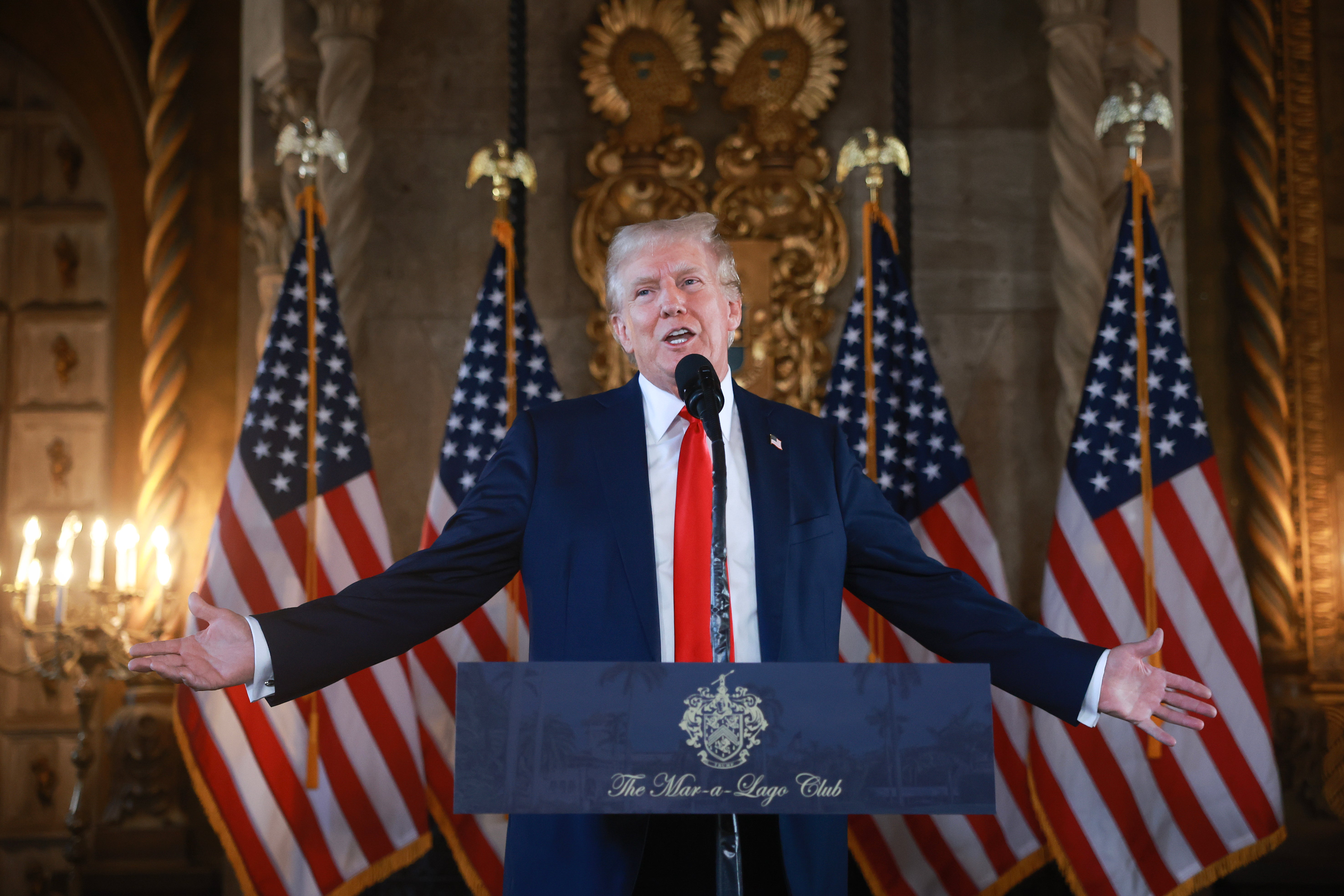
Trump, photographed in Mar-a-Lago in August, has made remarks about serving a third, or possibly fourth, term in the White House (Getty Images)

It wasn’t just the most recent election cycle where Trump seemingly eyed a third term in office.

“We’re going to win four more years in the White House,” he said in 2022. “And then after that, we’ll negotiate, right? Because we’re probably — based on the way we were treated — we are probably entitled to another four after that.”

In 2018, he praised Chinese President Xi Jinping’s potential lifetime term in office as “great,” saying “maybe we’ll give that a shot someday.”

By 2020, while campaigning for reelection in Reno, Nevada, Trump told his followers that he was going to win the state and “win four more years in the White House,” before adding: “We’re probably – based on the way we were treated – we’re probably entitled to another four after that.”

When Trump was pressed on whether he believes he can serve a third term, the president said he doesn’t want one.

“I wouldn’t be in favor of it. I wouldn’t be in favor of a challenge [to the 22nd Amendment]. Not for me,” Trump told TIME in April last year. “I wouldn’t be in favor of it at all. I intend to serve four years and do a great job.”

Trump and his supporters often insist the Republican is joking or not being literal after he faces scrutiny for his statements, including after the Access Hollywood scandal, Trump’s call for Russia to release hacked emails from the Clinton campaign, and the president’s suggestion in his first term that disinfectant could be used as a treatment against Covid-19.

The debate around the 22nd Amendment aside, observers are alarmed that Trump adopted quasi-fascist rhetoric on the 2024 campaign trail, including claiming immigrants are ”destroying the blood of our country” and suggesting using the military to go after domestic critics, whom he dubbed the “enemy within.”

What is the 22nd Amendment?


Trump with Joe Biden at the White House as the president promised a peacefully transfer of power in January (AP)

The 32nd U.S. President Franklin D. Roosevelt’s four terms in office helped inspire the 22nd Amendment in the first place.

Ratified in 1951, the amendment came after Roosevelt had been elected four consecutive times, from 1932 to 1944. He died in office in April 1945, shortly into his fourth term.


The amendment states that presidents can serve a maximum of two full terms.

If a vice president becomes president during the term of their predecessor, which has occurred nine times in U.S. history due to death or resignation, they can still serve two full terms as long as they serve less than half of their predecessor’s remaining term.

Before Roosevelt, whose time in office coincided with the twin international crises of the Depression and the Second World War, presidents had observed an unofficial tradition of not serving more than two terms.

Despite Trump bucking constitutional guardrails in his first presidency, he would face a tall order in getting a constitutional amendment through Congress to try to secure a third term.

A proposal for a constitutional amendment requires a two-thirds majority in both the House of Representatives and the Senate, despite Republicans holding a slim majority in both chambers.

Ratifying an amendment would require three-fourths of all state legislatures.

How are Democrats responding?


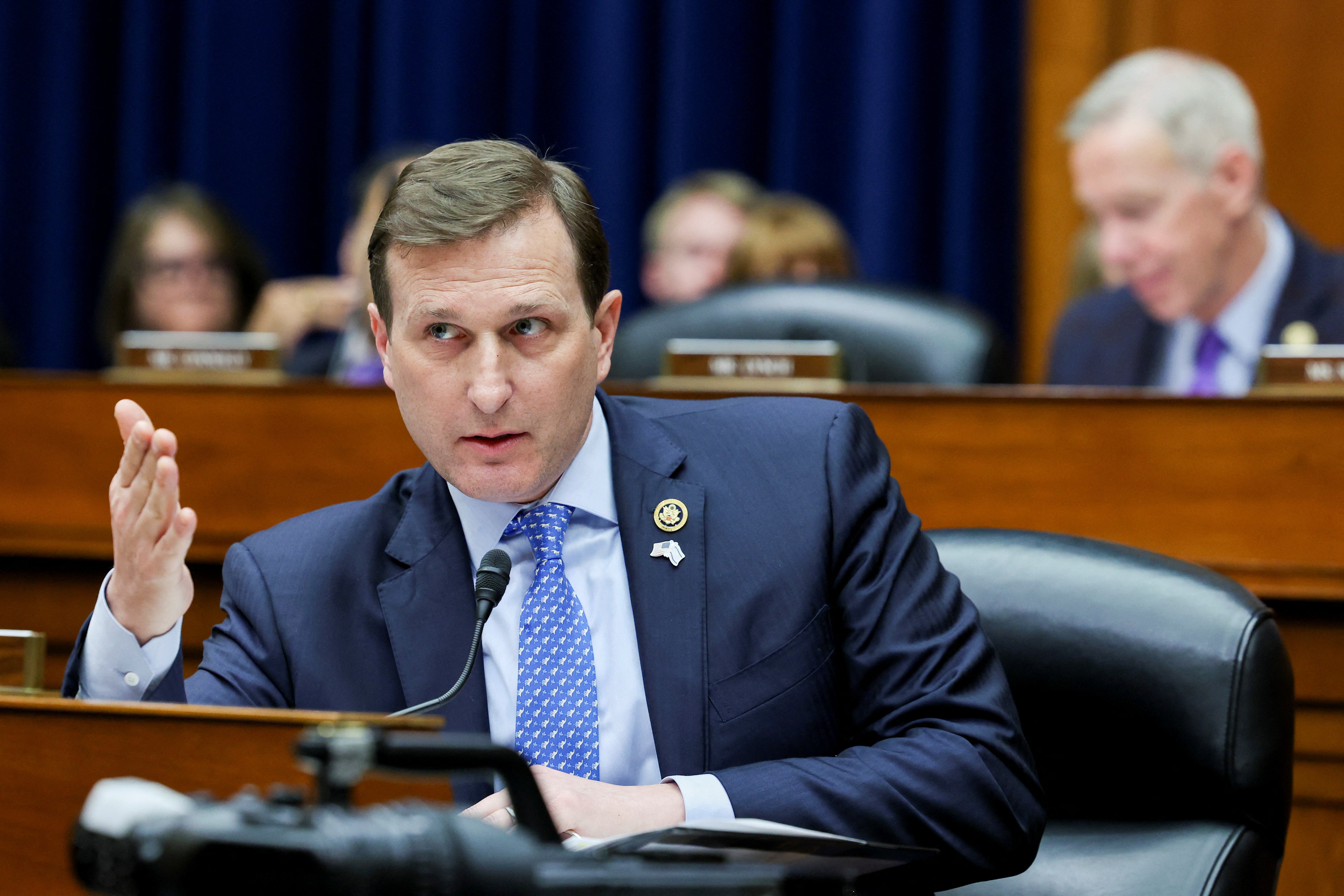
open image in galleryRep. Dan Goldman has introduced a resolution to clarify the matter (REUTERS)

Democrats are desperate for the Trump era to be over.

In November, New York Representative Dan Goldman introduced a resolution affirming that the 22nd Amendment would bar Trump from a third term.

He called on legislators from both parties to “stand by the oath we all took to support and defend the Constitution of the United States and confirm the Congress’ commitment to this principle.”

Goldman’s resolution would make clear that the 22nd Amendment “applies to two terms in the aggregate,” even if they are non-consecutive, like Trump’s.

Only one previous president, Grover Cleveland, has served two non-consecutive terms beginning in 1884 and 1892.

However, it is unlikely that Goldman’s resolution will make it to a vote in the Republican-dominated House.