Thursday, February 27, 2025


Explainer: JAG Firings Spark Concerns About US Military Legal Oversight

In a significant shake-up at the Pentagon last week, Defense Secretary Pete Hegseth fired the top military lawyers for the Army, Navy and Air Force.

This decision comes amid a broader series of dismissals across the Department of Defense (DOD), including that of Charles “CQ” Brown, Jr., Chairman of the Joint Chiefs of Staff — the highest ranking military officer in the US armed forces. The country’s Chief of Naval Operations and Air Force Vice Chief of Staff were also ousted. But despite the high profile natures of these firings, some analysts have argued that the firings of the military’s top lawyers — its Judge Advocate Generals (JAGs) — poses an even greater threat to the rule of law in the US.

“Trump…firing the Army, Navy, and Air Force JAGs [is in some ways] even more chilling than firing the four star [generals]. It’s what you do when you’re planning to break the law: you get rid of any lawyers who might try to slow you down,” wrote Georgetown Law Professor Rosa Brooks on X.

“When you start firing the military’s top lawyers, that means you are getting ready to order the military to do unlawful things. Trump replaces those JAGs with men who will  justify any future unlawful and unethical actions that he wants the military to do,” wrote Democratic political candidate and former US fighter pilot Amy McGrath, also via X.

Presented with concerns about the implications of these firings, Hegseth said in a Fox News interview, “We want lawyers who give sound constitutional advice and don’t exist to attempt to be roadblocks.”

In this explainer, we will consider the roles that JAGs play in safeguarding the rule of law and explore the potential consequences of these firings.

What do I need to know about the JAG firings?

On Friday, Feb. 21, 2025, Hegseth announced the reshuffling of several key DOD leadership positions. In the announcement, he named Brown and two other outgoing officers: Admiral Lisa Franchetti — the first woman to have served as chief of naval operations, and General James Slife, the US Air Force Vice Chief of Staff. Hegseth praised all three of these officers for their distinguished careers and service records.

Without names or praise, he also noted the DOD was looking for new JAGs for the Army, Navy, and Air Force. On the matter, he said only: “Under President [Donald] Trump, we are putting in place new leadership that will focus our military on its core mission of deterring, fighting and winning wars.”

The dismissals come amid a broader shakeup of the US federal government, which Trump has prioritized since reentering the Oval Office last month.

What do JAGs do?

JAG officers are lawyers who serve across all branches of the US armed forces. They provide legal advice to military commanders on operational law while prosecuting and defending service members in courts-martial. JAGs represent military personnel in administrative proceedings, advise on international law and rules of engagement during operations, and handle military justice cases to maintain good order and discipline.

JAGs play a significant role in accountability, investigating potential violations of military law and the laws of armed conflict. They participate in after-action reviews, help determine if misconduct occurred, and may be involved in court-martial proceedings when service members face charges for violations of the Uniform Code of Military Justice or laws of war.

What do we know about Hegseth’s views on legal compliance and accountability?

Hegseth has been openly critical of military lawyers throughout his career. In his 2024 book The War on Warriors, he derisively referred to JAGs as “jagoffs” and blamed them for imposing what he considers overly restrictive rules of engagement that hampered combat effectiveness in Iraq and Afghanistan. This terminology became contentious during his confirmation hearings, with Senator Jack Reed questioning whether someone who disparaged military personnel could effectively lead the DOD.

Hegseth has also spoken disparagingly of international legal accountability. During his confirmation hearing, US Senator Angus King of Maine asked whether under his leadership, the DOD would abide by the Geneva Conventions. Hegseth responded:

What an America first national security policy is not going to do is hand its prerogatives over to international bodies that make decisions about how our men and women make decisions on the battlefield.

During Trump’s first term, Hegseth used his platform as a Fox News host to advocate for pardoning US service members accused or convicted of war crimes.

Why are these firings significant from a domestic perspective?

The dismissal of the military’s top lawyers comes amid growing tensions between the executive branch and the judiciary. These firings could escalate efforts to reduce legal oversight of executive actions, particularly in the military domain.

By removing senior JAGs trained to provide independent legal advice, the administration may be positioning itself to implement policies that could test legal boundaries with reduced internal resistance. This raises concerns about adherence to the Uniform Code of Military Justice and constitutional limitations on military power.

Why are these firings significant from an international perspective?

The dismissal of top military lawyers raises concerns about US commitment to international laws of armed conflict.

Hegseth has expressed frustration with international legal frameworks, questioning their value when enemies don’t follow them. In his book, he writes: “What do you do if your enemy does not honor the Geneva Conventions? We never got an answer. Only more war. More casualties. And no victory.”

This stance, combined with removing legal advisors tasked with ensuring compliance with international law, may signal a potential shift in how the US approaches legal obligations in conflicts. Such a shift could have diplomatic repercussions and affect relationships with allies who emphasize adherence to international humanitarian law.

The United States has maintained a complex relationship with international accountability mechanisms like the International Criminal Court (ICC). While advocating for international justice in principle, the US has refused ICC jurisdiction over American personnel in the past, and has imposed sanctions against ICC officials under Trump.

The firing of JAGs could further distance the US from international legal accountability structures

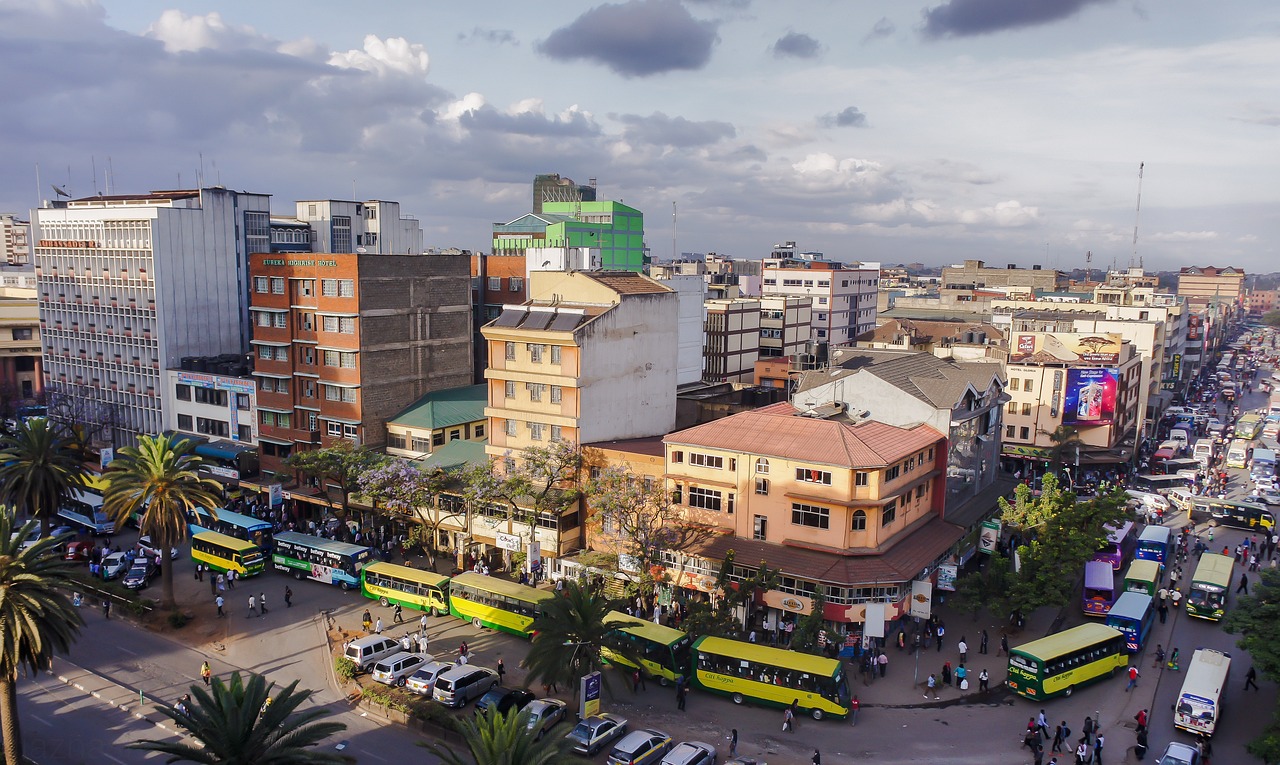
Rights groups urge Kenya government to end abductions and renditions

Amnesty International and several civil society organizations jointly released a petition on Monday addressed to the National Assembly of Kenya, urging the Departmental Committee on Defence, Intelligence and Foreign Relations to acknowledge and end abductions and renditions in Kenya.

Petitioners recalled that in November 2024, prominent Ugandan opposition figure and former presidential candidate for the Forum for Democratic Change (FDC) political party Kizza Besigye was abducted in Nairobi, Kenya, and resurfaced a few days later in a military court back in Kampala, Uganda. Besigye, along with his colleague Haji Obed Lutale, was charged with offenses relating to security and the unlawful possession of firearms and ammunition at Makindye General Court Martial. Besigye’s lawyer, Eron Kiiza, was later arrested after reportedly shouting at a court martial after being denied entry to the reserved space for lawyers at a court hearing. He was convicted by General Court Martial for “contempt of court” and sentenced to nine months imprisonment without a fair trial, which amounts to breaches of Article 14 of the International Covenant on Civil and Political Rights (ICCPR).

Besigye was remanded to Luzira Maximum Security Prison in Kampala, where he continues to be detained and charged by a Ugandan military tribunal of treachery pointing to treason on 14 January. On January 31, 2025, the Supreme Court of Uganda found that trying civilians in courts-martial is unconstitutional and ordered that “all charges or ongoing criminal trials, or pending trials, before the courts-martial involving civilians, must immediately cease and be transferred to the ordinary courts of law with complete jurisdiction.”

In their petition, the organizations stressed that by lawfully detaining people, their rights to personal liberty are breached under the Constitution of Kenya and Uganda and international law documents such as the ICCPR and the African Charter on Human and Peoples’ Rights. Additionally, they stated the transfer of Kizza Besigye and Hajj Obeid Lutale to civilian courts on February 21 violates international human rights law which obliges the Kenya government to ensure the right to a fair trial and the freedom from torture and other ill-treatment.

Several international organizations expressed deep concerns about the deteriorating human rights conditions in Kenya and urgently called on the government to fulfill its commitments regarding human rights by ensuring the release of unjustly detained individuals, addressing any harm caused to activists, and ending the abduction of dissenters while holding accountable those responsible for violence and intimidation. However, petitioners argued that the Kenya Defence Forces, the National Intelligence Service, and the National Police Service have failed to give satisfactory responses.

Petitioners called on relevant authorities in Kenya to acknowledge that abductions and renditions potentially constituting crimes under international law have been committed in Kenya. Further, they should urgently summon the national security organs to promptly, thoroughly, impartially, and transparently investigate all reported cases and take necessary measures to end abductions and renditions in Kenya within a reasonable time.

EU proposes to scrap sustainability reporting laws for businesses

The European Commission (EC) proposed to simplify sustainability rules for businesses, on Wednesday, arguing that complex regulations and “red tape” are preventing EU businesses from maintaining competitiveness and hindering economic investment. The primary proposal is to delay the application of the new Corporate Sustainability Reporting Directive (CSRD) law for applicable companies, as well as other sustainability laws that form part of the European Green Deal. 

The EC’s proposal forms part of this cross-cutting. The proposal was made by Commissioner Maria Luis Albuquerque and Commissioner Valdis Dombrovskis at the European Economic and Social Committee (EESC) plenary debate. At the debate, Dombrovskis said:

While our commitment to securing the green transition has not wavered, we must acknowledge that this has come at a cost, generating a large regulatory burden on people and businesses. As we take stock, we se that this accumulation of rules, and their increased complexity, are limiting our economic potential and our prosperity.

Dombrovskis proposed to “free” 80 percent of companies “under the scope of the CSRD,” delay the application of the corporate sustainability due diligence,  lift the mandate “to adopt sectoral-specific standards,” amend rules within the EU taxonomy on sustainable investments, and to instate “unprecedented simplification changes to the Carbon border Adjustment Mechanism.”

The European Climate Law, better known as the EU Green Deal Plan was endorsed by EU Parliament in 2021. It set out a comprehensive plan to help the EU achieve climate neutrality by 2050. In January 2025, the EC announced its “Competitive Compass” framework, aiming to balance sustainability with competitiveness through a focus on three pillars: innovation, decarbonization, and security. The EU said that “cross-cutting” actions would be used to achieve this, including the “simplification of regulatory and administrative burdens on firms.”

Organizations, such as BusinessEurope and the EU Employers Group, have welcomed the Competitive Compass, praising the initiative for its focus on innovation and reducing regulatory burdens. Other parties, such as the president of the EU Socialists and Democrats, Iratxe García, have criticized the initiative for failing to properly address problems and undermining the Green Deal

Under pressure, EU to take axe to green rules

Agence France-Presse
February 26, 2025 

The EU believes that with the U.S. 'moving away' from the green agenda under U.S. President Donald Trump, the bloc should 'step forward' (PATRICK HERTZOG/AFP)

by Raziye Akkoc and Camille Camdessus

The EU is expected to roll back a slew of environmental rules on Wednesday as it charges ahead with a deregulation drive in a bid to keep up with the United States and China.

The European Union's focus has pivoted to competitivity amid concerns over sluggish economic growth -- in a significant move away from EU chief Ursula von der Leyen's first mandate that focused on tackling climate change.

The issue has taken on acute urgency with US President Donald Trump pushing an America First strategy that risks a trade war with the EU.

Exasperated companies -- as well as key powers France and Germany -- are urging Brussels to make it easier to do business and bring down energy costs, which are higher than in the United States.

With their concerns in mind, the European Commission will unveil a package of proposals that leaked draft documents, seen by AFP, indicate will include watering down green standards as well as measures to cut energy costs and strengthen the clean tech sector.

They will need approval from EU states and the European Parliament.

At stake are new rules on environmental and human rights supply chain standards -- adopted with fanfare barely months ago but now attacked as too burdensome for businesses.

"The reality is there is an increasingly tense geopolitical context and we cannot ask our companies to invest massively in reporting resources when they should be in a war economy and are in the midst of decarbonizing," EU industry chief Stephane Sejourne said.

- Clipping green rules -

Two major texts are in the EU's firing line: the Corporate Sustainability Reporting Directive (CSRD), which requires large firms to give investors and other "stakeholders" information on their climate impacts and emissions, and steps taken to limit them.

The other is the Corporate Sustainability Due Diligence Directive (CSDDD) -- passed last year -- which demands large companies fix the "adverse human rights and environmental impacts" of their supply chains worldwide.


In a draft document, the EU says companies must report on supply chains every five years rather than annually, which will "significantly reduce burdens".

It added the commission would make larger companies -- with more than 1,000 employees -- comply.

Today, the rules apply to firms with over 250 employees and a 40-million-euro ($42-million) turnover.

- Past 'mistakes' -

The changes will likely be hotly debated in the EU parliament, with centrists, left-wing and green lawmakers opposed to weakening environmental rules -- although some liberals said they accepted changes.

French centrist Marie-Pierre Vedrenne now considers the rules to have been a "mistake", despite previously voting for them.


"The world is completely changing," she said. "I think we need to say at the European Parliament 'OK, sometimes we make mistakes'".

The parliament's socialist grouping, however, urged Brussels to "revisit" its approach in a letter last week.

Climate groups oppose paring back the rules.

"Changing the course now would be very detrimental to leading companies who are committed to sustainability and started investing money and resources in complying with legislation," Amandine Van Den Berghe of environmental law NGO ClientEarth said.

"If the race is a race to the bottom, we won't win," she said.

- 'Step forward' Europe -

Brussels insists it remains committed to its environmental goals, and to become climate-neutral by 2050.

In sync with the move to cut red tape, the EU will Wednesday present its "Clean Industrial Deal" -- a mix of measures for a stronger green tech sector -- as well as steps to lower energy prices.

With Trump rejecting his predecessor's push to bolster clean tech investment, Brussels believes there is an opportunity for Europe.

"The fact that the U.S. is now moving away from the green agenda... does not mean that we would do the same. The opposite. It means that we need to step forward," said EU energy commissioner Dan Jorgensen.

Representatives for the business sector in Brussels, however, privately expressed concern that concrete measures to reduce energy costs could come too late.

For example, they pointed to a leaked document which says Brussels will reform state aid rules by July and a legal proposal to cut waiting times for renewable energy projects' permits that will be introduced by the end of 2025.

© Agence France-Presse

Brussels pitches €100B for grand plan to boost made-in-EU clean manufacturing

The funding is part of the Clean Industrial Deal.


The funding is part of the EU executive's master plan to help traditional industries cut carbon emissions. | Nikolay Doychinov/AFP via Getty Images


February 26, 2025 
By Zia Weise


BRUSSELS — The European Commission today announced €100 billion in short-term relief to supercharge climate-friendly manufacturing in the EU.

The funding is part of the EU executive's Clean Industrial Deal, its master plan to help traditional industries cut carbon emissions and boost the EU's emerging clean-technology sector amid fierce competition from China and the United States.

The Commission faces financing constraints as the bloc is only just starting to negotiate its new long-term budget. But it promises to "mobilize over €100 billion" for "EU-made clean manufacturing" in the short term.

The funding effort announced Wednesday centers on an "Industrial Decarbonization Bank" and is scraped together from several places. The initiative will pull funds from the EU's existing Innovation Fund and a revision of the InvestEU program. It will also source revenue from the bloc's carbon market, according to the Commission's proposal.

The Clean Industrial Deal also encompasses measures to boost investment, lower energy prices and increase demand for clean manufacturing.

Other initiatives include new made-in-EU criteria for climate-friendly materials bought by governments and other public authorities, joint purchasing of critical raw materials, and voluntary carbon labeling for industrial products.
‘No one talks about this’: Remembering Germany’s role in colonising Africa

How do Germans remember – or forget – their colonial history and role in the Berlin Conference that carved up Africa 140 years ago?

A plaque commemorating the 1884-1885 Berlin Conference on Africa in front of No. 77 William Street [Shola Lawal/Al Jazeera]
 26 Feb 2025
Al Jazeera


Berlin, Germany – The plaque that marks 77 William Street, the building in the German capital where a meeting that forever shaped Africa’s fate took place, is different.

Unlike those beside it – official square plaques that tell of Germany’s Nazi history in sombre colours – this one is set awkwardly in front of a tree and bears an old map of Africa in vibrant hues of red and blue. That’s because it’s fairly new – put up just three years ago by the nonprofit Afrika Forum instead of the city of Berlin.

Recommended Storieslist of 3 itemslist 1 of 3
Berlin Conference: How Europe carved up Africa 140 years agolist 2 of 3
The colonial partition that keeps Cameroon split along ‘artificial lines’list 3 of 3
Ever wonder why Africa’s borders appear so strange?end of list

In a country long hailed for its detailed and prolific remembrance of Nazi crimes during the 20th century, the Africa plaque’s obscure loneliness highlights how Germany remembers – or forgets – its colonial past.

On a winter afternoon, a few tourists troop past without as much as a glance, heading towards the remnants of the Berlin Wall, about 200 metres (650 feet) away, and a memorial for Jews murdered in the Holocaust. No longer a palace, the old 77 building now houses an apartment block and a couple of restaurants and cafes on the bottom level. Even the people working nearby do not know how important this location is in African history – “Keine Ahnung [No idea],” one waitress, replied, when asked.
Advertisement


Exactly 140 years ago today, European leaders gathered at this spot finalised the carving up of Africa and the rules of the colonisation game. They’d been haggling on and off for about three months, from November 15, 1884, until February 26, 1885, arguing about who owned which territories on the continent. Known as the Berlin or the Congo Conference, the meeting would go on to accelerate the occupation of African nations, affecting the fate of that continent in ways that still reverberate today.

Here in Germany though, that history is largely a black hole.

“I don’t remember that we talked about colonialism a lot,” Berlin resident Sanga Lenz, 34, told Al Jazeera. Growing up, her school’s history curriculum centred around the Holocaust, the second world war, and the Cold War. A history teacher once took the class to a slavery exhibition and introduced Lenz to German imperialism. But it wasn’t until 2020 when she stumbled on a photo of an old male relative who was deployed to the colonies that she realised just how deeply connected she was to that past.

“He was stationed in German East Africa and he was building these train tracks there. I was like, wait a minute. Of course, this happened, but nobody ever talked about it. Growing up in Germany people talk about how some relatives were Nazis, but no one talks about this history,” Lenz said incredulously.

Johnny Whitlam, a tour guide in the city, said he is one of few who tries to bring his clients through William Street to point out the Africa plaque. “People are usually happy to find out about this, even if that’s not what they came to see,” he said.

“I’d say there’s definitely not enough being done in terms of the awareness of this history,” Whitlam said.

For Nadja Ofuatey-Alazard, an activist and co-director of Each One Teach One (EOTO) which advocates for the interests of Africans and Afro-Germans, Germany has chosen to focus on its most recent dark history but has failed to examine its brutal precursor.

“Germany is slow to come to the realisation that it was a colonial power,” Ofuatey-Alazard said. “Its main historical focus is on National Socialist history but there was a predecessor to that, and so Germany has to this day, not yet acted upon its historic responsibility. It needs to come into the mainstream. It has to wind up in schools and universities.”

A cartoon, uncredited, in the French magazine “L’illustration” dated January 3, 1885, on page 17, presents a critical view of the Berlin Conference of 1884-1885. It depicts Otto von Bismarck, the then Chancellor of Germany, cutting a cake labelled ‘Africa’ with a knife, symbolising the division of the continent. The other delegates at the conference are shown sitting around the table, watching the scene in shock [Courtesy: Creative Commons]


The European conference that shaped Africa


In the late 1800s, European powers became embroiled in a mad “scramble for Africa”, as that period is now known. Their aim was to take control of resources they’d been buying on the continent – from rubber to palm oil.

Germany, the United Kingdom, Portugal and France each tried to outdo the other, forcing local African leaders to sign exclusive “protection treaties” that meant they’d lose their sovereignty. At times, colonial officers bought vast expanses of African territory, or in other instances, scouts simply staked a country’s flag in an African nation to claim it.

At the time, 77 William Street was the palace of the then-German Chancellor Otto von Bismarck, the leader who took on the task of summoning his rival European counterparts to the Berlin Conference to avoid a war in Europe as countries began butting heads over the colonies.

Initially, historians note, Bismarck was only vaguely interested in the race for Africa due to the cost of building and supporting colonial governments, as well as the complicated diplomatic overtures required. However, he was pressured by a growing movement of German pro-colonial writers and lobbyists who took to the media to highlight the opportunities to expand the German Empire’s sphere of influence. Germany was rapidly industrialising, and free labour and resources from the colonies was an opportunity Bismarck later came to appreciate. But there had to be some order, Bismarck and officials of the French government agreed, according to documents detailing their correspondence in the months before the meeting was called.

Fourteen countries took part in the Berlin Conference, with 19 delegates in total, including from the United States. There were no African representatives, not even from the Europe-recognised nations of Ethiopia, Liberia or Zanzibar.

By the end of the conference, a General Act spelling out the rules of “effective occupation” had emerged: Countries were to no longer merely stake flags and declare territories as their own, for example, but had to actually enforce their authority on the existing African nations. There was also to be free navigation in the Congo and Niger Basins, and Belgium’s King Leopold’s claim on the area that would later be called the Congo Free State was recognised.

Germany claimed four major areas: German East Africa, Kamerun, Togoland, and German Southwest Africa.

The Berlin Conference, November 1884 to February 1885, Germany [Getty images]


‘Greed and hubris’


Some researchers do not fully agree that the Berlin Conference singularly sealed Africa’s fate, as is widely believed. Jack Paine, a researcher with Emory University, told Al Jazeera that African states were already forming before the conference and that the boundaries of many countries would not be official until many years after. However, the conference likely went on to prompt a more frenzied rush to occupy colonies, he added.

“The Berlin Conference was a clear symbol of European greed and hubris,” Paine said. “In many ways, it served to legitimise [among Europeans] the ongoing process of claiming African territory, although even this interpretation warrants caution. Perhaps having a large number of leading statesmen convene together in person did more to boost efforts to dominate the entire area relative to an alternative world in which the conference did not convene.”

Indeed, within five years of the conference, the percentage of colonised parts of Africa went from 20 to 90 percent. The German Schutztruppe, or colonial guard, was particularly brutal in the colonies. In present-day Namibia, German troops massacred thousands from the revolting Herero and Nama people for their resistance, and then put them in concentration camps.

“They rented out the women to German companies and German settlers,” activist Sima Luipert, whose great-grandmother was “rented” and who is now part of a group of Herero and Nama leaders pressing Germany for reparations, told Al Jazeera.

Because Germany lost World War I, and thus all its African possessions by 1919, there’s a lingering sense in the country that it didn’t have much stake in the game, and that other European powers, such as Belgium, did much worse. But that thinking is flawed, activists point out.

“European leaders love to point to each other and say, ‘No, they did worse than us,’” Ofuatey-Alazard of EOTO said. “The truth is that they all did terrible things. Germany needs to acknowledge that history more.”

Hoping to push for better acknowledgement of that history, Ofuatey-Alazard has led the organisation of a series of “Decolonisation” Conferences since 2020, a project partly sponsored by the state. At the first conference, she invited delegates from African countries who gathered to discuss the impacts of colonisation on Africa today.

“I decided to come up with a format that was a counter-conference,” she said. “Since there had been 19 delegates at the historic [Berlin] Conference representing 14 nations back then, I mirrored that and invited 19 women of African descent, because obviously, historically it had been 19 men.”

In the most recent conference in November, another set of 19 delegates, this time all people of African descent, came up with a 10-point list of demands for European countries: Pay reparations, abolish tenuous visa regimes, and protect human rights at a time when Europe is veering dangerously to the right, the document read. However, the European Union has not yet responded to those requests, the activist said.
Justice Mfuma Mvemba stands by street signs showing streets named after cities in the former German colony of Namibia [Shola Lawal/Al Jazeera]


Traces of the past in the present

Growing up in Germany, Justice Lufuma Mvemba said she struggled to reconcile what she was being taught in school and her conversations with peers, with her family’s reality.

Her family fled from the Democratic Republic of the Congo amid a period of political unrest in the 1990s. The country was badly fractured due to intervention in its local politics by colonial powers, and is still at war today. At home, her father’s fear of violence was so enormous that he wouldn’t let them play with toy guns.

But in Germany, people would refer to colonial history as being “not that relevant”, and history classes were devoid of any critical thinking on imperialism. “I was confused,” said Mvemba, 33, who found it hard not to notice how Africa’s resources were being dominated by foreign powers.

Now, looking to offer a more realistic view of the situation, Mvemba founded the Decolonial City Tour, specifically showing residents and tourists alike the parts of Berlin that still carry colonial and controversial histories. It’s a unique concept in the city.

A typical tour takes visitors down to the African Quarters, in the city’s Mitte district. The quiet residential area, filled with pastel-coloured modernist apartment blocks, was initially developed by animal lover Carl Hagenbeck to house a human zoo where “exotic” people from German colonies would be exhibited. It is why some of the streets here are named after former colonies: Togo Street, or Windhoek Street for example. Hagenbeck’s death from a snakebite and the outbreak of World War I, however, scuttled those plans.

At Manga-Bell Square, tourists learn that the public space only got its name in 2022. Initially, it was named after Gustav Nachtigal, the German commissioner for Africa who was instrumental in taking control of Cameroon, Togo and Namibia. After years of controversy, the Berlin city council finally renamed it after Rudolf Manga-Bell, the Cameroonian prince who was executed by colonial Germany in 1914 on charges of treason because he dared to question the arbitrary displacement of his people, the Duala.
Advertisement


As the group walks around, guides often throw in fun facts. One that leaves many stunned is that the popular German grocery store, Edeka, was originally an acronym for (E)inkaufsgenossenschaft (de)r (K)olonialwarenhaendler or the Cooperative of Colonial Grocers.

Mvemba said she often gets positive reactions from her mostly German clientele. “It’s always interesting to see people’s reactions to that,” she said. “People are always like, ‘Wow, I had no idea’, and they do appreciate that history.”

On the other hand, some struggle to see the less pleasant side of Germany, pushing back on the tours by questioning Mvemba, or very quietly slipping away as the group rounds a corner, she said. “It’s a very small percentage, but it’s there. And sometimes we get nasty comments on social media, too.”

This is part of why activists say Germany needs to invest more in memorialising its history, alongside paying appropriate reparations to its former colonies. While Ofuatey-Alazard credits the outgoing government of Olaf Scholz under the Social Democratic Party for putting its African past on the agenda, she also says the future of remembrance in the country is shaky.

In last week’s general elections, the conservative Christian Democrats Union (CDU) party won, but the far-right Alternative for Germany (AfD) party recorded strong gains too, becoming the strongest opposition in parliament. That’s a threat, the activist said.

“Even though [the far-right] might not wind up in government as the conservatives have promised, the problem is that they are sort of driving the others, and pushing the others, and so that is of concern,” Ofuatey-Alazard said. “And definitely, the AfD is completely against any decolonial or memory culture. They consider addressing the past shameful and so they are completely in denial. So we don’t know how that will affect our work. We are obviously very worried.”


Source: Al Jazeera
Faith that the Protestant Reformation stood for freedom was dashed by Martin Luther and the nobility

(The Conversation) — The German peasants were among the first to try to unlock the revolutionary potential of Reformation teachings to fight social and economic injustice.


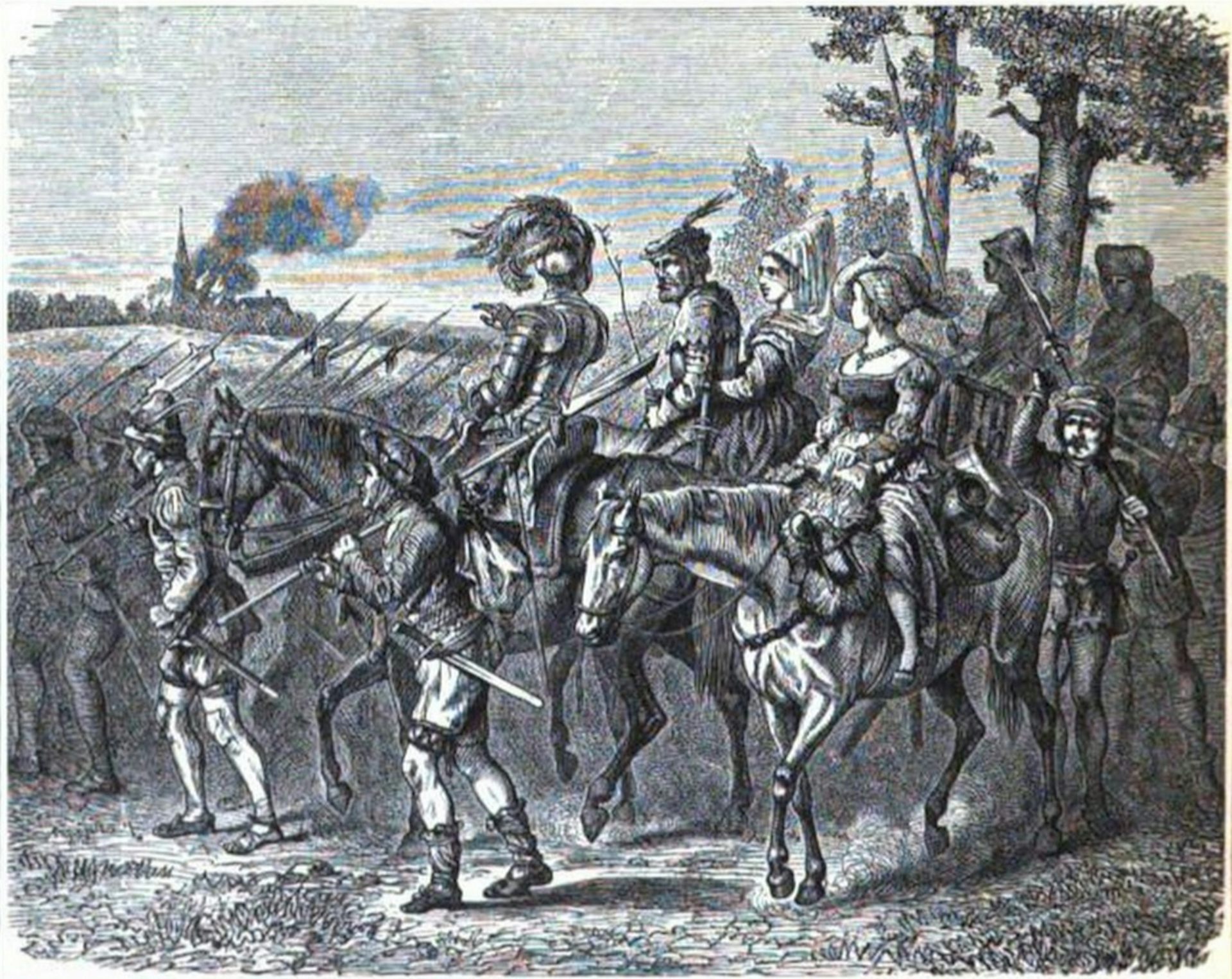
A sketch of groups of peasants wandering around the countryside during the German Peasants' War. (Warwick Press via Wikimedia Commons.)
Michael Bruening
February 26, 2025

(The Conversation) — Five hundred years ago, in the winter of 1524-1525, bands of peasants roamed the German countryside seeking recruits. It was the start of the German Peasants’ War, the largest uprising in Europe before the French Revolution. The peasants’ goal was to overturn serfdom and create a fairer society grounded on the Christian Bible.

For months, they seized their landlords’ monasteries and castles. By March 1525, the peasant armies had grown to encompass tens of thousands of peasants from Alsace to Austria and from Switzerland to Saxony.

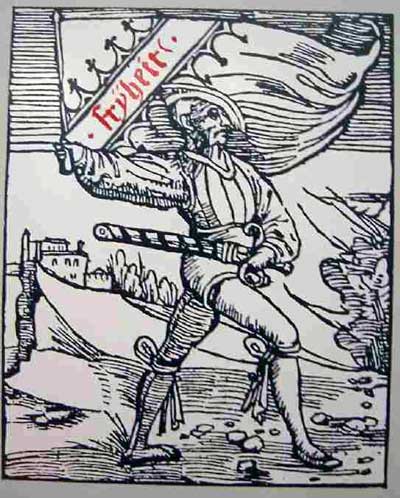
The peasants had economic grievances, to be sure, but they also drew inspiration from the message of freedom, or “Fryheit” in German, being preached by theologian Martin Luther, who had recently launched the Protestant Reformation

Luther’s rejection of the peasants’ cause, however, would help lead to their crushing defeat.

I am a scholar of the Reformation, and I included the peasants’ list of demands in my book on the debates of the era. The question of the legitimacy of the peasants’ uprising was one of the most consequential debates of the era.
Luther’s message of freedom

In 1517, eight years before the German Peasants’ War, Luther launched the Reformation with his 95 Theses. The theses reflected Luther’s belief that the pope and the Catholic Church were preying on the poor by selling them indulgences, taking their money for a false promise that their sins would be forgiven.

Luther taught instead that God freely forgives the sins of believers. In one of his most famous early treatises, “The Freedom of a Christian,” written in 1520, Luther argued that because they are saved or “justified” by faith alone, Christians are entirely free from the need to do works to merit salvation. This included fasting, going on pilgrimages and buying indulgences.

Luther’s attacks on the Catholic Church, clergy and monks quickly grew more vehement. He and his allies lambasted them for fleecing the peasants and the poor through usury, a practice of lending money at high rates of interest. Since the Bible provided no support for such practices, they argued, the poor should be free of them.
The Twelve Articles

In her 2025 book “Summer of Fire and Blood,” Reformation scholar Lyndal Roper argues that the religious element of the peasants’ war was central. The German peasants were among the first to try to unlock the revolutionary potential of Reformation teachings to fight social and economic injustice.

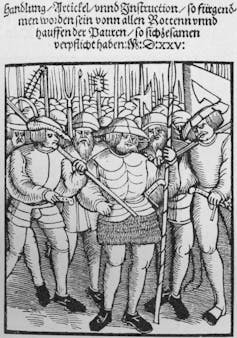
The peasants’ efforts to do so can be seen in the most important statement of their demands: The Twelve Articles. The articles are rooted in Reformation ideas and demanded, among other things, each village’s right to elect its own pastor and to be exempt from payments and duties not found in the Bible.


A pamphlet that peasants distributed with their Twelve Articles in 1525.
Otto Henne am Rhyn: Cultural History of the German People, via Wikimedia Commons

Most important was the message of freedom in the third article: “Considering that Christ has delivered and redeemed us all, without exception … it is consistent with Scripture that we should be free.” It was a cry for equality based on Christ’s redemption of all, rich and poor alike.

The Twelve Articles were hugely successful, going through 25 printings in just two months. Since the vast majority of peasants were illiterate, this was an astounding number.

For the lower classes, the Reformation promised to break up not just the spiritual monopoly held by the Catholic Church but the entrenched feudal system that kept them oppressed. Their desire for freedom was at the same time a denunciation of serfdom.

The peasants were willing to take up arms to secure their freedom. In winter 1524-1525, the peasants were able to capture castles and monasteries without much bloodshed. But starting in the spring of 1525, the uprising became increasingly violent. On Easter Sunday, the peasants shockingly slaughtered two dozen knights in the city of Weinsberg, Germany. A torrent of bloodshed would follow.
Luther’s rejection of the peasants

Although Luther may have provided the initial inspiration for the peasants, he denounced their revolt in the harshest terms. In his treatise “Admonition to Peace,” Luther complained that the peasants had made “Christian liberty an utterly carnal thing,” which “would make all men equal … and that is impossible.”

Responding to the revolt, Luther produced a tract entitled “Against the Murdering and Robbing Hordes of Peasants.” “Let everyone who can,” he infamously wrote, “smite, slay, and stab” the rebellious peasants. The rulers did just that.

The nobility had been slow to react to the peasants’ initial incursions, but when they finally organized their own armies, the peasants didn’t stand a chance. On the battlefield, the nobles’ cavalry and superior artillery brutally cut down the rebels. Many who escaped the battlefield were hunted down and executed.

The exact number of those killed are not known, but estimates place the number at around 100,000. As Roper notes, “this was slaughter on a vast scale.”

Consequences for the Reformation

English historian A. G. Dickens famously described the Reformation as an “urban event”, meaning that the movement’s important developments took place in cities. The German Peasants’ War shows the idea to be wrong.

In its first years, the Reformation galvanized the hopes and dreams of Germans in both town and country. To peasants and townsfolk, it seemed to promise the chance for a complete reordering of an unjust society.


Luther’s rejection of the peasants had important long-term consequences. His decision to side with the princes transformed the Reformation from a grassroots movement into an act of state. Everywhere the Protestant reformers went, they sought to work with the proper authorities. The close cooperation of Christian leaders and secular authorities would last for centuries.

For their part, the European peasantry grew wary of the Christian leaders who seemed to have abandoned them. Social uprisings over the next centuries lost the religious character of the 1525 conflict and would climax in the decidedly secular French Revolution.

(Michael Bruening, Professor of History, Missouri University of Science and Technology. The views expressed in this commentary do not necessarily reflect those of Religion News Service.)


The Conversation religion coverage receives support through the AP’s collaboration with The Conversation US, with funding from Lilly Endowment Inc. The Conversation is solely responsible for this content.


LA REVUE GAUCHE - Left Comment: Search results for PEASANT WAR GERMANY


Marxists.org
https://www.marxists.org/archive/marx/works/1850/peasant-war-germany/index.htm

The Peasant War in Germany by Frederick Engels 1850

Jun 6, 2023 ... The Peasant War in Germany was the first history book to assert that the real motivating force behind the Reformation and 16th-century peasant ...


Libcom.org
https://libcom.org/article/third-revolution-popular-movements-revolutionary-era

The Third Revolution: Popular Movements in the Revolutionary...

Jun 15, 2020 ... pdf (17.78 MB). ThirdRevVol2Pt1.pdf (12.23 MB). ThirdRevVol2Pt2.pdf (28.3 MB) ... Audiobook of Murray Bookchin's Ecology and Revolutionary Thought.
Advocates: NY Prison Guard Strike Is Part of History of Repression & Violence Against Prison Activism


DEMOCRACY NOW!
February 26, 2025

Guests
Jose Saldaña
director of Release Aging People in Prison.
Orisanmi Burton
assistant professor of anthropology at American University.

Links"Tip of the Spear: Black Radicalism, Prison Repression, and the Long Attica Revolt"
Release Aging People in Prison

We speak with Jose Saldaña, director of Release Aging People in Prison, about a wildcat strike by New York prison guards who claim limits on solitary confinement have made their work more dangerous. “The people who are living in a dangerous environment are the incarcerated men and women,” says Saldaña, who notes the strike began the same week murder charges were announced against six of the guards who brutally beat to death handcuffed prisoner Robert Brooks in an attack captured on body-camera video. “The whole world saw it, and they’re questioning: How long has this been going on in the prison system? This illegal strike is to erase that consciousness that’s building,” says Saldaña. We are also joined by anthropologist Orisanmi Burton, who studies prisons and says the proliferation of solitary confinement and other harsh measures is directly linked to political organizing behind bars starting in the late 1960s. “Prisons in the United States are best understood as institutions of low-intensity warfare that masquerade as apolitical instruments of crime control,” says Burton, author of Tip of the Spear: Black Radicalism, Prison Repression, and the Long Attica Revolt.


Transcript
This is a rush transcript. Copy may not be in its final form.


AMY GOODMAN: This is Democracy Now!, democracynow.org. I’m Amy Goodman, with Juan González.

We end today’s show here in New York, where state prison guards are on the second week of a wildcat strike over what they say are unsafe conditions. The National Guard have been called in.

Some say the timing of the strike is curious. It started the same week charges were filed against prison guards at the Marcy Correctional Facility in Utica, New York, who brutally beat to death handcuffed prisoner Robert Brooks in an attack captured on video footage by body cameras. Brooks was Black. All the officers who took turns beating him appear to be white.

Meanwhile, prison officials have responded to the prison guard strike by indefinitely suspending provisions in New York’s HALT Solitary Act, which stands for Humane Alternatives to Long-Term Solitary Confinement, which limits solitary confinement to 15 consecutive days or 20 days over a 60-day period.

For more, we’ve got two guests with us. In Washington, D.C., Orisanmi Burton is assistant professor of anthropology at American University, author of a book about the 1971 Attica prison uprising, upstate New York, titled Tip of the Spear: Black Radicalism, Prison Repression, and the Long Attica Revolt. And here in our New York studio is Jose Saldaña, director of Release Aging People in Prison, known as RAPP. He was released from New York state prison in 2018 after 38 years behind bars.

We welcome you both to Democracy Now! Jose, welcome back to Democracy Now! You’re just back from the state capital here in New York, from Albany.

JOSE SALDAÑA: That’s correct.

AMY GOODMAN: Talk about the significance of the wildcat strike and how it’s affecting the prisoners.

JOSE SALDAÑA: Well, first of all, you know, for those who don’t know, this is an illegal strike. The correction guards had just finished negotiating a contract a few months ago, and now they are going on strike. And the reason why they are going on strike is because the world saw that video. We call it a lynching. Fourteen to 16 correction prison guards lynched a Black man. And the whole world saw it, and they’re questioning: How long has this been going on in the prison system? So, this illegal strike is to erase that consciousness that’s building. We are building a consciousness to dismantle that type of racial brutality and sexual violence in the prison system that’s been going on for decades. They’re trying to erase that.

JUAN GONZÁLEZ: And, Jose, could you talk about their demand that the reforms around solitary confinement be removed?

JOSE SALDAÑA: Yes. They want the Solitary Confinement Act repealed. And the Solitary Confinement Act does not only restrict them from putting people in the box for decades, actual decades, it also stops them from putting pregnant women in the box, women breast-feeding in the box, people who have mental health problems, people who have physical disabilities, paralyzed people, wheelchair-bound. It prohibits them from putting these people in solitary confinement. They’re trying to repeal that. They’re trying to say that this whole Solitary Confinement Act has made their work dangerous, it has created a dangerous environment. And they actually are trying to erase what we saw in that video. The people who are living in a dangerous environment are the incarcerated men and women.

AMY GOODMAN: Is it true that a prisoner died this week? I’m not talking the one who was beaten to death.

JOSE SALDAÑA: Absolutely. One that has been reported —

AMY GOODMAN: A 61-year-old man?

JOSE SALDAÑA: At least one person has been reported to have died since then.

AMY GOODMAN: And this is after the National Guard —

JOSE SALDAÑA: After the National Guard, yes.

AMY GOODMAN: — were moved into these prison facilities.

JUAN GONZÁLEZ: Yeah, I wanted to bring in Orisanmi Burton, assistant professor of anthropology at American University, author of the Tip of the Spear: Black Radicalism, Prison Repression, and the Long Attica Revolt. Could you talk somewhat about the role of correction officers? Especially in your book on Attica, you went back in time, of course, the Attica revolt being one of the biggest in American history in its impact on reforms within the prison system.

ORISANMI BURTON: Yes. Well, the role of the guards is really to enforce domination. And Jose was exactly right in talking about the role of solitary confinement in all of this. Of course, a repeal of the HALT Act is really the primary demand of the guards. And this is a legacy of Attica. So, in the wake of the Attica rebellion, we saw nationally the proliferation of solitary confinement and the extension of the lengths of time to which people were subjected to solitary confinement. And this was really an effort to assert control and domination over the prison population. People might be aware of this popular narrative that solitary confinement is about confining the worst of the worst. But you just heard from Jose the different categories of people that the HALT Act was designed to prevent from being put into solitary confinement.

And there’s also a pronounced political dimension to the use of solitary confinement. So, for instance, in the 1980s, the warden of the Marion control unit, which is a supermax prison in Illinois, said that the purpose of the Marion solitary confinement unit is to control revolutionary attitudes within the prison system and within the society at large. And so, part of this is the use of the prison as a form of counterrevolution. And the guards are really in place to enforce that dominance and to ensure that prisons remain quiet. And for the most part, people don’t hear about it, but because this video was released, people have no choice but to be faced with the kinds of violence that happen all the time in prisons.

AMY GOODMAN: Professor, if you could talk about — and you talk a lot about this in your book — what you think needs to happen now, the whole issue of abolition versus reforms as the legacy of what happened after Attica? And explain what happened then.

ORISANMI BURTON: Right. So, I mean, the dominant narrative of Attica is that it’s a four-day rebellion that unfolded largely within Attica prison and that the demands were primarily oriented towards improving prison conditions. I don’t think that that’s wrong. I just think that it’s incomplete. My book shows that Attica was a protracted struggle that lasted for at least 13 months, that it traversed multiple prisons, and that it was revolutionary and abolitionist in its politics, that it was informed by anti-colonial movements unfolding throughout the world and that it had material links to those movements.

Part of the response to Attica was massive repression and violence, as many of your viewers will know. But the focus on the intense violence waged by the state often obscures the extent to which reforms were used as a counterinsurgency method designed to suppress political consciousness and suppress activism. And so, one of those reforms was the proliferation of solitary confinement, as I just mentioned. Other reforms were just the proliferation of prisons in general, which were used as a method to separate out more prisoners so that they couldn’t organize.

But, importantly, the proliferation of prisons was also used as a way to market prison growth and development to white rural populations whose economies had been ravaged by deindustrialization. So it was a way to sort of shore up support for rural white workers who had very few other employment options, especially in light of the fact that during the repression at Attica, the New York state assault force that went in to suppress the rebellion also killed several of the guards, 10 guards. And so, the building of prisons became a marketing tool to try to build support for prison development among rural white populations. And much of this is what we’re dealing with now in terms of the — some of the demands and conversations around what’s happening with the strike have to do with animosity around the recent closure of prisons that has been unfolding in New York over the past decade.

JUAN GONZÁLEZ: And you mentioned earlier solitary confinement used as a means of political repression of revolutionary movements. Could you talk about what your book found in terms of Attica specifically, the level of political activism that occurred in the prisons? I know when I was in the Young Lords back in the ’70s, we actually had members in Attica as part of the Inmates Liberation Front. But the Black Panther Party, the Nation of Islam, many other political groups, Republic of New Afrika, had membership and developed membership in Attica and other prisons, as well.

ORISANMI BURTON: Absolutely. And the Inmates Liberation Front is discussed in my book. I mean, part of what I want people to understand is that prisons in the United States are best understood as institutions of low-intensity warfare that masquerade as apolitical instruments of crime control. And so, part of what we see in the late 1960s is the use of prisons to repress and contain and neutralize political activism on the outside, groups like the Black Panthers and the Young Lords, as you just mentioned.

But, in fact, what happens is that the strategy backfires. And prisons, in fact, become schools of revolutionary political education. And these groups, in fact, proliferate in the prisons. And that politicization interacts with the intense repression that these groups were facing, which gives rise to these different forms of rebellion that emerge all throughout the prisons. Attica happened to be one of the most brutal prisons in New York state and, in fact, in the country, where many of the most political and most intellectual, most charismatic people were transferred and repressed. And it turned into a tinderbox.

AMY GOODMAN: Professor Burton, that’s where the wildcat prison guard strike is. Jose Saldaña, we just have 20 seconds. What you’re calling for?

JOSE SALDAÑA: This is to say that they have engaged in illegal activity, and they will continue to escalate that illegality. We are building a movement to dismantle this racial brutality. But in the meantime, we have to get people out of that brutal system. We have legislation, elder parole, fair and timely, second look at. These legislations will help relieve people out of these systems of brutal oppression and unite them back to their families.

AMY GOODMAN: I want to thank you both for being with us, Jose Saldaña, director of RAPP, and Orisanmi Burton, author of Tip of the Spear: Black Radicalism, Prison Repression, and the Long Attica Revolt. He’s also professor of anthropology at American University. That does it for our show. I’m Amy Goodman, with Juan González.
The original content of this program is licensed under a Creative Commons Attribution-Noncommercial-No Derivative Works 3.0 United States License. Please attribute legal copies of this work to democracynow.org. Some of the work(s) that this program incorporates, however, may be separately licensed. For further information or additional permissions, contact us.


IMPERIALIST MONOPOLY CAPITALISM 


SMARTPHONE COUNTRY

How Chinese mobile-phone firms use pop culture to dominate the Pakistani market

Riding on the strong ties between the governments of the two countries, Chinese firms use cricket

Anand P Krishnan
FEB. 26, 2025
A vendor in Karachi sells covers for mobile phones. 
| Rizwan Tabassum/ AFP

Between January and September 2024, in the list of top 10 companies making or assembling devices in Pakistan, the top eight are Chinese. In the competitive market for mobile phones, how did Chinese firms manage to establish such dominance across the border?

The strong political relationship between both countries is one part of it. In addition, Chinese consumer electronics brands extend their reach by also using popular culture.

The bilateral relations between China and Pakistan have been described as an “all-weather friendship” by both the countries. Despite terrorist attacks that have targetted Chinese personnel and project infrastructure in Pakistan, the leaders in both countries have remained committed to further strengthening the relationship.

Riding on the wings of this friendship, Chinese mobile phone companies ventured into the Pakistani market from 1998 and, over time, built a loyal consumer base.

The signing in 2015 of the China Pakistan Economic Corridor framework for regional connectivity provided a fillip to later entrants to solidify their operations.

Chinese companies hold an advantageous position in the mobile-phone sector, as their high numbers and globalised nature of operations have helped them grow as well as evolve in different markets.

Localising initiatives

Huawei had a head start, having begun its journey in the country from 1998. It claims to employ over 3,000 local workers. They form 91% of the company’s employees in Pakistan.

Huawei deepened its presence and association with the Pakistani government, by committing resources and partnering in areas ranging from rural connectivity and connecting overseas workers with their families through digital means, to developing solar power as well as conducting training programmes for youth in information and communications technology.

During Pakistan’s Prime Minister, Shahbaz Sharief‘s visit to China in June 2024, he visited Huawei’s headquarters to explore more collaborations and to allay fears about the security of existing Chinese investments in his country.

This deepening of relations with Huawei came out despite the allegations in 2021 that the company was spying and stealing sensitive data of the provincial Punjab government.

Other Chinese companies have followed Huawei’s lead in collaborating with Pakistan in its digital projects.

The companies have aligned themselves with the federal government’s programmes such as the “Made in Pakistan” initiative by setting up domestic manufacturing facilities. This followed the federal government’s Mobile Device Manufacturing Policy in 2020 to encourage local manufacturing and assembly of smartphone devices with 4G service technology, to reduce dependence on imports, boost local employment and to export manufactured products to other markets.

The policy also seeks to provide an alternate manufacturing base for Chinese investors in view of the adversarial trade relations with the US.

Chinese forays are not restricted to only mobile handset production and sales. Their presence also extends to its role as a service provider in network connectivity. China Mobile Pakistan, a 100% subsidiary of China Mobile Communication Corporation operates under the brand name, Zong.

In terms of mobile subscribers, Zong is the third-largest of the country’s mobile network providers, and second-largest for mobile broadband subscribers.
Popular culture

The Chinese consumer electronics brands extend their reach and become relatable through popular culture associations. While such localisation is the standard operating pattern for many foreign companies, the Chinese brands have realised its advantages more than others.

From sponsorships and advertisements in cricket, endorsements by celebrities, using festivals like Eid for special promotions, Chinese companies have chosen obvious entities of popular culture to build bridges with consumers across age groups.

They have associated themselves with initiatives that strengthen a collective sense of belonging, such as a campaign for women’s empowerment and an advertisement paying tribute to the Pakistani national anthem.

The advantage for Chinese companies in Pakistan is the strong political relationship between both countries. While India and its rise remains the geopolitical glue that keeps its two neighbours, the dominance of Chinese electronics brands also illustrates how bonds have been reinforced – through winning the confidence of the consumer.

Anand P Krishnan is a fellow at Shiv Nadar Institution of Eminence’s Centre of Excellence for Himalayan Studies in Delhi.
Apple strikes deal with Indonesia, secures future market access for iPhones

Silicon Valley behemoth commits hundreds of millions of dollars in new investments in Indonesia, industry minister says.

Tria Dianti
2025.02.26
Jakarta
AFP
A customs official shows a smuggled iPhone 16 Pro Max before destroying it after it was confiscated due to a ban on iPhone 16 sales at the customs office of Soekarno–Hatta International Airport, near Jakarta, Nov. 29, 2024.  AFP

A new agreement between Apple Inc. and Indonesia will allow the tech giant to sell the iPhone16 in the country, a senior government official said, resolving a dispute over investment requirements that led Jakarta to ban the model.

The deal commits Apple to hundreds of millions of dollars in new investments, said Indonesian Minister of Industry Agus Gumiwang Kartasasmita.

Those include the establishment of a research and development center, integration of Indonesian suppliers into its global manufacturing network, and expansion of education and technology programs.

The agreement allows Apple to regain compliance with Indonesia’s Domestic Component Level (TKDN) certification, a rule mandating that foreign tech companies invest in the country in exchange for market access.

“The talks were challenging until the very last 15 minutes,” Agus told reporters in Jakarta on Wednesday. “But the memorandum of understanding has now been signed electronically on a provisional basis.”

RELATED STORIES

Indonesia holds firm on iPhone 16 ban despite Apple’s $1B investment offer

After doubling down on iPhone ban, Indonesia says Apple offers $1B

Indonesia courts US tech titans as it pursues digital transformation

For Apple, the agreement represents a win in Southeast Asia’s largest country, where smartphone penetration is rapidly increasing. The iPhone 16 is expected to hit Indonesian stores soon after Apple secures the necessary certification and distribution permits from the government.

“Sales could begin as early as next month,” Agus said, though he declined to provide a specific date.

The 2017 regulation requires that 40% of smartphones sold in Indonesia use domestically sourced components. The policy is part of Indonesia’s push to boost domestic manufacturing and reduce reliance on imports.

The dispute escalated in late 2024, when Apple failed to meet its previous investment commitments under the regulation, prompting Indonesian regulators to block sales of the iPhone 16

.
Apple Chief Executive Tim Cook (second from right), then-Minister of Communication and Informatics Budi Arie Setiadi (second from left) and Indonesian Minister of Industry Agus Gumiwang Kartasasmita (right), converse after attending a meeting with then- President Joko Widodo, at the Presidential Palace in Jakarta, April 17, 2024. (Willy Kurniawan/Reuters)


Unlike rivals such as Samsung and Oppo, which have built local assembly plants, Apple had chosen to fulfill its obligations through innovation investments, a strategy that fell short of government expectations.

With iPhone sales halted, Apple entered negotiations with the Ministry of Industry, culminating in this agreement, which the government said was a fresh investment cycle rather than a continuation of past obligations.

Under the new deal, Apple has pledged U.S. $160 million in hard cash investments and will deepen its supply-chain presence in Indonesia, the industry ministry said in a statement.

The company will bring in Luxshare, a key supplier in its global supply network, to invest $150 million in a new manufacturing facility in Batam, an industrial hub near Singapore.

The plant will produce AirTag accessories, with Indonesia set to become the supplier for 65% of the global AirTag market. An AirTag is a tracking device that when attached to a user’s belongings, such as keys, helps the user find the item.

Apple has also agreed to source AirTag batteries from Indonesian manufacturers, further embedding local suppliers into its ecosystem, the industry ministry said.

A vendor holds an iPhone at an Apple reseller store iBox at a mall in Jakarta on April 17, 2024. (Adek Berry/AFP)

Additionally, Apple is expanding production in Bandung, where local company Long Harmony will manufacture mesh fabric for AirPods Max, making it an official part of the company’s global supply network.

These investments represent a change in Apple’s approach to meeting Indonesia’s local content requirements, moving beyond software and education programs to deeper supply chain involvement.

One of the most significant commitments in the agreement is Apple’s decision to establish a research and development center in Indonesia, focused on software innovation, the ministry said.

It will be Apple’s first research and development center in Asia and only the second outside the United States, after Brazil.

The facility will partner with 15 leading Indonesian universities, including Bandung Institute of Technology and University of Indonesia, and will also be part of the Indonesia Chip Design Collaborative Center (ICDEC), an initiative aimed at strengthening Indonesia’s presence in the semiconductor and chip design industry, it said.
A whale caught in fishing nets has been freed off Poland’s Baltic coast

Sea rescuers and wildlife activists in dinghies approach a whale to cut it loose from fishing nets off the Baltic Sea beach near Miedzyzdroje, Poland, on Wednesday, Feb. 26, 2025. (Maritime Search and Rescue Service via AP) 

By Monika Scislowska - Associated Press - Wednesday, February 26, 2025

WARSAW, Poland — Teams of sea rescuers and wildlife experts on Wednesday successfully freed a whale that got caught in fishing nets near a popular Baltic Sea resort in Poland.

It took about an hour for the rescuers to cut and remove the nets and allow the whale to swim into the open sea, close to the popular summer resort and beach in Miedzyzdroje, where the stranded animal was spotted in the morning.

Konrad Wrzecionkowski from WWF Poland, a conservation organization, said the whale made a “great and positive impression” on him but the action was potentially dangerous for the rescuers and was very stressful.

“You have to approach these animals with a lot of respect and we knew that if it chose to wave its tail, we would all find ourselves in the water,” Wrzecionkowski told The Associated Press.

“The situation was very stressful for him, but with time, when the nets were getting looser, he seemed to understand that we were trying to help him and the untangling became easier. And then he swam off into the sea,” Wrzecionkowski said.

He said the boat he was in was some 3 meters (10 feet) long and the animal was at least twice as long. The rescuers used boathooks on long poles, rather than knives, to loosen and remove the nets, rather than cutting them with knives, in order to avoid harming the animal.

PHOTOS: A whale caught in fishing nets has been freed off Poland's Baltic coast

Whales normally live in the open waters of oceans, but sometimes individual animals swim from the Atlantic Ocean into the Baltic Sea through the Danish Straits.

The rescuers hope the whale will find its way back to the Atlantic because the Baltic is not a suitable environment for whales.