Syrian Kurdistan Front calls for multiple autonomous regions in Syria
By:TII team
February 26, 2025

HEWLÊR-Erbil,— The head of the External Relations Office of the Syrian Kurdistan Front, Siamand Hajo, has called for the creation of multiple autonomous regions in Syria, arguing that such a system would help protect Kurdish rights and prevent centralized control.
Speaking at the Third Annual Erbil Forum in Iraqi Kurdistan on Wednesday, Hajo compared Syria’s situation to post-war Germany, stating, “The Americans and the French imposed federalism on Germany because they wanted to prevent power from being concentrated in the hands of a small group.”
Federalism and Kurdish Rights
Hajo stressed that federalism would serve as a safeguard for Kurdish rights in Syria. “Kurds have faced decades of oppression, coercion, and persecution,” he said. “There need to be guarantees in place to protect their rights.”
He also criticized the marginalization of Kurds in Syria’s political institutions, pointing to the Constitutional Committee in Geneva. “Out of 45 members, only one is Kurdish,” he noted.
“Those who took power after the war formed a government without Kurdish representation. Federalism would ensure that Kurds have control over their own affairs.”
Push for Autonomy
While supporting federalism, Hajo also suggested that autonomy could be an alternative for the Kurds and other groups in Syria. He cited Italy’s system, where five autonomous regions operate within a centralized government.
“Syria does not have to be a fully federal state to grant autonomy,” he said. “There can be multiple autonomous regions, not just for the Kurds but for other communities as well.”
Hajo criticized the current Syrian leadership, calling its approach “a continuation of the Ba’ath regime’s policies.” He accused the new authorities of refusing to acknowledge Kurdish political movements.
Lack of Kurdish Representation in Damascus
Hajo mentioned that Syria’s interim Islamist president, Ahmed al-Sharaa—also known as Abu Mohammed al-Golani, declined to take a photograph with General Mazloum Abdi, the commander-in-chief of the Syrian Democratic Forces SDF of Syrian Kurdistan (Rojava), during a meeting.
According to Hajo, this signaled that Al-Sharaa had reservations about engaging with Kurdish leadership.
A national dialogue conference took place in Damascus on Tuesday to discuss Syria’s future governance, but Kurdish parties criticized the gathering, calling the inclusion of minority groups merely symbolic and arguing that it lacked genuine representation.
They also denounced the event for excluding Kurdish representatives, stating that they were not invited to participate in the discussions.
The Third Annual Erbil Forum in Iraqi Kurdistan, organized by the Rudaw Research Center in partnership with regional and international institutions, is set to continue until February 28, 2025.
(Credit: Rudaw, Agencies)
Copyright © 2025 The Insight International. All rights reserved
By: TII team
February 28, 2025
 General Mazloum Abdi, the commander-in-chief of the Kurdish-led Syrian Democratic Forces (SDF) in Syrian Kurdistan (Rojava), October 26, 2024. Photo: AFP
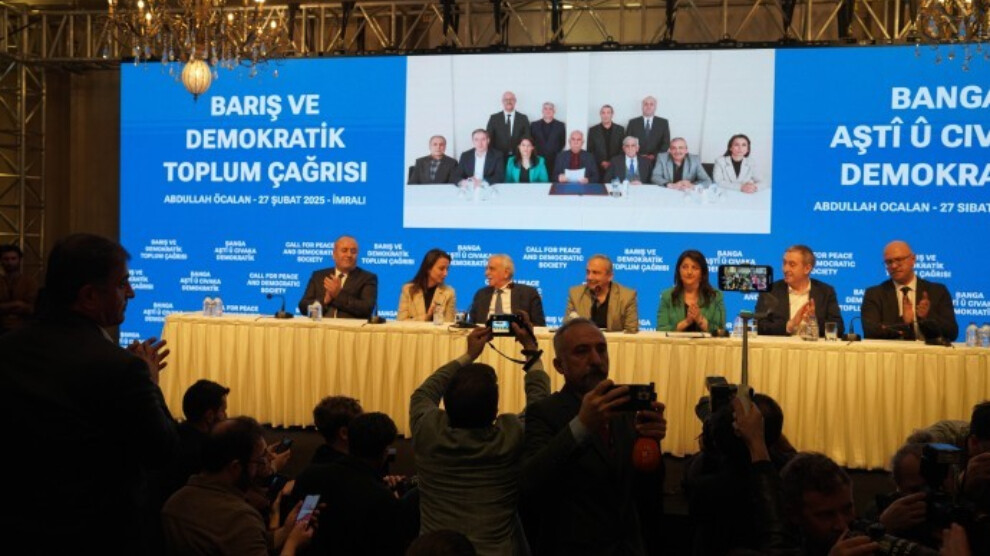
QAMISHLO,— The commander of the Kurdish-led Syrian Democratic Forces (SDF) on Thursday welcomed a proposal by imprisoned Kurdistan Workers’ Party (PKK) founder Abdullah Ocalan, who called for the group to disband and lay down its arms.
General Mazloum Abdi, head of the SDF, described the call as a positive step toward peace.
“This initiative is important because it concerns peace in our region,” Abdi said.
The SDF, which plays a key role in Syrian Kurdistan, is largely made up of fighters from the People’s Protection Units (YPG). Turkey is the only country that considers the YPG an extension of the PKK, which has waged an armed campaign against the Turkish government for decades. The conflict has resulted in the loss of tens of thousands of lives.
The Turkish military, which maintains a presence in northern Syria, regularly targets Kurdish areas. Turkish-backed Islamist factions have also launched attacks on SDF-held territory since November, despite mediation efforts led by the United States.
Washington views the SDF as a crucial partner in efforts to combat the Islamic State group.
“If this move succeeds, it could benefit us as well,” Abdi said. “Turkey sees the PKK as a threat, and because of that, they carry out attacks in our areas.”
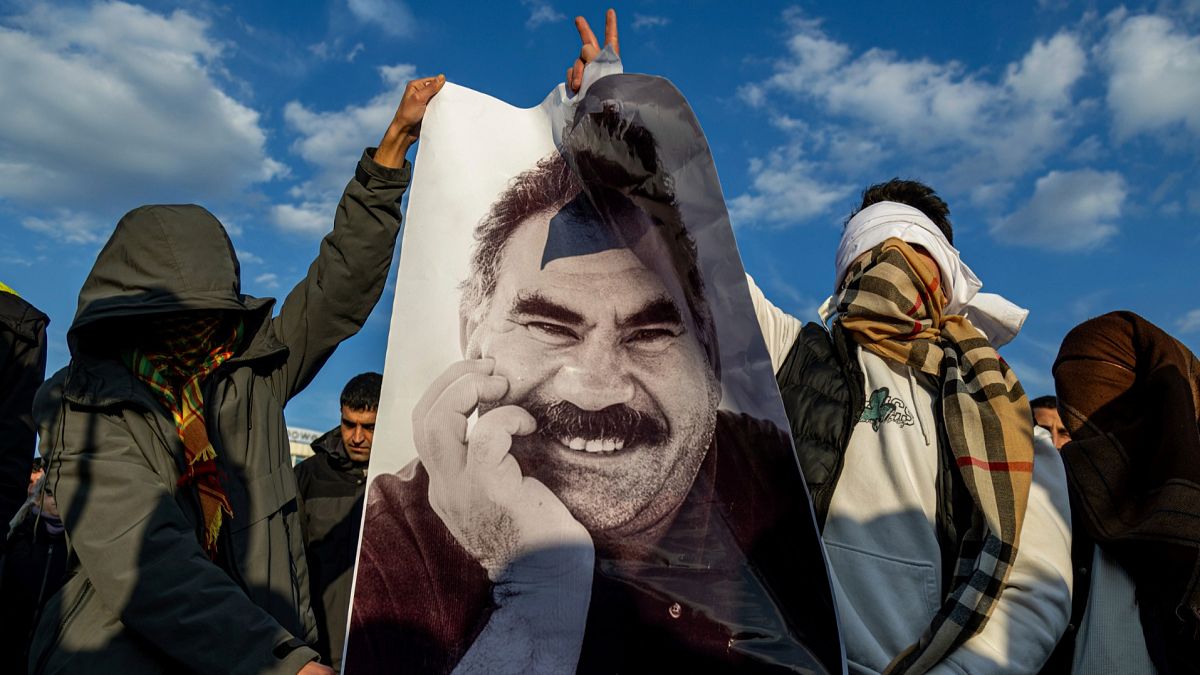
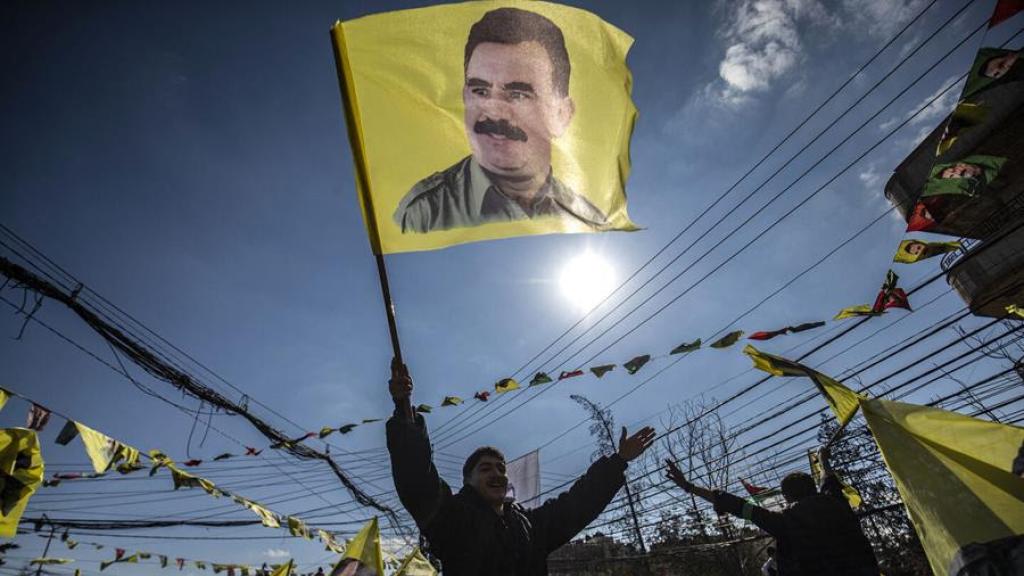
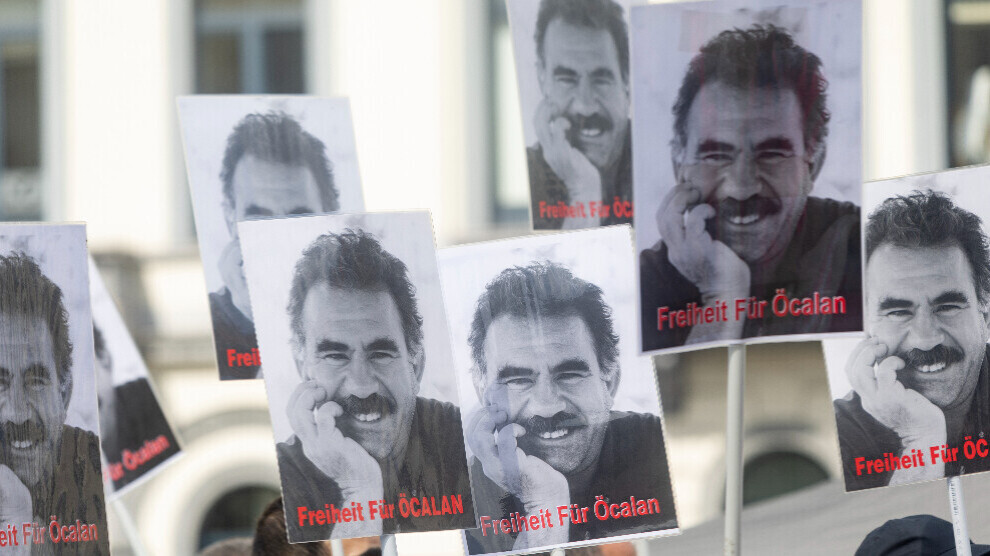
Portraits of Ocalan are a common sight in northeastern Syria, reflecting his influence. However, the SDF maintains that it is separate from the PKK.
“The PKK’s decision to lay down arms is their matter and does not affect our forces in Rojava,” Abdi said, using the Kurdish name for northeastern Syria.
The SDF gained control of large parts of Syrian Kurdistan, the Kurdish region in northern and northeastern Syria after government troops withdrew during the country’s civil war, which began in 2011.
However, the new Syrian Islamist authorities in Damascus, closely aligned with Turkey, have rejected Kurdish autonomy and called for all armed factions, including the SDF, to disarm.
Abdi emphasized that the SDF should remain part of Syria’s future security structure.
“A new Syria is emerging, and a new military force is taking shape,” he said. “The Syrian Democratic Forces should be integrated into the future Syrian army. Our goal is not to disband the SDF, but to contribute to a stronger national defense.”
Ocalan, who has been in solitary confinement on a prison island since 1999, declared that “all factions should disarm, and the PKK must disband.”
(Credit: AFP | Agencies)
Copyright © 2025 The Insight International. All rights reserved
The Syrian revolution, Iran and Israel: Squaring the circle, refuting myths
A version of this was first published at Their Anti-imperialism and Ours.
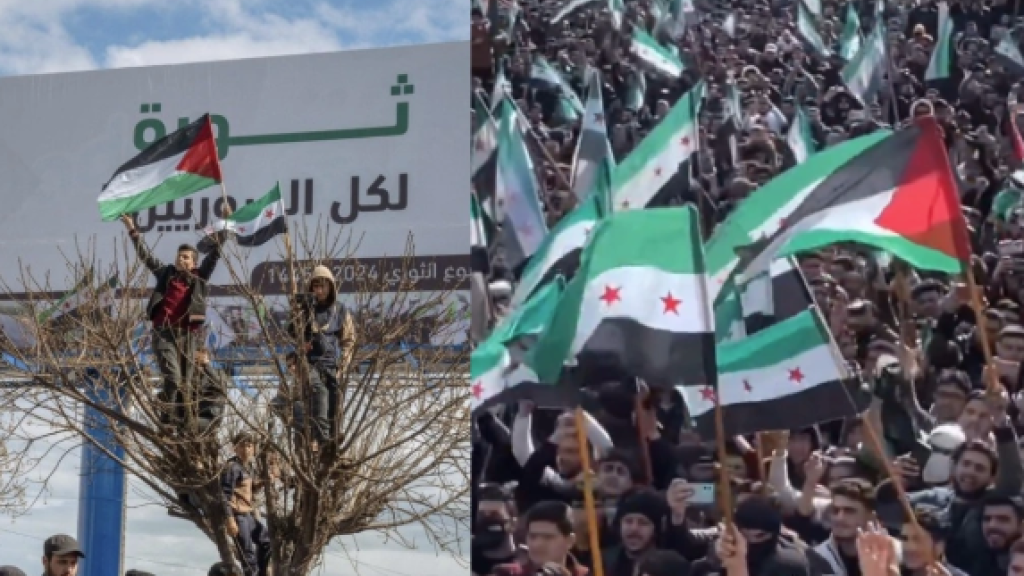
The huge popular revolution that overthrew the 54-year old Assad dynasty is a momentous event shaking West Asia. As the real scale and depth of the horror of the former regime’s prison-torture gulag is being revealed, along with the continual unveiling of mass graves containing some 100-150,000 souls, the enormous significance of the Syrian people’s achievement becomes more undeniable.
Meanwhile, leading up to the Gaza truce, Israel’s holocaust in Gaza became more unspeakably barbaric by the day, if that is even possible. The destruction of the last hospital in northern Gaza, the mass killing of civilians taking refuge there and mass arrest of doctors, the freezing to death of Palestinian infants, were all greeted with a collective yawn by the world’s rulers.
While Israel’s aim of annexing northern Gaza appears to have not succeeded as hundreds of thousands of Palestinians return — albeit to rubble — Israel Prime Minister Benjamin Netanyahu is expecting support from the Donald Trump administration for annexing the West Bank as a quid pro quo to consecrate Palestine’s worst catastrophe since 1948.
While the solidarity shown with Palestine by southern Lebanon under Hezbollah’s leadership and by the AnsarAllah authorities in north Yemen was undoubtedly appreciated by Palestinians, the realistic conclusion is that it made no difference to Israel’s ability to commit genocide. When Israel decided to turn around and “show deterrence” by destroying Hezbollah’s communication network, military capacity and most of its leadership in some ten days, this not only did not detract from its war of extermination in Gaza, but rather Israel accelerated it under the cover of Lebanon, implementing the General’s Plan for the complete ethnic cleansing and demolition of northern Gaza.
This demonstrated two things. First, any illusions that Israel — an entrenched colonial-settler state acting as a virtual extension of the world’s most powerful imperialist state — can be defeated purely by military pressure or that any “fronts” other than Palestine could be more than symbolic, ought to have been destroyed. Such illusions were particularly high in late 2023-early 2024 before reality set in. This is not an infantile criticism that Hezbollah or the Houthis “should have” done more when no-one else did anything, rather it is simply a statement of reality. Second, related illusions that these two outside fronts were driven and empowered by some “axis of resistance” led by the reactionary Iranian theocracy — rather than being more situational — should also have been smashed.
Indeed, the fact that the Iranian regime was unwilling or unable to do anything of note to prevent the defeat of its own close Lebanese ally essentially means the death-knell of “axis of resistance” discourse — if such an “axis” means illusions that repressive capitalist states such as Iran are willing or able to aid Palestinian liberation (the fact that Syria’s Assad regime not only did less, but arguably even sabotaged Hezbollah and even minimal Iranian efforts, is much less surprising). In reality, as Palestinian author Rashid Khalidi argues, that was never the purpose of Iran’s “axis” in the first place.
The key date here is November 27. This was both the day of the Israel-Hezbollah-Lebanon ceasefire agreement and the day that Syrian rebels launched their long-planned “ Operation Deter Aggression”, which, unbeknown to themselves, landed them in Damascus ten days later. The coincidence of the date, and the fact that both Hezbollah’s defeat and the fall of the Assad regime can be considered defeats to the Iran-led “axis” — even if one was a victory for a genocidal regime and the other a victory against one — has led to much debate about the “geopolitical” relationship between the two events, and their outcome.
There are three main assertions arising from this, which will be disputed here.
- The first assertion — made by many “anti-imperialists” who only see the world through the struggle against Israel and the US, and view everyone else’s struggle for freedom as secondary — is that Israel and the US were “behind” the toppling of Assad. This conspiracism is easy to refute, but nevertheless will be dealt with seriously.
- The second assertion — made not only by this group but also by many people who welcome Assad’s overthrow and wish the Syrian people well — is that while the fall of Assad may be good for the Syrian people, it also happens to be in Israel’s geopolitical interests since Assad’s Syria, though it did nothing for Palestine itself, was the territorial “link” across which Iran sent arms to Hezbollah. While more serious than the first assertion, Israel’s immediate attack on free Syria to destroy all the weapons it never had any problem with the Assad regime possessing, establish a “safe zone” on the Syrian side free of weapons and “terrorist” infrastructure” (Israeli defence minister Yisrael Katz), and ensure that no hostile force embeds itself right next to the border of Israel” (Netanyahu), along with Israeli leaders descriptions of the new Syrian government as “ a gang of terrorists” (Israeli foreign minister Gideon Saar) and “wolves in sheep’s clothing” (deputy foreign minister Sharren Haskel) and claims that “ the events in Syria are far from being a cause for celebration” (diaspora affairs minister Amachai Chikli), do not offer much support to this assertion.
- The third, and most serious, assertion — made by many who reject the first and even the second assertion above, and who welcome the Syrian revolution, stress that Syrian freedom should not be hostage to anyone else’s struggle, and so on — is that that Israel’s defeat of Hezbollah and Iran and the destruction of many of their assets played a key role (even if inadvertently) in enabling the rebels’ rapid victory and Assad’s collapse. Although the law of unintended consequences is a real thing, I will argue below that when we look at this argument in detail, the reality is that it played little, if any, role and makes little sense.
Each of these assertions will be dealt with in depth, but here at the outset, I will note that the explanation regarding the two events coinciding on November 27 is more simple than many imagine, yet belies precisely the kinds of “connections” many want to make: despite being under constant bombardment by the Assad regime ever since October 7, 2023, the Syrian rebels in Idlib, led by Hay’at Tahrir al-Sham (HTS), did not activate their Operation Deter Aggression to deter this aggression before the Lebanon ceasefire precisely so as to not help Israel. Once Hezbollah had signed the agreement to implement UN Resolution 1701, requiring it to withdraw north of the Litani River and be replaced there by the Lebanese army, we need to understand that the “axis” — if interpreted in the narrow sense of Iranian arms crossing Syrian territory to reach Hezbollah — had become irrelevant, not only for any symbolic solidarity with Palestine, but for defence of Lebanon itself. At that point, the Syrian rebels made the decision to no longer delay their own struggle against genocide to avoid harming another struggle, as that other struggle had come to a close.
Was Israel ‘behind’ Assad’s ouster?
It is difficult to “refute” an argument based on nothing. Just because conspiracists on social media proclaim that Israel was “behind” the Syrian rebel offensive without offering a grain of evidence, does not make it a fact. “On the streets they are saying it is Mossad,” I was reliably informed after December 8. Just exactly how is anyone’s guess, as these conspiracists never explain the alleged mechanism: for example, did Mossad secretly pay off every soldier in the Syrian army to not fight? In reality, no evidence has been presented of a connection between HTS in Idlib, which spent the year since October 7 campaigning for Gaza, and Israel, which calls the rebels “jihadists”, “terrorists”, “hostile entity”, “al-Qaeda”.
In contrast, there are some points we can make that demonstrate the distance from reality of these assertions, because they show not only that Israel wanted the regime to remain in power, but that it was as taken aback as everyone else was by its rapid collapse.
The first point concerns the revelations about the long-term intelligence links between Israel and the Assad regime, which have been exposed since the overthrow. Classified intelligence documents belonging to the regime came to light after its fall showing the messages exchanged between an Israeli agent code-named Mousa (or Moses) and then Syrian Defence Minister Lt. Gen. Ali Mahmoud Abbas, who then passed the messages onto Assad’s intelligence chief Ali Mamlouk. These documents concerned the long-term well-known “mechanism” by which Israel and Russia collaborated in the Syrian skies, as Russia’s world-class S-400 anti-aircraft missile system gave a decade-long pass to Israel’s attacks on Iranian and Hezbollah assets in Syria, as long as Israel spared the Assad regime itself.
But while it was previously assumed that Israel only coordinated with Russia, acting on Assad’s behalf, these exposures demonstrate Israel’s direct line to the regime itself. While some messages are warnings to Assad to reduce collaboration with Iran, others are Israeli explanations for certain anti-Iranian actions, sounding almost apologetic in some cases, while still others thank the regime for “positive” moves against Iran and show Israel’s respect for the regime meeting its own “security” needs.
For example, Hassan Hassan and Michael Weiss wrote up a message from “Moses” to Abbas on June 16, 2023, where it was noted that Syrian Airforce planes, which Israel had previously accused of helping transport Iranian weapons to the Hmeimim airport for transfer to Hezbollah, were no longer landing there, and that the Syrian regime had halted Iranian cargo flights that had been landing at Nayrab Airport. Moses comments that these steps “ are regarded (by us) as positive steps that will safeguard your interests. We do not wish to take action against the Syrian Arab Army. Therefore, using the organized mechanism under Russian supervision will allow you to meet the army’s needs without risking infrastructure or sites exploited by the Iranians for weapons transfers, which ultimately cause harm to you. Since you are the party responsible for halting these flights, know that you have successfully prevented an unnecessary confrontation, one that neither side desires.”
The exposed messages only cover the brief period May-July 2023, and as will be shown below, the regime went much further than these “positive” steps away from the “axis” in the year after October 7, with Iranian suspicions that the direct Israel-Assad communication line may have revealed Iranian assets that Israel subsequently bombed. The idea that Israel would move (somehow) to remove a regime with which it maintained this long-term useful intelligence connection with, and through which it was apparently making gains, to replace it with a former Sunni jihadist group with which it has zero links, makes little sense. Israel’s expressed wish to “not take action against the Syrian Arab Army” only turned into its opposite once the regime collapsed.
The second point relates to the visit by Ron Dermer, Netanyahu’s Strategic Affairs Minister, to Russia in early November 2024 to discuss Russia pressuring the Assad regime to fully block Iranian arms from reaching Lebanon (which Russian officials affirmed they were prepared to assist with). Writing in the Washington Post, David Ignatius cites Israeli officials being “hopeful that we can get Assad to, at a minimum, stop the flow of arms to Hezbollah through Syria. Maybe more.” More significantly, Dermer told his Russian hosts that Israel would propose to the US to lift or freeze sanctions on the Assad regime in exchange for such efforts. Ignatius also cited Israeli sources claiming that “the U.S. is willing to give the Syrians some benefit if they go down that road.” (Notably, the close ally of both Israel and the Assad regime — the United Arab Emirates (UAE) — also met US officials around this time to request such sanctions relief for Assad in exchange for positive moves.) This demonstrates that Israel still saw working through the regime as the way to go and believed the regime would still be around for some time. Why else would you request US sanctions relief for a regime you are about to overthrow?
Third, Israeli government and media statements leading up to the overthrow of Assad show either that Israeli leaders were opposed to the rebels (“the collapse of the Assad regime would likely create chaos in which military threats against Israel would develop”, according to Netanyahu’s November 29 security consultation with defence chiefs) and believed Israel may be “required to act” to prevent Syria’s strategic weaponry falling into the hands of the rebels. At best, Israel viewed both the regime and rebels as enemies (for example Israeli foreign minister Gideon Saar’s December 3 claim that “Israel doesn’t take sides” as “there is no good side there”), but in some cases open support for Assad was expressed because “the Islamic opposition that aims to turn Syria into a center of global jihad is a much more dangerous enemy”. Faced with this, Israel officials believed “The option of Syria under the rule of Assad under the auspices of Russia is still the least bad from Israel’s point of view,” moreover because Assad “is a weak enemy and a weak enemy serves our interests” so “we must support Assad’s existence.”
None of this looks like a government or military-security apparatus “behind” the overthrow of Assad. But if Israel was carrying out this nefarious plot, it is strange that many of these statements indicate a belief that the regime would survive at some level; indeed, the idea of Israel establishing a “buffer zone” in southern Syria between the Golan occupation and the HTS-led forces “guarded by forces of Assad’s regime” was put forward by former senior Israeli intelligence officer Lt.-Col. Amit Yagur.
While the last idea may sound outlandish, it corresponds to the claim made by David Hearst in Middle East Eye that “Israel wanted to keep Assad in power under Emirati tutelage” in southern Syria (while also pushing for Druze and Kurdish states) as a buffer zone against HTS and Turkish influence. Hearst reports that “In the early hours of Sunday 8 December, Mohammad Ghazi al-Jalali, the Syrian prime minister, appeared on video saying he was willing to hand over power peacefully.” As HTS forces approached Damascus to receive this handover, “the Emirati and Jordanian ambassadors in Syria were making desperate attempts to stop HTS from gaining control of Damascus,” and “encouraged the Free Syrian Army [FSA] and allied groups from the south to get to Damascus before HTS,” arranging for the prime minister to hand over the state institutions to these southern fighters rather than HTS. “Jalali was filmed being escorted to the [Four Seasons] hotel by soldiers from the Hauran region in southern Syria belonging to the Fifth Corps, a military force made up of former rebels who had previously reconciled with the Syrian government.” This was thwarted when HTS leader, al-Sharaa, told Jalali by phone not to do it.
It is hard to confirm the precise details of Hearst’s story. One problem is that it tends to cast the southern FSA as a treacherous body; in fact the Southern Front of the FSA in Daraa and Quneitra has a very proud history, and their revolt, alongside that of the Druze fighters in neighbouring Suweida, in the final days was every bit as valid as the revolution approaching from the north. However, as noted, much of the FSA Southern Front had been pressured to “reconcile” with the regime and join the Russian-led Fifth Corp in 2018, as the regime swept the south, as an alternative to slaughter. While for the majority, overthrowing this forced “reconciliation” in December was a genuine act of revolution, it cannot be ruled out that some elements — those most under Emirati-Jordanian influence — had actually reconciled, and now only came out in order to thwart HTS and be used by the regional counterrevolution. The recent rise of suspicions among Syrians about the commander Ahmad al-Awda of the Eighth Brigade of the Fifth Corp and his Emirati connections, could suggest a future UAE-backed “Haftar” possibility, though at this stage that is rather speculative.
[Incidentally, this Southern Front of the FSA, whatever its divisions, should not be confused with yet another group that western media sometimes calls the “FSA”, based in the US al-Tanf base in the southeast desert region. The US-backed “Tanf boys” actual name was the Syrian Free Army (SFA), not FSA; they were an ex-FSA brigade that many years ago accepted the US diktat to fight only ISIS and drop its fight against the Assad regime. As such they cannot be called “rebels”. Since around 2016 they have been the minor Arab component of the US war on ISIS, alongside the Kurdish-led Syrian Democratic Forces (SDF). All FSA and rebel brigades fought ISIS, but rejected the US demand they drop the fight against the regime. The “FSA” confusion has been exploited by some pro-Assadists on social media who claim the “US-backed FSA entered Damascus from the south;” in fact the US-backed SFA manifestly did not. They did begin moving in the final hours as the regime was collapsing by seizing Palmyra in the central desert to prevent its fall to ISIS after the regime had fled.]
More generally, the Arab regimes still most cautious about the new Syrian government (Egypt, UAE) are precisely those closest to Israel and its concerns in the region. Israel “behind” the overthrow of Assad? Nothing even remotely there.
Was Assad’s overthrow in Israel interests?
Clearly Israel had nothing to do with the rebel advance that overthrew Assad, and of which it was deeply anxious about. But was this result in Israel’s interests anyway?
As I have explained previously, throughout the Syrian conflict Israeli leaders (political, military and intelligence) as well as think tanks continually expressed their preference for the Assad regime prevailing against its opponents, and were especially appreciative of Assad’s decades of non-resistance on the occupied Golan frontier. They never considered Assad’s fall to be in their interests.
However, the argument is that, since Israel had just emerged from a war against elements of the “axis of resistance,” these traditional Israeli calculations may have changed. The key point is not that the Assad regime offered “resistance” to Israel itself — it had not fired a shot across the Golan in 51 years — but that it played a passive role in the “axis” by allowing Iran to cross its territory to deliver weapons to Hezbollah in Lebanon (in exchange for Iran and Hezbollah sending troops to bolster the genocidal regime against its people).
The regime was an odd geopolitical mix: the existence of the Assad regime was seen as crucial both by Israel for the protection of its Golan occupation, which included ensuring Palestinian factions were kept away, and by Iran, as the bridge to get weapons to Hezbollah ostensibly to fight Israel, though no such fight took place for the 17 years between 2006 and late 2023, spanning the entire Iran-Hezbollah intervention in Syria. (Indeed, at the time, Nasrallah told Russian minister Mikhail Bogdanov to tell Israel that “Lebanon’s southern borders are the safest place in the world because all of our attention is focused on” Syria, as Hezbollah “does not harbor any intention of taking any action against Israel”).
As such, one may say, well, for Israel, it’s six of one, half a dozen of the other, whether or not Assad falls. However, what this ignores is:
- the significant changes in the Assad regime’s geopolitical orientation both before and during the Gaza conflict; and
- the fact that the Syrian rebels only launched their offensive after Lebanon and Hezbollah had agreed to ceasefire arrangements with Israel that effectively ended Hezbollah’s ability to lead resistance to Israel, Iranian arms or otherwise.
Below both issues will be elaborated on. Plus, an additional claim — that Israel’s destruction of Syria’s anti-aircraft weaponry leaves the path open for Israel to launch an attack on Iran to destroy its nuclear industry — will also be dealt with.
Changes in the Assad regime’s geopolitical posture
The fact that the “Abraham Accords” countries (in its broadest sense, all who had relations with Israel) and the “Assad Accords” countries were the same — Egypt, UAE, Bahrain, Jordan etc, with Saudi Arabia supportive but more reticent on both — can be best understood as both an alliance for counterrevolution generally, and an anti-Muslim-Brotherhood (MB) alliance, in particular. These repressive states are hostile to the MB’s populist project of mixing democracy and a moderate form of political Islam. As the MB had strong influence over a part of the Syrian rebellion, and Hamas was the Palestinian branch of the MB, the connections here are clear.
While Saudi Arabia was more reluctant to be part of this for some years, it did come round in 2023, restoring relations with Assad, setting up an embassy, and playing a key role in getting Assad to the Arab League Summit in Riyadh. Moreover, while the Saudis were also hostile to the MB, they were equally hostile to Iranian influence in Syria due to Saudi-Iranian regional competition (despite common perceptions, Iran was not a key concern of the Egypt-UAE axis). Yet the Saudis and Iran also restored relations in 2023 in Beijing, which as I have analysed is a regional phenomenon more substantial than many realise. Ironically for much of the excitable western left and mass media alike, it is only Israel that Saudi Arabia still refuses to establish relations with.
What all this meant was that, alongside Russia and Iran, the Assad regime was now gaining a third leg to stand on: that of Arab reaction, with which the regime felt ideologically most at home. Russia, despite its own relations with Iran, also saw Iran as a competitor for the domination of the Assadist corpse, and had collaborated for a decade with Israel, allowing it to bomb Iranian and Hezbollah forces in Syria. Russia also has strong and growing relations with Egypt, UAE, Saudis and so on (indeed, the first two are BRICS members and the third a prospective one).
So, from the beginning of the Gaza genocide, the Assad regime felt in a stronger position to resist pressure from Iran to do anything even symbolically to support the “axis of resistance”. It refused to open a front on the Golan, like Hezbollah did in southern Lebanon, as has been widely noted in many reports. The Syrian regime, according to the Lebanese al-Modon, instructed its forces in the Golan “not to engage in any hostilities, including firing bullets or shells toward Israel.” Palestinians were arrested for attempting to hold rallies in solidarity with Gaza. Moreover, it was recently revealed that the regime had killed 94 Hamas members in prison without trial. While this is not surprising in itself, it is notable that “even after Hamas reconciled with the Assad regime in 2022, the targeted executions continued unabated. Prominent figures like Mamoun Al-Jaloudi, a senior commander in Hamas’ Al-Qassam Brigades, were among those executed.”
During Israel’s devastating war against Hezbollah in Lebanon, the Assad regime did nothing to come to the aid of its ally at its moment of existential need (despite Hezbollah’s dishonourable role in saving Assad). It closed Hezbollah recruitment offices, banned Syrian citizens from fighting abroad, prohibited the Iran-connected Fourth Division from transferring weapons or providing accommodation to Hezbollah or Iranian forces, confiscated Hezbollah ammunition depots in rural Damascus, and even set up temporary checkpoints to force car owners to remove images of Nasrallah from their vehicles. The regime took 48 hours to comment on Israel’s killing of Nasrallah. Emile Hokayem summarises the message as “Thanks for your service. It was nice knowing you. Bye.”
Several days after the October 7 2023 attacks, the Assad regime expelled the Houthi representatives from the Yemeni embassy in Syria and restored representatives of Yemen’s internationally-recognised, Saudi-backed government. This was a serious blow to the Houthis, as no other government (except Iran) recognises them as Yemen’s government. The Assad regime also voted in the Arab League to support its closest Arab ally, the UAE against its other ally, Iran, on the question of Iran’s occupation of three islands that the former Shah of Iran seized from the UAE back in 1971 (both Russia and China have done likewise).
Moreover, from September, Israel was already engaged in a small-scale invasion of the Syrian-held part of the Golan. The Syrian opposition news site Enab Baladi reported on September 21 that Israeli forces “penetrated into Syrian territories in Quneitra province, accompanied by tanks, bulldozers, and trench-digging equipment,” to a depth of 200 metres and “began bulldozing agricultural land, digging trenches, and building earthen berms as part of the ‘Sufa 53’ road project,” establishing observation points five meters high. According to Syrian media organization Levant24, in October “six Israeli Merkava tanks, accompanied by military bulldozers, crossed the border near the town of Kodna, seizing agricultural lands, bulldozing fields and olive groves”, constructing “a barbed wire fence” along the ‘Sufa 53’ road, and digging trenches “as deep as seven meters.” Israeli forces established a “security fence” inside Syrian territory along a 70-kilometre stretch, according to the Syrian Observer. The width of the area varies between 100 metres in some sections to 1 kilometre from the border with occupied Golan, and even up to 2 kilometres in some areas.
The Assad regime not only did nothing to confront the invasion, but denied it was happening. The pro-regime Al-Watan newspaper claimed “there is no truth to an Israeli incursion … in the countryside of Quneitra, and no Israeli movements in the area.” The Baathist governor of Quneitra, Moataz Abu al-Nasr Jomran, claimed “the residents of the villages live their normal life safely.” Regime commanders “ordered paramilitary units to withdraw from areas close to Israeli forces.” As for Russian forces which have been on the Golan line protecting both the Assad regime and the Israeli occupation since 2018, according to Al-Araby Al-Jadeed, the Israeli incursions followed “the withdrawal of a Russian monitoring force in the area,” who stepped aside and made way for Israel.
In fact, this Israeli advance into the non-occupied part of Golan had been going on under the Assad regime’s nose since 2022, as widely reported by various Syrian oppositional news sites such as Enab Baladi. It reported that “in mid-2022, Israel penetrated into Syrian territories eastward,” surpassing the 1974 armistice line, “and constructed a road called ‘Sufa 53’, which cuts through Syrian territories to a depth of up to two kilometers.” In November 2022, construction of the ‘Sufa 53’ road involved “bulldoz[ing] some agricultural lands of the border villages” and preventing farmers from approaching the area, even opening fire “on a daily basis to drive the farmers and shepherds away from the area.”
Military expert Rashid Hourani believes Israel intended to use this extra Syrian territory “to open up corridors for the entry of more forces, and to secure their route from Syrian territory into Lebanese territory east of the Litani River.” Former FSA commander and military analyst Colonel Abdul Jabbar Akidi, who calls Israel’s incursion “a continuation of the war of extermination in Gaza,” claimed Israel aimed “to keep the Iranian militias away and besiege them, and so cut off supply lines to Hezbollah.”
Whatever Israel’s purpose, it is clear the Assad regime (and Russia) were in cahoots with it. It was this regime that was brought down in early December. It was not in Israel’s interests to bring down a regime that had been moving so fast in “the right direction” from an Israeli viewpoint and had even been collaborating on renewed occupation of Syrian territory.
Why the Syrian rebels waited until November 27
Of course, Israel could still demand more: for example that Assad completely cut off Iranian access across its territory to Hezbollah, as it was doing in its negotiations with Russia. But arguably this became irrelevant to any “axis of resistance” when the Israel-Lebanon ceasefire agreement was made.
The fact that the rebel advance began on November 27, the same day as the Lebanon-Israel ceasefire, is precisely the point: despite being under constant attack by the Assad regime since October 7, the Idlib-based Syrian rebels did not activate Operation Deter Aggression before the Lebanon ceasefire precisely so as to not help Israel against Hezbollah (despite their low opinion of Hezbollah). This became irrelevant due to the substance of the ceasefire agreement. Let us look at these two assertions in detail.
First, the offensive did not come “out of nowhere”; in May 2023, Jolani promised an offensive on Aleppo. So, we can probably assume planning had begun by then (likely soon after Russia got itself distracted in Ukraine). However, it was postponed after October 7 with the onset of the Gaza genocide. From October 7 onward, the Assad regime, while maintaining complete quiet on its southern frontier with the Israeli-occupied Golan, used the cover of Gaza to step up its slaughter in opposition-controlled Idlib. In October 2023 alone, 366 were killed or wounded by regime and Russian bombing. Attacks on schools sharply rose over the past year, with 43 attacks between September 2023 and November 2024.
Therefore, the rebels now had even more reason to launch an operation to “deter” this “aggression.” Instead, all this time, people in towns throughout opposition-controlled Idlib and Aleppo continually demonstrated in support of Gaza, with ongoing rallies, seminars, donation drives and the like. The campaign “Gaza and Idlib: One Wound”, was launched by the HTS-led Syrian Salvation Government soon after October 2023, with an international tele-conference broadcast out of Idlib. In November 2023, this campaign raised $350,000 for Gaza in eight days, a remarkable achievement for a poor rural province under constant Assadist siege. April 2024 saw the opening of Gaza Square in the middle of Idlib. One year of genocide in Gaza was marked with actions throughout the region declaring “Our hearts are with Gaza.” Meanwhile, the Assadist “resistance” regime carried out its “resistance” against this extremely pro-Palestine population of the northwest.
This Assad-Putin war escalated as Israel turned northwards and began smashing Hezbollah and Lebanon. The 122 attacks recorded between just October 14 and October 17, including with the use of vacuum missiles, was the most intense military escalation in over three months. Daily attacks targeted villages, civilian infrastructure and agricultural zones, impacting some 55,000 families. In late October, the Syrian Response Coordinators “recorded the forced displacement of over 1,843 people from 37 towns and villages in just 48 hours.” According to Ibrahim Al-Sayed speaking to the New Arab, about three-quarters of the residents of Sarmin had fled the town, “the largest displacement the city has experienced since the ceasefire agreement was signed in March 2020.”
The question thus should not be why the two events occurred at the same time, but rather why the rebels waited so long to deter regime aggression. While the regime’s ongoing offensive made the necessity of their operation more acute, they refused to wage it as long as Israel’s war on Lebanon continued. As Aaron Y. Zelin, senior fellow at The Washington Institute, explained HTS waited for a ceasefire “because they did not want anything to do with Israel.” Hadi al-Bahra, head of the exile-based opposition Syrian National Coalition (SNC) also claimed plans for the offensive were a year old, but “the war on Gaza … then the war in Lebanon delayed it” because “it wouldn’t look good having the war in Lebanon at the same time they were fighting in Syria,” and therefore waited till the ceasefire.
However, there was no expectation their offensive to deter regime aggression would be so successful; surprised by the rapidity of regime collapse in Aleppo, their aims then widened to liberating the whole country.
The ‘axis of resistance’ ceased being relevant before the rebels advanced
Now let us look at the other event on November 27: the Israel-Lebanon ceasefire agreement based on UN Resolution 1701, which means Hezbollah must move its military forces north of the Litani River while the Lebanese army must move into this region and replace Hezbollah near the Israeli border. What should be clear is that this means the end of any “axis of resistance” even in the most positive sense of the hyped term: Hezbollah no longer controls the Israeli border, so what would be the point of Iran sending more advanced weapons there, unless Iran plans to arm the Lebanese army? So, if the rebel advance “cut off” the Iranian route to Hezbollah, that was no longer relevant even to Lebanon, and certainly not to Palestine. (A longer-term point is that the only reason the Syrian rebels would have for cutting this supply line was the actions of Iran and Hezbollah in support of Assad in Syria in the first place.)
Besides, Israel is estimated to have destroyed between 50and 80 percent of Hezbollah’s missile arsenal. So, what happened to the rest? We were constantly told that Hezbollah possessed “150,000 missiles aimed at Israel,” which we saw little of at any point. These Iranian-supplied rockets were not used and Hezbollah, in any case, had no say in the matter: their purpose was not to defend Lebanon or even Hezbollah (and still less, to aid Palestine during a genocide); rather, they were there for Iran’s own forward defence. Iran did not want to waste them. If they were not used, how would it help Palestine or even Lebanon for Iran to send more advanced weapons to Hezbollah?
This is simply a statement of fact, not a childish jibe that Hezbollah “should have” unleashed full force on Israel. Doing so probably would have brought on Israel’s escalation even faster (though not doing so obviously did not prevent it). The point is simply: if the Iranian supply of advanced missiles to Hezbollah was aimed at aiding Palestine, or even defending Lebanon, but were not used to anything close to full effect when Palestine is suffering a holocaust and Hezbollah is engaged in an existential battle, then when would they ever be used? What is their purpose?
Of course, Hezbollah still possesses thousands of shorter-range missiles that would be useful if they were still on the ground in the south in the case of a future Israeli invasion, but the ceasefire agreement means they will not be. And once the agreement was signed, the Syrian rebels could no longer see any reason to continue deferring their own struggle against their genocide-regime.
Israel’s ‘clear path’ to attacking Iran?
One more point: we have heard that Israel’s post-Assad destruction of Syria’s heavy weaponry, including anti-aircraft systems, means it now has a “clear path” to launching an attack on Iran and destroying its nuclear program. Of course, it destroyed these weapons now because it does not trust the post-revolution authorities like it trusted Assad, so that is hardly an argument that Assad’s fall is in Israel’s interests. But the issue raised is simply that Israel is now able to do this.
But this makes no sense. The S-300 anti-aircraft system that Russia provided the Assad regime with was of no use against Israel. As we know, Israel launched hundreds of attacks on Iranian and Hezbollah targets in Syria completely unimpeded. Even if this was less due to the uselessness of the S-300 and more due to Assad’s agreements with Israel, the fact remains the same: Assad’s missiles were no obstacle either way. What the regime did have was a Russian occupation, which possessed the world-class S-400 air-defence system. As we know, Russia never used this against Israel when it bombed Iranian and Hezbollah targets, based on explicit Putin-Netanyahu agreements.
People making this argument perhaps forget that on October 26, Israel launched its attack on Iran. But with Jordan and Saudi Arabia banning their airspace to Israel, Israeli F-35 warplanes flew over Syria, whose airspace was under Russian control, and Iraq, whose airspace is under US control. As in every other case, Russia’s air defence system once again gave Israeli warplanes a pass.
So, to conclude this section: Israel had long declared the survival of the Assad regime to be in its interests and certainly preferable to any of the alternatives. Far from this having changed, it was arguably now even less in Israel’s interests for Assad to fall than previously given the Assad regime’s trajectory. In any case, the Israel-Lebanon ceasefire agreement essentially made Iran’s traversing of Syrian territory to supply Hezbollah irrelevant to any regional “resistance” project. The rebels waited until that day — against their own interests — precisely so as not to help Israel. Finally, Israel already had a “clear path” to an attack on Iran if it had chosen, as it did on October 26.
Did Israel inadvertently aid Assad’s overthrow?
The final assertion is held even by many who not only reject the idea that Israel was “behind” the Syrian revolution, but also the idea that the outcome is beneficial to Israel. They argue that even though it was not Israel’s intention, the fact that it did so much damage to Hezbollah and Iranian assets in the region inadvertently facilitated Assad’s fall. Due to their weakness, they were no longer able to defend the Assad regime against the rebellion. After all, since Israel had no more idea than anyone else in the region that the Assad regime was as hollow as it turned out, it is quite possible that their actions facilitated Assad’s overthrow without having that intention.
The law of unintended consequences is a thing: for example, when Japanese imperialism first weakened British, French and Dutch colonialism in Asia, and then US imperialism in turn defeated Japan, this arguably facilitated the Chinese and Vietnamese revolutions — certainly not the aim of either Japan or the US! However, looking at the argument piece by piece in this case, it actually makes little sense.
This argument goes together with the claim that Russia’s decision to plunge itself into the Ukraine quagmire likewise meant that most of its airforce was bogged down in Europe and thus not in a position to provide the necessary support to the Assad regime. The Russia argument has slightly more validity, as Russia’s role in saving Assad over the past decade with its airforce — most of which is indeed needed in Ukraine — was overwhelming. The main contribution of the Iran-led forces, by contrast, was foot soldiers (and money), not weaponry; they fought with the regime’s heavy weaponry arsenal, under regime and Russian air cover. They were not down on foot soldiers as a result of the defeats imposed on them by Israel.
Either way, the argument remains weak for both, because once they could see the complete hollowness of the regime, that no soldier in Assad’s military was willing to raise a gun, that there was not even any popular resistance from frightened minorities, both Russia and Iran could see the complete futility of fighting on behalf of the empty Assadist shell, regardless of how “strong” or “weak” they were. As Iran began withdrawing its forces from Syria on December 6, Mehdi Rahmati, an advisor to the Iranian regime, told The New York Times that the decision was made “because we cannot fight as an advisory and support force if Syria’s army itself does not want to fight.” On December 8, Iranian foreign minister Abbas Araghchi stressed that Iran was “never supposed to replace the Syrian army in fighting the opposition. Syria’s internal affairs and countering the opposition is an issue for the government and army of Syria, not us. The Syrian army did not carry out its duty properly.”
Moreover, given the scale of the actual or potential geopolitical loss for both — Russia of its Mediterranean bases, Iran of its land link to Lebanon — the best way to attempt to gain some future leverage in Syria with the new regime would be to not shed any blood in vain in the final hour.
Now let us look in more detail at the common assertions. The most common is that Hezbollah’s defeat by Israel meant it was too weakened to be able to come to Assad’s defence. (An interesting aspect of this argument is that often the very people making it promote Hezbollah’s “victory” over Israel when it suits a different argument.)
The connection, however, is different: at the time most Hezbollah cadre were in southern Lebanon, where it exists, after all, doing what is supposed to be its raison d’etre: resisting Israel and thereby standing on the side of the region’s peoples resisting oppression. It was therefore in no position to be engaged as a counterrevolutionary force in Syria, with any more than a handful of troops, thus better allowing conditions for popular resistance in Syria too. In other words, popular resistance against a genocidal regime in southern Lebanon facilitated popular resistance against a genocidal regime in Syria.
The discourse that it was Hezbollah’s defeat by Israel, rather than its resistance to Israel, that enabled the victory over Assad makes no sense: victory or defeat are both besides the point. If anything, the ceasefire (whether interpreted as defeat or victory or a bit of both) freed it to send forces back to Syria, had it chosen to. As noted, the Hezbollah/Iranian contribution to the Assadist counterrevolution was essentially foot soldiers. While Hezbollah was certainly defeated by massive Israeli airpower, it was not in any sense “destroyed,” in fact the one aspect where Hezbollah could plausibly claim victory was that its cadres on the ground successfully kept Israel’s land invasion at bay. Its fighting prowess was, if anything, enhanced.
Indeed, during Netanyahu’s November 29 security consultation with “defence” chiefs after the fall of Aleppo, it was assessed (wrongly as it turns out) that Hezbollah’s forces would now shift back to Syria “to defend the Assad regime,” which would “bolster the likelihood of the Israel-Lebanon ceasefire holding” (that is, keep Hezbollah away from Israel’s own violations of the ceasefire), making these developments “appear to be positive” in the short-term. Similarly, the blows suffered by the Assad regime in Aleppo now “forces all members of the axis to focus on another theater that is not Israel,” likewise considered “a net positive for Israel” by former Israeli intelligence official Nadav Pollak.
Hezbollah, however, had no intention of sending its bloodied troops back to aid Assad. On December 2 it stated, diplomatically enough, that it has no plans to do so “at this stage,” while a Hezbollah spokesperson told Newsweek that “The Syrian Army does not need fighters. It can defend its land,” which given what was happening to the Syrian army sounds almost mocking. Hezbollah had shed blood and honour playing a significant role as Iranian proxy in Assad’s genocidal counterrevolution. Yet when it was in its existential struggle in Lebanon against Israel, the Assad regime did not lift a finger to help or even offer much in the way of verbal solidarity. Why would they now rush troops back to Assad? More likely, those still in Syria would have been the first to withdraw.
In fact, there is some evidence that Hezbollah had told Assad over a year earlier that they would not be coming to his defence again. According to Amwaj.media, “shortly before the Oct. 7, 2023 attack, Assad, Nasrallah and Mohammad Reza Zahedi — the top Islamic Revolutionary Guard Corps (IRGC) commander in the Levant — met for talks,” at which Assad requested the withdrawal of Iranian and Hezbollah forces from several regions, including Hama and Homs, no doubt in line with his dealings with Israel described above. In response, Nasrallah allegedly warned Assad that any evacuated forces “ will not return [to Syria], no matter how critical the threats become.”
Yes, Israel destroyed a lot of Hezbollah’s missile capacity in Lebanon, but these were rockets aimed at Israel; they had never been used in Syria to defend Assad in the past, so why would they be now? This was no more their purpose than liberating Palestine or defending Lebanon was. And, as we understand, significant missile capacity still remains in any case. This really is entirely besides the point.
Even Israel’s destruction of a lot of Iranian capacity in Syria largely means the infrastructure involved in delivering weapons across Syrian territory for Hezbollah (missile sites, storage facilities, missile manufacturing plants, etc). Take for example Israel’s September commando raid in the town of Maysaf in western Syria, killing 14 people, which the state recently took responsibility for. According to Times of Israel, “members of the Israeli Air Force’s elite Shaldag unit raided the Scientific Studies and Research Center, known as CERS or SSRC, in the Masyaf area on September 8, and demolished an underground facility used by Iranian forces to manufacture precision missiles for Hezbollah.” Why would the destruction of this centre affect the ability of Iran-led forces in Syria to defend the regime?
In fact, there were thousands of Iranian fighters in Syria at the time, and thousands more Iran-backed Shia fighters from Iraq, Pakistan and Afghanistan. Al-Dalati, deputy commander-in-chief of Ahrar al-Sham, confirmed that “Iranian-backed militias were present on every frontline, and the party’s [Hezbollah’s] fighters were at certain points,” adding: “Other Iran-backed militias — whether Syrian, Afghan, or otherwise — were there as well. But they lost their motivation to fight when they saw how the regime was behaving. The regime’s troops are ethically deplorable. They are criminals.”
Iran simply ordered them all to withdraw; they did not fight at all. In addition there were the Syrian fighters in the National Defence Forces (NDF) that Iranian officers had armed, trained and led (distinct from the actual Syrian Arab Army, SAA). The NDF was estimated to have 100-150,000 fighters, more than the SAA. The NDF was simply disbanded on December 6 once Hama was lost.
Russian president Vladimir Putin, blaming Iran for Assad’s collapse, claims that while in 2015 Iran had requested Russian intervention, “now they have asked us to help withdraw them. We facilitated the relocation of 4,000 Iranian fighters to Tehran from the Khmeimim air base. Some [other] pro-Iranian units withdrew to Lebanon, others to Iraq, without engaging in combat.” Iran began full withdrawal of its forces on December 6. Members of Iran’s Revolutionary Guards, along with diplomats and families, fled towards Iraq “in large numbers over the past several days” it was reported on December 9.
Direct contact was made between Iran and HTS before Iranian forces began their withdrawal from the country. Citing Iranian officials, The New York Times claimed that HTS “promised that it would protect Shiite religious sites and Shiite minorities and asked Iran not to fight its forces,” while Iran asked HTS to allow safe passage of its troops out of Syria and to protect the Shia shrines.” Speaking on December 29, al-Sharaa, while noting that “Syria cannot continue without relations with an important regional country like Iran,” pointed to this protection of “Iranian positions” by the rebels during their offensive to oust Assad.
So, despite Israeli blows to its command and control system in Syria, Iran did not lack forces on the ground as the regime began to fall, but did not use them. Apart from seeing no point fighting for a regime that would not fight for itself, Iran, like Hezbollah, had deeper issues with the regime that made wasting troops on it no longer of interest to Tehran.
The Financial Times cites Saeed Laylaz, an analyst close to Iran’s Pezeshkian government, as saying “Assad had become more of a liability than an ally … Defending him was no longer justifiable … Continuing to support him simply didn’t make sense.” Claiming frustrations with Assad had been growing “for more than a year,” Laylaz said “it was clear his time had passed.” He was not only a liability, “some even called him a betrayer,” referring to his complete inaction over the year of the Gaza crisis, which “cost us dearly,” his growing alignment with other “regional actors” (UAE, Egypt and finally Saudi Arabia), and even more pointedly, the Iranian perception that “people within his regime were leaking information [to Israel] about the whereabouts of Iranian commanders. Assad turned his back on us when we needed him most.”
Iran’s suspicions had already surfaced earlier in 2024. According to Syria analyst Ibrahim Hamidi writing last January, “relations between the Syrian and Iranian militaries have been strained after Israel’s targeted assassination of Iranian Revolutionary Guard leaders in Damascus. Iranian “experts” and former officials [claim] that these assassinations could only have succeeded if Israel had infiltrated Syria’s security apparatus.” A February 1 Reuters report claims Guard leaders “had raised concerns with Syrian authorities that information leaks from within the Syrian security forces played a part in the recent lethal strikes,” suggesting an “intelligence breach.”
Iran’s top-ranking general in Syria, Brig. Gen. Behrouz Esbati, likewise accused Assad of rejecting multiple requests for Iran-led militias to open a front against Israel from Syria after October 7, despite having presented Assad with “comprehensive military plans.” Esbati claimed that Russia facilitated Israel’s attacks on Iranian targets in Syria over the past year, by “turning off radars.” While also blaming Russia for Assad’s fall, he nevertheless said it was inevitable given that the regime consisted of nothing but “ a bunch of corrupt and decadent individuals disconnected from their society.”
Nicole Grajewski, writing for Diwan, also claimed that the movements of the Revolutionary Guards Quds Force were “increasingly restricted by the Syrian authorities” throughout the Gaza conflict, especially in the Golan region, and that the regime had even “begun limiting Shiite religious activities throughout Syria.” We saw above that Assad was already making important concessions to Israel in obstructing Iranian arms deliveries to Lebanon before October 7, in the direct intelligence cooperation Israel and the regime were engaged in.
Finally, both Russia and Iran were increasingly frustrated by the regime’s intransigence in relation to the long-term Astana agreements between Russia, Iran and Turkey, which required some degree of compromise by the regime, with the needs of both Turkey and the opposition to reduce the risk of precisely the kind of destabilising outcome that eventuated. Both were rational enough to understand that if Assad did not salvage something through a political process, they were going to end up with nothing.
The assertion that Israel’s battering of Hezbollah and Iranian assets meant they were unable to save Assad, while more rational than the first assertion, and more likely than the second, turns out to make little sense when the specifics are examined. Hezbollah’s large-scale presence in its own country, Lebanon, carrying out resistance to Israel, rather than its defeat, was the reason it could not be in Syria in any numbers to aid Assad. The smashing of Hezbollah’s missile arsenal was completely irrelevant to Syria as they were never designed to be used for this. The destruction of many Iranian assets in Syria was largely of systems and facilities related to the transfer of weapons to Hezbollah in Lebanon, not for defence of the Assad regime. In terms of foot soldiers, the main asset contributed by the Iran-led forces over the years, there were thousands of Iranian and Iran-led troops from other countries, but they chose to withdraw rather than fight. And given Assad’s inaction and perceived betrayal since October 7, neither Hezbollah nor Iran had much appetite to waste lives defending the regime, and even less so once they realised that if they tried, they would be defending a hollow corpse that would be useless to them going forward.
Conclusion
The Intercept’s Murtaza Hussain argues:
The liberation of Syria from the Assad family is the most positive development for Palestinian nationalism in decades. The reason that Palestinians bargaining position has been so weak vis a vis Israel and the U.S. is that the surrounding states — where the populations are broadly sympathetic to them — have been caged under absurdly dysfunctional and morally bankrupt regimes who have been unable to offer any effective material, economic, or diplomatic support for their position.
While this may be optimistic, the basis of Hussain’s argument is sound: the relationship between Israel and Arab dictatorships is symbiotic. A hyper-repressive Israeli occupation regime hates and fears democracy in the Arab world, as Palestinian academic and activist Amir Fakhory argues, and indeed the prospect of Syria’s revolution spreading to states such as Egypt and Jordan is even more frightening to it. With the purely military option for the defeat of Zionism having just been shown to be an incomprehensibly fatal illusion, it raises again the need for better political options, by which I do not mean the moribund, non-existent “peace process,” but rather steps towards the political unveiling of the apartheid state.
At this stage, the impact of Syria is unclear. Within Syria, the struggle to maintain a democratic and non-sectarian course will be a hard one, with the ruling HTS showing both positive and negative aspects in that regard. Key will be the ongoing mobilisation of the Syrian masses to maintain the course. Israel’s ongoing attacks on free Syria, including now proposals to divide Syria into “cantons,” demonstrates that it is determined to not let the revolution succeed, because even any half-successful democratic project in the Arab world is a threat to Zionism. It is also unclear whether the example of the Syrian revolution will spread to Jordan, Egypt and the Gulf and pose a more direct threat to Israel, or whether the crushing of the Arab Spring has been more decisive elsewhere — in which case the new bourgeois regime in Syria will come more and more under the conservatising influence of the regional repressive regimes it must now deal with for investment and indeed survival purposes.
But either way, to argue that the liberation of Syria from a genocidal regime is a bad thing for the struggle of Palestinians against genocide is to hold a deeply reactionary view on what liberation means. As Palestinian-American Ahmad Ibsais writes:
The Palestinian cause has never depended on dictators who oppress their own people. Our resistance has never needed those who murdered Palestinian refugees, who imprisoned our fighters, and who maintained decades of cold peace with our occupiers. Those of us truly guided by the Palestinian cause cannot separate our struggle for justice from the wider liberation of all peoples. The love that emanates from an unwavering commitment to a just cause has sustained our resistance through eight decades of displacement and betrayal – not alliances with oppressors, not the support of dictators, but the unbreakable will of a people who refuse to accept subjugation.