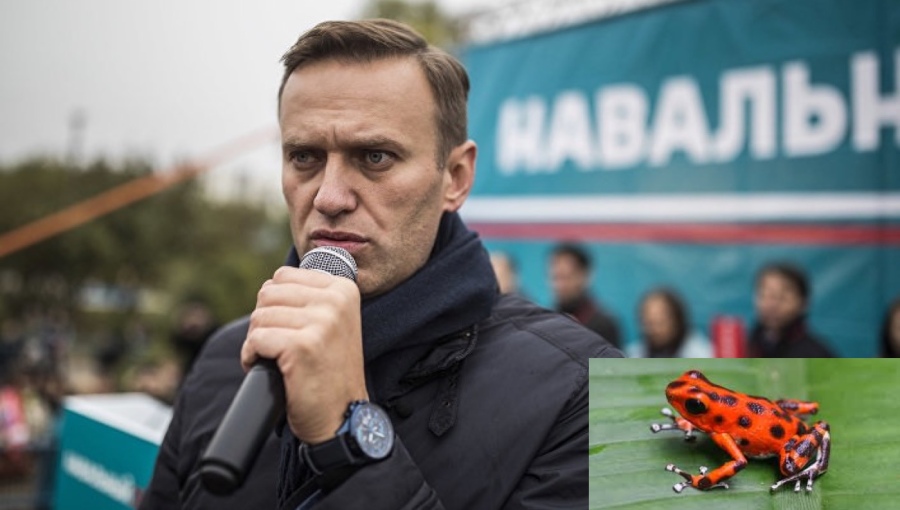
Russian opposition figure Alexei Navalny was killed using a toxin derived from a deadly frog poison, according to an investigation by five western governments, the Wall Street Journal reports.
Russia’s most high profile opposition figure, Navalny died suddenly February 16, 2024 in a remote prison in Russia’s far north under mysterious circumstances. He appeared in a video court meeting a few days earlier that was broadcast online and while he had lost weight, he appeared healthy and indominable, cracking jokes and making the judges laugh. According to reports at the time, he suddenly collapsed a few days later and died soon after. The original official explanation was that his death was caused by a blood clot.
Navalny had previously poisoned in 2020 using the military grade position Novichok and collapsed on a plane en route to Moscow. Landing in a regional airport, his wife Yulia Navalnaya organised an emergency medical evacuation by plane to Germany where he eventually recovered. However, when he decided to return to Russia he was immediately arrested and later convicted to 19 years in jail on charges ranging from fraud and extremism.
According to the latest reports, he was killed using a poison derived from the South American dart frog, one of the most toxic substances on earth. Details remain limited and have not been independently verified.
The frog has batrachotoxin in its skin, a lethal poison that disrupts nerve and muscle function in extremely small doses.
“Scientists from five European countries have established: my husband, Alexei Navalny, was poisoned with epibatidine — a neurotoxin, one of the deadliest poisons on earth. In nature, this poison can be found on the skin of the Ecuadorian dart frog. It causes paralysis, respiratory arrest, and a painful death,” his widow Navalnaya said in a post on social media. “I was certain from the first day that my husband had been poisoned, but now there is proof: Putin killed Alexei with a chemical weapon.”
Other high-profile dissidents such as Vladimir Kara-Murza who was sentenced to 25 years in jail have also been poisoned, but he survived and was later released in a prisoner swap in 2024.
Russian foreign ministry spokeswoman Maria Zakharova dismissed the reports of the frog poison as Western media propaganda. Russian authorities have never publicly confirmed Navalny’s cause of death and have rejected allegations of state involvement. The Kremlin has consistently denied any role in harm to Navalny, both in relation to the 2020 poisoning and his eventual death two years ago this week.
Experts note that frog-derived toxins are difficult to trace and can be administered in minute quantities, complicating forensic detection. Their lethality has historically drawn interest in both scientific and military research contexts.
Western officials have called for a transparent and independent inquiry. Several European governments have said that those responsible must be held accountable if foul play is established.
While nothing concrete is known about the circumstances and motivations for Navalny’s killing, one well-connected bne IntelliNews source speculated that his death may have been connected to negotiations that resulted in a historical prisoner swap was completed on August 1 that year.
The Kremlin was demanding the release of the Chechen-born FSB assassin Vadim Krasikov, who was serving life in Germany for the so-called Tiergarten shooting of a Russian dissident living in Berlin. In exchange the Kremlin offered to release US journalist Evan Gershkovich, who had been sentenced to 16-years in prison on espionage charges, US citizen Paul Whelan, and US-Russian citizen Alsu Kurmasheva amongst others.
According to bne IntelliNews’ source the German side were insisting that Navalny be included in the deal, which the Kremlin refused to contemplate. “So, the Kremlin simply took that card off the table,” the source said.

No comments:
Post a Comment